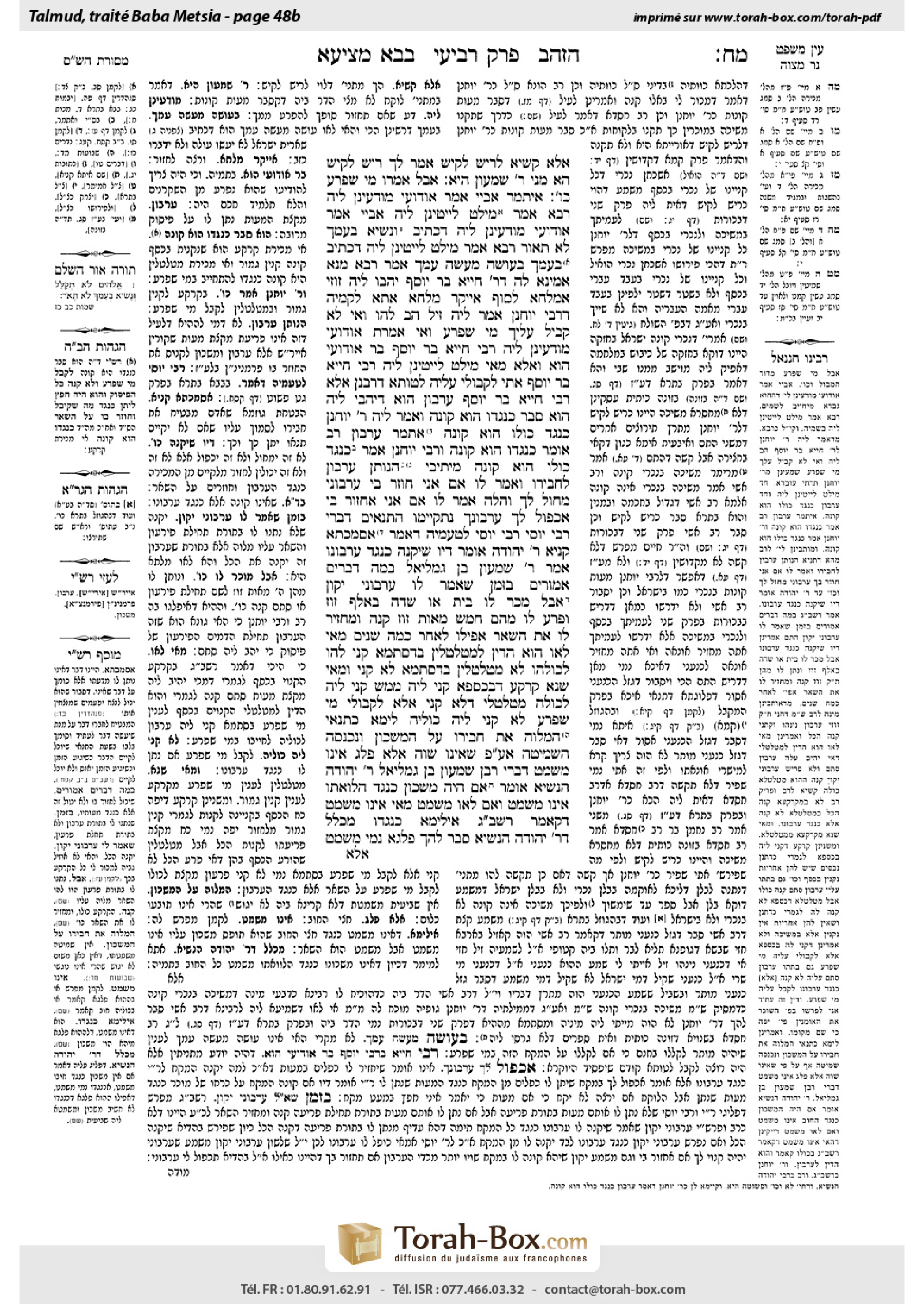
Bava Metzia 48b: Talmud study for Daf Yomi
Study the Talmud for Daf Yomi with scanned pages, Hebrew text, English translations from Sefaria and AI-generated French translations.
Passage selection and English or AI-generated French translation are available where the scan has annotations. Daf Study is independent of Torah-Box and Sefaria.
Browse Bava Metzia · בבא מציעא · All tractatesBava Metzia 48b text and translations
This page of Bava Metzia includes the Aramaic text, an English translation and an AI-generated French translation, alongside the scan above.
בבא מציעא מ״ח ב · Aramaic and Hebrew text
אֶלָּא קַשְׁיָא לְרֵישׁ לָקִישׁ! אָמַר לָךְ רֵישׁ לָקִישׁ: הָא מַנִּי רַבִּי שִׁמְעוֹן הִיא.
אֲבָל אָמְרוּ מִי שֶׁפָּרַע וְכוּ׳. אִיתְּמַר, אַבָּיֵי אָמַר: אוֹדוֹעֵי מוֹדְעִינַן לֵיהּ. רָבָא אָמַר: מֵילָט לָיְיטִינַן לֵיהּ.
אַבָּיֵי אָמַר: אוֹדוֹעֵי מוֹדְעִינַן לֵיהּ, דִּכְתִיב: ״וְנָשִׂיא בְעַמְּךָ לֹא תָאֹר״. רָבָא אָמַר: מֵילָט לָיְיטִינַן לֵיהּ, דִּכְתִיב: ״בְּעַמְּךָ״ – בְּעוֹשֶׂה מַעֲשֵׂה עַמְּךָ.
אָמַר רָבָא, מְנָא אָמֵינָא לַהּ? דְּרַבִּי חִיָּיא בַּר יוֹסֵף יְהַבוּ לֵיהּ זוּזֵי אַמִּלְחָא. לְסוֹף אִיַּיקַּר מִלְחָא. אֲתָא לְקַמֵּיהּ דְּרַבִּי יוֹחָנָן, אֲמַר לֵיהּ: זִיל הַב לְהוּ, וְאִי לָא – קַבֵּיל עֲלָיךְ ״מִי שֶׁפָּרַע״. וְאִי אָמְרַתְּ אוֹדוֹעֵי מוֹדְעִינַן לֵיהּ, רַבִּי חִיָּיא בַּר יוֹסֵף בַּר אוֹדוֹעֵי הוּא. וְאֶלָּא מַאי – מֵילָט לָיְיטִינַן לֵיהּ? רַבִּי חִיָּיא בַּר יוֹסֵף אָתֵי לְקַבּוֹלֵי עֲלֵיהּ לָטוּתָא דְרַבָּנַן?!
אֶלָּא רַבִּי חִיָּיא בַּר יוֹסֵף עֵרָבוֹן הוּא דְּיָהֲבִי לֵיהּ. הוּא סָבַר: כְּנֶגְדּוֹ הוּא קוֹנֶה. וַאֲמַר לֵיהּ רַבִּי יוֹחָנָן: כְּנֶגֶד כּוּלּוֹ הוּא קוֹנֶה.
אִתְּמַר: עֵרָבוֹן, רַב אוֹמֵר: כְּנֶגְדּוֹ הוּא קוֹנֶה, וְרַבִּי יוֹחָנָן אָמַר: כְּנֶגֶד כּוּלּוֹ הוּא קוֹנֶה.
מֵיתִיבִי: הַנּוֹתֵן עֵרָבוֹן לַחֲבֵירוֹ, וְאָמַר לוֹ: ״אִם אֲנִי חוֹזֵר בִּי – עֶרְבוֹנִי מָחוּל לָךְ״, וְהַלָּה אוֹמֵר לוֹ: ״אִם אֲנִי אֶחְזוֹר בִּי, אֶכְפּוֹל לְךָ עֵרְבוֹנְךָ״ – נִתְקַיְּימוּ הַתְּנָאִים, דִּבְרֵי רַבִּי יוֹסֵי. רַבִּי יוֹסֵי לְטַעְמֵיהּ, דְּאָמַר: אַסְמַכְתָּא קָנְיָא.
רַבִּי יְהוּדָה אוֹמֵר: דַּיּוֹ שֶׁיִּקְנֶה כְּנֶגֶד עֵרְבוֹנוֹ. אָמַר רַבָּן שִׁמְעוֹן בֶּן גַּמְלִיאֵל: בַּמֶּה דְּבָרִים אֲמוּרִים – בִּזְמַן שֶׁאָמַר לוֹ ״עֶרְבוֹנִי יִקּוֹן״. אֲבָל מָכַר לוֹ בַּיִת אוֹ שָׂדֶה בְּאֶלֶף זוּז, וּפָרַע לוֹ מֵהֶם חֲמֵשׁ מֵאוֹת זוּז – קָנָה, וּמַחֲזִיר לוֹ אֶת הַשְּׁאָר אֲפִילּוּ לְאַחַר כַּמָּה שָׁנִים. מַאי לָאו הוּא הַדִּין לְמִטַּלְטְלִין, (בְּדִסְתָמָא) [דְּבִסְתָמָא] קָנֵי לְהוּ לְכוּלְּהוּ!
לָא, מִטַּלְטְלִין בִּסְתָמָא לָא קָנֵי. וּמַאי שְׁנָא קַרְקַע, דִּבְכַסְפָּא קָנֵי לֵיהּ מַמָּשׁ – קָנֵי לֵיהּ לְכוּלַּהּ. מִטַּלְטְלֵי דְּלָא קָנֵי אֶלָּא לְקַבּוֹלֵי ״מִי שֶׁפָּרַע״ – לָא קָנֵי לֵיהּ כּוּלֵּיהּ.
לֵימָא כְּתַנָּאֵי: הַמַּלְוֶה אֶת חֲבֵירוֹ עַל הַמַּשְׁכּוֹן, וְנִכְנְסָה הַשְּׁמִיטָּה, אַף עַל פִּי שֶׁאֵינוֹ שָׁוֶה אֶלָּא פְּלָג – אֵינוֹ מְשַׁמֵּט, דִּבְרֵי רַבָּן שִׁמְעוֹן בֶּן גַּמְלִיאֵל. רַבִּי יְהוּדָה הַנָּשִׂיא אוֹמֵר: אִם הָיָה מַשְׁכּוֹן כְּנֶגֶד הַלְוָאָתוֹ – אֵינוֹ מְשַׁמֵּט, וְאִם לָאו – מְשַׁמֵּט.
מַאי ״אֵינוֹ מְשַׁמֵּט״ דְּקָאָמַר רַבָּן שִׁמְעוֹן בֶּן גַּמְלִיאֵל? אִילֵּימָא כְּנֶגְדּוֹ, מִכְּלָל דְּרַבִּי יְהוּדָה הַנָּשִׂיא סָבַר: לְהָךְ פַּלְגָא נָמֵי מְשַׁמֵּט!
Bava Metzia 48b · English translation
But this baraita is difficult according to Reish Lakish. The Gemara answers: Reish Lakish could have said to you: In accordance with whose opinion is this baraita? It is in accordance with the opinion of Rabbi Shimon, not that of the Rabbis.
§ The mishna teaches with regard to one who reneges on a transaction after the money was paid: But the Sages said: He Who exacted payment from the people of the generation of the flood, and from the generation of the dispersion, will in the future exact payment from whoever does not stand by his statement. It was stated that there is an amoraic dispute. Abaye said that we inform one who seeks to renege on a transaction: Be aware that this is the punishment of one who does not stand by his statement. Rava said that we curse him with that statement.
The Gemara elaborates: Abaye said that we inform him, as it is written: “Nor curse a ruler among your people” (Exodus 22:27), from which it is derived that it is prohibited to curse a ruler or any other member of the Jewish people. Rava said that we curse him, and the prohibition against cursing is not a concern, as it is written: “Among your people,” from which it is derived that the prohibition applies only with regard to one who performs an action befitting your people, not one who reneges on a transaction after the money is paid.
Rava said: From where do I say this halakha? I learned it from the incident where buyers gave Rabbi Ḥiyya bar Yosef money to purchase salt from him. Ultimately the price of salt increased, and Rabbi Ḥiyya bar Yosef sought to renege on the deal. He came before Rabbi Yoḥanan to ask his opinion. Rabbi Yoḥanan said to him: Go and give them the salt, and if not, accept upon yourself: He Who exacted payment. And if you say we merely inform him of this punishment, is Rabbi Ḥiyya bar Yosef one who must be informed? He knows the halakha. The Gemara rejects this proof: Rather, what is the alternative, that we curse him? Would Rabbi Ḥiyya bar Yosef come to accept upon himself a curse of the Sages?
Rather, the details of the incident were different. It is a down payment that buyers gave Rabbi Ḥiyya bar Yosef. The money was paid merely to bolster the commitment to complete the transaction. Rabbi Ḥiyya bar Yosef held that the down payment effects acquisition of salt commensurate with its value, and therefore he wanted to give them only that portion of the salt. And Rabbi Yoḥanan said to him: The down payment effects acquisition of salt commensurate with the entire amount of the transaction.
§ It was stated that there is an amoraic dispute with regard to a down payment. Rav says: A down payment effects acquisition of merchandise commensurate with its value. And Rabbi Yoḥanan said: It effects acquisition of merchandise commensurate with the entire amount of the transaction.
The Gemara raises an objection from a baraita: With regard to one who gives a down payment to another, and says to him: If I renege, my down payment is forfeited to you, and the other person says to him: If I renege, I will double your down payment for you, the conditions are in effect; this is the statement of Rabbi Yosei. The Gemara comments: Rabbi Yosei conforms to his standard line of reasoning, as he says: A transaction with inconclusive consent [asmakhta] effects acquisition. Even though it is a commitment that he undertook based on his certainty that he would never be forced to fulfill the condition, it is considered a full-fledged commitment.
The baraita continues: Rabbi Yehuda says: It is sufficient that the down payment effects acquisition of merchandise commensurate with the amount of his down payment. Rabban Shimon ben Gamliel said: In what case is this statement said? It is when the buyer said to the seller: My down payment will effect acquisition of the merchandise. But if one sold another a house or a field for one thousand dinars, and the buyer paid him five hundred dinars of that sum, he has acquired the entire house, and he returns the rest of the money to the seller even after several years have passed. The Gemara asks: What, is it not that the same is true with regard to movable property as well, and in a case where the agreement is unspecified, the buyer acquires the entire item, not merely commensurate with the down payment?
The Gemara rejects that comparison: No, with regard to movable property in a case where the agreement is unspecified, the buyer does not acquire the entire item. The Gemara asks: And in what way is movable property different from land? The Gemara explains: In the case of land, which with the payment of money one genuinely acquires it in a legal sense, the buyer acquires the entire tract of land with a down payment. In the case of movable property, which with the payment of money one acquires it only in the sense that if he reneges he will have to receive the curse: He Who exacted payment, the buyer does not acquire the entire item with a down payment.
The Gemara suggests: Let us say that this amoraic dispute between Rav and Rabbi Yoḥanan is parallel to a dispute between tanna’im. As it is taught in a baraita: With regard to one who lends money to another on the basis of collateral, and the Sabbatical Year commenced, even if the collateral is worth only half the sum of the loan, the Sabbatical Year does not abrogate the loan; this is the statement of Rabban Shimon ben Gamliel. Rabbi Yehuda HaNasi says: If the value of the collateral was commensurate with the sum of his loan, the Sabbatical Year does not abrogate the loan, but if it was not commensurate with the sum of his loan, the Sabbatical Year abrogates the loan.
The Gemara asks: What is the meaning of the statement: The Sabbatical Year does not abrogate the loan, that Rabban Shimon ben Gamliel is saying? If we say it means that the Sabbatical Year does not cancel that part of the loan commensurate with the collateral, but it does cancel the rest, this indicates by inference that Rabbi Yehuda HaNasi holds that the Sabbatical Year also abrogates that half as well. That is difficult, as is there not collateral commensurate with that half?
Bava Metzia 48b · Traduction française (IA)
Mais cette baraïta est difficile selon Reish Lakish. La Guemara répond : Reish Lakish aurait pu te dire : Selon quel avis est-ce que cette baraïta ? C'est selon l'avis de Rabbi Shimon, pas celui des Rabbins.
§ La Michna enseigne concernant celui qui renonce à une transaction après que l'argent ait été payé : Mais les Sages dirent : Celui qui a exigé le paiement des gens de la génération du Déluge, et de la génération de la dispersion, exigera à l'avenir le paiement de celui qui ne tient pas à sa déclaration. Il a été dit qu'il y a un débat entre les amoraïm. Abaye dit que nous informons celui qui cherche à renoncer à une transaction : Sois conscient que c'est la punition de celui qui ne tient pas à sa déclaration. Rava dit que nous le maudissons avec cette déclaration.
La Guemara développe : Abaye dit que nous l'informons, car il est écrit : « Ne maudis pas un prince parmi votre peuple » (Exode 22:27), d'où on déduit qu'il est interdit de maudire un prince ou tout autre membre du peuple juif. Rava dit que nous le maudissons, et la prohibition de maudire n'est pas un problème, car il est écrit : « Parmi votre peuple », d'où on déduit que la prohibition s'applique uniquement concernant celui qui effectue une action digne de votre peuple, pas celui qui renonce à une transaction après que l'argent ait été payé.
Rava dit : D'où dis-je cette halakha ? J'ai appris cela de l'incident où les acheteurs ont donné à Rabbi Ḥiyya bar Yosef de l'argent pour acheter du sel. Finalement le prix du sel a augmenté, et Rabbi Ḥiyya bar Yosef voulait rompre la transaction. Il est venu devant Rabbi Yoḥanan pour demander son avis. Rabbi Yoḥanan lui a dit : Va et donne-leur le sel, et si tu n'y vas pas, accepte sur toi : Celui qui a exigé le paiement. Et si tu dis que nous informons simplement lui de cette punition, est-ce que Rabbi Ḥiyya bar Yosef est celui qui doit être informé ? Il connaît la halakha. La Guemara rejette cette preuve : Plutôt, quelle est l'autre alternative, que nous le maudissons ? Viendrait-il Rabbi Ḥiyya bar Yosef accepter sur lui une malédiction des Sages ?
Plutôt, les détails de l'incident étaient différents. C'est un acompte que les acheteurs ont donné à Rabbi Ḥiyya bar Yosef. L'argent a été payé uniquement pour renforcer l'engagement de finaliser la transaction. Rabbi Ḥiyya bar Yosef pensait que l'acompte faisait acquirer du sel proportionnel à sa valeur, et donc il voulait donner à eux seulement cette portion du sel. Et Rabbi Yoḥanan lui a dit : L'acompte fait acquirer du sel proportionnel à l'intégralité de la transaction.
§ Il a été dit qu'il y a un débat entre les amoraïm concernant un acompte. Rav dit : Un acompte fait acquirer des marchandises proportionnel à sa valeur. Et Rabbi Yoḥanan dit : Il fait acquirer des marchandises proportionnel à l'intégralité de la transaction.
La Guemara soulève une objection tirée d'une baraïta : Concernant celui qui donne un acompte à un autre et lui dit : Si je renonce, mon acompte est perdu à toi, et l'autre personne lui dit : Si je renonce, je doublerai ton acompte pour toi, les conditions sont en effet ; c'est l'avis de Rabbi Yosei. La Guemara commente : Rabbi Yosei correspond à sa ligne de raisonnement habituelle, car il dit : Une transaction avec un consentement indéterminé [asmakhta] constitue un achat. Même si c'est un engagement qu'il a entrepris sur la base de sa certitude qu'il ne serait jamais contraint de remplir la condition, il est considéré comme un engagement complet.
La baraïta continue : Rabbi Yehuda dit : Il suffit que l'acompte constitue un achat de marchandises proportionnel à la quantité de l'acompte. Rabban Shimon ben Gamliel dit : Dans quel cas cette déclaration est-elle formulée ? C'est lorsque l'acheteur a dit au vendeur : Mon acompte constitue un achat des marchandises. Mais si l'un a vendu à un autre une maison ou un champ pour mille dinars, et l'acheteur a payé à lui cinq cents dinars de cette somme, il a acquis la totalité de la maison, et il rend le reste de l'argent au vendeur même après plusieurs années. La Guemara demande : Qu'est-ce que cela signifie, n'est-ce pas que cela est vrai aussi concernant les biens mobiliers, et dans un cas où l'accord est indéterminé, l'acheteur acquiert l'entier de l'objet, pas seulement proportionnel à l'acompte ?
La Guemara rejette cette comparaison : Non, concernant les biens mobiliers dans un cas où l'accord est indéterminé, l'acheteur ne possède pas l'entier de l'objet. La Guemara demande : Et en quel sens les biens mobiliers diffèrent-ils des terres ? La Guemara explique : Dans le cas des terres, où le paiement d'argent fait réellement acquérir la terre légalement, l'acheteur acquiert l'intégralité de la parcelle de terre avec un acompte. Dans le cas des biens mobiliers, où le paiement d'argent fait acquérir le bien seulement dans le sens où s'il renonce il devra recevoir la malédiction : Celui qui a exigé le paiement, l'acheteur ne possède pas l'entier de l'objet avec un acompte.
La Guemara suggère : Disons que ce débat entre les amoraïm de Rav et Rabbi Yoḥanan est parallèle à un débat entre les tannaïm. Comme il est enseigné dans une baraïta : Concernant celui qui prête de l'argent à un autre sur la base d'une garantie, et la année sabbatique a commencé, même si la garantie est seulement valable pour la moitié de la somme du prêt, la année sabbatique ne annule pas le prêt ; c'est l'avis de Rabban Shimon ben Gamliel. Rabbi Yehuda HaNasi dit : Si la valeur de la garantie était proportionnelle à la somme du prêt, la année sabbatique ne annule pas le prêt, mais si elle n'était pas proportionnelle à la somme du prêt, la année sabbatique annule le prêt.
La Guemara demande : Quelle est la signification de la déclaration : La année sabbatique ne annule pas le prêt, que Rabban Shimon ben Gamliel dit ? Si nous disons qu'il signifie que la année sabbatique ne annule pas cette partie du prêt proportionnelle à la garantie, mais annule le reste, cela indique par inférence que Rabbi Yehuda HaNasi considère que la année sabbatique annule cette moitié également. Cela est difficile, car n'y a-t-il pas une garantie proportionnelle à cette moitié ?
Traduction française générée par IA à partir de l’édition anglaise de Sefaria. Vérifie toujours un passage avec le texte source.
Text from Sefaria: William Davidson Edition - Vocalized Aramaic (CC BY NC); William Davidson Edition - English (CC BY NC).