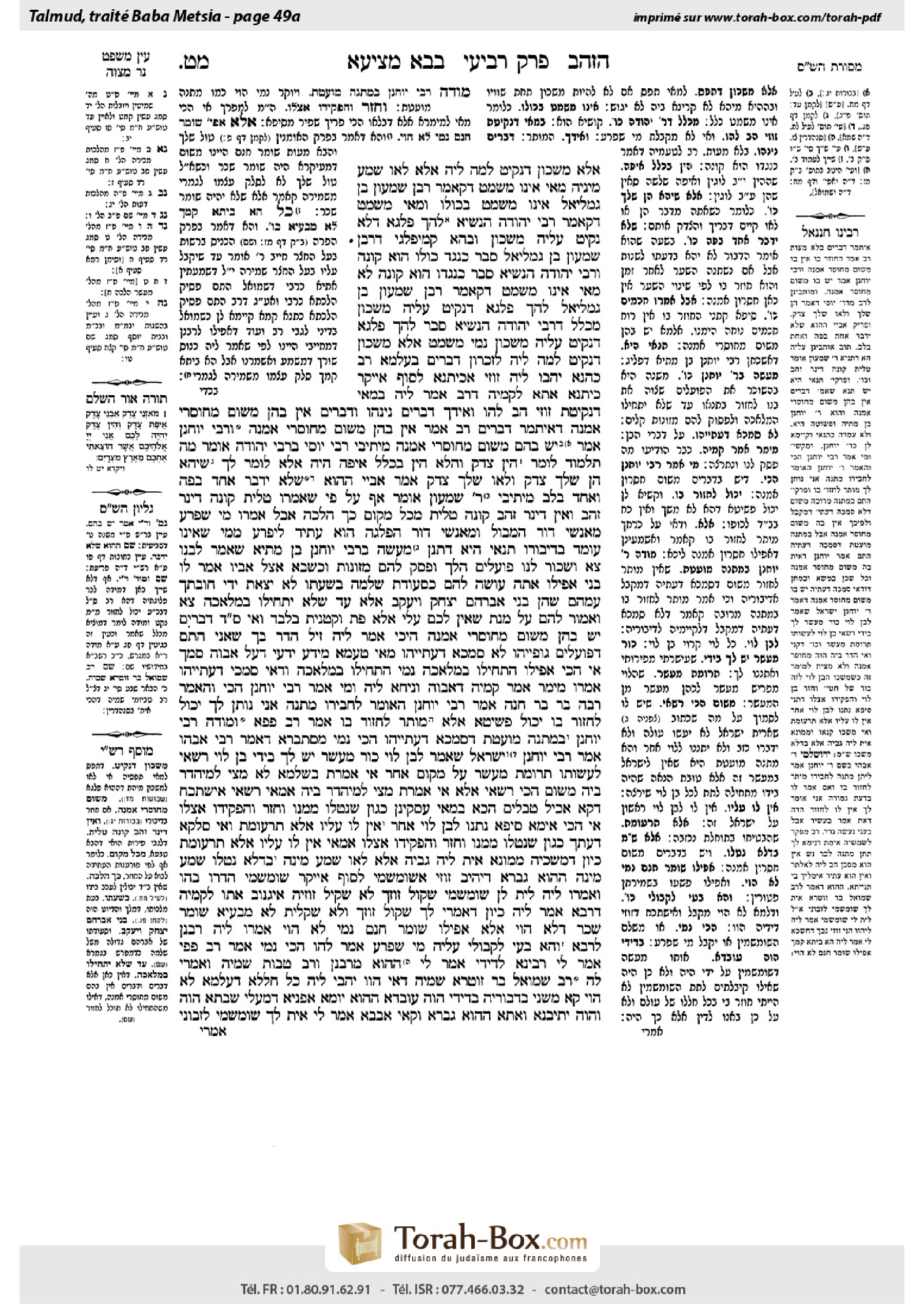
Bava Metzia 49a: Talmud study for Daf Yomi
Study the Talmud for Daf Yomi with scanned pages, Hebrew text, English translations from Sefaria and AI-generated French translations.
Passage selection and English or AI-generated French translation are available where the scan has annotations. Daf Study is independent of Torah-Box and Sefaria.
Browse Bava Metzia · בבא מציעא · All tractatesBava Metzia 49a text and translations
This page of Bava Metzia includes the Aramaic text, an English translation and an AI-generated French translation, alongside the scan above.
בבא מציעא מ״ט א · Aramaic and Hebrew text
אֶלָּא מַשְׁכּוֹן דְּנָקֵיט לְמָה לֵיהּ? אֶלָּא לָאו, שְׁמַע מִינֵּיהּ: מַאי ״אֵינוֹ מְשַׁמֵּט״ דְּקָאָמַר רַבָּן שִׁמְעוֹן בֶּן גַּמְלִיאֵל – אֵינוֹ מְשַׁמֵּט בְּכוּלּוֹ, וּמַאי ״מְשַׁמֵּט״ דְּקָאָמַר רַבִּי יְהוּדָה הַנָּשִׂיא – לְהָךְ פַּלְגָא דְּלָא נָקֵיט עֲלֵיהּ מַשְׁכּוֹן.
וּבְהָא קָמִיפַּלְגִי, דְּרַבָּן שִׁמְעוֹן בֶּן גַּמְלִיאֵל סָבַר: כְּנֶגֶד כּוּלּוֹ הוּא קוֹנֶה, וְרַבִּי יְהוּדָה הַנָּשִׂיא סָבַר: כְּנֶגְדּוֹ הוּא קוֹנֶה.
לָא, מַאי ״אֵינוֹ מְשַׁמֵּט״ דְּקָאָמַר רַבָּן שִׁמְעוֹן בֶּן גַּמְלִיאֵל – לְהָךְ פַּלְגָא דְּנָקֵיט עֲלֵיהּ מַשְׁכּוֹן, מִכְּלָל דְּרַבִּי יְהוּדָה הַנָּשִׂיא סָבַר: לְהָךְ פַּלְגָא דְּנָקֵיט עֲלֵיהּ מַשְׁכּוֹן נָמֵי מְשַׁמֵּט. אֶלָּא מַשְׁכּוֹן דְּנָקֵיט, לְמָה לֵיהּ? לְזִכְרוֹן דְּבָרִים בְּעָלְמָא.
רַב כָּהֲנָא יְהַבוּ לֵיהּ זוּזֵי אַכִּיתָּנָא, לְסוֹף אִיַּיקַּר כִּיתָּנָא. אֲתָא לְקַמֵּיהּ דְּרַב. אֲמַר לֵיהּ: בְּמַאי דִּנְקִיטַתְּ זוּזֵי – הַב לְהוּ, וְאִידַּךְ – דְּבָרִים נִינְהוּ, וּדְבָרִים אֵין בָּהֶן מִשּׁוּם מְחוּסְּרֵי אֲמָנָה.
דְּאִיתְּמַר: דְּבָרִים, רַב אָמַר: אֵין בָּהֶן מִשּׁוּם מְחוּסְּרֵי אֲמָנָה, וְרַבִּי יוֹחָנָן אָמַר: יֵשׁ בָּהֶם מִשּׁוּם מְחוּסְּרֵי אֲמָנָה.
מֵיתִיבִי, רַבִּי יוֹסֵי בְּרַבִּי יְהוּדָה אוֹמֵר: מָה תַּלְמוּד לוֹמַר ״הִין צֶדֶק״, וַהֲלֹא ״הִין״ בִּכְלַל אֵיפָה הָיָה? אֶלָּא לוֹמַר לָךְ: שֶׁיְּהֵא הֵן שֶׁלְּךָ צֶדֶק, וְלָאו שֶׁלְּךָ צֶדֶק. אָמַר אַבָּיֵי: הָהוּא שֶׁלֹּא יְדַבֵּר אֶחָד בַּפֶּה וְאֶחָד בַּלֵּב.
מֵיתִיבִי, רַבִּי שִׁמְעוֹן אוֹמֵר: אַף עַל פִּי שֶׁאָמְרוּ טַלִּית קוֹנָה דִּינַר זָהָב, וְאֵין דִּינַר זָהָב קוֹנֶה טַלִּית, מִכׇּל מָקוֹם כָּךְ הֲלָכָה. אֲבָל אָמְרוּ: מִי שֶׁפָּרַע מֵאַנְשֵׁי דּוֹר הַמַּבּוּל וּמֵאַנְשֵׁי דּוֹר הַפְּלַגָּה הוּא עָתִיד לִיפָּרַע מִמִּי שֶׁאֵינוֹ עוֹמֵד בְּדִיבּוּרוֹ!
תַּנָּאֵי הִיא. דִּתְנַן: מַעֲשֶׂה בְּרַבִּי יוֹחָנָן בֶּן מַתְיָא שֶׁאָמַר לִבְנוֹ: צֵא וּשְׂכוֹר לָנוּ פּוֹעֲלִים. הָלַךְ וּפָסַק לָהֶם מְזוֹנוֹת. וּכְשֶׁבָּא אֵצֶל אָבִיו, אָמַר לוֹ: בְּנִי, אֲפִילּוּ אַתָּה עוֹשֶׂה לָהֶם כִּסְעוּדַת שְׁלֹמֹה בִּשְׁעָתוֹ לֹא יָצָאתָ יְדֵי חוֹבָתְךָ עִמָּהֶם, שֶׁהֵן בְּנֵי אַבְרָהָם יִצְחָק וְיַעֲקֹב. אֶלָּא עַד שֶׁלֹּא יַתְחִילוּ בִּמְלָאכָה, צֵא וֶאֱמוֹר לָהֶם: עַל מְנָת שֶׁאֵין לָכֶם עָלַי אֶלָּא פַּת וְקִטְנִית בִּלְבַד.
וְאִי סָלְקָא דַעְתָּךְ דְּבָרִים יֵשׁ בָּהֶן מִשּׁוּם מְחוּסְּרֵי אֲמָנָה, הֵיכִי אֲמַר לֵיהּ זִיל הֲדַר בָּךְ? שָׁאנֵי הָתָם, דְּפוֹעֲלִים גּוּפַיְיהוּ לָא סָמְכָא דַּעְתַּיְיהוּ. מַאי טַעְמָא – מִידָּע יָדְעִי דְּעַל אֲבוּהּ סָמֵךְ.
אִי הָכִי, אֲפִילּוּ הִתְחִילוּ בִּמְלָאכָה נָמֵי? הִתְחִילוּ בִּמְלָאכָה, וַדַּאי סָמְכִי דַּעְתַּיְיהוּ, אֲמַרוּ: מֵימָר אָמַר קַמֵּיהּ דַּאֲבוּהּ וְנִיחָא לֵיהּ.
וּמִי אָמַר רַבִּי יוֹחָנָן הָכִי? וְהָאָמַר רַבָּה בַּר בַּר חָנָה אָמַר רַבִּי יוֹחָנָן: הָאוֹמֵר לַחֲבֵירוֹ מַתָּנָה אֲנִי נוֹתֵן לָךְ – יָכוֹל לַחֲזוֹר בּוֹ. יָכוֹל, פְּשִׁיטָא! אֶלָּא: מוּתָּר לַחֲזוֹר בּוֹ. אָמַר רַב פָּפָּא: וּמוֹדֶה רַבִּי יוֹחָנָן בְּמַתָּנָה מוּעֶטֶת, דְּסָמְכָא דַּעְתַּיְיהוּ.
הָכִי נָמֵי מִסְתַּבְּרָא, דְּאָמַר רַבִּי אֲבָהוּ אָמַר רַבִּי יוֹחָנָן: יִשְׂרָאֵל שֶׁאָמַר לְבֶן לֵוִי: כּוֹר מַעֲשֵׂר יֵשׁ לְךָ בְּיָדִי. בֶּן לֵוִי רַשַּׁאי לַעֲשׂוֹתוֹ תְּרוּמַת מַעֲשֵׂר עַל מָקוֹם אַחֵר. אִי אָמְרַתְּ בִּשְׁלָמָא לָא מָצֵי לְמִיהְדַּר בֵּיהּ – מִשּׁוּם הָכִי רַשַּׁאי. אֶלָּא אִי אָמְרַתְּ מָצֵי לְמִיהְדַּר בֵּיהּ, אַמַּאי רַשַּׁאי? אִישְׁתְּכַח דְּקָא אָכֵיל טְבָלִים!
הָכָא בְּמַאי עָסְקִינַן – כְּגוֹן שֶׁנְּטָלוֹ מִמֶּנּוּ וְחָזַר וְהִפְקִידוֹ אֶצְלוֹ.
אִי הָכִי אֵימָא סֵיפָא: נְתָנוֹ לְבֶן לֵוִי אַחֵר – אֵין לוֹ עָלָיו אֶלָּא תַּרְעוֹמֶת. וְאִי סָלְקָא דַעְתָּךְ כְּגוֹן שֶׁנְּטָלוֹ מִמֶּנּוּ וְחָזַר וְהִפְקִידוֹ אֶצְלוֹ, אַמַּאי אֵין לוֹ עָלָיו אֶלָּא תַּרְעוֹמֶת? כֵּיוָן דְּמַשְׁכֵיהּ מָמוֹנָא אִית לֵיהּ גַּבֵּיהּ! אֶלָּא לָאו, שְׁמַע מִינַּהּ בִּדְלָא נְטָלוֹ. שְׁמַע מִינַּהּ.
הָהוּא גַּבְרָא דִּיהַיב זוּזֵי אַשּׁוּמְשְׁמֵי. לְסוֹף אִיַּיקַּר שׁוּמְשְׁמֵי. הֲדַרוּ בְּהוּ וַאֲמַרוּ לֵיהּ: לֵית לַן שׁוּמְשְׁמֵי, שְׁקוֹל זוּזָךְ. לָא שְׁקֵיל זוּזֵיהּ, אִיגְּנוּב. אֲתוֹ לְקַמֵּיהּ דְּרָבָא. אֲמַר לֵיהּ: כֵּיוָן דְּאָמְרִי לָךְ שְׁקוֹל זוּזָךְ וְלָא שְׁקַלְיתְּ, לָא מִבַּעְיָא שׁוֹמֵר שָׂכָר דְּלָא הָוֵי, אֶלָּא אֲפִילּוּ שׁוֹמֵר חִנָּם נָמֵי לָא הָוֵי. אֲמַרוּ לֵיהּ רַבָּנַן לְרָבָא: וְהָא בָּעֵי לְקַבּוֹלֵי עֲלֵיהּ ״מִי שֶׁפָּרַע״? אֲמַר לְהוּ: הָכִי נָמֵי.
אָמַר רַב פַּפֵּי, אָמַר לִי רָבִינָא: לְדִידִי אֲמַר לִי הָהוּא מֵרַבָּנַן וְרַב טָבוּת שְׁמֵיהּ, וְאָמְרִי לַהּ רַב שְׁמוּאֵל בַּר זוּטְרָא שְׁמֵיהּ, דְּאִי הֲווֹ יָהֲבִי לֵיהּ כֹּל חֲלָלָא דְעָלְמָא לָא (הֲוֵי קָא) [הָוֵה] מְשַׁנֵּי בְּדִבּוּרֵיהּ. בְּדִידִי הֲוָה עוֹבָדָא: הָהוּא יוֹמָא אַפַּנְיָא דְּמַעֲלֵי שַׁבְּתָא הֲוָה, וַהֲוָה יָתֵיבְנָא, וַאֲתָא הָהוּא גַּבְרָא וְקָאֵי אַבָּבָא. אֲמַר לִי: אִית לָךְ שׁוּמְשְׁמֵי לְזַבּוֹנֵי?
Bava Metzia 49a · English translation
If that half is canceled as well, then why does he need the collateral that he is holding? The lender clearly took the collateral to enable him to collect at least part of his debt after the Sabbatical Year. Rather, do we not conclude from it: What is the meaning of the statement: The Sabbatical Year does not abrogate the loan, that Rabban Shimon ben Gamliel is saying? It means that the Sabbatical Year does not abrogate the entire loan. And what is the meaning of: The Sabbatical Year abrogates the loan, that Rabbi Yehuda HaNasi is saying? It is referring to that half of the loan that he did not take on the basis of collateral.
And they disagree with regard to this: As Rabban Shimon ben Gamliel holds that a down payment effects acquisition of merchandise commensurate with the entire amount of the transaction, and Rabbi Yehuda HaNasi holds that a down payment effects acquisition of merchandise commensurate with its value. Apparently, the amoraic dispute parallels the tannaitic dispute.
The Gemara rejects that parallel: No, what is the meaning of the statement: The Sabbatical Year does not abrogate the loan, that Rabban Shimon ben Gamliel is saying? It is referring to that half of the loan that he took on the basis of collateral. This indicates by inference that Rabbi Yehuda HaNasi holds: The Sabbatical Year also abrogates that half of the loan that he took on the basis of collateral. The Gemara asks: Then why does he need the collateral that he is holding? The Gemara answers: He requires it as a mere reminder to increase the likelihood that the loan will be repaid, and it does not prevent cancellation of a loan.
§ The Gemara relates: Buyers gave money to Rav Kahana to purchase linen. Ultimately, the price of linen increased. Rav Kahana came before Rav to ask his opinion. Rav said to him: Give them a quantity of linen equivalent in value to the money that you received, and concerning the rest, your verbal commitment is merely a statement, and reneging on a verbal commitment that was unaccompanied by an act of acquisition does not constitute an act of bad faith.
The Gemara comments: This is as it was stated: There is an amoraic dispute with regard to reneging on a verbal commitment that was unaccompanied by an act of acquisition. Rav says: It does not constitute an act of bad faith. And Rabbi Yoḥanan says: It constitutes an act of bad faith.
The Gemara raises an objection: Rabbi Yosei, son of Rabbi Yehuda, says: What is the meaning when the verse states: “A just ephah, and a just hin, shall you have” (Leviticus 19:36)? But wasn’t a hin included in an ephah? Why is it necessary to state both? Rather, this is an allusion that serves to say to you that your yes [hen] should be just, and your no should be just. Apparently, it is a mitzva for one to fulfill his promises. Abaye says: That verse means that one should not say one matter with his mouth and think one other matter in his heart. It is prohibited for one to make a commitment that he has no intention of fulfilling. Rav Kahana made his commitment in good faith and reneged due to changed circumstances. That is not prohibited.
The Gemara raises an objection. Rabbi Shimon says: Even though the Sages said that when one party takes possession of a garment, the other party acquires a gold dinar, but when one party takes possession of a gold dinar, the other party does not acquire a garment, in any case, that is what the halakha would be. But the Sages said with regard to one who reneges on a transaction where one party pulled the gold dinar into his possession: He Who exacted payment from the people of the generation of the flood, and from the people of the generation of the dispersion, and from the inhabitants of Sodom and Gomorrah, and from the Egyptians in the Red Sea, will in the future exact payment from whoever does not stand by his statement. And one who negotiates, where the negotiation culminates with a statement in which he commits himself to acquire the item, did not acquire the item without a formal act of acquisition. But with regard to one who reneges on his commitment, the Sages are displeased with him. Apparently, one who reneges is considered to have acted in bad faith.
The Gemara explains: This matter is a dispute between tanna’im, as we learned in a mishna (Bava Metzia 83a): There was an incident involving Rabbi Yoḥanan ben Matya, who said to his son: Go out and hire laborers for us. His son went and allocated sustenance for them, as part of their employment terms, without specifying the type of sustenance. And when he came to his father, his father said to him: My son, even if you prepare for them a meal like the feast of Solomon during his era, you will not fulfill your obligation to them, as they are the descendants of Abraham, Isaac, and Jacob, and due to that status they are deserving of any meal that they want. Rather, this is what you should do: Before they begin engaging in their labor, go out and say to them: Your employment is on the condition that you have the right to claim from me only the customary meal of bread and legumes.
The Gemara asks: And if it enters your mind that reneging on a verbal commitment unaccompanied by an act of acquisition constitutes an act of bad faith, how did Rabbi Yoḥanan ben Matya tell his son to renege? The Gemara answers: This is not difficult; it is different there in that case, as the laborers themselves do not rely on the son. What is the reason they do not rely on the son? It is due to the fact that they know that he relied on his father giving his approval when committing to feed them.
The Gemara asks: If so, then even if the laborers began engaging in their labor, they still would not rely on the son. Why then did his father instruct him specifically to tell them of the change before they began their labor? The Gemara answers: Once they began engaging in their labor they would certainly rely on the son’s commitment, as they would say: He must have come before his father and stated the conditions of their employment, and his father is amenable to those terms. Therefore, it was necessary to inform them before they began working.
The Gemara asks: And did Rabbi Yoḥanan say this, i.e., that one who reneges on a verbal commitment acted in bad faith? But didn’t Rabba bar bar Ḥana say that Rabbi Yoḥanan says: One who says to another: I am giving you a gift, is able to renege on his commitment? The Gemara asks: He is able to renege? It is obvious that he is able to renege, as in the absence of an act of acquisition no one can compel him to give the gift. Rather, it means: It is permitted for him to renege on his commitment. Apparently, one who reneges on a verbal guarantee is not considered to have acted in bad faith. Rav Pappa said: And Rabbi Yoḥanan concedes that in the case of a small gift one may not renege, as the recipients rely on him to fulfill his verbal commitment. By contrast, in the case of a large gift the recipients are aware that one might reconsider, and therefore they do not rely on his statement and do not assume that his decision is final.
The Gemara comments: So too, it is reasonable to say that this is the opinion of Rabbi Yoḥanan, as Rabbi Abbahu says that Rabbi Yoḥanan says: With regard to an Israelite who said to a Levite: You have a kor of first-tithe produce that is in my possession and that I separated from my produce, the Levite may render all or part of this kor teruma of the tithe for first-tithe produce that he has in another place. Granted, if you say that one is unable, i.e., it is not permitted for him, to renege, it is due to that reason that the Levite may render it teruma of the tithe for other produce. But if you say that one is able, i.e., it is permitted for him, to renege, why may he render it teruma of the tithe for other produce? The owner of the produce could renege, and in that case it will eventuate that he is consuming untithed produce, as the teruma of the tithe that he separated did not belong to him.
The Gemara answers: With what are we dealing here? We are dealing with a case where the Levite took the first-tithe produce from him and then deposited it with him, so that it already belongs to the Levite.
The Gemara asks: If so, that this is the circumstance addressed in the statement of Rabbi Yoḥanan, say the latter clause of that halakha: If the owner of the produce gave the first-tithe produce to a different Levite, the first Levite has only a grievance against the owner, but not any legal claim. And if it enters your mind that this is a case where the first Levite took the first-tithe produce from the owner and then deposited it with him, why does the Levite have only a grievance against him? Once the first Levite pulled the produce into his possession it is his, and therefore, he has property in the possession of the owner of the produce. Rather, must one not conclude from it that this is a case where the Levite did not take the produce and deposit it? The Gemara affirms: Conclude from it that there was only a verbal commitment, and that proves that reneging on a verbal commitment constitutes an act of bad faith.
The Gemara relates: There was a certain man who gave money as payment for sesame. Ultimately, the price of sesame increased, and the sellers reneged and said to him: We have no sesame; take your money. The buyer did not take his money, and the money was stolen. They came before Rava to adjudicate the case. Rava said to the buyer: Once they said to you: Take your money, and you did not take it, it is not necessary to say that their legal status is not that of a paid bailee. But my ruling is that their legal status is not even that of an unpaid bailee. The Sages said to Rava: But aren’t the sellers who reneged required to accept upon themselves the curse: He Who exacted payment? Rava said to them: Indeed, they must pay or accept the curse.
Rav Pappi said that Ravina said to me: One of the Sages, and Rav Tavot is his name, and some say Rav Shmuel bar Zutra is his name, and he is one who even if they were to give him the entire expanse of the world he would not deviate from the truth in his speech, said to me: There was an incident in which I was involved. On that day, it was twilight on Shabbat eve, and I was sitting, and a certain man came and stood at the entrance. He said to me: Do you have sesame to sell?
Bava Metzia 49a · Traduction française (IA)
Si cette moitié est également annulée, alors pourquoi a-t-il besoin de la garantie qu'il détient ? Le prêteur a clairement pris la garantie afin de pouvoir récupérer au moins une partie de son prêt après l'année sabbatique. Plutôt, ne concluons-nous pas de cela : Quelle est la signification de la déclaration : L'année sabbatique n'annule pas le prêt, que Rabban Shimon ben Gamliel affirme ? Cela signifie que l'année sabbatique n'annule pas le prêt dans son entier. Et quelle est la signification de : L'année sabbatique annule le prêt, que Rabbi Yehuda HaNasi affirme ? Cela fait référence à cette moitié du prêt qu'il n'a pas acquis sur la base d'une garantie.
Et ils divergent sur cela : Comme Rabban Shimon ben Gamliel affirme que l'acompte permet l'acquisition de marchandises équivalentes à l'intégralité de la transaction, et Rabbi Yehuda HaNasi affirme que l'acompte permet l'acquisition de marchandises équivalentes à leur valeur. Apparemment, le débat des amoraim correspond au débat des tannaïm.
La Guemara rejette cette analogie : Non, quelle est la signification de la déclaration : L'année sabbatique n'annule pas le prêt, que Rabban Shimon ben Gamliel affirme ? Cela fait référence à cette moitié du prêt qu'il a acquis sur la base d'une garantie. Cela indique par l'inférence que Rabbi Yehuda HaNasi affirme : L'année sabbatique annule également cette moitié du prêt qu'il a acquis sur la base d'une garantie. La Guemara pose la question : Alors pourquoi a-t-il besoin de la garantie qu'il détient ? La Guemara répond : Il a besoin de cela comme rappel pour augmenter la probabilité que le prêt soit remboursé, et cela ne bloque pas l'annulation d'un prêt.
§ La Guemara rapporte : Des acheteurs ont donné de l'argent à Rav Kahana pour acheter du lin. Finalement, le prix du lin a augmenté. Rav Kahana est venu devant Rav pour demander son avis. Rav lui a dit : Donnez-leur une quantité de lin équivalente en valeur à l'argent que vous avez reçu, et concernant le reste, votre engagement verbal n'est qu'une déclaration, et renoncer à un engagement verbal non accompagné d'une acquisition ne constitue pas un acte de mauvaise foi.
La Guemara commente : Cela correspond à ce qui a été dit : Il y a un débat amorique concernant le renoncement à un engagement verbal non accompagné d'une acquisition. Rav dit : Cela ne constitue pas un acte de mauvaise foi. Et Rabbi Yoḥanan dit : Cela constitue un acte de mauvaise foi.
La Guemara soulève une objection : Rabbi Yosei, fils de Rabbi Yehuda, dit : Quelle est la signification lorsque la Sainte Écriture dit : « Une mesure juste, et un hin juste, tu dois avoir » (Lévitique 19:36) ? Mais n'était-ce pas un hin inclus dans une ephah ? Pourquoi est-il nécessaire de mentionner les deux ? Plutôt, cela fait référence à ce que tu dois dire : ton oui [hen] doit être juste, et ton non doit être juste. Apparemment, c'est un mitsva de remplir ses promesses. Abaye dit : Ce verset signifie qu'on ne doit pas dire une chose avec la bouche et penser une autre chose dans le cœur. Il est interdit de faire un engagement qu'on n'a pas l'intention de remplir. Rav Kahana a fait son engagement en bonne foi et a renoncé en raison de circonstances changées. Cela n'est pas interdit.
La Guemara soulève une objection. Rabbi Shimon dit : Même si les Sages ont dit que lorsqu'une partie prend possession d'un vêtement, l'autre partie acquiert un dinar d'or, mais lorsqu'une partie prend possession d'un dinar d'or, l'autre partie ne l'acquiert pas, en tout cas, c'est ce que la halakha serait. Mais les Sages ont dit concernant celui qui renonce à une transaction où une partie a tiré le dinar d'or dans sa possession : Celui qui a exigé le paiement des gens de la génération de la diluvion, et des gens de la dispersion, et des habitants de Sodome et de Gomorrah, et des Égyptiens de la mer Rouge, exigera à l'avenir le paiement de celui qui ne tient pas parole. Et celui qui négocie, où la négociation se termine par une déclaration dans laquelle il s'engage à acquérir l'objet, n'a pas acquis l'objet sans un acte formel d'acquisition. Mais concernant celui qui renonce à son engagement, les Sages sont mécontents. Apparemment, celui qui renonce est considéré comme ayant agi en mauvaise foi.
La Guemara explique : Cette affaire est un débat entre les tannaïm, comme nous l'avons appris dans une mishna (Bava Metzia 83a) : Il y avait un incident concernant Rabbi Yoḥanan ben Matya, qui a dit à son fils : Sortez et embauchez des ouvriers pour nous. Son fils est sorti et a alloué des vivres pour eux, en tant que conditions de leur emploi, sans spécifier le type de vivres. Et lorsqu'il est venu auprès de son père, son père lui a dit : Mon fils, même si vous préparez pour eux un repas comme la fête de Salomon durant son époque, vous ne remplirez pas votre obligation envers eux, car ils sont les descendants d'Abraham, d'Isaac et de Jacob, et en raison de ce statut, ils méritent tout repas qu'ils veulent. Plutôt, voici ce que vous devriez faire : Avant qu'ils ne commencent à travailler, sortez et dites-leur : Votre emploi est conditionné par le fait que vous avez le droit de revendiquer de moi uniquement un repas ordinaire de pain et de légumes.
La Guemara pose la question : Et si cela entre dans votre tête que renoncer à un engagement verbal non accompagné d'une acquisition constitue un acte de mauvaise foi, comment Rabbi Yoḥanan ben Matya a-t-il dit à son fils de renoncer ? La Guemara répond : Ce n'est pas difficile ; c'est différent là-bas, car les ouvriers eux-mêmes ne s'appuient pas sur le fils. Quelle est la raison qu'ils ne s'appuient pas sur le fils ? C'est en raison du fait qu'ils savent qu'il s'est appuyé sur l'approbation de son père lors de l'engagement de les nourrir.
La Guemara pose la question : Si tel est le cas, alors même si les ouvriers ont commencé à travailler, ils ne s'appuieraient pas sur le fils. Pourquoi alors a-t-il instruit spécifiquement le fils de leur faire savoir la modification avant qu'ils ne commencent à travailler ? La Guemara répond : Une fois qu'ils ont commencé à travailler, ils s'appuieraient certainement sur l'engagement du fils, car ils diraient : Il a dû s'adresser à son père et avoir établi les conditions de leur emploi, et son père est d'accord avec ces conditions. Il était donc nécessaire d'informer les ouvriers avant qu'ils ne commencent à travailler.
Le Guemara pose la question : Et Rabbi Yoḥanan a-t-il dit cela, c'est-à-dire que celui qui renonce à une promesse verbale agit de mauvaise foi ? Mais n’a-t-il pas dit Rabba bar bar Ḥana que Rabbi Yoḥanan dit : Celui qui dit à un autre : Je t’offre un cadeau, peut renoncer à sa promesse ? Le Guemara pose la question : Il peut renoncer ? Il est évident qu’il peut renoncer, car en l’absence d’un acte d’acquisition, personne ne peut le contraindre à donner le cadeau. Plutôt, cela signifie : Il est permis qu’il renonce à sa promesse. Apparemment, celui qui renonce à une promesse verbale n’est pas considéré comme ayant agi de mauvaise foi. Rav Pappa dit : Et Rabbi Yoḥanan reconnaît que dans le cas d’un petit cadeau, on ne peut pas renoncer, car les bénéficiaires comptent sur lui pour respecter sa promesse verbale. À l’inverse, dans le cas d’un grand cadeau, les bénéficiaires savent qu’on peut changer d’avis, et par conséquent, ils ne comptent pas sur sa déclaration et ne considèrent pas sa décision comme définitive.
Le Guemara commente : De même, il est raisonnable de dire que c’est l’opinion de Rabbi Yoḥanan, car Rabbi Abbahu dit que Rabbi Yoḥanan dit : En ce qui concerne un Israelite qui dit à un Lévite : Tu as un kor de première tithe qui est en mon possession et que j’ai séparé de ma récolte, le Lévite peut rendre tout ou partie de ce kor de terouma de la tithe qui est en un autre lieu. Admettons que tu dis que l’on ne peut pas renoncer, c’est-à-dire qu’il n’est pas permis de renoncer, c’est pour cette raison que le Lévite peut rendre cette tithe de terouma pour d’autres récoltes. Mais si tu dis que l’on peut renoncer, c’est-à-dire qu’il est permis de renoncer, pourquoi peut-il rendre cette tithe de terouma pour d’autres récoltes ? Le propriétaire des récoltes pourrait renoncer, et dans ce cas, il en résulterait qu’il consomme une récolte non titrée, car la terouma de la tithe qu’il a séparée ne lui appartenait pas.
Le Guemara répond : De quoi sommes-nous en train de parler ? Nous parlons d’un cas où le Lévite a pris la première tithe du propriétaire et l’a déposé chez lui, de sorte qu’elle appartient déjà au Lévite.
Le Guemara pose la question : Si c’est ainsi, alors ce cas est celui mentionné dans la déclaration de Rabbi Yoḥanan, disons la seconde partie de cette halakha : Si le propriétaire des récoltes a donné la première tithe à un autre Lévite, le premier Lévite a seulement une plainte contre le propriétaire, mais pas de revendication légale. Et si cela t’entre en tête que ce cas est celui où le premier Lévite a pris la première tithe du propriétaire et l’a déposé chez lui, pourquoi le Lévite a-t-il seulement une plainte contre lui ? Une fois que le premier Lévite a mis les récoltes en son possession, elles lui appartiennent, et par conséquent, il a un droit sur la possession du propriétaire des récoltes. Plutôt, ne devons-nous pas conclure de cela que ce n’est pas un cas où le Lévite n’a pas pris les récoltes et les a déposées ? Le Guemara confirme : Concluez de cela qu’il n’y avait qu’une promesse verbale, et cela prouve que renoncer à une promesse verbale constitue un acte de mauvaise foi.
Le Guemara rapporte : Il y avait un certain homme qui a donné de l’argent en paiement pour du sesamum. Finalement, le prix du sesamum a augmenté, et les vendeurs ont renoncé et ont dit à lui : Nous n’avons plus de sesamum ; prends ton argent. L’acheteur n’a pas pris son argent, et l’argent a été volé. Ils se sont présentés devant Rava pour que ce cas soit tranché. Rava a dit à l’acheteur : Une fois qu’ils ont dit à vous : Prends ton argent, et que vous n’avez pas pris votre argent, il n’est pas nécessaire de dire que leur statut juridique n’est pas celui d’un dépositaire payé. Mais mon avis est que leur statut juridique n’est même pas celui d’un dépositaire non payé. Les Sages ont dit à Rava : Mais ne sont-ils pas tenus de s’engager à accepter la malédiction : Celui qui a exigé le paiement ? Rava a dit à eux : En effet, ils doivent payer ou accepter la malédiction.
Rav Pappi a dit que Ravina m'a dit : Un des Sages, et son nom est Rav Tavot, et certains disent Rav Shmuel bar Zutra, et il est celui qui même s'ils lui donnaient l'ensemble de l'étendue du monde, il ne dévierait pas de la vérité dans sa parole, m'a dit : Il y avait un incident dans lequel j'étais impliqué. Ce jour-là, c'était le crépuscule de la veille de la Shabbat, et j'étais assis, et un certain homme est venu et s'est planté à l'entrée. Il a dit à moi : As-tu du sesamum à vendre ?
Traduction française générée par IA à partir de l’édition anglaise de Sefaria. Vérifie toujours un passage avec le texte source.
Text from Sefaria: William Davidson Edition - Vocalized Aramaic (CC BY NC); William Davidson Edition - English (CC BY NC).