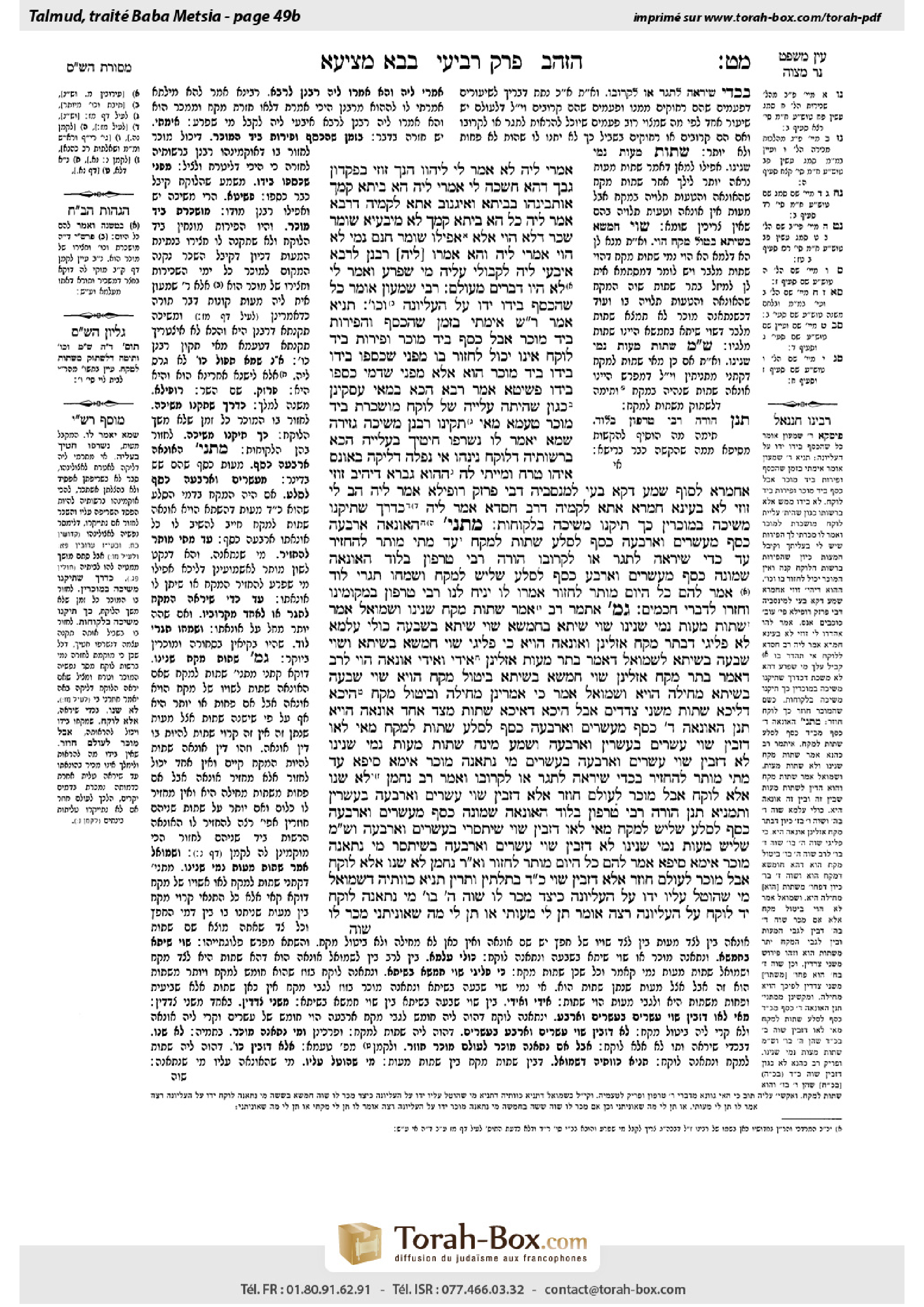
Bava Metzia 49b: Talmud study for Daf Yomi
Study the Talmud for Daf Yomi with scanned pages, Hebrew text, English translations from Sefaria and AI-generated French translations.
Passage selection and English or AI-generated French translation are available where the scan has annotations. Daf Study is independent of Torah-Box and Sefaria.
Browse Bava Metzia · בבא מציעא · All tractatesBava Metzia 49b text and translations
This page of Bava Metzia includes the Aramaic text, an English translation and an AI-generated French translation, alongside the scan above.
בבא מציעא מ״ט ב · Aramaic and Hebrew text
אֲמַרִי לֵיהּ: לָא. אֲמַר לִי: לֶיהְווֹ הָנָךְ זוּזֵי בְּפִקָּדוֹן גַּבָּךְ, דְּהָא חֲשַׁכָה לִי. אֲמַרִי לֵיהּ: הָא בֵּיתָא קַמָּךְ. אוֹתְבִינְהוּ בְּבֵיתָא וְאִיגְּנוּב. אֲתָא לְקַמֵּיהּ דְּרָבָא. אֲמַר לֵיהּ: כֹּל ״הָא בֵּיתָא קַמָּךְ״ לָא מִיבַּעְיָא שׁוֹמֵר שָׂכָר דְּלָא הָוֵי, אֶלָּא אֲפִילּוּ שׁוֹמֵר חִנָּם נָמֵי לָא הָוֵי. אֲמַרִי לֵיהּ: וְהָא אֲמַרוּ [לֵיהּ] רַבָּנַן לְרָבָא: אִיבְּעִי לֵיהּ לְקַבּוֹלֵי עֲלֵיהּ ״מִי שֶׁפָּרַע״. וַאֲמַר לִי: לֹא הָיוּ דְבָרִים מֵעוֹלָם.
רַבִּי שִׁמְעוֹן אוֹמֵר: כֹּל שֶׁהַכֶּסֶף בְּיָדוֹ – יָדוֹ עַל הָעֶלְיוֹנָה וְכוּ׳. תַּנְיָא, אָמַר רַבִּי שִׁמְעוֹן: אֵימָתַי – בִּזְמַן שֶׁהַכֶּסֶף וְהַפֵּירוֹת בְּיַד מוֹכֵר. אֲבָל כֶּסֶף בְּיַד מוֹכֵר וּפֵירוֹת בְּיַד לוֹקֵחַ – אֵינוֹ יָכוֹל לַחֲזוֹר בּוֹ, מִפְּנֵי שֶׁכַּסְפּוֹ בְּיָדוֹ. ״בְּיָדוֹ״?! בְּיַד מוֹכֵר הוּא. אֶלָּא – מִפְּנֵי שֶׁדְּמֵי כַסְפּוֹ בְּיָדוֹ.
פְּשִׁיטָא! אָמַר רָבָא: הָכָא בְּמַאי עָסְקִינַן – כְּגוֹן שֶׁהָיְתָה עֲלִיָּיה שֶׁל לוֹקֵחַ מוּשְׂכֶּרֶת בְּיַד מוֹכֵר. טַעְמָא מַאי תַּקִּינוּ רַבָּנַן מְשִׁיכָה – גְּזֵירָה שֶׁמָּא יֹאמַר לוֹ נִשְׂרְפוּ חִטֶּיךָ בַּעֲלִיָּיה. הָכָא בִּרְשׁוּתֵיהּ דְּלוֹקֵחַ נִינְהוּ, אִי נָפְלָה דְּלֵיקָה בְּאוֹנֶס – אִיהוּ טָרַח וּמַיְיתֵי לַהּ.
הָהוּא גַּבְרָא דִּיהַיב זוּזֵי אַחַמְרָא. לְסוֹף שְׁמַע דְּקָא בָעֵי לְמִנְסְבֵיהּ דְּבֵי פַּרְזַק רוּפִילָא. אֲמַר לֵיהּ: הַב לִי זוּזַי, לָא בָּעֵינָא חַמְרָא. אֲתָא לְקַמֵּיהּ דְּרַב חִסְדָּא, אֲמַר לֵיהּ: כְּדֶרֶךְ שֶׁתִּיקְּנוּ מְשִׁיכָה בַּמּוֹכְרִין כָּךְ תִּיקְּנוּ מְשִׁיכָה בַּלָּקוֹחוֹת.
מַתְנִי׳ הָאוֹנָאָה, אַרְבָּעָה כֶּסֶף מֵעֶשְׂרִים וְאַרְבָּעָה כֶּסֶף לַסֶּלַע, שְׁתוּת לְמִקָּח. עַד מָתַי מוּתָּר לְהַחְזִיר? עַד כְּדֵי שֶׁיַּרְאֶה לַתַּגָּר אוֹ לִקְרוֹבוֹ.
הוֹרָה רַבִּי טַרְפוֹן בְּלוֹד: הָאוֹנָאָה שְׁמוֹנָה כֶּסֶף מֵעֶשְׂרִים וְאַרְבַּע כֶּסֶף לַסֶּלַע, שְׁלִישׁ לְמִקָּח. וְשָׂמְחוּ תַּגָּרֵי לוֹד. אָמַר לָהֶם: כׇּל הַיּוֹם מוּתָּר לַחְזוֹר. אָמְרוּ לוֹ יַנִּיחַ לָנוּ רַבִּי טַרְפוֹן בִּמְקוֹמֵינוּ, וְחָזְרוּ לְדִבְרֵי חֲכָמִים.
גְּמָ׳ אִתְּמַר: רַב אָמַר: שְׁתוּת מִקָּח שָׁנִינוּ. וּשְׁמוּאֵל אָמַר: שְׁתוּת מָעוֹת נָמֵי שָׁנִינוּ. שָׁוֵי שִׁיתָּא בְּחַמְשָׁא, שָׁוֵי שִׁיתָּא בְּשִׁבְעָה – כּוּלֵּי עָלְמָא לָא פְּלִיגִי דְּבָתַר מִקָּח אָזְלִינַן וְאוֹנָאָה הָוְיָא. כִּי פְּלִיגִי שָׁוֵי חַמְשָׁא בְּשִׁיתָּא וְשָׁוֵי שִׁבְעָה בְּשִׁיתָּא.
לִשְׁמוּאֵל דְּאָמַר: בָּתַר מָעוֹת אָזְלִינַן, אִידֵּי וְאִידֵּי אוֹנָאָה הָוֵי. לְרַב דְּאָמַר: בָּתַר מִקָּח אָזְלִינַן, שָׁוֵי חַמְשָׁא בְּשִׁיתָּא בִּיטּוּל מִקָּח הָוְיָא. שָׁוֵי שִׁבְעָה בְּשִׁיתָּא, מְחִילָה הָוְיָא.
וּשְׁמוּאֵל אָמַר: כִּי אָמְרִינַן מְחִילָה וּבִיטּוּל מִקָּח – הֵיכָא דְּלֵיכָּא שְׁתוּת מִשְּׁנֵי צְדָדִים. אֲבָל הֵיכָא דְּאִיכָּא שְׁתוּת מִצַּד אֶחָד – אוֹנָאָה הָוְיָא.
תְּנַן: הָאוֹנָאָה אַרְבָּעָה כֶּסֶף מֵעֶשְׂרִים וְאַרְבָּעָה כֶּסֶף לַסֶּלַע, שְׁתוּת לְמִקָּח. מַאי לָאו, דְּזַבֵּין שָׁוֵי עֶשְׂרִים בְּעֶשְׂרִין וְאַרְבְּעָה, וּשְׁמַע מִינַּהּ: שְׁתוּת מָעוֹת נָמֵי שָׁנִינוּ! לָא, דְּזַבֵּין שָׁוֵי עֶשְׂרִים וְאַרְבְּעָה בְּעֶשְׂרִים.
מִי נִתְאַנָּה – מוֹכֵר. אֵימָא סֵיפָא: עַד מָתַי מוּתָּר לְהַחְזִיר – בִּכְדֵי שֶׁיַּרְאֶה לַתַּגָּר אוֹ לִקְרוֹבוֹ. וְאָמַר רַב נַחְמָן: לֹא שָׁנוּ אֶלָּא לוֹקֵחַ, אֲבָל מוֹכֵר – לְעוֹלָם חוֹזֵר.
אֶלָּא דְּזַבֵּין שָׁוֵי עֶשְׂרִים וְאַרְבְּעָה בְּעֶשְׂרִין וּתְמָנְיָא. תְּנַן, הוֹרָה רַבִּי טַרְפוֹן בְּלוֹד: הָאוֹנָאָה שְׁמוֹנָה כֶּסֶף מֵעֶשְׂרִים וְאַרְבָּעָה כֶּסֶף לַסֶּלַע, שְׁלִישׁ לְמִקָּח. מַאי לָאו, דְּזַבֵּין שָׁוֵי שִׁיתַּסְרֵי בְּעֶשְׂרִים וְאַרְבְּעָה? וּשְׁמַע מִינַּהּ: שְׁלִישׁ מָעוֹת נָמֵי שָׁנִינוּ.
לָא: דְּזַבֵּין שָׁוֵי עֶשְׂרִים וְאַרְבְּעָה בְּשִׁיתְּסַר. מִי נִתְאַנָּה מוֹכֵר, אֵימָא סֵיפָא: אָמַר לָהֶם – כׇּל הַיּוֹם מוּתָּר לַחְזוֹר. וְאָמַר רַב נַחְמָן: לֹא שָׁנוּ אֶלָּא לוֹקֵחַ, אֲבָל מוֹכֵר לְעוֹלָם חוֹזֵר. אֶלָּא דְּזַבֵּין שָׁוֵי עֶשְׂרִים וְאַרְבְּעָה בִּתְלָתִין וּתְרֵין.
תַּנְיָא כְּווֹתֵיהּ דִּשְׁמוּאֵל: מִי שֶׁהוּטַּל עָלָיו יָדוֹ עַל הָעֶלְיוֹנָה. כֵּיצַד? מָכַר לוֹ שָׁוֶה חֲמִשָּׁה בְּשִׁשָּׁה, מִי נִתְאַנָּה – לוֹקֵחַ, יָד לוֹקֵחַ עַל הָעֶלְיוֹנָה, רָצָה אוֹמֵר: תֵּן לִי מְעוֹתַי, אוֹ תֵּן לִי מָה שֶׁאוֹנֵיתַנִי. מָכַר לוֹ
Bava Metzia 49b · English translation
I said to him: No. He said to me: Let these dinars remain as a deposit with you, as the day has grown dark for me and I am unable to reach home before Shabbat. I said to him: This house is before you. He placed them in the house and the dinars were stolen. That man came to have his case judged before Rava, demanding his money. Rava said to him: With regard to anyone who states: This house is before you, it is not necessary to say that he is not a paid bailee, but he is not even an unpaid bailee. Ravina said to Rav Tavot: But didn’t the Sages say to Rava: The sesame merchant is required to accept upon himself the curse: He Who exacted payment? And Rav Tavot said to me: There were never such matters; that incident never occurred.
§ The mishna teaches that Rabbi Shimon says: Anyone who has the money in his possession has the advantage. It is taught in a baraita: Rabbi Shimon says: When does the one with the money in his possession have the advantage? It is when both the money and the produce are in the possession of the seller. But if the money is in the possession of the seller and the produce is in the possession of the buyer, the seller cannot renege, because his money is in his possession. The Gemara understood this to mean that the buyer still had the money in his possession, and asks: In his, i.e., the buyer’s, possession? Isn’t it in the possession of the seller? Rather, emend the text: Because the value of his, i.e., the buyer’s, money is in his, i.e., the buyer’s, possession.
The Gemara asks: Isn’t it obvious that the seller cannot renege, as the buyer acquired the produce through the transaction of pulling? Rava said: With what are we dealing here? It is a case where the upper story of the house belonging to the buyer, where the produce was stored, was rented to the seller. The Gemara elaborates: What is the reason the Sages instituted that pulling, and not payment of money, effects acquisition? It is a rabbinic decree, lest a seller say to the buyer: Your wheat burned in the upper story after you paid. Here, the produce is in the domain of the buyer. Therefore, if a fire is ignited due to circumstances beyond his control, the buyer will exert himself and bring the produce from the upper story.
The Gemara relates: There was a certain man who gave money in exchange for wine. Ultimately he heard that men from the house of Parzak the vizier [rufila] sought to appropriate the wine. The buyer said to the seller: Give me my money, as I do not want the wine. The case came before Rav Ḥisda, who said to him: Just as the Sages instituted pulling with regard to sellers, so did they institute pulling with regard to buyers. Since the buyer had yet to pull the wine into his possession, he can renege on the transaction.
MISHNA: The measure of exploitation for which one can claim that he was exploited is four silver ma’a from the twenty-four silver ma’a in a sela, or one-sixth of the transaction. Until when is it permitted for the buyer to return the item? He may return it only until a period of time has passed that would allow him to show the merchandise to a merchant or to his relative who is more familiar with the market price of merchandise. If more time has elapsed he can no longer return the item, as the assumption is that he waived his right to receive the sum of the disparity.
The mishna continues: Rabbi Tarfon ruled in Lod: Exploitation is a measure of eight silver ma’a from the twenty-four silver ma’a of a sela, one-third of the transaction. And the merchants of Lod rejoiced, as this ruling allowed them a greater profit margin and rendered the nullification of a transaction less likely. Rabbi Tarfon said to them: Throughout the entire day it is permitted to renege on the transaction and not merely for the period of time it takes to show the purchase item to a merchant or a relative. The merchants of Lod said to him: Let Rabbi Tarfon leave us as we were, with the previous ruling, and they reverted to following the statement of the Rabbis in the mishna with regard to both rulings.
GEMARA: It was stated that there is an amoraic dispute with regard to exploitation. Rav says: We learned that exploitation is determined by one-sixth of the transaction, i.e., one-sixth of the purchase item, not one-sixth of the money paid. And Shmuel says: We learned that exploitation is also determined by one-sixth of the money paid. The Gemara elaborates: With regard to an item worth six ma’a that was sold for five ma’a, or an item worth six ma’a that was sold for seven ma’a, everyone agrees that we follow the transaction, i.e., the fraction of the variation in price is determined relative to the market value of the item sold, and it is exploitation. Where Rav and Shmuel disagree is in the case of an item worth five ma’a sold for six ma’a, or an item worth seven ma’a sold for six ma’a.
According to Shmuel, who says that we also follow the fraction of the variation in price as determined by the money paid, both this case and that case are exploitation, as there is a disparity of one-sixth between the price paid and the value of the item. According to Rav, who says that we follow the transaction, when an item worth five ma’a sells for six ma’a, the halakha is that there is a nullification of the transaction, as the disparity between the value of the item and the price paid is greater than one-sixth. When an item worth seven ma’a sells for six ma’a, the halakha is that there is a waiver of the sum of the disparity, as the disparity between the value of the item and the price paid is less than one-sixth.
And Shmuel says: When we say that there is a waiver or a nullification of the transaction, it is in a case where there is not a disparity of one-sixth from both aspects, i.e., both in terms of the money paid and in terms of the value of the item. But in a case where there is a disparity of one-sixth from one aspect, either in terms of the money paid or the value of the item, it is exploitation.
The Gemara cites proof for the opinions of Rav and Shmuel. We learned in the mishna: The measure of exploitation for which one can claim that he was exploited is four silver ma’a from the twenty-four silver ma’a in a sela, which is one-sixth of the transaction. What, is it not a case where he bought an item worth twenty ma’a for twenty-four ma’a? And accordingly, one can conclude from the mishna that we learned that exploitation is also determined by one-sixth of the money paid, in accordance with the opinion of Shmuel. The Gemara rejects this proof: No, it is a case where he sold an item worth twenty-four ma’a for twenty ma’a.
The Gemara asks: If so, who was exploited in this transaction? It is the seller. Say the latter clause of the mishna: Until when is it permitted for the buyer to return the item? In the time that it takes the buyer to show the merchandise to a merchant or to his relative. And Rav Naḥman said: The Rabbis taught this halakha only with regard to a buyer, who is in possession of the item and can show it to a merchant immediately. But a seller may always renege on the transaction. Since the purchase item is not in his possession, he can determine its market price only if he happens to encounter a similar item, and there is no time frame within which this will certainly occur.
Rather, it is a case where he sold an item worth twenty-four ma’a for twenty-eight ma’a. We learned in the mishna that Rabbi Tarfon ruled in Lod: Exploitation is a measure of eight silver ma’a from the twenty-four silver ma’a of a sela, one-third of the transaction. What, is it not a case where he bought an item worth sixteen ma’a for twenty-four ma’a? And accordingly, one can conclude from the mishna that we learned that exploitation is also determined by one-third of the money paid, in accordance with the opinion of Shmuel.
The Gemara rejects this proof: No, it is a case where he sold an item worth twenty-four ma’a for sixteen ma’a. The Gemara asks: If so, who was exploited in this transaction? It is the seller. Say the latter clause of the mishna: Rabbi Tarfon said to them: Throughout the entire day it is permitted to renege on the transaction. And Rav Naḥman says: They taught this halakha only with regard to a buyer, but a seller may always renege on the transaction. Rather, it is a case where he sold an item worth twenty-four ma’a for thirty-two ma’a.
The Gemara comments: It is taught in a baraita in accordance with the opinion of Shmuel: The one upon whom the exploitation was imposed has the advantage. How so? In a case where one sold him an item worth five ma’a for six ma’a, who was exploited? It is the buyer. Therefore, the buyer is at an advantage. If he wishes, he can say to the seller: Give me back my money and nullify the transaction, or he can say: Give me back the sum which you received by engaging in exploitation of me. In a case where one sold him
Bava Metzia 49b · Traduction française (IA)
Je lui dis : Non. Il me dit : Laissez ces dinars rester en dépôt chez vous, car la journée s'assombrit pour moi et je ne puis rentrer chez moi avant la Shabbat. Je lui dis : Cette maison est devant vous. Il les mit dans la maison et les dinars furent volés. Ce homme vint présenter son cas devant Rava, exigeant son argent. Rava lui dit : En ce qui concerne celui qui dit : Cette maison est devant vous, il n'est pas nécessaire de dire qu'il n'est pas un dépositaire rémunéré, mais il n'est même pas un dépositaire non rémunéré. Ravina dit à Rav Tavot : Mais n'ont-ils pas dit aux Sages à Rava : Le marchand de sésame est tenu de s'engager à la malédiction : Celui qui exige le paiement ? Et Rav Tavot me dit : Il n'y a jamais eu de tels cas ; cet incident n'a jamais eu lieu.
§ La mitsna enseigne que Rabbi Shimon dit : Celui qui a l'argent en sa possession a l'avantage. Il est enseigné dans une baraïta : Rabbi Shimon dit : Quand le possesseur de l'argent a-t-il l'avantage ? C'est quand à la fois l'argent et les produits sont en possession du vendeur. Mais si l'argent est en possession du vendeur et les produits en possession de l'acheteur, le vendeur ne peut pas annuler la transaction, car son argent est en sa possession. La Guemara comprend cela pour signifier que l'acheteur avait encore l'argent en sa possession et demande : En son possession, c'est-à-dire en la possession de l'acheteur ? N'est-ce pas en la possession du vendeur ? Plutôt, corrigez le texte : Parce que la valeur de son, c'est-à-dire de l'acheteur, argent est en son, c'est-à-dire de l'acheteur, possession.
La Guemara demande : N'est-ce pas évident que le vendeur ne peut pas annuler la transaction, car l'acheteur a acquis les produits par le fait de tirer ? Rava dit : Avec quels éléments sommes-nous en présence ? C'est un cas où l'étage supérieur de la maison appartenant à l'acheteur, où les produits étaient entreposés, était loué au vendeur. La Guemara développe : Quel est le motif pour lequel les Sages ont institué le fait de tirer plutôt que le paiement d'argent pour l'acquisition ? C'est un décret rabbinique, afin que le vendeur ne dise pas à l'acheteur : Vos blés ont brûlé dans l'étage supérieur après que vous avez payé. Ici, les produits sont dans le domaine de l'acheteur. Ainsi, si un feu est allumé en raison de circonstances au-delà de son contrôle, l'acheteur se donnera la peine de ramener les produits de l'étage supérieur.
La Guemara rapporte : Il y avait un certain homme qui avait donné de l'argent en échange de vin. Finalement, il apprit que des hommes de la maison de Parzak le vizier [rufila] cherchaient à s'approprier le vin. L'acheteur dit au vendeur : Donnez-moi mon argent, car je ne veux pas le vin. Le cas fut porté devant Rav Ḥisda, qui dit à lui : Comme les Sages ont institué le fait de tirer concernant les vendeurs, ainsi ont-ils institué le fait de tirer concernant les acheteurs. Puisque l'acheteur n'avait pas encore tiré le vin en sa possession, il peut annuler la transaction.
MICHNA : La mesure d'exploitation pour laquelle on peut affirmer qu'on a été exploité est de quatre ma'ot d'argent de la vingt-quatre ma'ot d'argent d'un sela, ou un sixième du montant de la transaction. Jusqu'à quand est-il permis à l'acheteur de rendre l'article ? Il peut le rendre uniquement jusqu'à un délai suffisant pour qu'il puisse montrer l'article à un marchand ou à son parent plus familiarisé avec le prix du marché. Si plus de temps s'est écoulé, il ne peut plus rendre l'article, car on suppose qu'il a renoncé à son droit de recevoir la somme de la différence.
La mitsva continue: Rabbi Tarfon a rendu un jugement à Lod: L'exploitation est une mesure de huit ma'ot d'argent parmi les vingt-quatre ma'ot d'argent d'un sela, c'est-à-dire un tiers de la transaction. Et les marchands de Lod se réjouirent, car ce jugement leur permettait d'obtenir une plus grande marge de bénéfice et rendait la nullification d'une transaction moins probable. Rabbi Tarfon dit à eux: Il est permis de révoquer la transaction toute la journée, et non seulement pour le délai nécessaire pour montrer l'article à un marchand ou à un parent. Les marchands de Lod dirent à lui: Laissez Rabbi Tarfon nous laisser comme nous étions, avec le précédent jugement, et ils retournèrent à suivre l'affirmation des Rabbins de la mitsva concernant les deux jugements.
GUEMARA: Il a été dit qu'il y a un débat entre les amoraim concernant l'exploitation. Rav dit: Nous avons appris que l'exploitation est déterminée par un sixième de la transaction, c'est-à-dire un sixième du prix de l'article, et non un sixième de l'argent payé. Et Shmuel dit: Nous avons appris que l'exploitation est également déterminée par un sixième de l'argent payé. La Guemara développe: Concernant un article valant six ma'ot vendu pour cinq ma'ot, ou un article valant six ma'ot vendu pour sept ma'ot, tout le monde convient que nous suivons la transaction, c'est-à-dire que la fraction de la variation de prix est déterminée par rapport à la valeur de l'article vendu, et c'est une exploitation. Où Rav et Shmuel divergent est dans le cas d'un article valant cinq ma'ot vendu pour six ma'ot, ou d'un article valant sept ma'ot vendu pour six ma'ot.
Selon Shmuel, qui dit que nous suivons la fraction de la variation de prix déterminée par l'argent payé, les deux cas constituent une exploitation, car il y a une différence de un sixième entre le prix payé et la valeur de l'article. Selon Rav, qui dit que nous suivons la transaction, quand un article valant cinq ma'ot est vendu pour six ma'ot, la halakha est que la transaction est nulle, car la différence entre la valeur de l'article et le prix payé est supérieure à un sixième. Quand un article valant sept ma'ot est vendu pour six ma'ot, la halakha est que l'on renonce à la somme de la différence, car la différence entre la valeur de l'article et le prix payé est inférieure à un sixième.
Et Shmuel dit : Quand nous disons qu'il y a un renoncement ou une nullification de la transaction, c'est dans un cas où il n'y a pas de différence de un sixième d'un côté ou de l'autre, c'est-à-dire à la fois en termes de l'argent payé et de la valeur de l'article. Mais dans un cas où il y a une différence de un sixième d'un côté, soit en termes de l'argent payé, soit de la valeur de l'article, c'est une exploitation.
La Guemara cite un argument en faveur des opinions de Rav et de Shmuel. Nous avons appris dans la mitsna : La mesure d'exploitation pour laquelle on peut affirmer qu'on a été exploité est quatre ma'ot d'argent de vingt-quatre ma'ot d'argent dans un sela, ce qui est un sixième de la transaction. Mais comment, n'est-ce pas un cas où l'on a acheté un objet valant vingt ma'ot pour vingt-quatre ma'ot ? Et ainsi, on peut conclure de la mitsna que nous avons appris que l'exploitation est également déterminée par un sixième de l'argent payé, conformément à l'opinion de Shmuel. La Guemara rejette ce raisonnement : Non, c'est un cas où l'on a vendu un objet valant vingt-quatre ma'ot pour vingt ma'ot.
La Guemara pose la question : Si c'est ainsi, qui a été exploité dans cette transaction ? C'est le vendeur. Dites la dernière partie de la mitsna : Jusqu'à quand est-il permis à l'acheteur de rendre l'objet ? Pendant le temps qu'il faut à l'acheteur pour montrer l'objet à un marchand ou à son parent. Et Rav Naḥman dit : Les Sages ont enseigné cette halakha uniquement concernant un acheteur, qui possède l'objet et peut le montrer immédiatement à un marchand. Mais un vendeur peut toujours annuler la transaction. Puisque l'objet n'est pas en son possession, il peut déterminer son prix de marché uniquement s'il rencontre un objet similaire, et il n'y a pas de délai dans lequel cela arrivera certainement.
Plutôt, c'est un cas où l'on a vendu un objet valant vingt-quatre ma'ot pour vingt-huit ma'ot. Nous avons appris dans la mitsna que Rabbi Tarfon a rendu un jugement à Lod : L'exploitation est une mesure de huit ma'ot d'argent de vingt-quatre ma'ot d'argent dans un sela, un tiers de la transaction. Mais comment, n'est-ce pas un cas où l'on a acheté un objet valant seize ma'ot pour vingt-quatre ma'ot ? Et ainsi, on peut conclure de la mitsna que nous avons appris que l'exploitation est également déterminée par un tiers de l'argent payé, conformément à l'opinion de Shmuel.
La Guemara rejette ce raisonnement : Non, c'est un cas où l'on a vendu un objet valant vingt-quatre ma'ot pour seize ma'ot. La Guemara pose la question : Si c'est ainsi, qui a été exploité dans cette transaction ? C'est le vendeur. Dites la dernière partie de la mitsna : Rabbi Tarfon dit à ceux-ci : Tout au long de la journée, il est permis d'annuler la transaction. Et Rav Naḥman dit : Ils ont enseigné cette halakha uniquement concernant un acheteur, mais un vendeur peut toujours annuler la transaction. Plutôt, c'est un cas où l'on a vendu un objet valant vingt-quatre ma'ot pour trente-deux ma'ot.
La Guemara commente : Il est enseigné dans une baraïta conformément à l'opinion de Shmuel : Celui sur qui l'exploitation a été imposée a l'avantage. Comment cela ? Dans un cas où l'on a vendu à quelqu'un un objet valant cinq ma'ot pour six ma'ot, qui a été exploité ? C'est l'acheteur. Ainsi, l'acheteur est avantageux. S'il le souhaite, il peut dire au vendeur : Rends-moi mon argent et annule la transaction, ou il peut dire : Rends-moi la somme que tu as reçue en exploitant mon exploitation. Dans un cas où l'on a vendu à quelqu'un
Traduction française générée par IA à partir de l’édition anglaise de Sefaria. Vérifie toujours un passage avec le texte source.
Text from Sefaria: William Davidson Edition - Vocalized Aramaic (CC BY NC); William Davidson Edition - English (CC BY NC).