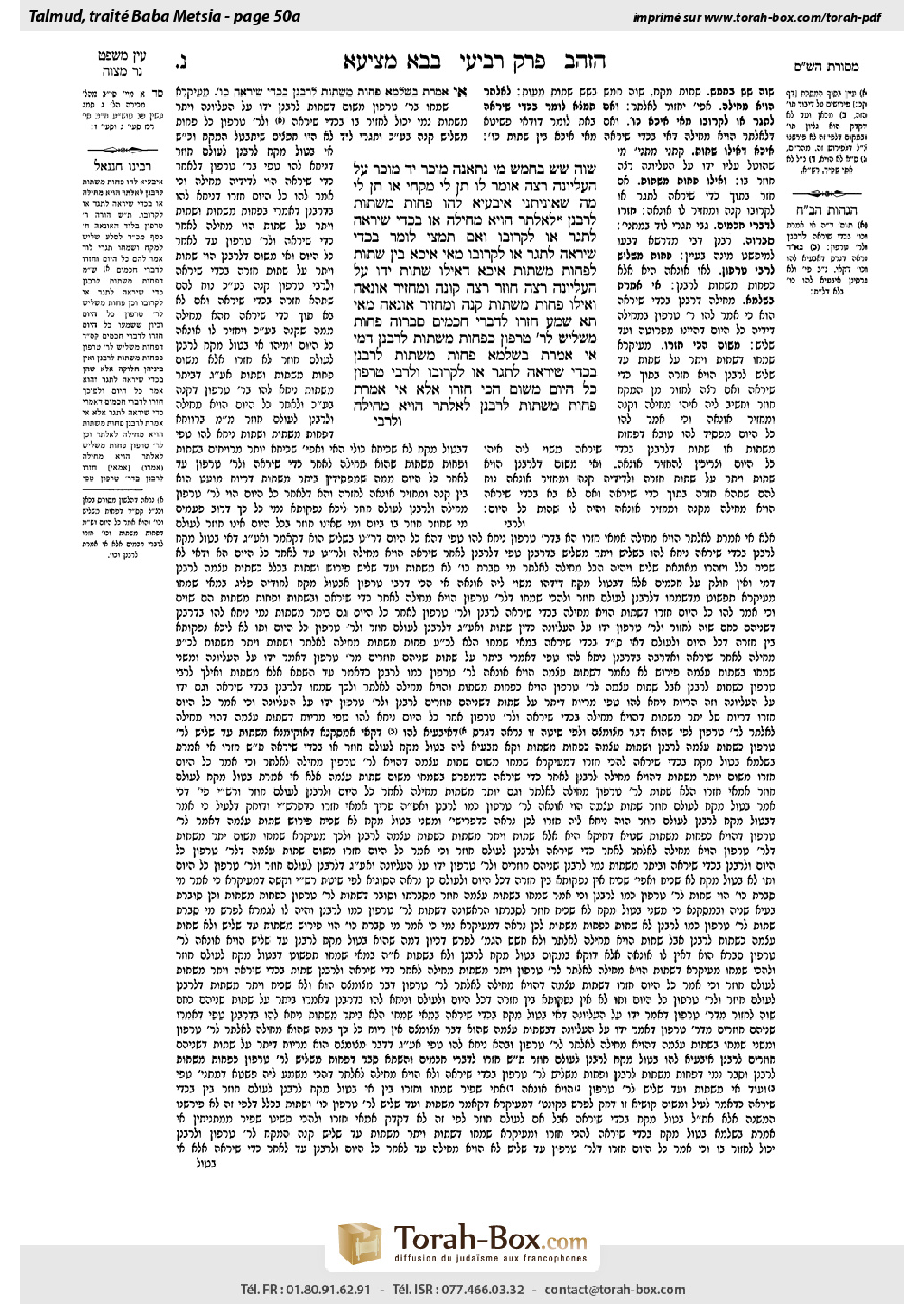
Bava Metzia 50a: Talmud study for Daf Yomi
Study the Talmud for Daf Yomi with scanned pages, Hebrew text, English translations from Sefaria and AI-generated French translations.
Passage selection and English or AI-generated French translation are available where the scan has annotations. Daf Study is independent of Torah-Box and Sefaria.
Browse Bava Metzia · בבא מציעא · All tractatesBava Metzia 50a text and translations
This page of Bava Metzia includes the Aramaic text, an English translation and an AI-generated French translation, alongside the scan above.
בבא מציעא נ׳ א · Aramaic and Hebrew text
שָׁוֶה שֵׁשׁ בְּחָמֵשׁ, מִי נִתְאַנָּה – מוֹכֵר, יָד מוֹכֵר עַל הָעֶלְיוֹנָה. רָצָה אוֹמֵר לוֹ: ״תֵּן לִי מִקָּחִי״, אוֹ ״תֵּן לִי מַה שֶּׁאוֹנֵיתַנִי״.
אִיבַּעְיָא לְהוּ: פָּחוֹת מִשְּׁתוּת לְרַבָּנַן, לְאַלְתַּר הָוְיָא מְחִילָה, אוֹ בִּכְדֵי שֶׁיַּרְאֶה לַתַּגָּר אוֹ לִקְרוֹבוֹ? וְאִם תִּמְצֵי לוֹמַר בִּכְדֵי שֶׁיַּרְאֶה לַתַּגָּר אוֹ לִקְרוֹבוֹ, מַאי אִיכָּא בֵּין שְׁתוּת לְפָחוֹת מִשְּׁתוּת?
אִיכָּא דְּאִלּוּ שְׁתוּת – יָדוֹ עַל הָעֶלְיוֹנָה, רָצָה – חוֹזֵר, רָצָה – קוֹנֶה וּמַחֲזִיר אוֹנָאָה. וְאִילּוּ פָּחוֹת מִשְּׁתוּת – קָנָה, וּמַחְזִיר אוֹנָאָה.
מַאי? תָּא שְׁמַע: חָזְרוּ לְדִבְרֵי חֲכָמִים.
סַבְרוּהָ פָּחוֹת מִשְּׁלִישׁ לְרַבִּי טַרְפוֹן כְּפָחוֹת מִשְּׁתוּת לְרַבָּנַן דָּמֵי. אִי אָמְרַתְּ בִּשְׁלָמָא פָּחוֹת מִשְּׁתוּת לְרַבָּנַן בִּכְדֵי שֶׁיַּרְאֶה לַתַּגָּר אוֹ לִקְרוֹבוֹ, וּלְרַבִּי טַרְפוֹן כׇּל הַיּוֹם – מִשּׁוּם הָכִי חָזְרוּ. אֶלָּא אִי אָמְרַתְּ פָּחוֹת מִשְּׁתוּת לְרַבָּנַן – לְאַלְתַּר הָוְיָא מְחִילָה,
Bava Metzia 50a · English translation
an item worth six ma’a for five ma’a, who was exploited? It is the seller. Therefore, the seller is at an advantage. If he wishes, he can say to the buyer: Give me back my merchandise and nullify the transaction, or he can say: Give me back the sum which you received by engaging in exploitation of me.
§ A dilemma was raised before the Sages: According to the opinion of the Rabbis that one has only until a period of time has passed that would allow him to show the merchandise to a merchant or to his relative in order to claim that he has been exploited, in a case where the disparity between the value of the purchase item and the price paid is less than one-sixth, is there a waiver of the discrepancy and therefore the transaction is finalized immediately, or in this case as well, is the transaction finalized only after the time that it takes the buyer to show the merchandise to a merchant or to his relative? And in addition, if you say that the transaction is finalized only after the time that it takes to show the merchandise to a merchant or to his relative, what difference is there between a disparity of one-sixth and a disparity of less than one-sixth?
The Gemara answers: There is a difference, as in the case of a disparity of one-sixth, the one who was exploited has the advantage, since if he wishes, he reneges on the transaction, and if he wishes, the buyer acquires the purchase item, and the one who perpetrated the exploitation returns the sum gained through his exploiting the other, while in the case of a disparity of less than one-sixth, the buyer acquires the purchase item, and the one who perpetrated the exploitation returns the sum gained through his exploiting the other, but there is no option of nullifying the transaction.
The Gemara returns to the dilemma: At what point in time is a disparity of less than one-sixth between the value of the purchase item and the price paid waived? The Gemara suggests: Come and hear a resolution of the dilemma from the mishna: Rabbi Tarfon said to them: Throughout the entire day it is permitted to renege on the transaction and not merely for the period of time it takes to show the purchase item to a merchant or a relative. The merchants of Lod said to him: Let Rabbi Tarfon leave us as we were, with the previous ruling. They reverted to following the statement of the Rabbis.
The Gemara explains the proof. The Sages assumed that the legal status of a disparity of less than one-third according to the opinion of Rabbi Tarfon, who holds that one-third is the determinative disparity, is like a disparity of less than one-sixth according to the opinion of the Rabbis, who hold that one-sixth is the determinative disparity. Granted, if you say that in the case of a disparity of less than one-sixth according to the Rabbis the buyer can claim exploitation only in the time that it takes him to show the merchandise to a merchant or to his relative, and according to Rabbi Tarfon the transaction is finalized only after the entire day has passed, it is due to that reason that the merchants of Lod reverted to following the statement of the Rabbis, as there was some benefit to them in following the opinion of the Rabbis. But if you say that in the case of a disparity of less than one-sixth according to the Rabbis the waiver is in effect and the transaction is finalized immediately,
Bava Metzia 50a · Traduction française (IA)
un objet valant six ma’ot acheté pour cinq ma’ot, qui est l’exploité ? C’est le vendeur. Ainsi, le vendeur est avantageux. S’il le souhaite, il peut dire à l’acheteur : Rends-moi mon bien et annule la transaction, ou il peut dire : Rends-moi la somme que tu as reçue en m’exploitant.
§ Un dilemme a été soulevé devant les Sages : Selon l’opinion des Rabbins, l’on a seulement jusqu’à un certain délai pour montrer l’objet à un marchand ou à un parent afin de prétendre avoir été exploité, dans un cas où la différence entre la valeur de l’objet acheté et le prix payé est inférieure à un sixième, y a-t-il un abandon de la différence et donc la transaction est finalisée immédiatement, ou dans ce cas également, la transaction est finalisée uniquement après le délai nécessaire pour montrer l’objet à un marchand ou à un parent ? Et en outre, si vous dites que la transaction est finalisée uniquement après le délai nécessaire pour montrer l’objet à un marchand ou à un parent, quelle est la différence entre une différence d’un sixième et une différence inférieure à un sixième ?
La Guemara répond : Il y a une différence, car dans le cas d’une différence d’un sixième, celui qui a été exploité a l’avantage, car s’il le souhaite, il annule la transaction, et s’il le souhaite, l’acheteur acquiert l’objet acheté, et celui qui a perpétré l’exploitation rend la somme gagnée grâce à son exploitation, tandis que dans le cas d’une différence inférieure à un sixième, l’acheteur acquiert l’objet acheté, et celui qui a perpétré l’exploitation rend la somme gagnée grâce à son exploitation, mais il n’y a pas d’option d’annuler la transaction.
La Guemara reprend le dilemme : À quel moment une différence inférieure à un sixième entre la valeur de l’objet acheté et le prix payé est-elle considérée comme abandonnée ? La Guemara suggère : Venez écouter la résolution du dilemme à partir de la mitsna : Rabbi Tarfon a dit à ceux-ci : Tout au long de la journée, il est permis d’annuler la transaction, et non pas uniquement pendant le délai nécessaire pour montrer l’objet à un marchand ou à un parent. Les marchands de Lod ont dit à lui : Laissez Rabbi Tarfon nous laisser comme nous étions, avec la décision précédente. Ils sont revenus à suivre l’opinion des Rabbins.
La Guemara explique la preuve. Les Sages supposaient que le statut juridique d’une différence inférieure à un tiers selon l’opinion de Rabbi Tarfon, qui considère un tiers comme la différence déterminante, est comme une différence inférieure à un sixième selon l’opinion des Rabbins, qui considèrent un sixième comme la différence déterminante. En effet, si vous dites que dans le cas d’une différence inférieure à un sixième selon les Rabbins, l’acheteur peut prétendre à l’exploitation uniquement pendant le délai nécessaire pour montrer l’objet à un marchand ou à un parent, et selon Rabbi Tarfon la transaction est finalisée uniquement après que la journée entière ait passé, c’est pour cette raison que les marchands de Lod sont revenus à suivre l’opinion des Rabbins, car cela leur apportait un avantage. Mais si vous dites que dans le cas d’une différence inférieure à un sixième selon les Rabbins, l’abandon est en vigueur et la transaction est finalisée immédiatement,
Traduction française générée par IA à partir de l’édition anglaise de Sefaria. Vérifie toujours un passage avec le texte source.
Text from Sefaria: William Davidson Edition - Vocalized Aramaic (CC BY NC); William Davidson Edition - English (CC BY NC).