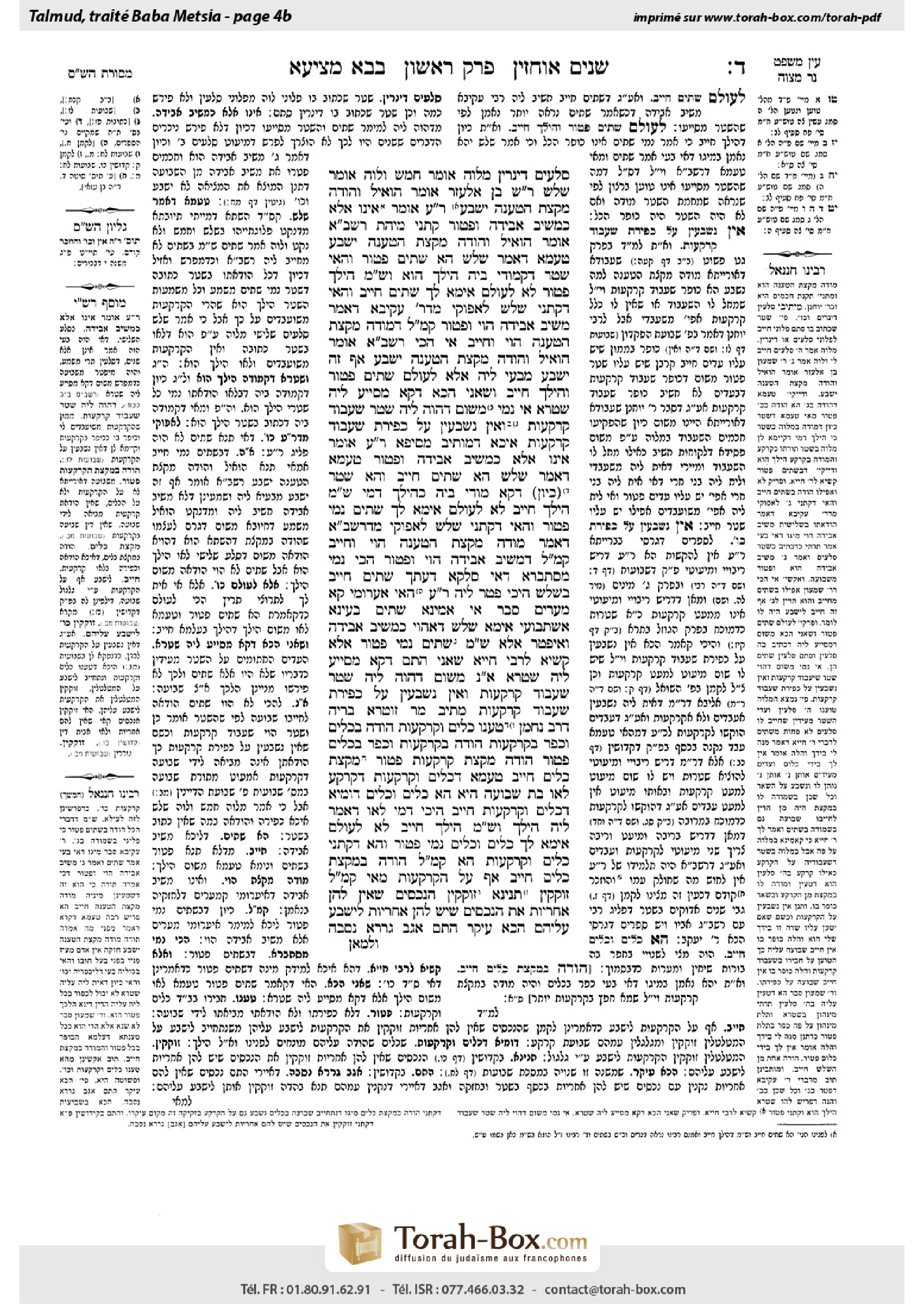
Bava Metzia 4b: Talmud study for Daf Yomi
Study the Talmud for Daf Yomi with scanned pages, Hebrew text, English translations from Sefaria and AI-generated French translations.
Passage selection and English or AI-generated French translation are available where the scan has annotations. Daf Study is independent of Torah-Box and Sefaria.
Browse Bava Metzia · בבא מציעא · All tractatesBava Metzia 4b text and translations
This page of Bava Metzia includes the Aramaic text, an English translation and an AI-generated French translation, alongside the scan above.
בבא מציעא ד׳ ב · Aramaic and Hebrew text
סְלָעִים, דִּינָרִין. מַלְוֶה אוֹמֵר חָמֵשׁ, וְלֹוֶה אוֹמֵר שָׁלֹשׁ. רַבִּי שִׁמְעוֹן בֶּן אֶלְעָזָר אוֹמֵר: הוֹאִיל וְהוֹדָה מִקְצָת הַטְּעָנָה – יִשָּׁבַע. רַבִּי עֲקִיבָא אוֹמֵר: אֵינוֹ אֶלָּא כְּמֵשִׁיב אֲבֵידָה, וּפָטוּר.
קָתָנֵי מִיהַת: רַבִּי שִׁמְעוֹן בֶּן אֶלְעָזָר אוֹמֵר, הוֹאִיל וְהוֹדָה מִקְצָת הַטְּעָנָה – יִשָּׁבַע. טַעְמָא דְּאָמַר שָׁלֹשׁ, הָא שְׁתַּיִם פָּטוּר, וְהַאי שְׁטָר דְּקָמוֹדֵי בֵּיהּ הֵילָךְ הוּא, וּשְׁמַע מִינַּהּ הֵילָךְ פָּטוּר!
לָא, לְעוֹלָם אֵימָא לָךְ שְׁתַּיִם חַיָּיב, וְהַאי דְּקָתָנֵי שָׁלֹשׁ, לְאַפּוֹקֵי מִדְּרַבִּי עֲקִיבָא, דְּאָמַר: מֵשִׁיב אֲבֵידָה הָוֵי וּפָטוּר, קָא מַשְׁמַע לַן דְּמוֹדֶה מִקְצָת הַטְּעָנָה הָוֵי, וְחַיָּיב.
אִי הָכִי: רַבִּי שִׁמְעוֹן בֶּן אֶלְעָזָר אוֹמֵר: הוֹאִיל וְהוֹדָה מִקְצָת הַטְּעָנָה יִשָּׁבַע, ״אַף זֶה יִשָּׁבַע״ מִבְּעֵי לֵיהּ!
אֶלָּא: לְעוֹלָם שְׁתַּיִם פָּטוּר, וְהֵילָךְ חַיָּיב. וְשָׁאנֵי הָכָא, דְּקָא מְסַיַּיע לֵיהּ שְׁטָרָא.
אִי נָמֵי: מִשּׁוּם דְּהָוֵה לֵיהּ שְׁטָר שִׁעְבּוּד קַרְקָעוֹת, וְאֵין נִשְׁבָּעִין עַל כְּפִירַת שִׁעְבּוּד קַרְקָעוֹת.
אִיכָּא דְּמוֹתֵיב מִסֵּיפָא, רַבִּי עֲקִיבָא אוֹמֵר: אֵינוֹ אֶלָּא כְּמֵשִׁיב אֲבֵידָה וּפָטוּר. טַעְמָא דְּאָמַר שָׁלֹשׁ, הָא שְׁתַּיִם חַיָּיב. וְהָא שְׁטָר, כֵּיוָן דְּקָא מוֹדֵי בֵּיהּ כְּ״הֵילָךְ״ דָּמֵי, שְׁמַע מִינַּהּ ״הֵילָךְ״ חַיָּיב!
לָא, לְעוֹלָם אֵימָא לָךְ שְׁתַּיִם נָמֵי פָּטוּר, וְהַאי דְּקָתָנֵי שָׁלֹשׁ, לְאַפּוֹקֵי מִדְּרַבִּי שִׁמְעוֹן בֶּן אֶלְעָזָר, דְּאָמַר מוֹדֶה מִקְצָת הַטַּעֲנָה הָוֵי – וְחַיָּיב, קָא מַשְׁמַע לַן דְּמֵשִׁיב אֲבֵידָה הָוֵי – וּפָטוּר.
הָכִי נָמֵי מִסְתַּבְּרָא. דְּאִי סָלְקָא דַעְתָּךְ: שְׁתַּיִם חַיָּיב, בְּשָׁלֹשׁ הֵיכִי פָּטַר לֵיהּ רַבִּי עֲקִיבָא, הַאי אִעָרוֹמֵי קָא מַעֲרִים! סָבַר: אִי אָמֵינָא שְׁתַּיִם בָּעֵינָא אִשְׁתְּבוֹעֵי, אֵימָא שָׁלֹשׁ דְּאֶהְוֵי כְּמֵשִׁיב אֲבֵידָה, וְאִיפָּטֵר. אֶלָּא שְׁמַע מִינַּהּ: שְׁתַּיִם נָמֵי פָּטוּר.
אֶלָּא קַשְׁיָא לְרַבִּי חִיָּיא! שָׁאנֵי הָתָם דְּקָא מְסַיַּיע לֵיהּ שְׁטָרָא. אִי נָמֵי מִשּׁוּם דְּהָוֵה לֵיהּ שְׁטָר שִׁעְבּוּד קַרְקָעוֹת, וְאֵין נִשְׁבָּעִין עַל כְּפִירַת שִׁעְבּוּד קַרְקָעוֹת.
מֵתִיב מַר זוּטְרָא בְּרֵיהּ דְּרַב נַחְמָן: טְעָנוֹ כֵּלִים וְקַרְקָעוֹת, הוֹדָה בַּכֵּלִים וְכָפַר בַּקַּרְקָעוֹת, הוֹדָה בַּקַּרְקָעוֹת וְכָפַר בַּכֵּלִים – פָּטוּר. הוֹדָה מִקְצָת קַרְקָעוֹת – פָּטוּר, מִקְצָת כֵּלִים – חַיָּיב.
טַעְמָא דְּכֵלִים וְקַרְקָעוֹת, דְּקַרְקַע לָאו בַּת שְׁבוּעָה הִיא, הָא כֵּלִים וְכֵלִים דּוּמְיָא דְּכֵלִים וְקַרְקָעוֹת חַיָּיב. הֵיכִי דָּמֵי? לָאו דְּאָמַר לֵיהּ הֵילָךְ, וּשְׁמַע מִינַּהּ הֵילָךְ חַיָּיב!
לָא, לְעוֹלָם אֵימָא לָךְ כֵּלִים וְכֵלִים נָמֵי פָּטוּר, וְהָא דְּקָתָנֵי כֵּלִים וְקַרְקָעוֹת, הָא קָא מַשְׁמַע לַן: הוֹדָה בְּמִקְצָת כֵּלִים – חַיָּיב אַף עַל הַקַּרְקָעוֹת.
מַאי קָא מַשְׁמַע לַן – זוֹקְקִין? תְּנֵינָא: זוֹקְקִין הַנְּכָסִים שֶׁאֵין לָהֶן אַחְרָיוּת אֶת הַנְּכָסִים שֶׁיֵּשׁ לָהֶן אַחְרָיוּת לִישָּׁבַע עֲלֵיהֶם.
הָכָא עִיקָּר, הָתָם אַגַּב גְּרָרָא נַסְבַהּ.
Bava Metzia 4b · English translation
If it is written in a promissory note that one borrowed an unspecified amount of sela’im, or that one borrowed an unspecified amount of dinars, and the creditor says: I lent you five sela, and the debtor says: You lent me only three, in this case Rabbi Shimon ben Elazar says: Since the debtor admitted to part of the claim, he takes an oath. Rabbi Akiva says: Since the wording of the note indicates only that he owes two dinars, the minimum plural amount, by admitting that he owes three he is merely the equivalent of one returning a lost item, and he is exempt from taking an oath.
In any event, the baraita teaches that Rabbi Shimon ben Elazar says: Since the debtor admitted to part of the claim, he takes an oath. This indicates that the reason that he is obligated to take an oath is specifically because he said that he owes three dinars, but had he admitted to owing only two, he would have been exempt from taking an oath. And concerning the minimal obligation recorded in this promissory note, to which he admits, which is two dinars, it is as though he said: Here you are. An obligation recorded in a promissory note is tantamount to an obligation concerning which the defendant says: Here you are. And therefore, conclude from it that one who says: Here you are, is exempt from taking an oath with regard to the part of the claim he denies.
The Gemara rejects this: No, actually I will say to you that even if he admitted that he owes two dinars he is obligated to take an oath, and the reason that the baraita teaches the dispute specifically with regard to the case of three dinars is not to exclude a case where he admits that he owes only two, but rather it is to exclude the opinion of Rabbi Akiva, who says that he is the equivalent of one returning a lost item, and he is therefore exempt. Therefore, Rabbi Shimon ben Elazar teaches us that he is considered like one who admits to part of the claim, and he is obligated to take an oath.
The Gemara asks: If so, the baraita should have been phrased differently. If the defendant is obligated to take an oath even in a case where he admits that he owes two dinars, rather than stating that Rabbi Shimon ben Elazar says: Since the debtor admitted to part of the claim, he takes an oath, the baraita should have stated: Even this one, who admits to owing three dinars, takes an oath, in addition to one who admits to owing two dinars.
Rather, that explanation should be rejected. Actually, if he admits that he owes two dinars, he is exempt from taking an oath, but nevertheless, one who says: Here you are, is obligated to take an oath. And the reason for this distinction is that here, the case is different, as the note supports him, i.e., it indicates that he owes two dinars. Therefore, he is exempt from taking an oath with regard to the rest.
Alternatively, if he admits to owing two dinars he is exempt for a different reason: Because a promissory note creates a lien on the debtor’s land, and there is a principle that one does not take an oath with regard to a debtor’s denial of a debt that is secured with a lien on land. Oaths are administered only when one denies owing money or movable property.
There are those who raise an objection to Rav Sheshet’s opinion from the latter clause of this baraita, which teaches that Rabbi Akiva says: He is merely the equivalent of one returning a lost item and is exempt from taking an oath. The Gemara infers: The reason he is exempt is that he said that he owes three dinars. But had he admitted to owing only two, he would have been obligated to take an oath. And concerning the minimal obligation recorded in this promissory note, to which he admits, which is two dinars, it is as though he said: Here you are. Learn from it that one who says: Here you are, is obligated to take an oath.
The Gemara rejects this: No, actually I will say to you that if he admits that he owes two dinars he is also exempt from taking an oath, and the reason that the baraita teaches the dispute specifically with regard to the case of three dinars is to exclude the opinion of Rabbi Shimon ben Elazar, who says that he is considered one who admits to part of the claim and he is obligated to take an oath. Rabbi Akiva, therefore, teaches us that in his opinion, the defendant is the equivalent of one returning a lost item, and he is exempt from taking an oath.
The Gemara comments: So too, it is reasonable to explain the baraita as just explained, as, if it enters your mind that one who admits that he owes two dinars is obligated to take an oath, how does Rabbi Akiva deem him exempt in a case where he admits that he owes three dinars? Perhaps this debtor is employing artifice, thinking: If I say that I owe two, I will be required to take an oath. Therefore, I will say that I owe three so that I will be considered equivalent to one returning a lost item and will be exempt from taking an oath. Rather, learn from it that even if he admits that he owes only two dinars, he is also exempt from taking an oath.
The Gemara asks: But this explanation poses a difficulty to the opinion of Rabbi Ḥiyya, that a defendant is obligated to take an oath in a case where he says: Here you are. In other words, Rabbi Ḥiyya’s opinion is negated by the case of one who admits that he owes only two dinars, where he is exempt from taking an oath. The Gemara answers: The case there is different, as the note supports him. Therefore, he is not required to take an oath. Alternatively, he is exempt because a promissory note creates a lien on the debtor’s land, and there is a principle that one does not take an oath with regard to a debtor’s denial of a debt that is secured with a lien on land.
Mar Zutra, son of Rav Naḥman, raises an objection to the opinion of Rav Sheshet from a mishna (Shevuot 38b): If one claimed that another owed him vessels and land, and the defendant admitted to owing him vessels but denied that he owes him land, or conversely, if he admitted to owing him land but denied that he owes him vessels, he is exempt from taking an oath with regard to what he denies. If he admitted that he owes him part of the land, he is exempt. If he admitted to owing some of the vessels, he is obligated to take an oath with regard to the remainder.
The Gemara infers: The reason he is exempt in the first cases is because the claim is for vessels and land, as a claim with regard to land is not subject to an oath. But if the claim is for vessels and vessels, i.e., two sets of vessels, in a manner similar to the case of a claim for vessels and land, he is obligated to take an oath. What are the circumstances of such a case? Is it not a case where he said to him: Here you are? And learn from the mishna that one who says: Here you are, is obligated to take an oath.
The Gemara answers: No, actually I will say to you that if the claim is for vessels and vessels he is also exempt. And the fact that the mishna teaches the case of vessels and land teaches us this different halakha: If he admitted that he owes some of the vessels, and is therefore obligated to take an oath, he is also obligated to take an oath with regard to the land that he denied owing his creditor, although in and of itself one does not take an oath with regard to land.
The Gemara asks: What is this teaching us? Is this teaching the halakha of binding? According to this halakha, one who is obligated to take an oath in response to a claim can be required to take an oath with regard to an additional claim of land. This cannot be, as we already learned this halakha in a mishna in tractate Kiddushin (26a): When there is a claim brought against a person for movable property and land, and he is obligated to take an oath with regard to the property that does not serve as a guarantee, i.e., the movable property, it binds the property that serves as a guarantee, i.e., the land, so that he is forced to take an oath with regard to it too. Why is this halakha repeated in tractate Shevuot?
The Gemara answers: The mishna here, in Shevuot, is the main reference to this halakha, as it discusses the halakhot of oaths, whereas the mishna there, in tractate Kiddushin, cites it incidentally, in the context of a broader survey of the difference between these two types of property.
Bava Metzia 4b · Traduction française (IA)
Si l'on écrit dans une promesse de prêt que l'un a emprunté une quantité indéterminée de selaïm, ou que l'un a emprunté une quantité indéterminée de dinars, et que le créancier dit : J'ai prêté à toi cinq selaïm, et que le débiteur dit : Tu m'as prêté seulement trois, dans ce cas, Rabbi Shimon ben Elazar dit : Puisque le débiteur a admis une partie de la réclamation, il prend un serment. Rabbi Akiva dit : Puisque le texte de la promesse indique qu'il doit deux dinars, la quantité minimale plurielle, en admettant qu'il doit trois, il est simplement équivalent à celui qui rend un objet perdu, et il est exempt de prendre un serment.
En tout cas, la baraïta enseigne que Rabbi Shimon ben Elazar dit : Puisque le débiteur a admis une partie de la réclamation, il prend un serment. Cela indique que la raison pour laquelle il est tenu de prendre un serment est spécifiquement parce qu'il a dit qu'il doit trois dinars, mais s'il avait admis qu'il devait seulement deux, il aurait été exempt de prendre un serment. Et concernant l'obligation minimale inscrite dans cette promesse, à laquelle il admet, qui est deux dinars, c'est comme s'il disait : Ici tu es. Une obligation inscrite dans une promesse est équivalente à une obligation concernant laquelle le défendeur dit : Ici tu es. Et donc, concluez-en que celui qui dit : Ici tu es, est exempt de prendre un serment concernant la partie de la réclamation qu'il nie.
La Guemara rejette cela : Non, en réalité, je vais te dire que même s'il admet qu'il doit deux dinars, il est tenu de prendre un serment, et la raison pour laquelle la baraïta enseigne ce débat spécifiquement dans le cas de trois dinars n'est pas pour exclure un cas où il admet qu'il doit seulement deux, mais plutôt pour exclure l'opinion de Rabbi Akiva, qui dit qu'il est équivalent à celui qui rend un objet perdu, et qu'il est donc exempt. Ainsi, Rabbi Shimon ben Elazar nous enseigne que l'on considère qu'il est comme celui qui admet une partie de la réclamation, et qu'il est tenu de prendre un serment.
La Guemara pose une question : Si c'est ainsi, la baraïta aurait dû être formulée différemment. Si le défendeur est tenu de prendre un serment même dans le cas où il admet qu'il doit deux dinars, plutôt que d'indiquer que Rabbi Shimon ben Elazar dit : Puisque le débiteur a admis une partie de la réclamation, il prend un serment, la baraïta aurait dû dire : Même celui qui admet qu'il doit trois dinars, prend un serment, en plus de celui qui admet qu'il doit deux dinars.
Plutôt, cette explication doit être rejetée. En réalité, si il admet qu'il doit deux dinars, il est exempt de prendre un serment, mais néanmoins, celui qui dit : Ici tu es, est tenu de prendre un serment. Et la raison de cette distinction est que dans ce cas, la situation est différente, car la note le soutient, c'est-à-dire qu'elle indique qu'il doit deux dinars. Ainsi, il est exempt de prendre un serment concernant le reste.
Une autre explication est la suivante : Si il admet qu'il doit deux dinars, il est exempt de prendre un serment pour une autre raison : car une promesse crée un droit de gage sur la terre du débiteur, et il y a un principe selon lequel on ne prend pas de serment concernant une dette que le débiteur nie, et qui est garantie par un droit de gage sur la terre. Les serments sont administrés uniquement lorsqu'on nie d'avoir emprunté de l'argent ou des biens mobiliers.
Certains soulèvent une objection contre l'opinion de Rav Sheshet à partir de la dernière partie de cette baraïta, qui enseigne que Rabbi Akiva dit : Il est simplement équivalent à celui qui rend un objet perdu et est exempt de prendre un serment. La Guemara infère : La raison pour laquelle il est exempt est qu'il a dit qu'il doit trois dinars. Mais s'il avait admis qu'il devait seulement deux, il aurait été tenu de prendre un serment. Et concernant l'obligation minimale inscrite dans cette promesse, à laquelle il admet, qui est deux dinars, c'est comme s'il disait : Ici tu es. Apprenez-en que celui qui dit : Ici tu es, est tenu de prendre un serment.
La Guemara rejette cette interprétation : Non, en réalité, je vais te dire que si il admet qu'il doit deux dinars, il est également exempt de prendre un serment, et la raison pour laquelle la baraïta enseigne ce débat spécifiquement dans le cas de trois dinars est pour exclure l'opinion de Rabbi Shimon ben Elazar, qui dit qu'il est considéré comme celui qui admet une partie de la réclamation et qu'il est tenu de prendre un serment. Rabbi Akiva, donc, nous enseigne que selon son opinion, le défendeur est équivalent à celui qui rend un objet perdu, et qu'il est exempt de prendre un serment.
La Guemara commente : De même, il est raisonnable d'expliquer la baraïta comme on l'a expliqué, car, si cela entre dans votre esprit que celui qui admet qu'il doit deux dinars est tenu de prendre un serment, comment Rabbi Akiva considère-t-il qu'il est exempt dans le cas où il admet qu'il doit trois dinars ? Peut-être que ce débiteur utilise un artifice, pensant : Si je dis que je dois deux, je serai tenu de prendre un serment. Donc, je dirai que je dois trois afin d'être considéré comme celui qui rend un objet perdu et d'être exempt de prendre un serment. Plutôt, apprenez-en que même s'il admet qu'il doit seulement deux dinars, il est également exempt de prendre un serment.
La Guemara pose une question : Mais cette explication pose un problème pour l'opinion de Rabbi Ḥiyya, qui affirme qu'un défendeur est tenu de prendre un serment dans le cas où il dit : Ici tu es. En d'autres termes, l'opinion de Rabbi Ḥiyya est invalidée par le cas d'une personne qui admet qu'il doit seulement deux dinars, où il est exempt de prendre un serment. La Guemara répond : Le cas est différent, car la note le soutient. Ainsi, il n'est pas tenu de prendre un serment. Alternativement, il est exempt parce qu'une promesse crée un droit de gage sur la terre du débiteur, et il y a un principe selon lequel on ne prend pas de serment concernant une dette que le débiteur nie, et qui est garantie par un droit de gage sur la terre.
Mar Zutra, fils de Rav Naḥman, émet une objection contre l'opinion de Rav Sheshet, en se basant sur une mitsva (Shevuot 38b) : Si l'on affirme qu'un autre lui doit des objets et des terres, et que le défendeur admet de lui devoir des objets mais nie de lui devoir des terres, ou inversement, s'il admet de lui devoir des terres mais nie de lui devoir des objets, il est exempt de prendre serment concernant ce qu'il nie. Si l'on admet qu'il lui doit une partie des terres, il est exempt. Si l'on admet qu'il lui doit une partie des objets, il est tenu de prendre serment concernant le reste.
La Guemara conclut : La raison pour laquelle il est exempt dans les premiers cas est que la revendication concerne des objets et des terres, car une revendication concernant des terres n'est pas soumise à serment. Mais si la revendication concerne des objets et des objets, c'est-à-dire deux ensembles d'objets, dans un sens similaire au cas d'une revendication concernant des objets et des terres, il est tenu de prendre serment. Quelles sont les circonstances de ce cas ? N'est-ce pas un cas où l'on dit à l'autre : Ici tu es ? Et l'on apprend de la mitsva que celui qui dit : Ici tu es, est tenu de prendre serment.
La Guemara répond : Non, en réalité je vais te dire que si la revendication concerne des objets et des objets, il est également exempt. Et le fait que la mitsva discute le cas des objets et des terres nous apprend cette halakha différente : Si l'on admet qu'il lui doit une partie des objets, et est donc tenu de prendre serment, il est également tenu de prendre serment concernant les terres qu'il a nié de devoir à son créancier, bien que, de lui-même, on ne prenne pas serment concernant les terres.
La Guemara pose la question : Quelle est la portée de cette enseignement ? Est-ce que cela nous apprend la halakha concernant la garantie ? Selon cette halakha, celui qui est tenu de prendre serment en réponse à une revendication peut être tenu de prendre serment concernant une autre revendication de terres. Cela est impossible, car nous avons déjà appris cette halakha dans une mitsva du traité Kiddushin (26a) : Lorsqu'une revendication est portée contre une personne concernant des biens mobiliers et des terres, et qu'il est tenu de prendre serment concernant les biens mobiliers qui ne servent pas de garantie, c'est-à-dire les biens mobiliers, cela engage les biens qui servent de garantie, c'est-à-dire les terres, de sorte qu'il est contraint de prendre serment concernant eux aussi. Pourquoi cette halakha est-elle répétée dans le traité Shevuot ?
La Guemara répond : La mitsva ici, dans Shevuot, est la référence principale à cette halakha, car elle discute des halakhot des serments, tandis que la mitsva là, dans le traité Kiddushin, la cite de manière incidentelle, dans le contexte d'une comparaison plus large entre ces deux types de biens.
Traduction française générée par IA à partir de l’édition anglaise de Sefaria. Vérifie toujours un passage avec le texte source.
Text from Sefaria: William Davidson Edition - Vocalized Aramaic (CC BY NC); William Davidson Edition - English (CC BY NC).