Bava Metzia 5a: Talmud study for Daf Yomi
Study the Talmud for Daf Yomi with scanned pages, Hebrew text, English translations from Sefaria and AI-generated French translations.
Passage selection and English or AI-generated French translation are available where the scan has annotations. Daf Study is independent of Torah-Box and Sefaria.
Browse Bava Metzia · בבא מציעא · All tractatesBava Metzia 5a text and translations
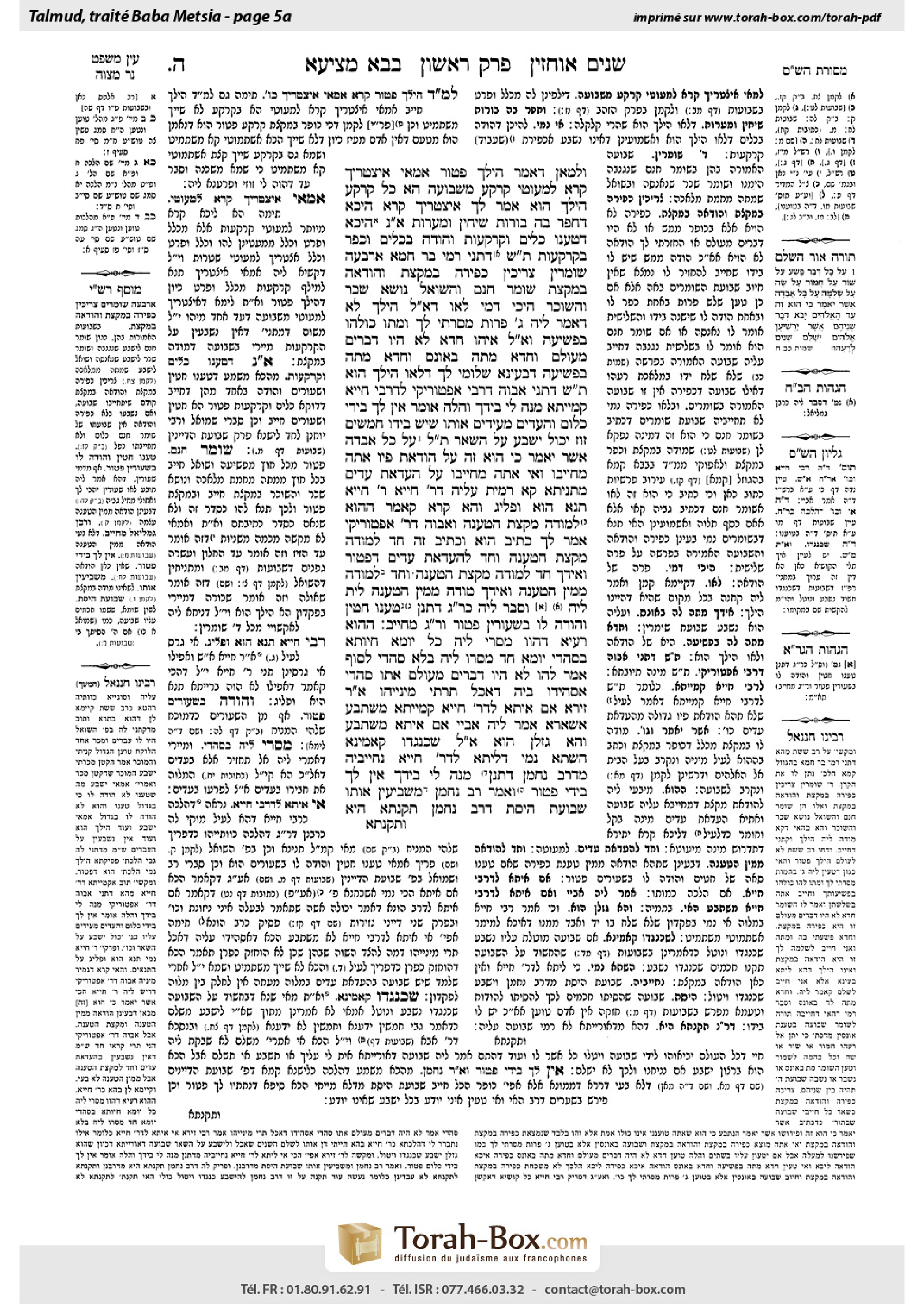
This page of Bava Metzia includes the Aramaic text, an English translation and an AI-generated French translation, alongside the scan above.
בבא מציעא ה׳ א · Aramaic and Hebrew text
וּלְמַאן דְּאָמַר הֵילָךְ פָּטוּר, אַמַּאי אִיצְטְרִיךְ קְרָא לְמַעוֹטֵי קַרְקַע מִשְּׁבוּעָה? הָא כׇּל קַרְקַע הֵילָךְ הוּא.
אָמַר לָךְ: אִיצְטְרִיךְ קְרָא הֵיכָא דְּחָפַר בָּהּ בּוֹרוֹת שִׁיחִין וּמְעָרוֹת.
אִי נָמֵי, הֵיכָא דִּטְעָנוֹ כֵּלִים וְקַרְקָעוֹת, וְהוֹדָה בַּכֵּלִים וְכָפַר בַּקַּרְקָעוֹת.
תָּא שְׁמַע, דְּתָנֵי רָמֵי בַּר חָמָא: אַרְבָּעָה שׁוֹמְרִין צְרִיכִין כְּפִירָה בְּמִקְצָת וְהוֹדָאָה בְּמִקְצָת. שׁוֹמֵר חִנָּם, וְהַשּׁוֹאֵל, נוֹשֵׂא שָׂכָר, וְהַשּׂוֹכֵר.
הֵיכִי דָּמֵי? לָאו דַּאֲמַר לֵיהּ: הֵילָךְ!
לָא, דַּאֲמַר לֵיהּ: שָׁלֹשׁ פָּרוֹת מָסַרְתִּי לָךְ וּמֵתוּ כּוּלְּהוּ בִּפְשִׁיעָה. וְאָמַר לֵיהּ אִיהוּ: חֲדָא – לָא הָיוּ דְבָרִים מֵעוֹלָם, וַחֲדָא – מֵתָה בְּאוֹנֶס, וַחֲדָא – מֵתָה בִּפְשִׁיעָה דִּבְעֵינָא שַׁלּוֹמֵי לָךְ. דְּלָאו ״הֵילָךְ״ הוּא.
תָּא שְׁמַע, דְּתָנֵי אֲבוּהּ דְּרַבִּי אַפְטוֹרִיקִי לִדְרַבִּי חִיָּיא קַמַּיְיתָא: מָנֶה לִי בְּיָדְךָ, וְהַלָּה אוֹמֵר: אֵין לְךָ בְּיָדִי כְּלוּם, וְהָעֵדִים מְעִידִים אוֹתוֹ שֶׁיֵּשׁ בְּיָדוֹ חֲמִשִּׁים זוּז, יָכוֹל יִשָּׁבַע עַל הַשְּׁאָר –
תַּלְמוּד לוֹמַר: ״עַל כׇּל אֲבֵידָה אֲשֶׁר יֹאמַר כִּי הוּא זֶה״. עַל הוֹדָאַת פִּיו אַתָּה מְחַיְּיבוֹ, וְאִי אַתָּה מְחַיְּיבוֹ עַל הַעֲדָאַת עֵדִים!
מַתְנִיתָא קָא רָמֵית עֲלֵיהּ דְּרַבִּי חִיָּיא?! רַבִּי חִיָּיא תַּנָּא הוּא וּפָלֵיג.
וְהָא קְרָא קָאָמַר! הָהוּא לְמוֹדֶה מִקְצָת הַטַּעֲנָה.
וַאֲבוּהּ דְּרַבִּי אַפְטוֹרִיקִי אָמַר לָךְ, כְּתִיב ״הוּא״ וּכְתִיב ״זֶה״, חַד לְמוֹדֶה מִקְצָת הַטַּעֲנָה, וְחַד לְהַעֲדָאַת עֵדִים דְּפָטוּר.
וְאִידָּךְ: חַד לְמוֹדֶה מִקְצָת הַטַּעֲנָה, וְחַד לְמוֹדֶה מִמִּין הַטַּעֲנָה.
וְאִידַּךְ מוֹדֶה מִמִּין הַטַּעֲנָה לֵית לֵיהּ, וְסָבַר לֵיהּ כְּרַבָּן גַּמְלִיאֵל, דִּתְנַן: טְעָנוֹ חִטִּין, וְהוֹדָה לוֹ בִּשְׂעוֹרִין, פָּטוּר. וְרַבָּן גַּמְלִיאֵל מְחַיֵּיב.
הָהוּא רָעֲיָא דְּהָווּ מָסְרִי לֵיהּ כׇּל יוֹמָא חֵיוָתָא בְּסָהֲדֵי. יוֹמָא חַד מְסַרוּ לֵיהּ בְּלָא סָהֲדֵי. לְסוֹף אָמַר לְהוּ: לֹא הָיוּ דְבָרִים מֵעוֹלָם. אֲתוֹ סָהֲדֵי אַסְהִידוּ בֵּיהּ דַּאֲכַל תַּרְתֵּי מִינַּיְיהוּ. אֲמַר רַבִּי זֵירָא: אִם אִיתָא לִדְרַבִּי חִיָּיא קַמַּיְיתָא, מִשְׁתְּבַע אַשְּׁאָרָא.
אֲמַר לֵיהּ אַבָּיֵי: אִם אִיתָא מִשְׁתְּבַע?! וְהָא גַּזְלָן הוּא! אֲמַר לֵיהּ: שֶׁכְּנֶגְדּוֹ קָאָמֵינָא.
הַשְׁתָּא נָמֵי דְּלֵיתָא לִדְרַבִּי חִיָּיא, נְחַיְּיבֵיהּ מִדְּרַב נַחְמָן.
דִּתְנַן: מָנֶה לִי בְּיָדְךָ, אֵין לְךָ בְּיָדִי – פָּטוּר. וְאָמַר רַב נַחְמָן: מַשְׁבִּיעִין אוֹתוֹ שְׁבוּעַת הֶיסֵּת.
דְּרַב נַחְמָן תַּקַּנְתָּא הִיא,
Bava Metzia 5a · English translation
The Gemara asks: But according to Rav Sheshet, with regard to the one who says that in a case where the debtor says: Here you are, he is exempt from taking an oath, why was it necessary for the verse to exclude a claim of land ownership from the defendant’s obligation to take an oath when he admits part of the claim? The exclusion of land is derived from the verse: “For any matter of trespass, for an ox, for a donkey, for a sheep, for a garment, for any lost item about which one shall say: This is it, the claims of both of them shall come before the judges” (Exodus 22:8). But all cases involving one who admits to part of the claim involving land are cases where the defendant effectively says: Here you are, as land always remains in its location. Therefore, the derivation from the verse appears to be unnecessary.
The Gemara answers that Rav Sheshet could have said to you: The verse was necessary in a case where the defendant dug pits, ditches, and caves in the land that he is returning to the plaintiff. Since the land has been damaged and is no longer in its prior state, the defendant is not effectively saying: Here you are.
Alternatively, there is the case where one claimed that another owed him vessels and land, and the defendant admitted to the claim involving the vessels and denied the claim involving the land. The verse teaches that although the defendant denied part of the claim and did not effectively say: Here you are, he is not obligated to take an oath with regard to the land.
Come and hear a proof for Rabbi Ḥiyya’s opinion, as Rami bar Ḥama teaches a baraita: All four types of bailees mentioned in the Torah require denial of part of the claim and admission of part of the claim in order to incur liability to take an oath when someone claims to have given them an item as a deposit. This applies to an unpaid bailee, who receives no payment in exchange for safeguarding the item, and a borrower, who does not pay the owner in exchange for the right to use the item, as well as a paid bailee, who receives payment in exchange for safeguarding the item, and a renter, who rents an item in order to use it and pays the owner in exchange for that right.
The Gemara elaborates: What are the circumstances in which the bailees both deny part of the claim and admit to part of the claim? Is it not referring to a case where the bailee said to the one who deposited the item: With regard to the items that I admit to having received from you: Here you are, and as to the rest, I never received them and I am therefore not obligated to return them? This supports Rabbi Ḥiyya’s opinion that one who says: Here you are, is obligated to take an oath.
The Gemara rejects this: No, Rami bar Ḥama is referring to a different case, for example, a case where the depositor said to the unpaid bailee: I gave you three cows and they all died due to your negligence. You are therefore liable to pay for them. And the bailee said to him: With regard to one cow, this matter never happened. In other words, I received only two cows, not three. And one of the cows died due to an unavoidable accident, and I am exempt from paying for it. And the other one died due to my negligence, for which I need to pay you. In that case, although he admits to part of the claim, it is not a case of: Here you are, as he is not returning the cow itself.
§ Come and hear a challenge to the first halakha of Rabbi Ḥiyya, as the father of Rabbi Aptoriki taught in a baraita: If one says to another: I have one hundred dinars in your possession, and the other says: Nothing of yours is in my possession, and the witnesses testify that he has fifty dinars in his possession that he owes the plaintiff, one might have thought that he should take an oath about the remainder.
To counter this, the verse states with regard to bailees: “For any matter of trespass, for an ox, for a donkey, for a sheep, for a garment, for any lost item about which one shall say: This is it, the claims of both of them shall come before the judges” (Exodus 22:8). This indicates that you obligate the defendant to take an oath based on the admission to part of a claim by his mouth, but you do not obligate him to take an oath based on the testimony of witnesses.
The Gemara rejects this challenge: Are you raising an objection to the opinion of Rabbi Ḥiyya from a baraita? Rabbi Ḥiyya himself is a tanna, and as such, he has the authority to dispute the determination in a baraita.
The Gemara asks: But doesn’t that tanna cite a verse? The Gemara answers: According to Rabbi Ḥiyya, that verse teaches that one who admits to part of the claim is obligated to take an oath.
And Rabbi Aptoriki’s father could have said to you that both halakhot are derived from the expression “This is it.” Since “this” is written and “it” is also written, it is interpreted that one word is stated to teach that one who admits to part of the claim is obligated to take an oath, and one word is stated to teach that in a case that involves the testimony of witnesses, one is exempt from taking an oath.
The Gemara asks: And how does the other Sage, Rabbi Ḥiyya, interpret the double qualification in the verse? The Gemara answers: In his opinion, one word is stated to teach that one who admits to part of the claim is obligated to take an oath, and one word is stated to teach that one is obligated to take an oath only if he admits that he owes an item that is of the same type as the subject of the claim. If the plaintiff claims one type of item and the defendant admits to owing a different type of item, he is not obligated to take an oath.
And the other Sage, Rabbi Aptoriki’s father, does not accept the principle that one is required to take an oath only if he admits that he owes an item that is of the same type as the subject of the claim, but he holds like Rabban Gamliel in this matter. As we learned in a mishna (Shevuot 38b): If one claimed that another owes him wheat, and the defendant admitted to owing him barley, which is less expensive than wheat, he is exempt from taking an oath despite his admission to part of the claim, as his admission does not correspond to the claim. And Rabban Gamliel deems him liable to take an oath.
§ The Gemara relates: There was a certain shepherd to whom people would give their animals for safekeeping every day in the presence of witnesses. One day, they gave him their animals without witnesses. At the end of the day he said to the owners of the animals: This matter never occurred; I never received the animals. Witnesses came and testified against him that he ate two of them. Rabbi Zeira said: If Rabbi Ḥiyya’s first halakha is so, the shepherd must take an oath with regard to the remainder, or else he must pay the value of the animals to their owners.
Abaye said to him: If Rabbi Ḥiyya’s first halakha is so, the shepherd takes an oath? Isn’t he a robber? The witnesses established through their testimony that he took and ate some of the animals, and consequently his oath lacks credibility. Rabbi Zeira said to him: I did not mean that the shepherd takes an oath; I was saying that the party opposing him takes an oath and collects payment.
The Gemara comments: Now, too, if it is so that the halakha is not in accordance with the opinion of Rabbi Ḥiyya, and testimony supporting part of the claim does not obligate the defendant to take an oath with regard to the rest, the court should still obligate the shepherd to take an oath due to the ordinance of Rav Naḥman, and since his oath is not deemed credible the plaintiff should take an oath and collect payment.
As we learned in a mishna (Shevuot 38b): If one says to another: I have one hundred dinars in your possession, and that person replies: Nothing of yours is in my possession, he is exempt from taking an oath. And Rav Naḥman says: Nevertheless, the judges administer an oath of inducement to him. Rav Naḥman instituted an ordinance that even if the defendant completely denies the claim, he is obligated to take an oath that the claim is false. Consequently, the shepherd is obligated to take that oath.
The Gemara responds: This halakha of Rav Naḥman is a rabbinic ordinance and not an oath required by Torah law,
Bava Metzia 5a · Traduction française (IA)
Le Guemara pose la question : Mais selon Rav Sheshet, concernant celui qui affirme que dans un cas où le débiteur dit : Voilà, il est exempt de prendre serment, pourquoi fallait-il que la parole exclue la revendication de propriété de terre de l'obligation du défendeur de prendre serment lorsqu'il admet une partie de la revendication ? L'exclusion de la terre est tirée de la parole : « Pour toute affaire de délit, pour un bœuf, pour un âne, pour une brebis, pour un vêtement, pour tout objet perdu dont on dira : C'est cela, les revendications des deux parties viendront devant les juges » (Exode 22:8). Mais tous les cas impliquant celui qui admet une partie de la revendication concernant la terre sont des cas où le défendeur dit effectivement : Voilà, car la terre reste toujours à sa place. Ainsi, la dérivation de la parole semble inutile.
Le Guemara répond que Rav Sheshet aurait pu dire à vous : La parole était nécessaire dans un cas où le défendeur creusait des fossés, des puits et des grottes dans la terre qu'il restitue au plaignant. Puisque la terre a été endommagée et n'est plus dans son état initial, le défendeur ne dit pas effectivement : Voilà.
Une autre possibilité est le cas où l'un affirmait que l'autre lui devait des objets et de la terre, et le défendeur admettait la revendication concernant les objets et déniant celle concernant la terre. La parole enseigne que bien que le défendeur ait dénié une partie de la revendication et ne dise pas effectivement : Voilà, il n'est pas tenu de prendre serment concernant la terre.
Venez écouter une preuve pour l'opinion de Rabbi Ḥiyya, car Rami bar Ḥama enseigne un baraïta : Tous les quatre types de dépositaires mentionnés dans la Torah exigent la dénégation d'une partie de la revendication et l'admission d'une autre partie pour encourir l'obligation de prendre serment lorsqu'on affirme avoir donné un objet en dépôt. Cela s'applique à un dépositaire non rémunéré, qui reçoit rien en échange de la garde de l'objet, et à un emprunteur, qui ne paie pas l'owner en échange du droit d'utiliser l'objet, ainsi qu'à un dépositaire rémunéré, qui reçoit une rémunération en échange de la garde de l'objet, et à un locataire, qui loue un objet pour l'utiliser et paie l'owner en échange de ce droit.
Le Guemara développe : Quels sont les circonstances où les dépositaires dénient une partie de la revendication et admettent une autre partie ? N'est-ce pas un cas où le dépositaire dit au déposant : Concernant les objets que j'admit d'avoir reçus de vous : Voilà, et concernant le reste, je n'ai jamais reçu ceux-ci et je n'ai donc pas l'obligation de les rendre ? Cela soutient l'opinion de Rabbi Ḥiyya selon laquelle celui qui dit : Voilà, est tenu de prendre serment.
Le Guemara rejette cela : Non, Rami bar Ḥama fait référence à un cas différent, par exemple, un cas où le déposant dit au dépositaire non rémunéré : J'ai donné trois vaches à vous et elles sont toutes mortes à cause de votre négligence. Vous êtes donc responsable de les payer. Et le dépositaire dit à lui : Concernant une vache, cela n'est jamais arrivé. En d'autres termes, j'ai reçu seulement deux vaches, pas trois. Et l'une des vaches est morte à cause d'un accident inévitable, et je suis exempt de payer pour elle. Et l'autre est morte à cause de ma négligence, pour laquelle je dois vous payer. Dans ce cas, bien qu'il admette une partie de la revendication, ce n'est pas un cas de : Voilà, car il ne rend pas la vache elle-même.
§ Venez écouter un défi à la première halakha de Rabbi Ḥiyya, car le père de Rabbi Aptoriki enseigne dans une baraïta : Si l'un dit à l'autre : J'ai cent drachmes en votre possession, et l'autre dit : Rien de vôtre n'est en ma possession, et les témoins témoignent qu'il a cinquante drachmes en sa possession qu'il doit au plaignant, on pourrait penser qu'il doit prendre serment sur le reste.
Pour contrecarrer cela, la parole dit concernant les dépositaires : « Pour toute affaire de délit, pour un bœuf, pour un âne, pour une brebis, pour un vêtement, pour tout objet perdu dont on dira : C'est cela, les revendications des deux parties viendront devant les juges » (Exode 22:8). Cela indique que l'on oblige le défendeur à prendre serment sur l'admission verbale d'une partie de la revendication, mais l'on ne l'oblige pas à prendre serment sur le témoignage des témoins.
Le Guemara rejette ce défi : Est-ce que vous élevez une objection contre l'opinion de Rabbi Ḥiyya à partir d'une baraïta ? Rabbi Ḥiyya lui-même est un tanna, et en tant que tel, il a le pouvoir de contester la détermination d'une baraïta.
Le Guemara pose la question : Mais ne cite-t-il pas ce tanna un verset ? Le Guemara répond : Selon Rabbi Ḥiyya, ce verset enseigne que celui qui admet une partie de la revendication est tenu de prendre serment.
Et le père de Rabbi Aptoriki aurait pu dire à vous que les deux halakhot sont tirées de l'expression « C'est cela ». Puisque « ceci » est écrit et « cela » est également écrit, cela est interprété que l'un des mots enseigne que celui qui admet une partie de la revendication est tenu de prendre serment, et l'autre mot enseigne que dans un cas impliquant le témoignage des témoins, l'on est exempt de prendre serment.
Le Guemara pose la question : Et comment l'autre Sage, Rabbi Ḥiyya, interprète-t-il la double qualification dans le verset ? Le Guemara répond : Selon son avis, l'un des mots enseigne que celui qui admet une partie de la revendication est tenu de prendre serment, et l'autre mot enseigne que l'on est tenu de prendre serment uniquement si l'on admet d'endettement d'un objet de même type que celui de la revendication. Si le plaignant revendique un type d'objet et le défendeur admet d'endettement d'un objet de type différent, il n'est pas tenu de prendre serment.
Et l'autre Sage, le père de Rabbi Aptoriki, ne reconnaît pas le principe selon lequel on est tenu de prendre un serment uniquement si l'on admet d'être en dette d'un objet de même type que celui en cause, mais il adopte l'opinion de Rabban Gamliel sur ce point. Comme nous l'avons appris dans une mitsva (Shevuot 38b) : Si l'un affirme que l'autre lui doit du blé, et que le défendeur admet d'être en dette de froment, qui est moins cher que le blé, il est exempt de prendre un serment, malgré son admission partielle, car son admission ne correspond pas à la revendication. Et Rabban Gamliel considère qu'il est tenu de prendre un serment.
§ La Guemara rapporte : Il y avait un berger à qui les gens donnaient leurs bêtes à garder chaque jour en présence de témoins. Un jour, ils lui donnèrent leurs bêtes sans témoins. À la fin de la journée, il dit aux propriétaires des bêtes : Cette affaire n'a jamais eu lieu ; je n'ai jamais reçu les bêtes. Des témoins vinrent témoigner contre lui en affirmant qu'il avait mangé deux d'entre elles. Rabbi Zeira dit : Si la première halakha de Rabbi Ḥiyya est ainsi, le berger doit prendre un serment concernant le reste, ou alors il doit payer la valeur des bêtes à leurs propriétaires.
Abaye dit à lui : Si la première halakha de Rabbi Ḥiyya est ainsi, le berger prend-il un serment ? N'est-il pas un voleur ? Les témoins ont établi par leur témoignage qu'il avait pris et mangé certaines des bêtes, et par conséquent son serment n'a pas de crédibilité. Rabbi Zeira dit à lui : Je n'ai pas voulu dire que le berger prenne un serment ; je disais que la partie adverse prenne un serment et récupère le paiement.
La Guemara commente : Maintenant aussi, si c'est ainsi que la halakha ne suit pas l'opinion de Rabbi Ḥiyya, et que le témoignage concernant une partie de la revendication n'oblige pas le défendeur à prendre un serment concernant le reste, la cour devrait tout de même obliger le berger à prendre un serment en vertu de l'ordonnance de Rav Naḥman, et puisque son serment n'est pas considéré comme crédible, le plaignant devrait prendre un serment et récupérer le paiement.
Comme nous l'avons appris dans une mitsva (Shevuot 38b) : Si l'un dit à l'autre : J'ai cent dinars à votre possession, et que cette personne répond : Rien de vôtre n'est à ma possession, il est exempt de prendre un serment. Et Rav Naḥman dit : Cependant, les juges administrent un serment d'incitation à lui. Rav Naḥman a institué une ordonnance selon laquelle même si le défendeur nie totalement la revendication, il est tenu de prendre un serment selon lequel la revendication est fausse. Par conséquent, le berger est tenu de prendre ce serment.
La Guemara répond : Cette halakha de Rav Naḥman est une ordonnance rabbinique et non un serment requis par la loi divine.
Traduction française générée par IA à partir de l’édition anglaise de Sefaria. Vérifie toujours un passage avec le texte source.
Text from Sefaria: William Davidson Edition - Vocalized Aramaic (CC BY NC); William Davidson Edition - English (CC BY NC).