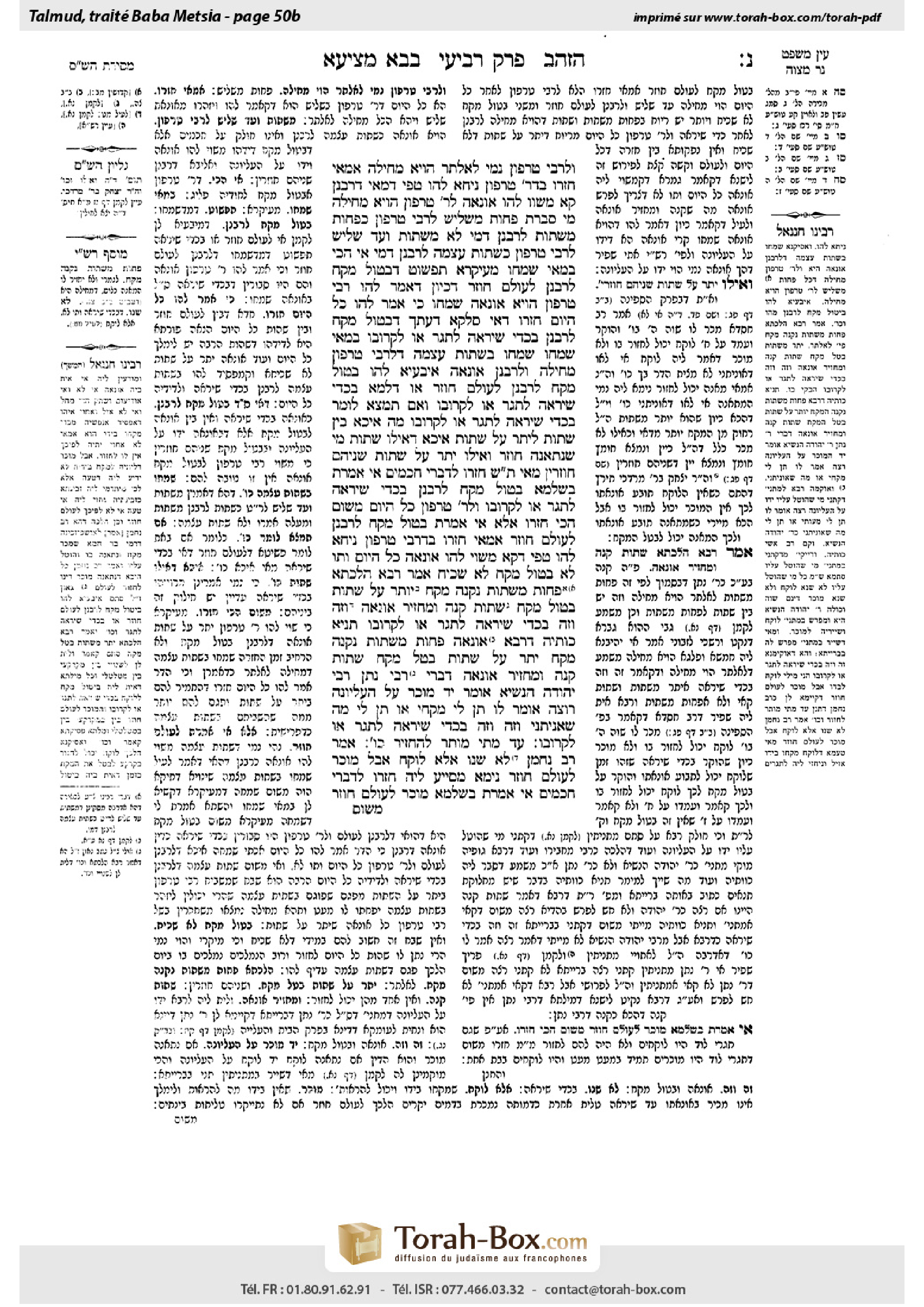
Bava Metzia 50b: Talmud study for Daf Yomi
Study the Talmud for Daf Yomi with scanned pages, Hebrew text, English translations from Sefaria and AI-generated French translations.
Passage selection and English or AI-generated French translation are available where the scan has annotations. Daf Study is independent of Torah-Box and Sefaria.
Browse Bava Metzia · בבא מציעא · All tractatesBava Metzia 50b text and translations
This page of Bava Metzia includes the Aramaic text, an English translation and an AI-generated French translation, alongside the scan above.
בבא מציעא נ׳ ב · Aramaic and Hebrew text
וּלְרַבִּי טַרְפוֹן נָמֵי לְאַלְתַּר הָוְיָא מְחִילָה, אַמַּאי חָזְרוּ? בִּדְרַבִּי טַרְפוֹן נִיחָא לְהוּ טְפֵי, דְּמַאי דְּרַבָּנַן קָא מְשַׁוֵּי לְהוּ אוֹנָאָה לְרַבִּי טַרְפוֹן הָוְיָא מְחִילָה?
מִי סָבְרַתְּ פָּחוֹת מִשְּׁלִישׁ לְרַבִּי טַרְפוֹן כְּפָחוֹת מִשְּׁתוּת לְרַבָּנַן דָּמֵי? לָא, מִשְּׁתוּת וְעַד שְׁלִישׁ לְרַבִּי טַרְפוֹן כִּשְׁתוּת עַצְמָהּ לְרַבָּנַן דָּמֵי. אִי הָכִי, בְּמַאי שָׂמְחוּ מֵעִיקָּרָא?
תִּפְשׁוֹט דְּבִטּוּל מִקָּח לְרַבָּנַן לְעוֹלָם חוֹזֵר, דְּכֵיוָן דַּאֲמַר לְהוּ רַבִּי טַרְפוֹן הָוְיָא אוֹנָאָה – שָׂמְחוּ, כִּי אֲמַר לְהוּ כׇּל הַיּוֹם – חָזְרוּ.
דְּאִי סָלְקָא דַעְתָּךְ דְּבִטּוּל מִקָּח לְרַבָּנַן בִּכְדֵי שֶׁיַּרְאֶה לַתַּגָּר אוֹ לִקְרוֹבוֹ, בְּמַאי שָׂמְחוּ? שָׂמְחוּ בְּשֶׁתּוּת עַצְמָהּ, דִּלְרַבִּי טַרְפוֹן מְחִילָה, וּלְרַבָּנַן אוֹנָאָה.
אִיבַּעְיָא לְהוּ: בִּטּוּל מִקָּח לְרַבָּנַן, לְעוֹלָם חוֹזֵר, אוֹ דִלְמָא בִּכְדֵי שֶׁיַּרְאֶה לַתַּגָּר אוֹ לִקְרוֹבוֹ? וְאִם תִּמְצָא לוֹמַר בִּכְדֵי שֶׁיַּרְאֶה לַתַּגָּר אוֹ לִקְרוֹבוֹ, מָה אִיכָּא בֵּין שְׁתוּת לְיָתֵר עַל שְׁתוּת? אִיכָּא: דְּאִילּוּ שְׁתוּת – מִי שֶׁנִּתְאַנָּה חוֹזֵר, וְאִילּוּ יָתֵר עַל שְׁתוּת – שְׁנֵיהֶם חוֹזְרִים.
מַאי? תָּא שְׁמַע, חָזְרוּ לְדִבְרֵי חֲכָמִים. אִי אָמְרַתְּ בִּשְׁלָמָא בִּטּוּל מִקָּח לְרַבָּנַן בִּכְדֵי שֶׁיַּרְאֶה לַתַּגָּר אוֹ לִקְרוֹבוֹ, וּלְרַבִּי טַרְפוֹן כׇּל הַיּוֹם – מִשּׁוּם הָכִי חָזְרוּ. אֶלָּא אִי אָמְרַתְּ בִּטּוּל מִקָּח לְרַבָּנַן לְעוֹלָם חוֹזֵר, אַמַּאי חָזְרוּ? בִּדְרַבִּי טַרְפוֹן נִיחָא לְהוּ טְפֵי, דְּקָא מְשַׁוֵּי לְהוּ אוֹנָאָה כׇּל הַיּוֹם וְתוּ לָא!
בִּטּוּל מִקָּח לָא שְׁכִיחַ.
אָמַר רָבָא, הִלְכְתָא: פָּחוֹת מִשְּׁתוּת – נִקְנֶה מִקָּח, יוֹתֵר עַל שְׁתוּת – בִּיטּוּל מִקָּח, שְׁתוּת – קָנָה וּמַחְזִיר אוֹנָאָה, וְזֶה וָזֶה – בִּכְדֵי שֶׁיַּרְאֶה לַתַּגָּר אוֹ לִקְרוֹבוֹ.
תַּנְיָא כְּווֹתֵיהּ דְּרָבָא: אוֹנָאָה פָּחוֹת מִשְּׁתוּת – נִקְנֶה מִקָּח. יָתֵר עַל שְׁתוּת – בָּטֵל מִקָּח. שְׁתוּת – קָנָה וּמַחְזִיר אוֹנָאָה, דִּבְרֵי רַבִּי נָתָן. רַבִּי יְהוּדָה הַנָּשִׂיא אוֹמֵר: יָד מוֹכֵר עַל הָעֶלְיוֹנָה, רוֹצֶה – אוֹמֵר לוֹ: ״תֵּן לִי מִקָּחִי״, אוֹ ״תֵּן לִי מַה שֶּׁאֹנֵיתַנִי״. וְזֶה וָזֶה בִּכְדֵי שֶׁיַּרְאֶה לַתַּגָּר אוֹ לִקְרוֹבוֹ.
עַד מָתַי מוּתָּר לְהַחֲזִיר כּוּ׳. אָמַר רַב נַחְמָן: לֹא שָׁנוּ אֶלָּא לוֹקֵחַ, אֲבָל מוֹכֵר – לְעוֹלָם חוֹזֵר. נֵימָא מְסַיַּיע לֵיהּ: חָזְרוּ לְדִבְרֵי חֲכָמִים. אִי אָמְרַתְּ בִּשְׁלָמָא מוֹכֵר לְעוֹלָם חוֹזֵר,
Bava Metzia 50b · English translation
and according to Rabbi Tarfon too, there is a waiver of the disparity of less than one-third and the transaction is finalized immediately, why did they revert to following the statement of the Rabbis? In that case, the ruling of Rabbi Tarfon would be preferable for them, as that which the Rabbis deem exploitation, i.e., a discrepancy of one-sixth, is waived according to Rabbi Tarfon.
The Gemara rejects this proof: Do you maintain that the legal status of a disparity of less than one-third according to the opinion of Rabbi Tarfon is like the legal status of a disparity of less than one-sixth according to the opinion of the Rabbis? No, the legal status of a disparity ranging from one-sixth until one-third according to the opinion of Rabbi Tarfon is like the legal status of a disparity of one-sixth itself according to the opinion of the Rabbis, and the exploited party receives the sum of the exploitation in return. The Gemara asks: If so, for what reason did the merchants of Lod rejoice initially? They gained nothing relative to the ruling of the Rabbis.
Resolve, based on this difficulty, the dilemma raised below, and conclude that in cases of nullification of the transaction according to the Rabbis, one may always renege on the transaction. Therefore, the reaction of the merchants of Lod is understandable, as, since Rabbi Tarfon said to them that a disparity between one-sixth and one-third is merely exploitation, they rejoiced, as this would mean that the buyer has only the time it takes to show the merchandise to a merchant or a relative to renege. When he said to them that the exploited person can renege on the transaction for the entire day, they reverted to following the statement of the Rabbis.
The Gemara explains why the dilemma is resolved: As, if it enters your mind to say that nullification of the transaction according to the Rabbis is limited to only within the time that it takes for the buyer to show the merchandise to a merchant or to his relative, for what reason did they rejoice over the ruling of Rabbi Tarfon? His ruling did not enable them to sell the merchandise at a higher price than the ruling of the Rabbis did. The Gemara rejects this proof: They initially rejoiced over the case of a disparity of one-sixth itself, as according to Rabbi Tarfon there is a waiver of the disparity, and according to the Rabbis it is exploitation.
§ The Gemara cites the dilemma referenced above. A dilemma was raised before the Sages: With regard to nullification of the transaction according to the Rabbis, may one always renege on the transaction? Or perhaps he can renege only within the time that it takes him to show the merchandise to a merchant or to his relative. And if you say that the transaction is nullified only within the time that it takes him to show the merchandise to a merchant or to his relative, what difference is there between a disparity of one-sixth and a disparity of greater than one-sixth? The Gemara answers: There is a difference, as in the case of a disparity of one-sixth, only the one who was exploited can renege on the transaction, while in the case where the disparity is greater than one-sixth, both can renege on the transaction.
The Gemara returns to discuss the dilemma: What is the halakha? The Gemara suggests: Come and hear a resolution of the dilemma from the mishna: The merchants of Lod reverted to following the statement of the Rabbis. Granted, if you say that one can claim nullification of the transaction according to the Rabbis only within the time that it takes the buyer to show the merchandise to a merchant or to his relative, and according to Rabbi Tarfon one can do so for the entire day, it is due to that reason that they reverted to following the statement of the Rabbis. But if you say that one can claim nullification of the transaction according to the Rabbis and always renege on the transaction, why did they revert to following the statement of the Rabbis? In that case, the ruling of Rabbi Tarfon is preferable for them, as he deems such a disparity exploitation and rules that one can claim nullification of the transaction for the entire day and no more, which is more beneficial to the merchant.
The Gemara answers: Nullification of the transaction is uncommon, and therefore the merchants of Lod did not take that into consideration when calculating which ruling was most advantageous.
The Gemara cites the halakhic resolutions of these dilemmas. Rava said: The halakha is that if the disparity is less than one-sixth, the merchandise is acquired immediately. If the disparity is greater than one-sixth, either party can demand nullification of the transaction. If the disparity is precisely one-sixth, the buyer has acquired the merchandise, and the one who benefited from the exploitation returns the sum gained by the exploitation. And one may claim both this, nullification of the transaction, and that, return of the sum gained, only within the time that it takes to show the merchandise to a merchant or to his relative.
The Gemara comments: It is taught in a baraita in accordance with the opinion of Rava: In cases of exploitation, if the disparity is less than one-sixth, the merchandise is acquired immediately. If the disparity is greater than one-sixth, the transaction is nullified. If the disparity is precisely one-sixth, the buyer has acquired the merchandise, and the one who benefited from the exploitation returns the sum gained by the exploitation. This is the statement of Rabbi Natan. Rabbi Yehuda HaNasi says: In a case where the seller was exploited, the seller is at an advantage. If he wishes, he reneges on the transaction and says to the buyer: Give me my merchandise, or he can say: Give me the sum that you gained by exploiting me. And one may claim both this, nullification of the transaction, and that, return of the sum gained, only within the time that it takes to show the merchandise to a merchant or to his relative.
§ The mishna teaches: Until when is it permitted for the buyer to return the item? He may return it only until a period of time has passed that would allow him to show the merchandise to a merchant or to his relative. Rav Naḥman says: The Sages taught this halakha only with regard to a buyer, but a seller may always renege on the transaction. The Gemara suggests: Let us say that the mishna supports his opinion, as the merchants of Lod reverted to following the statement of the Rabbis. Granted, if you say that a seller may always renege on a transaction,
Bava Metzia 50b · Traduction française (IA)
et selon Rabbi Tarphon également, il y a un abandon de la différence inférieure à un tiers et la transaction est finalisée immédiatement, pourquoi ont-ils réverti à suivre l'opinion des Sages ? Dans ce cas, la décision de Rabbi Tarphon serait préférable pour eux, car ce que les Sages considèrent comme une exploitation, c'est-à-dire une différence de sixième, est abandonné selon Rabbi Tarphon.
La Guemara rejette cette preuve : Voulez-vous dire que le statut juridique d'une différence inférieure à un tiers selon l'opinion de Rabbi Tarphon est comme le statut juridique d'une différence inférieure à un sixième selon l'opinion des Sages ? Non, le statut juridique d'une différence allant de un sixième jusqu'à un tiers selon l'opinion de Rabbi Tarphon est comme le statut juridique d'une différence de un sixième selon l'opinion des Sages, et la partie exploitée reçoit la somme de l'exploitation en retour. La Guemara demande : Si c'est ainsi, pourquoi les marchands de Lod se sont-ils réjouis initialement ? Ils n'ont rien gagné par rapport à la décision des Sages.
Résolvez, à partir de cette difficulté, le dilemme soulevé ci-dessous, et concluez que dans les cas de nullification de la transaction selon les Sages, on peut toujours révoquer la transaction. Ainsi, la réaction des marchands de Lod est compréhensible, car, puisque Rabbi Tarphon leur a dit qu'une différence entre un sixième et un tiers est simplement une exploitation, ils se sont réjouis, car cela signifierait que l'acheteur a seulement le temps qu'il faut pour montrer les marchandises à un marchand ou à un parent pour révoquer la transaction. Lorsqu'il a dit qu'à la personne exploitée il peut révoquer la transaction toute la journée, ils ont réverti à suivre l'opinion des Sages.
La Guemara explique pourquoi ce dilemme est résolu : Car, si l'on pense que la nullification de la transaction selon les Sages est limitée à seulement le temps qu'il faut pour que l'acheteur montre les marchandises à un marchand ou à son parent, pourquoi se sont-ils réjouis sur la décision de Rabbi Tarphon ? Sa décision ne leur permettait pas de vendre les marchandises à un prix supérieur à celui que la décision des Sages permettait. La Guemara rejette cette preuve : Ils se sont réjouis initialement sur le cas d'une différence de un sixième lui-même, car selon Rabbi Tarphon il y a un abandon de la différence, et selon les Sages c'est une exploitation.
§ La Guemara cite le dilemme mentionné ci-dessus. Un dilemme a été soulevé devant les Sages : Concernant la nullification de la transaction selon les Sages, peut-on toujours révoquer la transaction ? Ou peut-on révoquer la transaction uniquement pendant le temps qu'il faut pour que l'acheteur montre les marchandises à un marchand ou à son parent. Et si vous dites que la transaction est nullifiée uniquement pendant le temps qu'il faut pour que l'acheteur montre les marchandises à un marchand ou à son parent, quelle différence y a-t-il entre une différence de un sixième et une différence supérieure à un sixième ? La Guemara répond : Il y a une différence, car dans le cas d'une différence de un sixième, seul celui qui a été exploité peut révoquer la transaction, tandis que dans le cas où la différence est supérieure à un sixième, les deux peuvent révoquer la transaction.
La Guemara reprend la discussion sur ce dilemme : Quelle est la halakha ? La Guemara suggère : Venez écouter une résolution de ce dilemme à partir de la mitsna : Les marchands de Lod ont retourné à suivre l'opinion des Sages. Admettons, si vous dites que l'on peut réclamer la nullification de la transaction selon les Sages uniquement pendant le temps qu'il faut à l'acheteur pour montrer les marchandises à un marchand ou à son parent, et selon Rabbi Tarfon l'on peut le faire toute la journée, c'est pour cette raison qu'ils ont retourné à suivre l'opinion des Sages. Mais si vous dites que l'on peut réclamer la nullification de la transaction selon les Sages et toujours révoquer la transaction, pourquoi ont-ils retourné à suivre l'opinion des Sages ? Dans ce cas, la décision de Rabbi Tarfon serait préférable pour eux, car il considère que telle différence est une exploitation et règle que l'on peut réclamer la nullification de la transaction toute la journée et pas plus, ce qui est plus avantageux pour le marchand.
La Guemara répond : La nullification de la transaction est rare, et donc les marchands de Lod n'ont pas pris cela en compte lorsqu'ils calculaient quelle décision était la plus avantageuse.
La Guemara cite les résolutions halakhiques de ces dilemmes. Rava a dit : La halakha est que si la différence est inférieure à un sixième, les marchandises sont acquises immédiatement. Si la différence est supérieure à un sixième, n'importe quelle partie peut demander la nullification de la transaction. Si la différence est exactement un sixième, l'acheteur a acquis les marchandises, et celui qui a bénéficié de l'exploitation rend la somme gagnée par l'exploitation. Et l'on peut réclamer à la fois cette nullification de la transaction et cela, le retour de la somme gagnée, uniquement pendant le temps qu'il faut pour montrer les marchandises à un marchand ou à son parent.
La Guemara commente : Il est enseigné dans une baraïta selon l'opinion de Rava : Dans les cas d'exploitation, si la différence est inférieure à un sixième, les marchandises sont acquises immédiatement. Si la différence est supérieure à un sixième, la transaction est nullifiée. Si la différence est exactement un sixième, l'acheteur a acquis les marchandises, et celui qui a bénéficié de l'exploitation rend la somme gagnée par l'exploitation. C'est la déclaration de Rabbi Natan. Rabbi Yéhouda HaNasi dit : Dans un cas où le vendeur a été exploité, le vendeur est avantageux. S'il le souhaite, il révoque la transaction et dit à l'acheteur : Donnez-moi mes marchandises, ou il peut dire : Donnez-moi la somme que vous avez gagnée en m'exploitant. Et l'on peut réclamer à la fois cette nullification de la transaction et cela, le retour de la somme gagnée, uniquement pendant le temps qu'il faut pour montrer les marchandises à un marchand ou à son parent.
§ La mitsva enseigne : jusqu'à quand est-il permis à l'acheteur de rendre l'objet ? Il peut le rendre uniquement jusqu'à un délai suffisant pour qu'il puisse présenter l'objet à un marchand ou à son parent. Rav Naḥman dit : les Sages ont enseigné cette halakha uniquement concernant un acheteur, mais un vendeur peut toujours annuler la transaction. La Guemara suggère : disons que la mitsva soutient son opinion, car les marchands de Lod ont repris la déclaration des Rabbins. En effet, si vous dites qu'un vendeur peut toujours annuler une transaction,
Traduction française générée par IA à partir de l’édition anglaise de Sefaria. Vérifie toujours un passage avec le texte source.
Text from Sefaria: William Davidson Edition - Vocalized Aramaic (CC BY NC); William Davidson Edition - English (CC BY NC).