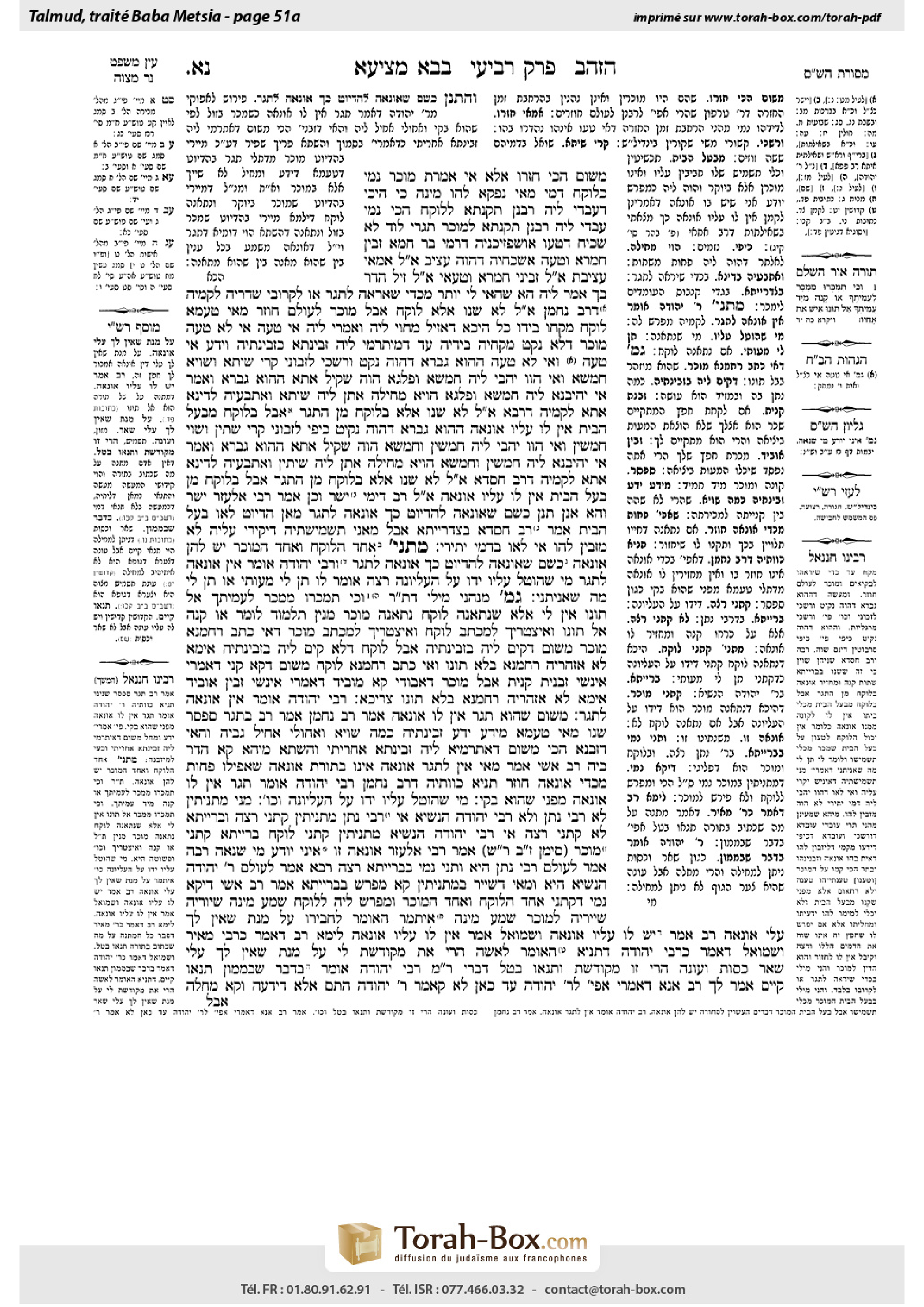
Bava Metzia 51a: Talmud study for Daf Yomi
Study the Talmud for Daf Yomi with scanned pages, Hebrew text, English translations from Sefaria and AI-generated French translations.
Passage selection and English or AI-generated French translation are available where the scan has annotations. Daf Study is independent of Torah-Box and Sefaria.
Browse Bava Metzia · בבא מציעא · All tractatesBava Metzia 51a text and translations
This page of Bava Metzia includes the Aramaic text, an English translation and an AI-generated French translation, alongside the scan above.
בבא מציעא נ״א א · Aramaic and Hebrew text
מִשּׁוּם הָכִי חָזְרוּ.
אֶלָּא אִי אָמְרַתְּ מוֹכֵר נָמֵי כְּלוֹקֵחַ דָּמֵי, מַאי נָפְקָא לְהוּ מִינַּהּ? כִּי הֵיכִי דְּעָבְדִי לַיהּ רַבָּנַן תַּקַּנְתָּא לְלוֹקֵחַ, הָכִי נָמֵי עָבְדִי לַיהּ רַבָּנַן תַּקַּנְתָּא לְמוֹכֵר!
תַּגָּרֵי לוֹד לָא שְׁכִיחַ דְּטָעוּ.
אוּשְׁפִּיזְכָנֵיהּ דְּרָמֵי בַּר חָמָא זַבֵּין חֲמָרָא וּטְעָה. אַשְׁכְּחֵיהּ דַּהֲוָה עֲצִיב, אֲמַר לֵיהּ: אַמַּאי עֲצִיבַתְּ? אֲמַר לֵיהּ: זַבֵּינִי חֲמָרָא וּטְעַאי. אֲמַר לֵיהּ: זִיל הֲדַר בָּךְ. אָמַר לֵיהּ: הָא שְׁהַאי לִי יוֹתֵר מִכְּדֵי שֶׁאַרְאֶה לַתַּגָּר אוֹ לִקְרוֹבִי! שַׁדְּרֵיהּ לְקַמֵּיהּ דְּרַב נַחְמָן, אֲמַר לֵיהּ לֹא שָׁנוּ אֶלָּא לוֹקֵחַ, אֲבָל מוֹכֵר – לְעוֹלָם חוֹזֵר.
מַאי טַעְמָא? לוֹקֵחַ מִקָּחוֹ בְּיָדוֹ, כֹּל הֵיכָא דְּאָזֵיל מַחְוִי לֵיהּ וְאָמְרִי לֵיהּ אִי טְעָה, אִי לָא טְעָה. מוֹכֵר דְּלָא נָקֵט מִקָּחֵיהּ בִּידֵיהּ עַד דְּמִיתְרְמֵי לֵיהּ זְבִינְתָּא כִּזְבִינְתֵּיהּ, וְיָדַע אִי טְעָה וְאִי לָא טְעָה.
הָהוּא גַּבְרָא דַּהֲוָה נָקֵט וַרְשְׁכֵי לְזַבּוֹנֵי, קָרֵי שִׁיתָּא וְשָׁוְיָא חַמְשָׁא, וְאִי הֲווֹ יָהֲבִי לֵיהּ חַמְשָׁא וּפַלְגָא הֲוָה שָׁקֵיל. אֲתָא הָהוּא גַּבְרָא וְאָמַר: אִי יָהֵיבְנָא לֵיהּ חַמְשָׁא וּפַלְגָא הָוְיָא מְחִילָה. אֶתֵּן לֵיהּ שִׁיתָּא וְאֶתְבְּעֵיהּ לְדִינָא. אֲתָא לְקַמֵּיהּ דְּרָבָא, אֲמַר לֵיהּ: לֹא שָׁנוּ אֶלָּא בְּלוֹקֵחַ מִן הַתַּגָּר, אֲבָל בְּלוֹקֵחַ מִבַּעַל הַבַּיִת – אֵין לוֹ עָלָיו אוֹנָאָה.
הָהוּא גַּבְרָא דַּהֲוָה נָקֵיט כִּיפֵּי לְזַבּוֹנֵי קָרֵי שִׁתִּין וְשָׁוֵי חַמְשִׁין, וְאִי הֲווֹ יָהֲבִי לֵיהּ חַמְשִׁין וְחַמְשָׁא הֲוָה שָׁקֵיל. אֲתָא הָהוּא גַּבְרָא וְאָמַר: אִי יָהֵיבְנָא לֵיהּ חַמְשִׁין וְחַמְשָׁא הָוְיָא מְחִילָה, אֶתֵּן לֵיהּ שִׁיתִּין וְאֶתְבְּעֵיהּ לְדִינָא. אֲתָא לְקַמֵּיהּ דְּרַב חִסְדָּא. אֲמַר לֵיהּ: לֹא שָׁנוּ אֶלָּא בְּלוֹקֵחַ מִן הַתַּגָּר, אֲבָל בְּלוֹקֵחַ מִן בַּעַל הַבַּיִת – אֵין לוֹ עָלָיו אוֹנָאָה.
אֲמַר לֵיהּ רַב דִּימִי: יִשַׁר. וְכֵן אָמַר רַבִּי אֶלְעָזָר: יִשַׁר. וְהָא אֲנַן תְּנַן: כְּשֵׁם שֶׁאוֹנָאָה לְהֶדְיוֹט כָּךְ אוֹנָאָה לַתַּגָּר. מַאן הֶדְיוֹט, לָאו בַּעַל הַבַּיִת? אָמַר רַב חִסְדָּא: בְּצַדְרְיָיתָא. אֲבָל מָאנֵי תַשְׁמִישְׁתֵּיהּ, דְּיַקִּירִי עֲלֵיהּ, לָא מְזַבֵּין לְהוּ אִי לָאו בִּדְמֵי יַתִּירֵי.
מַתְנִי׳ אֶחָד הַלּוֹקֵחַ וְאֶחָד הַמּוֹכֵר יֵשׁ לָהֶן אוֹנָאָה. כְּשֵׁם שֶׁאוֹנָאָה לַהֶדְיוֹט כָּךְ אוֹנָאָה לַתַּגָּר. רַבִּי יְהוּדָה אוֹמֵר: אֵין אוֹנָאָה לַתַּגָּר. מִי שֶׁהוּטַּל עָלָיו – יָדוֹ עַל הָעֶלְיוֹנָה, רָצָה אוֹמֵר לוֹ: תֵּן לִי מְעוֹתַי, אוֹ תֵּן לִי מַה שֶּׁאֹנֵיתַנִי.
גְּמָ׳ מְנָהָנֵי מִילֵּי? דְּתָנוּ רַבָּנַן: ״וְכִי תִמְכְּרוּ מִמְכָּר לַעֲמִיתֶךָ ... אַל תּוֹנוּ״ – אֵין לִי אֶלָּא שֶׁנִּתְאַנָּה לוֹקֵחַ, נִתְאַנָּה מוֹכֵר מִנַּיִן? תַּלְמוּד לוֹמַר: ״אוֹ קָנֹה ... אַל תּוֹנוּ״.
וְאִיצְטְרִיךְ לְמִכְתַּב לוֹקֵחַ וְאִיצְטְרִיךְ לְמִכְתַּב מוֹכֵר, דְּאִי כְּתַב רַחֲמָנָא מוֹכֵר – מִשּׁוּם דְּקִים לֵיהּ בִּזְבִינְתֵּיהּ, אֲבָל לוֹקֵחַ – דְּלָא קִים לֵיהּ בִּזְבִינְתֵּיהּ, אֵימָא לָא אַזְהֲרֵיהּ רַחֲמָנָא בְּ״לֹא תּוֹנוּ״.
וְאִי כְּתַב רַחֲמָנָא לוֹקֵחַ – מִשּׁוּם דְּקָא קָנֵי, דְּאָמְרִי אִינָשֵׁי: זְבַנְתְּ קְנֵית. אֲבָל מוֹכֵר דְּאֹבוֹדֵי קָא מוֹבֵיד, דְּאָמְרִי אִינָשֵׁי: זַבֵּין אוֹבֵיד, אֵימָא לָא אַזְהֲרֵיהּ רַחֲמָנָא בְּ״לֹא תּוֹנוּ״, צְרִיכָא.
רַבִּי יְהוּדָה אוֹמֵר: אֵין אוֹנָאָה לַתַּגָּר. מִשּׁוּם שֶׁהוּא תַּגָּר אֵין לוֹ אוֹנָאָה?!
אָמַר רַב נַחְמָן אָמַר רַב: בְּתַגָּר סַפְסָר שָׁנוּ. מַאי טַעְמָא – מִידָּע יָדַע זְבִינְתֵּיהּ כַּמָּה שָׁוְיָא, וְאַחוֹלֵי אַחֵיל גַּבֵּיהּ. וְהַאי דְּזַבְּנַהּ הָכִי – מִשּׁוּם דְּאִתְרַמְיָא לֵיהּ זְבִינְתָּא אַחֲרִיתִי.
וְהַשְׁתָּא מִיהָא קָא הָדַר בֵּיהּ! רַב אָשֵׁי אָמַר: מַאי אֵין לַתַּגָּר אוֹנָאָה – אֵינוֹ בְּתוֹרַת אוֹנָאָה, שֶׁאֲפִילּוּ פָּחוֹת מִכְּדֵי אוֹנָאָה חוֹזֵר. תַּנְיָא כְּווֹתֵיהּ דְּרַב נַחְמָן: רַבִּי יְהוּדָה אוֹמֵר, תַּגָּר אֵין לוֹ אוֹנָאָה, מִפְּנֵי שֶׁהוּא בָּקִי.
מִי שֶׁהוּטַּל עָלָיו יָדוֹ עַל הָעֶלְיוֹנָה וְכוּ׳. מַנִּי מַתְנִיתִין? לָא רַבִּי נָתָן וְלָא רַבִּי יְהוּדָה הַנָּשִׂיא.
אִי רַבִּי נָתָן – מַתְנִיתִין קָתָנֵי ״רָצָה״, וּבָרַיְיתָא לָא קָתָנֵי ״רָצָה״. אִי רַבִּי יְהוּדָה הַנָּשִׂיא – מַתְנִיתִין קָתָנֵי ״לוֹקֵחַ״, בָּרַיְיתָא קָתָנֵי ״מוֹכֵר״.
(סִימָן זָב רָשׁ)
אָמַר רַבִּי אֶלְעָזָר: אוֹנָאָה זוֹ אֵינִי יוֹדֵעַ מִי שְׁנָאָהּ. רַבָּה אָמַר: לְעוֹלָם רַבִּי נָתָן הִיא, וּתְנִי נָמֵי בְּבָרַיְיתָא ״רָצָה״. רָבָא אָמַר: לְעוֹלָם רַבִּי יְהוּדָה הַנָּשִׂיא הִיא, וּמַאי דְּשַׁיַּיר בְּמַתְנִיתִין קָא מְפָרֵישׁ בְּבָרַיְיתָא. אָמַר רַב אָשֵׁי: דַּיְקָא נָמֵי, דְּקָתָנֵי ״אֶחָד הַלּוֹקֵחַ וְאֶחָד הַמּוֹכֵר״, וּמְפָרֵשׁ לֵיהּ לְלוֹקֵחַ, שְׁמַע מִינַּהּ שַׁיּוֹרֵיה שַׁיְּירֵיהּ לְמוֹכֵר. שְׁמַע מִינַּהּ.
אִיתְּמַר: הָאוֹמֵר לַחֲבֵירוֹ עַל מְנָת שֶׁאֵין לְךָ עָלַי אוֹנָאָה. רַב אָמַר: יֵשׁ לוֹ עָלָיו אוֹנָאָה. וּשְׁמוּאֵל אָמַר: אֵין לוֹ עָלָיו אוֹנָאָה. לֵימָא רַב דְּאָמַר כְּרַבִּי מֵאִיר, וּשְׁמוּאֵל דְּאָמַר כְּרַבִּי יְהוּדָה.
דְּתַנְיָא: הָאוֹמֵר לְאִשָּׁה הֲרֵי אַתְּ מְקוּדֶּשֶׁת לִי עַל מְנָת שֶׁאֵין לְךָ עָלַי שְׁאֵר כְּסוּת וְעוֹנָה – הֲרֵי זוֹ מְקוּדֶּשֶׁת, וּתְנָאוֹ בָּטֵל, דִּבְרֵי רַבִּי מֵאִיר. רַבִּי יְהוּדָה אוֹמֵר: בְּדָבָר שֶׁבְּמָמוֹן – תְּנָאוֹ קַיָּים.
אָמַר לְךָ רַב: אֲנָא דַּאֲמַרִי אֲפִילּוּ לְרַבִּי יְהוּדָה – עַד כָּאן לָא קָאָמַר רַבִּי יְהוּדָה הָתָם, אֶלָּא דְּיָדְעָה וְקָא מָחֲלָה,
Bava Metzia 51a · English translation
it is due to this reason that they reverted to following the statement of the Rabbis, as the sellers were in any event able to renege at any point, while Rabbi Tarfon extended the period during which the buyers could renege on the transaction.
But if you say that the legal status of a seller is also limited like that of a buyer in terms of the period of time during which he may renege, what difference is there to the merchants? Just as the Sages instituted an ordinance on behalf of a buyer enabling him to renege on the transaction, so too, the Sages instituted an ordinance on behalf of a seller. If the time afforded to the seller is equal to the time afforded to the buyer, the fact that Rabbi Tarfon extended this time would not be a reason for the merchants to revert to following the opinion of the Rabbis, as there is a benefit and a loss for the merchants according to both opinions.
The Gemara answers: With regard to the merchants of Lod, it is rare for them to err, and therefore they preferred limiting the period during which the buyer could renege over extending the period during which they themselves could renege.
The Gemara relates: The landlord of Rami bar Ḥama sold a donkey and erred in fixing its price. Rami bar Ḥama encountered him and noticed that he was sad. Rami bar Ḥama said to him: Why are you sad? The landlord said to him: I sold a donkey and I erred in fixing its price. Rami bar Ḥama said to him: Go and renege on the transaction. The landlord said to him: I have waited more than the period of time that it takes for me to show the merchandise to a merchant or to my relative. Rami bar Ḥama sent the landlord before Rav Naḥman for a ruling and Rav Naḥman said to him: The Sages taught this halakha only with regard to a buyer, but a seller may always renege on a transaction.
The Gemara asks: What is the reason for this? The Gemara explains: A buyer has his merchandise in his possession; therefore, anywhere that he goes he shows it to those familiar with the market price and they tell him whether he erred or whether he did not err. A seller, who does not have his merchandise in his possession, can ascertain the market price only when merchandise like his merchandise happens to come before him, and only then will he know whether he erred or whether he did not err.
§ The Gemara relates: There was a certain man who had silk strips [varshekhei] to sell. He announced that he was selling them for six ma’a, and they were worth five ma’a, and if they would give him five and a half ma’a, he would take it and sell the silk. This man, i.e., a potential buyer, came and said to himself: If I give him five and a half ma’a, it is a case of a waiver, and I will not be entitled to recover the difference. I will give him six ma’a and claim from him by law the return of the sum gained by the exploitation. He did so. The case came before Rava, who said to him: The Sages taught this halakha of exploitation only with regard to one who buys merchandise from a merchant, but one who buys merchandise from a regular homeowner does not have a claim of exploitation against him.
The Gemara relates a similar incident: There was a certain man who was holding jewelry to sell. He announced that he was selling it for sixty ma’a, and it was worth fifty ma’a, and if they would give him fifty-five ma’a, he would take it and sell the jewels. This man, i.e., a potential buyer, came and said to himself: If I give him fifty-five ma’a, it is a case of a waiver, and I will not be entitled to recover the difference. I will give him sixty ma’a and claim from him by law the return of the sum gained by the exploitation. He did so. The case came before Rav Ḥisda, who said to him: The Sages taught this halakha of exploitation only with regard to one who buys merchandise from a merchant, but one who buys merchandise from a regular homeowner does not have a claim of exploitation against him.
Rav Dimi said to Rav Ḥisda: The ruling is correct. And likewise, Rabbi Elazar said: The ruling is correct. The Gemara asks: But didn’t we learn in the mishna that follows: Just as the halakhot of exploitation apply to a layman [lahedyot], so do the halakhot of exploitation apply to a merchant? Who is the layman to whom the mishna is referring? Is he not a regular homeowner as opposed to a merchant? Rav Ḥisda said: That mishna is referring to simple linen garments [tzadriyyata], which the homeowner crafts expressly for sale. But with regard to vessels and garments designed for the personal use of a homeowner, which are important to him, he sells them only to receive extra money, as people are generally hesitant to part with their belongings. Therefore, when purchasing an item from a homeowner, a buyer must consider the likelihood that his asking price is greater than the item’s actual worth.
MISHNA: Both the buyer and the seller are subject to the halakhot of exploitation. Just as the halakhot of exploitation apply to a layman, so do the halakhot of exploitation apply to a merchant. Rabbi Yehuda says: There is no exploitation for a merchant, as he is an expert in the market price of merchandise. The one upon whom the exploitation was imposed has the advantage. If he wishes, he can say to the other: Give me back my money and nullify the transaction, or he can say: Give me back the sum that you gained by exploiting me.
GEMARA: The Gemara asks: From where are these matters derived, that both the buyer and the seller are subject to the halakha of exploitation? As the Sages taught concerning the verse: “And if you sell to your colleague an item that is sold, or acquire from your colleague’s hand, you shall not exploit his brother” (Leviticus 25:14). I have derived only a case where a buyer was exploited. From where do I derive that the halakha is the same in a case where the seller was exploited? The same verse states: “Or acquire from your colleague’s hand, you shall not exploit his brother.”
The Gemara comments: And it was necessary to write the prohibition against exploitation with regard to a buyer, and it was necessary to write the prohibition against exploitation with regard to a seller. As, had the Merciful One written this prohibition only with regard to a seller, one would conclude that it is prohibited for him because he is certain of the value of his merchandise, but with regard to a buyer, who is not certain of the value of the seller’s merchandise, say that the Merciful One did not render it prohibited for him to engage in exploitation with the verse “You shall not exploit.”
And had the Merciful One written this prohibition only with regard to a buyer, one would conclude that it is prohibited for him because he acquires the item and he benefits from his purchase, as people say: If you purchased an item, you acquired a durable item for yourself. But with regard to a seller, who loses from the sale, as people say: One who sells an item loses, say that the Merciful One did not render it prohibited for him to engage in exploitation with the verse “You shall not exploit.” Therefore, it was necessary for the Torah to write this prohibition with regard to both parties to the transaction.
§ The mishna teaches that Rabbi Yehuda says: There is no exploitation for a merchant. The Gemara expresses surprise at this statement: Due to the fact that he is a merchant, he is not subject to the halakhot of exploitation? Anyone could arrive at a mistaken assessment of the value of merchandise.
Rav Naḥman says that Rav says: It is with regard to a merchant who is a trader, who buys and sells merchandise, that they taught the halakha. What is the reason that he is not subject to the halakhot of exploitation according to Rabbi Yehuda? He knows how much his merchandise is worth, and he waives the sum of the disparity between the value and the price for the buyer. And the reason why he sells the merchandise in that manner, knowing that he is selling it for less than its value, is due to the fact that other merchandise happens to become available to him and he needs the money to purchase that item.
The Gemara asks: But now, in any event, he retracts from the transaction, indicating that he did not waive the sum of the disparity. Rav Ashi said: What is the meaning of: There is no exploitation for a merchant? He is not subject to the principles of exploitation at all, as even if the disparity is less than the measure of exploitation, i.e., less than one-sixth, he may renege on the transaction. Since his entire livelihood is based on the slight profit margin that he earns from each transaction, he does not waive even that sum. The Gemara comments: It is taught in a baraita in accordance with the opinion of Rav Naḥman: Rabbi Yehuda says: There is no exploitation for a merchant, because he is expert in these matters.
§ The mishna teaches: The one upon whom the exploitation was imposed has the advantage. If he wishes, he can say to the other: Give me back my money and nullify the transaction, or he can say: Give me back the sum that you gained by exploiting me. The Gemara asks: Whose opinion is expressed in the mishna? It is neither the opinion of Rabbi Natan nor the opinion of Rabbi Yehuda HaNasi.
The Gemara explains: If it is the opinion of Rabbi Natan, in the mishna the tanna teaches: If he wishes, he can say: Give me back my money and nullify the transaction, or he can say: Give me back the sum that you gained by exploiting me. And in the baraita (50b) Rabbi Natan does not teach: If he wishes, indicating that the transaction takes effect regardless of his wishes. And if it is the opinion of Rabbi Yehuda HaNasi, in the mishna the tanna teaches the halakha with regard to the buyer, and in the baraita Rabbi Yehuda HaNasi teaches: In a case where the seller was exploited, the seller is at an advantage, apparently to the exclusion of the buyer.
The Gemara presents a mnemonic device for the Sages who discussed this difficulty: Zayin, referring to Rabbi Elazar; beit, referring to Rabba; reish, referring to Rava; shin, referring to Rav Ashi.
Rabbi Elazar says: Concerning this halakha of exploitation in the mishna, I do not know who taught it, as it does not correspond to the opinion of any of the Sages. Rabba said: Actually, the mishna is the opinion of Rabbi Natan, and emend and teach that Rabbi Natan stated in the baraita as well: If he wishes. Rava said: Actually, the mishna is the opinion of Rabbi Yehuda HaNasi, and the ruling that Rabbi Yehuda HaNasi omits in the mishna he explicates in the baraita. The mishna and the baraita are complementary. Rav Ashi said: The language of the mishna is also precise, as the tanna teaches: Both the buyer and the seller, and then he proceeds to elucidate the halakha of the buyer. Learn from it that the tanna indeed omitted the halakha of the seller, but he did not exclude the seller from the halakha. The Gemara affirms: Learn from it that this is the case.
§ It was stated that there is a dispute among amora’im. With regard to one who says to another: I will be party to this sale on the condition that you have no claim of exploitation against me, even if you are exploited, Rav says: The exploited party has a claim of exploitation against him, and Shmuel says: He does not have a claim of exploitation against him. The Gemara suggests: Let us say that Rav stated his opinion in accordance with the opinion of Rabbi Meir, and Shmuel stated his opinion in accordance with the opinion of Rabbi Yehuda.
This is as it is taught in a baraita: With regard to one who says to a woman: You are hereby betrothed to me on the condition that you do not have a claim against me for food, clothing, and conjugal rights that a husband is obligated to provide his wife by Torah law, she is betrothed to him and his condition is void; this is the statement of Rabbi Meir, who maintains that a person cannot stipulate a condition that negates obligations by Torah law. And Rabbi Yehuda says: In monetary matters, as opposed to personal obligations, one’s condition is in effect.
The Gemara refutes this parallel. Rav could have said to you: I stated my opinion even in accordance with the opinion of Rabbi Yehuda, as Rabbi Yehuda states his opinion that a stipulation is valid in monetary matters only there, where a woman knows that she is entitled to food and clothing but waives her rights to them.
Bava Metzia 51a · Traduction française (IA)
C'est pour cette raison qu'ils ont retourné à suivre l'opinion des Rabbins, car les vendeurs pouvaient en tout cas toujours annuler la transaction à tout moment, tandis que Rabbi Tarfon a prolongé la période pendant laquelle les acheteurs pouvaient annuler la transaction.
Mais si vous dites que le statut juridique du vendeur est également limité comme celui de l'acheteur en termes de la période pendant laquelle il peut annuler la transaction, quelle différence cela fait-il aux marchands ? Tout comme les Sages ont institué un ordonnance au profit de l'acheteur lui permettant d'annuler la transaction, de même les Sages ont institué un ordonnance au profit du vendeur. Si la période accordée au vendeur est égale à celle accordée à l'acheteur, le fait que Rabbi Tarfon ait prolongé cette période ne serait pas une raison pour que les marchands retournent à suivre l'opinion des Rabbins, car il y a un bénéfice et une perte pour les marchands selon les deux opinions.
La Guemara répond : Concernant les marchands de Lod, il est rare qu'ils commettent une erreur, et par conséquent ils ont préféré limiter la période pendant laquelle l'acheteur pouvait annuler la transaction plutôt que prolonger la période pendant laquelle ils eux-mêmes pouvaient annuler la transaction.
La Guemara rapporte : Le propriétaire de Rami bar Ḥama a vendu un âne et avait commis une erreur dans le prix. Rami bar Ḥama l'a rencontré et a remarqué qu'il était triste. Rami bar Ḥama lui a dit : Pourquoi es-tu triste ? Le propriétaire lui a répondu : J'ai vendu un âne et j'ai commis une erreur dans le prix. Rami bar Ḥama lui a dit : Va annuler la transaction. Le propriétaire lui a répondu : J'ai attendu plus longtemps que la période nécessaire pour montrer les marchandises à un marchand ou à mon parent. Rami bar Ḥama a envoyé le propriétaire devant Rav Naḥman pour obtenir un avis, et Rav Naḥman lui a dit : Les Sages ont enseigné cette halakha uniquement concernant un acheteur, mais un vendeur peut toujours annuler une transaction.
La Guemara pose la question : Quelle est la raison de cela ? La Guemara explique : L'acheteur a les marchandises en sa possession ; par conséquent, partout qu'il va, il montre à ceux qui connaissent le prix du marché et ils lui disent s'il a commis une erreur ou non. Le vendeur, qui ne possède pas ses marchandises, peut seulement déterminer le prix du marché lorsque des marchandises semblables à ses marchandises lui sont présentées, et seulement alors saura-t-il s'il a commis une erreur ou non.
§ La Guemara relate : Il y avait un certain homme qui avait des bandes de soie [varshekhei] à vendre. Il annonça qu'il les vendait pour six ma’a, et qu'elles valaient cinq ma’a, et s'il recevait cinq et demi ma’a, il les prendrait et les vendrait. Cet homme, c'est-à-dire un acheteur potentiel, vint et se dit : Si je lui donne cinq et demi ma’a, c'est un cas de renonciation, et je ne serai pas autorisé à récupérer la différence. Je lui donnerai six ma’a et revendiquerais par la loi le remboursement de la somme gagnée par l'exploitation. Il fit ainsi. Le cas vint devant Rava, qui lui dit : Les Sages ont enseigné cette halakha de l'exploitation uniquement concernant celui qui achète des marchandises à un marchand, mais celui qui achète des marchandises à un propriétaire ordinaire n'a pas de revendication d'exploitation contre lui.
La Guemara relate un incident similaire : Il y avait un certain homme qui tenait des bijoux à vendre. Il annonça qu'il les vendait pour soixante ma’a, et qu'ils valaient cinquante ma’a, et s'ils lui donnaient cinquante-cinq ma’a, il les prendrait et les vendrait. Cet homme, c'est-à-dire un acheteur potentiel, vint et se dit : Si je lui donne cinquante-cinq ma’a, c'est un cas de renonciation, et je ne serai pas autorisé à récupérer la différence. Je lui donnerai soixante ma’a et revendiquerais par la loi le remboursement de la somme gagnée par l'exploitation. Il fit ainsi. Le cas vint devant Rav Ḥisda, qui lui dit : Les Sages ont enseigné cette halakha de l'exploitation uniquement concernant celui qui achète des marchandises à un marchand, mais celui qui achète des marchandises à un propriétaire ordinaire n'a pas de revendication d'exploitation contre lui.
Rav Dimi a dit à Rav Ḥisda : Le jugement est correct. Et de même, Rabbi Elazar a dit : Le jugement est correct. La Guemara pose la question : Mais n'avons-nous pas appris dans la mishna suivante : Comme les halakhot de l'exploitation s'appliquent à un laïc [lahedyot], ainsi les halakhot de l'exploitation s'appliquent à un marchand ? De qui est-ce que la mishna parle ? N'est-ce pas un laïc, c'est-à-dire un propriétaire ordinaire, en opposition à un marchand ? Rav Ḥisda a dit : Cette mishna parle de vêtements simples [tzadriyyata], que le propriétaire confectionne expressément pour la vente. Mais concernant les objets et les vêtements destinés à l'usage personnel du propriétaire, qui sont importants pour lui, il les vend seulement pour recevoir de l'argent supplémentaire, car les gens sont généralement réticents à se séparer de leurs biens. Par conséquent, lorsqu'on achète un objet à un propriétaire, l'acheteur doit considérer la probabilité que son prix demandé soit supérieur à la valeur réelle de l'objet.
MICHNA : À la fois l'acheteur et le vendeur sont soumis aux halakhot de l'exploitation. Comme les halakhot de l'exploitation s'appliquent à un laïc, ainsi les halakhot de l'exploitation s'appliquent à un marchand. Rabbi Yehuda dit : Il n'y a pas d'exploitation pour un marchand, car il est expert dans le prix du marché des marchandises. Celui à qui l'exploitation a été imposée a l'avantage. S'il le souhaite, il peut dire à l'autre : Rends-moi mon argent et annule la transaction, ou il peut dire : Rends-moi la somme que tu as gagnée en m'exploitant.
GUEMARA : La Guemara pose la question : D'où ces enseignements sont-ils dérivés, que tant l'acheteur que le vendeur sont soumis à la halakha de l'exploitation ? Comme les Sages ont enseigné concernant la parole : « Et si tu vends à ton frère un objet qui est vendu, ou si tu achètes de la main de ton frère, tu ne devras pas exploiter ton frère » (Lévitique 25:14). J'ai dérivé uniquement le cas où l'acheteur a été exploité. D'où dérive-t-on que la halakha est la même dans le cas où le vendeur a été exploité ? La même parole dit : « Ou si tu achètes de la main de ton frère, tu ne devras pas exploiter ton frère. »
La Guemara commente : Il était nécessaire d’écrire la prohibition contre l’exploitation concernant l’acheteur, et il était nécessaire d’écrire la prohibition contre l’exploitation concernant le vendeur. Car, si le Merciieux avait seulement écrit cette prohibition concernant le vendeur, on en conclurait qu’il est interdit à lui, car il est certain de la valeur de ses marchandises, mais concernant l’acheteur, qui n’est pas certain de la valeur des marchandises du vendeur, on dirait que le Merciieux n’a pas rendu cette action interdite à lui avec la phrase « Tu ne devras pas exploiter ».
Et si le Merciieux avait seulement écrit cette prohibition concernant l’acheteur, on en conclurait qu’il est interdit à lui, car il acquiert l’objet et il en tire avantage, comme on dit : Si tu as acheté un objet, tu as acquis un objet durable pour toi-même. Mais concernant le vendeur, qui perd de la vente, comme on dit : Celui qui vend un objet perd, on dirait que le Merciieux n’a pas rendu cette action interdite à lui avec la phrase « Tu ne devras pas exploiter ». Par conséquent, il était nécessaire que la Torah écrive cette prohibition concernant les deux parties à la transaction.
§ La michna enseigne que Rabbi Yéhuda dit : Il n’y a pas d’exploitation pour un marchand. La Guemara exprime une surprise face à cette déclaration : En raison du fait qu’il est un marchand, il n’est pas soumis aux halakhot de l’exploitation ? Quiconque pourrait arriver à une évaluation erronée de la valeur des marchandises.
Rav Naḥman dit que Rav dit : C’est concernant un marchand qui est un commerçant, qui achète et vend des marchandises, que l’on a enseigné la halakha. Quelle est la raison selon laquelle il n’est pas soumis aux halakhot de l’exploitation selon Rabbi Yéhuda ? Il sait combien ses marchandises valent, et il renonce à la somme de la différence entre la valeur et le prix pour l’acheteur. Et la raison pour laquelle il vend ses marchandises ainsi, sachant qu’il les vend à un prix inférieur à leur valeur, est en raison du fait que d’autres marchandises deviennent disponibles à lui et qu’il a besoin d’argent pour acheter cet objet.
La Guemara pose une question : Mais maintenant, en tout cas, il retire de la transaction, indiquant qu’il n’a pas renoncé à la somme de la différence. Rav Ashi dit : Quelle est la signification de : Il n’y a pas d’exploitation pour un marchand ? Il n’est pas soumis aux principes de l’exploitation du tout, car même si la différence est inférieure à la mesure de l’exploitation, c’est-à-dire inférieure à un sixième, il peut annuler la transaction. Puisque son tout son revenu est basé sur le petit bénéfice qu’il gagne de chaque transaction, il ne renonce même pas à cette somme. La Guemara commente : Il est enseigné dans une baraïta selon l’opinion de Rav Naḥman : Rabbi Yéhuda dit : Il n’y a pas d’exploitation pour un marchand, car il est expert dans ces matières.
§ La michna enseigne : Celui à qui l’exploitation a été imposée a l’avantage. S’il le souhaite, il peut dire à l’autre : Rends-moi mon argent et annule la transaction, ou il peut dire : Rends-moi la somme que tu as gagné en m’exploitant. La Guemara pose une question : Quel est l’opinion exprimée dans la michna ? C’est ni l’opinion de Rabbi Natan ni l’opinion de Rabbi Yéhuda HaNasi.
La Guemara explique : Si c’est l’opinion de Rabbi Natan, dans la michna le tanna enseigne : S’il le souhaite, il peut dire : Rends-moi mon argent et annule la transaction, ou il peut dire : Rends-moi la somme que tu as gagné en m’exploitant. Et dans la baraïta (50b) Rabbi Natan ne dit pas : S’il le souhaite, indiquant que la transaction prend effet indépendamment de son souhait. Et si c’est l’opinion de Rabbi Yéhuda HaNasi, dans la michna le tanna enseigne la halakha concernant l’acheteur, et dans la baraïta Rabbi Yéhuda HaNasi enseigne : Dans un cas où le vendeur a été exploité, le vendeur est avantageux, apparemment à l’exclusion de l’acheteur.
La Guemara présente un dispositif mnémotechnique pour les Sages qui ont discuté de cette difficulté : Zayin, c’est-à-dire Rabbi Eléazar ; beth, c’est-à-dire Rabba ; réish, c’est-à-dire Rava ; shin, c’est-à-dire Rav Ashi.
Rabbi Eléazar dit : Concernant cette halakha de l’exploitation dans la michna, je ne sais pas qui l’a enseignée, car cela ne correspond pas à l’opinion de l’un des Sages. Rabba dit : En réalité, la michna est l’opinion de Rabbi Natan, et corrige et enseigne que Rabbi Natan a dit dans la baraïta également : S’il le souhaite. Rava dit : En réalité, la michna est l’opinion de Rabbi Yéhuda HaNasi, et le règlement que Rabbi Yéhuda HaNasi omet dans la michna, il l’explique dans la baraïta. La michna et la baraïta sont complémentaires. Rav Ashi dit : Le langage de la michna est également précis, car le tanna enseigne : Les deux, l’acheteur et le vendeur, et ensuite il développe la halakha concernant l’acheteur. Apprends-en que le tanna a effectivement omis la halakha concernant le vendeur, mais il n’a pas exclu le vendeur de la halakha. La Guemara affirme : Apprends-en que c’est le cas.
§ Il a été dit qu’il y a un désaccord parmi les amora’im. Concernant celui qui dit à un autre : Je serai partie à cette vente sous la condition que tu n’aies pas de revendication contre moi en matière d’exploitation, même si tu es exploité, Rav dit : La personne exploitée a une revendication contre lui, et Shmuel dit : Il n’a pas de revendication contre lui. La Guemara suggère : Faisons-le savoir que Rav a exprimé son opinion selon l’opinion de Rabbi Méir, et Shmuel a exprimé son opinion selon l’opinion de Rabbi Yéhuda.
C’est comme il est enseigné dans une baraïta : Concernant celui qui dit à une femme : Tu es désormais betrothed à moi sous la condition que tu n’aies pas de revendication contre moi en matière de nourriture, de vêtements et de relations conjugales que l’homme est tenu de fournir à sa femme selon la loi divine, elle est betrothed à lui et sa condition est nulle ; c’est l’opinion de Rabbi Méir, qui maintient que personne ne peut stipuler une condition qui annule des obligations selon la loi divine. Et Rabbi Yéhuda dit : En matière financière, contrairement aux obligations personnelles, la condition est en vigueur.
La Guemara réfute ce parallèle. Rav aurait pu te dire : J'ai exprimé mon avis même conformément à l'avis de Rabbi Yéhuda, car Rabbi Yéhuda énonce son avis selon lequel une stipulation est valide dans les affaires monétaires uniquement là où une femme sait qu'elle a droit à de la nourriture et des vêtements, mais renonce à ses droits sur ces choses.
Traduction française générée par IA à partir de l’édition anglaise de Sefaria. Vérifie toujours un passage avec le texte source.
Text from Sefaria: William Davidson Edition - Vocalized Aramaic (CC BY NC); William Davidson Edition - English (CC BY NC).