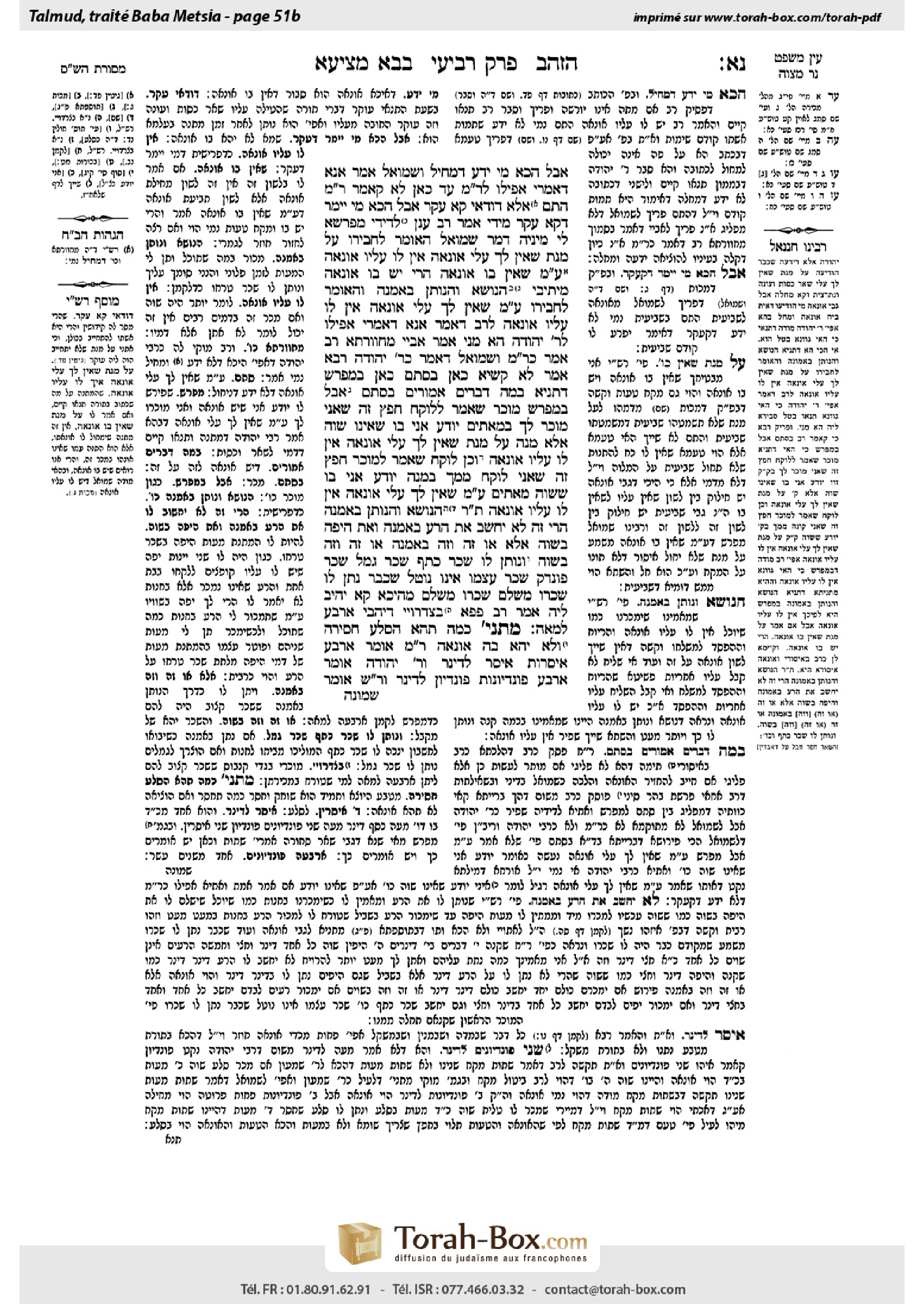
Bava Metzia 51b: Talmud study for Daf Yomi
Study the Talmud for Daf Yomi with scanned pages, Hebrew text, English translations from Sefaria and AI-generated French translations.
Passage selection and English or AI-generated French translation are available where the scan has annotations. Daf Study is independent of Torah-Box and Sefaria.
Browse Bava Metzia · בבא מציעא · All tractatesBava Metzia 51b text and translations
This page of Bava Metzia includes the Aramaic text, an English translation and an AI-generated French translation, alongside the scan above.
בבא מציעא נ״א ב · Aramaic and Hebrew text
אֲבָל הָכָא מִי יָדַע דְּמָחֵיל?
וּשְׁמוּאֵל אָמַר: אֲנָא דַּאֲמַרִי אֲפִילּוּ לְרַבִּי מֵאִיר, עַד כָּאן לָא קָאָמַר רַבִּי מֵאִיר הָתָם, אֶלָּא דְּוַדַּאי קָא עָקַר, אֲבָל הָכָא מִי יֵימַר דְּקָא עָקַר מִידֵּי.
אָמַר רַב עָנָן: לְדִידִי מִפָּרְשָׁא לִי מִינֵּיהּ דְּמָר שְׁמוּאֵל: הָאוֹמֵר לַחֲבֵירוֹ ״עַל מְנָת שֶׁאֵין לְךָ עָלַי אוֹנָאָה״ – אֵין לוֹ עָלָיו אוֹנָאָה. ״עַל מְנָת שֶׁאֵין בּוֹ אוֹנָאָה״ – הֲרֵי יֵשׁ בּוֹ אוֹנָאָה.
מֵיתִיבִי: הַנּוֹשֵׂא וְהַנּוֹתֵן בַּאֲמָנָה, וְהָאוֹמֵר לַחֲבֵירוֹ ״עַל מְנָת שֶׁאֵין לְךָ עָלַי אוֹנָאָה״ – אֵין לוֹ עָלָיו אוֹנָאָה. לְרַב דְּאָמַר: אֲנָא דַּאֲמַרִי אֲפִילּוּ לְרַבִּי יְהוּדָה, הָא מַנִּי?
אָמַר אַבָּיֵי: מְחַוַּורְתָּא, רַב אָמַר כְּרַבִּי מֵאִיר, וּשְׁמוּאֵל דְּאָמַר כְּרַבִּי יְהוּדָה.
רָבָא אָמַר: לָא קַשְׁיָא, כָּאן – בִּסְתָם, כָּאן – בִּמְפָרֵשׁ.
דְּתַנְיָא: בַּמֶּה דְּבָרִים אֲמוּרִים – בִּסְתָם. אֲבָל בִּמְפָרֵשׁ, מוֹכֵר שֶׁאָמַר לַלּוֹקֵחַ: חֵפֶץ זֶה שֶׁאֲנִי מוֹכֵר לָךְ בְּמָאתַיִם יוֹדֵעַ אֲנִי בּוֹ שֶׁאֵינוֹ שָׁוֶה אֶלָּא מָנֶה. עַל מְנָת שֶׁאֵין לְךָ עָלַי אוֹנָאָה – אֵין לוֹ עָלָיו אוֹנָאָה. וְכֵן לוֹקֵחַ שֶׁאָמַר לַמּוֹכֵר: חֵפֶץ זֶה שֶׁאֲנִי לוֹקֵחַ מִמְּךָ בְּמָנֶה יוֹדֵעַ אֲנִי בּוֹ שֶׁשָּׁוֶה מָאתַיִם. עַל מְנָת שֶׁאֵין לְךָ עָלַי אוֹנָאָה – אֵין לוֹ עָלָיו אוֹנָאָה.
תָּנוּ רַבָּנַן: הַנּוֹשֵׂא וְהַנּוֹתֵן בַּאֲמָנָה, הֲרֵי זֶה לֹא יְחַשֵּׁב אֶת הָרַע בַּאֲמָנָה וְאֶת הַיָּפֶה בְּשָׁוֶה. אֶלָּא, אוֹ זֶה וָזֶה בַּאֲמָנָה, אוֹ זֶה וָזֶה בְּשָׁוֶה.
וְנוֹתֵן לוֹ שְׂכַר כַּתָּף, שְׂכַר גַּמָּל, שְׂכַר פּוּנְדָּק. שְׂכַר עַצְמוֹ – אֵינוֹ נוֹטֵל, שֶׁכְּבָר נָתַן לוֹ שְׂכָרוֹ מִשָּׁלֵם.
שְׂכָרוֹ מִשָּׁלֵם מֵהֵיכָא קָא יָהֵיב לֵיהּ? אָמַר רַב פָּפָּא: בְּצַדְרוֹיֵי, דְּיָהֲבִי אַרְבַּע לִמְאָה.
מַתְנִי׳ כַּמָּה תְּהֵא הַסֶּלַע חֲסֵירָה וְלֹא יְהֵא בָּהּ אוֹנָאָה? רַבִּי מֵאִיר אוֹמֵר: אַרְבַּע אִיסָּרוֹת, אִיסָּר לְדִינָר. וְרַבִּי יְהוּדָה אוֹמֵר: אַרְבַּע פּוּנְדְּיוֹנוֹת, פּוּנְדְּיוֹן לְדִינָר. וְרַבִּי שִׁמְעוֹן אוֹמֵר:
Bava Metzia 51b · English translation
But here, where he says: On the condition that you have no claim of exploitation against me, does the other party know that there will be exploitation so that he will consciously waive his rights to claim compensation in the event that there is? He believes that perhaps there will be no exploitation at all.
And Shmuel says: I state my opinion even in accordance with the opinion of Rabbi Meir, as Rabbi Meir states his opinion only there, in the case of betrothal, where the husband definitely abrogates Torah law with his condition. But here, who says that either party to the sale will abrogate any Torah law?
Rav Anan says: This matter was explained to me personally by Mar Shmuel. In the case of one who says to another: I will be party to this sale on the condition that you have no claim of exploitation against me, the other party does not have a claim of exploitation against him, as one can waive his rights to compensation for the exploitation that he suffered. But if one said: I will be party to this sale on the condition that it is not subject to the halakhot of exploitation, it is subject to the halakhot of exploitation, as in this case it is directly counter to Torah law.
The Gemara raises an objection from a baraita: In the case of one who conducts business on faith; and in the case of one who says to another: I will be party to this sale on the condition that you have no claim of exploitation against me, the exploited party does not have a claim of exploitation against the one who exploited him. According to Rav, who said: I stated my opinion even in accordance with the opinion of Rabbi Yehuda, in accordance with whose opinion is this baraita, as pursuant to that statement, even Rabbi Yehuda holds that in cases of exploitation one cannot stipulate counter to that which is written in the Torah?
Abaye said: Based on this proof from the baraita it is clear that Rav stated his opinion in accordance with the opinion of Rabbi Meir, and that Shmuel stated his opinion in accordance with the opinion of Rabbi Yehuda, and this baraita expresses the opinion of Rabbi Yehuda.
Rava said: It is not difficult, as there is a distinction between the cases. Here, in this baraita, the tanna is speaking in a case where the condition is stated in an ordinary case, where it is not stated explicitly that the price paid is not the market value. In that case, Rav says that Rabbi Yehuda holds that the condition is void. There, where Rabbi Yehuda would uphold the condition, the tanna is speaking in a case where the exploitation is explicit, i.e., both parties know that the price paid is not the market value.
This is as it is taught in a baraita: In what case is this statement said? It is in an ordinary case, but in a case where the exploitation is explicit, e.g., in the case of a seller who said to the buyer: Concerning this item that I am selling to you for two hundred dinars, I know about it that it is worth only one hundred dinars, and I am selling it on the condition that you have no claim of exploitation against me, the buyer has no claim of exploitation against him. And likewise, in the case of a buyer who said to the seller: Concerning this item that I am buying from you for one hundred dinars, I know about it that it is worth two hundred dinars, and I am buying it on the condition that you have no claim of exploitation against me, the seller has no claim of exploitation against him.
Apropos the mention of one who conducts business on faith, the Gemara cites a baraita that teaches several halakhot concerning such an arrangement. The Sages taught: When selling merchandise that one purchased in bulk, one who conducts business on faith may not calculate the price of the merchandise of inferior quality on faith and the price of the merchandise of superior quality at their market value. Rather, he has two options: Either the price of both this merchandise and that merchandise must be calculated on faith, or the price of both this merchandise and that merchandise must be calculated at their market value.
The baraita continues: And the buyer gives the seller the payment for the money he spent in hiring a porter, the payment for the money he spent in hiring a camel driver if necessary, and the payment for the lodgings he used during the time of the transaction. These expenses had been borne by the seller, so it is not exploitation if he recovers them by charging the buyer. But as for the seller’s own wages, i.e., payment for the time he spent engaging in the transaction, he does not take his own wages, as the one from whom he purchased the merchandise already gave him his full wages.
The Gemara asks: With regard to his wages in full, from where did he give that to him? With what was he paid by the one from whom he purchased the merchandise? The Gemara responds: Rav Pappa said: This is referring to sellers of inexpensive garments, where the one from whom he purchases the merchandise gives four additional units for each one hundred units purchased, and that functions as payment for his efforts.
MISHNA: How much can the sela coin be eroded through usage, and its use in a transaction at its original value will still not constitute exploitation? Rabbi Meir says: The accepted depreciation is four issar, which is a rate of one issar per dinar, or one twenty-fourth of a dinar. And Rabbi Yehuda says: The accepted depreciation is four pundeyon, which is a rate of one pundeyon per dinar, or one-twelfth of a dinar. And Rabbi Shimon says:
Bava Metzia 51b · Traduction française (IA)
Mais ici, où il dit : sous la condition que vous n'ayez pas de revendication d'exploitation contre moi, le parti adverse sait-il qu'il y aura de l'exploitation, de sorte qu'il renonce volontairement à ses droits pour demander une compensation en cas de survenance ? Il pense que peut-être il n'y aura aucune exploitation du tout.
Et Shmuel dit : Je formule mon opinion même conformément à l'opinion de Rabbi Meir, car Rabbi Meir formule son opinion uniquement dans le cas de l'union, où le mari abroge sans doute la loi divine par sa condition. Mais ici, qui dit que l'une des parties à la vente abroge toute loi divine ?
Rav Anan dit : Cette affaire m'a été expliquée personnellement par Mar Shmuel. Dans le cas d'une personne qui dit à une autre : Je serai partie à cette vente sous la condition que vous n'ayez pas de revendication d'exploitation contre moi, la personne adverse n'a pas de revendication d'exploitation contre lui, car on peut renoncer volontairement à ses droits de compensation pour les dommages subis. Mais si l'on dit : Je serai partie à cette vente sous la condition qu'elle ne soit pas soumise aux halakhot de l'exploitation, elle est soumise aux halakhot de l'exploitation, car dans ce cas, c'est directement contraire à la loi divine.
La Guemara soulève une objection tirée d'une baraïta : Dans le cas d'une personne qui fait des affaires sur foi ; et dans le cas d'une personne qui dit à une autre : Je serai partie à cette vente sous la condition que vous n'ayez pas de revendication de dommages contre moi, la personne exploitée n'a pas de revendication de dommages contre celui qui l'a exploitée. Selon Rav, qui dit : J'ai formulé mon opinion même conformément à l'opinion de Rabbi Yehuda, selon laquelle opinion cette baraïta s'aligne, car selon cette déclaration, même Rabbi Yehuda considère que dans les cas d'exploitation, on ne peut pas stipuler contraire à ce qui est écrit dans la Torah ?
Abaye dit : Selon cette preuve tirée de la baraïta, il est clair que Rav a formulé son opinion conformément à l'opinion de Rabbi Meir, et que Shmuel a formulé son opinion conformément à l'opinion de Rabbi Yehuda, et cette baraïta exprime l'opinion de Rabbi Yehuda.
Rava dit : Ce n'est pas difficile, car il y a une distinction entre les cas. Ici, dans cette baraïta, le tanna parle d'un cas où la condition est formulée dans un cas ordinaire, où il n'est pas dit explicitement que le prix payé n'est pas la valeur du marché. Dans ce cas, Rav dit que Rabbi Yehuda considère que la condition est nulle. Là, où Rabbi Yehuda soutiendrait la condition, le tanna parle d'un cas où l'exploitation est explicite, c'est-à-dire où les deux parties savent que le prix payé n'est pas la valeur du marché.
C'est comme il est enseigné dans une baraïta : Dans quel cas cette déclaration est-elle dite ? C'est dans un cas ordinaire, mais dans un cas où l'exploitation est explicite, par exemple, dans le cas d'un vendeur qui dit à l'acheteur : Concernant cet article que je vends à vous pour deux cents dinars, je sais qu'il vaut seulement cent dinars, et je le vends sous la condition que vous n'ayez pas de revendication d'exploitation contre moi, l'acheteur n'a pas de revendication d'exploitation contre lui. De même, dans le cas d'un acheteur qui dit au vendeur : Concernant cet article que je vous achète pour cent dinars, je sais qu'il vaut deux cents dinars, et je l'achète sous la condition que vous n'ayez pas de revendication d'exploitation contre moi, le vendeur n'a pas de revendication d'exploitation contre lui.
A propos de la mention d'une personne qui fait des affaires sur foi, la Guemara cite une baraïta qui enseigne plusieurs halakhot concernant telle disposition. Les Sages enseignent : Lors de la vente de marchandises achetées en quantité, une personne qui fait des affaires sur foi ne peut pas calculer le prix des marchandises de qualité inférieure sur foi et le prix des marchandises de qualité supérieure à leur valeur du marché. Il lui reste deux options : Soit le prix des deux marchandises doit être calculé sur foi, soit le prix des deux marchandises doit être calculé à leur valeur du marché.
La baraïta continue : Et l'acheteur paie au vendeur la somme qu'il a dépensée pour embaucher un porteur, la somme qu'il a dépensée pour embaucher un conducteur de chameau si nécessaire, et la somme qu'il a dépensée pour les logements utilisés pendant la durée de la transaction. Ces dépenses ont été supportées par le vendeur, donc il n'y a pas d'exploitation s'il récupère ces dépenses en facturant l'acheteur. Mais concernant les salaires du vendeur, c'est-à-dire le paiement pour le temps qu'il a passé dans la transaction, il ne prend pas ses salaires, car celui d'origine a déjà donné ses salaires complets.
La Guemara pose la question : Concernant ses salaires complets, d'où vient-il qu'il les ait reçus ? Avec quoi a-t-il été payé par celui d'origine ? La Guemara répond : Rav Pappa dit : Il s'agit des vendeurs de vêtements bon marché, où celui d'origine donne quatre unités supplémentaires pour chaque cent unités achetées, et cela fonctionne comme paiement pour ses efforts.
MICHNA : De combien peut être érodé la monnaie de sela par usage, et son utilisation à sa valeur originale ne constitue-t-elle pas encore d'exploitation ? Rabbi Meir dit : La dépréciation acceptée est de quatre issar, ce qui correspond à un taux d'un issar par dinar, soit un vingt-quatrième de dinar. Et Rabbi Yehuda dit : La dépréciation acceptée est de quatre pundeyon, ce qui correspond à un taux d'un pundeyon par dinar, soit un douzième de dinar. Et Rabbi Shimon dit :
Traduction française générée par IA à partir de l’édition anglaise de Sefaria. Vérifie toujours un passage avec le texte source.
Text from Sefaria: William Davidson Edition - Vocalized Aramaic (CC BY NC); William Davidson Edition - English (CC BY NC).