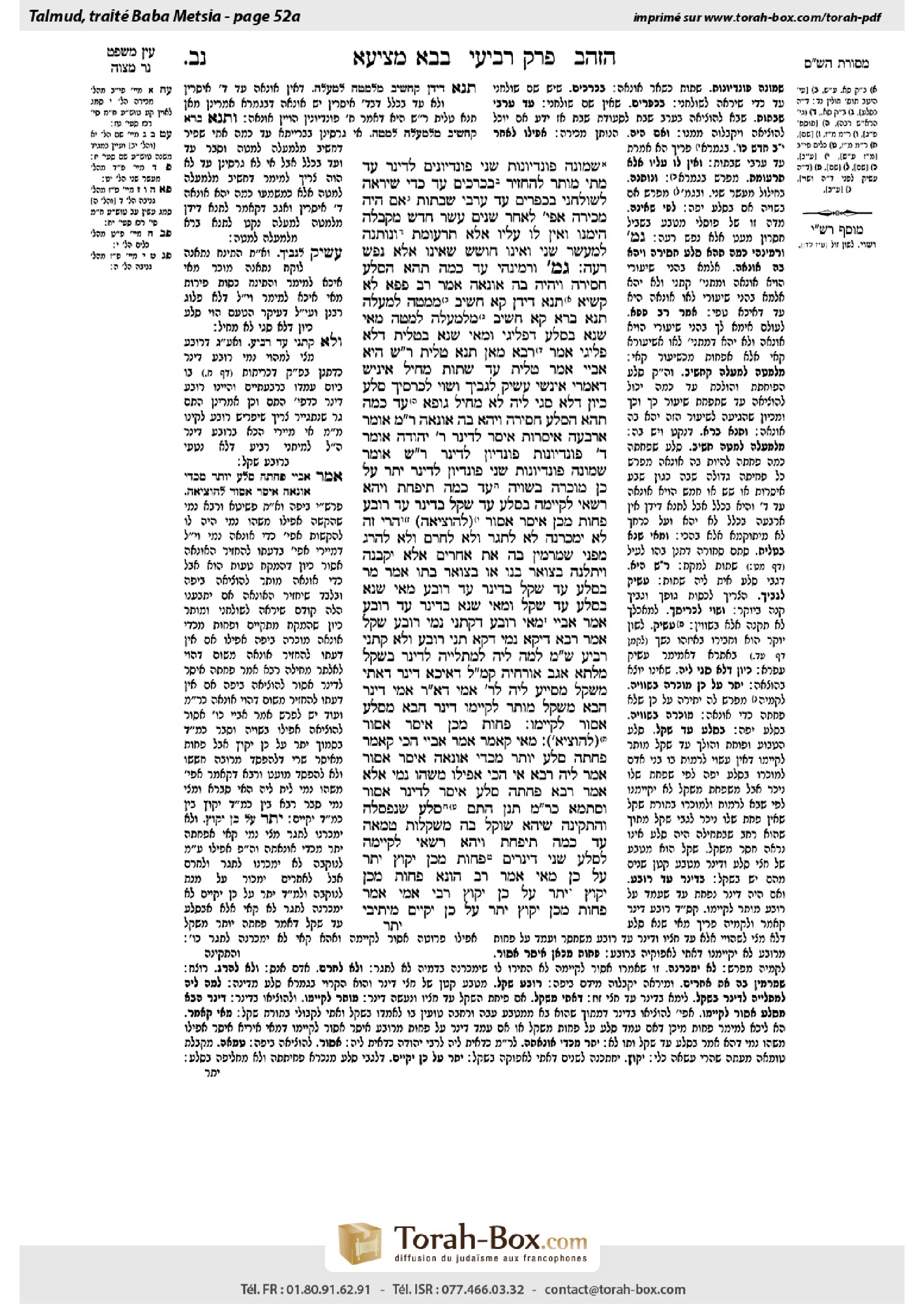
Bava Metzia 52a: Talmud study for Daf Yomi
Study the Talmud for Daf Yomi with scanned pages, Hebrew text, English translations from Sefaria and AI-generated French translations.
Passage selection and English or AI-generated French translation are available where the scan has annotations. Daf Study is independent of Torah-Box and Sefaria.
Browse Bava Metzia · בבא מציעא · All tractatesBava Metzia 52a text and translations
This page of Bava Metzia includes the Aramaic text, an English translation and an AI-generated French translation, alongside the scan above.
בבא מציעא נ״ב א · Aramaic and Hebrew text
שְׁמוֹנָה פּוּנְדְּיוֹנוֹת, שְׁנֵי פּוּנְדְּיוֹנוֹת לְדִינָר.
עַד מָתַי מוּתָּר לְהַחְזִיר? בִּכְרַכִּים – עַד כְּדֵי שֶׁיַּרְאֶה לַשּׁוּלְחָנִי, בִּכְפָרִים – עַד עַרְבֵי שַׁבָּתוֹת. אִם הָיָה מַכִּירָהּ – אֲפִילּוּ לְאַחַר שְׁנֵים עָשָׂר חֹדֶשׁ מְקַבְּלָהּ הֵימֶנּוּ, וְאֵין לוֹ עָלָיו אֶלָּא תַּרְעוֹמֶת.
וְנוֹתְנָהּ לְמַעֲשֵׂר שֵׁנִי וְאֵינוֹ חוֹשֵׁשׁ, שֶׁאֵינוֹ אֶלָּא נֶפֶשׁ רָעָה.
גְּמָ׳ וּרְמִינְהִי: עַד כַּמָּה תְּהֵא הַסֶּלַע חֲסֵירָה וְיִהְיֶה בָּהּ אוֹנָאָה?
אָמַר רַב פָּפָּא, לָא קַשְׁיָא: תַּנָּא דִּידַן קָא חָשֵׁיב מִמַּטָּה לְמַעְלָה, תַּנָּא בָּרָא קָא חָשֵׁיב מִלְּמַעְלָה לְמַטָּה.
מַאי שְׁנָא בְּסֶלַע דִּפְלִיגִי, וּמַאי שְׁנָא בְּטַלִּית דְּלָא פְּלִיגִי?
אָמַר רָבָא: מַאן תְּנָא טַלִּית – רַבִּי שִׁמְעוֹן הִיא. אַבָּיֵי אָמַר: טַלִּית – עַד שְׁתוּת מָחֵיל אִינִישׁ. דְּאָמְרִי אִינָשֵׁי: עֲשִׁיק לְגַבָּיךְ וְשָׁוֵי לִכְרֵסָיךְ. סֶלַע, כֵּיוָן דְּלָא סַגִּי לֵיהּ – לָא מָחֵיל.
גּוּפָא: עַד כַּמָּה תְּהֵא הַסֶּלַע חֲסֵירָה וִיהֵא בָּהּ אוֹנָאָה? רַבִּי מֵאִיר אוֹמֵר: אַרְבָּעָה אִיסָּרוֹת, אִיסָּר לְדִינָר. רַבִּי יְהוּדָה אוֹמֵר: אַרְבָּעָה פּוּנְדְּיוֹנוֹת, פּוּנְדְּיוֹן לְדִינָר. רַבִּי שִׁמְעוֹן אוֹמֵר: שְׁמוֹנָה פּוּנְדְּיוֹנוֹת, שְׁנֵי פּוּנְדְיוֹנִים לְדִינָר. יָתֵר עַל כֵּן – מוֹכְרָהּ בְּשׇׁוְיָהּ.
עַד כַּמָּה תִּיפָּחֵת וִיהֵא רַשַּׁאי לְקַיְּימָהּ? בְּסֶלַע – עַד שֶׁקֶל. בְּדִינָר – עַד רוֹבַע. פָּחוֹת מִכֵּן אִיסָּר – אָסוּר לְהוֹצִיאָהּ. הֲרֵי זֶה לֹא יִמְכְּרֶנָּה לֹא לַתַּגָּר וְלֹא לְחָרָם וְלֹא לְהָרָג, מִפְּנֵי שֶׁמְּרַמִּין בָּהּ אֶת אֲחֵרִים. אֶלָּא יִקֳּבֶנָּה וְיִתְלֶנָּה בְּצַוַּאר בְּנוֹ אוֹ בְּצַוַּאר בִּתּוֹ.
אָמַר מָר: בְּסֶלַע עַד שֶׁקֶל, בְּדִינָר עַד רוֹבַע. מַאי שְׁנָא בְּסֶלַע עַד שֶׁקֶל, וּמַאי שְׁנָא בְּדִינָר עַד רוֹבַע?
אָמַר אַבָּיֵי: מַאי ״רוֹבַע״ דְּקָתָנֵי – נָמֵי רוֹבַע שֶׁקֶל. אָמַר רָבָא: דַּיְקָא נָמֵי, דְּקָא תָּנֵי ״רוֹבַע״, וְלָא קָתָנֵי ״רְבִיעַ״. שְׁמַע מִינַּהּ.
לְמָה לֵיהּ לְמִתְלְיֵיהּ לְדִינָר בְּשֶׁקֶל? מִלְּתָא אַגַּב אוֹרְחֵיהּ קָא מַשְׁמַע לַן, דְּאִיכָּא דִּינָר דְּאָתֵי מִשֶּׁקֶל.
מְסַיַּיע לֵיהּ לְרַבִּי אַמֵּי. דְּאָמַר רַבִּי אַמֵּי: דִּינָר הַבָּא מִשֶּׁקֶל – מוּתָּר לְקַיְּימוֹ. דִּינָר הַבָּא מִסֶּלַע – אָסוּר לְקַיְּימוֹ.
פָּחוֹת מִכֵּן אִיסָּר – אָסוּר לְהוֹצִיאָהּ. מַאי קָאָמַר? אָמַר אַבָּיֵי, הָכִי קָאָמַר: פָּחֲתָה סֶלַע יוֹתֵר מִכְּדֵי אוֹנָאָה אִיסָּר – אָסוּר. אֲמַר לֵיהּ רָבָא: אִי הָכִי – אֲפִילּוּ מַשֶּׁהוּ נָמֵי! אֶלָּא אָמַר רָבָא: פָּחֲתָה סֶלַע אִיסָּר לְדִינָר – אָסוּר, וּסְתָמָא כְּרַבִּי מֵאִיר.
תְּנַן הָתָם: סֶלַע שֶׁנִּפְסְלָה וְהִתְקִינָהּ שֶׁיְּהֵא שׁוֹקֵל בָּהּ מִשְׁקָלוֹת – טְמֵאָה. עַד כַּמָּה תִּיפָּחֵת וִיהֵא רַשַּׁאי לְקַיְּימָהּ? (לַסֶּלַע) שְׁנֵי דִּינָרִים, פָּחוֹת מִכֵּן – יָקוֹץ.
יָתֵר עַל כֵּן מַאי? אָמַר רַב הוּנָא: פָּחוֹת מִכֵּן – יָקוֹץ, יָתֵר עַל כֵּן – יָקוֹץ. רַבִּי אַמֵּי אָמַר: פָּחוֹת מִכֵּן – יָקוֹץ, יָתֵר עַל כֵּן – יְקַיֵּים.
מֵיתִיבִי:
Bava Metzia 52a · English translation
The accepted depreciation is eight pundeyon, which is a rate of two pundeyon per dinar, or one-sixth of a dinar.
The mishna continues: Until when is it permitted for one to return a worn coin once he realizes that it is defective? In the cities [bakerakim], one may return it only until a period of time has passed that would allow him to show it to a money changer, who is an expert in matters of coins. In the villages, where there is no money changer, one may return it only until Shabbat eves, when people purchase their Shabbat needs. Although these are the limits of how much a coin must be eroded in order for there to be exploitation, if the one who gave the coin to the aggrieved party recognized it, he must accept it back from him even after twelve months have passed no matter how little the erosion affected its value. And he has only a grievance against him, as the Gemara will explain.
And one may give the slightly eroded coin for use in the desacralizing of second-tithe produce and he need not be concerned, as one who would refuse to accept a slightly eroded coin is merely a miserly soul, while the coin is in fact valid for any use.
GEMARA: And the Gemara raises a contradiction to the mishna from a baraita in which the same measures of depreciation are enumerated, as in that baraita those measures are introduced with the question: How much must the sela coin be eroded so that its use in a transaction at its original value will constitute exploitation? That is diametrically opposed to the mishna.
Rav Pappa says: This is not difficult. The tanna of our mishna calculates the measures from low to high. The tanna says that it does not constitute exploitation up to, but not including, the levels of depreciation enumerated in the mishna. Beginning with those levels of depreciation, it is exploitation. And the external tanna, i.e., the tanna of the baraita, calculates from high to low. That tanna says that it is exploitation down to and including the levels of depreciation enumerated in the baraita. It is only beneath those levels that it is not considered exploitation. There is no halakhic dispute between the two tanna’im.
The Gemara returns to discuss the mishna and asks: What is different with regard to a sela, that the tanna’im disagree about the level of depreciation that constitutes exploitation, and what is different with regard to a garment, that the tanna’im do not disagree concerning whether the disparity between value and price that constitutes exploitation is one-sixth or less than one-sixth?
Rava said: Who is the tanna that taught the halakhot of exploitation with regard to a garment in the mishnayot cited earlier in this chapter? It is Rabbi Shimon, who maintains that even in the case of a sela, the measure of exploitation is one-sixth. Abaye said that the two cases are different: With regard to a garment, a person is likely to waive the disparity up to one-sixth, as people say: Overpay and acquire an item for your back, i.e., a garment, and acquire at cost items for your stomach, i.e., food. Since it is worth purchasing fine garments, the disparity is not significant. By contrast, with regard to the sela in question, since it does not circulate, he does not waive even the sum of a smaller disparity.
§ With regard to the matter of exploitation and coins itself, the Gemara elaborates: How much will the sela coin be eroded and its use in a transaction will constitute exploitation? Rabbi Meir says: Four issar, which is a rate of an issar per dinar. Rabbi Yehuda says: Four pundeyon, a pundeyon per dinar. Rabbi Shimon says: Eight pundeyon, two pundeyon per dinar. If the depreciation is greater than that, he may sell the coin at its value as metal, not for its original value.
To what extent can the coin erode and it will still be permitted for one to maintain it as a coin? With regard to a sela, it can be used as a sela until it erodes so that its value reaches one shekel, i.e., half a sela. With regard to a dinar, it can be used as a dinar until it erodes so that its value reaches one-quarter. Once it erodes to the point where its value reaches an issar less than that, it is prohibited to spend it. He may not sell the invalidated coin to a merchant, nor to a violent man, nor to a murderer, because they deceive others with it or force them to take it. Rather, he should perforate it and suspend it as an ornament on the neck of his son or the neck of his daughter.
The Gemara continues its analysis of the baraita. The Master said: With regard to a sela, it can be used as a sela until it erodes so that its value reaches one shekel, i.e., half a sela. With regard to a dinar, it can be used as a dinar until it erodes so that its value reaches one-quarter. The Gemara asks: What is different whereby with regard to a sela, it can be used as a sela until it erodes so that its value reaches one shekel, which is half a sela, and what is different whereby with regard to a dinar, it can be used as a dinar until it erodes so that its value reaches one-quarter [rova]?
Abaye says: What is the meaning of rova that the baraita teaches? It too is referring to a coin called rova, which is worth one-quarter of a shekel, which is half a dinar. Rava said: The language of the baraita is also precise in this regard, as the tanna teaches rova and does not teach one-quarter [revia]. The Gemara concludes: Learn from that inference that the reference of the tanna of the baraita is to the coin called rova, which is half a dinar.
The Gemara asks: Why does the tanna state his ruling so that the amount of erosion that disqualifies a dinar is dependent on a shekel? Why does the tanna state the measure as one-quarter of a shekel, rather than stating it as one-half of a dinar? The Gemara explains: By doing so, the tanna teaches us a matter in passing, that there are cases where a dinar originates from a shekel, e.g., a shekel that eroded and is now worth one-half its original value, i.e., one dinar.
This supports the opinion of Rabbi Ami, as Rabbi Ami says: With regard to a dinar that originated from a shekel, it is permitted to maintain it and use it as a dinar. Based on its size and shape, there is no concern that people will confuse it with a shekel. With regard to a dinar that originated from a sela, it is prohibited to maintain it and use it as a dinar. Due to the fact that even after erosion the coin remains the size of a sela, which is clearly larger than a dinar, the concern is that people will mistakenly consider it more valuable than a dinar.
§ The Gemara continues its analysis of the baraita, which teaches: Once it erodes to the point where its value reaches an issar less than that, it is prohibited to spend it. The Gemara asks: What is the tanna saying in that statement? Abaye said that this is what the tanna is saying: If a sela eroded by the amount of an issar greater than the measure of exploitation, it is prohibited to spend it at its original value. Rava said to Abaye: If so, then even any amount greater than the measure of exploitation should be forbidden as well. Rather, Rava said that this is what the tanna is saying: If a sela eroded by the amount of an issar per dinar, it is prohibited to spend it, and this unattributed baraita is in accordance with the opinion of Rabbi Meir, who says in the mishna that the measure of exploitation is one issar per dinar.
We learned in a mishna there (Kelim 12:7): A sela that was invalidated for use as a coin, and an individual designated it so that he would weigh with it items that require weighing, is susceptible to becoming ritually impure. His designation rendered it a vessel like any other weight. To what extent can the coin erode and it will still be permitted to maintain it? For a sela, it is an erosion of two dinars, half its value. If it eroded to an extent that it was worth less than that, he must cut it into pieces to prevent its being confused with a proper coin.
The Gemara asks: If it eroded but its current value is greater than one shekel, what is the halakha? Rav Huna says: If it eroded and depreciated less than one shekel he must cut it into pieces, and if it eroded and depreciated more than that he must also cut it into pieces. Rabbi Ami says: If it eroded and depreciated less than one shekel he must cut it into pieces, and if it eroded and depreciated more than that he may maintain it, because there is no concern that one will confuse a coin that eroded to that extent with a sela.
The Gemara raises an objection from the baraita:
Bava Metzia 52a · Traduction française (IA)
La dépréciation acceptée est de huit pundeyon, ce qui correspond à un taux de deux pundeyon par dinar, soit un sixième de dinar.
La Michna continue : Jusqu'à quel moment est-il permis à une personne de rendre une pièce usée une fois qu'elle a constaté qu'elle est défectueuse ? Dans les villes [bakerakim], on peut la rendre uniquement jusqu'à un délai suffisant pour permettre à une personne de la montrer à un changeur, qui est un expert en matière de monnaie. Dans les villages, où il n'y a pas de changeur, on peut la rendre uniquement jusqu'au vendredi soir, moment où les gens achètent leurs besoins pour le Shabbat. Bien que ces limites soient celles qui définissent la mesure de l'érosion nécessaire pour constituer une exploitation, si la personne qui a donné la pièce à la partie blessée la reconnaît, il doit la reprendre même après un an, quels que soient les effets de l'érosion sur sa valeur. Et il n'a qu'une plainte contre lui, comme l'expliquera la Guemara.
On peut donner la pièce légèrement érodée pour l'usage dans la désacralisation des dixièmes secondaires et il n'a pas à s'inquiéter, car celui qui refuse de recevoir une pièce légèrement érodée est simplement une personne avare, tandis que la pièce est en fait valide pour tout usage.
GUEMARA : Et la Guemara soulève une contradiction avec la Michna à partir d'une baraïta dans laquelle les mêmes mesures de dépréciation sont énumérées, comme dans cette baraïta, ces mesures sont introduites par la question : De combien doit être érodée la pièce sela pour que son utilisation dans une transaction à sa valeur originale constitue une exploitation ? Cela est diamétralement opposé à la Michna.
Rav Pappa dit : Ce n'est pas difficile. Le tanna de notre Michna calcule les mesures du bas vers le haut. Le tanna dit que cela ne constitue pas une exploitation jusqu'à, mais sans inclure, les niveaux de dépréciation énumérés dans la Michna. À partir de ces niveaux de dépréciation, c'est une exploitation. Et le tanna externe, c'est-à-dire le tanna de la baraïta, calcule du haut vers le bas. Ce tanna dit que c'est une exploitation jusqu'à et y compris les niveaux de dépréciation énumérés dans la baraïta. C'est seulement en dessous de ces niveaux que cela ne constitue pas une exploitation. Il n'y a pas de débat halakhique entre les deux tanna’im.
La Guemara retourne discuter de la Michna et demande : Qu'est-ce qui diffère concernant la sela, que les tanna’im débattent du niveau de dépréciation qui constitue une exploitation, et qu'est-ce qui diffère concernant un vêtement, que les tanna’im ne débattent pas sur le fait que la disparité entre valeur et prix qui constitue une exploitation soit un sixième ou moins d'un sixième ?
Rava dit : Qui est le tanna qui a enseigné les halakhot de l'exploitation concernant un vêtement dans les mishnayot cités plus tôt dans ce chapitre ? C'est Rabbi Shimon, qui affirme que même dans le cas d'une sela, la mesure de l'exploitation est un sixième. Abaye dit que les deux cas sont différents : concernant un vêtement, une personne est susceptible de renoncer à la disparité jusqu'à un sixième, car les gens disent : Payez un peu plus et achetez un article pour votre dos, c'est-à-dire un vêtement, et achetez des articles à prix coûtant pour votre estomac, c'est-à-dire de la nourriture. Puisque c'est valable d'acheter des vêtements de qualité, la disparité n'est pas significative. En revanche, concernant la sela en question, puisqu'elle ne circule pas, il ne renonce pas même à la somme d'une petite disparité.
§ Concernant la question de l'exploitation et la pièce elle-même, la Guemara développe : De combien la pièce sela doit-elle être érodée pour que son utilisation dans une transaction constitue une exploitation ? Rabbi Meir dit : Quatre issar, ce qui correspond à un issar par dinar. Rabbi Yehuda dit : Quatre pundeyon, un pundeyon par dinar. Rabbi Shimon dit : Huit pundeyon, deux pundeyon par dinar. Si la dépréciation est supérieure à cela, on peut vendre la pièce à sa valeur en métal, pas à sa valeur originale.
Dans quelle mesure la pièce peut-elle s'éroder et rester encore utilisable comme pièce ? Concernant la sela, elle peut être utilisée comme sela jusqu'à ce qu'elle s'érode à un point où sa valeur atteint un shekel, c'est-à-dire la moitié d'une sela. Concernant le dinar, il peut être utilisé comme dinar jusqu'à ce qu'il s'érode à un point où sa valeur atteint un quart. Une fois qu'il s'érode à un point où sa valeur atteint un issar moins que cela, il est interdit de le dépenser. On ne peut pas le vendre à un marchand, ni à un homme violent, ni à un meurtrier, car ils trompent les autres avec cela ou forcent les autres à l'accepter. Il devrait plutôt le percer et le suspendre comme un bijou autour du cou de son fils ou de sa fille.
La Guemara continue son analyse de la baraïta. Le Maître dit : Concernant la sela, elle peut être utilisée comme sela jusqu'à ce qu'elle s'érode à un point où sa valeur atteint un shekel, c'est-à-dire la moitié d'une sela. Concernant le dinar, il peut être utilisé comme dinar jusqu'à ce qu'il s'érode à un point où sa valeur atteint un quart. La Guemara demande : Qu'est-ce qui diffère concernant la sela, qu'elle peut être utilisée comme sela jusqu'à ce qu'elle s'érode à un point où sa valeur atteint un shekel, qui est la moitié d'une sela, et qu'est-ce qui diffère concernant le dinar, qu'il peut être utilisé comme dinar jusqu'à ce qu'il s'érode à un point où sa valeur atteint un quart [rova] ?
Abaye dit : Quelle est la signification du rova que la baraïta enseigne ? C'est aussi une pièce appelée rova, qui vaut un quart de shekel, c'est-à-dire la moitié d'un dinar. Rava dit : La langue de la baraïta est aussi précise à cet égard, car le tanna enseigne rova et ne mentionne pas un quart [revia]. La Guemara conclut : Apprenez-en à partir de cette inférence que la référence du tanna de la baraïta est à la pièce appelée rova, qui est la moitié d'un dinar.
La Guemara demande : Pourquoi le tanna énonce sa décision de sorte que la mesure d'érosion qui disqualifie un dinar dépend d'un shekel ? Pourquoi le tanna énonce la mesure comme un quart de shekel, plutôt que d'énoncer la mesure comme la moitié d'un dinar ? La Guemara explique : En le faisant ainsi, le tanna nous enseigne une chose en passant, qu'il existe des cas où un dinar provient d'un shekel, par exemple un shekel qui s'est érodé et vaut maintenant la moitié de sa valeur originale, c'est-à-dire un dinar.
Cela soutient l'opinion du Rabbi Ami, car le Rabbi Ami dit : En ce qui concerne un dinar issu d'un shekel, il est permis de le conserver et de l'utiliser comme un dinar. En raison de sa taille et de sa forme, il n'y a pas de crainte que les gens le confondent avec un shekel. En ce qui concerne un dinar issu d'un sela, il est interdit de le conserver et de l'utiliser comme un dinar. En effet, même après l'érosion, la pièce reste de la taille d'un sela, qui est clairement plus grande qu'un dinar, et il y a donc une crainte que les gens l'attribuent à tort à une valeur supérieure à celle d'un dinar.
§ La Guemara continue son analyse de la baraïta, qui enseigne : Une fois qu'elle s'est érodée jusqu'à ce que sa valeur atteigne un issar moins que celle d'un sela, il est interdit de l'utiliser. La Guemara demande : Quel est l'opinion du tanna dans cette déclaration ? Abaye dit que c'est ce que le tanna dit : Si un sela s'est érodé d'une quantité supérieure à un issar, il est interdit d'utiliser cette pièce à sa valeur originale. Rava répond à Abaye : Si c'est ainsi, alors même toute quantité supérieure à la mesure d'érosion devrait être interdite. En réalité, Rava dit que c'est ce que le tanna dit : Si un sela s'est érodé d'une quantité d'un issar par dinar, il est interdit d'utiliser cette pièce, et cette baraïta non attribuée est en conformité avec l'opinion du Rabbi Meir, qui dit dans la mishna que la mesure d'érosion est un issar par dinar.
Nous avons appris dans une mishna là (Kelim 12:7) : Un sela qui a été invalidé pour être utilisé comme monnaie, et un individu l'a désigné pour peser des objets qui nécessitent d'être pesés, est susceptible de devenir impur rituellement. Son désignation l'a rendu un récipient comme tout autre poids. Dans quelle mesure peut la pièce s'éroder et rester encore permise à conserver ? Pour un sela, c'est une érosion de deux dinars, la moitié de sa valeur. Si elle s'est érodée à un point où sa valeur est inférieure à cela, il faut le découper en morceaux pour éviter qu'il ne soit confondu avec une pièce valide.
La Guemara demande : Si la pièce s'est érodée mais sa valeur actuelle est supérieure à un shekel, quelle est la halakha ? Rav Huna dit : Si elle s'est érodée et a perdu moins d'un shekel, il faut la découper en morceaux, et si elle s'est érodée et a perdu plus que cela, il faut aussi la découper en morceaux. Le Rabbi Ami dit : Si elle s'est érodée et a perdu moins d'un shekel, il faut la découper en morceaux, et si elle s'est érodée et a perdu plus que cela, on peut la conserver, car il n'y a pas de crainte que quelqu'un confonde une pièce érodée à ce point avec un sela.
La Guemara soulève une objection à partir de la baraïta :
Traduction française générée par IA à partir de l’édition anglaise de Sefaria. Vérifie toujours un passage avec le texte source.
Text from Sefaria: William Davidson Edition - Vocalized Aramaic (CC BY NC); William Davidson Edition - English (CC BY NC).