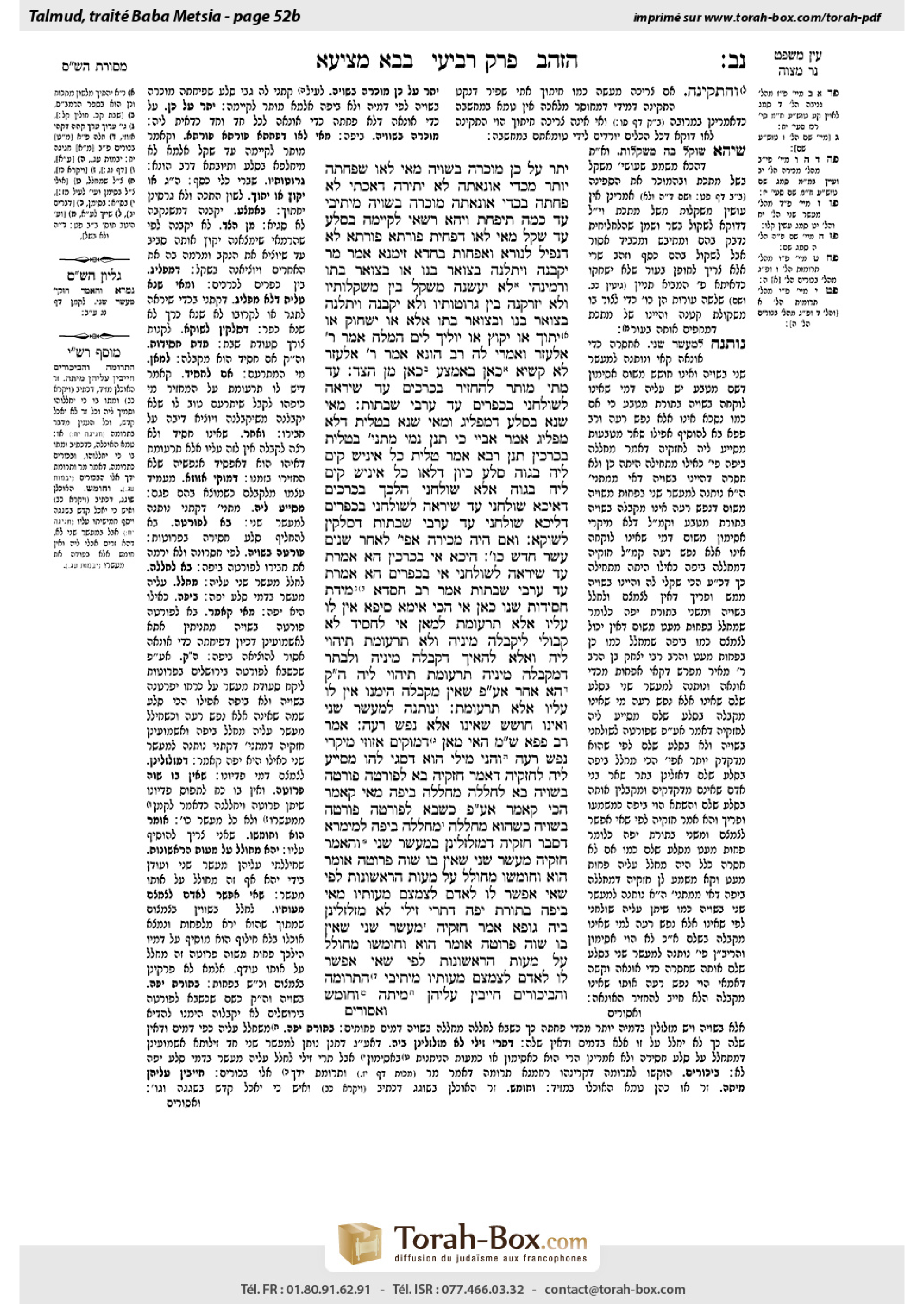
Bava Metzia 52b: Talmud study for Daf Yomi
Study the Talmud for Daf Yomi with scanned pages, Hebrew text, English translations from Sefaria and AI-generated French translations.
Passage selection and English or AI-generated French translation are available where the scan has annotations. Daf Study is independent of Torah-Box and Sefaria.
Browse Bava Metzia · בבא מציעא · All tractatesBava Metzia 52b text and translations
This page of Bava Metzia includes the Aramaic text, an English translation and an AI-generated French translation, alongside the scan above.
בבא מציעא נ״ב ב · Aramaic and Hebrew text
יָתֵר עַל כֵּן מוֹכְרָהּ בְּשׇׁוְיָהּ. מַאי לָאו: שֶׁפָּחֲתָה יוֹתֵר מִכְּדֵי אוֹנָאָתָהּ? לָא, יְתֵירָה: דְּאַכַּתִּי לָא פָּחֲתָה בִּכְדֵי אוֹנָאָתָהּ, מוֹכְרָהּ בְּשׇׁוְיָהּ.
מֵתִיבִי: עַד כַּמָּה תִּיפָּחֵת, וִיהֵא רַשַּׁאי לְקַיְּימָהּ? בְּסֶלַע – עַד שֶׁקֶל. מַאי לָאו דִּפְחַית פּוּרְתָּא פּוּרְתָּא! לָא, דִּנְפִיל לְנוּרָא וְאִפְּחִית בַּחֲדָא זִימְנָא.
אָמַר מָר: יִקֳּבֶנָּה וְיִתְלֶנָּה בְּצַוַּאר בְּנוֹ אוֹ בְּצַוַּאר בִּתּוֹ. וּרְמִינְהוּ: לֹא יַעֲשֶׂנָּה מִשְׁקָל בֵּין מִשְׁקְלוֹתָיו, וְלֹא יִזְרְקֶנָּה בֵּין גְּרוּטוֹתָיו, וְלֹא יִקֳּבֶנָּה וְיִתְלֶנָּה בְּצַוַּאר בְּנוֹ וּבְצַוַּאר בִּתּוֹ. אֶלָּא: אוֹ יִשְׁחוֹק, אוֹ יִתּוֹךְ, אוֹ יָקוֹץ, אוֹ יוֹלִיךְ לְיָם הַמֶּלַח!
אָמַר רַבִּי אֶלְעָזָר, וְאָמְרִי לַהּ רַב הוּנָא אָמַר רַבִּי אֶלְעָזָר, לָא קַשְׁיָא: כָּאן – בָּאֶמְצַע, כָּאן – מִן הַצַּד.
עַד מָתַי מוּתָּר לְהַחֲזִיר בִּכְרַכִּים? עַד שֶׁיַּרְאֶה לַשּׁוּלְחָנִי. בִּכְפָרִים? עַד עַרְבֵי שַׁבָּתוֹת. מַאי שְׁנָא בְּסֶלַע דִּמְפַלֵּיג, וּמַאי שְׁנָא בְּטַלִּית דְּלָא מְפַלֵּיג?
אֲמַר אַבָּיֵי: כִּי תְּנַן נָמֵי מַתְנִיתִין – בְּטַלִּית בִּכְרַכִּין תְּנַן. רָבָא אָמַר: טַלִּית, כֹּל אִינִישׁ קִים לֵיהּ בְּגַוַּהּ. סֶלַע, כֵּיוָן דְּלָאו כֹּל אִינִישׁ קִים לֵיהּ בְּגַוַּהּ אֶלָּא שׁוּלְחָנִי, הִלְכָּךְ בִּכְרַכִּים דְּאִיכָּא שׁוּלְחָנִי – עַד שֶׁיַּרְאֶה לַשּׁוּלְחָנִי. בִּכְפָרִים דְּלֵיכָּא שׁוּלְחָנִי – עַד עַרְבֵי שַׁבָּתוֹת דְּסָלְקִין לְשׁוּקָא.
וְאִם הָיָה מַכִּירָהּ אֲפִילּוּ לְאַחַר שְׁנֵים עָשָׂר חֹדֶשׁ כּוּ׳. הֵיכָא? אִי בִּכְרַכִּין, הָא אָמְרַתְּ עַד שֶׁיַּרְאֶה לַשּׁוּלְחָנִי. אִי בִּכְפָרִים, הָא אָמְרַתְּ עַד עַרְבֵי שַׁבָּתוֹת!
אָמַר רַב חִסְדָּא: מִידַּת חֲסִידוּת שָׁנוּ כָּאן. אִי הָכִי, אֵימָא סֵיפָא: אֵין לוֹ עָלָיו אֶלָּא תַּרְעוֹמֶת. לְמַאן? אִי לְחָסִיד – לָא קַבּוֹלֵי לִיקַבְּלַהּ מִינֵּיהּ, וְלָא תַּרְעוֹמֶת תֶּיהְוֵי לֵיהּ. וְאֶלָּא לְהַאיְךְ דְּקַבְּלַהּ מִינֵּיהּ, וּלְבָתַר דִּמְקַבְּלַהּ מִינֵּיהּ – תַּרְעוֹמֶת תֶּיהְוֵי לֵיהּ?
הָכִי קָאָמַר: הָא אַחֵר, אַף עַל פִּי שֶׁאֵין מְקַבְּלָהּ הֵימֶנּוּ – אֵין לוֹ עָלָיו אֶלָּא תַּרְעוֹמֶת.
וְנוֹתְנָהּ לְמַעֲשֵׂר שֵׁנִי, וְאֵינוֹ חוֹשֵׁשׁ, שֶׁאֵינוֹ אֶלָּא נֶפֶשׁ רָעָה. אָמַר רַב פָּפָּא, שְׁמַע מִינַּהּ: הַאי מַאן דְּמוֹקֵים אַזּוּזֵי, מִיקְּרֵי נֶפֶשׁ רָעָה. וְהָנֵי מִילֵּי הוּא דְּסָגֵי לְהוּ.
מְסַיַּיע לֵיהּ לְחִזְקִיָּה, דְּאָמַר חִזְקִיָּה: בָּא לְפוֹרְטָהּ – פּוֹרְטָהּ בְּשׇׁוְיָהּ, בָּא לְחַלְּלָהּ – מְחַלְּלָהּ בְּיָפָה.
מַאי קָאָמַר? הָכִי קָאָמַר: אַף עַל פִּי כְּשֶׁבָּא לְפוֹרְטָהּ – פּוֹרְטָהּ בְּשׇׁוְיָהּ, כְּשֶׁהוּא מְחַלְּלָהּ – מְחַלְּלָהּ בְּיָפָה.
לְמֵימְרָא דְּסָבַר חִזְקִיָּה דִּמְזַלְזְלִינַן בְּמַעֲשֵׂר שֵׁנִי? וְהָאָמַר חִזְקִיָּה: מַעֲשֵׂר שֵׁנִי שֶׁאֵין בּוֹ שָׁוֶה פְּרוּטָה, אוֹמֵר: הוּא וְחוּמְשׁוֹ מְחוּלָּל עַל מָעוֹת הָרִאשׁוֹנוֹת. לְפִי שֶׁאִי אֶפְשָׁר לוֹ לְאָדָם לְצַמְצֵם מְעוֹתָיו!
מַאי ״בְּיָפָה״, בְּתוֹרַת יָפָה. דִּתְרֵי זִילֵי לָא מְזַלְזְלִינַן בֵּיהּ.
גּוּפָא. אָמַר חִזְקִיָּה: מַעֲשֵׂר שֵׁנִי שֶׁאֵין בּוֹ שָׁוֶה פְּרוּטָה, אוֹמֵר: ״הוּא וְחוּמְשׁוֹ מְחוּלָּל עַל מָעוֹת הָרִאשׁוֹנוֹת״, לְפִי שֶׁאִי אֶפְשָׁר לוֹ לְאָדָם לְצַמְצֵם מְעוֹתָיו.
מֵיתִיבִי: הַתְּרוּמָה וְהַבִּיכּוּרִים חַיָּיבִין עֲלֵיהֶן מִיתָה וָחוֹמֶשׁ,
Bava Metzia 52b · English translation
If the erosion was greater than that, he may sell the coin at its value as metal, not for its original value. What, is it not that it eroded more than its measure of exploitation? The Gemara rejects this claim: No, the term greater means that if it did not yet erode to its measure of exploitation, he may sell it at its value.
Another objection was raised: To what extent can the coin erode and one would still be permitted to maintain it? For a sela that deteriorated, it is permitted to maintain it up to a shekel, which is half its value. Does this not mean that the sela depreciated little by little, which indicates that even though it lost half its value, which is far greater than the measure of exploitation, it is still permitted for one to maintain it, and there is no concern about deceit? The Gemara rejects this: No, it is referring to a coin that fell into the fire and eroded all at once, and therefore no deceit is possible.
The Master said in the baraita: If a coin greatly depreciated he should perforate it, and suspend it as an ornament on the neck of his son or the neck of his daughter. And the Gemara raises a contradiction from a baraita: With regard to an eroded coin, one should not make it a weight among his weights, nor cast it among his metal scraps [gerutotav], nor perforate it and suspend it on the neck of his son or the neck of his daughter, lest he come to use it by mistake. Rather, he should either grind it or melt it, or cut it into pieces, or take it and cast it into the Dead Sea.
Rabbi Elazar said, and some say Rav Huna said that Rabbi Elazar said: This is not difficult. Here, where it is permitted to fashion the coin into an ornament, it is in a case where he perforated the coin in the middle, and therefore it can no longer be mistaken for a valid coin; there, where it is prohibited to fashion the coin into an ornament, it is in a case where he perforated the coin from the side. In that case the concern is that he might cut the edge of the coin and use the unperforated remainder to deceive others.
§ The mishna teaches: Until when is it permitted for one to return a depreciated coin? In the cities, one may return it only until a period of time has passed that would allow him to show it to a money changer, who is an expert in matters of coins. In the villages, where there is no money changer, one may return it only until Shabbat eves, when people purchase their Shabbat needs. The Gemara asks: What is different with regard to a sela whereby the tanna distinguishes between cities and villages, and what is different with regard to a garment whereby he does not distinguish between cities and villages?
Abaye said: When we learned the halakha in the mishna with regard to a garment as well, it is with regard to its sale in the cities that we learned it. Concerning the sale of a garment in a village, he can return it even at a later stage. Rava said: There is a difference between a garment and a coin. In the case of a garment, every person is certain with regard to its value, and presumably the buyer will be informed of his mistake immediately. In the case of a sela, since not every person is certain with regard to its value, and rather it is only a money changer who is certain, therefore, in the cities, where there is a money changer available, the buyer can return the coin until a period of time has passed that would allow him to show it to a money changer. In the villages, where there is no money changer available, he has until Shabbat eves, when people go to the market, at which point he will discover the actual value of the sela.
The mishna teaches: And although these are the limits of how much a coin must be eroded in order for there to be exploitation, if the one who gave the coin to the aggrieved party recognized it, he must accept it back from him even after twelve months have passed, no matter how little the erosion affected its value; and he has only a grievance against him. The Gemara asks: Where did this occur? If it was in the cities, didn’t you say that he has only until a period of time has passed that would allow him to show it to a money changer? If it was in the villages, didn’t you say that he has until Shabbat eves?
Rav Ḥisda said: The Sages taught an attribute of piety here, according to which he must accept it even after considerable time has passed. The Gemara asks: If so, say the latter clause of the mishna: And he has only a grievance against him. For whom is there a grievance? If it is for the pious person who accepted the return of the flawed coin although he was not required to accept it, and is teaching that he may have a grievance against the one who requested of him to accept the coin, let him not accept the coin from him and let him not have a grievance. Rather, perhaps it is referring to that person from whom he accepted the coin. But after the person piously accepts return of the coin from him, is it reasonable that the one who returned the coin will have a grievance?
The Gemara answers that this is what the tanna is saying: But with regard to another person who is not pious and does not accept the coin, although he does not accept return of the coin from him after the time has passed, the one who requested that he accept it has only a grievance against him. One cannot compel the person from whom he received the coin to accept it in return, as although the coin maintains its value, not everyone is willing to conduct business with a coin whose value is questionable.
§ The mishna teaches: And one may give the slightly eroded coin for use in the desacralizing of second-tithe produce and he need not be concerned, as one who would refuse to accept a slightly eroded coin is merely a miserly soul, while the coin is in fact valid for any use. Rav Pappa said: Conclude from this formulation of the mishna that this one who insists upon the integrity of his coins and accepts only unflawed coins is characterized as a miserly soul. The Gemara adds: And this matter applies only if the flawed coins that he rejected still circulate.
The Gemara comments: This supports the opinion of Ḥizkiyya, as Ḥizkiyya says: If one comes to change this flawed silver coin for copper coins, he changes it for its value, deducting several perutot due to erosion. If he comes to desacralize second tithe with it, he desacralizes the produce with it as though its value were that of an unflawed [beyafa] coin.
The Gemara asks: What is Ḥizkiyya saying? Is he merely repeating the halakha cited in the mishna? The Gemara explains that this is what he is saying: Although when he comes to change into perutot this flawed silver coin upon which he redeemed his second-tithe produce he changes it for its actual, not its original, value, when he desacralizes second tithe with it, he desacralizes the produce with it as though it were an unflawed coin.
The Gemara asks: Is that to say that Ḥizkiyya holds that we treat second tithe with contempt, i.e., we redeem it for less than its actual value? But doesn’t Ḥizkiyya say: In the case of second-tithe produce that does not have the value of even one peruta and therefore cannot be redeemed, one says: The second-tithe produce and its one-fifth that is added when one redeems his own second-tithe produce are desacralized upon the first coins upon which I already redeemed second-tithe produce worth at least one peruta, because it is impossible for a person to be precise with his coins? Presumably, the value of the coins with which he redeemed the produce somewhat exceeded the value of the produce. Therefore, he can desacralize additional produce worth less than one peruta with those coins. Apparently, Ḥizkiyya holds that one may not display contempt for second-tithe produce by redeeming it on coins worth less than its value.
The Gemara explains: What is the meaning of beyafa? It means that although the coin has eroded, it is accorded unflawed status, and one may desacralize second-tithe produce with it. Nevertheless, it is assessed according to its actual, not its original, value, as we do not treat second tithe with two forms of contempt. One may use an eroded coin, but only according to its actual value.
§ Apropos the statement of Ḥizkiyya, the Gemara analyzes the matter itself. Ḥizkiyya said: In the case of second-tithe produce that does not have the value of one peruta and therefore cannot be redeemed, one says: The second-tithe produce and its one-fifth that is added when one redeems his own second-tithe produce are desacralized upon the first coins upon which I already redeemed second-tithe produce worth at least one peruta, because it is impossible for a person to be precise with his coins.
The Gemara raises an objection from a mishna (Ḥalla 1:9): With regard to teruma and first fruits, a non-priest is liable to receive the penalty of death at the hand of Heaven for partaking of them intentionally, and the Torah imposes the payment of a penalty of one-fifth of the value of the produce for partaking of them unwittingly.
Bava Metzia 52b · Traduction française (IA)
Si l'érosion est supérieure à cela, il peut vendre la pièce à sa valeur métallique, et non à sa valeur originale. Qu'est-ce que cela signifie, que l'érosion est supérieure à sa mesure d'exploitation ? La Guemara rejette cette affirmation : Non, le terme « supérieur » signifie que si la pièce n'a pas encore érodé à sa mesure d'exploitation, il peut la vendre à sa valeur.
Une autre objection a été soulevée : jusqu'à quel point une pièce peut-elle s'éroder et encore être autorisée à être conservée ? Pour une sela qui s'est détériorée, il est permis de la conserver jusqu'à un shekel, qui est la moitié de sa valeur. Ne signifie-t-il pas que la sela s'est dépréciée progressivement, ce qui indique que même si elle a perdu la moitié de sa valeur, ce qui est bien supérieur à la mesure d'exploitation, il est encore permis de la conserver, et il n'y a pas de crainte de tromperie ? La Guemara rejette cela : Non, il s'agit d'une pièce tombée dans le feu et s'érodant d'un seul coup, et donc il n'y a pas de tromperie possible.
Le Maître a dit dans la baraïta : Si une pièce s'est fortement dépréciée, il doit la percer et la suspendre comme un bijou autour du cou de son fils ou de sa fille. Et la Guemara soulève une contradiction à partir d'une baraïta : En ce qui concerne une pièce érodée, on ne doit pas la faire servir comme poids parmi ses poids, ni la jeter parmi ses débris métalliques, ni la percer et la suspendre autour du cou de son fils ou de sa fille, de peur qu'on l'utilise par erreur. Il doit plutôt la broyer, la fondre, la couper en morceaux, ou la jeter dans la Mer Morte.
Rabbi Eléazar a dit, et certains disent Rav Huna a dit que Rabbi Eléazar a dit : Cela n'est pas difficile. Ici, où il est permis de faire de la pièce un bijou, c'est dans un cas où il a percé la pièce au milieu, et donc elle ne peut plus être confondue avec une pièce valide ; là, où il est interdit de faire de la pièce un bijou, c'est dans un cas où il a percé la pièce du côté. Dans ce cas, la crainte est qu'il puisse couper le bord de la pièce et utiliser la partie non percée pour tromper les autres.
§ La mitsva enseigne : jusqu'à quand est-il permis de rendre une pièce dépréciée ? Dans les villes, on peut la rendre seulement jusqu'à un délai qui permettrait de la montrer à un changeur, expert en matière de monnaie. Dans les villages, où il n'y a pas de changeur, on peut la rendre seulement jusqu'au soir du Shabbat, quand les gens achètent leurs besoins du Shabbat. La Guemara demande : Qu'est-ce qui diffère concernant une sela, où le tanna distingue entre les villes et les villages, et qu'est-ce qui diffère concernant une robe, où il ne distingue pas entre les villes et les villages ?
Abaye dit : Quand nous avons appris la halakha dans la mitsna concernant une robe également, c'est concernant sa vente dans les villes que nous l'avons apprise. Concernant la vente d'une robe dans un village, il peut la rendre même plus tard. Rava dit : Il y a une différence entre une robe et une pièce. Concernant une robe, chaque personne est certaine de sa valeur, et on suppose que l'acheteur sera immédiatement informé de son erreur. Concernant une sela, puisque non chaque personne est certaine de sa valeur, et que seul un changeur est certain, donc dans les villes, où un changeur est disponible, l'acheteur peut rendre la pièce jusqu'à un délai qui permettrait de la montrer à un changeur. Dans les villages, où il n'y a pas de changeur, il a jusqu'au soir du Shabbat, quand les gens vont au marché, à ce moment-là il découvrira la valeur réelle de la sela.
La mitsna enseigne : Et même si ces sont les limites de la mesure d'érosion d'une pièce pour qu'il y ait exploitation, si celui qui a donné la pièce à la personne opprimée la reconnaît, il doit l'accepter à nouveau même après un an, peu importe à quel point l'érosion a affecté sa valeur ; et il n'a qu'une réclamation contre lui. La Guemara demande : Où cela s'est-il produit ? Si c'était dans les villes, n'avez-vous pas dit qu'il a qu'à un délai qui permettrait de la montrer à un changeur ? Si c'était dans les villages, n'avez-vous pas dit qu'il a jusqu'au soir du Shabbat ?
Rav Ḥisda a dit : Les Sages ont enseigné une vertu de piété ici, selon laquelle il doit l'accepter même après un long temps. La Guemara demande : Si c'est ainsi, dites la dernière partie de la mitsva : Et il n'a qu'une réclamation contre lui. Pour qui y a-t-il une réclamation ? Si c'est pour la personne pieuse qui a accepté le retour de la pièce défectueuse bien qu'il ne soit pas obligé de le faire, et qui enseigne qu'il peut avoir une réclamation contre celui qui lui a demandé de l'accepter, qu'il ne l'accepte pas et qu'il n'ait pas de réclamation. Plutôt, peut-être il s'agit de cette personne d'où il a reçu la pièce. Mais après que la personne pieuse ait accepté le retour de la pièce, est-il raisonnable que celui qui a rendu la pièce ait une réclamation ?
La Guemara répond que c'est ce que le tanna dit : Mais concernant une autre personne qui n'est pas pieuse et qui ne veut pas accepter la pièce, bien qu'il ne l'accepte pas après le délai, celui qui a demandé qu'il l'accepte a seulement une réclamation contre lui. On ne peut pas obliger la personne d'où il a reçu la pièce à l'accepter en retour, car bien que la pièce conserve sa valeur, pas tout le monde est prêt à faire des affaires avec une pièce dont la valeur est douteuse.
§ La mitsva enseigne : Et on peut donner la pièce légèrement érodée pour l'usage dans la désacralisation des dixièmes secondaires et il n'a pas à s'inquiéter, car celui qui refuse de recevoir une pièce légèrement érodée est simplement un âme avare, tandis que la pièce est en fait valide pour tout usage. Rav Pappa a dit : Concluez de cette formulation de la mitsva que celui qui insiste sur l'intégrité de ses pièces et accepte uniquement des pièces parfaites est caractérisé comme un âme avare. La Guemara ajoute : Et cette affaire s'applique seulement si les pièces défectueuses qu'il a rejetées continuent à circuler.
Le Guemara commente : cela soutient l'opinion de Chizkiyya, car Chizkiyya dit : si l'on vient échanger cette pièce d'argent déficiente contre des pièces de cuivre, on l'échange selon sa valeur, en déduisant plusieurs perutot en raison de l'usure. Si l'on vient désacraliser la dîme de seconde avec cela, on désacralise la production avec cela comme si sa valeur était celle d'une pièce parfaite [beyafa].
Le Guemara pose la question : Quel est le sens de la déclaration de Chizkiya ? Est-ce qu'il répète simplement la halakha citée dans la mitsva ? Le Guemara explique que c'est ce que Chizkiya affirme : bien que lorsqu'il vient à échanger une pièce d'argent défectueuse sur laquelle il a racheté son produit de la dîme de seconde, il échange cette pièce pour sa valeur réelle et non pour sa valeur originale, lorsqu'il désacralise la dîme de seconde avec cette pièce, il désacralise le produit comme si c'était une pièce parfaite.
Le Guemara pose la question : Est-ce que cela signifie que Chizkiya considère que l'on traite la dîme de seconde avec mépris, c'est-à-dire qu'on la rachète pour moins de sa valeur réelle ? Mais ne dit-il pas Chizkiya : dans le cas d'un produit de dîme de seconde dont la valeur ne dépasse pas même une peruta et qui ne peut donc être racheté, on dit : le produit de dîme de seconde et son cinquième qui est ajouté lorsqu'on rachète soi-même son produit de dîme de seconde sont désacralisés sur les premières pièces sur lesquelles j'ai déjà racheté un produit de dîme de seconde d'une valeur d'au moins une peruta, car il est impossible à une personne d'être précis avec ses pièces ? Probablement, la valeur des pièces avec lesquelles il a racheté le produit dépassait un peu celle du produit. Ainsi, il peut désacraliser un produit de valeur inférieure à une peruta avec ces pièces. Apparemment, Chizkiya considère que l'on ne doit pas montrer de mépris envers le produit de dîme de seconde en le rachetant avec des pièces de valeur inférieure à sa valeur.
La Guemara explique : Quelle est la signification de beyafa ? Cela signifie que bien que la monnaie ait été érodée, elle est considérée comme ayant un statut intact, et l'on peut désacraliser les produits de la dîme secondaire avec elle. Cependant, elle est évaluée selon sa valeur réelle et non selon sa valeur originale, car nous ne traitons pas la dîme secondaire avec deux formes de mépris. On peut utiliser une monnaie érodée, mais uniquement selon sa valeur réelle.
§ En ce qui concerne la déclaration de Chizkiya, la Guemara analyse la question elle-même. Chizkiya a dit : Dans le cas de produits de dîme secondaire qui n'ont pas la valeur d'un peruta et donc ne peuvent être rachetés, on dit : Les produits de dîme secondaire et leur cinquième qui est ajouté lorsqu'on rachète ses propres produits de dîme secondaire sont désacralisés sur les premières monnaies sur lesquelles j'ai déjà racheté des produits de dîme secondaire valant au moins un peruta, car il est impossible à une personne d'être précise avec ses monnaies.
La Guemara soulève une objection tirée d'une mitsva (Ḥalla 1:9) : En ce qui concerne la terouma et les premiers fruits, un non-prêtre est puni de mort par le Royaume des Cieux pour avoir consommé intentionnellement ces choses, et la Torah impose le paiement d'une amende égale au cinquième de la valeur des produits pour avoir consommé ces choses sans le savoir.
Traduction française générée par IA à partir de l’édition anglaise de Sefaria. Vérifie toujours un passage avec le texte source.
Text from Sefaria: William Davidson Edition - Vocalized Aramaic (CC BY NC); William Davidson Edition - English (CC BY NC).