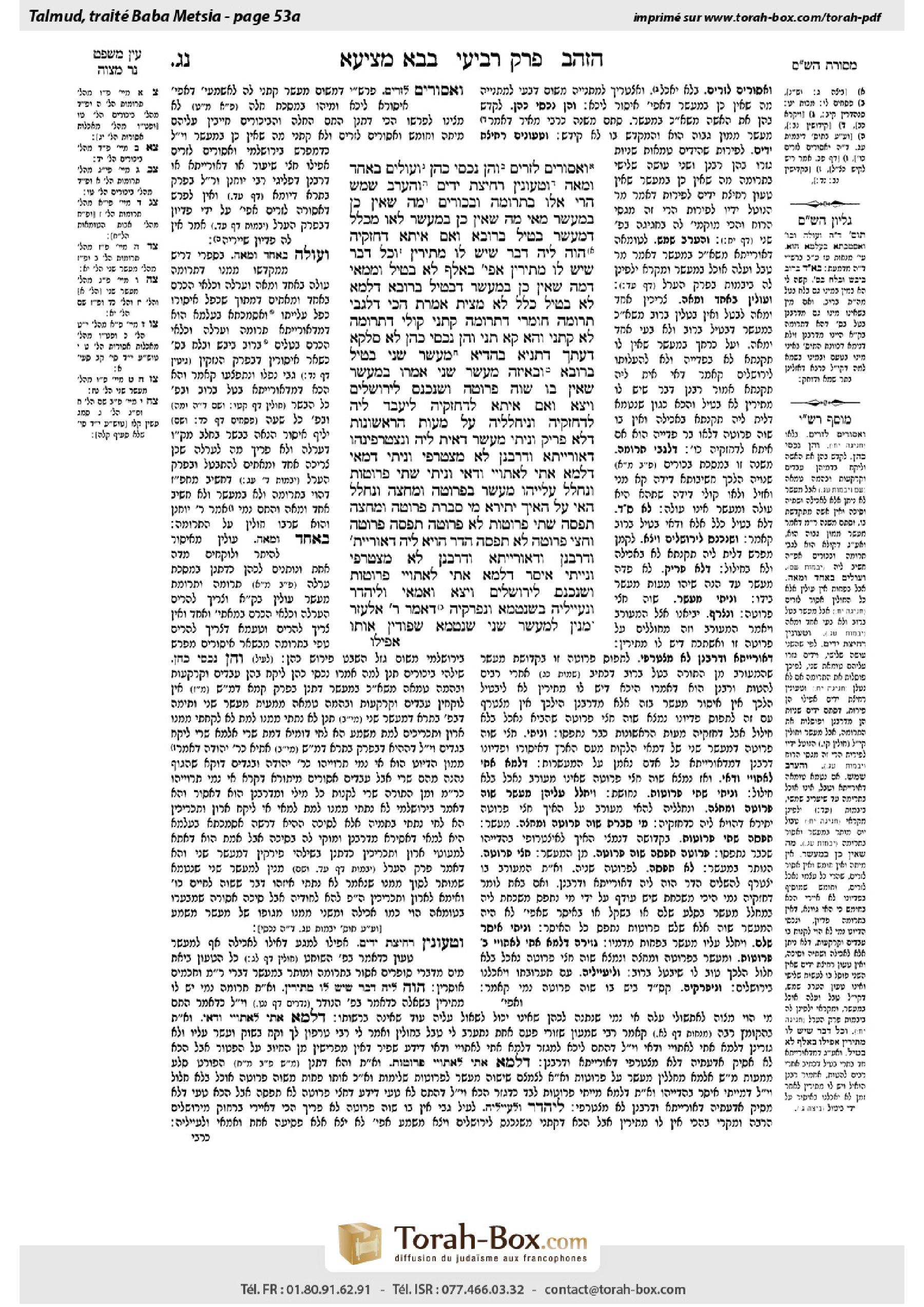
Bava Metzia 53a: Talmud study for Daf Yomi
Study the Talmud for Daf Yomi with scanned pages, Hebrew text, English translations from Sefaria and AI-generated French translations.
Passage selection and English or AI-generated French translation are available where the scan has annotations. Daf Study is independent of Torah-Box and Sefaria.
Browse Bava Metzia · בבא מציעא · All tractatesBava Metzia 53a text and translations
This page of Bava Metzia includes the Aramaic text, an English translation and an AI-generated French translation, alongside the scan above.
בבא מציעא נ״ג א · Aramaic and Hebrew text
וַאֲסוּרִים לְזָרִים, וְהֵן נִכְסֵי כֹהֵן, וְעוֹלִים בְּאֶחָד וּמֵאָה, וּטְעוּנִין רְחִיצַת יָדַיִם וְהֶעֱרֵב שֶׁמֶשׁ. הֲרֵי אֵלּוּ בִּתְרוּמָה וּבִכּוּרִים, מַה שֶּׁאֵין כֵּן בַּמַּעֲשֵׂר.
מַאי ״מַה שֶּׁאֵין כֵּן בַּמַּעֲשֵׂר״ – לָאו מִכְּלָל דְּמַעֲשֵׂר בָּטֵיל בְּרוּבָּא? וְאִם אִיתָא דְּחִזְקִיָּה, הֲוָה לֵיהּ דָּבָר שֶׁיֵּשׁ לוֹ מַתִּירִין. וְכׇל דָּבָר שֶׁיֵּשׁ לוֹ מַתִּירִין, אֲפִילּוּ בְּאֶלֶף לֹא בָּטֵיל!
וּמִמַּאי דְּמַה שֶּׁאֵין כֵּן בַּמַּעֲשֵׂר – דְּבָטֵיל בְּרוּבָּא? דִּלְמָא לָא בָּטֵיל כְּלָל! לָא מָצֵית אָמְרַתְּ הָכִי, דִּלְגַבֵּי תְּרוּמָה – חוּמְרֵי דִתְרוּמָה קָתָנֵי, קוּלֵּי דִתְרוּמָה לָא קָתָנֵי. וְהָא קָא תָנֵי: וְהֵן נִכְסֵי כֹהֵן!
לָא סָלְקָא דַּעְתָּךְ, דְּתַנְיָא בְּהֶדְיָא: מַעֲשֵׂר שֵׁנִי בָּטֵיל בְּרוּבָּא. וּבְאֵיזֶה מַעֲשֵׂר שֵׁנִי אָמְרוּ – בְּמַעֲשֵׂר שֶׁאֵין בּוֹ שָׁוֶה פְּרוּטָה, וְשֶׁנִּכְנַס לִירוּשָׁלַיִם וְיָצָא. וְאִם אִיתָא לִדְחִזְקִיָּה, לֶיעְבֵּד לֵיהּ לִדְחִזְקִיָּה, וְנִיחַלְּלֵיהּ עַל מָעוֹת הָרִאשׁוֹנוֹת! דְּלָא פָּרֵיק.
וְנַיְתֵי מַעֲשֵׂר דְּאִית לֵיהּ (וְנִצְטָרְפִינְהוּ) [וּנְצָרֵף]! דְּאוֹרָיְיתָא וּדְרַבָּנַן לָא מִצְטָרְפִי.
וְנַיְתֵי דְּמַאי! דִּלְמָא אָתֵי לְאֵתוֹיֵי וַדַּאי.
וְנַיְתֵי שְׁתֵּי פְרוּטוֹת, וּנְחַלֵּל עֲלַיְיהוּ מַעֲשֵׂר בִּפְרוּטָה וּמֶחֱצָה, וּנְחַלֵּל הַאי עַל הַיְאךְ יַתִּירָא. מִי סָבְרַתְּ: פְּרוּטָה וּמֶחֱצָה תָּפְסָה שְׁתֵּי פְרוּטוֹת? לָא. פְּרוּטָה תָּפְסָה פְּרוּטָה, וַחֲצִי פְּרוּטָה לָא תָּפְסָה. הֲדַר הָוְיָא לֵיהּ דְּאוֹרָיְיתָא וּדְרַבָּנַן. וּדְאוֹרָיְיתָא וּדְרַבָּנַן לָא מִצְטָרְפִי.
וְנַיְתֵי אִיסָּר! דִּלְמָא אָתֵי לְאֵתוֹיֵי פְּרוּטוֹת.
וְשֶׁנִּכְנַס לִירוּשָׁלַיִם וְיָצָא. וְאַמַּאי: וְלִיהְדַּר וּנְעַיְּילֵיהּ! בְּשֶׁנִּטְמָא. וְנִפְרְקֵיהּ! דְּאָמַר רַבִּי אֶלְעָזָר: מִנַּיִן לְמַעֲשֵׂר שֵׁנִי שֶׁנִּטְמָא, שֶׁפּוֹדִין אוֹתוֹ
Bava Metzia 53a · English translation
And their consumption is prohibited to non-priests; and they are the property of the priest in every sense, e.g., to sell them to another priest or betroth a woman with them; and if they were intermingled with non-sacred produce they are negated only if the ratio is one part teruma in one hundred parts non-sacred produce; and they require the washing of one’s hands before partaking of them; and one who was impure and immersed must wait for sunset before partaking of them. These are halakhot that are in effect with regard to teruma and first fruits, which is not so with regard to second tithe.
The Gemara asks: What is the meaning of: Which is not so with regard to second tithe? Is it not, by inference, that second tithe is negated in a majority of non-sacred produce? And if it is so that the opinion of Ḥizkiyya is correct and even second-tithe produce worth less than one peruta can be redeemed, second tithe is an item whose prohibition has permitting factors, and the principle is that any item whose prohibition has permitting factors is not negated even if it is in a mixture with one thousand permitted parts.
The Gemara rejects this proof: And from where is it learned that from the phrase: Which is not so with regard to second tithe, one infers that second tithe is negated in a simple majority? Perhaps infer that second tithe is not negated at all. The Gemara answers: You cannot say so, as with regard to teruma, the tanna in the mishna is teaching the stringencies of teruma but he is not teaching the leniencies of teruma. The Gemara asks: But doesn’t the tanna teach: And they are the property of the priest, which is a leniency? Apparently, the tanna did not restrict his treatment of the halakhot of teruma to stringencies.
The Gemara states: The inference that second tithe is not negated at all should not enter your mind, as it is taught explicitly in a baraita: Second tithe is negated in a simple majority. And with regard to which second tithe did the Sages say this? It is with regard to second tithe that is not worth even one peruta, and which entered Jerusalem and exited. The Gemara states its objection to the ruling of Ḥizkiyya: And if it is so that the opinion of Ḥizkiyya is correct and even second-tithe produce worth less than one peruta can be redeemed, let him take action according to Ḥizkiyya and redeem the second tithe upon the first coins. Therefore, as an item whose prohibition has permitting factors, it should not be negated at all. The Gemara answers: This is a case where he did not redeem his second tithe, and therefore he has no first coins upon which to redeem the produce.
The Gemara asks: And let him bring other second-tithe produce worth half a peruta that he has, and join it to the second tithe worth half a peruta intermingled with the non-sacred produce, and desacralize them together. It remains an item whose prohibition has permitting factors. The Gemara answers: Second tithe by Torah law and second tithe by rabbinic law do not join. By Torah law second tithe is negated in a majority of non-sacred produce and retains no sanctity, and it is by rabbinic law that an item whose prohibition has permitting factors is not negated. Therefore, the half-peruta of second tithe that he brought, which is not in a mixture and is second tithe by Torah law, cannot be redeemed.
The Gemara continues: And let him bring half a peruta of second-tithe produce from doubtfully tithed produce [demai], which is by rabbinic law, and join it to the intermingled half-peruta. The Gemara explains: One may not do so ab initio lest he come to bring a half-peruta from produce that is definitely untithed, as in practice one treats demai in the same manner that he treats untithed produce.
The Gemara suggests: And let him bring two perutot and desacralize second tithe worth one and a half perutot upon them, and desacralize this half-peruta of second tithe upon that remaining half-peruta. The Gemara rejects this: Do you hold that the sanctity of second-tithe produce worth one and a half perutot takes effect on two perutot? No, the sanctity of one peruta takes effect on one peruta of the coins, and the sanctity of the half-peruta of produce does not take effect on anything. Once again it becomes a case of one half-peruta of produce that is second tithe by Torah law and the half-peruta in mixture that is second tithe by rabbinic law, and second tithe by Torah law and second tithe by rabbinic law do not join.
The Gemara asks: And let him bring an issar, worth eight perutot, and redeem second tithe worth almost that much, and redeem the intermingled half-peruta of second tithe upon the rest. The Gemara answers: One may not do so ab initio, lest he come to bring perutot to redeem the produce, in which case the sanctity of the tithe will not take effect on a half-peruta, and the remedy will be ineffective.
It is taught in the baraita: And which entered Jerusalem and exited. The Gemara asks: And why is the matter of negation in a majority relevant? Let him bring it back into Jerusalem and partake of it there. The Gemara answers: The reference is to second tithe that became ritually impure outside Jerusalem. The Gemara asks: But why not let him redeem it, in accordance with the statement of Rabbi Elazar? As Rabbi Elazar says: From where is it derived with regard to second-tithe produce that became ritually impure that one may redeem it
Bava Metzia 53a · Traduction française (IA)
Et leur consommation est interdite aux non-prêtres ; elles appartiennent au prêtre dans tous les sens, par exemple, pour les vendre à un autre prêtre ou pour fiancer une femme avec elles ; et si elles étaient mélangées avec des produits non sacrés, elles sont annulées uniquement si le rapport est une part de terouma dans cent parts de produits non sacrés ; et elles exigent le lavage des mains avant de les consommer ; et celui qui était impur et s'est purifié doit attendre le coucher du soleil avant de les consommer. Ces sont des halakhot qui s'appliquent à la terouma et aux premiers fruits, ce qui n'est pas le cas pour la deuxième tithe.
Le Guemara demande : Quelle est la signification de : Ce n'est pas le cas concernant la deuxième tithe ? N'est-ce pas, par l'inférence, que la deuxième tithe est annulée dans une majorité de produits non sacrés ? Et si c'est ainsi que l'opinion de Chizkiyya est correcte et même les produits de la deuxième tithe valant moins d'un peruta peuvent être rachetés, la deuxième tithe est un objet dont l'interdiction a des facteurs permettant, et le principe est que tout objet dont l'interdiction a des facteurs permettant n'est pas annulé même s'il est mélangé avec mille parties permises.
Le Guemara rejette cette démonstration : Et d'où apprend-on que d'après la phrase : Ce n'est pas le cas concernant la deuxième tithe, on infère que la deuxième tithe est annulée dans une majorité simple ? Peut-être inférer que la deuxième tithe n'est pas annulée du tout. Le Guemara répond : On ne peut pas dire cela, car concernant la terouma, le tanna dans la mishna enseigne les stringences de la terouma mais il ne parle pas des leniencies de la terouma. Le Guemara demande : Mais ne dit-il pas le tanna : Et elles appartiennent au prêtre, ce qui est une leniency ? Apparemment, le tanna n'a pas limité son traitement des halakhot de la terouma aux stringences.
Le Guemara affirme : L'inférence que la deuxième tithe n'est pas annulée du tout ne doit pas entrer dans votre esprit, car il est explicitement enseigné dans une baraïta : La deuxième tithe est annulée dans une majorité simple. Et concernant quelle deuxième tithe les Sages ont-ils dit cela ? C'est concernant la deuxième tithe qui ne vaut même pas un peruta, et qui est entrée à Jérusalem et est sortie. Le Guemara formule son objection à la décision de Chizkiyya : Et si c'est ainsi que l'opinion de Chizkiyya est correcte et même les produits de la deuxième tithe valant moins d'un peruta peuvent être rachetés, qu'il agisse selon Chizkiyya et rachète la deuxième tithe sur les premières monnaies. Ainsi, comme un objet dont l'interdiction a des facteurs permettant, il ne devrait pas être annulé du tout. Le Guemara répond : C'est un cas où il n'a pas racheté sa deuxième tithe, et donc il n'a pas de premières monnaies sur lesquelles racheter les produits.
Le Guemara demande : Et qu'il apporte d'autres produits de la deuxième tithe valant demi-peruta qu'il possède, et les mélange à la deuxième tithe valant demi-peruta mélangée avec les produits non sacrés, et désacralise-les ensemble. Il reste un objet dont l'interdiction a des facteurs permettant. Le Guemara répond : La deuxième tithe selon la loi divine et la deuxième tithe selon la loi rabbinique ne s'unissent pas. Selon la loi divine, la deuxième tithe est annulée dans une majorité de produits non sacrés et ne conserve plus de sanctité, et c'est selon la loi rabbinique que l'objet dont l'interdiction a des facteurs permettant n'est pas annulé. Ainsi, la demi-peruta de deuxième tithe qu'il apporte, qui n'est pas mélangée et est une deuxième tithe selon la loi divine, ne peut pas être rachetée.
Le Guemara continue : Et qu'il apporte une demi-peruta de produits de la deuxième tithe provenant de produits douteusement tithés [demai], qui est selon la loi rabbinique, et les mélange à la demi-peruta mélangée. Le Guemara explique : On ne peut pas faire cela d'abord, de peur qu'il apporte une demi-peruta provenant de produits certainement non tithés, car en pratique, on traite les demai de la même manière que les produits non tithés.
Le Guemara suggère : Et qu'il apporte deux perutot et désacralise la deuxième tithe valant un et demi perutot sur elles, et désacralise cette demi-peruta de deuxième tithe sur cette autre demi-peruta restante. Le Guemara rejette cela : Est-ce que vous pensez que la sanctité des produits de la deuxième tithe valant un et demi perutot s'applique sur deux perutot ? Non, la sanctité d'une peruta s'applique sur une peruta des monnaies, et la sanctité de la demi-peruta des produits ne s'applique sur rien. À nouveau, cela devient un cas d'une demi-peruta de produits de la deuxième tithe selon la loi divine et la demi-peruta mélangée selon la loi rabbinique, et la deuxième tithe selon la loi divine et la deuxième tithe selon la loi rabbinique ne s'unissent pas.
Le Guemara demande : Et qu'il apporte un issar, valant huit perutot, et rachète la deuxième tithe valant presque autant, et rachète la demi-peruta mélangée de la deuxième tithe sur le reste. Le Guemara répond : On ne peut pas faire cela d'abord, de peur qu'il apporte des perutot pour racheter les produits, dans ce cas la sanctité de la tithe ne s'appliquera pas sur une demi-peruta, et le remède sera inefficace.
Il est enseigné dans la baraïta : Et qui est entré à Jérusalem et est sorti. Le Guemara demande : Et pourquoi la question de l'annulation dans une majorité est-elle pertinente ? Qu'il le ramène à Jérusalem et en profite là-bas. Le Guemara répond : La référence est à la deuxième tithe devenue impure en dehors de Jérusalem. Le Guemara demande : Mais pourquoi ne pas lui permettre de le racheter selon la déclaration de Rabbi Elazar ? Car Rabbi Elazar dit : D'où est tiré concernant les produits de la deuxième tithe devenue impure que l'on peut les racheter
Traduction française générée par IA à partir de l’édition anglaise de Sefaria. Vérifie toujours un passage avec le texte source.
Text from Sefaria: William Davidson Edition - Vocalized Aramaic (CC BY NC); William Davidson Edition - English (CC BY NC).