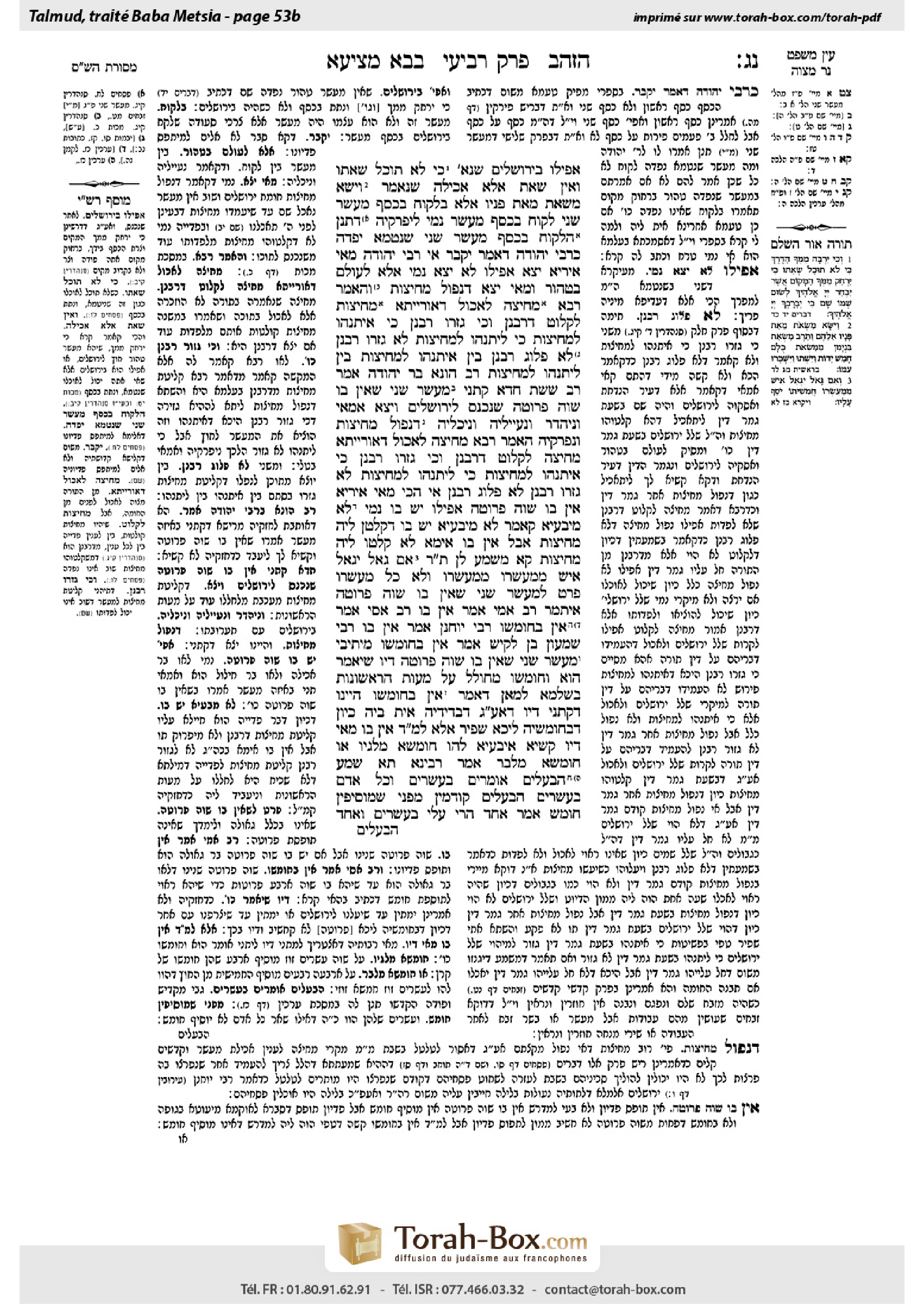
Bava Metzia 53b: Talmud study for Daf Yomi
Study the Talmud for Daf Yomi with scanned pages, Hebrew text, English translations from Sefaria and AI-generated French translations.
Passage selection and English or AI-generated French translation are available where the scan has annotations. Daf Study is independent of Torah-Box and Sefaria.
Browse Bava Metzia · בבא מציעא · All tractatesBava Metzia 53b text and translations
This page of Bava Metzia includes the Aramaic text, an English translation and an AI-generated French translation, alongside the scan above.
בבא מציעא נ״ג ב · Aramaic and Hebrew text
אֲפִילּוּ בִּירוּשָׁלַיִם – שֶׁנֶּאֱמַר: ״כִּי לֹא תוּכַל שְׂאֵתוֹ״, וְאֵין ״שְׂאֵת״ אֶלָּא אֲכִילָה, שֶׁנֶּאֱמַר: ״וַיִּשָּׂא מַשְׂאֹת מֵאֵת פָּנָיו״.
אֶלָּא בְּלָקוּחַ בְּכֶסֶף מַעֲשֵׂר שֵׁנִי. לָקוּחַ בְּכֶסֶף מַעֲשֵׂר נָמֵי לִיפְרְקֵיהּ, דִּתְנַן: הַלָּקוּחַ בְּכֶסֶף מַעֲשֵׂר שֵׁנִי שֶׁנִּטְמָא – יִפָּדֶה! כְּרַבִּי יְהוּדָה דְּאָמַר יִקָּבֵר.
אִי רַבִּי יְהוּדָה, מַאי אִירְיָא ״יָצָא״? אֲפִילּוּ לֹא יָצָא נָמֵי, אֶלָּא: לְעוֹלָם בְּטָהוֹר, וּמַאי ״יָצָא״ – דִּנְפוּל מְחִיצוֹת.
וְהָאָמַר רָבָא: מְחִיצָה לֶאֱכוֹל – דְּאוֹרָיְיתָא, מְחִיצוֹת לִקְלוֹט – דְּרַבָּנַן. וְכִי גְּזַרוּ דְּרַבָּנַן: כִּי אִיתַנְהוּ לִמְחִיצוֹת. כִּי לֵיתַנְהוּ לִמְחִיצוֹת – לָא גְּזַרוּ רַבָּנַן! לָא פְּלוּג רַבָּנַן בֵּין אִיתַנְהוּ לִמְחִיצוֹת, בֵּין לֵיתַנְהוּ לִמְחִיצוֹת.
רַב הוּנָא בַּר יְהוּדָה אָמַר רַב שֵׁשֶׁת: חֲדָא קָתָנֵי: מַעֲשֵׂר שֵׁנִי שֶׁאֵין בּוֹ שָׁוֶה פְּרוּטָה שֶׁנִּכְנַס לִירוּשָׁלַיִם וְיָצָא. אַמַּאי? וְנִיהְדַּר וּנְעַיְּילֵיהּ וְנֵיכְלֵיהּ! דִּנְפוּל מְחִיצוֹת.
וְנִפְרְקֵיהּ? הָאָמַר רָבָא: מְחִיצָה לֶאֱכוֹל דְּאוֹרָיְיתָא, מְחִיצָה לִקְלוֹט דְּרַבָּנַן, וְכִי גְּזַרוּ רַבָּנַן – כִּי אִיתַנְהוּ לִמְחִיצוֹת. כִּי לֵיתַנְהוּ לִמְחִיצוֹת – לָא גְּזַרוּ רַבָּנַן. לָא פְּלוּג רַבָּנַן.
אִי הָכִי, מַאי אִירְיָא אֵין בּוֹ שָׁוֶה פְּרוּטָה? אֲפִילּוּ יֵשׁ בּוֹ נָמֵי! לָא מִיבַּעְיָא קָאָמַר. לָא מִיבַּעְיָא יֵשׁ בּוֹ, דְּקָלְטָן לֵיהּ מְחִיצוֹת. אֲבָל אֵין בּוֹ, אֵימָא: לָא קְלַטוּ לֵיהּ מְחִיצוֹת, קָא מַשְׁמַע לַן.
תָּנוּ רַבָּנַן: ״אִם גָּאֹל יִגְאַל אִישׁ מִמַּעַשְׂרוֹ״, מִמַּעַשְׂרוֹ – וְלֹא כׇּל מַעַשְׂרוֹ. פְּרָט לְמַעֲשֵׂר שֵׁנִי שֶׁאֵין בּוֹ שָׁוֶה פְּרוּטָה. אִיתְּמַר. רַב אַמֵּי אָמַר: אֵין בּוֹ. רַב אַסִּי אָמַר: אֵין בְּחוּמְשׁוֹ. רַבִּי יוֹחָנָן אָמַר: אֵין בּוֹ. רַבִּי שִׁמְעוֹן בֶּן לָקִישׁ אָמַר: אֵין בְּחוּמְשׁוֹ.
מֵיתִיבִי: מַעֲשֵׂר שֵׁנִי שֶׁאֵין בּוֹ שָׁוֶה פְּרוּטָה – דַּיּוֹ שֶׁיֹּאמַר ״הוּא וְחוּמְשׁוֹ מְחוּלָּל עַל מָעוֹת רִאשׁוֹנוֹת״.
בִּשְׁלָמָא לְמַאן דְּאָמַר ״אֵין בְּחוּמְשׁוֹ״ – הַיְינוּ דְּקָתָנֵי ״דַּיּוֹ״, דְּאַף עַל גַּב דִּבְדִידֵיהּ אִית בֵּיהּ, כֵּיוָן דִּבְחוּמְשֵׁיהּ לֵיכָּא – שַׁפִּיר. אֶלָּא לְמַאן דְּאָמַר ״אֵין בּוֹ״, מַאי ״דַּיּוֹ״? קַשְׁיָא.
אִיבַּעְיָא לְהוּ: חוּמְשָׁא מִלְּגָיו, אוֹ חוּמְשָׁא מִלְּבַר? אָמַר רָבִינָא, תָּא שְׁמַע: הַבְּעָלִים אוֹמְרִים בְּעֶשְׂרִים, וְכׇל אָדָם בְּעֶשְׂרִים – הַבְּעָלִים קוֹדְמִין מִפְּנֵי שֶׁמּוֹסִיפִין חוֹמֶשׁ. אָמַר אֶחָד: הֲרֵי עָלַי בְּעֶשְׂרִים וְאֶחָד –
Bava Metzia 53b · English translation
even in Jerusalem, although ritually pure second tithe cannot be desacralized in Jerusalem? It is as it is stated: “For you are unable to carry [se’et] it…and you shall turn it into money, and bind up the money in your hand” (Deuteronomy 14:24–25). And se’et means nothing other than eating, as it is stated: “And he took portions [masot] from before him” (Genesis 43:34). Since ritually impure second-tithe produce may not be consumed, Rabbi Elazar holds that one may desacralize it even if it had been brought into Jerusalem.
Rather, the halakha of the baraita is taught not with regard to second-tithe produce, but with regard to food acquired with second-tithe money, which cannot be desacralized. The Gemara asks: With regard to food acquired with second-tithe money too, let him redeem it, as we learned in a mishna (Ma’aser Sheni 3:10): Food acquired with second-tithe money that became ritually impure should be redeemed. The Gemara answers: The baraita is in accordance with the opinion of Rabbi Yehuda, who says: Food acquired with second-tithe money that became ritually impure must be buried and may not be redeemed.
The Gemara asks: If the baraita is in accordance with the opinion of Rabbi Yehuda, why did the tanna teach specifically a case where the food exited Jerusalem? Even if it did not exit Jerusalem, that halakha also applies, as he holds that once the food becomes ritually impure it must be buried. Rather, actually, it is taught in the baraita with regard to second tithe that is ritually pure, and what is the meaning of exited? It is not that the produce actually exited Jerusalem. Rather, the baraita is discussing a case where the partitions, i.e., the walls, surrounding the city fell. The legal status of that second-tithe produce is that of produce that exited the city.
The Gemara asks: But doesn’t Rava say: The halakha that a partition enables one to eat second-tithe produce is by Torah law, and the halakha with regard to the capability of partitions of the city to gather second-tithe produce into the city is by rabbinic law, and when the Sages issued a decree that partitions gather second-tithe produce in terms of their being considered within the city, they did so only where there are intact partitions, but where there are no intact partitions, the Sages did not issue a decree? The Gemara answers: Once they issued the decree, the Sages did not distinguish between cases where there are intact partitions and cases where there are not intact partitions. Once the Sages issued the decree with regard to partitions and the produce being gathered they applied it globally. This is one manner of explaining the baraita.
Rav Huna bar Yehuda said that Rav Sheshet said: The tanna of the baraita is teaching one halakha: It is with regard to second-tithe produce that is not worth even one peruta and which both entered Jerusalem and then exited it. It cannot be redeemed because it is worth less than one peruta. The Gemara asks: Why? And let him bring it back into Jerusalem and partake of it there. The Gemara answers: It is a case where the partitions surrounding the city fell.
The Gemara asks: And let him redeem the second-tithe produce, as doesn’t Rava say: The halakha that a partition enables one to eat second-tithe produce is by Torah law, and the halakha with regard to the capability of partitions of the city to gather second-tithe produce into the city is by rabbinic law, and when the Sages issued a decree that partitions gather second-tithe produce in terms of their being considered within the city, they did so only where there are intact partitions, but where there are no intact partitions, the Sages did not issue a decree? The Gemara answers: The Sages did not distinguish between cases where there are intact partitions and cases where there are not intact partitions.
The Gemara comments: If so, why did the tanna teach specifically a case where the produce does not have the value of one peruta? The same would hold true even if it has the value of one peruta. The Gemara answers: The tanna is speaking utilizing the style of: It is not necessary. It is not necessary to state that if the produce has the value of one peruta the halakha is that the partitions gather it and it can no longer be redeemed, but if it does not have the value of one peruta, say that the partitions do not gather it. Therefore, he teaches us that the partitions gather even second-tithe produce worth less than one peruta, and it cannot be redeemed.
§ The Sages taught that it is written: “And if a man will redeem of his tithe, he shall add to it the fifth part thereof” (Leviticus 27:31), from which it is inferred: Of his tithe, but not all his tithe. This serves to exclude second tithe that does not have the value of one peruta, which cannot be redeemed. It was stated that there is an amoraic dispute with regard to this halakha. Rav Ami says: The second tithe cannot be redeemed in a case where the produce itself does not have the value of one peruta. Rav Asi says: The second tithe cannot be redeemed in a case where its additional payment of one-fifth does not have the value of one peruta. Other amora’im dispute the same issue. Rabbi Yoḥanan says: The produce itself does not have the value of one peruta. Rabbi Shimon ben Lakish says: Its additional payment of one-fifth does not have the value of one peruta.
The Gemara raises an objection from a baraita: With regard to second-tithe produce that does not have the value of one peruta, it is sufficient that he will say: It and its additional payment of one-fifth are desacralized upon the first coins upon which I already redeemed second-tithe produce.
The Gemara explains the objection: Granted, according to the one who says: There is not the value of a peruta in its additional payment of one-fifth, this is the reason that the tanna teaches: It is sufficient, which indicates that even though in the produce itself it has the value of one peruta, since there is not the value of a peruta in its one-fifth payment, it works out well, as it is sufficient if he redeems the produce with other second-tithe produce. But according to the one who says: It is in a case where the produce itself does not have the value of one peruta that the second tithe cannot be redeemed, what is the meaning of: It is sufficient? From the outset, there was never sufficient value for there to be any element of redemption. The Gemara concludes: Indeed, it is difficult to explain the baraita according to that opinion.
§ Apropos the additional payment of one-fifth, a dilemma was raised before the Sages: Is the payment of one-fifth calculated from within, i.e., one-fifth of the value of the redeemed item, or is the payment of one-fifth calculated from without, meaning one-quarter of the value of the redeemed item, which is one-fifth of the eventual payment, i.e., the principal plus the additional one-fifth? Ravina says: Come and hear a resolution of the dilemma from a baraita: In a case where the owner says he is willing to redeem consecrated property for twenty dinars, and any other person is willing to purchase the property for twenty dinars, the owners take precedence and redeem the property due to the fact that they are obligated to add one-fifth, and the Temple treasury profits more from the owner than from anyone else. If one who is not the owner said: It is incumbent upon me to desacralize it for twenty-one dinars,
Bava Metzia 53b · Traduction française (IA)
Même à Jérusalem, bien que la dîme secondaire pure ne puisse pas être désacrifiée à Jérusalem ? Il est dit : « Car vous ne pouvez pas porter [se’et] cela… et vous le changerez en argent, et vous attacherez l’argent à votre main » (Deutéronome 14:24–25). Et se’et signifie rien d’autre que manger, comme il est dit : « Et il prit des portions [masot] devant lui » (Genèse 43:34). Puisque les produits de dîme secondaire impurs ne peuvent pas être consommés, Rabbi Eléazar affirme que l’on peut désacrifier ces produits même s’ils ont été apportés à Jérusalem.
Au contraire, la halakha du baraïta est enseignée sans rapport aux produits de dîme secondaire, mais concernant les aliments achetés avec l’argent de dîme secondaire, qui ne peuvent pas être désacrifiés. La Guemara demande : Concernant les aliments achetés avec l’argent de dîme secondaire également, qu’on les rachète, comme nous l’avons appris dans une mitsva (Ma’aser Sheni 3:10) : Les aliments achetés avec l’argent de dîme secondaire qui sont devenus impurs doivent être rachetés. La Guemara répond : Le baraïta suit l’opinion de Rabbi Yéhuda, qui dit : Les aliments achetés avec l’argent de dîme secondaire qui sont devenus impurs doivent être enterrés et ne peuvent pas être rachetés.
La Guemara demande : Si le baraïta suit l’opinion de Rabbi Yéhuda, pourquoi le tanna a-t-il enseigné spécifiquement un cas où les aliments sont sortis de Jérusalem ? Même s’ils n’ont pas quitté Jérusalem, cette halakha s’applique également, car il considère que dès que les aliments deviennent impurs, ils doivent être enterrés. Au contraire, en réalité, le baraïta est enseigné concernant la dîme secondaire pure, et que signifie « sorti » ? Ce n’est pas que les produits aient réellement quitté Jérusalem. Au contraire, le baraïta discute d’un cas où les parois, c’est-à-dire les murs, entourant la ville sont tombés. Le statut juridique de cette dîme secondaire est celui des produits sortis de la ville.
La Guemara demande : Mais ne dit pas Rava : La halakha selon laquelle une paroi permet de manger les produits de dîme secondaire est selon la Loi divine, et la halakha concernant la capacité des parois de la ville à réunir les produits de dîme secondaire dans la ville est selon la loi rabbinique, et lorsque les Sages ont émis un décret selon lequel les parois réunissent les produits de dîme secondaire en les considérant comme étant à l’intérieur de la ville, ils l’ont fait uniquement là où les parois sont intactes, mais là où les parois ne sont pas intactes, les Sages n’ont pas émis de décret ? La Guemara répond : Une fois qu’ils ont émis le décret, les Sages n’ont pas distingué entre les cas où les parois sont intactes et ceux où elles ne le sont pas. Une fois que les Sages ont émis le décret concernant les parois et les produits réunis, ils l’ont appliqué globalement. C’est une manière d’expliquer le baraïta.
Rav Huna bar Yéhuda dit que Rav Sheshét a dit : Le tanna du baraïta enseigne une halakha : C’est concernant les produits de dîme secondaire qui ne valent même pas un peruta et qui sont entrés à Jérusalem puis sont sortis d’elle. Ils ne peuvent pas être rachetés car ils valent moins qu’un peruta. La Guemara demande : Pourquoi ? Et qu’on les ramène à Jérusalem et qu’on les consomme là-bas. La Guemara répond : C’est un cas où les parois entourant la ville sont tombées.
La Guemara demande : Et qu’on rachète les produits de dîme secondaire, car ne dit pas Rava : La halakha selon laquelle une paroi permet de manger les produits de dîme secondaire est selon la Loi divine, et la halakha concernant la capacité des parois de la ville à réunir les produits de dîme secondaire dans la ville est selon la loi rabbinique, et lorsque les Sages ont émis un décret selon lequel les parois réunissent les produits de dîme secondaire en les considérant comme étant à l’intérieur de la ville, ils l’ont fait uniquement là où les parois sont intactes, mais là où les parois ne sont pas intactes, les Sages n’ont pas émis de décret ? La Guemara répond : Les Sages n’ont pas distingué entre les cas où les parois sont intactes et ceux où elles ne le sont pas.
La Guemara commente : Si c’est ainsi, pourquoi le tanna a-t-il enseigné spécifiquement un cas où les produits n’ont pas la valeur d’un peruta ? La même chose s’appliquerait même s’ils avaient la valeur d’un peruta. La Guemara répond : Le tanna parle en utilisant le style : Il n’est pas nécessaire. Il n’est pas nécessaire de dire que si les produits ont la valeur d’un peruta, la halakha est que les parois les réunissent et qu’ils ne peuvent plus être rachetés, mais s’ils n’ont pas la valeur d’un peruta, disons que les parois ne les réunissent pas. Ainsi, il nous enseigne que les parois réunissent même les produits de dîme secondaire valant moins qu’un peruta, et qu’ils ne peuvent pas être rachetés.
Les Sages ont enseigné que ce qui est écrit : « Et si un homme rachète de sa dîme, il ajoutera à elle la cinquième partie de celle-ci » (Lévitique 27:31), d’où on déduit : De sa dîme, mais pas toute sa dîme. Cela sert à exclure la dîme secondaire qui ne vaut pas un peruta, qui ne peut pas être rachetée. Il a été dit qu’il y a un débat entre les amoraïm concernant cette halakha. Rav Ami dit : La dîme secondaire ne peut pas être rachetée dans un cas où le produit lui-même ne vaut pas un peruta. Rav Asi dit : La dîme secondaire ne peut pas être rachetée dans un cas où sa rémunération supplémentaire d’une cinquième partie ne vaut pas un peruta. D’autres amoraïm débattent de la même question. Rabbi Yoḥanan dit : Le produit lui-même ne vaut pas un peruta. Rabbi Shimon ben Lakish dit : Sa rémunération supplémentaire d’une cinquième partie ne vaut pas un peruta.
La Guemara soulève une objection à partir d’un baraïta : Concernant les produits de dîme secondaire qui ne valent pas un peruta, il suffit qu’il dise : Il et sa rémunération supplémentaire d’une cinquième partie sont désacrifiés sur les premières monnaies sur lesquelles j’ai déjà racheté la dîme secondaire.
La Guemara explique l'objection : Cela est vrai, selon celui qui dit : Il n'y a pas la valeur d'un peruta dans le paiement supplémentaire d'un cinquième, c'est la raison pour laquelle le tanna enseigne : C'est suffisant, ce qui indique que même si dans le produit lui-même il a la valeur d'un peruta, puisque la valeur d'un peruta n'est pas trouvée dans le paiement d'un cinquième, cela s'avère bien, car il suffit qu'il le rachète avec d'autres produits de la deuxième part. Mais selon celui qui dit : C'est dans un cas où le produit lui-même n'a pas la valeur d'un peruta que la deuxième part ne peut être rachetée, quelle est la signification de : C'est suffisant ? D'entrée de jeu, il n'y avait jamais suffisamment de valeur pour qu'il y ait un élément de rachat. La Guemara conclut : En effet, il est difficile d'expliquer la baraïta selon cet avis.
§ A propos du paiement supplémentaire d'un cinquième, un dilemme a été soulevé devant les Sages : Le paiement d'un cinquième est-il calculé à l'intérieur, c'est-à-dire un cinquième de la valeur de l'objet racheté, ou le paiement d'un cinquième est-il calculé à l'extérieur, c'est-à-dire un quart de la valeur de l'objet racheté, ce qui est un cinquième de la valeur finale, c'est-à-dire le principal plus le cinquième supplémentaire ? Ravina dit : Viens écouter une résolution du dilemme à partir d'une baraïta : Dans un cas où l'propriétaire dit qu'il est prêt à racheter un objet consacré pour vingt dinars, et toute autre personne est prêt à acheter l'objet pour vingt dinars, les propriétaires ont la priorité et rachètent l'objet en raison du fait qu'ils sont obligés d'ajouter un cinquième, et le trésor du Temple en profite davantage par le propriétaire que par quiconque d'autre. Si celui qui n'est pas le propriétaire dit : Il m'est imposé de désacraliser l'objet pour vingt et un dinars,
Traduction française générée par IA à partir de l’édition anglaise de Sefaria. Vérifie toujours un passage avec le texte source.
Text from Sefaria: William Davidson Edition - Vocalized Aramaic (CC BY NC); William Davidson Edition - English (CC BY NC).