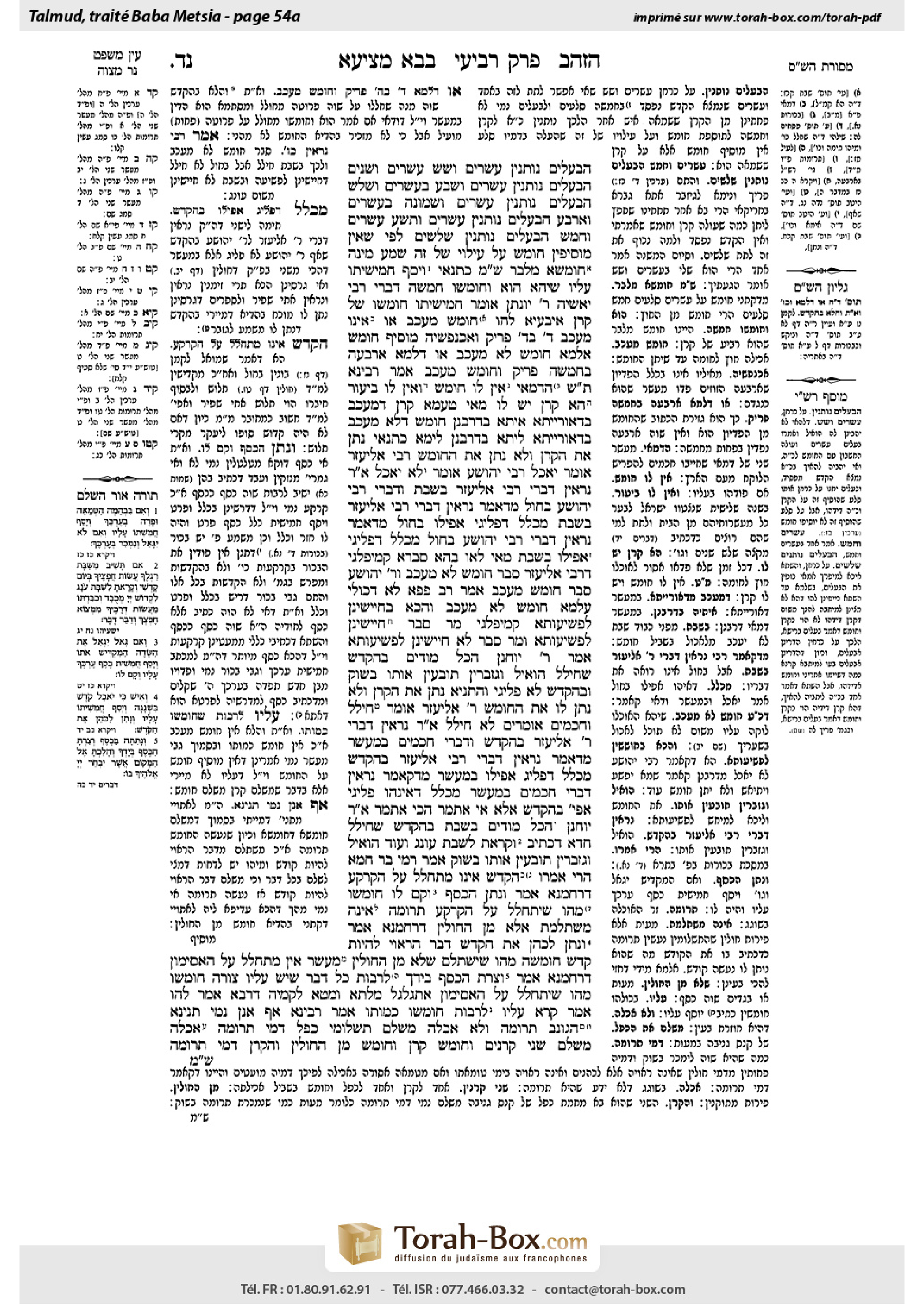
Bava Metzia 54a: Talmud study for Daf Yomi
Study the Talmud for Daf Yomi with scanned pages, Hebrew text, English translations from Sefaria and AI-generated French translations.
Passage selection and English or AI-generated French translation are available where the scan has annotations. Daf Study is independent of Torah-Box and Sefaria.
Browse Bava Metzia · בבא מציעא · All tractatesBava Metzia 54a text and translations
This page of Bava Metzia includes the Aramaic text, an English translation and an AI-generated French translation, alongside the scan above.
בבא מציעא נ״ד א · Aramaic and Hebrew text
הַבְּעָלִים נוֹתְנִין עֶשְׂרִים וָשֵׁשׁ. עֶשְׂרִים וּשְׁנַיִם – הַבְּעָלִים נוֹתְנִין עֶשְׂרִים וָשֶׁבַע. בְּעֶשְׂרִים וְשָׁלֹשׁ – הַבְּעָלִים נוֹתְנִין עֶשְׂרִים וּשְׁמוֹנֶה. בְּעֶשְׂרִים וְאַרְבַּע – הַבְּעָלִים נוֹתְנִין עֶשְׂרִים וָתֵשַׁע.
עֶשְׂרִים וְחָמֵשׁ – הַבְּעָלִים נוֹתְנִין שְׁלֹשִׁים, לְפִי שֶׁאֵין מוֹסִיפִין חוֹמֶשׁ עַל עִילּוּי שֶׁל זֶה. שְׁמַע מִינַּהּ חוּמְשָׁא מִלְּבַר. שְׁמַע מִינַּהּ.
כְּתַנָּאֵי: ״וְיָסַף חֲמִשִׁתוֹ עָלָיו״, שֶׁיְּהֵא הוּא וְחוּמְשׁוֹ חֲמִשָּׁה, דִּבְרֵי רַבִּי יֹאשִׁיָּה. רַבִּי יוֹנָתָן אוֹמֵר: חֲמִישִׁיתוֹ חוּמְשׁוֹ שֶׁל קֶרֶן.
אִיבַּעְיָא לְהוּ: חוֹמֶשׁ מְעַכֵּב, אוֹ אֵינוֹ מְעַכֵּב? אַרְבְּעָה בְּאַרְבְּעָה פָּרֵיק, וְאַכְּנַפְשֵׁיהּ מוֹסִיף חוֹמֶשׁ, אַלְמָא חוֹמֶשׁ לָא מְעַכֵּב. אוֹ דִּלְמָא אַרְבְּעָה בְּחַמְשָׁה פָּרֵיק, וְחוֹמֶשׁ מְעַכֵּב.
אָמַר רָבִינָא, תָּא שְׁמַע: הַדְּמַאי – אֵין לוֹ חוֹמֶשׁ, וְאֵין לוֹ בִּיעוּר.
הָא קֶרֶן יֵשׁ לוֹ. מַאי טַעְמָא? קֶרֶן דִּמְעַכֵּב בִּדְאוֹרָיְיתָא – אִיתַהּ בִּדְרַבָּנַן, חוֹמֶשׁ דְּלָא מְעַכֵּב בִּדְאוֹרָיְיתָא – לֵיתַהּ בִּדְרַבָּנַן.
לֵימָא כְּתַנָּאֵי: נָתַן אֶת הַקֶּרֶן, וְלֹא נָתַן אֶת הַחוֹמֶשׁ, רַבִּי אֱלִיעֶזֶר אוֹמֵר: יֹאכַל. רַבִּי יְהוֹשֻׁעַ אוֹמֵר: לֹא יֹאכַל. אָמַר רַבִּי: נִרְאִין דִּבְרֵי רַבִּי אֱלִיעֶזֶר בַּשַּׁבָּת, וְדִבְרֵי רַבִּי יְהוֹשֻׁעַ בַּחוֹל.
מִדְּאָמַר נִרְאִין דִּבְרֵי רַבִּי אֱלִיעֶזֶר בַּשַּׁבָּת, מִכְּלָל דִּפְלִיגִי אֲפִילּוּ בְּחוֹל. מִדְּאָמַר נִרְאִין דִּבְרֵי רַבִּי יְהוֹשֻׁעַ בַּחוֹל, מִכְּלָל דִּפְלִיגִי אֲפִילּוּ בְּשַׁבָּת.
מַאי לָאו בְּהָא סְבָרָא קָמִיפַּלְגִי: דְּרַבִּי אֱלִיעֶזֶר סָבַר חוֹמֶשׁ לָא מְעַכֵּב, וְרַבִּי יְהוֹשֻׁעַ סָבַר חוֹמֶשׁ מְעַכֵּב?
אָמַר רַב פָּפָּא: לָא, דְּכוּלֵּי עָלְמָא חוֹמֶשׁ לָא מְעַכֵּב. וְהָכָא בְּחָיְישִׁינַן לִפְשִׁיעוּתָא קָמִיפַּלְגִי. מָר סָבַר חָיְישִׁינַן לִפְשִׁיעוּתָא. וּמַר סָבַר לָא חָיְישִׁינַן לִפְשִׁיעוּתָא.
אָמַר רַבִּי יוֹחָנָן: הַכֹּל מוֹדִים בְּהֶקְדֵּשׁ – שֶׁחִילֵּל, הוֹאִיל וְגִזְבָּרִין תּוֹבְעִין אוֹתוֹ בַּשּׁוּק.
וּבְהֶקְדֵּשׁ לָא פְּלִיגִי? וְהָתַנְיָא: נָתַן אֶת הַקֶּרֶן, וְלֹא נָתַן לוֹ אֶת הַחוֹמֶשׁ, רַבִּי אֱלִיעֶזֶר אוֹמֵר: חִילֵּל, וַחֲכָמִים אוֹמְרִים: לֹא חִילֵּל. אָמַר רַבִּי: נִרְאִין דִּבְרֵי רַבִּי אֱלִיעֶזֶר בְּהֶקְדֵּשׁ, וְדִבְרֵי חֲכָמִים בְּמַעֲשֵׂר.
מִדְּאָמַר נִרְאִין דִּבְרֵי רַבִּי אֱלִיעֶזֶר בְּהֶקְדֵּשׁ – מִכְּלָל דִּפְלִיג אֲפִילּוּ בְּמַעֲשֵׂר. מִדְּקָאָמַר נִרְאִין דִּבְרֵי חֲכָמִים בְּמַעֲשֵׂר – מִכְּלָל דְּאִינְהוּ פְּלִיגִי אֲפִילּוּ בְּהֶקְדֵּשׁ!
אֶלָּא אִי אִתְּמַר, הָכִי אִתְּמַר: אָמַר רַבִּי יוֹחָנָן: הַכֹּל מוֹדִים בְּשַׁבָּת בְּהֶקְדֵּשׁ שֶׁחִילֵּל. חֲדָא – דִּכְתִיב: ״וְקָרָאתָ לַשַּׁבָּת עֹנֶג״. וְעוֹד, הוֹאִיל וְגִזְבָּרִין תּוֹבְעִין אוֹתוֹ בַּשּׁוּק.
אָמַר רָמֵי בַּר חָמָא: הֲרֵי אָמְרוּ הֶקְדֵּשׁ אֵינוֹ מִתְחַלֵּל עַל הַקַּרְקַע, דְּרַחֲמָנָא אָמַר: ״וְנָתַן הַכֶּסֶף וְקָם לוֹ״. חוּמְשׁוֹ מַהוּ שֶׁיִּתְחַלֵּל עַל הַקַּרְקַע?
תְּרוּמָה אֵינָהּ מִשְׁתַּלֶּמֶת אֶלָּא מִן הַחוּלִּין. דְּרַחֲמָנָא אָמַר: ״וְנָתַן לַכֹּהֵן אֶת הַקֹּדֶשׁ״, דָּבָר הָרָאוּי לִהְיוֹת קֹדֶשׁ. חוּמְשָׁהּ מַהוּ שֶׁיִּשְׁתַּלֵּם שֶׁלֹּא מִן הַחוּלִּין?
מַעֲשֵׂר אֵין מִתְחַלֵּל עַל הָאֲסִימוֹן. דְּרַחֲמָנָא אָמַר: ״וְצַרְתָּ הַכֶּסֶף בְּיָדְךָ״, לְרַבּוֹת כׇּל דָּבָר שֶׁיֵּשׁ עָלָיו צוּרָה. חוּמְשׁוֹ מַהוּ שֶׁיִּתְחַלֵּל עַל הָאֲסִימוֹן?
אִתְגַּלְגַּל מִלְּתָא וּמְטָא לְקַמֵּיהּ דְּרָבָא. אֲמַר לְהוּ: אָמַר קְרָא ״עָלָיו״, לְרַבּוֹת חוּמְשׁוֹ כְּמוֹתוֹ.
אָמַר רָבִינָא: אַף אֲנַן נָמֵי תְּנֵינָא, הַגּוֹנֵב תְּרוּמָה וְלֹא אֲכָלָהּ – מְשַׁלֵּם תַּשְׁלוּמֵי כֶפֶל דְּמֵי תְרוּמָה. אֲכָלָהּ – מְשַׁלֵּם שְׁנֵי קְרָנִים וָחוֹמֶשׁ. קֶרֶן וָחוֹמֶשׁ מִן הַחוּלִּין, וְהַקֶּרֶן דְּמֵי תְרוּמָה.
Bava Metzia 54a · English translation
the owner gives a payment of twenty-six dinars. Were they to enable the other person to purchase it for twenty-one dinars, the Temple treasury would incur a loss, as the principal plus one-fifth paid by the owner is greater than the payment of the other person, who must pay only the principal. Were the owner to pay only twenty for the principal and add one-fifth, the principal paid by the owner is less than the sum offered by the other person. Therefore, the owner pays the principal proposed by the other person and then adds the payment of one-fifth that he was obligated to pay based on his own offer, i.e., five dinars, for a total of twenty-six. Likewise, if the other person offers twenty-two dinars, the owner gives twenty-seven; if the other person offers twenty-three, the owner gives twenty-eight; if the other person offers twenty-four, the owner gives twenty-nine.
If the other person offers twenty-five dinars, the owner gives thirty, due to the fact that the owner does not add one-fifth based on the raise in the offer of this other person, but only on the principal according to his own offer. It is clear from these calculations that a principal of twenty plus an addition of one-fifth equal twenty-five dinars. Learn from it that one-fifth is calculated from without, meaning one-quarter of the value of the redeemed item. The Gemara affirms: Learn from it that this is the halakha.
The Gemara comments: The two sides of this dilemma are parallel to a dispute between tanna’im, as it is taught in a baraita that it is written: “And shall add unto it one-fifth part thereof” (Leviticus 27:27). This means that the item and its additional one-fifth payment will total five parts; one-fifth is calculated from without; this is the statement of Rabbi Yoshiya. Rabbi Yonatan says: Its one-fifth means one-fifth of the principal; one-fifth is calculated from within.
§ A dilemma was raised before the Sages: Does failure to pay the additional one-fifth prevent consumption outside of Jerusalem of second tithe that was redeemed, or does it not prevent consumption? The dilemma is: Is second-tithe produce worth four dinars redeemed with four dinars, and the obligation to add the payment of one-fifth is an obligation incumbent upon the owner himself? In that case, apparently, failure to pay the additional one-fifth does not prevent consumption. Or perhaps second-tithe produce worth four dinars is redeemed with five dinars, no less, and failure to pay the additional one-fifth prevents consumption.
Ravina said: Come and hear a resolution to this dilemma from a mishna (Demai 1:2): For second tithe of doubtfully tithed produce [demai], whose status is that of untithed produce by rabbinic law, there is no payment of one-fifth if the owner redeems its second tithe, and there is no obligation of the eradication of tithes after three years, as is the case with tithes taken from untithed produce.
Ravina explains: But by inference, there is payment of principal. Although there is no obligation to add one-fifth, second tithe separated from demai requires redemption. What is the reason for this? Apparently, concerning the principal, about which failure to pay it prevents consumption of second tithe of untithed produce by Torah law, it is also a sum that must be paid in the case of demai by rabbinic law. Concerning the payment of one-fifth, about which failure to pay it does not prevent consumption of second tithe of untithed produce by Torah law, it is not a sum that must be paid in the case of demai by rabbinic law.
The Gemara suggests: Let us say that the two sides of this dilemma are parallel to a dispute between tanna’im, as it is taught in a baraita: In a case where one gave payment to redeem the principal but did not give payment of the additional one-fifth, Rabbi Eliezer says: One may eat it, and Rabbi Yehoshua says: One may not eat it. Rabbi Yehuda HaNasi said: The statement of Rabbi Eliezer appears correct with regard to Shabbat, when the Sages deemed it permitted for one to eat without the additional payment, in deference to Shabbat, and the statement of Rabbi Yehoshua appears correct with regard to the days of the week.
The Gemara infers: From the fact that Rabbi Yehuda HaNasi says: The statement of Rabbi Eliezer appears correct with regard to Shabbat, by inference they disagree even with regard to the days of the week. Likewise, from the fact that Rabbi Yehuda HaNasi says: The statement of Rabbi Yehoshua appears correct with regard to the days of the week, by inference they disagree even with regard to Shabbat. Apparently, theirs is a fundamental dispute.
What, is it not that they disagree with regard to this reasoning, that Rabbi Eliezer holds that failure to pay the additional one-fifth does not prevent consumption, as redemption of the principal alone suffices; and Rabbi Yehoshua holds that failure to pay the additional one-fifth prevents consumption?
Rav Pappa said: No, perhaps the explanation is that everyone agrees that failure to pay the additional one-fifth does not prevent consumption, and here they disagree with regard to whether we are concerned for potential negligence. One Sage, Rabbi Yehoshua, holds: We are concerned for negligence, lest one fail to pay the additional one-fifth and therefore the owner may not eat the second-tithe produce until he adds the one-fifth payment. And one Sage, Rabbi Eliezer, holds: We are not concerned for negligence, and one will presumably add the one-fifth payment later.
Rabbi Yoḥanan says: Although the tanna’im disagree with regard to second tithe, all concede with regard to consecrated property that if the one who consecrated it paid the principal and did not add one-fifth, that he successfully desacralized the produce, since the Temple treasurers demand payment from him in the marketplace, preventing any potential negligence. Therefore, he may use the property immediately.
The Gemara asks: And do they not disagree with regard to consecrated property? But isn’t it taught in a baraita: In a case where one gave payment to redeem the principal but did not give him payment of the additional one-fifth, Rabbi Eliezer says: He successfully desacralized the produce, and the Rabbis say: He did not desacralize the produce? Rabbi Yehuda HaNasi said: The statement of Rabbi Eliezer appears correct with regard to consecrated property, and the statement of the Rabbis appears correct with regard to second tithe.
The Gemara infers: From the fact that Rabbi Yehuda HaNasi says that the statement of Rabbi Eliezer appears correct with regard to consecrated property, by inference they disagree even with regard to second tithe. Likewise, from the fact that Rabbi Yehuda HaNasi said that the statement of the Rabbis appears correct with regard to second tithe, by inference they disagree even with regard to consecrated property. This contradicts Rabbi Yoḥanan’s statement that there is no dispute with regard to consecrated property.
Rather, if it was stated, it was stated like this: Rabbi Yoḥanan says: All concede that concerning Shabbat with regard to consecrated property that he successfully desacralized the property. One reason for this halakha is as it is written: “And you shall call Shabbat a delight” (Isaiah 58:13). The Sages sought to facilitate that delight in Shabbat by ruling leniently. And furthermore, it is desacralized without payment of the additional one-fifth, since the Temple treasurers demand payment from him in the marketplace.
§ Rami bar Ḥama says: The Sages said that consecrated property cannot be desacralized with land, as the Merciful One states with regard to the redemption of a consecrated field: “And he will give the money and it will be assured to him” (Leviticus 27:19), indicating that redemption is accomplished with money. The question is with regard to payment of its additional one-fifth: What is the halakha in terms of the possibility that it will be desacralized with land?
If a non-priest unwittingly ate teruma, his debt can be repaid to the priest only with non-sacred property, not with teruma, as the Merciful One states: “And if a man eats that which is sacred unwittingly…and he shall give that which is sacred to a priest” (Leviticus 22:14), from which it is derived that repayment must be with an item fit to become sacred, i.e., a non-sacred item, not teruma, which cannot be consecrated again. The question is with regard to payment of its additional one-fifth: What is the halakha in terms of the possibility that it will be repaid not from non-sacred items, but from teruma?
Second-tithe produce cannot be desacralized with an unminted coin, as the Merciful One states: “And you shall bind up [vetzarta] the money in your hand” (Deuteronomy 14:25), which the Sages interpret as serving to include any item that has the imprint [tzura] of a coin upon it for desacralization, not an unminted coin. The question is with regard to payment of its additional one-fifth: What is the halakha in terms of the possibility that it will be desacralized with an unminted coin?
Rami bar Ḥama was unable to resolve this series of dilemmas, and the matter proceeded and came before Rava, who said to the people who related the dilemmas to him: The verse states: “And shall add unto it one-fifth part thereof” (Leviticus 27:27), which serves to include its additional one-fifth within the same legal status as that of its principal.
Ravina said: We too learn this in a mishna (Terumot 6:4): One who steals teruma and did not partake of it pays a payment of double the principal at the price of the teruma, as a thief pays double the value of the item that he stole. Both payments are calculated based on the price of teruma, which is lower than the price of non-sacred food, as the demand for it is lower because it is eaten only by priests. If the thief ate it unwittingly, he pays a payment worth the value of two principals and adds one-fifth in this manner: He pays one principal and one-fifth from non-sacred items, like any non-priest who partakes of teruma, and with regard to the other principal, he pays it according to the price of teruma.
Bava Metzia 54a · Traduction française (IA)
L'acharnier paie vingt-six dinars. S'ils permettaient à l'autre personne d'acheter l'objet pour vingt-et-un dinars, le trésor du Temple subirait une perte, car la somme principale plus un cinquième payé par l'acharnier est supérieure au paiement de l'autre personne, qui doit payer uniquement la somme principale. Si l'acharnier ne payait que vingt dinars pour la somme principale et ajoutait un cinquième, la somme principale payée par l'acharnier serait inférieure à celle offerte par l'autre personne. Par conséquent, l'acharnier paie la somme principale proposée par l'autre personne et ajoute le paiement d'un cinquième qu'il était tenu de payer selon son propre offre, c'est-à-dire cinq dinars, pour un total de vingt-six. De même, si l'autre personne offre vingt-deux dinars, l'acharnier paie vingt-sept ; si l'autre personne offre vingt-trois dinars, l'acharnier paie vingt-huit ; si l'autre personne offre vingt-quatre dinars, l'acharnier paie vingt-neuf.
Si l'autre personne offre vingt-cinq dinars, l'acharnier paie trente, en raison du fait que l'acharnier ne rajoute pas un cinquième en fonction de l'augmentation de l'offre de cette autre personne, mais uniquement sur la somme principale selon son propre offre. Il est clair à partir de ces calculs que la somme principale de vingt dinars plus l'ajout d'un cinquième équivaut à vingt-cinq dinars. Apprenez-en que le cinquième est calculé à partir de l'extérieur, c'est-à-dire un quart de la valeur de l'objet racheté. La Guemara affirme : Apprenez-en que c'est la halakha.
La Guemara commente : Les deux côtés de ce dilemme sont parallèles à un débat entre tannaïm, comme il est enseigné dans une baraïta qui dit : « Et il ajoutera à cela un cinquième de cela » (Lévitique 27:27). Cela signifie que l'objet et son ajout d'un cinquième totalisent cinq parties ; le cinquième est calculé à partir de l'extérieur ; c'est l'opinion de Rabbi Yossé. Rabbi Yonatan dit : Son cinquième signifie un cinquième de la somme principale ; le cinquième est calculé à partir de l'intérieur.
§ Un dilemme a été soulevé devant les Sages : L'échec de payer le cinquième supplémentaire empêche-t-il la consommation en dehors de Jérusalem du dîme secondaire racheté, ou ne l'empêche-t-il pas ? Le dilemme est : Un dîme secondaire de valeur quatre dinars est racheté avec quatre dinars, et l'obligation d'ajouter le paiement d'un cinquième est une obligation qui incombe à l'acheteur lui-même ? Dans ce cas, apparemment, l'échec de payer le cinquième supplémentaire ne bloque pas la consommation. Ou peut-être un dîme secondaire de valeur quatre dinars est racheté avec cinq dinars, pas moins, et l'échec de payer le cinquième supplémentaire bloque la consommation.
Ravina dit : Venez écouter une résolution à ce dilemme à partir d'une mitsva (Demai 1:2) : Pour un dîme secondaire de produit douteusement tithé [demai], dont le statut est celui d'un produit non tithé selon la loi rabbinique, il n'y a pas de paiement d'un cinquième si l'acheteur rachète son dîme secondaire, et il n'y a pas d'obligation d'effacer les dîmes après trois ans, comme c'est le cas avec les dîmes prises à partir de produits non tithés.
Ravina explique : Mais par déduction, il y a un paiement de la somme principale. Bien qu'il n'y ait pas d'obligation d'ajouter un cinquième, le dîme secondaire séparé de demai nécessite un rachat. Quelle est la raison de cela ? Apparemment, concernant la somme principale, dont l'échec à le payer bloque la consommation du dîme secondaire de produit non tithé selon la loi divine, il s'agit également d'une somme qui doit être payée dans le cas de demai selon la loi rabbinique. Concernant le paiement d'un cinquième, dont l'échec à le payer ne bloque pas la consommation du dîme secondaire de produit non tithé selon la loi divine, il ne s'agit pas d'une somme qui doit être payée dans le cas de demai selon la loi rabbinique.
La Guemara suggère : Disons que les deux côtés de ce dilemme sont parallèles à un débat entre tannaïm, comme il est enseigné dans une baraïta : Dans un cas où l'on a payé pour racheter la somme principale mais n'a pas payé le paiement d'un cinquième supplémentaire, Rabbi Eliezer dit : On peut le manger, et Rabbi Yéhoshua dit : On ne peut pas le manger. Rabbi Yehuda HaNasi dit : L'opinion de Rabbi Eliezer semble correcte concernant le Shabbat, lorsque les Sages ont estimé qu'il était permis de manger sans le paiement supplémentaire, en faveur du Shabbat, et l'opinion de Rabbi Yéhoshua semble correcte concernant les jours de la semaine.
La Guemara infère : À partir du fait que Rabbi Yehuda HaNasi dit : L'opinion de Rabbi Eliezer semble correcte concernant le Shabbat, par déduction ils divergent même concernant les jours de la semaine. De même, à partir du fait que Rabbi Yehuda HaNasi dit : L'opinion de Rabbi Yéhoshua semble correcte concernant les jours de la semaine, par déduction ils divergent même concernant le Shabbat. Apparemment, c'est un débat fondamental.
Qu'est-ce que cela signifie, qu'ils divergent concernant cette raisonnement, que Rabbi Eliezer maintient que l'échec à payer le cinquième supplémentaire ne bloque pas la consommation, car le rachat de la somme principale seul suffit ; et Rabbi Yéhoshua maintient que l'échec à payer le cinquième supplémentaire bloque la consommation ?
Rav Pappa dit : Non, peut-être l'explication est que tout le monde convient que l'échec à payer le cinquième supplémentaire ne bloque pas la consommation, et ici ils divergent concernant le fait que nous soyons préoccupés par la négligence potentielle. Un sage, Rabbi Yéhoshua, dit : Nous sommes préoccupés par la négligence, de peur qu'une personne échoue à payer le cinquième supplémentaire et que l'owner ne puisse pas manger le dîme secondaire jusqu'à ce qu'il ajoute le paiement du cinquième. Et un sage, Rabbi Eliezer, dit : Nous ne sommes pas préoccupés par la négligence, et on supposera que l'owner ajoutera le paiement du cinquième plus tard.
Rabbi Yoḥanan dit : Bien que les tannaïm divergent concernant le dîme secondaire, tous reconnaissent concernant la propriété consacrée que si celui qui a consacré la propriété a payé la somme principale et n'a pas ajouté un cinquième, il a réussi à désacraliser la production, car les trésoriers du Temple exigent un paiement de lui sur le marché, empêchant toute négligence potentielle. Par conséquent, il peut utiliser la propriété immédiatement.
Le Guemara pose la question : Et ne s'agit-il pas d'une divergence d'opinions concernant la propriété consacrée ? Mais n'est-il pas enseigné dans une baraïta : Dans un cas où l'on a versé une récompense pour racheter le principal mais qu'on n'a pas versé la récompense de l'addition du cinquième, Rabbi Eliezer dit : Il a réussi à désacrifier la production, et les Sages disent : Il n'a pas réussi à désacrifier la production ? Rabbi Yehuda HaNasi dit : L'affirmation de Rabbi Eliezer semble correcte concernant la propriété consacrée, et l'affirmation des Sages semble correcte concernant la dîme de second rang.
Le Guemara en déduit : Du fait que Rabbi Yehuda HaNasi dit que l'affirmation de Rabbi Eliezer semble correcte concernant la propriété consacrée, on en déduit qu'ils divergent même concernant la dîme de second rang. De même, du fait que Rabbi Yehuda HaNasi a dit que l'affirmation des Sages semble correcte concernant la dîme de second rang, on en déduit qu'ils divergent même concernant la propriété consacrée. Cela contredit l'affirmation de Rabbi Yoḥanan selon laquelle il n'y a pas de divergence concernant la propriété consacrée.
Plutôt, si cela a été dit, cela a été dit ainsi : Rabbi Yoḥanan dit : Tout le monde reconnaît que concernant le Shabbat concernant la propriété consacrée, il a réussi à désacrifier la propriété. Une raison pour cette halakha est que cela est écrit : « Et tu appelleras le Shabbat un délice » (Yachin 58:13). Les Sages ont cherché à faciliter ce délice du Shabbat en adoptant une interprétation clémente. Et de plus, il est désacrifié sans le paiement du cinquième additionnel, car les trésoriers du Temple exigeant le paiement dans le marché.
§ Rami bar Ḥama dit : Les Sages ont dit que la propriété consacrée ne peut être désacrifiée avec la terre, car l'Éternel dit concernant le rachat d'un champ consacré : « Et il donnera l'argent et cela sera assuré à lui » (Lévitique 27:19), indiquant que le rachat est accompli avec de l'argent. La question est concernant le paiement du cinquième additionnel : Quelle est la halakha en termes de la possibilité qu'il soit désacrifié avec la terre ?
Si un non-prêtre mange accidentellement la terouma, sa dette peut être remboursée au prêtre uniquement avec une propriété non sacrée, pas avec la terouma, car l'Éternel dit : « Et si un homme mange ce qui est sacré accidentellement… et il donnera ce qui est sacré à un prêtre » (Lévitique 22:14), d'où on déduit que le remboursement doit être fait avec un objet adapté à devenir sacré, c'est-à-dire un objet non sacré, pas la terouma, qui ne peut pas être reconsecrée. La question est concernant le paiement du cinquième additionnel : Quelle est la halakha en termes de la possibilité qu'il soit remboursé non à partir d'objets non sacrés, mais à partir de la terouma ?
La production de la dîme de second rang ne peut pas être désacrifiée avec une pièce non moulée, car l'Éternel dit : « Et tu enverras [vetzarta] l'argent dans ta main » (Deutéronome 14:25), que les Sages interprètent comme incluant tout objet ayant l'impression [tzura] d'une pièce pour le désacrif, pas une pièce non moulée. La question est concernant le paiement du cinquième additionnel : Quelle est la halakha en termes de la possibilité qu'il soit désacrifié avec une pièce non moulée ?
Rami bar Ḥama n'a pas réussi à résoudre cette série de dilemmes, et l'affaire a été portée devant Rava, qui a dit aux gens qui lui avaient rapporté les dilemmes : La Torah écrite dit : « Et il ajoutera à cela un cinquième de cela » (Lévitique 27:27), ce qui sert à inclure son cinquième additionnel dans le même statut juridique que celui de son principal.
Ravina dit : Nous aussi, nous apprenons cela dans une mitsva (Terumot 6:4) : Celui qui vole la terouma et n'a pas mangé de celle-ci paie un paiement double du principal au prix de la terouma, car un voleur paie double la valeur de l'objet qu'il a volé. Les deux paiements sont calculés selon le prix de la terouma, qui est inférieur au prix des aliments non sacrés, car la demande pour celle-ci est moindre car elle est mangée uniquement par les prêtres. Si le voleur l'a mangé accidentellement, il paie un paiement équivalent à la valeur de deux principaux et ajoute un cinquième de cette manière : Il paie un principal et un cinquième à partir d'objets non sacrés, comme tout non-prêtre qui mange de la terouma, et concernant l'autre principal, il le paie selon le prix de la terouma.
Traduction française générée par IA à partir de l’édition anglaise de Sefaria. Vérifie toujours un passage avec le texte source.
Text from Sefaria: William Davidson Edition - Vocalized Aramaic (CC BY NC); William Davidson Edition - English (CC BY NC).