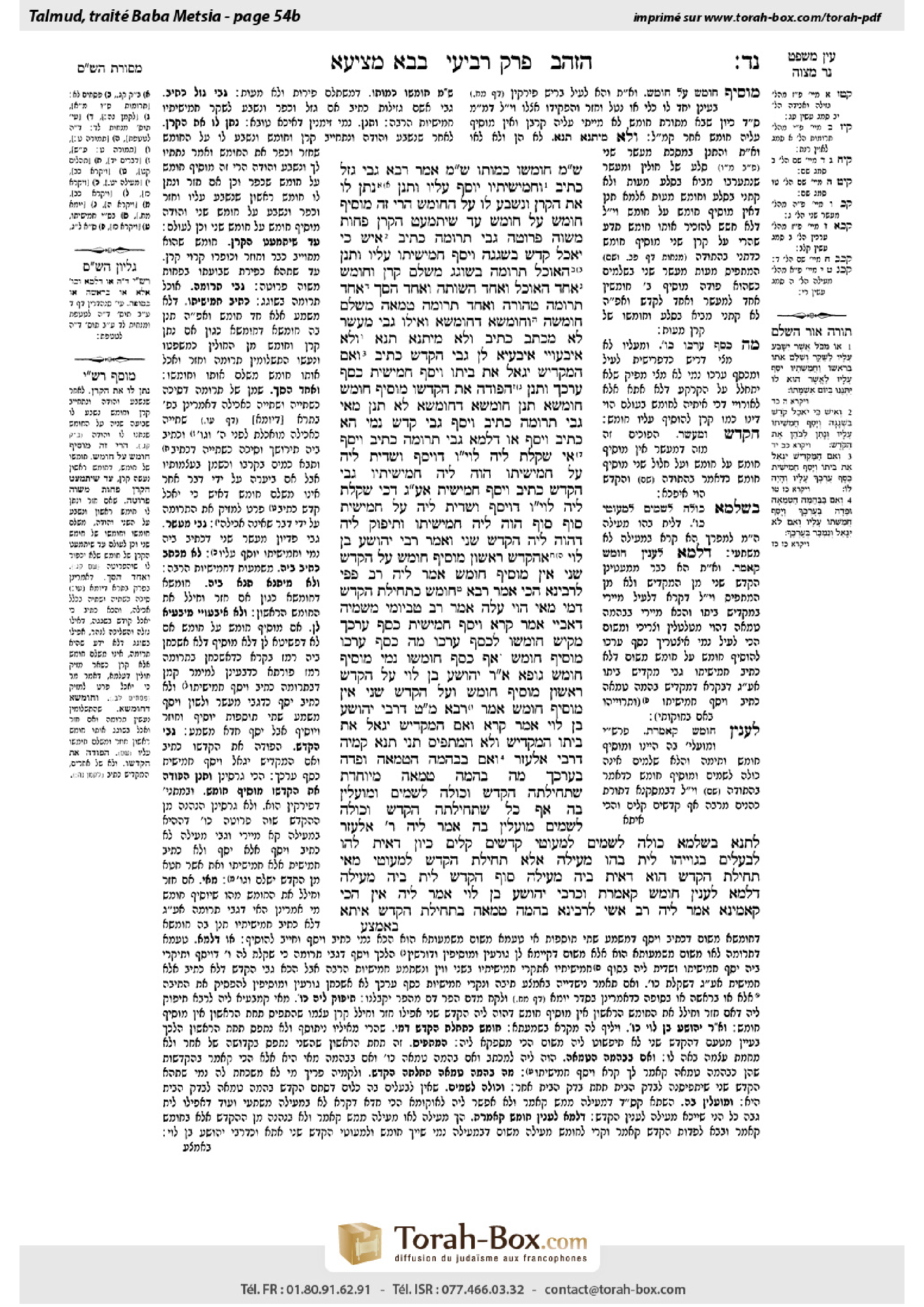
Bava Metzia 54b: Talmud study for Daf Yomi
Study the Talmud for Daf Yomi with scanned pages, Hebrew text, English translations from Sefaria and AI-generated French translations.
Passage selection and English or AI-generated French translation are available where the scan has annotations. Daf Study is independent of Torah-Box and Sefaria.
Browse Bava Metzia · בבא מציעא · All tractatesBava Metzia 54b text and translations
This page of Bava Metzia includes the Aramaic text, an English translation and an AI-generated French translation, alongside the scan above.
בבא מציעא נ״ד ב · Aramaic and Hebrew text
שְׁמַע מִינַּהּ חוּמְשׁוֹ כְּמוֹתוֹ. שְׁמַע מִינַּהּ.
אָמַר רָבָא, גַּבֵּי גָּזֵל כְּתִיב: ״וַחֲמִשִׁתָיו יֹסֵף עָלָיו״. וּתְנַן: נָתַן לוֹ אֶת הַקֶּרֶן, וְנִשְׁבַּע לוֹ עַל הַחוֹמֶשׁ – הֲרֵי זֶה מוֹסִיף חוֹמֶשׁ עַל חוֹמֶשׁ, עַד שֶׁיִּתְמַעֵט הַקֶּרֶן פָּחוֹת מִשָּׁוֶה פְּרוּטָה.
גַּבֵּי תְּרוּמָה כְּתִיב: ״אִישׁ כִּי יֹאכַל קֹדֶשׁ בִּשְׁגָגָה וְיָסַף חֲמִשִׁיתוֹ עָלָיו״. וּתְנַן: הָאוֹכֵל תְּרוּמָה בְּשׁוֹגֵג – מְשַׁלֵּם קֶרֶן וָחוֹמֶשׁ. אֶחָד הָאוֹכֵל וְאֶחָד הַשּׁוֹתֶה וְאֶחָד הַסָּךְ. אֶחָד תְּרוּמָה טְהוֹרָה, וְאֶחָד תְּרוּמָה טְמֵאָה – מְשַׁלֵּם חוּמְשָׁהּ וְחוּמְשָׁא דְחוּמְשָׁא. וְאִילּוּ גַּבֵּי מַעֲשֵׂר, לָא מִכְתָּב כְּתִיב, וְלָא מִיתְנָא תְּנֵא, וְלָא אִיבְּעוֹיֵי אִיבַּעְיָא לַן.
גַּבֵּי הֶקְדֵּשׁ כְּתִיב: ״וְאִם הַמַּקְדִּישׁ יִגְאַל אֶת בֵּיתוֹ וְיָסַף חֲמִישִׁית כֶּסֶף עֶרְכְּךָ״. וּתְנַן: הַפּוֹדֶה אֶת הֶקְדֵּשׁוֹ – מוֹסִיף חוֹמֶשׁ. חוּמְשָׁא תְּנַן, חוּמְשָׁא דְחוּמְשָׁא לָא תְּנַן. מַאי? גַּבֵּי תְּרוּמָה כְּתִיב ״וְיָסַף״, גַּבֵּי קֹדֶשׁ נָמֵי הָא כְּתִיב ״וְיָסַף״.
אוֹ דִלְמָא גַּבֵּי תְּרוּמָה כְּתִיב ״וְיָסַף״: אִי שָׁקְלַתְּ לֵיהּ לְוָיו דִּ״וְיָסַף״ וְשָׁדֵית לֵיהּ עַל ״חֲמִשִּׁיתוֹ״, הָוֵה לֵיהּ ״חֲמִישִׁיתָיו״. גַּבֵּי הֶקְדֵּשׁ כְּתִיב ״וְיָסַף חֲמִישִׁית״: אַף עַל גַּב דְּכִי שָׁקְלַתְּ לֵיהּ לְוָיו דִּ״וְיָסַף״ וְשָׁדֵית לֵיהּ עַל ״חֲמִישִׁית״, סוֹף סוֹף הָוֵה לֵיהּ ״חֲמִשִׁתוֹ״.
וְתִיפּוֹק לֵיהּ דְּהָוֵה לֵיהּ הֶקְדֵּשׁ שֵׁנִי. וְאָמַר רַבִּי יְהוֹשֻׁעַ בֶּן לֵוִי: אַהֶקְדֵּשׁ רִאשׁוֹן מוֹסִיף חוֹמֶשׁ, עַל הֶקְדֵּשׁ שֵׁנִי אֵין מוֹסִיף חוֹמֶשׁ! אֲמַר לֵיהּ רַב פַּפִּי לְרָבִינָא: הָכִי אָמַר רָבָא: חוֹמֶשׁ כִּתְחִילַּת הֶקְדֵּשׁ דָּמֵי.
מַאי הָוֵה עֲלַהּ? אָמַר רַב טָבְיוֹמֵי מִשְּׁמֵיהּ דְּאַבָּיֵי: אָמַר קְרָא ״וְיָסַף חֲמִישִׁית כֶּסֶף עֶרְכְּךָ״, מַקִּישׁ חוּמְשׁוֹ לְכֶסֶף עֶרְכּוֹ. מָה כֶּסֶף עֶרְכּוֹ מוֹסִיף חוֹמֶשׁ – אַף כֶּסֶף חוּמְשׁוֹ נָמֵי מוֹסִיף חוֹמֶשׁ.
גּוּפָא, אָמַר רַבִּי יְהוֹשֻׁעַ בֶּן לֵוִי: עַל הֶקְדֵּשׁ רִאשׁוֹן מוֹסִיף חוֹמֶשׁ, וְעַל הֶקְדֵּשׁ שֵׁנִי אֵין מוֹסִיף חוֹמֶשׁ. אָמַר רָבָא: מַאי טַעְמָא דְּרַבִּי יְהוֹשֻׁעַ בֶּן לֵוִי, אָמַר קְרָא: ״וְאִם הַמַּקְדִּישׁ יִגְאַל אֶת בֵּיתוֹ״. הַמַּקְדִּישׁ, וְלֹא הַמַּתְפִּיס.
תָּנֵי תַּנָּא קַמֵּיהּ דְּרַבִּי אֶלְעָזָר: ״וְאִם בַּבְּהֵמָה הַטְּמֵאָה וּפָדָה בְעֶרְכֶּךָ״, מָה בְּהֵמָה טְמֵאָה מְיוּחֶדֶת, שֶׁתְּחִילָּתָהּ הֶקְדֵּשׁ וְכוּלָּהּ לַשָּׁמַיִם – וּמוֹעֲלִין בָּהּ, אַף כֹּל שֶׁתְּחִילָּתָהּ הֶקְדֵּשׁ וְכוּלָּהּ לַשָּׁמַיִם – מוֹעֲלִין בָּהּ.
אֲמַר לֵיהּ רַבִּי אֶלְעָזָר לְתַנָּא: בִּשְׁלָמָא ״כּוּלָּהּ לַשָּׁמַיִם״ – לְמַעוֹטֵי קָדָשִׁים קַלִּים, כֵּיוָן דְּאִית לְהוּ לִבְעָלִים בְּגַוַּיְיהוּ – לֵית בְּהוּ מְעִילָה. אֶלָּא ״תְּחִילַּת הֶקְדֵּשׁ״ לְמַעוֹטֵי מַאי? תְּחִילַּת הֶקְדֵּשׁ הוּא דְּאִית בֵּיהּ מְעִילָה, סוֹף הֶקְדֵּשׁ לֵית בֵּיהּ מְעִילָה?! דִּלְמָא לְעִנְיַן חוֹמֶשׁ קָאָמְרַתְּ, וּכְרַבִּי יְהוֹשֻׁעַ בֶּן לֵוִי? אֲמַר לֵיהּ: אִין, הָכִי קָאָמֵינָא.
אֲמַר לֵיהּ רַב אָשֵׁי לְרָבִינָא: בְּהֵמָה טְמֵאָה בִּתְחִילַּת הֶקְדֵּשׁ אִיתַהּ?
Bava Metzia 54b · English translation
Learn from it that the legal status of its one-fifth payment is like that of the principal itself, in that it must be paid from non-sacred property. The Gemara affirms: Learn from it that it is so.
§ Rava said: With regard to robbery, it is written: “And he shall restore the robbed item that he robbed…and he shall add its one-fifth payments to it” (Leviticus 5:23–24), and we learned in a mishna (Bava Kamma 103a): If the robber gave the robbery victim the principal and took a false oath to him concerning the additional one-fifth payment, asserting that he had already paid it, then the additional one-fifth is considered a new principal obligation. This robber adds an additional one-fifth payment apart from the additional one-fifth payment about which he had taken a false oath. If he then takes a false oath concerning the second one-fifth payment, he is assessed an additional one-fifth payment for that oath, until the principal, i.e., the additional one-fifth payment about which he has most recently taken the false oath, is reduced to less than the value of one peruta.
Rava continues: With regard to teruma too, it is written: “If a man eats that which is sacred unwittingly, then he shall add its one-fifth payment to it” (Leviticus 22:14), and as we learned in a mishna (Terumot 6:1): One who partakes of teruma unwittingly pays the principal and an additional one-fifth. This is the halakha whether it concerns one who partakes of teruma, or one who drinks it, or one who applies oil to himself; or whether it is ritually pure teruma or ritually impure teruma. He pays its one-fifth payment, and if he partook of that one-fifth, he pays one-fifth of its one-fifth. Rava concludes: While with regard to second tithe, it is neither written in the Torah, nor taught in a mishna, nor raised as a dilemma before us by the amora’im.
The Gemara pursues a similar line of inquiry: With regard to consecrated property it is written: “And if he who consecrated it will redeem his house, then he shall add one-fifth of the money of your valuation unto it, and it shall be his” (Leviticus 27:15), and we learned in a mishna (55b): One who redeems his own consecrated property that he consecrated himself adds one-fifth to the sum of the redemption. We learned one-fifth; we did not learn one-fifth of the one-fifth. What is the halakha? The Gemara elaborates: With regard to teruma it is written: “Then he shall add,” and with regard to consecrated property too, isn’t it written: “Then he shall add”? Apparently, in a case of consecrated property one also pays one-fifth of the one-fifth.
Or perhaps we should learn the halakha as follows: With regard to teruma it is written: “Then he shall add [veyasaf ],” and the halakha of one-fifth of the one-fifth is derived in this manner: If you take the letter vav of the word veyasaf, and cast it to the end of the word ḥamishito, its one-fifth payment, it then becomes the plural ḥamishitav, its one-fifths payments, as it is written in the case of robbery, indicating that one pays one-fifth of one-fifth. With regard to consecrated property, it is written: “Then he shall add [veyasaf ] one-fifth [ḥamishit].” Even when you take the vav of veyasaf and cast it to the end of the word ḥamishit, ultimately it is only ḥamishito, in the singular, indicating payment of only a single one-fifth. What is the halakha?
The Gemara suggests: And why not derive the halakha of consecrated property from the fact that it is tantamount to a second consecration. When one redeems consecrated property with another item, although that item is thereby consecrated, not all the halakhot of consecrated property apply to it. And Rabbi Yehoshua ben Levi says: For redemption of first consecration one adds one-fifth; for redemption of second consecration one does not add one-fifth. Rav Pappi said to Ravina that this is what Rava said: The legal status of the additional one-fifth is like that of initial consecration, not like that of second consecration.
The Gemara asks: What halakhic conclusion was reached about this dilemma? Rav Tavyumei said in the name of Abaye that the verse states with regard to one who redeems a house that he consecrated: “Then he shall add one-fifth of the money of your valuation unto it” (Leviticus 27:15). The Torah juxtaposes its payment of one-fifth to the money of its valuation, i.e., the consecrated house: Just as when redeeming the money of its valuation one adds one-fifth, so too, when redeeming the money of its one-fifth, one adds one-fifth as well.
§ The Gemara analyzes the matter itself. Rabbi Yehoshua ben Levi says: For redemption of first consecration one adds one-fifth; for redemption of second consecration one does not add one-fifth. Rava said: What is the reason for the opinion of Rabbi Yehoshua ben Levi? It is as the verse states: “And if he who consecrated it will redeem his house, then he shall add one-fifth of the money of your valuation unto it” (Leviticus 27:15), from which it may be inferred that when he who consecrates the house redeems it, he adds one-fifth, but this is not so with regard to one who associates an item with an existing sanctity, as in this case, where the sanctity of the one-fifth is derived from its association with the sanctity of the house.
The Gemara relates that the tanna who recited mishnayot and baraitot in the study hall taught a baraita before Rabbi Elazar. It is written: “And if it is of a non-kosher animal, then he shall redeem it according to your valuation” (Leviticus 27:27). This verse teaches that just as a non-kosher animal that was consecrated is unique in that it is an example of initial consecration and it is devoted entirely to Heaven, as neither the owner nor anyone else may derive benefit from it after its consecration, and one violates the prohibition against misuse of consecrated property by using it after it was consecrated, so too, with regard to any item that both undergoes initial consecration and is devoted entirely to Heaven, one violates the prohibition against misuse of consecrated property by using it after it was consecrated.
Rabbi Elazar said to the tanna: Granted, the statement: It is devoted entirely to Heaven, serves to exclude offerings of lesser sanctity, e.g., peace-offerings. Since the owners have a share in them, as they may partake of those offerings, they are not subject to the prohibition against misuse of consecrated property. But what does the mention of initial consecration in the baraita serve to exclude? Is it that initial consecration is subject to the prohibition against misuse of consecrated property and ultimate consecration is not subject to the prohibition against misuse of consecrated property? Even the property consecrated last in a series of redemptions is full-fledged consecrated property. Perhaps it is with regard to the matter of the payment of one-fifth that you are saying this, and it is in accordance with the statement of Rabbi Yehoshua ben Levi? The tanna said to him: Yes, that is what I am saying.
Apropos that baraita, Rav Ashi said to Ravina: Is it so that a non-kosher animal is subject to initial consecration
Bava Metzia 54b · Traduction française (IA)
On en déduit que le statut juridique du paiement de la cinquième partie est semblable à celui du principal lui-même, dans la mesure où il doit être payé à partir de biens non sacrés. La Guemara affirme : On en déduit que c'est ainsi.
§ Rava dit : En ce qui concerne le vol, il est écrit : « Et il rendra l'objet volé qu'il a volé, et il ajoutera à celui-ci le paiement de sa cinquième partie » (Lévitique 5:23-24), et nous avons appris dans une mitsva (Bava Kamma 103a) : Si le voleur donne à la victime du vol le principal et prétend, par un faux serment, avoir déjà payé la cinquième partie supplémentaire, alors la cinquième partie supplémentaire est considérée comme une nouvelle dette principale. Ce voleur ajoute une cinquième partie supplémentaire en dehors de la cinquième partie supplémentaire concernant laquelle il a pris un faux serment. Si ensuite il prétend, par un faux serment, concernant la deuxième cinquième partie, il est sanctionné d'une autre cinquième partie pour ce serment, jusqu'à ce que le principal, c'est-à-dire la cinquième partie supplémentaire concernant laquelle il a le plus récemment pris un faux serment, soit réduit à une valeur inférieure à celle d'un peruta.
Rava continue : En ce qui concerne la terouma également, il est écrit : « Si un homme mange ce qui est sacré sans le savoir, alors il ajoutera à celui-ci le paiement de sa cinquième partie » (Lévitique 22:14), et comme nous avons appris dans une mitsva (Terumot 6:1) : Celui qui consomme la terouma sans le savoir paie le principal et la cinquième partie supplémentaire. C'est la halakha, qu'il s'agisse d'une personne qui consomme la terouma, ou qui boit, ou qui applique de l'huile sur lui ; qu'il s'agisse de terouma rituellement pure ou impure. Il paie la cinquième partie, et si il a consommé cette cinquième partie, il paie la cinquième partie de cette cinquième partie. Rava conclut : En ce qui concerne la deuxième terouma, il n'est ni écrit dans la Torah, ni enseigné dans une mitsva, ni soulevé comme un problème devant nous par les amoraïm.
La Guemara poursuit une ligne d'argumentation similaire : En ce qui concerne la propriété consacrée, il est écrit : « Et si celui qui a consacré l'objet veut racheter sa maison, alors il ajoutera une cinquième partie de l'argent de votre estimation à celle-ci, et elle sera sienne » (Lévitique 27:15), et nous avons appris dans une mitsva (55b) : Celui qui rachète sa propre propriété consacrée qu'il a lui-même consacrée ajoute une cinquième partie à la somme du rachat. Nous avons appris une cinquième partie ; nous n'avons pas appris une cinquième partie de la cinquième partie. Quelle est la halakha ? La Guemara développe : En ce qui concerne la terouma, il est écrit : « Alors il ajoutera », et en ce qui concerne la propriété consacrée également, n'est-il pas écrit : « Alors il ajoutera » ? Apparemment, dans le cas de la propriété consacrée, on paie également une cinquième partie de la cinquième partie.
Ou peut-être devons-nous déduire la halakha ainsi : En ce qui concerne la terouma, il est écrit : « Alors il ajoutera [veyasaf] », et la halakha concernant la cinquième partie de la cinquième partie est déduite ainsi : Si vous prenez la lettre vav du mot veyasaf et la placez à la fin du mot ḥamishito, sa cinquième partie, alors cela devient le pluriel ḥamishitav, ses cinquièmes parties, comme il est écrit dans le cas du vol, indiquant que l'on paie une cinquième partie de la cinquième partie. En ce qui concerne la propriété consacrée, il est écrit : « Alors il ajoutera [veyasaf] une cinquième partie [ḥamishit] ». Même lorsque vous prenez la vav de veyasaf et la placez à la fin du mot ḥamishit, finalement il reste ḥamishito, au singulier, indiquant le paiement d'une seule cinquième partie. Quelle est la halakha ?
La Guemara suggère : Et pourquoi ne pas déduire la halakha concernant la propriété consacrée du fait qu'elle est équivalente à une deuxième consécration. Lorsqu'on rachète une propriété consacrée avec un autre objet, bien que cet objet soit ainsi consacré, toutes les halakhot de la propriété consacrée ne s'appliquent pas à cet objet. Et Rabbi Yehoshua ben Levi dit : Pour le rachat d'une première consécration, on ajoute une cinquième partie ; pour le rachat d'une deuxième consécration, on n'ajoute pas une cinquième partie. Rav Pappi a dit à Ravina que c'est ce que Rava a dit : Le statut juridique de la cinquième partie supplémentaire est semblable à celui de la consécration initiale, pas à celui de la deuxième consécration.
La Guemara pose la question : Quelle conclusion halakhique a-t-on tirée de ce dilemme ? Rav Tavyumei a dit en nom d'Abaye que le verset stipule concernant celui qui rachète une maison qu'il a consacrée : « Alors il ajoutera une cinquième partie de l'argent de votre estimation à celle-ci » (Lévitique 27:15). La Torah juxtapose le paiement de la cinquième partie à l'argent de l'estimation, c'est-à-dire à la maison consacrée : Comme lors du rachat de l'argent de l'estimation, on ajoute une cinquième partie, ainsi aussi lors du rachat de l'argent de la cinquième partie, on ajoute une cinquième partie.
§ La Guemara analyse la question elle-même. Rabbi Yehoshua ben Levi dit : Pour le rachat d'une première consécration, on ajoute une cinquième partie ; pour le rachat d'une deuxième consécration, on n'ajoute pas une cinquième partie. Rava dit : Quelle est la raison de l'opinion de Rabbi Yehoshua ben Levi ? C'est comme le verset stipule : « Et si celui qui a consacré l'objet rachète sa maison, alors il ajoutera une cinquième partie de l'argent de votre estimation à celle-ci » (Lévitique 27:15), d'où on peut déduire que lorsqu'il rachète sa maison, il ajoute une cinquième partie, mais cela n'est pas le cas lorsqu'on associe un objet à une sanctité existante, comme dans ce cas, où la sanctité de la cinquième partie est dérivée de son association avec la sanctité de la maison.
La Guemara rapporte que le tanna qui a récité des mitsnayot et des baraitot dans la salle de étude a enseigné une baraïta devant Rabbi Elazar. Il est écrit : « Et si c'est d'un animal non-kosher, alors il rachètera celui-ci selon votre estimation » (Lévitique 27:27). Ce verset enseigne que c'est comme un animal non-kosher consacré, qui est unique dans le sens où il est un exemple de consécration initiale et est entièrement consacré à Dieu, de sorte que ni l'propriétaire ni personne d'autre ne peut en tirer un bénéfice après sa consécration, et qu'on viole la prohibition contre l'usage de la propriété consacrée en l'utilisant après sa consécration, ainsi aussi avec tout objet qui subit une consécration initiale et est entièrement consacré à Dieu, on viole la prohibition contre l'usage de la propriété consacrée en l'utilisant après sa consécration.
Rabbi Elazar a dit au tanna : Cela est vrai, l'affirmation : « Il est entièrement consacré au Ciel », sert à exclure les offrandes de moindre sainteté, par exemple les offrandes de paix. Puisque les propriétaires en ont une part, car ils peuvent consommer ces offrandes, elles ne sont pas soumises à l'interdiction de mal utiliser les biens consacrés. Mais à quoi sert la mention de la consécration initiale dans la baraïta ? Est-ce que la consécration initiale est soumise à l'interdiction de mal utiliser les biens consacrés, tandis que la consécration ultime ne l'est pas ? Même la propriété consacrée en dernier dans une série de rachats est une propriété consacrée pleinement. Peut-être que c'est concernant la question du paiement d'un cinquième que tu dis cela, et cela est selon l'affirmation de Rabbi Yéhoshua ben Lévi ? Le tanna a répondu à lui : Oui, c'est exactement ce que je dis.
À propos de cette baraïta, Rav Ashi a dit à Ravina : Est-ce que l'animal non kasher est soumis à la consécration initiale ?
Traduction française générée par IA à partir de l’édition anglaise de Sefaria. Vérifie toujours un passage avec le texte source.
Text from Sefaria: William Davidson Edition - Vocalized Aramaic (CC BY NC); William Davidson Edition - English (CC BY NC).