Bava Metzia 55a: Talmud study for Daf Yomi
Study the Talmud for Daf Yomi with scanned pages, Hebrew text, English translations from Sefaria and AI-generated French translations.
Passage selection and English or AI-generated French translation are available where the scan has annotations. Daf Study is independent of Torah-Box and Sefaria.
Browse Bava Metzia · בבא מציעא · All tractatesBava Metzia 55a text and translations
This page of Bava Metzia includes the Aramaic text, an English translation and an AI-generated French translation, alongside the scan above.
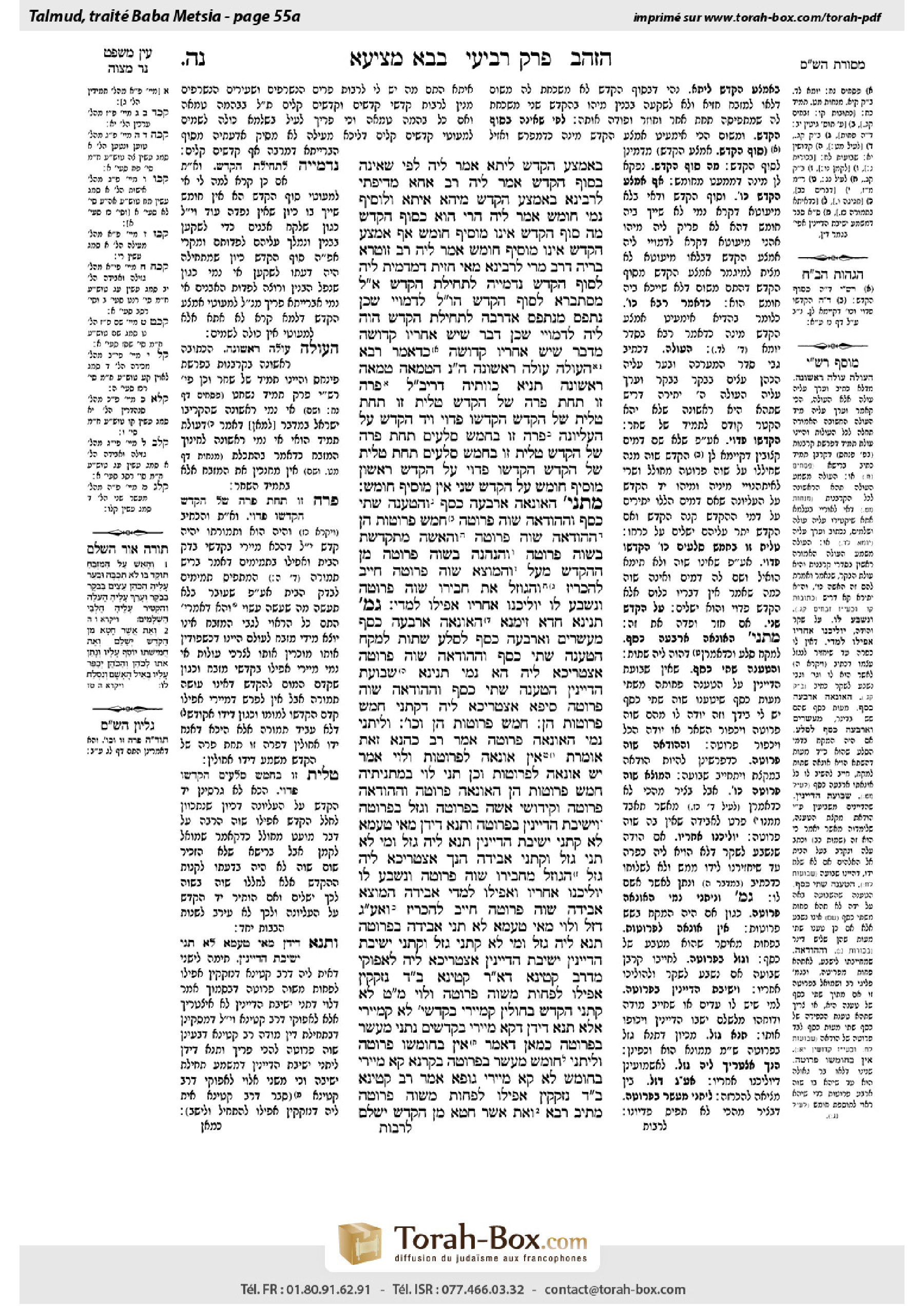
בבא מציעא נ״ה א · Aramaic and Hebrew text
בְּאֶמְצַע הֶקְדֵּשׁ, לֵיתַהּ? אֲמַר לֵיהּ: לְפִי שֶׁאֵינָהּ בְּסוֹף הֶקְדֵּשׁ.
אֲמַר לֵיהּ רַב אַחָא: מִדִּיפְתִּי לְרָבִינָא, בְּאֶמְצַע הֶקְדֵּשׁ מִיהָא אִיתַהּ, וְלוֹסֵיף נָמֵי חוֹמֶשׁ! אֲמַר לֵיהּ: הֲרֵי הוּא כְּסוֹף הֶקְדֵּשׁ, מָה סוֹף הֶקְדֵּשׁ אֵינוֹ מוֹסִיף חוֹמֶשׁ – אַף אֶמְצַע הֶקְדֵּשׁ אֵינוֹ מוֹסִיף חוֹמֶשׁ.
אֲמַר לֵיהּ רַב זוּטְרָא בְּרֵיהּ דְּרַב מָרִי לְרָבִינָא: מַאי חָזֵית דִּמְדַמֵּית לֵיהּ לְסוֹף הֶקְדֵּשׁ? נְדַמְּיֵיהּ לִתְחִילַּת הֶקְדֵּשׁ! אֲמַר לֵיהּ: מִסְתַּבְּרָא לְסוֹף הֶקְדֵּשׁ הֲוָה לֵיהּ לְדַמּוֹיֵי, שֶׁכֵּן נִתְפָּס מִנִּתְפָּס. אַדְּרַבָּה: לִתְחִילַּת הֶקְדֵּשׁ הֲוָה לֵיהּ לְדַמּוֹיֵי, שֶׁכֵּן דָּבָר שֶׁיֵּשׁ אַחֲרָיו קְדוּשָּׁה מִדָּבָר שֶׁיֵּשׁ אַחֲרָיו קְדוּשָּׁה!
כִּדְאָמַר רָבָא ״הָעֹלָה״ – עוֹלָה רִאשׁוֹנָה. הָכִי נָמֵי ״הַטְּמֵאָה״ – טְמֵאָה רִאשׁוֹנָה.
תַּנְיָא כְּווֹתֵיהּ דְּרַבִּי יְהוֹשֻׁעַ בֶּן לֵוִי: ״פָּרָה זוֹ תַּחַת פָּרָה שֶׁל הֶקְדֵּשׁ״, ״טַלִּית זוֹ תַּחַת טַלִּית שֶׁל הֶקְדֵּשׁ״ – הֶקְדֵּשׁוֹ פָּדוּי, וְיַד הֶקְדֵּשׁ עַל הָעֶלְיוֹנָה.
״פָּרָה זוֹ בְּחָמֵשׁ סְלָעִים תַּחַת פָּרָה שֶׁל הֶקְדֵּשׁ״, ״טַלִּית זוֹ בְּחָמֵשׁ סְלָעִים תַּחַת טַלִּית שֶׁל הֶקְדֵּשׁ״ – הֶקְדֵּשׁוֹ פָּדוּי. עַל הֶקְדֵּשׁ רִאשׁוֹן מוֹסִיף חוֹמֶשׁ, עַל הֶקְדֵּשׁ שֵׁנִי אֵין מוֹסִיף חוֹמֶשׁ.
מַתְנִי׳ הָאוֹנָאָה – אַרְבָּעָה כֶּסֶף, וְהַטַּעֲנָה – שְׁתֵּי כֶּסֶף, וְהַהוֹדָאָה – שָׁוֶה פְּרוּטָה.
חָמֵשׁ פְּרוּטוֹת הֵן: הַהוֹדָאָה שָׁוֶה פְּרוּטָה, וְהָאִשָּׁה מִתְקַדֶּשֶׁת בְּשָׁוֶה פְּרוּטָה, וְהַנֶּהֱנֶה בְּשָׁוֶה פְּרוּטָה מִן הַהֶקְדֵּשׁ מָעַל, וְהַמּוֹצֵא שָׁוֶה פְּרוּטָה חַיָּיב לְהַכְרִיז, וְהַגּוֹזֵל אֶת חֲבֵירוֹ שָׁוֶה פְּרוּטָה וְנִשְׁבַּע לוֹ, יוֹלִיכֶנּוּ אַחֲרָיו אֲפִילּוּ לְמָדַי.
גְּמָ׳ תְּנֵינָא חֲדָא זִימְנָא: הָאוֹנָאָה אַרְבָּעָה כֶּסֶף מֵעֶשְׂרִים וְאַרְבָּעָה כֶּסֶף לַסֶּלַע, שְׁתוּת לְמִקָּח! הַטַּעֲנָה שְׁתֵּי כֶּסֶף וְהַהוֹדָאָה שָׁוֶה פְּרוּטָה אִצְטְרִיכָא לֵיהּ.
הָא נָמֵי תְּנֵינָא: שְׁבוּעַת הַדַּיָּינִין, הַטַּעֲנָה שְׁתֵּי כֶּסֶף וְהַהוֹדָאָה שָׁוֶה פְּרוּטָה! סֵיפָא אִצְטְרִיכָא לֵיהּ, דְּקָתָנֵי: חָמֵשׁ פְּרוּטוֹת הֵן.
חָמֵשׁ פְּרוּטוֹת הֵן כּוּ׳. וְלִיתְנֵי נָמֵי הָאוֹנָאָה פְּרוּטָה? אָמַר רַב כָּהֲנָא: זֹאת אוֹמֶרֶת, אֵין אוֹנָאָה לִפְרוּטוֹת.
וְלֵוִי אָמַר: יֵשׁ אוֹנָאָה לִפְרוּטוֹת. וְכֵן תָּנֵי לֵוִי בְּמַתְנִיתֵיהּ: חָמֵשׁ פְּרוּטוֹת הֵן: הָאוֹנָאָה פְּרוּטָה, וְהַהוֹדָאָה פְּרוּטָה, וְקִדּוּשֵׁי אִשָּׁה בִּפְרוּטָה, וְגָזֵל בִּפְרוּטָה, וִישִׁיבַת הַדַּיָּינִין בִּפְרוּטָה.
וְתַנָּא דִּידַן, מַאי טַעְמָא לָא קָתָנֵי יְשִׁיבַת הַדַּיָּינִין? תְּנָא לֵיהּ גָּזֵל.
וּמִי לָא תָּנֵי גָּזֵל וְקָתָנֵי אֲבֵידָה? הָנָךְ אִצְטְרִיכָא לֵיהּ: גָּזֵל – הַגּוֹזֵל מֵחֲבֵירוֹ שָׁוֶה פְּרוּטָה וְנִשְׁבָּע לוֹ, יוֹלִיכֶנּוּ אַחֲרָיו וַאֲפִילּוּ לִמְדִי. אֲבֵידָה – הַמּוֹצֵא אֲבֵידָה שָׁוֶה פְּרוּטָה חַיָּיב לְהַכְרִיז, וְאַף עַל גַּב דְּזַל.
וְלֵוִי, מַאי טַעְמָא לָא תָּנֵי אֲבֵידָה בִּפְרוּטָה? תְּנָא לֵיהּ גָּזֵל.
וּמִי לָא קָתָנֵי גָּזֵל וְקָתָנֵי יְשִׁיבַת הַדַּיָּינִין? יְשִׁיבַת הַדַּיָּינִין אִצְטְרִיכָא לֵיהּ, לְאַפּוֹקֵי מִדְּרַב קַטִּינָא, דְּאָמַר רַב קַטִּינָא: בֵּית דִּין נִזְקָקִין אֲפִילּוּ לְפָחוֹת מִשָּׁוֶה פְּרוּטָה.
וְלֵוִי, מַאי טַעְמָא לָא קָתָנֵי הֶקְדֵּשׁ? בְּחוּלִּין קָמַיְירֵי, בְּקָדָשִׁים לָא קָמַיְירֵי.
אֶלָּא תַּנָּא דִּידַן דְּקָא מַיְירֵי בְּקָדָשִׁים, נִתְנֵי מַעֲשֵׂר בִּפְרוּטָה? כְּמַאן דְּאָמַר אֵין בְּחוּמְשׁוֹ פְּרוּטָה. וְלִיתְנֵי חוֹמֶשׁ מַעֲשֵׂר בִּפְרוּטָה? בְּקַרְנָא קָא מַיְירֵי, בְּחוֹמֶשׁ לָא קָא מַיְירֵי.
גּוּפָא, אָמַר רַב קַטִּינָא: בֵּית דִּין נִזְקָקִין אֲפִילּוּ לְפָחוֹת מִשָּׁוֶה פְּרוּטָה. מֵתִיב רָבָא: ״וְאֵת אֲשֶׁר חָטָא מִן הַקֹּדֶשׁ יְשַׁלֵּם״,
Bava Metzia 55a · English translation
but it is not subject to an intermediate stage of consecration resulting from redemption? Ravina said to him: It is due to the fact that it is not subject to ultimate consecration. A non-kosher animal does not ultimately remain consecrated, as it is used neither as an offering nor in the upkeep of the Temple. Instead, it is redeemed and its value is consecrated.
Rav Aḥa of Difti said to Ravina: It is subject, at least, to an intermediate stage of consecration; and in that case, let one add one-fifth as well. Ravina said to him: Its legal status is like that of ultimate consecration: Just as one does not add one-fifth with regard to a non-kosher animal in ultimate consecration, as that category does not exist in a non-kosher animal, so too, one does not add one-fifth in a case of intermediate consecration.
Rav Zutra, son of Rav Mari, said to Ravina: What did you see that led you to liken the intermediate stage of consecration to ultimate consecration? Let us liken it to initial consecration. Ravina said to him: It stands to reason that he should liken it to ultimate consecration, as he thereby derives the halakha of an item consecrated by association with the sanctity of an item consecrated by association. The Gemara asks: On the contrary, he should have likened it to initial consecration, as he thereby derives the halakha of an item after which there is another stage of sanctity, the intermediate stage of consecration, from an item after which there is another stage of sanctity.
The Gemara answers: It is as Rava says: “The burnt-offering” (Leviticus 6:2), employing the definite article, indicates that the reference is to the first burnt-offering. So too, when it is written: The non-kosher animal, the reference is to the initial consecration of the non-kosher animal, not the intermediate stage of consecration.
The Gemara comments: It is taught in a baraita in accordance with the opinion of Rabbi Yehoshua ben Levi: If one said that this cow is in place of that cow, which belongs to the Temple treasury, or this garment is in place of that garment, which belongs to the Temple treasury, his consecrated property is redeemed, and the treasurer of consecrated property is at an advantage. If the replacement item is equal to or more valuable than the original item, it belongs to the treasurer, and if it is less valuable, the one who consecrated it must pay the difference.
If he said: This cow valued at five sela is in place of this cow, which belongs to the Temple treasury, or: This garment valued at five sela is instead of this garment, which belongs to the Temple treasury, his consecrated property is redeemed. Even if the second consecrated item is more valuable, it is not considered a consecration done in error. He will have to pay the difference. He adds one-fifth when redeeming the item that was the initial consecration, but when redeeming the item for which the initial consecration was redeemed, the second consecration, he does not add one-fifth.
MISHNA: The measure of exploitation is four silver ma’a from the twenty-four silver ma’a of a sela. And the smallest monetary claim in court for which a plaintiff can obligate a respondent to take an oath is two silver ma’a. And the smallest monetary admission for which that respondent takes the oath is an admission that one owes at least the value of one peruta.
On a related note, the tanna adds that there are five halakhic situations involving perutot: The admission to part of a claim must be that one owes at least the value of one peruta, and a woman is betrothed with the value of one peruta. And one who derives benefit of the value of one peruta from consecrated property has misused consecrated property and is liable to bring an offering, and one who finds an item that has the value of one peruta is obligated to proclaim that he found it. And with regard to one who robs from another an item that has the value of one peruta and took an oath to him that he robbed nothing, when he repents and seeks to return the stolen item he must take it and follow its owner even to Media. In that case, he may not return the item by means of a messenger; he must give it directly to its owner.
GEMARA: The Gemara asks: We already learned this on another occasion in an earlier mishna (49b): The measure of exploitation for which one can claim that he was exploited is four silver ma’a from the twenty-four silver ma’a in a sela, which is one-sixth of the transaction. The Gemara answers: It was necessary for the tanna to mention two halakhot: The smallest monetary claim in court for which a plaintiff can obligate a respondent to take an oath is two silver ma’a, and the smallest monetary admission for which that respondent takes the oath is an admission that one owes at least the value of one peruta. Therefore, the tanna cited the halakha of exploitation as well.
The Gemara asks: That too we already learned in a mishna (Shevuot 38b): The oath for admission to part of a claim imposed by the judges is in a case where the claim is two silver ma’a, and the admission is the value of one peruta. The Gemara answers: It was necessary for the tanna to teach the latter clause of the mishna, as it teaches: There are five halakhic situations involving perutot, which is not taught elsewhere.
§ The mishna teaches: There are five halakhic situations involving perutot. The Gemara asks: And let the tanna also teach that the measure of exploitation is one peruta. Rav Kahana said: That is to say that there is no exploitation concerning perutot. Any disparity between value and price that is less than the value of the smallest silver coin, an issar, which is worth eight perutot, is not considered exploitation.
And Levi says: There is exploitation even for perutot. And likewise, Levi taught in his version of the Mishna, which parallels the Mishna redacted by Rabbi Yehuda HaNasi, that there are five halakhic situations involving perutot: The measure of exploitation is one peruta, the admission is the value of one peruta, and the betrothal of a woman is with one peruta, and the halakha of one who takes an oath denying a robbery applies in the case where he denies having robbed another of at least one peruta, and the convening of judges to adjudicate a case of monetary law is in the case where the claim is at least one peruta.
The Gemara asks: And with regard to the tanna of our mishna, what is the reason he does not teach the case of the convening of judges in his list of cases involving perutot? The Gemara answers: He taught the case of robbery, which includes all monetary claims one has against another.
The Gemara asks: But doesn’t the tanna teach the case of robbery and teach the case of lost property? Apparently, he lists monetary cases that are included under the rubric of robbery. The Gemara answers: With regard to these two cases, it was necessary for the tanna to teach them separately, as there is a novel element in each. The novel element in the case of robbery is not only that a robbery of one peruta is considered robbery, but also in the case of one who robs an item from another worth at least one peruta and then took an oath to him that he robbed nothing, he must carry the stolen item and follow its owner even to Media. The novel element in the case of lost property is that one who finds lost property the value of at least one peruta is obligated to proclaim that he found it, even though the lost article depreciated and is no longer worth one peruta.
The Gemara asks: And as for Levi, what is the reason he does not teach that one is obligated to proclaim that he found lost property only if it is worth at least one peruta? The Gemara answers: He taught the case of robbery, which includes all monetary claims one has against another.
The Gemara asks: But doesn’t he teach robbery and also teach the convening of judges? Apparently, he lists monetary cases that are included under the rubric of robbery. The Gemara explains: With regard to the convening of judges it was necessary for the tanna to specify the halakha to exclude the opinion of Rav Ketina, as Rav Ketina says: The court attends to monetary claims of even less than the value of one peruta. Anyone wronged by another is entitled to have his case adjudicated in court.
The Gemara asks: And as for Levi, what is the reason he does not teach the peruta of misuse of consecrated property? The Gemara answers: He is speaking with regard to non-sacred property; he is not speaking with regard to consecrated property.
The Gemara asks: But in the case of the tanna of our mishna, who is speaking with regard to consecrated property, let him teach the halakha that second tithe may be redeemed only if the produce is worth at least one peruta. The Gemara answers: This tanna holds in accordance with the one who says: Second tithe is redeemed only if its one-fifth, which one adds when redeeming his own produce, is worth at least one peruta. In other words, second tithe is redeemed only if it is worth at least four perutot. The Gemara asks: And let him teach that second tithe is redeemed only if its one-fifth, which one adds when redeeming his own produce, is worth at least one peruta. The Gemara responds: The tanna is speaking with regard to the principal; the tanna is not speaking with regard to the one-fifth.
§ With regard to the matter itself raised in the previous discussion, the Gemara elaborates. Rav Ketina says: The court attends to monetary claims of even less than the value of one peruta. Rava raises an objection from a baraita. It is written: “And he shall make restitution for that which he has done amiss in the sacred matter” (Leviticus 5:16).
Bava Metzia 55a · Traduction française (IA)
mais elle n'est pas soumise à une étape intermédiaire de consécration résultant d'une rachat ? Ravina dit à lui : C'est à cause du fait qu'elle n'est pas soumise à une consécration ultime. Un animal non-kosher ne reste pas ultimement consacré, car il n'est utilisé ni comme offrande ni dans l'entretien du Temple. Au contraire, il est racheté et sa valeur est consacrée.
Rav Aḥa de Difti dit à Ravina : Elle est soumise, du moins, à une étape intermédiaire de consécration ; et dans ce cas, on doit ajouter un cinquième également. Ravina dit à lui : Son statut juridique est comme celui de la consécration ultime : Tout comme on n'ajoute pas un cinquième concernant un animal non-kosher dans la consécration ultime, car cette catégorie n'existe pas dans un animal non-kosher, de même on n'ajoute pas un cinquième dans le cas d'une consécration intermédiaire.
Rav Zutra, fils de Rav Mari, dit à Ravina : Qu'est-ce que tu as vu qui t'a conduit à comparer la consécration intermédiaire à la consécration ultime ? Comparons-la plutôt à la consécration initiale. Ravina dit à lui : Il est logique qu'il la compare à la consécration ultime, car ainsi il dérive la halakha d'un objet consacré par association avec la sainteté d'un objet consacré par association. La Guemara demande : Au contraire, il aurait dû la comparer à la consécration initiale, car ainsi il dérive la halakha d'un objet après lequel vient une autre étape de sainteté, l'étape intermédiaire de consécration, à partir d'un objet après lequel vient une autre étape de sainteté.
La Guemara répond : C'est comme Rava dit : « L'holocauste » (Lévitique 6:2), en utilisant l'article défini, indique que la référence est à l'holocauste initial. De même, lorsqu'il est écrit : « L'animal non-kosher », la référence est à la consécration initiale de l'animal non-kosher, pas à l'étape intermédiaire de consécration.
La Guemara commente : Il est enseigné dans une baraïta selon l'opinion de Rabbi Yéhoshua ben Lévi : Si l'on dit que cette vache est en lieu et place de cette vache, qui appartient au trésor du Temple, ou que cette robe est en lieu et place de cette robe, qui appartient au trésor du Temple, sa propriété consacrée est rachetée, et le trésorier des propriétés consacrées est avantageux. Si l'objet de remplacement est équivalent ou plus précieux que l'objet original, il appartient au trésorier, et si l'objet de remplacement est moins précieux, celui qui a consacré l'objet doit payer la différence.
Si l'on dit : Cette vache, valorisée à cinq sela, est en lieu et place de cette vache, qui appartient au trésor du Temple, ou : Cette robe, valorisée à cinq sela, est au lieu de cette robe, qui appartient au trésor du Temple, sa propriété consacrée est rachetée. Même si la deuxième propriété consacrée est plus précieuse, elle n'est pas considérée comme une consécration faite à tort. Il devra payer la différence. On ajoute un cinquième lors du rachat de l'objet qui était la consécration initiale, mais lors du rachat de l'objet pour lequel la consécration initiale a été rachetée, la deuxième consécration, on n'ajoute pas un cinquième.
MICHNA : La mesure de l'exploitation est quatre ma'ot d'argent d'un sela, qui est composé de vingt-quatre ma'ot d'argent. Et la plus petite réclamation monétaire devant un tribunal pour laquelle un plaignant peut obliger un défendeur à prendre un serment est deux ma'ot d'argent. Et la plus petite admission monétaire pour laquelle ce défendeur prend le serment est une admission que l'on doit au moins la valeur d'une peruta.
En ce qui concerne cela, le tanna ajoute que se trouvent cinq situations halakhiques concernant les perutot : L'admission concernant une partie d'une réclamation doit être que l'on doit au moins la valeur d'une peruta, et une femme est fiancée avec la valeur d'une peruta. Et celui qui tire un bénéfice de la valeur d'une peruta à partir d'une propriété consacrée a abusé de la propriété consacrée et est tenu de présenter une offrande, et celui qui trouve un objet ayant la valeur d'une peruta est tenu de proclamer qu'il l'a trouvé. Et concernant celui qui vole à un autre un objet ayant la valeur d'une peruta et a pris serment à son égard qu'il n'avait pas volé, lorsqu'il se repent et veut rendre l'objet volé, il doit le prendre et le suivre jusqu'en Médie. Dans ce cas, il ne peut pas rendre l'objet par un messager ; il doit le donner directement à son propriétaire.
GUEMARA : La Guemara demande : Nous avons déjà appris cela à une autre occasion dans une autre mishna (49b) : La mesure de l'exploitation pour laquelle on peut affirmer qu'on a été exploité est quatre ma'ot d'argent d'un sela, qui est composé de vingt-quatre ma'ot d'argent, ce qui est un sixième de la transaction. La Guemara répond : Il était nécessaire que le tanna mentionne deux halakhot : La plus petite réclamation monétaire devant un tribunal pour laquelle un plaignant peut obliger un défendeur à prendre un serment est deux ma'ot d'argent, et la plus petite admission monétaire pour laquelle ce défendeur prend le serment est une admission que l'on doit au moins la valeur d'une peruta. Ainsi, le tanna a cité la halakha de l'exploitation également.
La Guemara demande : Cela aussi nous avons déjà appris dans une mishna (Shevuot 38b) : Le serment imposé pour l'admission concernant une partie d'une réclamation est dans le cas où la réclamation est deux ma'ot d'argent, et l'admission est la valeur d'une peruta. La Guemara répond : Il était nécessaire que le tanna enseigne la dernière partie de la mishna, car elle enseigne : Il y a cinq situations halakhiques concernant les perutot, ce qui n'est pas enseigné ailleurs.
§ La mishna enseigne : Il y a cinq situations halakhiques concernant les perutot. La Guemara demande : Et que le tanna enseigne également que la mesure de l'exploitation est une peruta. Rav Kahana dit : Cela signifie qu'il n'y a pas d'exploitation concernant les perutot. Tout déséquilibre entre valeur et prix inférieur à la valeur de la plus petite pièce d'argent, un issar, qui vaut huit perutot, n'est pas considéré comme une exploitation.
Et Lévi dit : Il y a une exploitation même pour des perutot. Et de même, Lévi enseigna dans sa version de la Michna, qui correspond à la Michna rédigée par Rabbi Yéhuda HaNasi, que sont cinq situations halakhiques impliquant des perutot : la mesure de l'exploitation est une peruta, l'admission est la valeur d'une peruta, et le mariage est avec une peruta, et la halakha de celui qui prend un serment pour nier un vol s'applique au cas où il nie d'avoir volé à quelqu'un au moins une peruta, et la convocation des juges pour juger une affaire de droit civil s'applique au cas où la réclamation est au moins une peruta.
Le Guemara demande : Et concernant le tanna de notre mishna, quelle est la raison pour laquelle il ne cite pas le cas de la convocation des juges dans sa liste de cas impliquant des perutot ? Le Guemara répond : Il a enseigné le cas du vol, qui englobe toutes les réclamations monétaires qu'on a contre un autre.
Le Guemara demande : Mais ne dit-il pas le tanna enseigner le cas du vol et enseigner le cas des biens perdus ? Apparemment, il liste des cas monétaires inclus sous le rubrique du vol. Le Guemara répond : Concernant ces deux cas, il était nécessaire que le tanna les enseigne séparément, car chaque cas présente un élément nouveau. L'élément nouveau dans le cas du vol est non seulement que le vol d'une peruta est considéré comme un vol, mais aussi dans le cas d'une personne qui vole un objet à quelqu'un d'au moins une peruta et puis prend un serment pour dire qu'il n'a pas volé, il doit porter l'objet volé et suivre son propriétaire même en Médie. L'élément nouveau dans le cas des biens perdus est que celui qui trouve un bien perdu de valeur d'au moins une peruta est tenu de proclamer qu'il l'a trouvé, même si l'objet a perdu de la valeur et n'est plus d'une peruta.
Le Guemara demande : Et concernant Lévi, quelle est la raison pour laquelle il ne mentionne pas que l'on est tenu de proclamer qu'on a trouvé un bien perdu uniquement si sa valeur est d'au moins une peruta ? Le Guemara répond : Il a enseigné le cas du vol, qui englobe toutes les réclamations monétaires qu'on a contre un autre.
Le Guemara demande : Mais ne cite-t-il pas le vol et enseigne-t-il aussi le cas de la convocation des juges ? Apparemment, il liste des cas monétaires inclus sous le rubrique du vol. Le Guemara explique : Concernant la convocation des juges, il était nécessaire que le tanna précise la halakha pour exclure l'opinion de Rav Ketina, car Rav Ketina dit : Le tribunal s'occupe des réclamations monétaires même inférieures à la valeur d'une peruta. Quiconque a été trompé par un autre est dû à ce que son cas soit jugé en cour.
Le Guemara demande : Et concernant Lévi, quelle est la raison pour laquelle il ne cite pas la peruta de l'usage de biens sacrés ? Le Guemara répond : Il parle concernant des biens non sacrés ; il ne parle pas concernant des biens sacrés.
Le Guemara demande : Mais dans le cas du tanna de notre mishna, qui parle de biens sacrés, qu'il enseigne la halakha selon laquelle la deuxième part peut être rachetée uniquement si la production est d'une valeur d'au moins une peruta. Le Guemara répond : Ce tanna suit celui qui dit : La deuxième part peut être rachetée uniquement si sa cinquième, qui est ajoutée lors du rachat de sa propre production, est d'une valeur d'au moins une peruta. En d'autres termes, la deuxième part peut être rachetée uniquement si elle est d'une valeur d'au moins quatre perutot. Le Guemara demande : Et qu'il enseigne que la deuxième part peut être rachetée uniquement si sa cinquième, qui est ajoutée lors du rachat de sa propre production, est d'une valeur d'au moins une peruta. Le Guemara répond : Le tanna parle du principal ; le tanna ne parle pas de la cinquième.
§ Concernant la question elle-même soulevée dans la discussion précédente, le Guemara développe. Rav Ketina dit : Le tribunal s'occupe des réclamations monétaires même inférieures à la valeur d'une peruta. Rava soulève un objet à partir d'une baraïta. Il est écrit : « Et il fera restitution pour ce qu'il a fait de mal dans l'affaire sacrée » (Lévitique 5:16).
Traduction française générée par IA à partir de l’édition anglaise de Sefaria. Vérifie toujours un passage avec le texte source.
Text from Sefaria: William Davidson Edition - Vocalized Aramaic (CC BY NC); William Davidson Edition - English (CC BY NC).