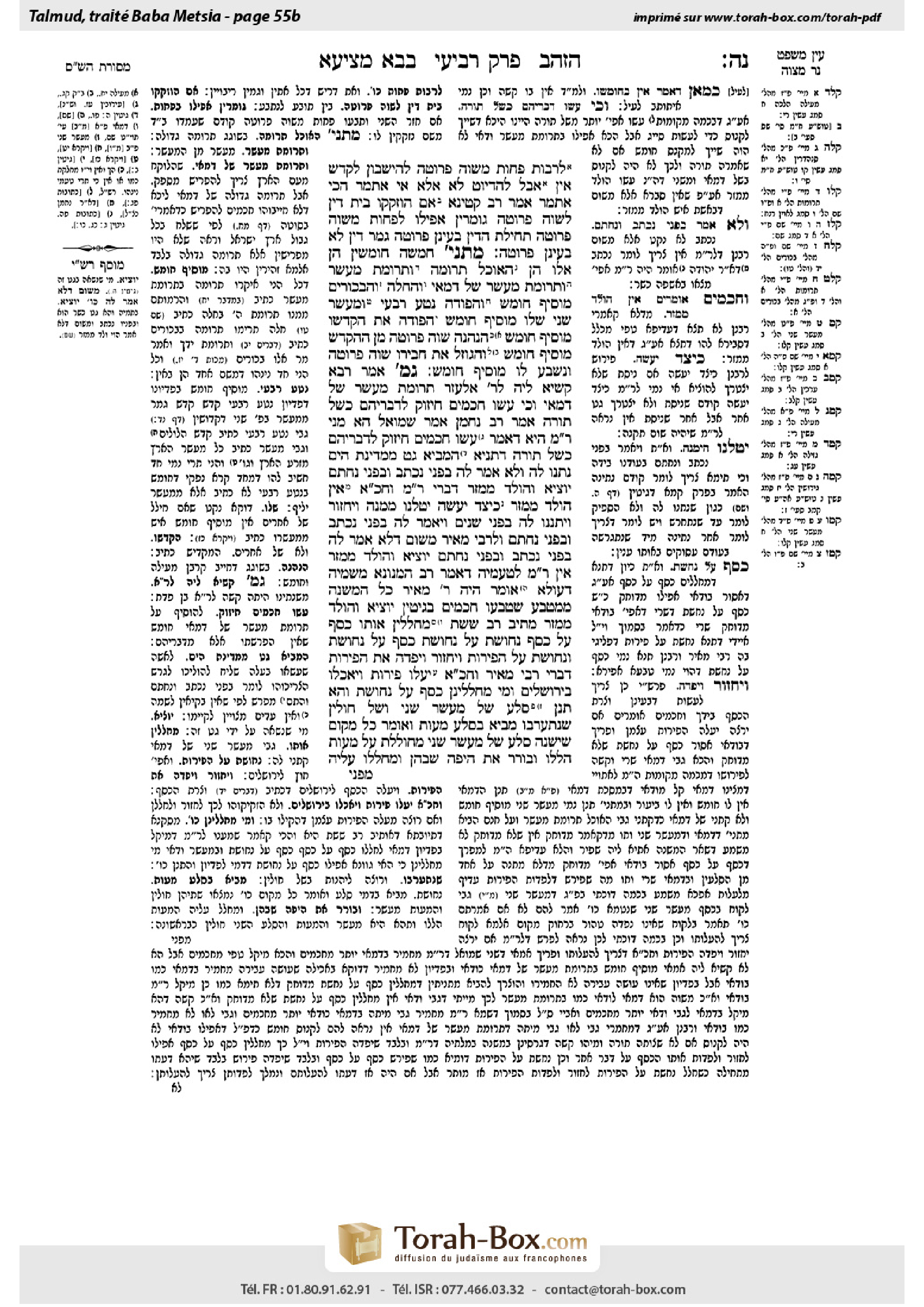
Bava Metzia 55b: Talmud study for Daf Yomi
Study the Talmud for Daf Yomi with scanned pages, Hebrew text, English translations from Sefaria and AI-generated French translations.
Passage selection and English or AI-generated French translation are available where the scan has annotations. Daf Study is independent of Torah-Box and Sefaria.
Browse Bava Metzia · בבא מציעא · All tractatesBava Metzia 55b text and translations
This page of Bava Metzia includes the Aramaic text, an English translation and an AI-generated French translation, alongside the scan above.
בבא מציעא נ״ה ב · Aramaic and Hebrew text
לְרַבּוֹת פָּחוֹת מִשָּׁוֶה פְּרוּטָה לְהִישָּׁבוֹן. לְקֹדֶשׁ – אִין, אֲבָל לְהֶדְיוֹט – לָא.
אֶלָּא, אִי אִתְּמַר הָכִי אִתְּמַר: אָמַר רַב קַטִּינָא, אִם הוּזְקְקוּ בֵּית דִּין לְשָׁוֶה פְּרוּטָה – גּוֹמְרִין, אֲפִילּוּ לְפָחוֹת מִשָּׁוֶה פְּרוּטָה. תְּחִילַּת הַדִּין בָּעֵינַן פְּרוּטָה, גְּמַר הַדִּין לָא בָּעֵינַן פְּרוּטָה.
מַתְנִי׳ חֲמִשָּׁה חוּמְשִׁין הֵן, אֵלּוּ הֵן: הָאוֹכֵל תְּרוּמָה, וּתְרוּמַת מַעֲשֵׂר, וּתְרוּמַת מַעֲשֵׂר שֶׁל דְּמַאי, וְהַחַלָּה, וְהַבִּכּוּרִים – מוֹסִיף חוֹמֶשׁ. וְהַפּוֹדֶה נֶטַע רְבָעִי וּמַעֲשֵׂר שֵׁנִי שֶׁלּוֹ – מוֹסִיף חוֹמֶשׁ. הַפּוֹדֶה אֶת הֶקְדֵּשׁוֹ – מוֹסִיף חוֹמֶשׁ. הַנֶּהֱנֶה שָׁוֶה פְּרוּטָה מִן הַהֶקְדֵּשׁ – מוֹסִיף חוֹמֶשׁ. וְהַגּוֹזֵל אֶת חֲבֵירוֹ שָׁוֶה פְּרוּטָה וְנִשְׁבַּע לוֹ – מוֹסִיף חוֹמֶשׁ.
גְּמָ׳ אָמַר רָבָא: קַשְׁיָא לֵיהּ לְרַבִּי אֶלְעָזָר תְּרוּמַת מַעֲשֵׂר שֶׁל דְּמַאי, וְכִי עָשׂוּ חֲכָמִים חִיזּוּק לְדִבְרֵיהֶם כְּשֶׁל תּוֹרָה?
אָמַר רַב נַחְמָן אָמַר שְׁמוּאֵל: הָא מַנִּי – רַבִּי מֵאִיר הִיא, דְּאָמַר עָשׂוּ חֲכָמִים חִיזּוּק לְדִבְרֵיהֶם כְּשֶׁל תּוֹרָה. דְּתַנְיָא: הַמֵּבִיא גֵּט מִמְּדִינַת הַיָּם, נְתָנוֹ לָהּ וְלֹא אָמַר לָהּ ״בְּפָנַי נִכְתַּב וּבְפָנַי נֶחְתַּם״ – יוֹצִיא, וְהַוָּלָד מַמְזֵר, דִּבְרֵי רַבִּי מֵאִיר. וַחֲכָמִים אוֹמְרִים: אֵין הַוָּלָד מַמְזֵר. כֵּיצַד יַעֲשֶׂה? יִטְּלֶנּוּ מִמֶּנָּה וְיַחֲזוֹר וְיִתְּנֶנּוּ לָהּ בִּפְנֵי שְׁנַיִם, וְיֹאמַר לָהּ: ״בְּפָנַי נִכְתַּב וּבְפָנַי נֶחְתַּם״.
וּלְרַבִּי מֵאִיר, מִשּׁוּם דְּלֹא אָמַר לָהּ ״בְּפָנַי נִכְתַּב וּבְפָנַי נֶחְתַּם״, יוֹצִיא וְהַוָּלָד מַמְזֵר? אִין, רַבִּי מֵאִיר לְטַעְמֵיהּ, דְּאָמַר רַב הַמְנוּנָא מִשְּׁמֵיהּ דְּעוּלָּא: אוֹמֵר הָיָה רַבִּי מֵאִיר: כָּל הַמְשַׁנֶּה מִמַּטְבֵּעַ שֶׁטָּבְעוּ חֲכָמִים בְּגִיטִּין – יוֹצִיא, וְהַוָּלָד מַמְזֵר.
מֵתִיב רַב שֵׁשֶׁת: מְחַלְּלִין אוֹתוֹ כֶּסֶף עַל כֶּסֶף, נְחוֹשֶׁת עַל נְחוֹשֶׁת, כֶּסֶף עַל נְחוֹשֶׁת, וּנְחוֹשֶׁת עַל הַפֵּירוֹת, וְיַחְזוֹר וְיִפְדֶּה אֶת הַפֵּירוֹת – דִּבְרֵי רַבִּי מֵאִיר. וַחֲכָמִים אוֹמְרִים: יַעֲלוּ פֵּירוֹת וְיֹאכְלוּ בִּירוּשָׁלַיִם.
וּמִי מְחַלְּלִינַן כֶּסֶף עַל נְחוֹשֶׁת? וְהָא תְּנַן: סֶלַע שֶׁל מַעֲשֵׂר שֵׁנִי וְשֶׁל חוּלִּין שֶׁנִּתְעָרְבוּ, מֵבִיא בְּסֶלַע מָעוֹת וְאוֹמֵר: כׇּל מָקוֹם שֶׁיֶּשְׁנָהּ סֶלַע שֶׁל מַעֲשֵׂר שֵׁנִי, מְחוּלֶּלֶת עַל מָעוֹת הַלָּלוּ, וּבוֹרֵר אֶת הַיָּפֶה שֶׁבָּהֶן וּמְחַלְּלוֹ עָלֶיהָ.
Bava Metzia 55b · English translation
This serves to include misuse of consecrated property less than the value of one peruta in the halakha of restitution to the Temple treasury. The Gemara infers: To the Temple treasury, yes, one must return that which he took; but to an ordinary person [hedyot], no, one need not pay restitution for theft of less than one peruta.
Rather, if Rav Ketina’s ruling was stated, this is how it was stated: Rav Ketina says: If the court attends to a monetary claim of the value of one peruta, the judges conclude adjudicating and issue a ruling even if the item in question depreciated to less than the value of one peruta. For the beginning of the legal proceedings, we require a claim worth one peruta, whereas for the verdict, we do not require a claim worth one peruta.
MISHNA: In this mishna, as in the previous one, the tanna enumerates several halakhot that share a common element. There are five halakhic situations where one-fifth is added to the value of the principal, and these are they: A non-priest who eats either teruma, or teruma of the tithe, which the Levite separates from the first tithe and gives to a priest, or teruma of the tithe of demai, or ḥalla, or first fruits; in each of these cases, he adds one-fifth when paying restitution to the priest who owned the produce. And one who redeems his own fruit of a fourth-year sapling or second-tithe produce adds one-fifth. One who redeems his own consecrated property adds one-fifth. One who derives benefit worth one peruta from consecrated property adds one-fifth. And one who robs the value of one peruta from another and takes a false oath in response to his claim adds one-fifth when paying restitution.
GEMARA: Rava says: Rabbi Elazar found the halakha in the mishna with regard to teruma of the tithe of demai to be difficult. He asked: And since the obligation to tithe demai is by rabbinic law, did the Sages reinforce their pronouncements and render them parallel to Torah law by requiring the addition of one-fifth when paying restitution?
Rav Naḥman said that Shmuel said: In accordance with whose opinion is this mishna? It is in accordance with the opinion of Rabbi Meir, who says: The Sages reinforced their pronouncements and rendered them parallel to Torah law, as it is taught in a baraita: With regard to an agent who brings a bill of divorce from a country overseas, if he gave it to the woman but did not say to her: It was written in my presence and it was signed in my presence, as is the requirement by rabbinic ordinance, one who marries that woman must divorce her, and any offspring born of that marriage is a mamzer; this is the statement of Rabbi Meir. And the Rabbis say: Although he is in violation of the ordinance, the offspring is not a mamzer. How then should the agent proceed? He should take the bill of divorce from her and give it to her again, this time in the presence of two witnesses, and say to her: It was written in my presence and it was signed in my presence.
The Gemara asks: And according to Rabbi Meir, although the bill of divorce was otherwise valid, merely due to the fact that he did not say to her: It was written in my presence and it was signed in my presence, must he divorce her and the offspring is a mamzer? The Gemara answers: Yes, as Rabbi Meir conforms to his standard line of reasoning, as Rav Hamnuna says in the name of Ulla that Rabbi Meir would say: In the case of anyone who gives a bill of divorce that deviates from the formula coined by the Sages with regard to bills of divorce, one who then marries the divorced woman on the basis of that bill of divorce must divorce her, and the offspring is a mamzer. Concerning teruma of the tithe of demai as well, Rabbi Meir reinforced the pronouncements of the Sages and rendered them parallel to Torah law.
Rav Sheshet raises an objection to this principle from a mishna (Demai 1:2), which teaches: One may desacralize silver coins of second tithe of demai upon other silver coins, and copper coins upon copper coins, and silver coins upon copper coins, and copper coins upon produce, and he may then redeem that produce with money; this is the statement of Rabbi Meir. And the Rabbis say: That produce that redeemed the copper coins must be taken up and eaten in Jerusalem. It may not be redeemed again.
Rav Sheshet continues: And can one desacralize silver coins with copper coins? But didn’t we learn in a mishna (Ma’aser Sheni 2:6): In the case of a silver sela of second tithe and a sela of non-sacred property that were intermingled, one brings copper ma’a equaling the value of a sela and says: Wherever there is a sela of second tithe among these two coins, it is redeemed upon these copper ma’a, which assume the sanctity of second tithe. And he selects the better-quality sela among the two and redeems the copper coins upon that sela. The result is that the better-quality sela is second tithe, while the other sela and the copper coins are non-sacred.
Bava Metzia 55b · Traduction française (IA)
Cela permet d'inclure l'usage abusif de biens consacrés de valeur inférieure à un peruta dans la halakha de restitution au trésor du Temple. La Guemara déduit : Pour le trésor du Temple, oui, on doit rendre ce que l'on a pris ; mais pour un homme ordinaire, non, on n'a pas besoin de payer une restitution pour le vol d'une valeur inférieure à un peruta.
Au contraire, si la décision de Rav Ketina a été émise, c'est ainsi qu'elle a été formulée : Rav Ketina dit : Si la cour s'occupe d'une réclamation monétaire d'une valeur d'un peruta, les juges concluent à l'adjudication et rendent un verdict même si l'objet en question s'est déprécié à une valeur inférieure à un peruta. Pour le début des procédures juridiques, nous exigeons une réclamation d'une valeur d'un peruta, tandis que pour le verdict, nous n'exigeons pas une réclamation d'une valeur d'un peruta.
MICHNA : Dans cette mishna, comme dans la précédente, le tanna énumère plusieurs halakhot qui partagent un élément commun. Il y a cinq situations halakhiques où un cinquième est ajouté à la valeur du principal, et ce sont celles-ci : Un non-prêtre qui mange soit la terouma, soit la terouma de la dîme, que le Lévi sépare de la première dîme et donne à un prêtre, soit la terouma de la dîme de demai, soit la challa, soit les premiers fruits ; dans chaque cas, il ajoute un cinquième lors de la restitution au prêtre propriétaire des produits. Et celui qui rachète ses propres fruits d'un jeune arbre de la quatrième année ou des produits de la deuxième dîme ajoute un cinquième. Celui qui rachète ses propres biens consacrés ajoute un cinquième. Celui qui tire un bénéfice d'une valeur d'un peruta de biens consacrés ajoute un cinquième. Et celui qui vole une valeur d'un peruta à un autre et prend un faux serment en réponse à sa réclamation ajoute un cinquième lors de la restitution.
GUEMARA : Rava dit : Rabbi Elazar trouvait la halakha dans la mishna concernant la terouma de la dîme de demai difficile. Il demanda : Et puisque l'obligation de dîme de demai est d'origine rabbinique, les Sages ont-ils renforcé leurs déclarations et les ont-ils rendus parallèles à la loi divine en exigeant l'ajout d'un cinquième lors de la restitution ?
Rav Naḥman dit que Shmuel dit : Selon quel avis est-ce que cette mishna ? C'est selon l'avis de Rabbi Meir, qui dit : Les Sages ont renforcé leurs déclarations et les ont rendus parallèles à la loi divine, comme il est enseigné dans une baraïta : Concernant un agent qui apporte un divorce d'un pays étranger, si il le donne à la femme mais ne dit pas à elle : Cela a été écrit en mon présence et signé en mon présence, comme c'est la exigence par ordonnance rabbinique, celui qui épouse cette femme doit la divorcer, et tout enfant né de ce mariage est un mamzer ; c'est l'avis de Rabbi Meir. Et les Rabbins disent : Bien qu'il soit en violation de l'ordonnance, l'enfant n'est pas un mamzer. Comment alors l'agent doit-il agir ? Il doit prendre le divorce de sa main et le lui redonner, cette fois en présence de deux témoins, et lui dire : Cela a été écrit en mon présence et signé en mon présence.
La Guemara demande : Et selon Rabbi Meir, bien que le divorce fût autrement valide, simplement en raison du fait qu'il n'a pas dit à elle : Cela a été écrit en mon présence et signé en mon présence, doit-il la divorcer et l'enfant est-il un mamzer ? La Guemara répond : Oui, car Rabbi Meir correspond à sa ligne de raisonnement habituelle, comme Rav Hamnuna dit en nom d'Ulla que Rabbi Meir dirait : Dans le cas de quelqu'un qui donne un divorce qui dévie de la formule établie par les Sages concernant les divorces, celui qui épouse la femme divorcée sur la base de ce divorce doit la divorcer, et l'enfant est un mamzer. Concernant la terouma de la dîme de demai également, Rabbi Meir a renforcé les déclarations des Sages et les a rendus parallèles à la loi divine.
Rav Sheshet éleve une objection contre ce principe à partir d'une mishna (Demai 1:2), qui enseigne : On peut désacraliser des pièces d'argent de la deuxième dîme de demai en d'autres pièces d'argent, et des pièces de cuivre en d'autres pièces de cuivre, et des pièces d'argent en pièces de cuivre, et des pièces de cuivre en produits, et puis on peut racheter ces produits avec de l'argent ; c'est l'avis de Rabbi Meir. Et les Rabbins disent : Ce produit qui a racheté les pièces de cuivre doit être ramené et mangé à Jérusalem. Il ne peut pas être racheté à nouveau.
Rav Sheshet continue : Et peut-on désacraliser des pièces d'argent avec des pièces de cuivre ? Mais n'avons-nous pas appris dans une mishna (Ma’aser Sheni 2:6) : Dans le cas d'une pièce d'argent de la deuxième dîme et d'une pièce de propriété non sacrée qui sont mélangées, on apporte des ma’a de cuivre équivalent à la valeur d'une sela et on dit : Partout où il y a une sela de deuxième dîme parmi ces deux pièces, il est racheté sur ces ma’a de cuivre, qui prennent la sanctité de la deuxième dîme. Et on choisit la meilleure qualité sela parmi les deux et on rachète les pièces de cuivre sur cette sela. Le résultat est que la meilleure qualité sela est la deuxième dîme, tandis que l'autre sela et les pièces de cuivre sont non sacrés.
Traduction française générée par IA à partir de l’édition anglaise de Sefaria. Vérifie toujours un passage avec le texte source.
Text from Sefaria: William Davidson Edition - Vocalized Aramaic (CC BY NC); William Davidson Edition - English (CC BY NC).