Bava Metzia 56a: Talmud study for Daf Yomi
Study the Talmud for Daf Yomi with scanned pages, Hebrew text, English translations from Sefaria and AI-generated French translations.
Passage selection and English or AI-generated French translation are available where the scan has annotations. Daf Study is independent of Torah-Box and Sefaria.
Browse Bava Metzia · בבא מציעא · All tractatesBava Metzia 56a text and translations
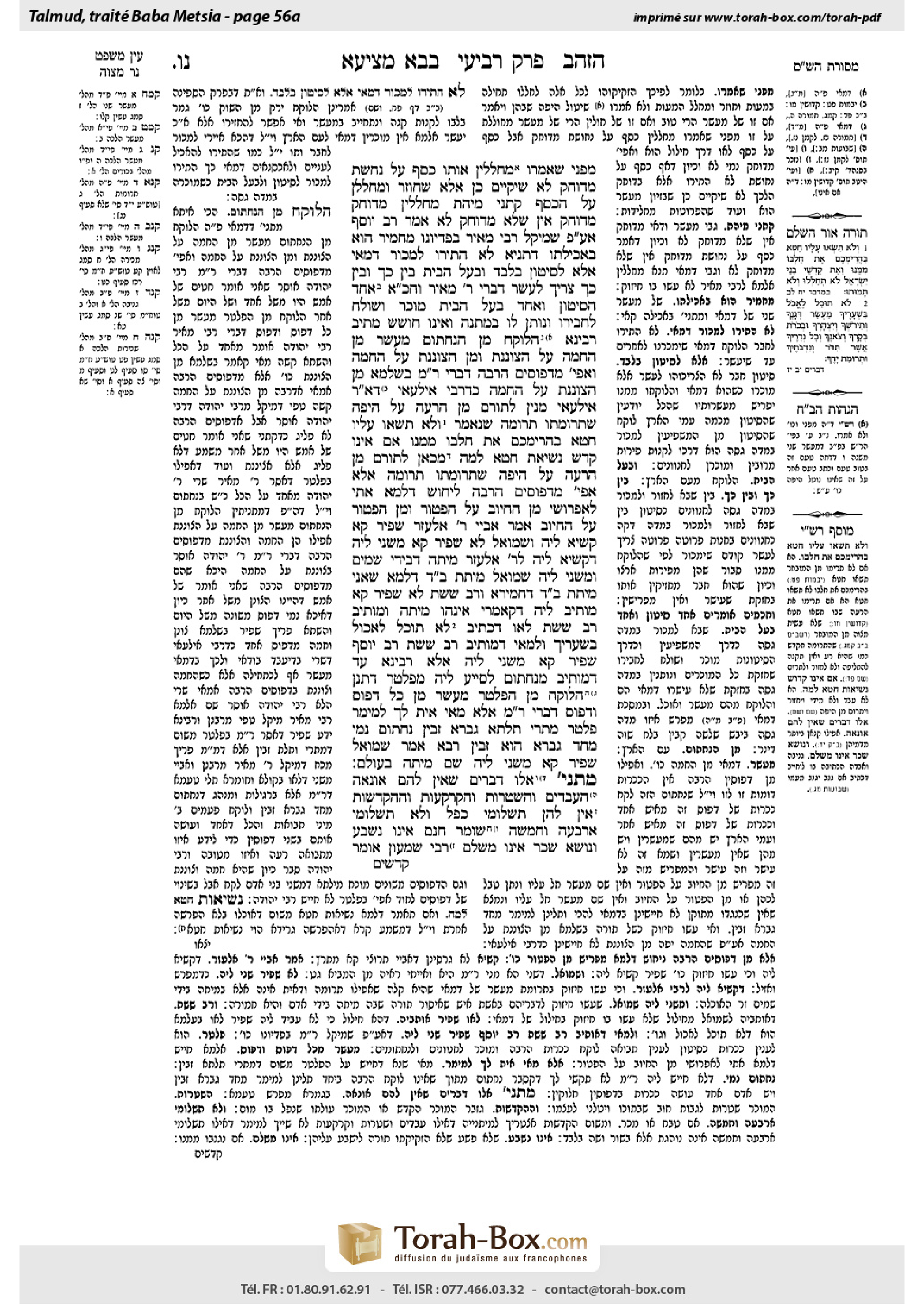
This page of Bava Metzia includes the Aramaic text, an English translation and an AI-generated French translation, alongside the scan above.
בבא מציעא נ״ו א · Aramaic and Hebrew text
מִפְּנֵי שֶׁאָמְרוּ: מְחַלְּלִין (אוֹתוֹ), כֶּסֶף עַל נְחֹשֶׁת, מִדּוֹחַק, לֹא שֶׁיְּקַיֵּים כֵּן, אֶלָּא שֶׁחוֹזֵר וּמְחַלְּלָן עַל הַכֶּסֶף. קָתָנֵי מִיהַת: מְחַלְּלִין מִדּוֹחַק, מִדּוֹחַק – אִין, שֶׁלֹּא מִדּוֹחַק – לָא.
אָמַר רַב יוֹסֵף: אַף עַל פִּי שֶׁמֵּיקֵל רַבִּי מֵאִיר בְּפִדְיוֹנוֹ, מַחְמִיר הוּא בַּאֲכִילָתוֹ, דְּתַנְיָא: לֹא הִתִּירוּ לִמְכּוֹר דְּמַאי אֶלָּא לְסִיטוֹן בִּלְבָד, וּבַעַל הַבַּיִת. בֵּין כָּךְ וּבֵין כָּךְ, צָרִיךְ לְעַשֵּׂר, דִּבְרֵי רַבִּי מֵאִיר.
וַחֲכָמִים אוֹמְרִים: אֶחָד הַסִּיטוֹן וְאֶחָד בַּעַל הַבַּיִת – מוֹכֵר, וְשׁוֹלֵחַ לַחֲבֵירוֹ, וְנוֹתֵן לוֹ בְּמַתָּנָה, וְאֵינוֹ חוֹשֵׁשׁ.
מֵתִיב רָבִינָא: הַלּוֹקֵחַ מִן הַנַּחְתּוֹם, מְעַשֵּׂר מִן הַחַמָּה עַל הַצּוֹנֶנֶת, וּמִן הַצּוֹנֶנֶת עַל הַחַמָּה, וַאֲפִילּוּ מִדְּפוּסִים הַרְבֵּה, דִּבְרֵי רַבִּי מֵאִיר.
בִּשְׁלָמָא מִן הַצּוֹנֶנֶת עַל הַחַמָּה, כִּדְרַבִּי אִילְעַאי. דְּאָמַר רַבִּי אִילְעַאי: מִנַּיִן לַתּוֹרֵם מִן הָרָעָה עַל הַיָּפָה שֶׁתְּרוּמָתוֹ תְּרוּמָה? שֶׁנֶּאֱמַר: ״וְלֹא תִשְׂאוּ עָלָיו חֵטְא בַּהֲרִימְכֶם אֶת חֶלְבּוֹ מִמֶּנּוּ״. אִם אֵינוֹ קֹדֶשׁ, נְשִׂיאַת חֵטְא לָמָּה? מִכָּאן לַתּוֹרֵם מִן הָרָעָה עַל הַיָּפָה, שֶׁתְּרוּמָתוֹ תְּרוּמָה.
אֶלָּא אֲפִילּוּ מִדְּפוּסִים הַרְבֵּה, לֵיחוּשׁ דִּלְמָא אָתֵי לְאַפְרוֹשֵׁי מִן הַחִיּוּב עַל הַפְּטוּר, וּמִן הַפְּטוּר עַל הַחִיּוּב!
אָמַר אַבָּיֵי: רַבִּי אֶלְעָזָר שַׁפִּיר קָא קַשְׁיָא לֵיהּ, וּשְׁמוּאֵל לָא שַׁפִּיר קָא מְשַׁנֵּי לֵיהּ. דְּקַשְׁיָא לֵיהּ לְרַבִּי אֶלְעָזָר: מִיתָה דְּבִידֵי שָׁמַיִם, וּמְשַׁנֵּי לֵיהּ שְׁמוּאֵל: מִיתַת בֵּית דִּין. דִּלְמָא שָׁאנֵי מִיתַת בֵּית דִּין דַּחֲמִירָא!
וְרַב שֵׁשֶׁת לָא שַׁפִּיר קָא מוֹתֵיב לֵיהּ, דְּקָאָמְרִי אִינְהוּ מִיתָה. וּמוֹתֵיב רַב שֵׁשֶׁת לָאו, דִּכְתִיב ״לֹא תוּכַל לֶאֱכֹל בִּשְׁעָרֶיךָ״. וּלְמַאי דְּמוֹתֵיב רַב שֵׁשֶׁת, רַב יוֹסֵף שַׁפִּיר קָא מְשַׁנֵּי לֵיהּ.
אֶלָּא רָבִינָא, עַד דְּמוֹתֵיב מִנַּחְתּוֹם לְסַיַּיע לֵיהּ מִפַּלְטֵר! דִּתְנַן: הַלּוֹקֵחַ מִן הַפַּלְטֵר – מְעַשֵּׂר מִן כׇּל דְּפוּס וּדְפוּס, דִּבְרֵי רַבִּי מֵאִיר.
אֶלָּא מַאי אִית לָךְ לְמֵימַר? פַּלְטֵר מִתְּרֵי תְּלָתָא גַּבְרָא זָבֵין, נַחְתּוֹם נָמֵי מֵחַד גַּבְרָא הוּא זָבֵין.
רָבָא אָמַר: שְׁמוּאֵל שַׁפִּיר קָא מְשַׁנֵּי לֵיהּ, שֵׁם מִיתָה בָּעוֹלָם.
מַתְנִי׳ אֵלּוּ דְּבָרִים שֶׁאֵין לָהֶם אוֹנָאָה: הָעֲבָדִים, וְהַשְּׁטָרוֹת, וְהַקַּרְקָעוֹת, וְהַהֶקְדֵּשׁוֹת. אֵין לָהֶן תַּשְׁלוּמֵי כֶפֶל, וְלֹא תַּשְׁלוּמֵי אַרְבָּעָה וַחֲמִשָּׁה. שׁוֹמֵר חִנָּם אֵינוֹ נִשְׁבָּע, וְנוֹשֵׂא שָׂכָר אֵינוֹ מְשַׁלֵּם. רַבִּי שִׁמְעוֹן אוֹמֵר:
Bava Metzia 56a · English translation
The reason one must employ this procedure is due to the fact that the Sages said: One desacralizes second-tithe silver coins upon copper coins under duress. And it is not that he will maintain them in that form; rather, it is that he again desacralizes them upon silver coins. In any event, the tanna teaches that one desacralizes second-tithe coins in this manner under duress, from which it may be inferred: Under duress, yes; not under duress, no. This is the halakha with regard to redemption of second-tithe coins by Torah law. By contrast, in the case of demai, which is by rabbinic law, Rabbi Meir permits desacralizing it in this manner ab initio. Apparently, Rabbi Meir is more lenient with regard to matters of rabbinic law than he is with regard to matters of Torah law.
Rav Yosef said: Although Rabbi Meir is lenient with regard to redemption of second-tithe demai, he is stringent with regard to its consumption. This is as it is taught in a baraita: The Sages permitted only a wholesaler to sell demai. Since a wholesaler acquires grain from numerous sources and sells large quantities, he would suffer significant loss if he were required to separate tithes each time. But in the case of a proprietor who purchased produce from an am ha’aretz, whether he purchased large quantities to sell in bulk or whether he purchased small quantities to sell little by little, he must tithe the produce; this is the statement of Rabbi Meir.
The baraita continues: And the Rabbis say: Both a wholesaler and a proprietor who sells in bulk may sell demai, or send it to another, or give it to him as a gift, and they need not be concerned. The one who receives the produce separates the tithes and consumes the remaining produce. In this baraita, Rabbi Meir was stringent with regard to the concern that someone will consume demai without the tithes being separated.
Ravina raises an objection from a mishna (Demai 5:3): One who purchases bread from a baker who is unreliable with regard to tithes [am ha’aretz] may tithe from warm bread for, i.e., to exempt, cold bread, and from cold bread for warm bread, and one may do so even if the bread is in different shapes from many molds; this is the statement of Rabbi Meir.
Granted, one may tithe from cold bread for warm bread, in accordance with the opinion of Rabbi Elai, as Rabbi Elai says: From where is it derived with regard to one who separates teruma from poor-quality produce for superior-quality produce that his teruma is teruma? It is as it is stated: “And you shall bear no sin by reason of it, seeing that you have set apart from it the best thereof” (Numbers 18:32). The Torah warns the Levites not to separate teruma from low-quality produce. The question arises: If when one separates lower-quality produce, that produce is not sacred, why would one think that he bears sin? He did nothing. From here it is derived that although the Levite acted improperly, in the case of one who separates teruma from poor-quality produce for superior-quality produce, his teruma is teruma.
Rather, with regard to the halakha that one may tithe even if the bread is in different shapes from many molds, let Rabbi Meir be concerned lest the buyer come to tithe from the loaves that one is obligated to tithe for the loaves that one is exempt from tithing, or from the exempt for the obligated. Since these loaves are all demai, it is possible that the loaves shaped in one mold were baked from produce that was tithed and the loaves shaped in another mold were baked from produce that was not tithed. Apparently, Rabbi Meir rules leniently in cases of rabbinic law, e.g., demai.
The Gemara returns to discuss the difficulties raised above. Abaye said: The problem raised by Rabbi Elazar was legitimately difficult for him, and Shmuel did not legitimately responded to his difficulty by stating that the mishna is in accordance with the opinion of Rabbi Meir. The reason the response is insufficient is that it was the case in the mishna of teruma of the tithe, which is punishable with death at the hand of Heaven, that was difficult for Rabbi Elazar, who was questioning whether the Sages reinforced their pronouncements concerning such a prohibition and rendered them parallel to Torah law; and Shmuel responded to him by citing Rabbi Meir’s opinion concerning a bill of divorce, which involves court-imposed capital punishment. Perhaps the case involving court-imposed capital punishment is different, as it is more stringent, and Rabbi Meir renders rabbinic law parallel to Torah law only in such a case.
Abaye continued: And Rav Sheshet does not legitimately raise an objection, as Rabbi Elazar and Shmuel are speaking about cases punishable by death, and Rav Sheshet raised his objection from a case involving a mere prohibition, as it is written with regard to second tithe: “You may not eat within your gates the tithe of your grain, or of your wine, or of your oil” (Deuteronomy 12:17). And to that which Rav Sheshet raised as an objection, Rav Yosef legitimately respond to his difficulty.
But as for Ravina, the question arises: Rather than raising an objection from this case of a baker, from which proof is cited that Rabbi Meir does not draw a parallel between rabbinic law and Torah law, let him cite support for the assessment of the opinion of Rabbi Meir from the case of a bread merchant [mipalter], as we learned in a mishna (Demai 5:4): One who purchases bread from a merchant tithes separately from the bread of each and every mold; this is the statement of Rabbi Meir. In this case, Rabbi Meir is stringent with regard to demai.
Rather, what have you to say in explaining why Ravina did not cite a proof from this mishna? It is because a merchant purchases his supply from two or three people. Therefore, Rabbi Meir holds that one must be concerned that perhaps one of the suppliers separated tithes and another did not, so the customer must separate tithes from the bread of each and every mold. But if that is the case, Ravina should not cite a proof from the case of the baker, as well; as the baker discussed in the mishna typically purchases his stock of grain from only one person. Therefore, in that case there is no concern that perhaps the customer will tithe from the loaves that he is exempt from tithing for the loaves that he is obligated to tithe.
Rava said: Shmuel responds well to that which was difficult to Rabbi Elazar, as the category of death in the world is one. Therefore, it is appropriate to cite proof from the case of court-imposed capital punishment to the case of death at the hand of Heaven.
MISHNA: These are matters that are not subject to the halakhot of exploitation even if the disparity between the value and the payment is one-sixth or greater: Slaves, and documents, and land, and consecrated property. In addition, if they are stolen, these items are subject neither to payment of double the principal for theft nor to payment of four or five times the principal, if the thief slaughtered or sold a stolen sheep or cow, respectively. An unpaid bailee does not take an oath and a paid bailee does not pay if these items were stolen or lost. Rabbi Shimon says:
Bava Metzia 56a · Traduction française (IA)
La raison pour laquelle on doit employer cette procédure est que les Sages ont dit : On désacralise les monnaies d'argent de la deuxième part sur des monnaies de cuivre sous la contrainte. Et ce n'est pas parce qu'il les maintiendra ainsi ; plutôt, c'est parce qu'il les désacralise à nouveau sur des monnaies d'argent. En tout cas, le tanna enseigne que l'on désacralise les monnaies de la deuxième part de cette manière sous la contrainte, d'où on peut déduire : sous la contrainte, oui ; sans contrainte, non. C'est la halakha concernant le rachat des monnaies de la deuxième part selon la loi divine. En revanche, dans le cas des demai, qui est selon la loi rabbinique, Rabbi Meir permet de désacraliser ainsi dès le début. Apparemment, Rabbi Meir est plus clément concernant les questions de loi rabbinique qu'il ne l'est concernant les questions de loi divine.
Rav Yosef a dit : Bien que Rabbi Meir soit clément concernant la consommation des demai de la deuxième part, il est strict concernant leur rachat. C'est ce qui est enseigné dans une baraïta : Les Sages ont permis seulement un marchand de vendre des demai. Puisque le marchand achète des céréales de multiples sources et vend des quantités importantes, il subirait une perte considérable s'il devait séparer les dîmes chaque fois. En revanche, dans le cas d'un propriétaire qui a acheté des produits d'un am ha'aretz, qu'il ait acheté de grandes quantités pour les vendre en vrac ou qu'il ait acheté de petites quantités pour les vendre petit à petit, il doit titrer les produits ; c'est l'opinion de Rabbi Meir.
La baraïta continue : Et les Rabbins disent : à la fois le marchand et le propriétaire qui vend en vrac peuvent vendre des demai, ou les envoyer à un autre, ou les lui donner en cadeau, et ils n'ont pas à s'inquiéter. Celui qui reçoit les produits sépare les dîmes et consomme le reste des produits. Dans cette baraïta, Rabbi Meir était strict concernant l'inquiétude que quelqu'un puisse consommer des demai sans que les dîmes soient séparées.
Ravina éleve un objet d'une mitsva (Demai 5:3) : Celui qui achète du pain auprès d'un boulanger peu fiable concernant les dîmes [am ha'aretz] peut titrer du pain chaud afin d'exempter le pain froid, et du pain froid afin de titrer le pain chaud, et on peut le faire même si le pain est en formes différentes provenant de plusieurs moules ; c'est l'opinion de Rabbi Meir.
D'accord, on peut titrer du pain froid pour le pain chaud, selon l'opinion de Rabbi Elai, comme Rabbi Elai dit : D'où est-il dérivé concernant celui qui sépare la terouma des produits de qualité inférieure pour des produits de qualité supérieure que sa terouma est terouma ? C'est ce qui est dit : « Et vous ne porterez point de péché à cause de cela, car vous avez séparé de cela le meilleur » (Nombres 18:32). La Torah avertit les Lévites de ne pas séparer la terouma des produits de qualité inférieure. La question se pose : Si lorsqu'on sépare des produits de qualité inférieure, ces produits ne sont pas sacrés, pourquoi penses-t-on qu'on porte un péché ? On n'a rien fait. D'où on déduit que, bien que le Lévite ait agi de manière inappropriée, dans le cas de celui qui sépare la terouma des produits de qualité inférieure pour des produits de qualité supérieure, sa terouma est terouma.
Plutôt, concernant la halakha qui permet de titrer même si le pain est en formes différentes provenant de plusieurs moules, laisseons Rabbi Meir s'inquiéter que l'acheteur vienne à titrer des pains que l'on est tenu de titrer pour les pains que l'on est exempt de titrer, ou inversement. Puisque ces pains sont tous des demai, il est possible que les pains en un moule aient été cuits à partir de produits titrés et les pains en un autre moule aient été cuits à partir de produits non titrés. Apparemment, Rabbi Meir règle lenientement dans les cas de loi rabbinique, par exemple, des demai.
Le Guemara reprend la discussion des difficultés soulevées ci-dessus. Abaye a dit : Le problème soulevé par Rabbi Elazar était légitimement difficile pour lui, et Shmuel n'a pas légitimement répondu à sa difficulté en affirmant que la mitsva est selon l'opinion de Rabbi Meir. La raison pour laquelle la réponse est insuffisante est que c'était le cas de la mitsva de la terouma de la dîme, qui est punissable par la mort à la main du Ciel, qui était difficile pour Rabbi Elazar, qui questionnait si les Sages avaient renforcé leurs déclarations concernant une telle interdiction et les avaient rendues parallèles à la loi divine ; et Shmuel a répondu à lui en citant l'opinion de Rabbi Meir concernant un acte de divorce, qui implique une peine de mort imposée par le tribunal. Peut-être que le cas impliquant une peine de mort imposée par le tribunal est différent, car il est plus strict, et Rabbi Meir rend la loi rabbinique parallèle à la loi divine uniquement dans de tels cas.
Abaye a poursuivi : Et Rav Sheshet ne soulève pas légitimement d'objection, car Rabbi Elazar et Shmuel parlent de cas punissables par la mort, et Rav Sheshet a soulevé son objection à partir d'un cas impliquant une simple interdiction, comme il est écrit concernant la deuxième dîme : « Vous ne pouvez pas manger à l'intérieur de vos portes la dîme de vos céréales, ou de votre vin, ou de votre huile » (Deutéronome 12:17). Et à ce que Rav Sheshet a soulevé comme objection, Rav Yosef a légitimement répondu à sa difficulté.
Mais concernant Ravina, la question se pose : Plutôt que de soulever une objection à partir de ce cas du boulanger, à partir duquel une preuve est citée que Rabbi Meir ne fait pas de parallèle entre la loi rabbinique et la loi divine, qu'il cite un soutien pour l'évaluation de l'opinion de Rabbi Meir à partir du cas du marchand de pain [mipalter], comme nous avons appris dans une mitsna (Demai 5:4) : Celui qui achète du pain d'un marchand titre séparément du pain de chaque moule ; c'est l'opinion de Rabbi Meir. Dans ce cas, Rabbi Meir est strict concernant les demai.
Plutôt, que dis-tu pour expliquer pourquoi Ravina n'a pas cité une preuve à partir de cette mitsna ? C'est parce qu'un marchand achète sa fourniture à deux ou trois personnes. Ainsi, Rabbi Meïr considère qu'il faut avoir peur que l'un des fournisseurs ait séparé les dîmes et que l'autre n'ait pas fait cela, donc le client doit séparer les dîmes du pain de chaque moule. Mais si c'est le cas, Ravina ne devrait pas non plus citer une preuve à partir du cas du boulanger, car le boulanger mentionné dans la mitsna achète généralement son stock de céréales à une seule personne. Ainsi, dans ce cas, il n'y a pas de crainte que le client tithe à partir des pains qu'il est dispensé de titrer pour les pains qu'il est tenu de titrer.
Rava dit : Shmuel répond bien à ce qui était difficile pour Rabbi Eléazar, car la catégorie de la mort dans le monde est une. Ainsi, il est approprié de citer une preuve à partir du cas de la peine de mort imposée par la cour pour le cas de la mort à la main du Ciel.
MICHNA : Ces sont des choses qui ne sont pas soumises aux halakhot de l'exploitation même si la différence entre la valeur et le paiement est d'un sixième ou plus : les esclaves, les documents, la terre et les biens consacrés. De plus, si ces objets sont volés, ils ne sont pas soumis à un paiement double du principal pour le vol ni à un paiement de quatre ou cinq fois le principal, si le voleur a tué ou vendu une brebis ou une vache volée, respectivement. Un bailee non rémunéré ne prend pas d'œuf et un bailee rémunéré ne paie pas si ces objets ont été volés ou perdus. Rabbi Shimon dit :
Traduction française générée par IA à partir de l’édition anglaise de Sefaria. Vérifie toujours un passage avec le texte source.
Text from Sefaria: William Davidson Edition - Vocalized Aramaic (CC BY NC); William Davidson Edition - English (CC BY NC).