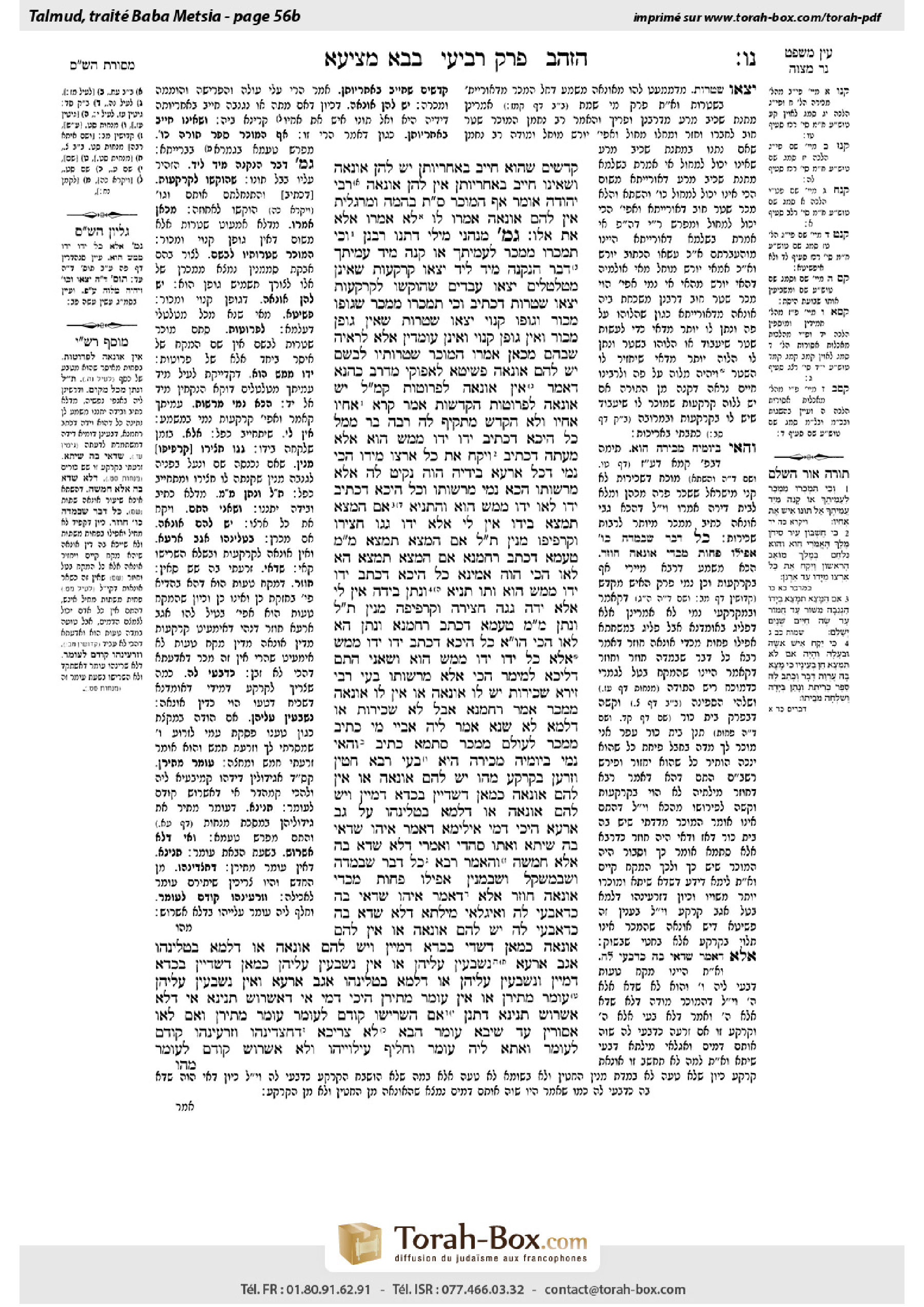
Bava Metzia 56b: Talmud study for Daf Yomi
Study the Talmud for Daf Yomi with scanned pages, Hebrew text, English translations from Sefaria and AI-generated French translations.
Passage selection and English or AI-generated French translation are available where the scan has annotations. Daf Study is independent of Torah-Box and Sefaria.
Browse Bava Metzia · בבא מציעא · All tractatesBava Metzia 56b text and translations
This page of Bava Metzia includes the Aramaic text, an English translation and an AI-generated French translation, alongside the scan above.
בבא מציעא נ״ו ב · Aramaic and Hebrew text
קֳדָשִׁים שֶׁהוּא חַיָּיב בְּאַחְרָיוּתָן – יֵשׁ לָהֶן אוֹנָאָה. וְשֶׁאֵינוֹ חַיָּיב בְּאַחְרָיוּתָן – אֵין לָהֶן אוֹנָאָה. רַבִּי יְהוּדָה אוֹמֵר: אַף הַמּוֹכֵר סֵפֶר תּוֹרָה, בְּהֵמָה וּמַרְגָּלִית – אֵין לָהֶם אוֹנָאָה. אָמְרוּ לוֹ: לֹא אָמְרוּ אֶלָּא אֶת אֵלּוּ.
גְּמָ׳ מְנָהָנֵי מִילֵּי? דְּתָנוּ רַבָּנַן: ״וְכִי תִמְכְּרוּ מִמְכָּר לַעֲמִיתֶךָ אוֹ קָנֹה מִיַּד עֲמִיתֶךָ״, דָּבָר הַנִּקְנֶה מִיָּד לְיָד. יָצְאוּ קַרְקָעוֹת, שֶׁאֵינָן מְטַלְטְלִים. יָצְאוּ עֲבָדִים, שֶׁהוּקְּשׁוּ לְקַרְקָעוֹת. יָצְאוּ שְׁטָרוֹת, דִּכְתִיב: ״וְכִי תִמְכְּרוּ מִמְכָּר״, שֶׁגּוּפוֹ מָכוּר וְגוּפוֹ קָנוּי. יָצְאוּ שְׁטָרוֹת, שֶׁאֵין גּוּפָן מָכוּר וְאֵין גּוּפָן קָנוּי, וְאֵינָן עוֹמְדִין אֶלָּא לִרְאָיָה שֶׁבָּהֶם.
מִכָּאן אָמְרוּ: הַמּוֹכֵר שְׁטָרוֹתָיו לְבַשָּׂם, יֵשׁ לָהֶם אוֹנָאָה. פְּשִׁיטָא! לְאַפּוֹקֵי מִדְּרַב כָּהֲנָא, דְּאָמַר: אֵין אוֹנָאָה לִפְרוּטוֹת, קָא מַשְׁמַע לַן: יֵשׁ אוֹנָאָה לִפְרוּטוֹת. הֶקְדֵּשׁוֹת? אָמַר קְרָא ״אָחִיו״ – אָחִיו, וְלֹא הֶקְדֵּשׁ.
מַתְקֵיף לַהּ רַבָּה בַּר מֶמֶל: כֹּל הֵיכָא דִּכְתִיב ״יָדוֹ״, יָדוֹ מַמָּשׁ הוּא? אֶלָּא מֵעַתָּה, דִּכְתִיב ״וַיִּקַּח אֶת כׇּל אַרְצוֹ מִיָּדוֹ״, הָכִי נָמֵי דְּכֹל אַרְעָא בִּידֵיהּ הֲוָה נָקֵיט לַהּ? אֶלָּא מֵרְשׁוּתוֹ, הָכָא נָמֵי מֵרְשׁוּתוֹ.
וְכֹל הֵיכָא דִּכְתִיב ״יָדוֹ״, לָאו יָדוֹ מַמָּשׁ הוּא? וְהָתַנְיָא: ״אִם הִמָּצֵא תִמָּצֵא בְיָדוֹ״, אֵין לִי אֶלָּא יָדוֹ. גַּגּוֹ, חֲצֵירוֹ וְקַרְפֵּיפוֹ מִנַּיִן? תַּלְמוּד לוֹמַר: ״אִם הִמָּצֵא תִמָּצֵא״, מִכׇּל מָקוֹם.
טַעְמָא דִּכְתַב רַחֲמָנָא ״אִם הִמָּצֵא תִמָּצֵא״, הָא לָאו הָכִי הֲוָה אָמֵינָא: כֹּל הֵיכָא דִּכְתַב ״יָדוֹ״, יָדוֹ מַמָּשׁ הוּא. וְתוּ, תַּנְיָא: ״וְנָתַן בְּיָדָהּ״, אֵין לִי אֶלָּא יָדָהּ. גַּגָּהּ חֲצֵירָהּ וְקַרְפֵּיפָהּ מִנַּיִן? תַּלְמוּד לוֹמַר: ״וְנָתַן״, מִכׇּל מָקוֹם. טַעְמָא דִּכְתַב רַחֲמָנָא ״וְנָתַן״, הָא לָאו הָכִי הֲוָה אָמֵינָא: כֹּל הֵיכָא דִּכְתַב ״יָדוֹ״, יָדוֹ מַמָּשׁ.
אֶלָּא, כֹּל ״יָדוֹ״ – יָדוֹ מַמָּשׁ הוּא. וְשָׁאנֵי הָתָם, דְּלֵיכָּא לְמֵימַר הָכִי, אֶלָּא בִּרְשׁוּתוֹ.
בָּעֵי רַבִּי זֵירָא: שְׂכִירוּת יֵשׁ לוֹ אוֹנָאָה, אוֹ אֵין לוֹ אוֹנָאָה? ״מִמְכָּר״ אָמַר רַחֲמָנָא, אֲבָל לֹא שְׂכִירוּת, אוֹ דִלְמָא לָא שְׁנָא? אֲמַר לֵיהּ אַבָּיֵי: מִי כְּתִיב ״מִמְכָּר לְעוֹלָם״? ״מִמְכָּר״ סְתָמָא כְּתִיב, וְהַאי נָמֵי, בְּיוֹמֵיהּ מְכִירָה הִיא.
בָּעֵי רָבָא: חִטִּין וּזְרָעָן בַּקַּרְקַע, מַהוּ? יֵשׁ לָהֶם אוֹנָאָה, אוֹ אֵין לָהֶם אוֹנָאָה? כְּמַאן דְּשַׁדְיָין בְּכַדָּא דָּמְיָין, וְיֵשׁ לָהֶם אוֹנָאָה, אוֹ דִלְמָא בַּטְּלִינְהוּ עַל גַּב אַרְעָא?
הֵיכִי דָמֵי? אִילֵימָא דְּאָמַר אִיהוּ: ״שְׁדַאי בַּהּ שִׁיתָּא״, וַאֲתוֹ סָהֲדִי וְאָמְרִי דְּלָא שְׁדָא בָּהּ אֶלָּא חַמְשָׁה, וְהָאָמַר רָבָא: כׇּל דָּבָר שֶׁבְּמִדָּה וְשֶׁבְּמִשְׁקָל וְשֶׁבְּמִנְיָן, אֲפִילּוּ פָּחוֹת מִכְּדֵי אוֹנָאָה – חוֹזֵר!
אֶלָּא דְּאָמַר אִיהוּ: ״שְׁדַאי בָּהּ כִּדְאִבְּעִי לַהּ״, וְאִיגַּלַּאי מִילְּתָא דְּלָא שְׁדָא בָּהּ כִּדְאִבְּעִי לַהּ, יֵשׁ לָהֶם אוֹנָאָה אוֹ אֵין לָהֶם אוֹנָאָה? כְּמַאן דִּשְׁדֵי בְּכַדָּא דָּמְיָין וְיֵשׁ לָהֶם אוֹנָאָה, אוֹ דִּלְמָא בַּטְּלִינְהוּ אַגַּב אַרְעָא?
נִשְׁבָּעִין עֲלֵיהֶן, אוֹ אֵין נִשְׁבָּעִין עֲלֵיהֶן? כְּמַאן דְּשַׁדְיָין בְּכַדָּא דָּמְיָין וְנִשְׁבָּעִין עֲלֵיהֶן, אוֹ דִלְמָא בַּטְּלִינְהוּ אַגַּב אַרְעָא וְאֵין נִשְׁבָּעִין עֲלֵיהֶן?
עוֹמֶר מַתִּירָן אוֹ אֵין עוֹמֶר מַתִּירָן? הֵיכִי דָמֵי: אִי דְּאַשְׁרוּשׁ – תְּנֵינָא, אִי דְּלָא אַשְׁרוּשׁ – תְּנֵינָא! דִּתְנַן: אִם הִשְׁרִישׁוּ קוֹדֶם לָעוֹמֶר – עוֹמֶר מַתִּירָן, וְאִם לָאו – אֲסוּרִין עַד שֶׁיָּבֹא עוֹמֶר הַבָּא!
לָא צְרִיכָא, דְּחַצְדִינְהוּ וְזַרְעִינְהוּ קוֹדֶם לָעוֹמֶר, וַאֲתָא לֵיהּ עוֹמֶר וַחֲלֵיף עִילָּוַיְיהוּ, וְלָא אַשְׁרוּשׁ קוֹדֶם לָעוֹמֶר.
Bava Metzia 56b · English translation
With regard to sacrificial animals for which one bears responsibility to replace them, they are subject to the halakhot of exploitation, as this responsibility indicates a certain aspect of ownership. And those for which one does not bear responsibility to replace them, they are not subject to the halakhot of exploitation. Rabbi Yehuda says: Even in the case of one who sells a Torah scroll, an animal, or a pearl, these items are not subject to the halakhot of exploitation, as they have no fixed price. The Rabbis said to him: The early Sages stated that only these items listed above are not subject to the halakhot of exploitation.
GEMARA: The Gemara asks: From where are these matters derived? It is as the Sages taught: It is written: “And if you sell to your colleague an item that is sold, or acquire from your colleague’s hand, one shall not exploit his brother” (Leviticus 25:14). This is referring to an item acquired from hand to hand. Land is excluded, as it is not movable. Slaves are excluded, as they are juxtaposed to land in several sources, and therefore their legal status is like that of land in certain respects. Documents are excluded, as it is written: “And if you sell to your colleague an item that is sold,” indicating an item that is itself sold and itself acquired. Documents are excluded, as they are not sold themselves and they are not acquired themselves. They have no intrinsic value, and they exist only for the proof therein.
From here the Sages said: In the case of one who sells his documents that are no longer in use to a perfumer for use in packaging his wares, they are subject to the halakhot of exploitation because he is selling the paper itself. The Gemara asks: Isn’t this obvious? In that case, one sold paper, and it is no different from any other movable property. The Gemara answers: This serves to exclude the opinion of Rav Kahana, who says: There is no exploitation for cases involving perutot, as paper is sold for mere perutot. The Sages therefore teach us: There is exploitation for cases involving perutot. Consecrated property is excluded, as the verse states: “One shall not exploit his brother” (Leviticus 25:14), indicating that these halakhot apply only to transactions involving “his brother,” but not to transactions involving consecrated property.
Rabba bar Memel objects to this: Is that to say that anywhere that it is written “his hand,” the reference is to his actual hand, and not merely to his possession, in its metaphorical sense? If that is so, that which is written: “And taken all his land from his hand” (Numbers 21:26), would you also explain here that he was holding all his land in his hand? Rather, clearly, “from his hand” means from his possession. Here too, “from your colleague’s hand” in the case of exploitation means from his possession.
The Gemara asks: Is that to say that anywhere that it is written “his hand” the reference is not to his actual hand? But isn’t it taught in a baraita: “If the theft is found in his hand” (Exodus 22:3): I have derived from here only his hand; from where do I derive that the halakha is the same if the stolen item is found on his roof, in his courtyard, or in his enclosure? The verse states: “If the theft is found [himmatze timmatze]”; the use of the double verb teaches that the halakha applies in any case where the stolen item is in his possession.
The Gemara infers: The halakha applies if the stolen item is found in his possession, and this includes any place in his possession. The reason is that the Merciful One writes: “If the theft is found [himmatze timmatze].” If that were not so, I would say that wherever He writes “his hand,” the reference is to his actual hand. And furthermore, it is taught in a baraita that it is written with regard to a bill of divorce: “And place it in her hand” (Deuteronomy 24:1). I have derived only her hand; from where do I derive that the halakha is the same if he places the bill of divorce on her roof, in her courtyard, or in her enclosure? The verse states: And place, in any case that he places it in her possession. Here too, the Gemara infers: The reason that any place in her possession is included is that the Merciful One writes “and place.” If that were not so, I would say that wherever He writes “his hand,” the reference is to his actual hand.
Rather, the Gemara rejects Rabba bar Memel’s objection and concludes: Every mention of the term “his hand” in the Torah is a reference to his actual hand. And it is different there, in the verse: “And taken all his land from his hand” (Numbers 21:26), where it cannot be said that the reference is to his actual hand. Rather, it means there: In his possession.
§ Rabbi Zeira raises a dilemma with regard to rental: Is it subject to the halakhot of exploitation, or is it not subject to the halakhot of exploitation? The Gemara elaborates: Is it an item that is sold about which the Merciful One speaks, but not a rental; or perhaps there is no difference? Abaye said to him: Is it written: And if you sell an item that is sold forever? What is written is simply: “And if you sell an item that is sold,” and indeed for its day the rental is considered a sale. The legal status of a rental is that of a sale for a limited period. Consequently, it is subject to the halakhot of exploitation.
Rava raises a dilemma: In a case involving wheat kernels, and one sowed them in the ground, what is the halakha? Are they subject to the halakhot of exploitation, or are they not subject to the halakhot of exploitation? The Gemara elaborates: Is their legal status like that of kernels cast into a jug, and they are subject to the halakhot of exploitation, as they remain movable property? Or, perhaps he subordinated them to the ground, and like land they are not subject to the halakhot of exploitation.
The Gemara asks: What are the circumstances? If we say that the hired laborer said: I sowed six kav of grain in the field, and witnesses came and said that he sowed only five kav in it, but doesn’t Rava himself say: With regard to any item that is otherwise subject to the halakhot of exploitation, and it is sold by measure, or by weight, or by number, even if the disparity was less than the measure of exploitation in the transaction, the transaction is reversed. A disparity of one-sixth between the value of an item and its price constitutes exploitation only in cases where there is room for error in assessing the value of an item. In a case where the sale item is easily quantifiable, any deviation from the designated quantity results in a nullification of the transaction, even if the wheat kernels are subordinate to the ground.
Rather, it is a case where the hired laborer said: I cast kernels in the field as required, without quantifying the measure of the kernels that he cast, and it was discovered that he did not cast kernels in the field as required. Are they subject to the halakhot of exploitation or are they not subject to the halakhot of exploitation? Is the legal status of these kernels like that of kernels cast into a jug, and they are subject to the halakhot of exploitation? Or, perhaps the laborer subordinated them to the ground?
Rava raises an additional dilemma: If the laborer admitted to part of the claim, does he take an oath with regard to the kernels or does he not take an oath with regard to the kernels? Is their legal status like that of kernels cast into a jug, and one takes an oath with regard to them? Or, perhaps he subordinated them to the ground, and one does not take an oath with regard to them, as the halakha is that one does not take an oath about a claim involving land.
Rava raises an additional dilemma: Does the sacrifice of the omer offering permit one to eat the produce grown from these kernels, or does the sacrifice of the omer offering not permit one to eat the produce? The Gemara asks: What are the circumstances? If it is a case where the kernels took root, we already learned that halakha. If it is a case where the kernels did not yet take root, we already learned that halakha also. As we learned in a mishna (Menaḥot 70a): If crops took root before the sacrifice of the omer offering, the omer offering renders it permitted to eat them. And if not, if they took root only after the sacrifice of the omer offering, it is prohibited to eat them until the time for the sacrifice of the next omer offering will arrive.
No, Rava’s dilemma is not superfluous, as it is necessary to raise it in a case where one reaped grain and sowed its kernels prior to the time of the omer offering, and the time of the omer offering arrived and passed while they were in the ground, and the kernels did not take root before the sacrifice of the omer offering.
Bava Metzia 56b · Traduction française (IA)
Concernant les animaux sacrés pour lesquels l'on est tenu responsable de les remplacer, ils sont soumis aux halakhot de l'exploitation, car cette responsabilité indique un aspect particulier de la propriété. Et ceux pour lesquels l'on n'est pas tenu responsable de les remplacer, ils ne sont pas soumis aux halakhot de l'exploitation. Rabbi Yéhuda dit : Même dans le cas d'une personne qui vend un rouleau de Torah, un animal ou une perle, ces objets ne sont pas soumis aux halakhot de l'exploitation, car ils n'ont pas de prix fixe. Les Sages lui répondent : Les Sages anciens ont dit que seuls ces objets mentionnés ci-dessus ne sont pas soumis aux halakhot de l'exploitation.
GUEMARA : La Guemara pose la question : D'où sont dérivées ces choses ? C'est comme les Sages ont enseigné : Il est écrit : « Et si tu vends à ton collègue un objet qui est vendu, ou que tu acquiers de la main de ton collègue, on ne doit pas exploiter son frère » (Lévitique 25:14). Cela fait référence à un objet acquis de main en main. La terre est exclue, car elle n'est pas mobile. Les esclaves sont exclus, car ils sont juxtaposés à la terre dans plusieurs sources, et leur statut juridique est donc similaire à celui de la terre en certains aspects. Les documents sont exclus, car il est écrit : « Et si tu vends à ton collègue un objet qui est vendu », indiquant un objet qui est lui-même vendu et lui-même acquis. Les documents sont exclus, car ils ne sont pas eux-mêmes vendus et ne sont pas eux-mêmes acquis. Ils n'ont pas de valeur intrinsèque et ils existent uniquement pour la preuve qu'ils contiennent.
D'où les Sages ont dit : Dans le cas d'une personne qui vend ses documents non utilisés à un parfumeur pour l'emballage de ses marchandises, ils sont soumis aux halakhot de l'exploitation, car il vend le papier lui-même. La Guemara pose la question : N'est-ce pas évident ? Dans ce cas, on vend du papier, et cela ne diffère pas d'un autre bien mobilier. La Guemara répond : Cela sert à exclure l'opinion de Rav Kahana, qui dit qu'il n'y a pas d'exploitation dans les cas concernant les perutot, car le papier est vendu uniquement pour les perutot. Les Sages enseignent donc : Il y a une exploitation dans les cas concernant les perutot. La propriété consacrée est exclue, car la versette dit : « On ne doit pas exploiter son frère » (Lévitique 25:14), indiquant que ces halakhot s'appliquent uniquement aux transactions impliquant « son frère », mais pas aux transactions impliquant la propriété consacrée.
Rabba bar Memel s'oppose à cela : Est-ce que cela signifie que partout où il est écrit « sa main », la référence est à sa main réelle, et non simplement à sa possession, dans un sens métaphorique ? Si c'est le cas, alors ce qui est écrit : « Et on a pris toute sa terre de sa main » (Nb 21:26), ne devrais-tu pas expliquer ici qu'il tenait toute sa terre dans sa main ? Plutôt, clairement, « de sa main » signifie de sa possession. Ici aussi, « de la main de ton collègue » dans le cas de l'exploitation signifie de sa possession.
La Guemara pose la question : Est-ce que cela signifie que partout où il est écrit « sa main », la référence n'est pas à sa main réelle ? Mais n'est-ce pas enseigné dans une baraïta : « Si le vol est trouvé dans sa main » (Ex 22:3) : J'ai dérivé d'ici seulement sa main ; d'où dérive-t-on que la halakha est la même si l'objet volé est trouvé sur son toit, dans son jardin ou dans son enclos ? La versette dit : « Si le vol est trouvé [himmatze timmatze] » ; l'emploi du verbe double enseigne que la halakha s'applique à tout cas où l'objet volé est en possession de la personne.
La Guemara déduit : La halakha s'applique si l'objet volé est trouvé en possession de la personne, et cela inclut toute place en possession de la personne. La raison est que l'Éternel a écrit : « Si le vol est trouvé [himmatze timmatze] ». Si ce n'était pas le cas, je dirais que partout où il est écrit « sa main », la référence est à sa main réelle. Et de plus, il est enseigné dans une baraïta que cela concerne un divorce : « Et place-le dans sa main » (Dt 24:1). J'ai dérivé seulement sa main ; d'où dérive-t-on que la halakha est la même si l'on place le divorce sur son toit, dans son jardin ou dans son enclos ? La versette dit : Et place, dans tout cas où il le place en possession de la personne. Ici aussi, la Guemara déduit : La raison pour laquelle toute place en possession de la personne est incluse est que l'Éternel a écrit « et place ». Si ce n'était pas le cas, je dirais que partout où il est écrit « sa main », la référence est à sa main réelle.
Plutôt, la Guemara rejette l'objection de Rabba bar Memel et conclut : Toute mention du terme « sa main » dans la Torah est une référence à sa main réelle. Et cela est différent là, dans la versette : « Et on a pris toute sa terre de sa main » (Nb 21:26), où on ne peut pas dire que la référence est à sa main réelle. Plutôt, cela signifie là : En possession de la personne.
§ Rabbi Zéira soulève un dilemme concernant le loyer : Est-ce soumis aux halakhot de l'exploitation, ou n'est-il pas soumis aux halakhot de l'exploitation ? La Guemara développe : Est-ce un objet qui est vendu dont l'Éternel parle, mais pas un loyer ; ou peut-être y a-t-il une différence ? Abaye dit à lui : Est-ce écrit : Et si tu vends un objet qui est vendu pour toujours ? Ce qui est écrit est simplement : « Et si tu vends un objet qui est vendu », et en effet, pour sa journée, le loyer est considéré comme une vente. Le statut juridique du loyer est celui d'une vente pour une période limitée. Par conséquent, il est soumis aux halakhot de l'exploitation.
Rava soulève un dilemme : Dans un cas où des graines de blé ont été semées dans le sol, quelle est la halakha ? Sont-elles soumises aux halakhot de l'exploitation, ou ne le sont-elles pas ? La Guemara développe : Est-ce que leur statut juridique est celui des graines jetées dans un récipient, et qu'elles sont soumises aux halakhot de l'exploitation, car elles restent des biens mobiliers ? Ou, peut-être qu'elles ont été soumises au sol, et qu'elles sont comme la terre, et qu'elles ne sont pas soumises aux halakhot de l'exploitation.
La Guemara pose la question : Quelles sont les circonstances ? Si nous disons que le travailleur engagé a déclaré : J'ai semé six kav de blé dans le champ, et des témoins ont dit qu'il n'avait semé que cinq kav, mais ne dit-on pas que Rava lui-même affirme : Concernant toute chose qui est soumise aux halakhot de l'exploitation, et qui est vendue par mesure, ou par poids, ou par nombre, même si la différence était inférieure à la mesure de l'exploitation dans la transaction, la transaction est annulée. Une différence de un sixième entre la valeur d'une chose et son prix constitue une exploitation uniquement dans les cas où il y a lieu d'erreur dans l'évaluation de la valeur d'une chose. Dans un cas où la chose vendue est facilement quantifiable, toute déviation par rapport à la quantité désignée annule la transaction, même si les grains sont subordonnés au sol.
Plutôt, il s'agit d'un cas où le travailleur engagé a déclaré : J'ai jeté des grains dans le champ selon la mesure requise, sans quantifier la mesure des grains qu'il a jetés, et il a été découvert qu'il n'avait pas jeté les grains dans le champ selon la mesure requise. Sont-ils soumis aux halakhot de l'exploitation ou ne le sont-ils pas ? Le statut juridique de ces grains est-il comme celui des grains jetés dans un récipient, et sont-ils soumis aux halakhot de l'exploitation ? Ou, peut-être, le travailleur les a subordonnés au sol ?
Rava soulève une autre difficulté : Si le travailleur a admis une partie de la revendication, prend-il serment concernant les grains ou ne prend-il pas serment concernant les grains ? Le statut juridique de ces grains est-il comme celui des grains jetés dans un récipient, et l'on prend serment concernant eux ? Ou, peut-être, il les a subordonnés au sol, et l'on ne prend pas serment concernant eux, car la halakha est que l'on ne prend pas serment concernant une revendication liée au sol.
Rava soulève une autre difficulté : Le sacrifice de l'offrande de l'omer permet-il de manger les produits issus de ces grains, ou le sacrifice de l'offrande de l'omer ne permet-il pas de manger les produits ? La Guemara pose la question : Quelles sont les circonstances ? Si c'est un cas où les grains ont pris racine, nous avons déjà appris cette halakha. Si c'est un cas où les grains n'ont pas encore pris racine, nous avons aussi déjà appris cette halakha. Comme nous l'avons appris dans une mitsva (Menaḥot 70a) : Si les cultures ont pris racine avant le sacrifice de l'offrande de l'omer, l'offrande de l'omer rend leur consommation permise. Et si ce n'est pas le cas, si elles ont pris racine seulement après le sacrifice de l'offrande de l'omer, il est interdit de les manger jusqu'au moment du sacrifice de l'offrande de l'omer suivante.
Non, la difficulté de Rava n'est pas superflue, car il est nécessaire de la soulever dans un cas où l'on a récolté du blé et semé ses grains avant l'époque de l'offrande de l'omer, et l'époque de l'offrande de l'omer est arrivée et est passée pendant qu'ils étaient dans le sol, et les grains n'ont pas pris racine avant le sacrifice de l'offrande de l'omer.
Traduction française générée par IA à partir de l’édition anglaise de Sefaria. Vérifie toujours un passage avec le texte source.
Text from Sefaria: William Davidson Edition - Vocalized Aramaic (CC BY NC); William Davidson Edition - English (CC BY NC).