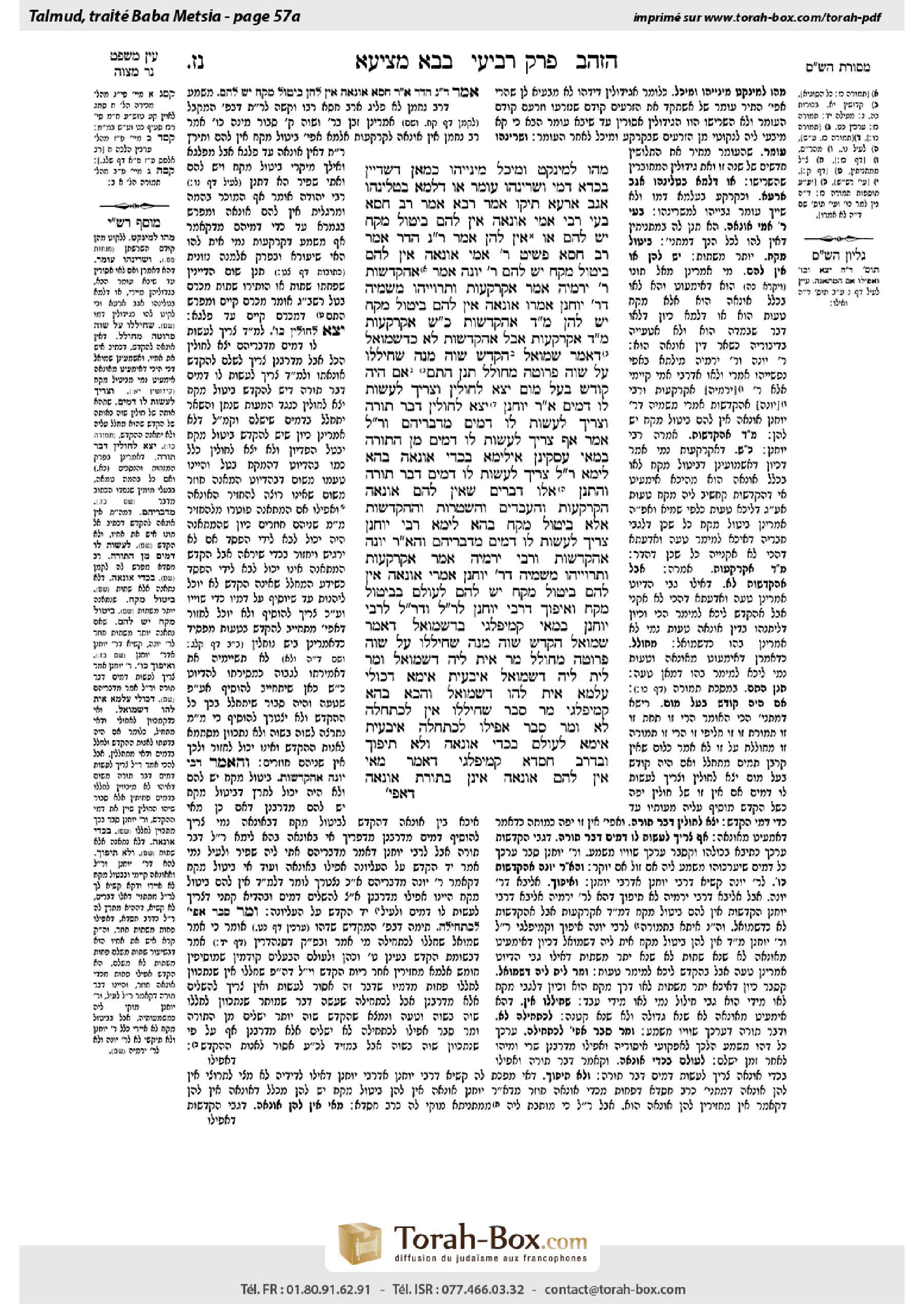
Bava Metzia 57a: Talmud study for Daf Yomi
Study the Talmud for Daf Yomi with scanned pages, Hebrew text, English translations from Sefaria and AI-generated French translations.
Passage selection and English or AI-generated French translation are available where the scan has annotations. Daf Study is independent of Torah-Box and Sefaria.
Browse Bava Metzia · בבא מציעא · All tractatesBava Metzia 57a text and translations
This page of Bava Metzia includes the Aramaic text, an English translation and an AI-generated French translation, alongside the scan above.
בבא מציעא נ״ז א · Aramaic and Hebrew text
מַהוּ לְמִינְקַט וּמֵיכַל מִינַּיְיהוּ: כְּמַאן דְּשַׁדְיָין בְּכַדָּא דָּמֵי, וּשְׁרִינְהוּ עוֹמֶר, אוֹ דִלְמָא בַּטְּלִינְהוּ אַגַּב אַרְעָא? תֵּיקוּ.
אָמַר רָבָא: אָמַר רַב חַסָּא, בָּעֵי רַבִּי אַמֵּי: אוֹנָאָה אֵין לָהֶם, בִּיטּוּל מִקָּח יֵשׁ לָהֶם אוֹ אֵין לָהֶן? אָמַר רַב נַחְמָן: הֲדַר אָמַר רַב חַסָּא, פָּשֵׁיט רַבִּי אַמֵּי: אוֹנָאָה אֵין לָהֶם, בִּיטּוּל מִקָּח יֵשׁ לָהֶם. רַבִּי יוֹנָה אָמַר אַהֶקְדֵּשׁוֹת, רַבִּי יִרְמְיָה אָמַר אַקַּרְקָעוֹת, וְתַרְוַיְיהוּ מִשְּׁמֵיהּ דְּרַבִּי יוֹחָנָן אָמְרוּ: אוֹנָאָה אֵין לָהֶם, בִּיטּוּל מִקָּח יֵשׁ לָהֶן.
מַאן דְּאָמַר אַהֶקְדֵּשׁוֹת, כׇּל שֶׁכֵּן אַקַּרְקָעוֹת. מַאן דְּאָמַר אַקַּרְקָעוֹת, אֲבָל אַהֶקְדֵּשׁוֹת לָא. כְּדִשְׁמוּאֵל, דְּאָמַר שְׁמוּאֵל: הֶקְדֵּשׁ שָׁוֶה מָנֶה שֶׁחִילְּלוֹ עַל שָׁוֶה פְּרוּטָה – מְחוּלָּל.
תְּנַן הָתָם: אִם הָיָה קוֹדֶשׁ בַּעַל מוּם, יָצָא לְחוּלִּין, וְצָרִיךְ לַעֲשׂוֹת לוֹ דָּמִים. אָמַר רַבִּי יוֹחָנָן: יָצָא לְחוּלִּין – דְּבַר תּוֹרָה, וְצָרִיךְ לַעֲשׂוֹת לוֹ דָּמִים – מִדִּבְרֵיהֶם. וְרֵישׁ לָקִישׁ אָמַר: אַף צָרִיךְ לַעֲשׂוֹת לוֹ דָּמִים מִן הַתּוֹרָה.
בְּמַאי עָסְקִינַן? אִילֵימָא בִּכְדֵי אוֹנָאָה, בְּהָא לֵימָא רֵישׁ לָקִישׁ: צָרִיךְ לַעֲשׂוֹת לוֹ דָּמִים דְּבַר תּוֹרָה? וְהָתְנַן: אֵלּוּ דְּבָרִים שֶׁאֵין לָהֶם אוֹנָאָה: הַקַּרְקָעוֹת, וְהָעֲבָדִים, וְהַשְּׁטָרוֹת, וְהַהֶקְדֵּשׁוֹת!
אֶלָּא בִּיטּוּל מִקָּח, בְּהָא לֵימָא רַבִּי יוֹחָנָן צָרִיךְ לַעֲשׂוֹת לוֹ דָּמִים מִדִּבְרֵיהֶם? וְהָאָמַר רַבִּי יוֹנָה אַהֶקְדֵּשׁוֹת, וְרַבִּי יִרְמְיָה אָמַר אַקַּרְקָעוֹת, וְתַרְוַיְיהוּ מִשְּׁמֵיהּ דְּרַבִּי יוֹחָנָן אָמְרִי: אוֹנָאָה אֵין לָהֶם, בִּיטּוּל מִקָּח יֵשׁ לָהֶם! לְעוֹלָם בְּבִיטּוּל מִקָּח, וְאֵיפוֹךְ דְּרַבִּי יוֹחָנָן – לְרֵישׁ לָקִישׁ, וּדְרֵישׁ לָקִישׁ – לְרַבִּי יוֹחָנָן.
בְּמַאי קָמִיפַּלְגִי? בְּדִשְׁמוּאֵל, דְּאָמַר שְׁמוּאֵל: הֶקְדֵּשׁ שָׁוֶה מָנֶה שֶׁחִילְּלוֹ עַל שָׁוֶה פְּרוּטָה – מְחוּלָּל. מָר אִית לֵיהּ דִּשְׁמוּאֵל, וּמָר לֵית לֵיהּ דִּשְׁמוּאֵל.
אִיבָּעֵית אֵימָא, דְּכוּלֵּי עָלְמָא אִית לְהוּ דִּשְׁמוּאֵל, וְהָכָא בְּהָא קָמִיפַּלְגִי: מָר סָבַר שֶׁחִילְּלוֹ – אִין, לְכַתְּחִילָּה – לָא. וּמָר סָבַר: אֲפִילּוּ לְכַתְּחִלָּה.
אִיבָּעֵית אֵימָא: לְעוֹלָם בִּכְדֵי אוֹנָאָה, וְלָא תֵּיפוֹךְ, וּבִדְרַב חִסְדָּא קָמִיפַּלְגִי, דְּאָמַר: מַאי אֵין לָהֶם אוֹנָאָה? אֵינָן בְּתוֹרַת אוֹנָאָה,
Bava Metzia 57a · English translation
This is Rava’s dilemma: What is the halakha? Is it permitted for one to take some of the kernels and eat from them? Is their legal status like that of kernels cast into a jug, and the sacrifice of the omer offering rendered their consumption permitted? Or perhaps he subordinated them to the ground, and their legal status is that of seeds that did not take root, and they are therefore forbidden. The Gemara concludes: The dilemmas shall stand unresolved.
§ Rava said that Rav Ḥasa said that Rabbi Ami raises a dilemma with regard to those matters that are not subject to the halakhot of exploitation: Is the halakha that they are not subject to exploitation where the disparity in the price is one-sixth, but they are subject to nullification of the transaction when it is greater than that? Or, perhaps they are not subject to nullification of the transaction either. Rav Naḥman said: Rav Ḥasa then said that Rabbi Ami resolved this dilemma and said: They are not subject to exploitation; they are subject to nullification of the transaction. Rabbi Yona said: This ruling applies to consecrated property. Rabbi Yirmeya said: It applies to land. And both of them said it in the name of Rabbi Yoḥanan: They are not subject to exploitation; they are subject to nullification of the transaction.
The Gemara comments: The one who states that this ruling applies to consecrated property, all the more so does it apply to land. The one who states that this ruling applies to land states it only with regard to land, but it does not apply to consecrated property, in accordance with the opinion of Shmuel, as Shmuel says: Consecrated property worth one hundred dinars that one desacralized upon a coin worth one peruta, is desacralized. Since consecrated property is not subject to the halakhot of exploitation at all, it is desacralized upon coins worth any sum.
We learned in a mishna there (Temura 26b): If the consecrated animal was blemished and another was substituted for it, the blemished animal leaves its consecrated state and assumes non-sacred status, and one is required to calculate the difference in monetary value between the two animals and pay it to the Temple treasury. Rabbi Yoḥanan says: It leaves its consecrated state and assumes non-sacred status by Torah law, and one is required to calculate the difference in monetary value and pay it to the Temple treasury by rabbinic law. And Reish Lakish says: Even the halakha that one is required to calculate the difference in monetary value and pay it to the Temple treasury is by Torah law.
The Gemara asks: With what are we dealing? If we say that the difference between the value of the substitute animal and the value of the consecrated animal was the measure of exploitation, does Reish Lakish say in that case: He is required to calculate the difference in monetary value and pay it to the Temple treasury by Torah law? But didn’t we learn in the mishna: These are matters that are not subject to the halakhot of exploitation: Land, slaves, documents, and consecrated property?
Rather, the difference was the measure of nullification of the transaction. In that case, would Rabbi Yoḥanan say: He is required to calculate the difference in monetary value and pay it to the Temple treasury by rabbinic law? But didn’t Rabbi Yona say that this ruling applies to consecrated property, and didn’t Rabbi Yirmeya say it applies to land, and both of them say in the name of Rabbi Yoḥanan: They are not subject to exploitation; they are subject to nullification of the transaction? The Gemara answers: Actually, the difference was the measure of nullification of the transaction. And reverse attribution of the opinions, so that the opinion of Rabbi Yoḥanan will be attributed to Reish Lakish, and the opinion of Reish Lakish will be attributed to Rabbi Yoḥanan.
The Gemara asks: With regard to what do Reish Lakish and Rabbi Yoḥanan disagree? They disagree with regard to the halakha of Shmuel, as Shmuel says: Consecrated property worth one hundred dinars that one desacralized upon a coin worth one peruta is desacralized. One Sage, Reish Lakish, accepts the opinion of Shmuel, and therefore the consecrated article is desacralized by Torah law and the requirement to calculate and pay the difference is by rabbinic law. And one Sage, Rabbi Yoḥanan, does not accept the opinion of Shmuel, and he therefore holds that the requirement to calculate and pay the difference is by Torah law.
If you wish, say instead that everyone accepts the opinion of Shmuel, and here they disagree about this: One Sage, Rabbi Yoḥanan, holds that yes, consecrated property worth one hundred dinars that one desacralized upon a coin worth one peruta is desacralized after the fact, but ab initio, no, one may not do so. Therefore, one must nevertheless pay the difference to the Temple treasury by Torah law. And one Sage, Reish Lakish, holds that the opinion of Shmuel applies even ab initio. Therefore, the requirement to pay the difference to the Temple treasury is by rabbinic law.
If you wish, say instead: Actually, the difference between the actual value of the animal and the amount used to desacralize it was within the measure of exploitation, and do not reverse attribution of the opinions of Reish Lakish and Rabbi Yoḥanan. And they disagree with regard to the opinion of Rav Ḥisda, who said: What is the meaning of: They are not subject to the halakhot of exploitation? It means that they are not subject to the principle of exploitation at all. Rather, a more stringent standard applies,
Bava Metzia 57a · Traduction française (IA)
C’est la difficulté de Rava : Quel est le halakha ? Est-il permis à une personne de prendre quelques graines et de les manger ? Leur statut juridique est-il celui des graines jetées dans un récipient, et la consommation de l’offrande de l’omer rend leur consommation permise ? Ou bien les a-t-il soumises au sol, et leur statut juridique est-il celui des graines qui n’ont pas pris racine, et elles sont donc interdites ? La Guemara conclut : Les difficultés restent sans solution.
§ Rava a dit que Rav Ḥasa a dit que Rabbi Ami pose une difficulté concernant les choses qui ne sont pas soumises aux halakhot de l’exploitation : Est-ce que le halakha est qu’elles ne sont pas soumises à l’exploitation lorsque la différence de prix est un sixième, mais qu’elles sont soumises à l’annulation de la transaction lorsqu’elle est supérieure à cela ? Ou bien est-ce qu’elles ne sont pas soumises à l’annulation de la transaction non plus ? Rav Naḥman a dit : Rav Ḥasa a dit que Rabbi Ami a résolu cette difficulté et a dit : Elles ne sont pas soumises à l’exploitation ; elles sont soumises à l’annulation de la transaction. Rabbi Yona a dit : Cette décision s’applique aux biens consacrés. Rabbi Yirmeya a dit : Elle s’applique à la terre. Et tous deux l’ont dit au nom de Rabbi Yoḥanan : Elles ne sont pas soumises à l’exploitation ; elles sont soumises à l’annulation de la transaction.
La Guemara commente : Celui qui dit que cette décision s’applique aux biens consacrés, encore davantage s’applique-t-elle à la terre. Celui qui dit que cette décision s’applique à la terre l’énonce uniquement concernant la terre, mais elle ne s’applique pas aux biens consacrés, conformément à l’opinion de Shmuel, car Shmuel dit : Un bien consacré valant cent dinars que l’on a désacralisé sur une pièce valant un peruta, est désacralisé. Puisque les biens consacrés ne sont pas soumis aux halakhot de l’exploitation du tout, ils sont désacralisés sur des pièces valant n’importe quelle somme.
Nous avons appris dans une mitsna là (Temura 26b) : Si l’animal consacré était brouillé et qu’un autre a été substitué à celui-ci, l’animal brouillé sort de son état consacré et assume un statut non sacré, et l’on est tenu de calculer la différence de valeur monétaire entre les deux animaux et de la payer au trésor du Temple. Rabbi Yoḥanan dit : Il sort de son état consacré et assume un statut non sacré selon la Loi divine, et l’on est tenu de calculer la différence de valeur monétaire et de la payer au trésor du Temple selon la loi rabbinique. Et Reish Lakish dit : Même la halakha selon laquelle l’on est tenu de calculer la différence de valeur monétaire et de la payer au trésor du Temple est selon la Loi divine.
La Guemara pose une question : Avec quoi sommes-nous en train de traiter ? Si nous disons que la différence entre la valeur de l’animal substitué et la valeur de l’animal consacré était la mesure de l’exploitation, Reish Lakish dit-il dans ce cas : Il est tenu de calculer la différence de valeur monétaire et de la payer au trésor du Temple selon la Loi divine ? Mais n’avons-nous pas appris dans la mitsna : Ces sont des choses qui ne sont pas soumises aux halakhot de l’exploitation : La terre, les esclaves, les documents et les biens consacrés ?
Plutôt, la différence était la mesure de l’annulation de la transaction. Dans ce cas, Rabbi Yoḥanan dirait-il : Il est tenu de calculer la différence de valeur monétaire et de la payer au trésor du Temple selon la loi rabbinique ? Mais n’avons-nous pas appris que Rabbi Yona a dit que cette décision s’applique aux biens consacrés, et que Rabbi Yirmeya a dit qu’elle s’applique à la terre, et tous deux l’ont dit au nom de Rabbi Yoḥanan : Elles ne sont pas soumises à l’exploitation ; elles sont soumises à l’annulation de la transaction ? La Guemara répond : En réalité, la différence était la mesure de l’annulation de la transaction. Et l’attribution des opinions est inversée, de sorte que l’opinion de Rabbi Yoḥanan sera attribuée à Reish Lakish, et l’opinion de Reish Lakish sera attribuée à Rabbi Yoḥanan.
La Guemara pose une question : À propos de quoi Reish Lakish et Rabbi Yoḥanan s’opposent-ils ? Ils s’opposent à propos de la halakha de Shmuel, car Shmuel dit : Un bien consacré valant cent dinars que l’on a désacralisé sur une pièce valant un peruta est désacralisé. Un Sage, Reish Lakish, accepte l’opinion de Shmuel, et donc le bien consacré est désacralisé selon la Loi divine et la nécessité de calculer et de payer la différence est selon la loi rabbinique. Un Sage, Rabbi Yoḥanan, ne accepte pas l’opinion de Shmuel, et il considère donc que la nécessité de calculer et de payer la différence est selon la Loi divine.
Si vous le souhaitez, dites plutôt que tout le monde accepte l’opinion de Shmuel, et ici ils s’opposent à ce point : Un Sage, Rabbi Yoḥanan, considère que le bien consacré valant cent dinars que l’on a désacralisé sur une pièce valant un peruta est désacralisé après coup, mais ab initio, non, on ne peut pas le faire. Par conséquent, on doit tout de même payer la différence au trésor du Temple selon la Loi divine. Un Sage, Reish Lakish, considère que l’opinion de Shmuel s’applique même ab initio. Par conséquent, la nécessité de payer la différence au trésor du Temple est selon la loi rabbinique.
Si vous le souhaitez, dites plutôt : En réalité, la différence entre la valeur réelle de l’animal et la somme utilisée pour désacraliser était dans la mesure de l’exploitation, et ne reversez pas l’attribution des opinions de Reish Lakish et Rabbi Yoḥanan. Et ils s’opposent à propos de l’opinion de Rav Ḥisda, qui a dit : Quelle est la signification de : Ils ne sont pas soumis aux halakhot de l’exploitation ? Cela signifie qu’ils ne sont pas soumis au principe de l’exploitation du tout. Plutôt, un standard plus strict s’applique,
Traduction française générée par IA à partir de l’édition anglaise de Sefaria. Vérifie toujours un passage avec le texte source.
Text from Sefaria: William Davidson Edition - Vocalized Aramaic (CC BY NC); William Davidson Edition - English (CC BY NC).