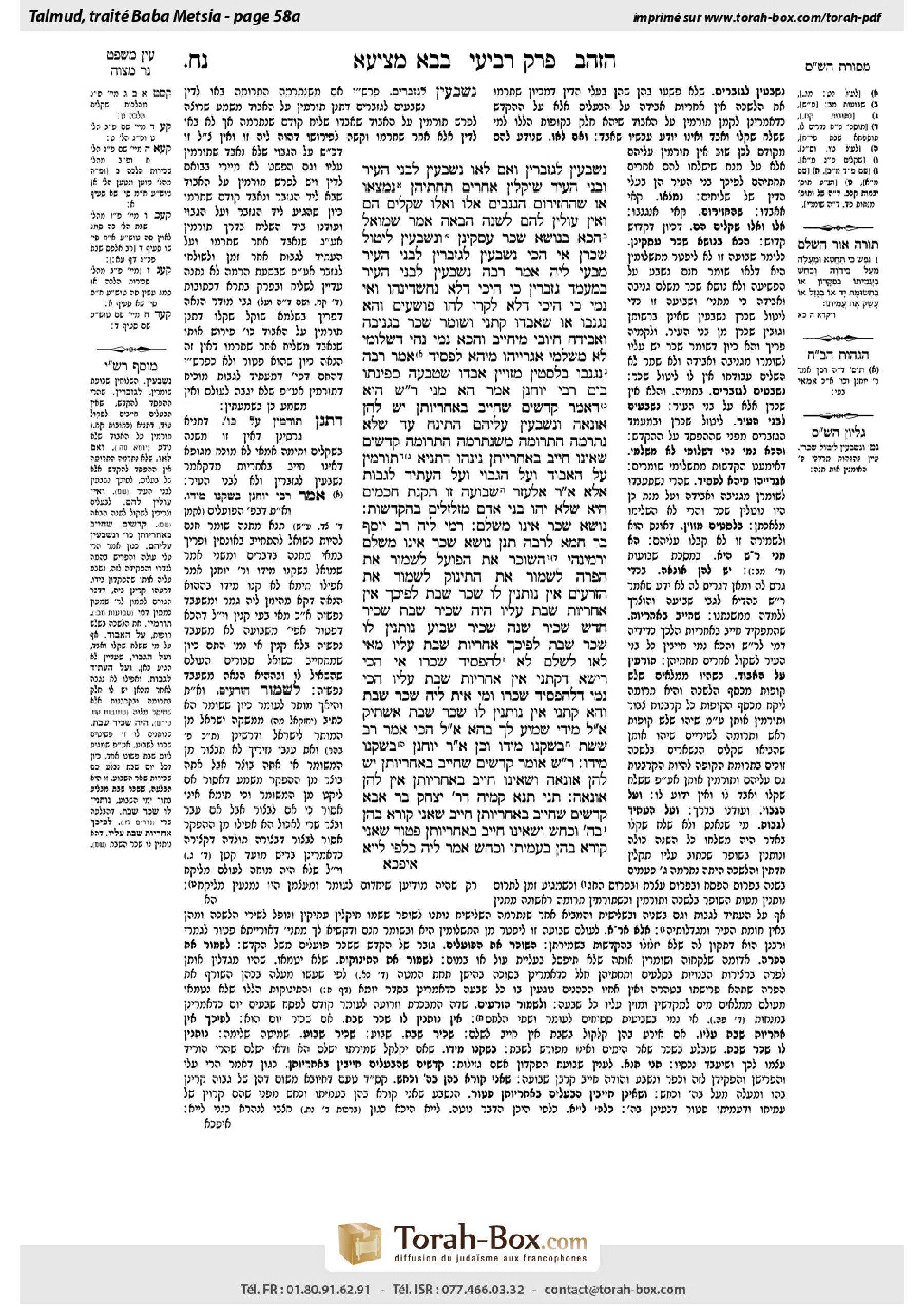
Bava Metzia 58a: Talmud study for Daf Yomi
Study the Talmud for Daf Yomi with scanned pages, Hebrew text, English translations from Sefaria and AI-generated French translations.
Passage selection and English or AI-generated French translation are available where the scan has annotations. Daf Study is independent of Torah-Box and Sefaria.
Browse Bava Metzia · בבא מציעא · All tractatesBava Metzia 58a text and translations
This page of Bava Metzia includes the Aramaic text, an English translation and an AI-generated French translation, alongside the scan above.
בבא מציעא נ״ח א · Aramaic and Hebrew text
נִשְׁבָּעִין לַגִּזְבָּרִין, וְאִם לָאו – נִשְׁבָּעִין לִבְנֵי הָעִיר, וּבְנֵי הָעִיר שׁוֹקְלִין אֲחֵרִים תַּחְתֵּיהֶן. נִמְצְאוּ, אוֹ שֶׁהֶחְזִירוּם הַגַּנָּבִים – אֵלּוּ וְאֵלּוּ שְׁקָלִים הֵם, וְאֵין עוֹלִין לָהֶם לַשָּׁנָה הַבָּאָה.
אָמַר שְׁמוּאֵל: הָכָא בְּנוֹשֵׂא שָׂכָר עָסְקִינַן, וְנִשְׁבָּעִין לִיטּוֹל שְׂכָרָן. אִי הָכִי, נִשְׁבָּעִין לַגִּזְבָּרִין? לִבְנֵי הָעִיר מִבְּעֵי לֵיהּ! אָמַר רַבָּה: נִשְׁבָּעִין לִבְנֵי הָעִיר בְּמַעֲמַד גִּזְבָּרִין, כִּי הֵיכִי דְּלָא נִחְשְׁדִינְהוּ, וְאִי נָמֵי, כִּי הֵיכִי דְּלָא לִקְרוֹ לְהוּ ״פּוֹשְׁעִים״.
וְהָא נִגְנְבוּ אוֹ שֶׁאָבְדוּ קָתָנֵי, וְשׁוֹמֵר שָׂכָר בִּגְנֵיבָה וַאֲבֵידָה חַיּוֹבֵי מִיחַיַּיב! וְהָכָא נָמֵי, נְהִי דְּשַׁלּוֹמֵי לָא מְשַׁלְּמִי, אַגְרַיְיהוּ מִיהָא לַפְסֵיד.
אָמַר רַבָּה: נִגְנְבוּ – בְּלִסְטִים מְזוּיָּין, אָבְדוּ – שֶׁטָּבְעָה סְפִינָתוֹ בַּיָּם.
רַבִּי יוֹחָנָן אָמַר: הָא מַנִּי? רַבִּי שִׁמְעוֹן הִיא, דְּאָמַר: קָדָשִׁים שֶׁחַיָּיב בְּאַחְרָיוּתָן – יֵשׁ לָהֶן אוֹנָאָה, וְנִשְׁבָּעִין עֲלֵיהֶם.
הָתִינַח עַד שֶׁלֹּא נִתְרְמָה הַתְּרוּמָה. מִשֶּׁנִּתְרְמָה הַתְּרוּמָה, קָדָשִׁים שֶׁאֵינוֹ חַיָּיב בְּאַחְרָיוּתָן נִינְהוּ, דְּתַנְיָא: תּוֹרְמִין עַל הָאָבוּד, וְעַל הַגָּבוּי, וְעַל הֶעָתִיד לִגָּבוֹת.
אֶלָּא אָמַר רַבִּי אֶלְעָזָר: שְׁבוּעָה זוֹ תַּקָּנַת חֲכָמִים הִיא, שֶׁלֹּא יְהוּ בְּנֵי אָדָם מְזַלְזְלִים בַּהֶקְדֵּשׁוֹת.
נוֹשֵׂא שָׂכָר אֵינוֹ מְשַׁלֵּם. רָמֵי לֵיהּ רַב יוֹסֵף בַּר חָמָא לְרַבָּה: תְּנַן, נוֹשֵׂא שָׂכָר אֵינוֹ מְשַׁלֵּם, וּרְמִינְהוּ: הַשּׂוֹכֵר אֶת הַפּוֹעֵל לִשְׁמוֹר אֶת הַפָּרָה, לִשְׁמוֹר אֶת הַתִּינוֹק, לִשְׁמוֹר אֶת הַזְּרָעִים – אֵין נוֹתְנִים לוֹ שְׂכַר שַׁבָּת, לְפִיכָךְ אֵין אַחְרָיוּת שַׁבָּת עָלָיו.
הָיָה שְׂכִיר שַׁבָּת, שְׂכִיר חֹדֶשׁ, שְׂכִיר שָׁנָה, שְׂכִיר שָׁבוּעַ – נוֹתְנִין לוֹ שְׂכַר שַׁבָּת, לְפִיכָךְ אַחְרָיוּת שַׁבָּת עָלָיו. מַאי לָאו לְשַׁלֵּם?
לָא, לְהַפְסִיד שְׂכָרוֹ. אִי הָכִי, רֵישָׁא דְּקָתָנֵי: ״אֵין אַחְרָיוּת שַׁבָּת עָלָיו״ – הָכִי נָמֵי דִּלְהַפְסִיד שְׂכָרוֹ? וּמִי אִית לֵיהּ שְׂכַר שַׁבָּת? וְהָא קָתָנֵי: ״אֵין נוֹתְנִין לוֹ שְׂכַר שַׁבָּת״! אִשְׁתִּיק.
אֲמַר לֵיהּ: מִידֵּי שְׁמִיעַ לָךְ בְּהָא? אֲמַר לֵיהּ: הָכִי אָמַר רַב שֵׁשֶׁת, בְּשֶׁקָּנוּ מִיָּדוֹ. וְכֵן אָמַר רַבִּי יוֹחָנָן, בְּשֶׁקָּנוּ מִיָּדוֹ.
רַבִּי שִׁמְעוֹן אוֹמֵר: קָדָשִׁים שֶׁחַיָּיב בְּאַחְרָיוּתָן – יֵשׁ לָהֶן אוֹנָאָה. וְשֶׁאֵינוֹ חַיָּיב בְּאַחְרָיוּתָן – אֵין לָהֶן אוֹנָאָה. תָּנֵי תַּנָּא קַמֵּיהּ דְּרַבִּי יִצְחָק בַּר אַבָּא:
קָדָשִׁים שֶׁחַיָּיב בְּאַחְרָיוּתָן, חַיָּיב, שֶׁאֲנִי קוֹרֵא בָּהֶן: ״בַּה׳ וְכִחֵשׁ״. וְשֶׁאֵינוֹ חַיָּיב בְּאַחְרָיוּתָן, פָּטוּר, שֶׁאֲנִי קוֹרֵא בָּהֶן: ״בַּעֲמִיתוֹ וְכִחֵשׁ״.
אֲמַר לֵיהּ: כְּלַפֵּי לְיָיא?!
Bava Metzia 58a · English translation
the agents must take the oath of a bailee to the treasurers that they did not misappropriate the coins. If the collection of the chamber was not yet performed, the lost or stolen shekels remain the property of the residents of the city. Therefore, the agents take an oath to the residents of the city. The residents of the city then contribute other shekels in place of the original shekels. If the original shekels were then found or the thieves returned them, both these, the original shekels, and those, the replacement shekels, assume the status of consecrated shekels and belong to the Temple. But the two half-shekels that they contributed this year do not count to absolve them from their obligation to contribute the shekels for the following year. This mishna teaches that an unpaid bailee does take an oath concerning consecrated property, contrary to the mishna here.
Shmuel said: Here we are dealing with paid bailees, and the purpose of the oath is not to exempt them from their liability to pay for the theft. Rather, they take an oath that they performed their task properly, in order to collect their wages. The Gemara asks: If so, is this phrase accurate: They take an oath to the treasurers? The tanna should have taught: They take an oath to the residents of the city, from whom they are claiming their wages. Rabba said: They take an oath to the residents of the city in the presence of the treasurers, so that the treasurers will not suspect that the residents of the city did not contribute their shekels at all. Alternatively, the agents take an oath that they executed their mission properly, so that the Temple treasurers will not call them negligent.
The Gemara asks: But isn’t it taught in the mishna: And the coins were stolen or were lost en route, and paid bailees are liable to pay in cases of theft and loss? And here too, when safeguarding consecrated property, although paid bailees do not pay for the theft, as a paid bailee is exempt, let them at least forfeit their wages, as their responsibility to safeguard the money includes preventing theft and loss.
Rabba said: When the tanna says that they were stolen, the reference is to a case where the item was stolen by armed bandits. When he said that they were lost, the reference is to a case where the agent’s ship sank at sea. Since the shekels left his possession through circumstances beyond his control, this is considered an unavoidable accident, for which a paid bailee is exempt.
Rabbi Yoḥanan said: In accordance with whose opinion is this mishna? It is in accordance with the opinion of Rabbi Shimon, who says: Consecrated items for which one bears responsibility to replace them are subject to the halakhot of exploitation, and therefore one takes an oath concerning them.
The Gemara asks: This works out well if the contribution of the chamber had not yet been collected into the baskets. At that stage, residents of the city bear responsibility to replace the shekels, and that is why Rabbi Shimon deems the agent liable to take an oath. But if the shekels were lost or stolen once the contribution of the chamber had been collected, the shekels are tantamount to sacrificial animals for which one does not bear responsibility, and the residents of the city should be exempt, as it is taught in a baraita: One collects shekels in the Temple chamber with the intention of fulfilling the obligation for those coins that are lost on the way, and for those that are collected but did not yet arrive, and for those that are destined to be collected in the future. Apparently, the residents of the city no longer bear responsibility for the shekels.
The Gemara concludes: Rather, Rabbi Elazar said: This oath of the agents is a rabbinic ordinance, instituted so that people will not treat consecrated property with contempt. If they knew that there is no oath, they would neglect to safeguard the shekels properly.
§ The mishna teaches: A paid bailee does not pay if these items were stolen or lost. Rav Yosef bar Ḥama raises a contradiction before Rabba. We learned in the mishna: A paid bailee does not pay. And the Gemara raises a contradiction from a baraita: One who hires a day laborer to watch the red heifer to ensure that it is not disqualified, to watch the child to ensure that he remains ritually pure from birth in order to draw the water mixed with the ashes of the heifer, or to safeguard the seeds for the barley that will be used in the omer offering, does not give him wages for Shabbat. Therefore, if the items that the day laborer was entrusted to watch were lost on Shabbat, financial responsibility for their loss on Shabbat is not incumbent upon him, since he is not a paid bailee on that day.
The baraita continues: But if he was a laborer hired for a week, hired for a month, hired for a year, or hired for seven years, the one who hired him gives him wages for labor performed on Shabbat as well. Therefore, if the items were lost on Shabbat, financial responsibility for their loss on Shabbat is incumbent upon him. What, is it not that he is liable to pay for the loss he caused? As the list of the items being safeguarded includes consecrated items, this baraita apparently rules that a paid bailee bears responsibility for consecrated property.
The Gemara rejects this: No, the ruling of the baraita stating that the bailee is responsible is only with regard to forfeiting his wages because he was derelict in safeguarding the items with which he was entrusted. Rav Yosef bar Ḥama asks: If so, in the first clause of the baraita, which teaches that financial responsibility for their loss on Shabbat is not incumbent upon him, is this also with regard to forfeiting his wages? But does he have wages for the work he did on Shabbat? But isn’t it taught that one does not give him wages for Shabbat? Clearly, the reference is to responsibility to pay for the safeguarded items themselves. Rabba was silent, unable to answer.
Rabba said to Rav Yosef bar Ḥama: Have you heard anything with regard to this? Rav Yosef bar Ḥama said to him that this is what Rav Sheshet says: The ruling of the latter clause is stated with regard to a case where the laborers made a commitment to the one who hired them to take responsibility for the items, and they performed an act of acquisition with the one who hired them to reinforce that commitment. And likewise Rabbi Yoḥanan says: The ruling of the latter clause is stated with regard to a case where the laborers made a commitment to the one who hired them to take responsibility for the items, and they performed an act of acquisition with him.
§ The mishna teaches that Rabbi Shimon says: Sacrificial animals for which one bears responsibility to replace them are subject to the halakhot of exploitation, and those for which one does not bear responsibility to replace them are not subject to the halakhot of exploitation. The Gemara relates that the tanna who recited mishnayot and baraitot in the study hall taught a baraita before Rabbi Yitzḥak bar Abba with regard to the source of the opinion of Rabbi Shimon. It is derived from the verse: “If anyone sins, and commits a trespass against the Lord, and deals falsely with his colleague in a matter of deposit, or of pledge, or of robbery, or has oppressed his neighbor” (Leviticus 5:21).
In that baraita, it is taught: For an oath concerning sacrificial animals for which one bears responsibility, one is liable to bring an offering for taking a false oath, as I apply the phrase “against the Lord, and deals falsely.” And for an oath concerning sacrificial animals for which one does not bear responsibility, one is exempt, as I read in their regard: With his neighbor, and deals falsely. That reading indicates that even one who deals falsely in matters related to the Lord, e.g., sacrificial animals, is liable to bring an offering for a false oath.
Rabbi Yitzḥak said to him: Isn’t it the opposite [kelapei layya]?
Bava Metzia 58a · Traduction française (IA)
les agents doivent prendre l'œuf du dépositaire auprès des trésoriers afin de prouver qu'ils n'ont pas détourné les monnaies. Si la collecte de la chambre n'avait pas encore été effectuée, les sicles perdus ou volés restent la propriété des habitants de la ville. Ainsi, les agents prennent l'œuf auprès des habitants de la ville. Les habitants de la ville contribuent alors d'autres sicles à la place des sicles originels. Si les sicles originels ont été retrouvés ou si les voleurs les ont rendus, à la fois ces sicles originels et ces sicles de remplacement acquièrent le statut de sicles sacrés et appartiennent au Temple. Cependant, les deux demi-sicles qu'ils ont contribués cette année ne dispensent pas leur obligation de contribuer les sicles pour l'année suivante. Cette mitsva enseigne que le dépositaire non rémunéré prend l'œuf concernant les biens sacrés, contrairement à la mitsva ici.
Shmuel a dit : Nous sommes ici en présence de dépositaires rémunérés, et le but de l'œuf n'est pas de les exempter de leur responsabilité de payer pour le vol. Plutôt, ils prennent l'œuf pour prouver qu'ils ont bien accompli leur tâche afin de récupérer leurs salaires. La Guemara pose la question : Si c'est ainsi, est-ce que cette phrase est exacte : Ils prennent l'œuf auprès des trésoriers ? Le tanna aurait dû enseigner : Ils prennent l'œuf auprès des habitants de la ville, d'où ils réclament leurs salaires. Rabba a dit : Ils prennent l'œuf auprès des habitants de la ville en présence des trésoriers, afin que les trésoriers ne soupçonnent pas que les habitants de la ville n'ont pas contribué leurs sicles du tout. Alternativement, les agents prennent l'œuf pour prouver qu'ils ont bien exécuté leur mission, afin que les trésoriers du Temple ne les accusent pas d'être négligents.
La Guemara pose la question : Mais n'est-ce pas enseigné dans la Michna : Et les sicles furent volés ou perdus en route, et les dépositaires rémunérés sont responsables en cas de vol et de perte ? Et ici aussi, lors de la garde des biens sacrés, bien que les dépositaires rémunérés ne soient pas responsables pour le vol, comme le dépositaire rémunéré est exempt, qu'ils au moins perdent leurs salaires, car leur responsabilité de garder l'argent inclut de prévenir le vol et la perte.
Rabba a dit : Lorsque le tanna dit qu'ils furent volés, il fait référence à un cas où l'objet fut volé par des bandits armés. Lorsqu'il dit qu'ils furent perdus, il fait référence à un cas où le bateau de l'agent coula en mer. Puisque les sicles quittèrent sa possession en raison de circonstances hors de son contrôle, cela est considéré comme un accident inévitable, pour lequel le dépositaire rémunéré est exempt.
Rabbi Yoḥanan a dit : Selon l'opinion de qui est cette Michna ? C'est selon l'opinion de Rabbi Shimon, qui dit : Les objets sacrés pour lesquels on a la responsabilité de les remplacer sont soumis aux halakhot de l'exploitation, et par conséquent on prend serment concernant eux.
La Guemara pose la question : Cela fonctionne bien si la contribution de la chambre n'avait pas encore été collectée dans les paniers. À cette étape, les habitants de la ville portent la responsabilité de remplacer les sicles, et c'est pourquoi Rabbi Shimon considère que l'agent est tenu de prendre l'œuf. Mais si les sicles furent perdus ou volés une fois que la contribution de la chambre avait été collectée, les sicles sont équivalents à des animaux sacrés pour lesquels on ne porte pas la responsabilité, et les habitants de la ville devraient être exemptés, comme il est enseigné dans une baraïta : On collecte des sicles dans la chambre du Temple avec l'intention de remplir l'obligation pour ceux qui sont perdus en route, et pour ceux qui sont collectés mais n'ont pas encore arrivé, et pour ceux qui sont destinés à être collectés à l'avenir. Apparemment, les habitants de la ville ne portent plus la responsabilité des sicles.
La Guemara conclut : Plutôt, Rabbi Elazar a dit : Cet œuf des agents est un ordonnance rabbinique, instituée afin que les gens ne traitent pas avec mépris les biens sacrés. S'ils savaient qu'il n'y a pas d'œuf, ils négligeraient de garder les sicles correctement.
§ La mitsna enseigne : Un dépositaire rémunéré ne paie pas si ces objets furent volés ou perdus. Rav Yosef bar Ḥama soulève une contradiction devant Rabba. Nous avons appris dans la mitsna : Un dépositaire rémunéré ne paie pas. Et la Guemara soulève une contradiction d'une baraïta : Celui qui embauche un ouvrier de jour pour veiller sur la bête rouge afin de s'assurer qu'elle n'est pas disqualifiée, pour veiller sur l'enfant afin de s'assurer qu'il reste rituellement pur à la naissance afin de ramener l'eau mélangé aux cendres de la bête rouge, ou pour garder les semences du blé qui sera utilisé dans l'offrande de l'omer, ne lui donne pas de salaire pour le sabbat. Ainsi, si les objets que l'ouvrier était chargé de veiller ont été perdus le sabbat, la responsabilité financière de leur perte le sabbat ne pèse pas sur lui, car il n'est pas un dépositaire rémunéré ce jour-là.
La baraïta continue : Mais si c'était un ouvrier embauché pour une semaine, pour un mois, pour un an, ou pour sept ans, celui qui l'a embauché lui donne un salaire pour le travail effectué le sabbat. Ainsi, si les objets ont été perdus le sabbat, la responsabilité financière de leur perte le sabbat pèse sur lui. Qu'est-ce que cela signifie ? N'est-ce pas que l'homme est responsable de la perte qu'il a causée ? Comme la liste des objets à garder inclut des objets sacrés, cette baraïta semble plutôt décider que le dépositaire rémunéré porte la responsabilité des objets sacrés.
La Guemara rejette cela : Non, la décision de la baraïta qui dit que le dépositaire est responsable est uniquement concernant la perte de ses salaires à cause de son négligence dans la garde des objets confiés. Rav Yosef bar Ḥama demande : Si c'est ainsi, dans la première clause de la baraïta, qui enseigne que la responsabilité financière de leur perte le sabbat ne pèse pas sur lui, est-ce aussi concernant la perte de ses salaires ? Mais est-ce qu'il a des salaires pour le travail qu'il a effectué le sabbat ? Mais n'est-ce pas enseigné que l'on ne lui donne pas de salaire le sabbat ? Évidemment, la référence est à la responsabilité de payer pour les objets eux-mêmes. Rabba restait silencieux, incapable de répondre.
Rabba dit à Rav Yosef bar Ḥama : Avez-vous entendu quelque chose à ce sujet ? Rav Yosef bar Ḥama dit à lui que c'est ce que Rav Sheshet dit : La déclaration du second verset est formulée dans un cas où les ouvriers ont fait une promesse à celui qui les avait engagés pour prendre la responsabilité des objets, et ils ont accompli un acte d'acquisition avec celui qui les avait engagés pour renforcer cette promesse. Et de même, Rabbi Yoḥanan dit : La déclaration du second verset est formulée dans un cas où les ouvriers ont fait une promesse à celui qui les avait engagés pour prendre la responsabilité des objets, et ils ont accompli un acte d'acquisition avec lui.
§ La mitsna enseigne que Rabbi Shimon dit : Les animaux sacrés pour lesquels on porte la responsabilité de les remplacer sont soumis aux halakhot de l'exploitation, et ceux pour lesquels on ne porte pas la responsabilité de les remplacer ne sont pas soumis aux halakhot de l'exploitation. La Guemara rapporte que le tanna qui a récité des mitsvot et des baraitot dans la salle de étude a enseigné une baraïta devant Rabbi Yitzḥak bar Abba concernant la source de l'opinion de Rabbi Shimon. Elle est tirée de la parole : « Si quelqu'un péche et commet un péché contre l'Éternel, et trompe son camarade dans une affaire de dépôt, ou de caution, ou de vol, ou qu'il opprime son voisin » (Lévitique 5:21).
Dans cette baraïta, il est enseigné : Pour un serment concernant des animaux sacrés pour lesquels on porte la responsabilité, on est tenu de présenter un sacrifice pour un serment faux, car je lis la phrase « contre l'Éternel, et trompe ». Et pour un serment concernant des animaux sacrés pour lesquels on ne porte pas la responsabilité, on est exempt, car je lis à leur sujet : « avec son voisin, et trompe ». Cette lecture indique que même celui qui trompe dans les affaires liées à l'Éternel, c'est-à-dire les animaux sacrés, est tenu de présenter un sacrifice pour un serment faux.
Rabbi Yitzḥak dit à lui : N'est-ce pas l'opposé [kelapei layya] ?
Traduction française générée par IA à partir de l’édition anglaise de Sefaria. Vérifie toujours un passage avec le texte source.
Text from Sefaria: William Davidson Edition - Vocalized Aramaic (CC BY NC); William Davidson Edition - English (CC BY NC).