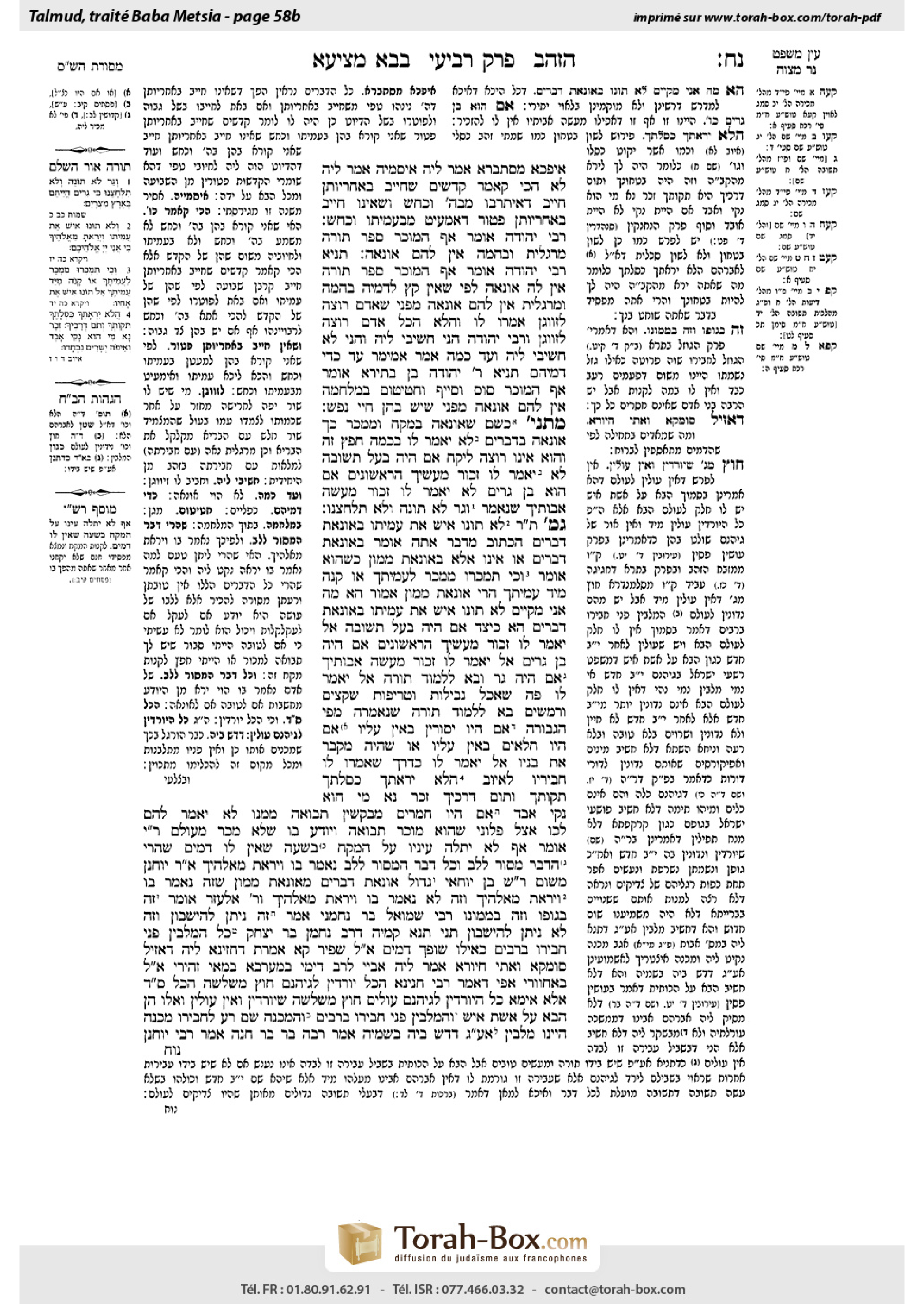
Bava Metzia 58b: Talmud study for Daf Yomi
Study the Talmud for Daf Yomi with scanned pages, Hebrew text, English translations from Sefaria and AI-generated French translations.
Passage selection and English or AI-generated French translation are available where the scan has annotations. Daf Study is independent of Torah-Box and Sefaria.
Browse Bava Metzia · בבא מציעא · All tractatesBava Metzia 58b text and translations
This page of Bava Metzia includes the Aramaic text, an English translation and an AI-generated French translation, alongside the scan above.
בבא מציעא נ״ח ב · Aramaic and Hebrew text
אִיפְּכָא מִסְתַּבְּרָא! אֲמַר לֵיהּ: אֶיסְמְיַהּ?
אֲמַר לֵיהּ: לָא. הָכִי קָאָמַר: קָדָשִׁים שֶׁחַיָּיב בְּאַחְרָיוּתָן – חַיָּיב, דְּאִיתְרַבּוּ מִ״בַּה׳ וְכִחֵשׁ״. וְשֶׁאֵינוֹ חַיָּיב בְּאַחְרָיוּתָן – פָּטוּר, דְּאִמְּעִיט מִ״בַּעֲמִיתוֹ וְכִחֵשׁ״.
רַבִּי יְהוּדָה אוֹמֵר: אַף הַמּוֹכֵר סֵפֶר תּוֹרָה, מַרְגָּלִית וּבְהֵמָה, אֵין לָהֶם אוֹנָאָה. תַּנְיָא, רַבִּי יְהוּדָה אוֹמֵר: אַף הַמּוֹכֵר סֵפֶר תּוֹרָה, אֵין לָהּ אוֹנָאָה – לְפִי שֶׁאֵין קֵץ לְדָמֶיהָ. בְּהֵמָה וּמַרְגָּלִית, אֵין לָהֶם אוֹנָאָה – מִפְּנֵי שֶׁאָדָם רוֹצֶה לְזַוְּוגָן.
אָמְרוּ לוֹ: וַהֲלֹא הַכֹּל אָדָם רוֹצֶה לְזַוְּוגָן? וְרַבִּי יְהוּדָה, הָנֵי חֲשִׁיבִי לֵיהּ, וְהָנֵי לָא חֲשִׁיבִי לֵיהּ. וְעַד כַּמָּה? אָמַר אַמֵּימָר: עַד כְּדֵי דְּמֵיהֶם.
תַּנְיָא, רַבִּי יְהוּדָה בֶּן בְּתֵירָא אוֹמֵר: אַף הַמּוֹכֵר סוּס וְסַיִיף וַחֲטִיטוֹם בַּמִּלְחָמָה – אֵין לָהֶם אוֹנָאָה, מִפְּנֵי שֶׁיֵּשׁ בָּהֶן חַיֵּי נֶפֶשׁ.
מַתְנִי׳ כְּשֵׁם שֶׁאוֹנָאָה בְּמִקָּח וּמִמְכָּר, כָּךְ אוֹנָאָה בִּדְבָרִים. לֹא יֹאמַר לוֹ: בְּכַמָּה חֵפֶץ זֶה? וְהוּא אֵינוֹ רוֹצֶה לִיקַּח. אִם הָיָה בַּעַל תְּשׁוּבָה, לֹא יֹאמַר לוֹ: זְכוֹר מַעֲשֶׂיךָ הָרִאשׁוֹנִים. אִם הוּא בֶּן גֵּרִים, לֹא יֹאמַר לוֹ: זְכוֹר מַעֲשֵׂה אֲבוֹתֶיךָ, שֶׁנֶּאֱמַר: ״וְגֵר לֹא תוֹנֶה וְלֹא תִלְחָצֶנּוּ״.
גְּמָ׳ תָּנוּ רַבָּנַן: ״לֹא תוֹנוּ אִישׁ אֶת עֲמִיתוֹ״ – בְּאוֹנָאַת דְּבָרִים הַכָּתוּב מְדַבֵּר. אַתָּה אוֹמֵר בְּאוֹנָאַת דְּבָרִים, אוֹ אֵינוֹ אֶלָּא בְּאוֹנָאַת מָמוֹן? כְּשֶׁהוּא אוֹמֵר ״וְכִי תִמְכְּרוּ מִמְכָּר לַעֲמִיתֶךָ אוֹ קָנֹה מִיַּד עֲמִיתֶךָ״, הֲרֵי אוֹנָאַת מָמוֹן אָמוּר! הָא מָה אֲנִי מְקַיֵּים ״לֹא תוֹנוּ אִישׁ אֶת עֲמִיתוֹ״? בְּאוֹנָאַת דְּבָרִים.
הָא כֵּיצַד? אִם הָיָה בַּעַל תְּשׁוּבָה, אַל יֹאמַר לוֹ: ״זְכוֹר מַעֲשֶׂיךָ הָרִאשׁוֹנִים״. אִם הָיָה בֶּן גֵּרִים, אַל יֹאמַר לוֹ: ״זְכוֹר מַעֲשֵׂה אֲבוֹתֶיךָ״. אִם הָיָה גֵּר וּבָא לִלְמוֹד תּוֹרָה, אַל יֹאמַר לוֹ: ״פֶּה שֶׁאָכַל נְבֵילוֹת וּטְרֵיפוֹת, שְׁקָצִים וּרְמָשִׂים, בָּא לִלְמוֹד תּוֹרָה שֶׁנֶּאֶמְרָה מִפִּי הַגְּבוּרָה״?
אִם הָיוּ יִסּוּרִין בָּאִין עָלָיו, אִם הָיוּ חֳלָאִים בָּאִין עָלָיו, אוֹ שֶׁהָיָה מְקַבֵּר אֶת בָּנָיו, אַל יֹאמַר לוֹ כְּדֶרֶךְ שֶׁאָמְרוּ לוֹ חֲבֵירָיו לְאִיּוֹב: ״הֲלֹא יִרְאָתְךָ כִּסְלָתֶךָ תִּקְוָתְךָ וְתֹם דְּרָכֶיךָ. זְכׇר נָא מִי הוּא נָקִי אָבָד״.
אִם הָיוּ חַמָּרִים מְבַקְּשִׁין תְּבוּאָה מִמֶּנּוּ, לֹא יֹאמַר לָהֶם: ״לְכוּ אֵצֶל פְּלוֹנִי שֶׁהוּא מוֹכֵר תְּבוּאָה״, וְיוֹדֵעַ בּוֹ שֶׁלֹּא מָכַר מֵעוֹלָם. רַבִּי יְהוּדָה אוֹמֵר: אַף לֹא יִתְלֶה עֵינָיו עַל הַמִּקָּח, בְּשָׁעָה שֶׁאֵין לוֹ דָּמִים, שֶׁהֲרֵי הַדָּבָר מָסוּר לַלֵּב, וְכׇל דָּבָר הַמָּסוּר לַלֵּב נֶאֱמַר בּוֹ ״וְיָרֵאתָ מֵאֱלֹהֶיךָ״.
אָמַר רַבִּי יוֹחָנָן מִשּׁוּם רַבִּי שִׁמְעוֹן בֶּן יוֹחַאי: גָּדוֹל אוֹנָאַת דְּבָרִים מֵאוֹנָאַת מָמוֹן, שֶׁזֶּה נֶאֱמַר בּוֹ ״וְיָרֵאתָ מֵאֱלֹהֶיךָ״, וְזֶה לֹא נֶאֱמַר בּוֹ ״וְיָרֵאתָ מֵאֱלֹהֶיךָ״. וְרַבִּי אֶלְעָזָר אוֹמֵר: זֶה בְּגוּפוֹ וְזֶה בְּמָמוֹנוֹ. רַבִּי שְׁמוּאֵל בַּר נַחְמָנִי אָמַר: זֶה נִיתַּן לְהִישָּׁבוֹן, וְזֶה לֹא נִיתַּן לְהִישָּׁבוֹן.
תָּנֵי תַּנָּא קַמֵּיהּ דְּרַב נַחְמָן בַּר יִצְחָק: כׇּל הַמַּלְבִּין פְּנֵי חֲבֵירוֹ בָּרַבִּים, כְּאִילּוּ שׁוֹפֵךְ דָּמִים. אֲמַר לֵיהּ: שַׁפִּיר קָא אָמְרַתְּ, דְּחָזֵינָא לֵיהּ דְּאָזֵיל סוּמָּקָא וְאָתֵי חִוּוֹרָא. אֲמַר לֵיהּ אַבָּיֵי לְרַב דִּימִי: בְּמַעְרְבָא בְּמַאי זְהִירִי? אֲמַר לֵיהּ: בְּאַחְווֹרֵי אַפֵּי, דְּאָמַר רַבִּי חֲנִינָא: הַכֹּל יוֹרְדִין לְגֵיהִנָּם, חוּץ מִשְּׁלֹשָׁה.
הַכֹּל סָלְקָא דַּעְתָּךְ? אֶלָּא אֵימָא: כָּל הַיּוֹרְדִין לְגֵיהִנָּם עוֹלִים, חוּץ מִשְּׁלֹשָׁה שֶׁיּוֹרְדִין וְאֵין עוֹלִין. וְאֵלּוּ הֵן: הַבָּא עַל אֵשֶׁת אִישׁ, וְהַמַּלְבִּין פְּנֵי חֲבֵירוֹ בָּרַבִּים, וְהַמְכַנֶּה שֵׁם רַע לַחֲבֵירוֹ. מְכַנֶּה הַיְינוּ מַלְבִּין? אַף עַל גַּב דְּדָשׁ בֵּיהּ בִּשְׁמֵיהּ.
אָמַר רַבָּה בַּר בַּר חָנָה אָמַר רַבִּי יוֹחָנָן:
Bava Metzia 58b · English translation
The opposite is reasonable. An oath concerning sacrificial animals for which one does not bear responsibility is considered to be a matter related to the Lord even more than an oath concerning a sacrificial animal for which one bears responsibility, as in the latter case it is owned by the person in some respects. The tanna said to him: Should I delete this baraita because it is corrupted?
Rabbi Yitzḥak bar Abba said to him: No, this is what the baraita is saying: For an oath taken concerning sacrificial animals for which one bears responsibility, one is liable to bring an offering for a false oath, as it is included due to the phrase “against the Lord, and deals falsely.” It is derived from this that one is liable for taking a false oath even with regard to an item which belongs, to a certain degree, to the Lord. And with regard to sacrificial animals for which one does not bear responsibility, one is exempt, as it is excluded by the phrase: With his neighbor and deals falsely. It is derived from this that one is liable to bring an offering for a false oath only if it pertained to property that belongs to a layman, i.e., his neighbor, but not for an item that belongs completely to God, as is the case with regard to sacrificial animals for which one does not bear responsibility.
§ The mishna teaches: Rabbi Yehuda says: Even in the case of one who sells a Torah scroll, a pearl, or an animal, those items are not subject to the halakhot of exploitation. It is taught in a baraita that Rabbi Yehuda says: Even in the case of one who sells a Torah scroll, it is not subject to the halakhot of exploitation, as there is no limit to its value. It is the Torah of God, which is priceless. An animal and a pearl are not subject to the halakhot of exploitation because a person seeks to pair them. An animal is paired with an animal of similar strength so that they can be yoked together to work in the field. A pearl is paired with a similar pearl to fashion jewelry. Since there is a need to obtain a specific variant of these items, one is not particular about the price.
The baraita continues: The Rabbis said to him: But isn’t it the case that with regard to every item, a person seeks to pair them with similar items under certain circumstances? According to your explanation, the halakhot of exploitation would never apply. The Gemara asks: And what does Rabbi Yehuda respond to that question? He claims that these are significant to a person, but those are not significant to him. In other words, it is particularly important to find a precise match for an animal and a pearl. The Gemara continues to analyze Rabbi Yehuda’s opinion. And up to how much can one deviate from the value of items for which exploitation does not apply, as Rabbi Yehuda is clearly not saying that any deviation is acceptable? Ameimar said: One can deviate up to double their value.
It is taught in a baraita that Rabbi Yehuda ben Beteira says: Even in the case one who sells a horse, or a sword, or a helmet [veḥatitom] during wartime, these items are not subject to the halakhot of exploitation, because they then have the capacity to preserve life, and a person is willing to pay any price for them.
MISHNA: Just as there is a prohibition against exploitation [ona’a] in buying and selling, so is there ona’a in statements, i.e., verbal mistreatment. The mishna proceeds to cite examples of verbal mistreatment. One may not say to a seller: For how much are you selling this item, if he does not wish to purchase it. He thereby upsets the seller when the deal fails to materialize. The mishna lists other examples: If one is a penitent, another may not say to him: Remember your earlier deeds. If one is the child of converts, another may not say to him: Remember the deeds of your ancestors, as it is stated: “And a convert shall you neither mistreat, nor shall you oppress him” (Exodus 22:20).
GEMARA: The Sages taught: It is written: “And you shall not mistreat [tonu] one man his colleague; and you shall fear your God, for I am the Lord your God” (Leviticus 25:17). The tanna explains: The verse is speaking with regard to verbal mistreatment. The baraita proceeds: Do you say that it is speaking of verbal mistreatment [be’ona’at devarim], or perhaps it is speaking only with regard to monetary exploitation [be’ona’at mammon]? When it says in a previous verse: “And if you sell to your colleague an item that is sold, or acquire from your colleague’s hand, you shall not exploit [tonu] his brother” (Leviticus 25:14), monetary exploitation is explicitly stated. How then do I realize the meaning of the verse: “And you shall not mistreat one man his colleague”? It is with regard to verbal mistreatment.
How so? If one is a penitent, another may not say to him: Remember your earlier deeds. If one is the child of converts, another may not say to him: Remember the deed of your ancestors. If one is a convert and he came to study Torah, one may not say to him: Does the mouth that ate unslaughtered carcasses and animals that had wounds that would have caused them to die within twelve months [tereifot], and repugnant creatures, and creeping animals, comes to study Torah that was stated from the mouth of the Almighty?
If torments are afflicting a person, if illnesses are afflicting him, or if he is burying his children, one may not speak to him in the manner that the friends of Job spoke to him: “Is not your fear of God your confidence, and your hope the integrity of your ways? Remember, I beseech you, whoever perished, being innocent?” (Job 4:6–7). Certainly you sinned, as otherwise you would not have suffered misfortune.
Likewise, if donkey drivers are asking to purchase grain from someone, and he has none, he may not say to them: Go to so-and-so, as he sells grain, if he knows about him that he never sold grain at all. He thereby causes the donkey drivers and the would-be seller anguish. Rabbi Yehuda says: One may not even cast his eyes on the merchandise for sale, creating the impression that he is interested, at a time when he does not have money to purchase it. Verbal mistreatment is not typically obvious, and it is difficult to ascertain the intent of the offender, as the matter is given to the heart of each individual, as only he knows what his intention was when he spoke. And with regard to any matter given to the heart, it is stated: “And you shall fear your God” (Leviticus 25:17), as God is privy to the intent of the heart.
Rabbi Yoḥanan says in the name of Rabbi Shimon ben Yoḥai: Greater is the transgression of verbal mistreatment than the transgression of monetary exploitation, as with regard to this, verbal mistreatment, it is stated: “And you shall fear your God.” But with regard to that, monetary exploitation, it is not stated: “And you shall fear your God.” And Rabbi Elazar said this explanation: This, verbal mistreatment, affects one’s body; but that, monetary exploitation, affects one’s money. Rabbi Shmuel bar Naḥmani says: This, monetary exploitation, is given to restitution; but that, verbal mistreatment, is not given to restitution.
The Gemara relates that the tanna who recited mishnayot and baraitot in the study hall taught a baraita before Rav Naḥman bar Yitzḥak: Anyone who humiliates another in public, it is as though he were spilling blood. Rav Naḥman bar Yitzḥak said to him: You have spoken well, as we see that after the humiliated person blushes, the red leaves his face and pallor comes in its place, which is tantamount to spilling his blood. Abaye said to Rav Dimi: In the West, i.e., Eretz Yisrael, with regard to what mitzva are they particularly vigilant? Rav Dimi said to him: They are vigilant in refraining from humiliating others, as Rabbi Ḥanina says: Everyone descends to Gehenna except for three.
The Gemara asks: Does it enter your mind that everyone descends to Gehenna? Rather, say: Anyone who descends to Gehenna ultimately ascends, except for three who descend and do not ascend, and these are they: One who engages in intercourse with a married woman, as this transgression is a serious offense against both God and a person; and one who humiliates another in public; and one who calls another a derogatory name. The Gemara asks with regard to one who calls another a derogatory name: That is identical to one who shames him; why are they listed separately? The Gemara answers: Although the victim grew accustomed to being called that name in place of his name, and he is no longer humiliated by being called that name, since the intent was to insult him, the perpetrator’s punishment is severe.
Rabba bar bar Ḥana says that Rabbi Yoḥanan says:
Bava Metzia 58b · Traduction française (IA)
L'opposé est raisonnable. Un serment concernant des animaux sacrés pour lesquels on ne porte pas de responsabilité est considéré comme une affaire du Seigneur plus que celui concernant des animaux sacrés pour lesquels on porte de la responsabilité, car dans ce dernier cas, l'animal est en quelque sorte propriété de la personne. Le tanna lui demande : Dois-je supprimer ce baraïta parce qu'il est corrompu ?
Rabbi Yitzḥak bar Abba lui répond : Non, c'est ce que dit le baraïta : Concernant un serment pris concernant des animaux sacrés pour lesquels on porte de la responsabilité, on est tenu de présenter un sacrifice pour un serment faux, car il est inclus en raison de la phrase « contre le Seigneur, et il ment ». On en déduit que l'on est tenu de présenter un sacrifice pour un serment faux même concernant un objet qui appartient en quelque sorte au Seigneur. Et concernant des animaux sacrés pour lesquels on ne porte pas de responsabilité, on est exempt, car il est exclu par la phrase : « avec son voisin et il ment ». On en déduit que l'on est tenu de présenter un sacrifice pour un serment faux uniquement si cela concernait un objet appartenant à un laïc, c'est-à-dire son voisin, mais pas pour un objet qui appartient entièrement à Dieu, comme c'est le cas concernant des animaux sacrés pour lesquels on ne porte pas de responsabilité.
§ La mitsna enseigne : Rabbi Yehuda dit : Même dans le cas d'une personne qui vend un rouleau de Torah, une perle ou un animal, ces objets ne sont pas soumis aux halakhot de l'exploitation. Il est enseigné dans un baraïta que Rabbi Yehuda dit : Même dans le cas d'une personne qui vend un rouleau de Torah, il n'est pas soumis aux halakhot de l'exploitation, car il n'y a pas de limite à sa valeur. C'est la Torah de Dieu, qui est inestimable. Un animal et une perle ne sont pas soumis aux halakhot de l'exploitation car une personne cherche à les apparié. Un animal est apparié avec un animal de même force afin qu'ils puissent être yokes pour travailler dans le champ. Une perle est appariée avec une perle similaire pour fabriquer des bijoux. Puisque l'on a besoin d'obtenir une variante spécifique de ces objets, on n'est pas exigeant quant au prix.
Le baraïta continue : Les Rabbins lui disent : Mais n'est-ce pas le cas que, concernant chaque objet, une personne cherche à l'apparié avec des objets similaires dans certains cas ? Selon votre explication, les halakhot de l'exploitation ne s'appliqueraient jamais. La Guemara demande : Et que répond Rabbi Yehuda à cette question ? Il affirme que ces objets sont importants pour une personne, mais ceux-ci ne le sont pas pour lui. En d'autres termes, il est particulièrement important de trouver un appariement précis pour un animal et une perle. La Guemara continue d'analyser l'opinion de Rabbi Yehuda. Et jusqu'à quel point peut-on s'éloigner de la valeur des objets pour lesquels l'exploitation ne s'applique pas, comme Rabbi Yehuda ne dit clairement pas que tout déviation est acceptable ? Ameimar dit : On peut s'éloigner jusqu'à double leur valeur.
Il est enseigné dans un baraïta que Rabbi Yehuda ben Béteta dit : Même dans le cas d'une personne qui vend un cheval, une épée ou un casque [veḥatitom] pendant la guerre, ces objets ne sont pas soumis aux halakhot de l'exploitation, car ils ont la capacité de préserver la vie, et une personne est prête à payer n'importe quel prix pour eux.
MICHNA : Tout comme il y a une interdiction d'exploitation [ona’a] dans l'achat et la vente, il y a aussi une exploitation [ona’a] dans les paroles, c'est-à-dire une maltraitance verbale. La mitsna poursuit en citant des exemples de maltraitance verbale. On ne doit pas dire à un vendeur : Pour combien vendez-vous cet objet, si l'on ne souhaite pas l'acheter. Cela perturbe le vendeur lorsque la transaction ne se réalise pas. La mitsna liste d'autres exemples : Si l'on est un repent, un autre ne doit pas dire à lui : Souviens-toi de tes anciens actes. Si l'on est le fils de convertis, un autre ne doit pas dire à lui : Souviens-toi des actes de tes ancêtres, car il est dit : « Et tu ne traiteras pas le converti, ni ne l'oppresseras » (Exode 22:20).
GUEMARA : Les Sages enseignent : Il est écrit : « Et tu ne traiteras pas [tonu] l'un l'autre, et tu craigneras ton Dieu, car je suis le Seigneur ton Dieu » (Lévitique 25:17). Le tanna explique : Le verset parle de maltraitance verbale. Le baraïta continue : Dis-tu qu'il parle de maltraitance verbale [be’ona’at devarim], ou peut-être parle-t-il uniquement de l'exploitation monétaire [be’ona’at mammon] ? Lorsqu'il est dit dans un verset précédent : « Et si tu vends à ton collègue un objet qui est vendu, ou que tu achètes de la main de ton collègue, tu ne traiteras pas ton frère » (Lévitique 25:14), l'exploitation monétaire est explicitement mentionnée. Comment alors sais-je la signification du verset : « Et tu ne traiteras pas l'un l'autre » ? C'est en ce qui concerne la maltraitance verbale.
Comment cela ? Si l'on est un repent, un autre ne doit pas dire à lui : Souviens-toi de tes anciens actes. Si l'on est le fils de convertis, un autre ne doit pas dire à lui : Souviens-toi de l'acte de tes ancêtres. Si l'on est un converti et qu'il est venu étudier la Torah, un autre ne doit pas dire à lui : La bouche qui a mangé des cadavres non sacrifiés et des animaux qui avaient des plaies qui auraient causé leur mort en douze mois [tereifot], et des créatures repoussantes et des animaux rampants, vient-elle étudier la Torah qui a été dite de la bouche du Très Haut ?
Si des tourments affligent une personne, si des maladies affligent cette personne, ou s'il enterrer ses enfants, on ne doit pas parler à lui comme les amis de Job ont parlé à lui : « N'est-ce pas ta crainte du Seigneur ta confiance, et ta espérance l'intégrité de tes voies ? Souviens-toi, je t'implorais, de qui est mort, innocent ? » (Job 4:6–7). Certainement tu as péché, car autrement tu n'aurais pas souffert de malheur.
De même, si des conducteurs de chars demandent à acheter du grain à quelqu'un, et s'il n'en a pas, il ne doit pas leur dire : Allez chez tel et tel, car il vend du grain, si on sait qu'il n'a jamais vendu de grain du tout. Cela cause à la fois l'angoisse des conducteurs de chars et du vendeur potentiel. Rabbi Yéhuda dit : On ne doit même pas jeter un regard sur les marchandises à vendre, donnant l'impression d'être intéressé, lorsqu'on n'a pas d'argent pour les acheter. La maltraitance verbale n'est pas généralement évidente, et il est difficile d'identifier l'intention de l'offenseur, car cela relève de la conscience de chaque individu, car seul il connaît l'intention qu'il avait lorsqu'il a parlé. Et concernant toute affaire qui relève de la conscience, il est dit : « Et tu craignes ton Dieu » (Lévitique 25:17), car Dieu connaît l'intention du cœur.
Rabbi Yoḥanan dit au nom de Rabbi Šimon ben Yoḥai : La transgression de la maltraitance verbale est plus grave que celle de l'exploitation monétaire, car concernant cela, la maltraitance verbale, il est dit : « Et tu craignes ton Dieu. » Mais concernant cela, l'exploitation monétaire, il n'est pas dit : « Et tu craignes ton Dieu. » Et Rabbi Eléazar a dit cette explication : Celle-ci, la maltraitance verbale, affecte le corps ; mais celle-là, l'exploitation monétaire, affecte l'argent. Rabbi Šmuel bar Naḥmani dit : Celle-ci, l'exploitation monétaire, est soumise à la réparation ; mais celle-là, la maltraitance verbale, n'est pas soumise à la réparation.
La Guemara rapporte que le tanna qui a récité des mitsnayot et des baraitot dans la salle de étude a enseigné une baraïta devant Rav Naḥman bar Yitzḥak : Quiconque humilie un autre en public, c'est comme s'il versait du sang. Rav Naḥman bar Yitzḥak a dit à lui : Tu as bien parlé, car nous voyons que, après que la personne humiliée rougit, la rougeur quitte son visage et la pâleur y prend place, ce qui est équivalent à verser son sang. Abaye a dit à Rav Dimi : Dans l'Ouest, c'est-à-dire en Terre d'Israël, concernant quelle mitsva sont-ils particulièrement vigilants ? Rav Dimi a dit à lui : Ils sont vigilants en évitant d'humilier les autres, car Rabbi Ḥanina dit : Tout le monde descend en Gehenna sauf trois.
La Guemara demande : Est-ce que cela entre dans votre esprit que tout le monde descend en Gehenna ? Plutôt, disons : Quiconque descend en Gehenna monte finalement, sauf trois qui descendent et ne montent pas, et ces trois sont : celui qui a des relations sexuelles avec une femme mariée, car cette transgression est une offense grave à la fois contre Dieu et contre une personne ; et celui qui humilie un autre en public ; et celui qui appelle un autre un nom dégradant. La Guemara demande concernant celui qui appelle un autre un nom dégradant : Cela est identique à celui qui le humilie ; pourquoi sont-ils mentionnés séparément ? La Guemara répond : Bien que la victime ait pris l'habitude d'être appelé ce nom à la place de son nom et ne soit plus humilié par ce nom, puisque l'intention était d'insulter, la punition du coupable est sévère.
Rabba bar bar Ḥana dit que Rabbi Yoḥanan dit :
Traduction française générée par IA à partir de l’édition anglaise de Sefaria. Vérifie toujours un passage avec le texte source.
Text from Sefaria: William Davidson Edition - Vocalized Aramaic (CC BY NC); William Davidson Edition - English (CC BY NC).