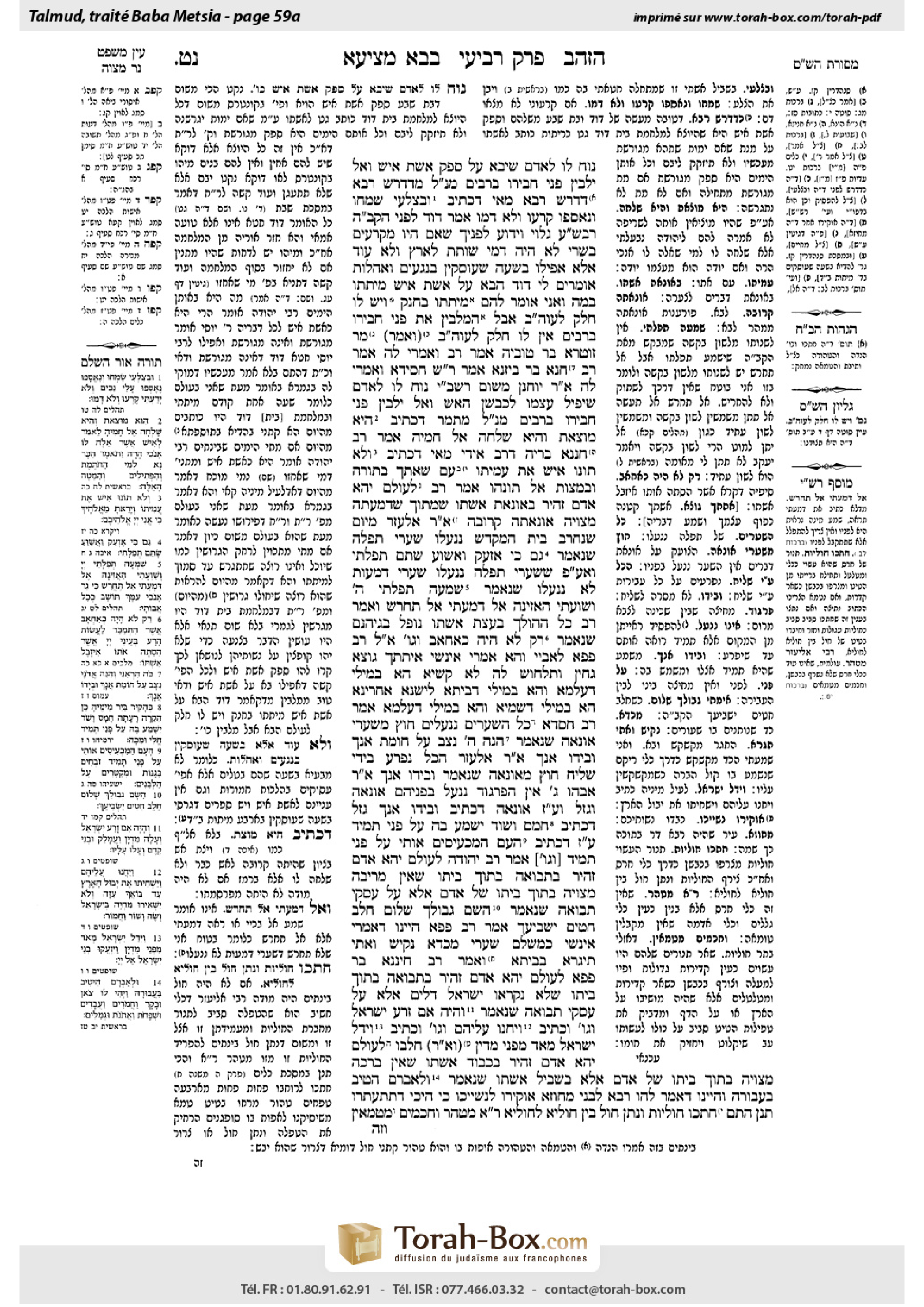
Bava Metzia 59a: Talmud study for Daf Yomi
Study the Talmud for Daf Yomi with scanned pages, Hebrew text, English translations from Sefaria and AI-generated French translations.
Passage selection and English or AI-generated French translation are available where the scan has annotations. Daf Study is independent of Torah-Box and Sefaria.
Browse Bava Metzia · בבא מציעא · All tractatesBava Metzia 59a text and translations
This page of Bava Metzia includes the Aramaic text, an English translation and an AI-generated French translation, alongside the scan above.
בבא מציעא נ״ט א · Aramaic and Hebrew text
נוֹחַ לוֹ לְאָדָם שֶׁיָּבוֹא עַל סְפֵק אֵשֶׁת אִישׁ, וְאַל יַלְבִּין פְּנֵי חֲבֵירוֹ בָּרַבִּים. מְנָא לַן? מִדְּדָרֵשׁ רָבָא, דְּדָרֵשׁ רָבָא: מַאי דִּכְתִיב ״וּבְצַלְעִי שָׂמְחוּ וְנֶאֱסָפוּ... קָרְעוּ וְלֹא דָמּוּ״? אָמַר דָּוִד לִפְנֵי הַקָּדוֹשׁ בָּרוּךְ הוּא: רִבּוֹנוֹ שֶׁל עוֹלָם, גָּלוּי וְיָדוּעַ לְפָנֶיךָ, שֶׁאִם הָיוּ מְקָרְעִים בְּשָׂרִי, לֹא הָיָה דָּמִי שׁוֹתֵת לָאָרֶץ.
וְלֹא עוֹד אֶלָּא, אֲפִילּוּ בְּשָׁעָה שֶׁעוֹסְקִין בִּנְגָעִים וְאֹהָלוֹת, אוֹמְרִים לִי: דָּוִד, הַבָּא עַל אֵשֶׁת אִישׁ, מִיתָתוֹ בַּמֶּה? וַאֲנִי אוֹמֵר לָהֶם: מִיתָתוֹ בְּחֶנֶק, וְיֵשׁ לוֹ חֵלֶק לָעוֹלָם הַבָּא. אֲבָל הַמַּלְבִּין אֶת פְּנֵי חֲבֵירוֹ בָּרַבִּים, אֵין לוֹ חֵלֶק לָעוֹלָם הַבָּא.
וְאָמַר מָר זוּטְרָא בַּר טוֹבִיָּה אָמַר רַב, וְאָמְרִי לַהּ: אָמַר רַב חָנָא בַּר בִּיזְנָא אָמַר רַבִּי שִׁמְעוֹן חֲסִידָא, וְאָמְרִי לָהּ: אָמַר רַבִּי יוֹחָנָן מִשּׁוּם רַבִּי שִׁמְעוֹן בֶּן יוֹחַאי: נוֹחַ לוֹ לְאָדָם שֶׁיַּפִּיל עַצְמוֹ לְכִבְשַׁן הָאֵשׁ וְאַל יַלְבִּין פְּנֵי חֲבֵירוֹ בָּרַבִּים. מְנָא לַן? מִתָּמָר, דִּכְתִיב: ״הִיא מוּצֵאת וְהִיא שָׁלְחָה אֶל חָמִיהָ״.
אָמַר רַב חִנָּנָא בְּרֵיהּ דְּרַב אִידִי: מַאי דִּכְתִיב ״וְלֹא תוֹנוּ אִישׁ אֶת עֲמִיתוֹ״? עַם שֶׁאִתְּךָ בְּתוֹרָה וּבַמִּצְווֹת, אַל תּוֹנֵיהוּ. אָמַר רַב: לְעוֹלָם יְהֵא אָדָם זָהִיר בְּאוֹנָאַת אִשְׁתּוֹ, שֶׁמִּתּוֹךְ שֶׁדִּמְעָתָהּ מְצוּיָה, אוֹנָאָתָהּ קְרוֹבָה.
אָמַר רַבִּי אֶלְעָזָר: מִיּוֹם שֶׁנֶּחְרַב בֵּית הַמִּקְדָּשׁ, נִנְעֲלוּ שַׁעֲרֵי תְפִילָּה, שֶׁנֶּאֱמַר: ״גַּם כִּי אֶזְעַק וַאֲשַׁוֵּעַ שָׂתַם תְּפִילָּתִי״. וְאַף עַל פִּי שֶׁשַּׁעֲרֵי תְפִילָּה נִנְעֲלוּ, שַׁעֲרֵי דְמָעוֹת לֹא נִנְעֲלוּ, שֶׁנֶּאֱמַר: ״שִׁמְעָה תְפִלָּתִי ה׳ וְשַׁוְעָתִי הַאֲזִינָה, אֶל דִּמְעָתִי אַל תֶּחֱרַשׁ״.
וְאָמַר רַב: כׇּל הַהוֹלֵךְ בַּעֲצַת אִשְׁתּוֹ נוֹפֵל בְּגֵיהִנָּם, שֶׁנֶּאֱמַר: ״רַק לֹא הָיָה כְאַחְאָב וְגוֹ׳״. אֲמַר לֵיהּ רַב פָּפָּא לְאַבָּיֵי: וְהָא אָמְרִי אִינָשֵׁי, אִיתְּתָךְ גּוּצָא – גְּחֵין וְתִלְחוֹשׁ לָהּ! לָא קַשְׁיָא: הָא בְּמִילֵּי דְעָלְמָא, וְהָא בְּמִילֵּי דְבֵיתָא. לִישָּׁנָא אַחֲרִינָא: הָא בְּמִילֵּי דִשְׁמַיָּא, וְהָא בְּמִילֵּי דְעָלְמָא.
אָמַר רַב חִסְדָּא: כׇּל הַשְּׁעָרִים נִנְעָלִים, חוּץ מִשַּׁעֲרֵי אוֹנָאָה, שֶׁנֶּאֱמַר: ״הִנֵּה ה׳ נִצָּב עַל חוֹמַת אֲנָךְ וּבְיָדוֹ אֲנָךְ״. אָמַר רַבִּי אֶלְעָזָר: הַכֹּל נִפְרָע בִּידֵי שָׁלִיחַ, חוּץ מֵאוֹנָאָה, שֶׁנֶּאֱמַר: ״וּבְיָדוֹ אֲנָךְ״.
אָמַר רַבִּי אֲבָהוּ: שְׁלֹשָׁה אֵין הַפַּרְגּוֹד נִנְעָל בִּפְנֵיהֶם: אוֹנָאָה, וְגָזֵל, וַעֲבוֹדָה זָרָה. אוֹנָאָה, דִּכְתִיב: ״וּבְיָדוֹ אֲנָךְ״. גָּזֵל, דִּכְתִיב: ״חָמָס וָשֹׁד יִשָּׁמַע בָּהּ עַל פָּנַי תָּמִיד״. עֲבוֹדָה זָרָה, דִּכְתִיב: ״הָעָם הַמַּכְעִיסִים אוֹתִי עַל פָּנַי תָּמִיד וְגוֹ׳״.
אָמַר רַב יְהוּדָה: לְעוֹלָם יְהֵא אָדָם זָהִיר בִּתְבוּאָה בְּתוֹךְ בֵּיתוֹ, שֶׁאֵין מְרִיבָה מְצוּיָה בְּתוֹךְ בֵּיתוֹ שֶׁל אָדָם אֶלָּא עַל עִסְקֵי תְבוּאָה, שֶׁנֶּאֱמַר: ״הַשָּׂם גְּבוּלֵךְ שָׁלוֹם חֵלֶב חִטִּים יַשְׂבִּיעֵךְ״. אָמַר רַב פָּפָּא, הַיְינוּ דְּאָמְרִי אִינָשֵׁי: כְּמִשְׁלַם שְׂעָרֵי מִכַּדָּא, נָקֵישׁ וְאָתֵי תִּגְרָא בְּבֵיתָא.
וְאָמַר רַב חִינָּנָא בַּר פָּפָּא: לְעוֹלָם יְהֵא אָדָם זָהִיר בִּתְבוּאָה בְּתוֹךְ בֵּיתוֹ, שֶׁלֹּא נִקְרְאוּ יִשְׂרָאֵל דַּלִּים אֶלָּא עַל עִסְקֵי תְבוּאָה, שֶׁנֶּאֱמַר: ״וְהָיָה אִם זָרַע יִשְׂרָאֵל וְגוֹ׳״, וּכְתִיב: ״וַיַּחֲנוּ עֲלֵיהֶם וְגוֹ׳״, וּכְתִיב: ״וַיִּדַּל יִשְׂרָאֵל מְאֹד מִפְּנֵי מִדְיָן״.
וְאָמַר רַבִּי חֶלְבּוֹ: לְעוֹלָם יְהֵא אָדָם זָהִיר בִּכְבוֹד אִשְׁתּוֹ, שֶׁאֵין בְּרָכָה מְצוּיָה בְּתוֹךְ בֵּיתוֹ שֶׁל אָדָם אֶלָּא בִּשְׁבִיל אִשְׁתּוֹ, שֶׁנֶּאֱמַר: ״וּלְאַבְרָם הֵטִיב בַּעֲבוּרָהּ״. וְהַיְינוּ דַּאֲמַר לְהוּ רָבָא לִבְנֵי מָחוֹזָא: אוֹקִירוּ לִנְשַׁיְיכוּ, כִּי הֵיכִי דְּתִתְעַתְּרוּ.
תְּנַן הָתָם: חֲתָכוֹ חוּלְיוֹת, וְנָתַן חוֹל בֵּין חוּלְיָא לְחוּלְיָא – רַבִּי אֱלִיעֶזֶר מְטַהֵר, וַחֲכָמִים מְטַמְּאִין.
Bava Metzia 59a · English translation
It is preferable for a person to engage in intercourse with a woman whose married status is uncertain and not humiliate another in public. The Gemara asks: From where do we derive this? The Gemara answers: It is from that which Rava interpreted, as Rava interpreted: What is the meaning of that which is written: “And when I limped they rejoiced and gathered…they tore and did not cease [damu]” (Psalms 35:15)? The term “damu” can also be understood as a reference to blood. Concerning the fasting he undertook to atone for his sin with Bathsheba (see II Samuel, chapters 11–12), David said before the Holy One, Blessed be He: Master of the Universe, it is revealed and known before You that if my tormenters were to tear my flesh, my blood [dami] would not flow to the ground, due to excessive fasting.
And moreover, they torment me to the extent that even at the time when they are engaged in the public study of the halakhot of leprous sores and tents in which there is a corpse, i.e., halakhic matters that have no connection to my sin, they say to me: David, one who engages in intercourse with a married woman, his death is effected with what form of execution? And I say to them: One who engages in intercourse with a married woman before witnesses and with forewarning, his death is by strangulation, but he still has a share in the World-to-Come. But one who humiliates another in public has no share in the World-to-Come. The transgression of you, who humiliate me, is more severe than my transgression.
And Mar Zutra bar Toviyya says that Rav says; and some say Rav Ḥana bar Bizna says that Rabbi Shimon Ḥasida says; and some say Rabbi Yoḥanan says in the name of Rabbi Shimon ben Yoḥai: It is more comfortable for a person to cast himself into a fiery furnace, than to humiliate another in public to avoid being cast into the furnace. From where do we derive this? From Tamar, daughter-in-law of Judah. When she was taken out to be burned, she did not reveal that she was pregnant with Judah’s child. Rather, she left the decision to him, to avoid humiliating him in public, as it is written: “And Judah said: Bring her forth, and let her be burnt. When she was brought forth, she sent to her father-in-law, saying: I am pregnant by the man to whom these belong. And she said: Examine these, whose are these, the signet, and the cords, and the staff?” (Genesis 38:24–25).
§ Rav Ḥinnana, son of Rav Idi, says: What is the meaning of that which is written: “And you shall not mistreat each man his colleague [amito]” (Leviticus 25:17)? The word amito is interpreted as a contraction of im ito, meaning: One who is with him. With one who is with you in observance of Torah and mitzvot, you shall not mistreat him. Rav says: A person must always be careful about mistreatment of his wife. Since her tear is easily elicited, punishment for her mistreatment is immediate.
Rabbi Elazar says: Since the day the Temple was destroyed the gates of prayer were locked, and prayer is not accepted as it once was, as it is stated in lament of the Temple’s destruction: “Though I plead and call out, He shuts out my prayer” (Lamentations 3:8). Yet, despite the fact that the gates of prayer were locked with the destruction of the Temple, the gates of tears were not locked, and one who cries before God may rest assured that his prayers will be answered, as it is stated: “Hear my prayer, Lord, and give ear to my pleading, keep not silence at my tears” (Psalms 39:13).
And Rav says: Nevertheless, anyone who follows the counsel of his wife descends into Gehenna, as it is stated: “But there was none like Ahab, who did give himself over to do that which was evil in the sight of the Lord, whom Jezebel his wife incited” (I Kings 21:25). Rav Pappa said to Abaye: But don’t people say a popular proverb: If your wife is short, stoop and whisper to her and consult with her? The Gemara answers: This is not difficult, as this statement of Rav instructs that one not follow her counsel in general matters; and that proverb instructs that one follow her counsel in household matters. The Gemara presents another version of this distinction: This statement of Rav maintains that one should not follow her counsel in divine matters; and that proverb maintains that one should follow her counsel in general matters.
Rav Ḥisda says: All the gates of Heaven are apt to be locked, except for the gates of prayer for victims of verbal mistreatment, as it is stated: “And behold, the Lord stood upon a wall built with a plumb line, and a plumb line in His hand” (Amos 7:7). God stands with the scales of justice in His hand to determine if one has been subjected to injustice. Rabbi Elazar says: In response to all transgressions, God punishes the perpetrator by means of an agent, except for mistreatment [ona’a], as it is stated: “And a plumb line [anakh] in His hand.” The term for mistreatment and the term for plumb line are spelled in a similar manner, indicating that God Himself inflicts retribution.
Rabbi Abbahu says: There are three sins before whose transgressors the curtain [hapargod] between the world and the Divine Presence is not locked; their sins reach the Divine Presence. They are: Verbal mistreatment, robbery, and idol worship. Mistreatment, as it is stated: “And a plumb line in His hand”; robbery, as it is stated: “Violence and robbery are heard in her, they are before Me continually” (Jeremiah 6:7); idol worship, as it is stated: “A people that angers Me before Me continually; that sacrifice in gardens, and burn incense upon bricks” (Isaiah 65:3).
Apropos the topic of how a man should approach his household, Rav Yehuda says: A person must always be careful about ensuring that there is grain inside his house, as discord is found in a person’s house only over matters of grain, as it is stated: “He makes your borders peace; He gives you plenty with the finest wheat” (Psalms 147:14). If there is the finest wheat in your house, there will be peace there. Rav Pappa said: This is in accordance with the adage that people say: When the barley is emptied from the jug, quarrel knocks and enters the house.
And Rav Ḥinnana bar Pappa says: A person must always be careful about ensuring that there is grain inside his house, as the Jewish people were characterized as poor only over matters of grain, as it is stated: “And it was, if Israel sowed, and Midian and the children of the east ascended” (Judges 6:3); and it is written: “And they encamped against them and they destroyed the crops of the land” (Judges 6:4); and it is further written: “And Israel was greatly impoverished due to Midian” (Judges 6:6).
And Rabbi Ḥelbo says: A person must always be careful about sustaining the honor of his wife, as blessing is found in a person’s house only because of his wife, as it is stated in allusion to this: “And he dealt well with Abram for her sake, and he had sheep and oxen” (Genesis 12:16). And that is what Rava said to the residents of Meḥoza, where he lived: Honor your wives, so that you will become rich.
§ Apropos the topic of verbal mistreatment, we learned in a mishna there (Kelim 5:10): If one cut an earthenware oven widthwise into segments, and placed sand between each and every segment, Rabbi Eliezer deems it ritually pure. Because of the sand, its legal status is not that of a complete vessel, and therefore it is not susceptible to ritual impurity. And the Rabbis deem it ritually impure, as it is functionally a complete oven.
Bava Metzia 59a · Traduction française (IA)
Il est préférable qu'une personne ait des relations sexuelles avec une femme dont le statut marital est incertain plutôt que d'humilier un autre en public. La Guemara pose la question : D'où dérivons-nous cela ? La Guemara répond : C'est d'après l'interprétation de Rava, comme Rava interprétait : Quelle est la signification de ce qui est écrit : « Et quand je boitais, ils se réjouirent et se rassemblèrent… ils déchirèrent et ne s'arrêtèrent pas [damu] » (Psaumes 35:15) ? Le terme « damu » peut aussi être compris comme faisant référence au sang. Concernant le jeûne qu'il a entrepris pour expier son péché avec Bathsheba (voir II Samuel, chapitres 11–12), David dit devant le Saint, béni soit-Il : Seigneur de l'Univers, il est révélé et connu devant toi que si mes persécuteurs avaient déchiré ma chair, mon sang [dami] ne serait pas tombé sur le sol, en raison du jeûne excessif.
Et de plus, ils me tourmentent à tel point que même lorsqu'ils étudient publiquement les halakhot des ulcères et des tentes contenant un cadavre, c'est-à-dire des questions halakhiques n'ayant aucun lien avec mon péché, ils me disent : David, celui qui a des relations sexuelles avec une femme mariée, sa mort est accomplie par quelle forme d'exécution ? Et je leur dis : Celui qui a des relations sexuelles avec une femme mariée devant témoins et avec avertissement, sa mort est par strangulation, mais il a néanmoins une part dans le Monde à Venir. Celui qui humilie un autre en public n'a pas de part dans le Monde à Venir. Le péché que vous, qui m'humiliez, commettez est plus grave que mon péché.
Et Mar Zutra bar Toviyya dit que Rav dit ; et certains disent que Rav Ḥana bar Bizna dit que Rabbi Shimon Ḥasida dit ; et certains disent que Rabbi Yoḥanan dit au nom de Rabbi Shimon ben Yoḥai : Il est plus confortable pour une personne de se jeter dans un four à charbon que d'humilier un autre en public pour éviter d'être jeté dans le four. D'où dérivons-nous cela ? De Tamar, fille de Judah. Lorsqu'elle était sortie pour être brûlée, elle n'a pas révélé qu'elle était enceinte du fils de Judah. Elle a laissé la décision à lui, pour éviter d'humilier lui en public, comme il est écrit : « Et Judah dit : Apporte-la, et brûle-la. Lorsqu'elle fut apportée, elle envoya à son père-beau-père, disant : Je suis enceinte du homme à qui ces appartiennent. Et elle dit : Examine ces-ci, dont sont-ils, le sceau, et les cordes, et le bâton ? » (Genèse 38:24–25).
§ Rav Ḥinnana, fils de Rav Idi, dit : Quelle est la signification de ce qui est écrit : « Et tu ne traiteras pas ton collègue [amito] » (Lvïtique 25:17) ? Le mot « amito » est interprété comme un contraction de « im ito », c'est-à-dire : Celui qui est avec lui. Avec celui qui est avec toi dans l'observation de la Torah et des mitsvot, tu ne traiteras pas lui. Rav dit : Une personne doit toujours être prudent concernant la maltraitance de sa femme. Puisque ses larmes sont facilement évoquées, la punition pour sa maltraitance est immédiate.
Rabbi Elazar dit : Depuis que le Temple a été détruit, les portes de la prière ont été verrouillées, et la prière n'est plus acceptée comme elle l'était autrefois, comme il est dit dans la lamentation de la destruction du Temple : « Bien que j'implorie et j'appelle, Il me ferme ma prière » (Lamentations 3:8). Cependant, malgré le fait que les portes de la prière ont été verrouillées avec la destruction du Temple, les portes des larmes n'ont pas été verrouillées, et celui qui pleure devant Dieu peut être assuré que ses prières seront répondues, comme il est dit : « Écoute ma prière, Seigneur, et écoute ma supplication, ne reste pas muet à mes larmes » (Psaumes 39:13).
Et Rav dit : Cependant, celui qui suit le conseil de sa femme descend en Géhenna, comme il est dit : « Mais il n'y avait personne comme Ahab, qui s'est donné à faire ce qui était mauvais aux yeux du Seigneur, que Jézabel sa femme a incité » (I Rois 21:25). Rav Pappa dit à Abaye : Mais ne dit-on pas un proverbe populaire : Si ta femme est courte, incline-toi et murmure-lui et consulte-la ? La Guemara répond : Ce n'est pas difficile, car cette déclaration de Rav indique qu'on ne doit pas suivre son conseil en général ; et ce proverbe indique qu'on doit suivre son conseil en matière de ménage. La Guemara présente une autre version de cette distinction : Cette déclaration de Rav maintient qu'on ne doit pas suivre son conseil en matière divine ; et ce proverbe maintient qu'on doit suivre son conseil en général.
Rav Ḥisda dit : Toutes les portes du Ciel sont propices à être verrouillées, sauf les portes des prières pour les victimes de maltraitance verbale, comme il est dit : « Et voici, le Seigneur se tenait sur un mur construit avec une règle, et une règle en Sa main » (Amos 7:7). Dieu se tient avec les balances de justice en Sa main pour déterminer si l'on a été victime d'injustice. Rabbi Elazar dit : En réponse à tous les transgressions, Dieu puni le transgresseur par l'intermédiaire d'un agent, sauf la maltraitance [ona’a], comme il est dit : « Et une règle [anakh] en Sa main ». Le terme pour la maltraitance et le terme pour la règle sont orthographiés de manière similaire, indiquant que Dieu lui-même inflige la rétribution.
Rabbi Abbahu dit : Il y a trois péchés devant lesquels les transgresseurs ne verrouillent pas le rideau [hapargod] entre le monde et la Présence divine ; leurs péchés atteignent la Présence divine. Ils sont : la maltraitance verbale, le vol et l'idolâtrie. La maltraitance verbale, comme il est dit : « Et une règle en Sa main » ; le vol, comme il est dit : « La violence et le vol sont entendus en elle, ils sont devant Moi continuellement » (Jérémie 6:7) ; l'idolâtrie, comme il est dit : « Un peuple qui m'irrite devant Moi continuellement ; qui sacrifie dans les jardins et brûle des encens sur des briques » (Isaïe 65:3).
À propos du sujet de la manière dont un homme doit approcher sa maison, Rav Yehuda dit : Une personne doit toujours être prudent pour s'assurer qu'il y a du grain dans sa maison, car les discordes sont trouvées dans la maison d'une personne seulement sur les questions de grain, comme il est dit : « Il fait la paix de tes frontières ; Il te donne abondamment avec le meilleur blé » (Psaumes 147:14). Si il y a le meilleur blé dans ta maison, il y aura la paix là. Rav Pappa dit : Cela correspond à l'adage que les gens disent : Lorsque le blé est vide du tonneau, la querelle entre et frappe la maison.
Et Rav Ḥinnana bar Pappa dit : Une personne doit toujours être prudent pour s'assurer qu'il y a du grain à l'intérieur de sa maison, car le peuple juif a été caractérisé comme pauvre uniquement en ce qui concerne le grain, comme il est dit : « Et il fut, si Israël semait, et Midian et les enfants de l'orient montaient » (Juges 6:3) ; et il est écrit : « Et ils s'encampèrent contre eux et ils détruisirent les récoltes du pays » (Juges 6:4) ; et il est encore écrit : « Et Israël fut grandement ruiné à cause de Midian » (Juges 6:6).
Et Rabbi Ḥelbo dit : Une personne doit toujours être prudent pour préserver le respect de sa femme, car la bénédiction est trouvée dans la maison d'une personne uniquement grâce à sa femme, comme il est dit en allusion à cela : « Et il traita bien Abram à cause d'elle, et il avait des brebis et des bœufs » (Genèse 12:16). Et c'est ce que Rava dit aux habitants de Meḥoza, où il habitait : Honorez vos femmes, afin de devenir riches.
§ En ce qui concerne le sujet de la maltraitance verbale, nous avons appris dans une mitsva là (Kelim 5:10) : Si l'on coupe une fournaise en terre en segments, et qu'on place du sable entre chaque segment, Rabbi Eliezer considère cela comme rituellement pur. En raison du sable, son statut juridique n'est pas celui d'un récipient complet, et par conséquent il n'est pas sujet à la souillure rituelle. Et les Rabbins considèrent cela comme impur rituellement, car il fonctionne comme une fournaise complète.
Traduction française générée par IA à partir de l’édition anglaise de Sefaria. Vérifie toujours un passage avec le texte source.
Text from Sefaria: William Davidson Edition - Vocalized Aramaic (CC BY NC); William Davidson Edition - English (CC BY NC).