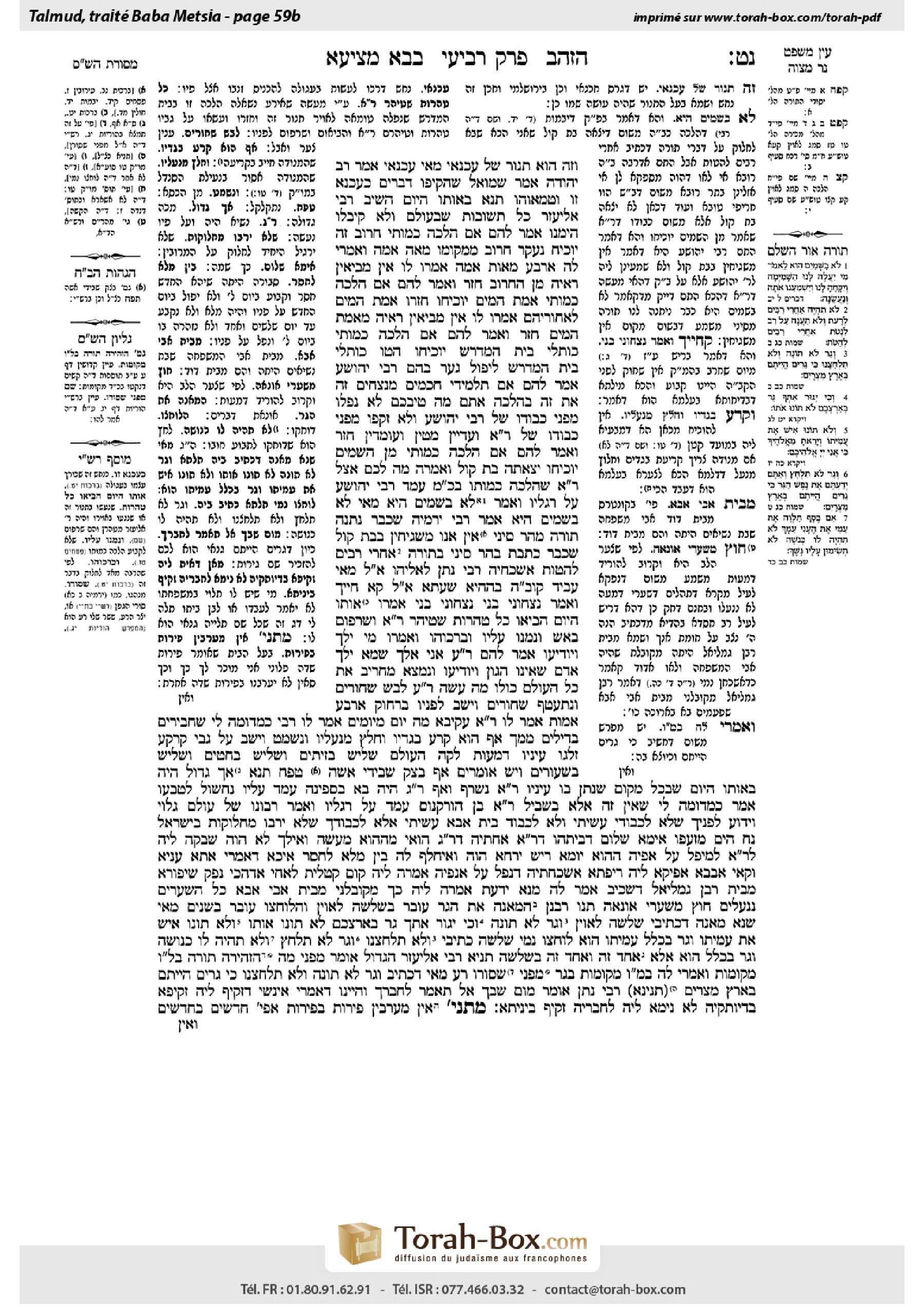
Bava Metzia 59b: Talmud study for Daf Yomi
Study the Talmud for Daf Yomi with scanned pages, Hebrew text, English translations from Sefaria and AI-generated French translations.
Passage selection and English or AI-generated French translation are available where the scan has annotations. Daf Study is independent of Torah-Box and Sefaria.
Browse Bava Metzia · בבא מציעא · All tractatesBava Metzia 59b text and translations
This page of Bava Metzia includes the Aramaic text, an English translation and an AI-generated French translation, alongside the scan above.
בבא מציעא נ״ט ב · Aramaic and Hebrew text
וְזֶה הוּא תַּנּוּר שֶׁל עַכְנַאי. מַאי עַכְנַאי? אָמַר רַב יְהוּדָה אָמַר שְׁמוּאֵל: שֶׁהִקִּיפוּ[הוּ] דְּבָרִים כְּעַכְנָא זוֹ, וְטִמְּאוּהוּ. תָּנָא: בְּאוֹתוֹ הַיּוֹם הֵשִׁיב רַבִּי אֱלִיעֶזֶר כׇּל תְּשׁוּבוֹת שֶׁבָּעוֹלָם, וְלֹא קִיבְּלוּ הֵימֶנּוּ.
אָמַר לָהֶם: אִם הֲלָכָה כְּמוֹתִי – חָרוּב זֶה יוֹכִיחַ. נֶעֱקַר חָרוּב מִמְּקוֹמוֹ מֵאָה אַמָּה, וְאָמְרִי לַהּ: אַרְבַּע מֵאוֹת אַמָּה. אָמְרוּ לוֹ: אֵין מְבִיאִין רְאָיָה מִן הֶחָרוּב. חָזַר וְאָמַר לָהֶם: אִם הֲלָכָה כְּמוֹתִי – אַמַּת הַמַּיִם יוֹכִיחוּ. חָזְרוּ אַמַּת הַמַּיִם לַאֲחוֹרֵיהֶם. אָמְרוּ לוֹ: אֵין מְבִיאִין רְאָיָה מֵאַמַּת הַמַּיִם.
חָזַר וְאָמַר לָהֶם: אִם הֲלָכָה כְּמוֹתִי – כּוֹתְלֵי בֵּית הַמִּדְרָשׁ יוֹכִיחוּ. הִטּוּ כּוֹתְלֵי בֵּית הַמִּדְרָשׁ לִיפּוֹל. גָּעַר בָּהֶם רַבִּי יְהוֹשֻׁעַ, אָמַר לָהֶם: אִם תַּלְמִידֵי חֲכָמִים מְנַצְּחִים זֶה אֶת זֶה בַּהֲלָכָה, אַתֶּם מָה טִיבְכֶם? לֹא נָפְלוּ מִפְּנֵי כְבוֹדוֹ שֶׁל רַבִּי יְהוֹשֻׁעַ, וְלֹא זָקְפוּ מִפְּנֵי כְבוֹדוֹ שֶׁל רַבִּי אֱלִיעֶזֶר, וַעֲדַיִן מַטִּין וְעוֹמְדִין.
חָזַר וְאָמַר לָהֶם: אִם הֲלָכָה כְּמוֹתִי – מִן הַשָּׁמַיִם יוֹכִיחוּ. יָצָאתָה בַּת קוֹל וְאָמְרָה: מָה לָכֶם אֵצֶל רַבִּי אֱלִיעֶזֶר, שֶׁהֲלָכָה כְּמוֹתוֹ בְּכׇל מָקוֹם.
עָמַד רַבִּי יְהוֹשֻׁעַ עַל רַגְלָיו וְאָמַר: ״לֹא בַשָּׁמַיִם הִיא!״ מַאי ״לֹא בַּשָּׁמַיִם הִיא״? אָמַר רַבִּי יִרְמְיָה: שֶׁכְּבָר נִתְּנָה תּוֹרָה מֵהַר סִינַי, אֵין אָנוּ מַשְׁגִּיחִין בְּבַת קוֹל, שֶׁכְּבָר כָּתַבְתָּ בְּהַר סִינַי בַּתּוֹרָה ״אַחֲרֵי רַבִּים לְהַטֹּת״. אַשְׁכְּחֵיהּ רַבִּי נָתָן לְאֵלִיָּהוּ, אֲמַר לֵיהּ: מַאי עָבֵיד קוּדְשָׁא בְּרִיךְ הוּא בְּהַהִיא שַׁעְתָּא? אֲמַר לֵיהּ: קָא חָיֵיךְ וְאָמַר, ״נִצְּחוּנִי בָּנַי! נִצְּחוּנִי בָּנַי!״
אָמְרוּ: אוֹתוֹ הַיּוֹם הֵבִיאוּ כׇּל טְהָרוֹת שֶׁטִּיהֵר רַבִּי אֱלִיעֶזֶר וּשְׂרָפוּם בָּאֵשׁ. וְנִמְנוּ עָלָיו וּבֵרְכוּהוּ, וְאָמְרוּ: מִי יֵלֵךְ וְיוֹדִיעוֹ? אֲמַר לָהֶם רַבִּי עֲקִיבָא: אֲנִי אֵלֵךְ, שֶׁמָּא יֵלֵךְ אָדָם שֶׁאֵינוֹ הָגוּן וְיוֹדִיעוֹ, וְנִמְצָא מַחְרִיב אֶת כָּל הָעוֹלָם כּוּלּוֹ.
מָה עָשָׂה רַבִּי עֲקִיבָא? לָבַשׁ שְׁחוֹרִים וְנִתְעַטֵּף שְׁחוֹרִים, וְיָשַׁב לְפָנָיו בְּרִיחוּק אַרְבַּע אַמּוֹת. אָמַר לוֹ רַבִּי אֱלִיעֶזֶר: עֲקִיבָא, מָה יוֹם מִיָּמִים? אָמַר לוֹ: רַבִּי, כִּמְדוּמֶּה לִי שֶׁחֲבֵירִים בְּדֵילִים מִמֶּךָ. אַף הוּא קָרַע בְּגָדָיו וְחָלַץ מִנְעָלָיו, וְנִשְׁמַט וְיָשַׁב עַל גַּבֵּי קַרְקַע.
זָלְגוּ עֵינָיו דְּמָעוֹת, לָקָה הָעוֹלָם: שְׁלִישׁ בְּזֵיתִים, וּשְׁלִישׁ בְּחִטִּים, וּשְׁלִישׁ בִּשְׂעוֹרִים. וְיֵשׁ אוֹמְרִים: אַף בָּצֵק שֶׁבִּידֵי אִשָּׁה טָפַח. תָּנָא: אַף גָּדוֹל הָיָה בְּאוֹתוֹ הַיּוֹם, שֶׁבְּכָל מָקוֹם שֶׁנָּתַן בּוֹ עֵינָיו רַבִּי אֱלִיעֶזֶר – נִשְׂרַף.
וְאַף רַבָּן גַּמְלִיאֵל הָיָה בָּא בִּסְפִינָה. עָמַד עָלָיו נַחְשׁוֹל לְטַבְּעוֹ. אָמַר: כִּמְדוּמֶּה לִי שֶׁאֵין זֶה אֶלָּא בִּשְׁבִיל רַבִּי אֱלִיעֶזֶר בֶּן הוּרְקָנוֹס. עָמַד עַל רַגְלָיו וְאָמַר: רִבּוֹנוֹ שֶׁל עוֹלָם, גָּלוּי וְיָדוּעַ לְפָנֶיךָ שֶׁלֹּא לִכְבוֹדִי עָשִׂיתִי, וְלֹא לִכְבוֹד בֵּית אַבָּא עָשִׂיתִי, אֶלָּא לִכְבוֹדְךָ, שֶׁלֹּא יִרְבּוּ מַחְלוֹקוֹת בְּיִשְׂרָאֵל. נָח הַיָּם מִזַּעְפּוֹ.
אִימָּא שָׁלוֹם, דְּבֵיתְהוּ דְּרַבִּי אֱלִיעֶזֶר, אֲחָתֵיהּ דְּרַבָּן גַּמְלִיאֵל הֲוַאי. מֵהָהוּא מַעֲשֶׂה וְאֵילָךְ, לָא הֲוָה שָׁבְקָה לֵיהּ לְרַבִּי אֱלִיעֶזֶר לְמִיפַּל עַל אַפֵּיהּ. הָהוּא יוֹמָא רֵישׁ יַרְחָא הֲוָה, וְאִיחַלַּף לַהּ בֵּין מָלֵא לְחָסֵר. אִיכָּא דְּאָמְרִי: אֲתָא עַנְיָא וְקָאֵי אַבָּבָא, אַפִּיקָא לֵיהּ רִיפְתָּא.
אַשְׁכַּחְתֵּיהּ דְּנָפֵל עַל אַנְפֵּיהּ. אֲמַרָה לֵיהּ: קוּם, (קטלית לאחי) [קְטַלְיתֵּהּ לְאָח]. אַדְּהָכִי נְפַק שִׁיפּוּרָא מִבֵּית רַבָּן גַּמְלִיאֵל דִּשְׁכֵיב. אֲמַר לַהּ: מְנָא יְדַעְתְּ? אֲמַרָה לֵיהּ: כָּךְ מְקוּבְּלַנִי מִבֵּית אֲבִי אַבָּא: כׇּל הַשְּׁעָרִים נִנְעָלִים חוּץ מִשַּׁעֲרֵי אוֹנָאָה.
תָּנוּ רַבָּנַן: הַמְאַנֶּה אֶת הַגֵּר, עוֹבֵר בִּשְׁלֹשָׁה לָאוִין. וְהַלּוֹחֲצוֹ, עוֹבֵר בִּשְׁנַיִם.
מַאי שְׁנָא מְאַנֶּה, דִּכְתִיבִי שְׁלֹשָׁה לָאוִין: ״וְגֵר לֹא תוֹנֶה״, ״וְכִי יָגוּר אִתְּךָ גֵּר בְּאַרְצְכֶם לֹא תוֹנוּ אֹתוֹ״, ״וְלֹא תוֹנוּ אִישׁ אֶת עֲמִיתוֹ״, וְגֵר בִּכְלַל עֲמִיתוֹ הוּא. לוֹחֲצוֹ נָמֵי שְׁלֹשָׁה כְּתִיבִי: ״וְלֹא תִלְחָצֶנּוּ״, ״וְגֵר לֹא תִלְחָץ״, ״וְלֹא תִהְיֶה לוֹ כְּנֹשֶׁה״, וְגֵר בַּכְּלָל הוּא! אֶלָּא, אֶחָד זֶה וְאֶחָד זֶה בִּשְׁלֹשָׁה.
תַּנְיָא, רַבִּי אֱלִיעֶזֶר הַגָּדוֹל אוֹמֵר: מִפְּנֵי מָה הִזְהִירָה תּוֹרָה בִּשְׁלֹשִׁים וְשִׁשָּׁה מְקוֹמוֹת, וְאָמְרִי לַהּ: בְּאַרְבָּעִים וְשִׁשָּׁה מְקוֹמוֹת, בְּגֵר? מִפְּנֵי שֶׁסּוֹרוֹ רַע.
מַאי דִּכְתִיב ״וְגֵר לֹא תוֹנֶה וְלֹא תִלְחָצֶנּוּ כִּי גֵרִים הֱיִיתֶם בְּאֶרֶץ מִצְרָיִם״? תְּנֵינָא, רַבִּי נָתָן אוֹמֵר: מוּם שֶׁבְּךָ אַל תֹּאמַר לַחֲבֵרֶךָ. וְהַיְינוּ דְּאָמְרִי אִינָשֵׁי: דִּזְקִיף לֵיהּ זְקִיפָא בִּדְיוּתְקֵיהּ, לָא נֵימָא לֵיהּ לְחַבְרֵיהּ זְקֵיף בִּינִיתָא.
מַתְנִי׳ אֵין מְעָרְבִין פֵּירוֹת בְּפֵירוֹת, אֲפִילּוּ חֲדָשִׁים בַּחֲדָשִׁים.
Bava Metzia 59b · English translation
And this is known as the oven of akhnai. The Gemara asks: What is the relevance of akhnai, a snake, in this context? Rav Yehuda said that Shmuel said: It is characterized in that manner due to the fact that the Rabbis surrounded it with their statements like this snake, which often forms a coil when at rest, and deemed it impure. The Sages taught: On that day, when they discussed this matter, Rabbi Eliezer answered all possible answers in the world to support his opinion, but the Rabbis did not accept his explanations from him.
After failing to convince the Rabbis logically, Rabbi Eliezer said to them: If the halakha is in accordance with my opinion, this carob tree will prove it. The carob tree was uprooted from its place one hundred cubits, and some say four hundred cubits. The Rabbis said to him: One does not cite halakhic proof from the carob tree. Rabbi Eliezer then said to them: If the halakha is in accordance with my opinion, the stream will prove it. The water in the stream turned backward and began flowing in the opposite direction. They said to him: One does not cite halakhic proof from a stream.
Rabbi Eliezer then said to them: If the halakha is in accordance with my opinion, the walls of the study hall will prove it. The walls of the study hall leaned inward and began to fall. Rabbi Yehoshua scolded the walls and said to them: If Torah scholars are contending with each other in matters of halakha, what is the nature of your involvement in this dispute? The Gemara relates: The walls did not fall because of the deference due Rabbi Yehoshua, but they did not straighten because of the deference due Rabbi Eliezer, and they still remain leaning.
Rabbi Eliezer then said to them: If the halakha is in accordance with my opinion, Heaven will prove it. A Divine Voice emerged from Heaven and said: Why are you differing with Rabbi Eliezer, as the halakha is in accordance with his opinion in every place that he expresses an opinion?
Rabbi Yehoshua stood on his feet and said: It is written: “It is not in heaven” (Deuteronomy 30:12). The Gemara asks: What is the relevance of the phrase “It is not in heaven” in this context? Rabbi Yirmeya says: Since the Torah was already given at Mount Sinai, we do not regard a Divine Voice, as You already wrote at Mount Sinai, in the Torah: “After a majority to incline” (Exodus 23:2). Since the majority of Rabbis disagreed with Rabbi Eliezer’s opinion, the halakha is not ruled in accordance with his opinion. The Gemara relates: Years after, Rabbi Natan encountered Elijah the prophet and said to him: What did the Holy One, Blessed be He, do at that time, when Rabbi Yehoshua issued his declaration? Elijah said to him: The Holy One, Blessed be He, smiled and said: My children have triumphed over Me; My children have triumphed over Me.
The Sages said: On that day, the Sages brought all the ritually pure items deemed pure by the ruling of Rabbi Eliezer with regard to the oven and burned them in fire, and the Sages reached a consensus in his regard and ostracized him. And the Sages said: Who will go and inform him of his ostracism? Rabbi Akiva, his beloved disciple, said to them: I will go, lest an unseemly person go and inform him in a callous and offensive manner, and he would thereby destroy the entire world.
What did Rabbi Akiva do? He wore black and wrapped himself in black, as an expression of mourning and pain, and sat before Rabbi Eliezer at a distance of four cubits, which is the distance that one must maintain from an ostracized individual. Rabbi Eliezer said to him: Akiva, what is different about today from other days, that you comport yourself in this manner? Rabbi Akiva said to him: My teacher, it appears to me that your colleagues are distancing themselves from you. He employed euphemism, as actually they distanced Rabbi Eliezer from them. Rabbi Eliezer too, rent his garments and removed his shoes, as is the custom of an ostracized person, and he dropped from his seat and sat upon the ground.
The Gemara relates: His eyes shed tears, and as a result the entire world was afflicted: One-third of its olives were afflicted, and one-third of its wheat, and one-third of its barley. And some say that even dough kneaded in a woman’s hands spoiled. The Sages taught: There was great anger on that day, as any place that Rabbi Eliezer fixed his gaze was burned.
And even Rabban Gamliel, the Nasi of the Sanhedrin at Yavne, the head of the Sages who were responsible for the decision to ostracize Rabbi Eliezer, was coming on a boat at the time, and a large wave swelled over him and threatened to drown him. Rabban Gamliel said: It seems to me that this is only for the sake of Rabbi Eliezer ben Hyrcanus, as God punishes those who mistreat others. Rabban Gamliel stood on his feet and said: Master of the Universe, it is revealed and known before You that neither was it for my honor that I acted when ostracizing him, nor was it for the honor of the house of my father that I acted; rather, it was for Your honor, so that disputes will not proliferate in Israel. In response, the sea calmed from its raging.
The Gemara further relates: Imma Shalom, the wife of Rabbi Eliezer, was the sister of Rabban Gamliel. From that incident forward, she would not allow Rabbi Eliezer to lower his head and recite the taḥanun prayer, which includes supplication and entreaties. She feared that were her husband to bemoan his fate and pray at that moment, her brother would be punished. A certain day was around the day of the New Moon, and she inadvertently substituted a full thirty-day month for a deficient twenty-nine-day month, i.e., she thought that it was the New Moon, when one does not lower his head in supplication, but it was not. Some say that a pauper came and stood at the door, and she took bread out to him. The result was that she left her husband momentarily unsupervised.
When she returned, she found him and saw that he had lowered his head in prayer. She said to him: Arise, you already killed my brother. Meanwhile, the sound of a shofar emerged from the house of Rabban Gamliel to announce that the Nasi had died. Rabbi Eliezer said to her: From where did you know that your brother would die? She said to him: This is the tradition that I received from the house of the father of my father: All the gates of Heaven are apt to be locked, except for the gates of prayer for victims of verbal mistreatment.
§ The Sages taught: One who verbally mistreats the convert violates three prohibitions, and one who oppresses him in other ways violates two.
The Gemara asks: What is different with regard to verbal mistreatment, that three prohibitions are written concerning it: “And you shall neither mistreat a convert” (Exodus 22:20); “And when a convert lives in your land, you shall not mistreat him” (Leviticus 19:33); “And you shall not mistreat, each man his colleague” (Leviticus 25:17), and a convert is included in the category of colleague? With regard to one who also oppresses a convert as well, three prohibitions are written: “And you shall neither mistreat a convert, nor oppress him” (Exodus 22:20); “And you shall not oppress a convert (Exodus 23:9); “And you shall not be to him like a creditor” (Exodus 22:24). This last prohibition is a general prohibition, in which converts are included. Consequently, it is not correct that one who oppresses a convert violates only two prohibitions. Rather, both this one, who verbally mistreats a convert, and that one, who oppresses him, violate three prohibitions.
It is taught in a baraita that Rabbi Eliezer the Great says: For what reason did the Torah issue warnings in thirty-six places, and some say in forty-six places, with regard to causing any distress to a convert? It is due to the fact that a convert’s inclination is evil, i.e., he is prone to return to his previous way of living.
What is the meaning of that which is written: “And you shall not mistreat a convert nor oppress him, because you were strangers in the land of Egypt” (Exodus 22:20)? We learned in a baraita that Rabbi Natan says: A defect that is in you, do not mention it in another. Since the Jewish people were themselves strangers, they are not in a position to demean a convert because he is a stranger in their midst. And this explains the adage that people say: One who has a person hanged in his family [bidyotkei], does not say to another member of his household: Hang a fish for me, as the mention of hanging is demeaning for that family.
MISHNA: One may not intermingle produce bought from one supplier with other produce, even if he intermingles new produce with other new produce and ostensibly the buyer suffers no loss from his doing so.
Bava Metzia 59b · Traduction française (IA)
Et c'est ce que l'on appelle l'four de Akhnai. La Guemara pose la question : Quel est le sens d'akhnai, un serpent, dans ce contexte ? Rav Yehuda a dit que Shmuel a dit : C'est ainsi qu'il est désigné, car les Rabbins l'ont entouré de leurs déclarations comme ce serpent, qui se tord souvent lorsqu'il est au repos, et l'ont déclaré impur. Les Sages enseignèrent : Ce jour-là, lorsqu'ils discutèrent de cette question, Rabbi Eliezer répondit à toutes les réponses possibles du monde pour soutenir son opinion, mais les Rabbins ne surent pas accepter ses explications de sa part.
Après avoir échoué à convaincre les Rabbins logiquement, Rabbi Eliezer dit à ceux-ci : Si la halakha suit mon opinion, ce carob se le prouvera. Le carob fut arraché de son lieu à cent coudées, et certains disent quatre cents coudées. Les Rabbins dirent à lui : On ne cite pas de preuve halakhique à partir du carob. Rabbi Eliezer dit alors à ceux-ci : Si la halakha suit mon opinion, le cours d'eau se le prouvera. L'eau du cours d'eau tourna en arrière et commença à couler dans la direction opposée. Ils dirent à lui : On ne cite pas de preuve halakhique à partir d'un cours d'eau.
Rabbi Eliezer dit alors à ceux-ci : Si la halakha suit mon opinion, les murs de la salle de étude se le prouveront. Les murs de la salle de étude s'inclinèrent vers l'intérieur et commencèrent à tomber. Rabbi Yehoshua réprimanda les murs et dit à ceux-ci : Si des savants de la Torah s'opposent entre eux sur des questions de halakha, quelle est votre implication dans ce débat ? La Guemara rapporte : Les murs ne tombèrent pas à cause de l'honneur due à Rabbi Yehoshua, mais ils ne se redressèrent pas à cause de l'honneur due à Rabbi Eliezer, et ils restent encore inclinés.
Rabbi Eliezer dit alors à ceux-ci : Si la halakha suit mon opinion, le Ciel se le prouvera. Une voix divine émergea du Ciel et dit : Pourquoi vous disputez-vous avec Rabbi Eliezer, car la halakha suit son opinion dans chaque lieu où il exprime son opinion ?
Rabbi Yehoshua se leva et dit : Il est écrit : « Ce n'est pas au Ciel » (Deutéronome 30:12). La Guemara pose la question : Quel est le sens de la phrase « Ce n'est pas au Ciel » dans ce contexte ? Rabbi Yirmeya dit : Puisque la Torah fut déjà donnée à la montagne de Sinaï, nous ne considérons pas une voix divine, car Vous avez déjà écrit à la montagne de Sinaï, dans la Torah : « Après la majorité, incliner » (Exode 23:2). Puisque la majorité des Sages s'opposaient à l'opinion de Rabbi Eliezer, la halakha ne suit pas son opinion. La Guemara rapporte : Plus tard, Rabbi Natan rencontra Eliezer le prophète et lui dit : Qu'as-tu fait, ô Saint-Esprit, béni soit-Il, lorsqu'Rabbi Yehoshua a fait cette déclaration ? Eliezer dit à lui : L'Esprit Saint, béni soit-Il, sourit et dit : Mes enfants ont triomphé de Moi ; Mes enfants ont triomphé de Moi.
Les Sages dirent : Ce jour-là, les Sages amenèrent tous les objets rituellement purs considérés comme purs par la décision de Rabbi Eliezer concernant le four et les brûlèrent dans le feu, et les Sages parvinrent à un consensus à son égard et l'expulsèrent. Et les Sages dirent : Qui ira informer lui de son expulsion ? Rabbi Akiva, son disciple chéri, dit à ceux-ci : Je vais y aller, de peur qu'une personne indigne ne vienne l'annoncer de manière indécente et offensive, et qu'il détruise ainsi le monde entier.
Qu'as-tu fait, Rabbi Akiva ? Il s'habilla en noir et s'enveloppa de noir, comme une expression de deuil et de douleur, et s'assit devant Rabbi Eliezer à une distance de quatre coudées, qui est la distance qu'on doit maintenir d'une personne expulsée. Rabbi Eliezer dit à lui : Akiva, qu'y a-t-il de particulier aujourd'hui par rapport aux autres jours, que tu t'habilles ainsi ? Rabbi Akiva dit à lui : Mon maître, il me semble que tes collègues t'éloignent. Il employa un euphémisme, car en réalité ils éloignèrent Rabbi Eliezer d'eux. Rabbi Eliezer aussi, déchira ses vêtements et ôta ses chaussures, comme c'est la coutume d'une personne expulsée, et il tomba de son siège et s'assit sur le sol.
La Guemara rapporte : Ses yeux versèrent des larmes, et en conséquence l'ensemble du monde fut affligé : un tiers de ses olives furent affectés, et un tiers de ses blés, et un tiers de ses orge. Et certains disent que même la pâte pétrie dans les mains d'une femme putri. Les Sages enseignèrent : Il y avait une grande colère ce jour-là, car toute place où Rabbi Eliezer fixait son regard fut brûlée.
Et même Rabban Gamliel, le Nasi du Sanhédrin à Yavne, le chef des Sages qui étaient responsables de la décision d'expulser Rabbi Eliezer, était en train de monter sur un bateau à ce moment-là, et une grande vague s'éleva sur lui et menaçait de le noyer. Rabban Gamliel dit : Il me semble que c'est uniquement en l'honneur de Rabbi Eliezer ben Hyrcanus, car Dieu puni ceux qui traitent les autres de manière injuste. Rabban Gamliel se leva et dit : Seigneur de l'Univers, il est révélé et connu devant toi que ni ce n'était pour mon honneur que j'ai agi lors de l'expulsion, ni pour l'honneur de la maison de mon père, mais plutôt pour ton honneur, afin que les disputes ne prolifèrent pas en Israël. En réponse, la mer s'apaisa de son tumulte.
La Guemara rapporte de plus : Imma Shalom, la femme de Rabbi Eliezer, était la sœur de Rabban Gamliel. À partir de cet incident, elle ne permit plus à Rabbi Eliezer de baisser la tête et de réciter la prière de taḥanun, qui inclut des supplications et des prières. Elle craignait que, si son mari pleurait son sort et priait à ce moment-là, son frère serait puni. Un jour était autour de la nouvelle lune, et elle substitua par erreur un mois de trente jours à un mois déficient de vingt-neuf jours, c'est-à-dire qu'elle pensait que c'était la nouvelle lune, lorsqu'on ne baisse pas la tête pour prier, mais ce n'était pas le cas. Certains disent qu'un pauvre vint et se tint à la porte, et elle sortit du pain pour lui. Le résultat fut qu'elle laissa son mari momentanément sans surveillance.
Quand elle revint, elle le trouva et vit qu'il avait baissé la tête pour prier. Elle lui dit : Lève-toi, tu as déjà tué mon frère. En même temps, le son d'un cor s'éleva de la maison de Rabban Gamliel pour annoncer que le Nasi était mort. Rabbi Eliezer lui dit : D'où as-tu su que ton frère allait mourir ? Elle lui répondit : C'est la tradition que j'ai reçue de la maison du père de mon père : toutes les portes du Ciel sont susceptibles d'être verrouillées, sauf les portes des prières des victimes de mauvais traitements verbaux.
§ Les Sages enseignent : Celui qui mauvaise traite un converti transgresse trois prohibitions, et celui qui l'opprime d'une autre manière transgresse deux.
La Guemara pose la question : Qu'est-ce qui diffère concernant le mauvais traitements verbaux, que trois prohibitions y sont écrites : « Et tu ne traiteras pas le converti en mal » (Exode 22:20) ; « Et quand un converti habite dans ton pays, tu ne le traiteras pas en mal » (Lévitique 19:33) ; « Et tu ne traiteras pas, chacun son collègue » (Lévitique 25:17), et un converti est-il inclus dans la catégorie de collègue ? Concernant celui qui opprime également un converti, trois prohibitions sont écrites : « Et tu ne traiteras pas le converti, ni ne l'oppresseras » (Exode 22:20) ; « Et tu ne opprimes pas le converti » (Exode 23:9) ; « Et tu ne lui seras pas comme un créancier » (Exode 22:24). Cette dernière prohibition est une prohibition générale, dans laquelle les convertis sont inclus. Ainsi, il n'est pas correct que celui qui opprime un converti transgresse seulement deux prohibitions. Plutôt, celui-ci, qui mauvaise traite un converti, et celui-là, qui l'opprime, transgressent trois prohibitions.
Il est enseigné dans une baraïta que Rabbi Eliezer le Grand dit : Pourquoi la Torah a-t-elle donné des avertissements dans trente-six endroits, et certains disent quarante-six endroits, concernant causer une détresse à un converti ? C'est à cause du fait que la tendance d'un converti est mauvaise, c'est-à-dire qu'il est enclin à revenir à sa manière de vivre précédente.
Quelle est la signification de ce qui est écrit : « Et tu ne traiteras pas le converti ni ne l'oppresseras, car tu étais étranger dans la terre d'Égypte » (Exode 22:20) ? Nous avons appris dans une baraïta que Rabbi Natan dit : Un défaut qui est en toi, ne le mentionne pas chez un autre. Puisque le peuple juif lui-même était étranger, il n'est pas en position de dénigrer un converti, car il est étranger parmi eux. Et cela explique l'adage que les gens disent : Celui qui a un homme pendu dans sa famille [bidyotkei], ne dit pas à un autre membre de sa famille : Pend un poisson pour moi, car la mention de la pendaison est dénigrante pour cette famille.
MICHNA : On ne doit pas mélanger les produits achetés chez un même fournisseur avec d'autres produits, même si l'on mélange des produits nouveaux avec d'autres produits nouveaux et apparemment l'acheteur ne subit aucune perte à cause de cela.
Traduction française générée par IA à partir de l’édition anglaise de Sefaria. Vérifie toujours un passage avec le texte source.
Text from Sefaria: William Davidson Edition - Vocalized Aramaic (CC BY NC); William Davidson Edition - English (CC BY NC).