Bava Metzia 60a: Talmud study for Daf Yomi
Study the Talmud for Daf Yomi with scanned pages, Hebrew text, English translations from Sefaria and AI-generated French translations.
Passage selection and English or AI-generated French translation are available where the scan has annotations. Daf Study is independent of Torah-Box and Sefaria.
Browse Bava Metzia · בבא מציעא · All tractatesBava Metzia 60a text and translations
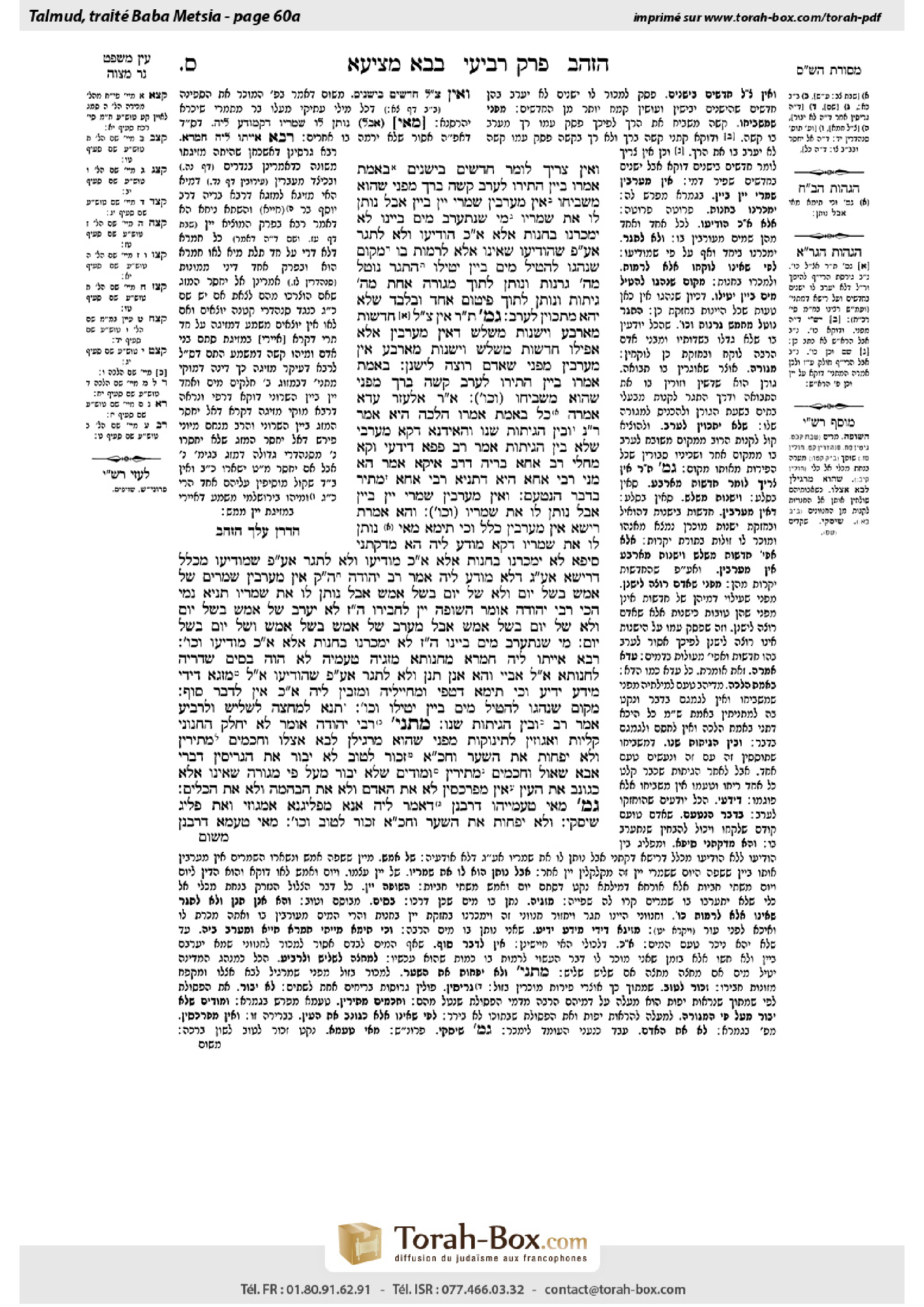
This page of Bava Metzia includes the Aramaic text, an English translation and an AI-generated French translation, alongside the scan above.
בבא מציעא ס׳ א · Aramaic and Hebrew text
וְאֵין צָרִיךְ לוֹמַר, חֲדָשִׁים בִּישָׁנִים.
בֶּאֱמֶת אָמְרוּ: בְּיַיִן הִתִּירוּ לְעָרֵב קָשֶׁה בְּרַךְ, מִפְּנֵי שֶׁהוּא מַשְׁבִּיחוֹ. אֵין מְעָרְבִין שִׁמְרֵי יַיִן בְּיַיִן, אֲבָל נוֹתֵן לוֹ אֶת שְׁמָרָיו.
מִי שֶׁנִּתְעָרֵב מַיִם בְּיֵינוֹ, לֹא יִמְכְּרֶנּוּ בַּחֲנוּת, אֶלָּא אִם כֵּן הוֹדִיעוֹ. וְלֹא לַתַּגָּר, אַף עַל פִּי שֶׁהוֹדִיעוֹ, שֶׁאֵינוֹ אֶלָּא לְרַמּוֹת בּוֹ. מָקוֹם שֶׁנָּהֲגוּ לְהָטִיל מַיִם בַּיַּיִן – יָטִילוּ.
הַתַּגָּר נוֹטֵל מֵחָמֵשׁ גֳּרָנוֹת וְנוֹתֵן לְתוֹךְ מְגוּרָה אַחַת, מֵחָמֵשׁ גִּתּוֹת וְנוֹתֵן לְתוֹךְ פִּיטוֹם אֶחָד, וּבִלְבַד שֶׁלֹּא יְהֵא מִתְכַּוֵּין לְעָרֵב.
גְּמָ׳ תָּנוּ רַבָּנַן: אֵין צָרִיךְ לוֹמַר חֲדָשׁוֹת מֵאַרְבַּע וִישָׁנוֹת מִשָּׁלֹשׁ דְּאֵין מְעָרְבִין, אֶלָּא אֲפִילּוּ חֲדָשׁוֹת מִשָּׁלֹשׁ וִישָׁנוֹת מֵאַרְבַּע – אֵין מְעָרְבִין, מִפְּנֵי שֶׁאָדָם רוֹצֶה לְיַשְּׁנָן.
בֶּאֱמֶת אָמְרוּ: בַּיַּיִן הִתִּירוּ לְעָרֵב קָשֶׁה בְּרַךְ, מִפְּנֵי שֶׁהוּא מַשְׁבִּיחוֹ וְכוּ׳. אָמַר רַבִּי אֶלְעָזָר: עֲדָא אָמְרָה, כֹּל ״בֶּאֱמֶת אָמְרוּ״ – הֲלָכָה הִיא.
אָמַר רַב נַחְמָן: וּבֵין הַגִּיתּוֹת שָׁנוּ.
וְהָאִידָּנָא דְּקָא מְעָרְבִי שֶׁלֹּא בֵּין הַגִּיתּוֹת? אָמַר רַב פָּפָּא: דְּיָדְעִי וְקָא מָחֲלִי. רַב אַחָא בְּרֵיהּ דְּרַב אִיקָא אָמַר: הָא מַנִּי? רַבִּי אַחָא הִיא, דְּתַנְיָא: רַבִּי אַחָא מַתִּיר בְּדָבָר הַנִּטְעָם.
וְאֵין מְעָרְבִין שִׁמְרֵי יַיִן בְּיַיִן, אֲבָל נוֹתֵן לוֹ אֶת שְׁמָרָיו וְכוּ׳. וְהָא אָמְרַתְּ רֵישָׁא אֵין מְעָרְבִין כְּלָל! וְכִי תֵּימָא מַאי ״נוֹתֵן לוֹ אֶת שְׁמָרָיו״? דְּקָא מוֹדַע לֵיהּ, הָא מִדְּקָתָנֵי סֵיפָא: לֹא יִמְכְּרֶנּוּ בַּחֲנוּת אֶלָּא אִם כֵּן מוֹדִיעוֹ, וְלֹא לַתַּגָּר אַף עַל פִּי שֶׁמּוֹדִיעוֹ, מִכְּלָל דְּרֵישָׁא אַף עַל גַּב דְּלָא מוֹדַע לֵיהּ!
אָמַר רַב יְהוּדָה: הָכִי קָאָמַר, אֵין מְעָרְבִין שְׁמָרִים שֶׁל אֶמֶשׁ בְּשֶׁל יוֹם, וְלֹא שֶׁל יוֹם בְּשֶׁל אֶמֶשׁ. אֲבָל נוֹתֵן לוֹ אֶת שְׁמָרָיו. תַּנְיָא נָמֵי הָכִי, רַבִּי יְהוּדָה אוֹמֵר: הַשּׁוֹפֶה יַיִן לַחֲבֵירוֹ – הֲרֵי זֶה לֹא יְעָרֵב שֶׁל אֶמֶשׁ בְּשֶׁל יוֹם, וְלֹא שֶׁל יוֹם בְּשֶׁל אֶמֶשׁ. אֲבָל מְעָרֵב שֶׁל אֶמֶשׁ בְּשֶׁל אֶמֶשׁ, וְשֶׁל יוֹם בְּשֶׁל יוֹם.
מִי שֶׁנִּתְעָרֵב מַיִם בְּיֵינוֹ, הֲרֵי זֶה לֹא יִמְכְּרֶנּוּ בַּחֲנוּת, אֶלָּא אִם כֵּן מוֹדִיעוֹ וְכוּ׳. רָבָא אַיְיתוֹ לֵיהּ חַמְרָא מֵחָנוּתָא, מַזְגֵיהּ, טַעְמֵיהּ, לָא הֲוָה בְּסִים, שַׁדְּרֵיהּ לְחָנוּתָא. אֲמַר לֵיהּ אַבָּיֵי: וְהָא אֲנַן תְּנַן, וְלֹא לַתַּגָּר, אַף עַל פִּי שֶׁהוֹדִיעוֹ! אֲמַר לֵיהּ: מִזְגָּא דִּידִי מִידָּע יְדִיעַ. וְכִי תֵּימָא דְּטָפֵי וּמְחַיְּילֵיהּ וּמְזַבֵּין לֵיהּ – אִם כֵּן, אֵין לַדָּבָר סוֹף.
מָקוֹם שֶׁנָּהֲגוּ לְהַטִּיל מַיִם בַּיַּיִן, יָטִילוּ וְכוּ׳. תָּנָא: לְמֶחֱצָה, לִשְׁלִישׁ, וְלִרְבִיעַ. אָמַר רַב: וּבֵין הַגִּיתּוֹת שָׁנוּ.
מַתְנִי׳ רַבִּי יְהוּדָה אוֹמֵר: לֹא יְחַלֵּק הַחֶנְוָנִי קְלָיוֹת וֶאֱגוֹזִין לַתִּינוֹקוֹת, מִפְּנֵי שֶׁהוּא מַרְגִּילָן לָבֹא אֶצְלוֹ. וַחֲכָמִים מַתִּירִין. וְלֹא יִפְחוֹת אֶת הַשַּׁעַר, וַחֲכָמִים אוֹמְרִים: זָכוּר לַטּוֹב.
לֹא יָבוֹר אֶת הַגְּרִיסִין, דִּבְרֵי אַבָּא שָׁאוּל. וַחֲכָמִים מַתִּירִין, וּמוֹדִים שֶׁלֹּא יָבוֹר מֵעַל פִּי מְגוּרָה, שֶׁאֵינוֹ אֶלָּא כְּגוֹנֵב אֶת הָעַיִן. אֵין מְפַרְכְּסִין לֹא אֶת הָאָדָם, וְלֹא אֶת הַבְּהֵמָה, וְלֹא אֶת הַכֵּלִים.
גְּמָ׳ מַאי טַעְמַיְיהוּ דְּרַבָּנַן? דַּאֲמַר לֵיהּ: אֲנָא מְפַלֵּיגְנָא אַמְגּוֹזֵי, וְאַתְּ פַּלֵּיג שִׁיסְקֵי.
וְלֹא יִפְחוֹת אֶת הַשַּׁעַר, וַחֲכָמִים אוֹמְרִים: זָכוּר לַטּוֹב וְכוּ׳. מַאי טַעְמָא דְּרַבָּנַן?
Bava Metzia 60a · English translation
And needless to say, one may not intermingle new produce with old produce, in the event that the old produce is superior, as with grains, since intermingling lowers its value.
Actually, they said: With regard to wine, they permitted one to mix strong wine with weak wine, because one thereby enhances it. One may not intentionally mix wine sediment with the wine, but one may give the buyer wine with its sediment; the seller is not required to filter the wine.
One who had water mix with his wine may not sell it in the store, unless he informs the buyer that it contains water. And he may not sell it to a merchant, even if he informs him of the mixture, as, although he is aware that there is water mixed with the wine, it will be used for nothing other than deceit because the merchant will likely not inform the buyer that it is diluted. In a place where they are accustomed to place water into the wine to dilute it and everyone is aware of that fact, one may place water in the wine.
The prohibition against mixing different types of produce applies only to an individual selling the produce of his field. By contrast, a merchant may take grain from five threshing floors belonging to different people, and place the produce in one warehouse. He may also take wine from five winepresses and place the wine in one large cask [pitom], provided that he does not intend to mix low-quality merchandise with high-quality merchandise.
GEMARA: The Sages taught: Needless to say, if the price of the new produce is four se’a for a sela and the price of the old produce is three se’a for a sela, one may not intermingle them together. That is full-fledged deceit, as one is selling inexpensive produce at the price of expensive produce. Rather, even if the price of the new produce is three se’a for a sela and the price of the old produce is four se’a for a sela, one may not intermingle them. This is because in this case the price of the new produce is higher, as people want to age the produce, i.e., new produce is more valuable to those who seek to place it in storage for a lengthy period, although it may be of inferior quality compared to old produce.
The mishna teaches: Actually, they said: With regard to wine, they permitted one to mix strong wine with weak wine because mixing the wine enhances it. Rabbi Elazar said: That is to say, every time a halakha is introduced with the phrase: Actually they said, it is an established halakha with regard to which there is no uncertainty.
Rav Naḥman says: And it is with regard to the period when the wine is among the winepresses, i.e., before the wine ferments, that they taught this halakha. When the wine is still in the process of fermentation, if different wines are mixed and ferment together, this enhances their flavor. By contrast, if they are mixed at a later stage, this will harm their flavor.
The Gemara asks: And today, when people mix old and new wine even when the wine is not among the winepresses, on what basis is mixing permitted? Rav Pappa said: It is because buyers are aware of the potential loss and waive it. Rav Aḥa, son of Rav Ika, said: In accordance with whose opinion is this mishna? It is the opinion of Rabbi Aḥa, as it is taught in a baraita: Rabbi Aḥa permits mixing in a case where the product will be tasted before its purchase. Then there is no deceit, as when the buyer tastes it, he is immediately aware that it is a mixture, and the choice of whether or not to purchase the product is his.
The mishna teaches: And one may not intentionally mix wine sediment with the wine, but one may give the buyer wine with its sediment. The Gemara asks: But didn’t you say in the former clause of the mishna that one may not mix sediment at all? And lest you say: What is the meaning of: He may give the buyer wine with its sediment; it means that he informs the buyer that the wine contains sediment, this suggestion is not tenable. From the fact that the latter clause teaches: One may not sell it in the store unless he informs the buyer and he may not sell it to a merchant even if he informs him, it may be inferred that the former clause is speaking of a situation where one may sell it in the store even if he does not inform the buyer.
Rav Yehuda said: This is what the tanna is saying: One may neither mix sediment remaining from wine that he poured the night before with the wine of the next day, nor the sediment of the next day with the wine of the night before. But he may give the buyer sediment of that wine itself. That is also taught in a baraita: Rabbi Yehuda says: With regard to one who pours wine for another, attempting to pour the liquid while leaving the sediment in the cask, that person may neither mix sediment remaining from wine that he poured the night before with the wine of the next day, nor the sediment of the next day with the wine of the night before. But he may mix the sediment of the night before with the wine poured the night before, and the sediment of the next day with the wine of the next day.
The mishna teaches: One who had water mix with his wine may not sell it in the store, unless he informs the buyer that it contains water. The Gemara relates: They brought wine to Rava from a store. He diluted it with water, tasted it, and it was not tasty. He sent it back to the store, so they could sell it there. Abaye said to him: But didn’t we learn in the mishna: And he may not sell it to a merchant, even if he informs him? Rava said to him: My dilution of the wine is evident to all, as I add more water than is typically added. And lest you say that the storekeeper will add wine, and sweeten the mixture, and sell it again, when the dilution is no longer evident, if this is a concern, there is no end to the matter. It should be prohibited to sell any wine to a merchant due to the concern lest he engage in deceit in its resale.
The mishna teaches: In a place where they are accustomed to place water into the wine to dilute it and everyone is aware of that fact, one may place water in the wine. It was taught: One may dilute the wine by adding water that will constitute one-half, one-third, or one-fourth of the mixture, in accordance with the local custom. Rav says: And it is with regard to the period when the wine is among the winepresses, before the wine ferments, that they taught this halakha. If wine is diluted at a later stage, the dilution will cause the wine to spoil.
MISHNA: Rabbi Yehuda says: A storekeeper may not hand out toasted grain and nuts to children who patronize his store, due to the fact that he thereby accustoms them to come to him at the expense of competing storekeepers. And the Rabbis permit doing so. And one may not reduce the price of sale items below the market rate. And the Rabbis say: If he wishes to do so, he should be remembered positively.
One may not sift ground beans to remove the waste, lest he charge an inappropriately high price for the sifted meal, beyond its actual value; this is the statement of Abba Shaul. And the Rabbis permit doing so. And the Rabbis concede that one may not sift the meal only from the beans that are close to the opening of the bin to create the impression that the contents of the entire bin were sifted, as this is nothing other than deception. One may neither adorn a person before selling him on the slave market, nor an animal nor vessels that he seeks to sell. Rather, they must be sold unembellished, to avoid deceiving the buyer.
GEMARA: The Gemara asks: What is the reason for the opinion of the Rabbis, who permit the free distribution of toasted grain and nuts? It is because the storekeeper can say to his competitors: I hand out nuts; and you hand out jujubes [shiskei]. All merchants are able to hand out goods that will attract children, and consequently this is not unfair competition.
The mishna teaches: And one may not reduce the price of items below the market rate. And the Rabbis say: If he wishes to do so, he should be remembered positively. The Gemara asks: What is the reason for the opinion of the Rabbis, who not only condone the practice but even praise the person, saying that he should be remembered positively?
Bava Metzia 60a · Traduction française (IA)
Et de toute évidence, on ne doit pas mélanger des produits nouveaux avec des produits anciens, si les produits anciens sont supérieurs, comme les céréales, car le mélange réduit leur valeur.
En réalité, ils dirent : En ce qui concerne le vin, on permet à une personne de mélanger du vin fort avec du vin faible, car cela améliore le vin. On ne doit pas intentionnellement mélanger les dépôts de vin avec le vin, mais on peut vendre du vin avec ses dépôts ; le vendeur n'est pas tenu de filtrer le vin.
Celui qui a mélangé de l'eau à son vin ne peut pas le vendre en magasin, à moins qu'il informe l'acheteur qu'il contient de l'eau. Il ne peut pas non plus le vendre à un marchand, même s'il l'informe, car, bien qu'il sache qu'il y a de l'eau mélangée au vin, ce dernier ne servira qu'à la tromperie, car le marchand ne dira probablement pas à l'acheteur qu'il est dilué. Dans un lieu où on est habitué de mettre de l'eau dans le vin pour le diluer et où tout le monde en est conscient, on peut mettre de l'eau dans le vin.
L'interdiction de mélanger des produits différents s'applique uniquement à une personne vendant les produits de son champ. En revanche, un marchand peut prendre des céréales provenant de cinq étals différents et les placer dans un seul entrepôt. Il peut également prendre du vin provenant de cinq pressoirs et le placer dans une grande cuve, à condition qu'il n'ait pas l'intention de mélanger des produits de qualité inférieure avec des produits de qualité supérieure.
GUEMARA : Les Sages enseignèrent : Et de toute évidence, si le prix des produits nouveaux est de quatre se'ot pour un sela et le prix des produits anciens est de trois se'ot pour un sela, on ne doit pas les mélanger ensemble. C'est une tromperie complète, car on vend des produits peu coûteux au prix de produits coûteux. En revanche, même si le prix des produits nouveaux est de trois se'ot pour un sela et celui des produits anciens est de quatre se'ot pour un sela, on ne doit pas les mélanger ensemble. Cela est dû au fait que, dans ce cas, le prix des produits nouveaux est plus élevé, car les gens veulent conserver les produits, c'est-à-dire que les produits nouveaux sont plus précieux pour ceux qui souhaitent les conserver pendant une longue période, même s'ils sont de moindre qualité par rapport aux produits anciens.
La mitsva enseigne : En réalité, ils dirent : En ce qui concerne le vin, on permet à une personne de mélanger du vin fort avec du vin faible, car le mélange améliore le vin. Rabbi Eléazar dit : Cela signifie que chaque fois qu'une halakha est introduite avec la formule : En réalité, ils dirent, c'est une halakha établie sans ambiguïté.
Rav Naḥman dit : Et c'est à propos de la période où le vin est encore dans les pressoirs, c'est-à-dire avant la fermentation, qu'ils ont enseigné cette halakha. Lorsque le vin est encore en cours de fermentation, si différents vins sont mélangés et ferment ensemble, cela améliore leur goût. En revanche, si le mélange a lieu à une étape ultérieure, cela nuira à leur goût.
La Guemara pose la question : Et aujourd'hui, lorsque les gens mélangent du vin ancien et nouveau même lorsque le vin n'est pas encore dans les pressoirs, sur quel fondement est-ce permis ? Rav Pappa dit : C'est parce que les acheteurs sont conscients du potentiel de perte et y renoncent. Rav Acha, fils de Rav Ika, dit : Selon quel avis est-ce que cette mitsva ? C'est l'avis de Rabbi Acha, comme il est enseigné dans une baraïta : Rabbi Acha permet le mélange dans un cas où le produit est goûté avant d'être acheté. Il n'y a pas de tromperie, car lorsque l'acheteur goûte le produit, il est immédiatement conscient qu'il s'agit d'un mélange, et la décision d'acheter ou non est la sienne.
La mitsva enseigne : Et on ne doit pas intentionnellement mélanger les dépôts de vin avec le vin, mais on peut vendre du vin avec ses dépôts. La Guemara pose la question : Mais n'avez-vous pas dit dans la première partie de la mitsva que l'on ne doit pas mélanger les dépôts du tout ? Et si l'on dit : Qu'entend-on par : On peut vendre du vin avec ses dépôts ; cela signifie qu'on informe l'acheteur que le vin contient des dépôts, cette suggestion n'est pas tenable. À partir du fait que la seconde partie enseigne : On ne peut pas le vendre en magasin à moins qu'on informe l'acheteur et on ne peut pas le vendre à un marchand même si on l'informe, on peut en déduire que la première partie parle d'une situation où on peut le vendre en magasin même si on ne l'informe pas.
Rav Yéhuda dit : C'est ce que le tanna dit : On ne doit pas mélanger les dépôts restants du vin que l'on a versé la veille avec le vin du lendemain, ni les dépôts du lendemain avec le vin de la veille. Mais on peut vendre au client les dépôts de ce vin lui-même. Cela est également enseigné dans une baraïta : Rabbi Yéhuda dit : En ce qui concerne celui qui verse du vin pour un autre, cherchant à verser le liquide tout en laissant les dépôts dans le tonneau, cette personne ne doit pas mélanger les dépôts restants du vin qu'il a versé la veille avec le vin du lendemain, ni les dépôts du lendemain avec le vin de la veille. Mais il peut mélanger les dépôts de la veille avec le vin versé la veille, et les dépôts du lendemain avec le vin du lendemain.
La mitsva enseigne : Celui qui a mélangé de l'eau à son vin ne peut pas le vendre en magasin, à moins qu'il informe l'acheteur qu'il contient de l'eau. La Guemara rapporte : On a apporté du vin à Rava d'un magasin. Il l'a dilué avec de l'eau, l'a goûté et il n'avait pas de goût. Il l'a renvoyé au magasin afin qu'ils puissent le vendre là-bas. Abaye a dit à lui : Mais n'avons-nous pas appris dans la mitsva : Et il ne peut pas le vendre à un marchand, même s'il l'informe ? Rava a répondu à lui : Mon dilution du vin est évidente à tous, car j'ajoute plus d'eau que ce qui est habituellement ajouté. Et si l'on dit que le vendeur ajoutera du vin et sucrera le mélange pour le vendre à nouveau, et que la dilution ne sera plus évidente, si c'est une préoccupation, il n'y a pas de fin à cela. Il devrait être interdit de vendre tout vin à un marchand en raison de la crainte qu'il engage en tromperie lors de sa revente.
La Michna enseigne : Dans un lieu où on est habitué à verser de l'eau dans le vin pour le diluer et où tout le monde en est conscient, on peut verser de l'eau dans le vin. Il a été enseigné : On peut diluer le vin en ajoutant de l'eau qui représente la moitié, le tiers ou le quart du mélange, conformément à la coutume locale. Rav dit : Et c'est concernant la période où le vin est encore dans la presse, avant qu'il ne ferment, que cette halakha a été enseignée. Si le vin est dilué à une étape ultérieure, cette dilution provoquera la détérioration du vin.
La Michna : Rabbi Yéhuda dit : Un marchand ne doit pas distribuer des grains grillés et des noix aux enfants qui fréquentent son établissement, car cela l'habituerait à venir chez lui au détriment des marchands concurrents. Et les Rabbins autorisent cette pratique. Et on ne doit pas vendre des marchandises en dessous du prix du marché. Et les Rabbins disent : S'il le souhaite, il devrait être souvenu favorablement.
On ne doit pas tamiser les haricots enlevés pour enlever les débris, de peur de facturer un prix inappropriément élevé pour le farine tamisée, au-delà de sa valeur réelle ; c'est l'opinion d'Abba Shaul. Et les Rabbins autorisent cette pratique. Et les Rabbins reconnaissent que l'on ne doit pas tamiser la farine uniquement à partir des haricots proches de l'ouverture du sac pour créer l'impression que tout le contenu du sac a été tamisé, car cela n'est autre chose que de la tromperie. On ne doit pas non plus décorer une personne avant de le vendre sur le marché des esclaves, ni un animal ni des objets qu'on souhaite vendre. Ils doivent être vendus sans embellissement, afin d'éviter de tromper l'acheteur.
GUEMARA : La Guemara pose la question : Quel est le motif de l'opinion des Rabbins, qui autorisent la distribution gratuite des grains grillés et des noix ? C'est parce que le marchand peut dire à ses concurrents : Je distribue des noix ; et toi, tu distribues des kishkes. Tous les marchands peuvent distribuer des produits attirants pour les enfants, et par conséquent cela n'est pas une concurrence déloyale.
La Michna enseigne : On ne doit pas vendre des marchandises en dessous du prix du marché. Et les Rabbins disent : S'il le souhaite, il devrait être souvenu favorablement. La Guemara demande : Quel est le motif de l'opinion des Rabbins, qui ne seulement tolèrent cette pratique, mais même la louent en disant que l'homme devrait être souvenu favorablement ?
Traduction française générée par IA à partir de l’édition anglaise de Sefaria. Vérifie toujours un passage avec le texte source.
Text from Sefaria: William Davidson Edition - Vocalized Aramaic (CC BY NC); William Davidson Edition - English (CC BY NC).