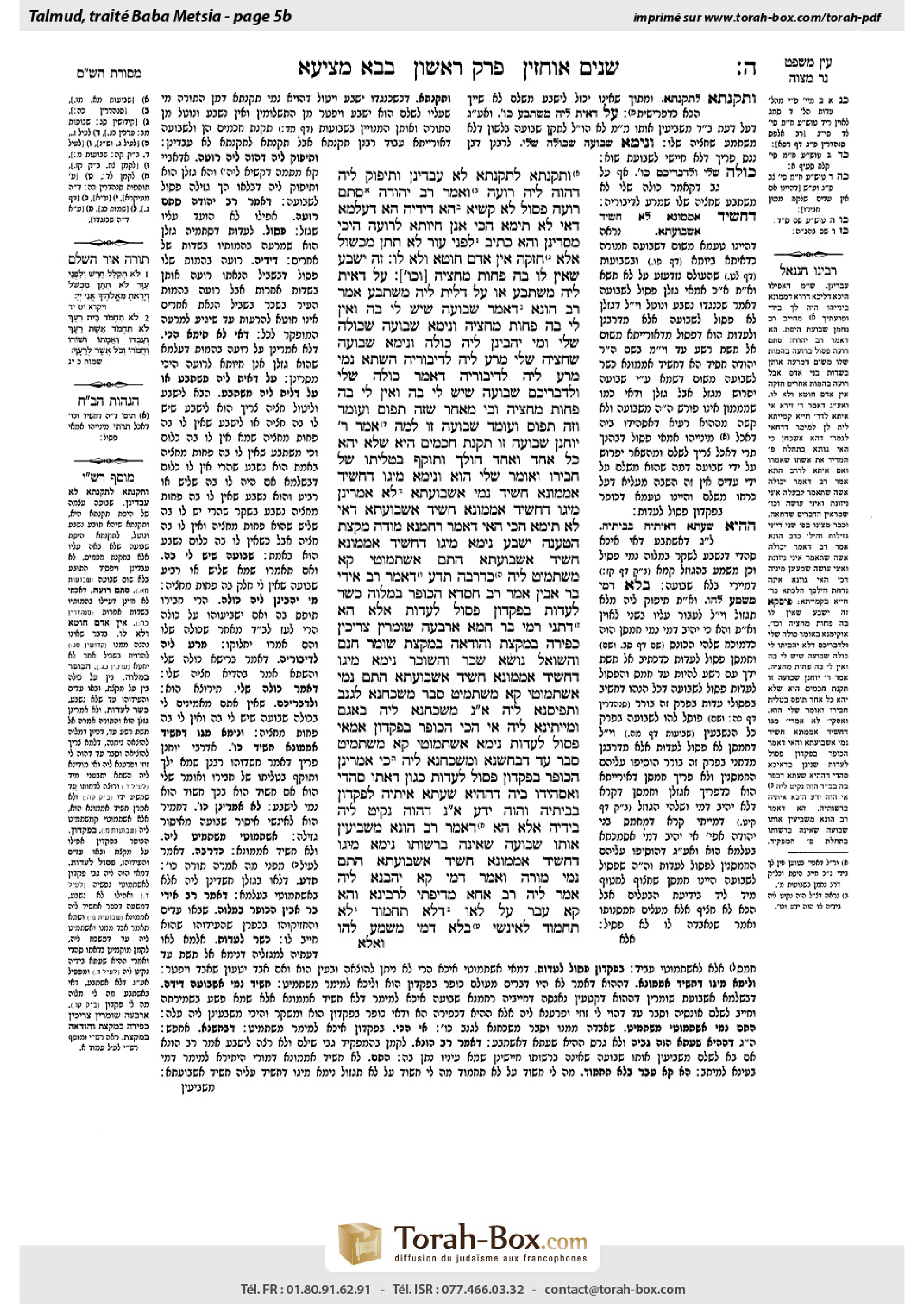
Bava Metzia 5b: Talmud study for Daf Yomi
Study the Talmud for Daf Yomi with scanned pages, Hebrew text, English translations from Sefaria and AI-generated French translations.
Passage selection and English or AI-generated French translation are available where the scan has annotations. Daf Study is independent of Torah-Box and Sefaria.
Browse Bava Metzia · בבא מציעא · All tractatesBava Metzia 5b text and translations
This page of Bava Metzia includes the Aramaic text, an English translation and an AI-generated French translation, alongside the scan above.
בבא מציעא ה׳ ב · Aramaic and Hebrew text
וְתַקַּנְתָּא לְתַקַּנְתָּא לָא עָבְדִינַן.
וְתִיפּוֹק לֵיהּ דְּהָוֵה לֵיהּ רוֹעֶה! וְאָמַר רַב יְהוּדָה: סְתָם רוֹעֶה פָּסוּל.
לָא קַשְׁיָא: הָא דִידֵיהּ, הָא דְּעָלְמָא. דְּאִי לָא תֵּימָא הָכִי, אֲנַן חֵיוָתָא לְרוֹעָה הֵיכִי מָסְרִינַן? וְהָא כְּתִיב: ״לִפְנֵי עִוֵּר לֹא תִתֵּן מִכְשֹׁל״! אֶלָּא חֲזָקָה: אֵין אָדָם חוֹטֵא וְלֹא לוֹ.
זֶה יִשָּׁבַע שֶׁאֵין לוֹ בָּהּ פָּחוֹת מֵחֶצְיָהּ [וְכוּ׳]. עַל דְּאִית לֵיהּ מִשְׁתְּבַע, אוֹ עַל דְּלֵית לֵיהּ מִשְׁתְּבַע! אָמַר רַב הוּנָא, דְּאָמַר: שְׁבוּעָה שֶׁיֵּשׁ לִי בָּהּ וְאֵין לִי בָּהּ פָּחוֹת מֵחֶצְיָהּ.
וְנֵימָא שְׁבוּעָה שֶׁכּוּלָּהּ שֶׁלִּי. וּמִי יָהֲבִינַן לֵיהּ כּוּלַּהּ?
וְנֵימָא שְׁבוּעָה שֶׁחֶצְיָהּ שֶׁלִּי – מַרַע לֵיהּ לְדִיבּוּרֵיהּ.
הַשְׁתָּא נָמֵי מַרַע לֵיהּ לְדִיבּוּרֵיהּ. דְּאָמַר: כּוּלָּהּ שֶׁלִּי, וּלְדִבְרֵיכֶם – שְׁבוּעָה שֶׁיֵּשׁ לִי בָּהּ וְאֵין לִי בָּהּ פָּחוֹת מֵחֶצְיָהּ.
וְכִי מֵאַחַר שֶׁזֶּה תָּפוּס וְעוֹמֵד וְזֶה תָּפוּס וְעוֹמֵד, שְׁבוּעָה זוֹ לָמָּה? אָמַר רַבִּי יוֹחָנָן: שְׁבוּעָה זוֹ תַּקָּנַת חֲכָמִים הִיא, שֶׁלֹּא יְהֵא כׇּל אֶחָד וְאֶחָד הוֹלֵךְ וְתוֹקֵף בְּטַלִּיתוֹ שֶׁל חֲבֵירוֹ וְאוֹמֵר: ״שֶׁלִּי הוּא״.
וְנֵימָא מִיגּוֹ דַּחֲשִׁיד אַמָּמוֹנָא חֲשִׁיד נָמֵי אַשְּׁבוּעָתָא?
לָא אָמְרִינַן מִיגּוֹ דַּחֲשִׁיד אַמָּמוֹנָא חֲשִׁיד אַשְּׁבוּעָתָא. דְּאִי לָא תֵּימָא הָכִי, הַאי דְּאָמַר רַחֲמָנָא מוֹדֶה מִקְצָת הַטַּעֲנָה יִשָּׁבַע, נֵימָא מִיגּוֹ דַּחֲשִׁיד אַמָּמוֹנָא חֲשִׁיד אַשְּׁבוּעָתָא.
הָתָם אִשְׁתְּמוֹטֵי קָא מִשְׁתְּמִיט לֵיהּ, כִּדְרַבָּה.
תִּדַּע דְּאָמַר רַב אִידִי בַּר אָבִין אָמַר רַב חִסְדָּא: הַכּוֹפֵר בְּמִלְוֶה – כָּשֵׁר לְעֵדוּת. בְּפִיקָּדוֹן – פָּסוּל לְעֵדוּת.
אֶלָּא הָא דְּתָנֵי רָמֵי בַּר חָמָא: אַרְבָּעָה שׁוֹמְרִין צְרִיכִין כְּפִירָה בְּמִקְצָת וְהוֹדָאָה בְּמִקְצָת – שׁוֹמֵר חִנָּם וְהַשּׁוֹאֵל, נוֹשֵׂא שָׂכָר וְהַשּׂוֹכֵר, נֵימָא מִיגּוֹ דַּחֲשִׁיד אַמָּמוֹנָא חֲשִׁיד אַשְּׁבוּעָתָא!
הָתָם נָמֵי אִשְׁתְּמוֹטֵי קָא מִשְׁתְּמִיט. סָבַר: מַשְׁכַּחְנָא לְגַנָּב וְתָפֵיסְנָא לֵיהּ. אִי נָמֵי מַשְׁכַּחְנָא לֵיהּ בַּאֲגַם וּמַיְיתֵינָא לֵיהּ.
אִי הָכִי, הַכּוֹפֵר בְּפִקָּדוֹן אַמַּאי פָּסוּל לְעֵדוּת? נֵימָא: אִשְׁתְּמוֹטֵי קָא מִשְׁתְּמִיט, סָבַר עַד דְּבָחֵשְׁנָא וּמְשַׁכַּחְנָא לֵיהּ!
כִּי אָמְרִינַן הַכּוֹפֵר בְּפִקָּדוֹן פָּסוּל לְעֵדוּת, כְּגוֹן דְּאָתוּ סָהֲדֵי וְאַסְהִידוּ בֵּיהּ דְּהָהִיא שַׁעְתָּא אִיתֵיהּ לְפִקָּדוֹן בְּבֵיתֵיהּ וַהֲוָה יָדַע, אִי נָמֵי דַּהֲוָה נָקֵיט לֵיהּ בִּידֵיהּ.
אֶלָּא הָא דְּאָמַר רַב הוּנָא, מַשְׁבִּיעִין אוֹתוֹ שְׁבוּעָה שֶׁאֵינָהּ בִּרְשׁוּתוֹ, נֵימָא מִיגּוֹ דַּחֲשִׁיד אַמָּמוֹנָא חֲשִׁיד אַשְּׁבוּעָתָא!
הָתָם נָמֵי, מוֹרֶה וְאָמַר: דְּמֵי קָא יָהֵבְנָא לֵיהּ.
אֲמַר לֵיהּ רַב אַחָא מִדִּיפְתִּי לְרָבִינָא: וְהָא קָא עָבַר עַל לָאו דְּ״לֹא תַּחְמֹד״?
״לֹא תַּחְמֹד״ לְאִינָשֵׁי בְּלָא דְּמֵי מַשְׁמַע לְהוּ.
Bava Metzia 5b · English translation
Likewise, the halakha that if the defendant is suspect with regard to taking a false oath the plaintiff takes the oath and collects the money is also a rabbinic ordinance, and we do not institute one rabbinic ordinance upon another rabbinic ordinance. Therefore no oath is administered.
The reason cited for the lack of credibility of the oath of the shepherd is that he is guilty of robbery. The Gemara asks: But why not let Rabbi Zeira derive that he is disqualified from testifying or taking an oath because he is a shepherd; and Rav Yehuda says that an ordinary shepherd is disqualified from testifying? A shepherd is presumed to be a robber since shepherds allow the animals under their care to graze in the fields of other people.
The Gemara rejects this: This is not difficult. That case, where he is presumed a robber, is a case where he herds his own animals, and this case, where he is not presumed a robber, is a case where he herds animals that belong to others. As if you do not say so, if even one who herds the animals of others is presumably a robber, how do we give our animals to a shepherd? Isn’t it written: “Do not put a stumbling block before the blind” (Leviticus 19:14)? It is prohibited to cause others to commit a transgression. Rather, there is a presumption that a person sins only for his own benefit, and one would not commit robbery for the benefit of animals that are not his.
§ The mishna teaches: This one takes an oath that he does not have ownership of less than half of it, and that one takes an oath that he does not have ownership of less than half of it, and they divide it. The Gemara asks: Does he take an oath with regard to the part that he has in his grasp, taking an oath that it is his, or does he take an oath with regard to the part that he does not have, i.e., that he does not have a claim to less than half of it? The latter wording of the oath is problematic, as he may mean that he does not have a claim to the garment at all. Rav Huna said: He must take an oath in which he says: I hereby take an oath that I have a claim to it, and I hereby take an oath that I do not have a claim to less than half of it.
The Gemara asks: But let him say: I hereby take an oath that all of it is mine, as that is his claim. Why does he take an oath that merely half of it belongs to him? The Gemara answers: And would we give him all of it if he took such an oath? Since he will not be awarded the entire garment, it would be inappropriate for the court to administer to him an oath that he owns all of it.
The Gemara asks: But let him say: I hereby take an oath that half of it is mine. Why is the complicated formulation suggested by Rav Huna necessary? The Gemara answers: If he takes an oath to that effect he compromises his initial statement, i.e., his claim that the entire garment is his.
The Gemara challenges: Now too, when he takes an oath according to Rav Huna’s formulation, he compromises his initial statement, as he takes an oath only with regard to his claim to half the garment. The Gemara answers: This is not so, as he makes the following statement to the court: All of it is mine; but according to your statement, I hereby take an oath that I have a claim to it and I do not have a claim to less than half of it.
§ The Gemara questions the requirement that the litigants take an oath at all: But since this one is standing with half the item in his grasp and that one is standing with half the item in his grasp, and each party ultimately receives what is in his grasp, why is this oath necessary? Rabbi Yoḥanan says: This oath is an ordinance instituted by the Sages so that everyone will not go and seize the garment of another and say: It is mine.
The Gemara asks: But let us say that since he is suspect with regard to financial dishonesty, i.e., stealing another’s property and lying in court that it belongs to him, he is also suspect with regard to taking an oath, and his oath cannot be accepted.
The Gemara answers: In principle, we do not say that since one is suspect with regard to financial dishonesty he is suspect with regard to taking an oath. This is because even one who steals property is presumed to consider taking a false oath more severe. As if you do not say so, then with regard to that which the Merciful One states, that one who admits to part of the claim must take an oath, let us also say that his oath cannot be accepted, as since he is suspect with regard to financial dishonesty he is suspect with regard to taking an oath.
The Gemara rejects this proof: There, the debtor is presumably evading the creditor temporarily, in accordance with the explanation of Rabba that the debtor really intends to repay the entire debt, and the reason that he admits to owing only part of it is because he wants to buy time until he can afford to repay the entire debt.
The Gemara adds: Know that this distinction is correct, as Rav Idi bar Avin says that Rav Ḥisda says: One who denies a claim that he received a loan and is contradicted by witnesses is fit to bear witness in a different case. By contrast, if one denies receiving a deposit and witnesses testify that he is lying, he is disqualified from bearing witness in other cases. The reason for this distinction is that since money is borrowed to be spent, the assumption is that the debtor did so, and his denial is merely an attempt to buy time until he can repay the debt. A deposited item, by contrast, may not be used by the bailee, so if he denies having received the deposit he presumably stole it. Therefore, he is disqualified from bearing witness. This demonstrates the distinction between lying in court about a debt and lying about property.
The Gemara asks: But if one who denies having received a deposit is considered a robber, this is contradicted by that baraita that Rami bar Ḥama teaches: All four types of bailees mentioned in the Torah require denial of part of the claim and admission of part of the claim in order to be liable to take an oath: These four are an unpaid bailee, and a borrower; a paid bailee, and a renter. Since a bailee has no need to buy time, let us say that the court cannot administer an oath to the bailee, as since he is suspect with regard to financial dishonesty he is suspect with regard to taking an oath as well.
The Gemara answers: There too, in the case of a bailee, it is conceivable that the bailee is not a robber; rather, the deposit was stolen and the bailee is evading the depositor temporarily, thinking: If I have enough time I will find the thief and seize the deposit and return it. Alternatively, if the deposit was lost, the bailee is thinking: I will find the deposit in the marsh and I will bring it back to him. Therefore, he is not considered a robber but merely one seeking to buy time.
The Gemara asks: If so, then why is one who denies receiving a deposit disqualified from bearing witness? Let us say in that case too, that he is evading the depositor, thinking: I will buy time until I search and find the item.
The Gemara answers: In an ordinary case, one who denies receiving a deposit is not disqualified from testifying. When we say that one who denies receiving a deposit is disqualified from bearing witness, it is with regard to a case where witnesses came and testified against him that at that time, when he denied the owner’s claim in court, the deposit was in his house and he knew that it was there. Alternatively, it is with regard to a case where he was holding the item in his hand. In those circumstances, it is obvious that he was not buying time, but rather he intended to keep the item.
The Gemara asks: But if one who is suspected of financial dishonesty cannot be administered an oath, that which Rav Huna says with regard to the halakhot of bailees is difficult, as Rav Huna says that if a bailee did not return the deposit, claiming that it was lost or stolen, and says that he is prepared to pay for it, the judges nevertheless administer an oath to him that the item is not in his possession. Let us say that since he is suspected of financial dishonesty, he is suspect with regard to taking an oath as well.
The Gemara answers: There too, the bailee is not suspected of outright robbery, as even if he took the deposited item for himself, he could rationalize his behavior, saying to himself: Since I gave him money for the item, I did nothing wrong. Therefore, his oath is deemed credible and an oath can be administered to him.
Rav Aḥa of Difti said to Ravina: But by paying for the deposit instead of returning it, doesn’t the bailee violate the prohibition of: “You shall not covet your neighbor’s wife, nor his slave, nor his maidservant, nor his ox, nor his donkey, nor anything that is your neighbor’s” (Exodus 20:14)? One transgresses this prohibition by taking an item from another by force or deceit, even if one pays for it.
The Gemara answers: The prohibition “You shall not covet” is understood by most people as referring to taking an item without paying money. Since the bailee may have been unaware that he was acting criminally, his testimony and his oath are deemed credible.
Bava Metzia 5b · Traduction française (IA)
De même, la halakha selon laquelle, si le défendeur est soupçonné d'avoir prêté serment faux, le plaignant prend le serment et récupère l'argent est également un ordonnance rabbinique, et nous ne faisons pas reposer une ordonnance rabbinique sur une autre ordonnance rabbinique. Par conséquent, aucun serment n'est administré.
La raison invoquée pour l'incrédibilité du serment du berger est qu'il est coupable de vol. La Guemara demande : Mais pourquoi ne pas permettre à Rabbi Zeira d'inférer qu'il est inéligible à témoigner ou à prendre un serment en raison de son statut de berger ; et Rav Yehuda dit que le berger ordinaire est inéligible à témoigner ? Le berger est supposé être un voleur, car les bergers permettent aux animaux sous leur garde de paître dans les champs des autres.
La Guemara rejette cette interprétation : Ce n'est pas difficile. Dans ce cas, où il est supposé être un voleur, il s'agit d'un cas où il garde ses propres animaux, et dans ce cas, où il n'est pas supposé être un voleur, il s'agit d'un cas où il garde des animaux appartenant à autrui. Si vous ne dites pas cela, si même celui qui garde les animaux d'autrui est supposé être un voleur, comment pouvons-nous confier nos animaux à un berger ? N'est-il pas écrit : « Ne placez pas un obstacle devant le boiteux » (Lévitique 19:14) ? Il est interdit de causer à autrui un péché. Plutôt, il y a une présomption selon laquelle une personne ne commet un péché que pour son propre bénéfice, et on ne commet pas de vol pour le bénéfice d'animaux qui ne sont pas les siens.
§ La mitsna enseigne : Celui-ci prend un serment qu'il ne possède pas moins de la moitié de cela, et celui-ci prend un serment qu'il ne possède pas moins de la moitié de cela, et ils divisent. La Guemara demande : Prend-il un serment concernant la part qu'il tient en main, affirmant qu'il s'agit de la sienne, ou prend-il un serment concernant la part qu'il ne possède pas, c'est-à-dire qu'il ne possède pas un droit à moins de la moitié de cela ? La formulation du serment mentionnée est problématique, car il pourrait signifier qu'il n'a aucun droit au vêtement. Rav Huna a dit : Il doit prendre un serment dans lequel il dit : Je prends ici un serment que j'ai un droit sur cela, et je prends ici un serment que je ne possède pas un droit à moins de la moitié de cela.
La Guemara demande : Mais laissez-le dire : Je prends ici un serment que tout cela m'appartient, car c'est sa revendication. Pourquoi prend-il un serment selon lequel seulement la moitié appartient à lui ? La Guemara répond : Et donnerions-nous tout cela à lui si il prenait un tel serment ? Puisque il ne sera pas récompensé pour l'ensemble du vêtement, il serait inapproprié que le tribunal administre à lui un serment affirmant qu'il possède tout cela.
La Guemara demande : Mais laissez-le dire : Je prends ici un serment que la moitié de cela m'appartient. Pourquoi la formulation complexe suggérée par Rav Huna est-elle nécessaire ? La Guemara répond : Si il prend un serment à cet effet, il compromet son déclaration initiale, c'est-à-dire sa revendication que le vêtement entier est à lui.
La Guemara conteste : Maintenant aussi, lorsqu'il prend un serment selon la formulation de Rav Huna, il compromet sa déclaration initiale, car il prend un serment uniquement concernant son droit à la moitié du vêtement. La Guemara répond : Ce n'est pas ainsi, car il déclare au tribunal : Tout cela m'appartient ; mais selon votre déclaration, je prends ici un serment que j'ai un droit sur cela et que je ne possède pas un droit à moins de la moitié de cela.
§ La Guemara questionne la nécessité que les parties prenantes prennent un serment : Mais puisque celui-ci est debout avec la moitié de l'objet en main et celui-ci est debout avec la moitié de l'objet en main, et que chaque partie finit par recevoir ce qu'il tient en main, pourquoi ce serment est-il nécessaire ? Rabbi Yoḥanan dit : Ce serment est une ordonnance instituée par les Sages afin que personne ne va pas s'emparer du vêtement d'autrui et dire : C'est à moi.
La Guemara demande : Mais laissez-nous dire que puisque il est soupçonné d'infidélité financière, c'est-à-dire de voler la propriété d'autrui et de mentir en cour qu'il appartient à lui, il est également soupçonné de prendre un serment, et son serment ne peut être accepté.
La Guemara répond : En principe, nous ne disons pas que puisque l'un est soupçonné d'infidélité financière il est soupçonné de prendre un serment. Cela est dû au fait que même celui qui vole des biens est supposé considérer que prendre un serment faux est plus grave. Car si vous ne dites pas cela, alors concernant ce que l'Éternel a dit, que celui qui admet une partie de la revendication doit prendre un serment, disons aussi que son serment ne peut être accepté, car puisque il est soupçonné d'infidélité financière il est soupçonné de prendre un serment.
La Guemara rejette cette preuve : Là, le débiteur est supposé échapper temporairement au créancier, selon l'explication de Rabba que le débiteur veut vraiment rembourser la totalité de la dette, et la raison pour laquelle il admet d'ôter seulement une partie est qu'il veut gagner du temps jusqu'à ce qu'il puisse rembourser la totalité.
La Guemara ajoute : Sachez que cette distinction est correcte, car Rav Idi bar Avin dit que Rav Ḥisda dit : Celui qui nie une revendication qu'il a reçu un prêt et est contredit par des témoins est digne de témoigner dans un autre cas. En revanche, si l'on nie avoir reçu un dépôt et que des témoins témoignent qu'il ment, il est disqualifié de témoigner dans d'autres cas. La raison de cette distinction est que puisque l'argent est prêté pour être dépensé, on suppose que le débiteur l'a fait, et sa négation est simplement un effort pour gagner du temps jusqu'à ce qu'il puisse rembourser la dette. Un objet déposé, en revanche, ne peut pas être utilisé par le dépositaire, donc si il nie avoir reçu le dépôt, on suppose qu'il l'a volé. Par conséquent, il est disqualifié de témoigner. Cela démontre la distinction entre mentir en cour concernant une dette et mentir concernant une propriété.
Le Guemara pose la question : Mais si celui qui nie avoir reçu un dépôt est considéré comme un voleur, cela est contredit par cette baraïta que Rami bar Ḥama enseigne : Les quatre types de dépositaires mentionnés dans la Torah exigent de nier une partie de la réclamation et d'admettre une partie de la réclamation afin d'être tenus responsables de prendre un serment : Ces quatre sont un dépositaire non rémunéré, et un emprunteur ; un dépositaire rémunéré, et un locataire. Puisque le dépositaire n'a pas besoin d'acheter du temps, disons que le tribunal ne peut administrer un serment au dépositaire, car, étant suspect en matière de fraude financière, il est suspect également en matière de prendre un serment.
Le Guemara répond : De même, dans le cas du dépositaire, il est concevable que le dépositaire ne soit pas un voleur ; plutôt, le dépôt a été volé et le dépositaire échappe temporairement au déposant, pensant : Si j'ai assez de temps, je trouverai le voleur et je récupérerai le dépôt et je le rendrai. Alternativement, si le dépôt a été perdu, le dépositaire pense : Je trouverai le dépôt dans la marais et je le ramènerai à lui. Ainsi, il n'est pas considéré comme un voleur mais simplement quelqu'un cherchant à acheter du temps.
Le Guemara pose la question : Si c'est ainsi, alors pourquoi celui qui nie avoir reçu un dépôt est-il disqualifié pour témoigner ? Disons que dans ce cas également, il échappe au déposant, pensant : Je vais acheter du temps jusqu'à ce que je cherche et trouve l'objet.
Le Guemara répond : Dans un cas ordinaire, celui qui nie avoir reçu un dépôt n'est pas disqualifié pour témoigner. Lorsque nous disons que celui qui nie avoir reçu un dépôt est disqualifié pour témoigner, c'est dans le cas où des témoins sont venus témoigner contre lui et ont affirmé que, lorsqu'il a nié la réclamation du propriétaire devant le tribunal, le dépôt était chez lui et qu'il savait qu'il y était. Alternativement, c'est dans le cas où il tenait l'objet dans sa main. Dans ces circonstances, il est évident qu'il ne cherchait pas à acheter du temps, mais qu'il avait l'intention de garder l'objet.
Le Guemara pose la question : Mais si celui qui est suspect de fraude financière ne peut pas être administré un serment, cela pose un problème avec ce que Rav Huna dit concernant les halakhot des dépositaires, car Rav Huna dit que si un dépositaire n'a pas rendu le dépôt, affirmant qu'il l'avait perdu ou volé, et dit qu'il est prêt à le payer, les juges administrent tout de même un serment à lui affirmant que l'objet n'est pas en son possession. Disons que, puisque il est suspect de fraude financière, il est suspect également en matière de prendre un serment.
Le Guemara répond : De même, le dépositaire n'est pas suspect d'ouverture de vol, car même s'il a pris l'objet déposé pour lui, il peut justifier son comportement en disant à lui-même : Puisque j'ai donné de l'argent pour l'objet, je n'ai rien fait de mal. Ainsi, son serment est considéré comme crédible et un serment peut être administré à lui.
Rav Aḥa de Difti dit à Ravina : Mais en payant pour le dépôt au lieu de le rendre, ne viole-t-il pas la prohibition de : « Tu ne convoiteras pas la femme de ton prochain, ni son serviteur, ni sa servante, ni son bœuf, ni son âne, ni toute chose de ton prochain » (Exode 20:14) ? On transgresse cette prohibition en prenant un objet d'un autre par la force ou la tromperie, même si l'on paie pour cela.
Le Guemara répond : La prohibition « Tu ne convoiteras pas » est généralement comprise par la plupart des gens comme se référant à prendre un objet sans payer de l'argent. Puisque le dépositaire pouvait être ignorant du fait qu'il agissait illégalement, son témoignage et son serment sont considérés comme crédibles.
Traduction française générée par IA à partir de l’édition anglaise de Sefaria. Vérifie toujours un passage avec le texte source.
Text from Sefaria: William Davidson Edition - Vocalized Aramaic (CC BY NC); William Davidson Edition - English (CC BY NC).