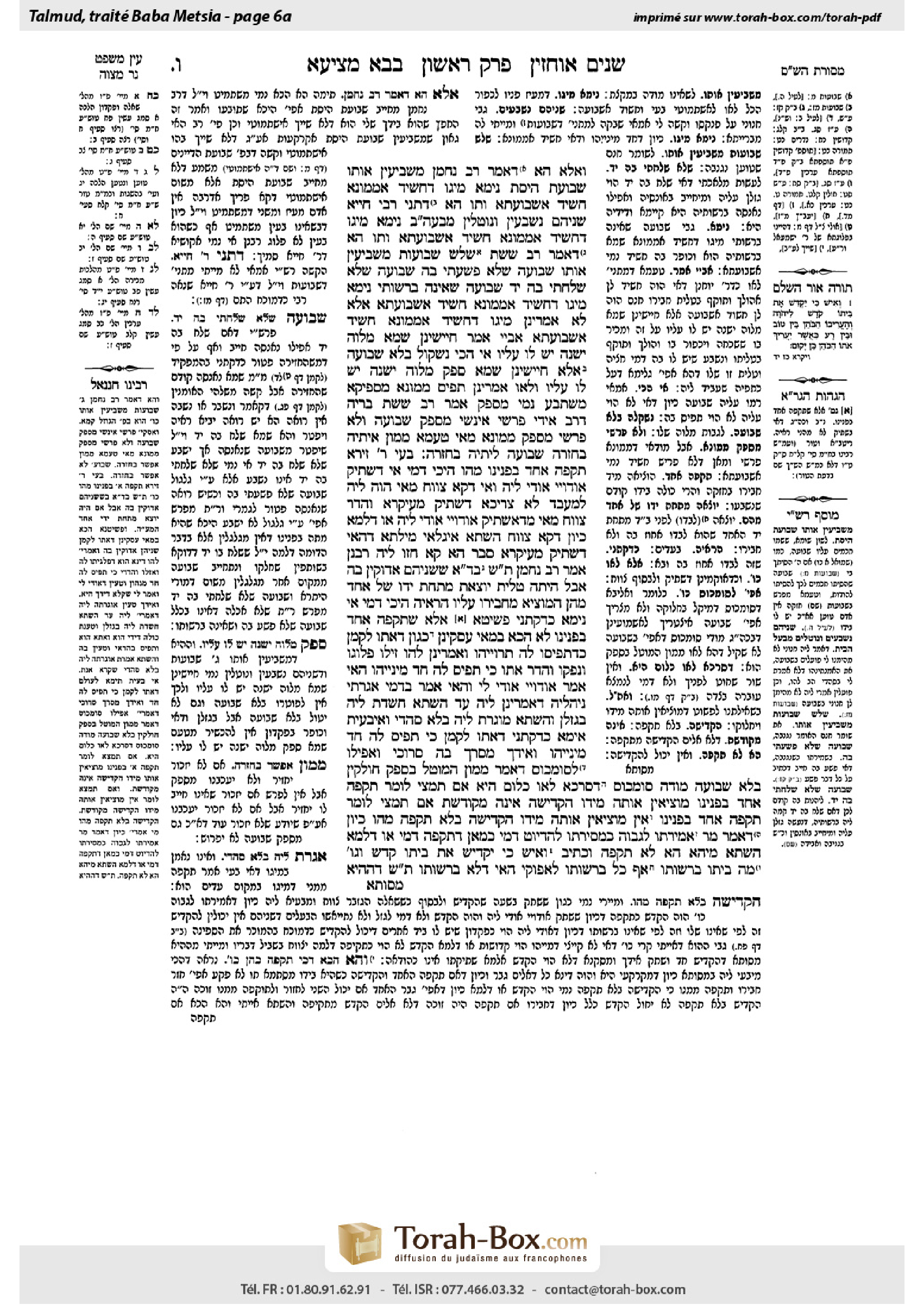
Bava Metzia 6a: Talmud study for Daf Yomi
Study the Talmud for Daf Yomi with scanned pages, Hebrew text, English translations from Sefaria and AI-generated French translations.
Passage selection and English or AI-generated French translation are available where the scan has annotations. Daf Study is independent of Torah-Box and Sefaria.
Browse Bava Metzia · בבא מציעא · All tractatesBava Metzia 6a text and translations
This page of Bava Metzia includes the Aramaic text, an English translation and an AI-generated French translation, alongside the scan above.
בבא מציעא ו׳ א · Aramaic and Hebrew text
וְאֶלָּא הָא דְּאָמַר רַב נַחְמָן מַשְׁבִּיעִין אוֹתוֹ שְׁבוּעַת הֶיסֵּת, נֵימָא מִיגּוֹ דַּחֲשִׁיד אַמָּמוֹנָא חֲשִׁיד אַשְּׁבוּעָתָא.
וְתוּ הָא דְתָנֵי רַבִּי חִיָּיא: שְׁנֵיהֶם נִשְׁבָּעִין וְנוֹטְלִין מִבַּעַל הַבַּיִת, נֵימָא מִיגּוֹ דַּחֲשִׁיד אַמָּמוֹנָא חֲשִׁיד אַשְּׁבוּעָתָא.
וְתוּ הָא דְּאָמַר רַב שֵׁשֶׁת, שָׁלֹשׁ שָׁבוּעוֹת מַשְׁבִּיעִין אוֹתוֹ: שְׁבוּעָה שֶׁלֹּא פָּשַׁעְתִּי בָּהּ, שְׁבוּעָה שֶׁלֹּא שָׁלַחְתִּי בָּהּ יָד, שְׁבוּעָה שֶׁאֵינָהּ בִּרְשׁוּתִי. נֵימָא: מִיגּוֹ דַּחֲשִׁיד אַמָּמוֹנָא חֲשִׁיד אַשְּׁבוּעָתָא.
אֶלָּא לָא אָמְרִינַן מִיגּוֹ דַּחֲשִׁיד אַמָּמוֹנָא חֲשִׁיד אַשְּׁבוּעָתָא.
אַבָּיֵי אָמַר: חָיְישִׁינַן שֶׁמָּא מִלְוֶה יְשָׁנָה יֵשׁ לוֹ עָלָיו.
אִי הָכִי נִשְׁקוֹל בְּלָא שְׁבוּעָה!
אֶלָּא חָיְישִׁינַן שֶׁמָּא סְפֵק מִלְוֶה יְשָׁנָה יֵשׁ לוֹ עָלָיו.
וְלָאו אָמְרִינַן תָּפֵיס מָמוֹנָא מִסְּפֵיקָא? מִשְׁתְּבַע נָמֵי מִסָּפֵק!
אָמַר רַב שֵׁשֶׁת בְּרֵיהּ דְּרַב אִידִי: פָּרְשִׁי אִינָשֵׁי מִסְּפֵק שְׁבוּעָה וְלָא פָּרְשִׁי מִסְּפֵק מָמוֹנָא. מַאי טַעְמָא? מָמוֹן אִיתֵיהּ בַּחֲזָרָה, שְׁבוּעָה לֵיתֵיהּ בַּחֲזָרָה.
בָּעֵי רַבִּי זֵירָא: תְּקָפָהּ אֶחָד בְּפָנֵינוּ, מַהוּ?
הֵיכִי דָמֵי? אִי דְּשָׁתֵיק, אוֹדוֹיֵי אוֹדִי לֵיהּ. וְאִי דְּקָא צָוַוח, מַאי הֲוָה לֵיהּ לְמֶעְבַּד?
לָא צְרִיכָא דִּשְׁתֵיק מֵעִיקָּרָא וַהֲדַר צָוַוח, מַאי? מִדְּאִשְׁתִּיק – אוֹדוֹיֵי אוֹדִי לֵיהּ, אוֹ דִלְמָא: כֵּיוָן דְּקָא צָוַוח הַשְׁתָּא אִיגַּלַּאי מִילְּתָא דְּהַאי דִּשְׁתֵיק מֵעִיקָּרָא, סָבַר: הָא קָא חָזוּ לֵיהּ רַבָּנַן.
אָמַר רַב נַחְמָן, תָּא שְׁמַע: בַּמֶּה דְּבָרִים אֲמוּרִים שֶׁשְּׁנֵיהֶם אֲדוּקִין בָּהּ, אֲבָל הָיְתָה טַלִּית יוֹצֵאת מִתַּחַת יָדוֹ שֶׁל אֶחָד מֵהֶן, הַמּוֹצִיא מֵחֲבֵירוֹ עָלָיו הָרְאָיָה. הֵיכִי דָמֵי? אִי נֵימָא כִּדְקָתָנֵי, פְּשִׁיטָא! אֶלָּא שֶׁתְּקָפָהּ אֶחָד בְּפָנֵינוּ.
לָא, הָכָא בְּמַאי עָסְקִינַן – כְּגוֹן דְּאָתוּ לְקַמַּן כְּדִתְפִיסוּ לַהּ תַּרְוַיְיהוּ, וְאָמְרִינַן לְהוּ: זִילוּ פְּלוּגוּ, וּנְפַקוּ, וַהֲדַר אֲתוֹ כִּי תָּפֵיס לַהּ חַד מִינַּיְיהוּ, הַאי אֲמַר: אוֹדוֹיֵי אוֹדִי לִי. וְהַאי אֲמַר: בִּדְמֵי אֹגַרְתִּי נִיהֲלֵיהּ, דְּאָמְרִינַן לֵיהּ: עַד הַשְׁתָּא חָשְׁדַתְּ לֵיהּ בְּגַזְלָן, וְהַשְׁתָּא מוֹגְרַת לֵיהּ בְּלָא סָהֲדִי.
וְאִיבָּעֵית אֵימָא, כִּדְקָתָנֵי: דְּאָתוּ לְקַמַּן כִּי תָּפֵיס לַהּ חַד מִינַּיְיהוּ, וְאִידַּךְ מְסָרֵךְ בָּהּ סָרוֹכֵי, וַאֲפִילּוּ לְסוֹמְכוֹס דְּאָמַר מָמוֹן הַמּוּטָּל בְּסָפֵק חוֹלְקִין בְּלֹא שְׁבוּעָה, מוֹדֶה סוֹמְכוֹס דְּסִרְכָא לָאו כְּלוּם הִיא.
אִם תִּמְצֵי לוֹמַר תְּקָפָהּ אֶחָד בְּפָנֵינוּ מוֹצִיאִין אוֹתָהּ מִיָּדוֹ, הִקְדִּישָׁה – אֵינָהּ מְקוּדֶּשֶׁת. אִם תִּמְצֵי לוֹמַר תְּקָפָהּ אֶחָד בְּפָנֵינוּ אֵין מוֹצִיאִין אוֹתָהּ מִיָּדוֹ, הִקְדִּישָׁהּ בְּלֹא תְּקָפָהּ – מַהוּ?
כֵּיוָן דְּאָמַר מָר: אֲמִירָתוֹ לַגָּבוֹהַּ כִּמְסִירָתוֹ לַהֶדְיוֹט דָּמֵי. כְּמַאן דְּתַקְפַהּ דָּמֵי.
אוֹ דִלְמָא: הַשְׁתָּא מִיהָא הָא לָא תַּקְפַהּ, וּכְתִיב: ״וְאִישׁ כִּי יַקְדִּישׁ אֶת בֵּיתוֹ קֹדֶשׁ וְגוֹ׳״, מָה בֵּיתוֹ בִּרְשׁוּתוֹ – אַף כֹּל בִּרְשׁוּתוֹ, לְאַפּוֹקֵי הַאי דְּלֹא בִּרְשׁוּתוֹ.
תָּא שְׁמַע: דְּהָהִיא
Bava Metzia 6a · English translation
The Gemara asks: But if one who is suspected of theft cannot be administered an oath, that which Rav Naḥman says, that when a person denies a debt entirely the judges administer an oath of inducement to him, is difficult. Let us say that since he is suspect with regard to financial dishonesty, he is suspect with regard to taking an oath.
And furthermore, that which Rabbi Ḥiyya teaches in a baraita with regard to the case of the storekeeper and the laborer (see 3a), that both parties take an oath and take payment from the employer, is also difficult. Let us say there, too, that since he is suspect with regard to financial dishonesty, he is suspect with regard to taking an oath.
And furthermore, with regard to that which Rav Sheshet says: The judges administer three oaths to an unpaid bailee who claims that the deposit with which he was entrusted was stolen: I hereby take an oath that I was not negligent in safeguarding it; I hereby take an oath that I did not misappropriate the deposit; and I hereby take an oath that it is no longer in my possession, there is the same difficulty. Since the court raises these suspicions against the bailee, let us say that since he is suspected of financial dishonesty, he is suspected with regard to taking an oath. How can the court administer these oaths?
Rather, the conclusion from all of the above is that we do not say that since one is suspected of financial dishonesty, he is suspected with regard to taking an oath.
Abaye said: There is no proof from the three halakhot cited above that an oath is administered to one who is suspect with regard to financial dishonesty, as it can be explained that the reason the oath is administered in these cases is that we suspect that perhaps the defendant has an old loan that he lent to the plaintiff, and he has been unable to get his money back. He is therefore withholding or claiming ownership of the item or money of the plaintiff as repayment of the loan and not as an act of outright robbery. Therefore, an oath is administered to him.
The Gemara asks: If so, why does he take an oath in these cases? Let him take the item or money without taking an oath, as perhaps he is withholding it as repayment for an old loan, in which case the oath will not determine the truth in the dispute at hand.
Rather, Abaye’s suggestion should be understood as follows: We suspect that perhaps he is uncertain as to whether he has an old loan that he lent to the plaintiff. The defendant is unsure whether the plaintiff owes him money and is withholding the item just in case.
The Gemara asks: But why don’t we say in this case that if the defendant is capable of seizing another person’s property due to an uncertain debt, he may also take an oath falsely due to that same uncertainty? How is the oath administered to him?
Rav Sheshet, son of Rav Idi, said: People refrain from taking an oath about which they are uncertain but do not refrain from seizing property about which they are uncertain. What is the reason for this? People reason that property can be returned, but an oath cannot be retracted. If it is proven that his seizure of the property was unjustified, the defendant can return it. By contrast, once he takes a false oath, there is no remedy for the situation. Therefore, one is more cautious when taking an oath than when seizing property.
§ Rabbi Zeira raises a dilemma: If two people together had a garment in their grasp and one of them seized it in its entirety from the grasp of the other in our presence, i.e., before the court, what is the halakha?
The Gemara asks: What are the circumstances? If the one from whom it was seized remained silent, his silence indicates that he admits to the one who seized it from him that he is the owner. And if he shouted in protest at the seizure, what more should he have done? The fact that the other person is stronger than him is irrelevant as far as determining legal ownership of the garment is concerned.
The Gemara explains: No, it is necessary to raise this dilemma in a case where he was silent initially, when the other litigant seized the garment, and he later shouted. What is the halakha? Is there an assumption that since he was initially silent, he admitted to the one who seized it from him that in seizing it the litigant became the owner, and it was only later that he regretted doing so and shouted? Or perhaps, since he is shouting now about the injustice that was done to him, the matter is revealed that the fact that he was silent initially was because he thought: The Rabbis of the court saw him grab it from me, so there is no need to cry out.
Rav Naḥman says: Come and hear a solution to the dilemma from what was taught in a baraita: In what case is this statement said that both of them take an oath and each receives half of the garment? It is said in a case where both of them are still holding the garment. But if the garment was in the possession of only one of them, the burden of proof rests upon the claimant, i.e., the one not holding the garment. In the absence of proof, the item remains in the possession of the one holding the garment. The Gemara asks: What are the circumstances of this case? If we say that it is to be understood as it is taught, it is obvious that one who claims an item that is in another’s possession must bring proof to support his claim. Rather, it must be referring to a case where one of them seized it in our presence, which is the case to which Rabbi Zeira referred.
The Gemara rejects this proof: No, it is possible that here we are dealing with a case where they came before us, the court, while both were holding the garment, and we said to them: Go divide the garment, and they left the court and afterward came back while one of them was holding it. This one, who was holding the garment, said: The other one admitted to me that I was justified in my claim. And that one, who was not holding the garment, said: I rented half of the garment to him for money and did not relinquish my right to it. In this case the latter person’s claim is not accepted, as we say to him: Until now you suspected him of being a robber, claiming that he took from you an item that you found, and now you rented it to him without witnesses? Therefore, the burden of proof rests upon the one who is not holding the garment.
And if you wish, say instead that it is possible to understand the case in the baraita as it is taught, i.e., they came before us while only one of them was holding the garment itself, but the other was hanging on to the edge of the garment. And the baraita teaches that even according to Sumakhos, who says that in a case of property of uncertain ownership the parties divide it without an oath, in this case Sumakhos concedes that hanging on to the edge is worth nothing. It does not render the ownership of the garment uncertain, and therefore the burden of proof rests upon the claimant, i.e., one who is hanging on to the edge.
Rabbi Zeira’s dilemma was not resolved, but the Gemara states a related halakha: If you say that if one seizes the garment in our presence the court removes it from his possession, then if either of the parties consecrated the entire garment to the Temple treasury, the consecration is not valid, as it is not his. But if you say that if one seizes the garment in our presence the court does not remove it from his possession, then if one of them consecrated the entire garment to the Temple treasury without seizing it, what is the halakha?
The two sides of this dilemma are as follows: Since the Master said a principle with regard to the halakhot of transactions that a declaration to the Most High is equivalent to a transfer to an ordinary person, i.e., verbal consecration of an item is equivalent to a formal act of acquisition in a non-sacred transaction, is the one who consecrated the garment therefore considered like one who seized it, and consequently the consecration takes effect?
Or perhaps the consecration does not take effect, as now, in any event, he did not actually seize the garment and it is not his? And it is written: “And when a man shall sanctify his house to be sacred unto God” (Leviticus 27:14), from which the Sages derive: Just as his house is in his possession, so too, anything that one wishes to consecrate must be in his possession, to the exclusion of this garment, which is not in his possession, as he did not actually seize it, and therefore the consecration does not take effect.
The Gemara attempts to answer the question: Come and hear proof from an incident that transpired, as there was a certain
Bava Metzia 6a · Traduction française (IA)
La Guemara pose la question : Mais si une personne soupçonnée de vol ne peut pas être soumise à un serment, ce que Rav Naḥman dit, à savoir que lorsqu'une personne nie totalement une dette, les juges soumettent un serment d'incitation à cette personne, est difficile. Disons que puisque cette personne est soupçonnée d'infidélité financière, elle est soupçonnée de prendre un serment.
Et de plus, ce que Rabbi Ḥiyya enseigne dans une baraïta concernant le cas du marchand et du travailleur (voir 3a), à savoir que les deux parties prennent un serment et reçoivent le paiement du patron, est également difficile. Disons, là encore, que puisque cette personne est soupçonnée d'infidélité financière, elle est soupçonnée de prendre un serment.
Et de plus, concernant ce que Rav Sheshet dit : Les juges soumettent trois serments à un dépositaire non payé qui affirme que le dépôt qu'il a été confié a été volé : Je prends serment que je n'ai pas négligé à le garder ; je prends serment que je n'ai pas détourné le dépôt ; et je prends serment qu'il n'est plus en mon possession, il y a la même difficulté. Puisque le tribunal suscite ces soupçons contre le dépositaire, disons que puisque cette personne est soupçonnée d'infidélité financière, elle est soupçonnée de prendre un serment. Comment peut-on soumettre ces serments ?
Plutôt, la conclusion de tout cela est que nous ne disons pas que puisque l'on soupçonne une personne d'infidélité financière, on la soupçonne de prendre un serment.
Abaye dit : Il n'y a pas de preuve dans les trois halakhot citées ci-dessus que l'on soumet un serment à une personne soupçonnée d'infidélité financière, car cela peut être expliqué par le fait que la raison pour laquelle un serment est soumis dans ces cas est que nous soupçonnons que le défendeur pourrait avoir un ancien prêt qu'il a prêté au plaignant, et qu'il n'a pas réussi à récupérer son argent. Il retient donc ou revendique l'objet ou l'argent du plaignant comme remboursement du prêt et non comme acte de vol pur et simple. Un serment est donc soumis à lui.
La Guemara pose la question : Si c'est ainsi, pourquoi soumet-on un serment dans ces cas ? Laissons-le prendre l'objet ou l'argent sans serment, car peut-être qu'il le retient comme remboursement d'un ancien prêt, dans ce cas le serment ne déterminera pas la vérité dans le litige en question.
Plutôt, la suggestion d'Abaye devrait être comprise ainsi : Nous soupçonnons qu'il puisse être incertain s'il a prêté à l'accusé un ancien prêt. Le défendeur est incertain s'il doit de l'argent à l'accusé et retient l'objet juste au cas où.
La Guemara pose la question : Mais pourquoi ne disons-nous pas dans ce cas que si le défendeur est capable de saisir la propriété d'une autre personne en raison d'une dette incertaine, il peut aussi prendre un serment à cause de cette même incertitude ? Comment est administré le serment à son égard ?
Rav Sheshet, fils de Rav Idi, dit : Les gens évitent de prendre un serment concernant une chose dont ils sont incertains, mais ne s'abstiennent pas de saisir une propriété concernant laquelle ils sont incertains. Quelle est la raison de cela ? Les gens pensent que la propriété peut être rendue, mais un serment ne peut pas être rétracté. Si on prouve que la saisie de la propriété était injustifiée, le défendeur peut la rendre. En revanche, une fois qu'il a pris un serment faux, il n'y a plus de remède. Par conséquent, on est plus prudent lorsqu'on prend un serment que lorsqu'on saisit une propriété.
§ Rabbi Zeira soulève un dilemme : Si deux personnes possédaient ensemble un vêtement et que l'une d'entre elles l'a entièrement saisi de l'autre devant nous, c'est-à-dire devant le tribunal, quelle est la halakha ?
La Guemara pose la question : Quelles sont les circonstances ? Si celui d'entre eux à qui le vêtement a été saisi reste muet, son silence indique qu'il admet à celui qui l'a saisi qu'il est le propriétaire. Et si il crie en protestant contre la saisie, qu'est-ce qu'il devrait encore faire ? Le fait que l'autre personne soit plus forte que lui n'a pas d'importance pour déterminer la propriété légale du vêtement.
La Guemara explique : Non, il est nécessaire de soulever ce dilemme dans un cas où il était silencieux initialement, lorsque l'autre partie litigante a saisi le vêtement, et qu'il a ensuite crié. Quelle est la halakha ? Est-ce qu'on suppose que puisque d'abord il était silencieux, il a admis à celui qui l'a saisi qu'en le saisissant, la partie litigante est devenue propriétaire, et qu'il a seulement ensuite regretté et crié ? Ou bien, puisque maintenant il crie sur l'injustice faite à lui, la situation est révélée que le fait qu'il était silencieux initialement était parce qu'il pensait : Les Rabbins du tribunal ont vu qu'il l'a saisi de moi, donc il n'y a pas besoin de crier.
Rav Naḥman dit : Approchez-vous et écoutez une solution à ce dilemme à partir de ce qui a été enseigné dans une baraïta : Dans quel cas cette déclaration est-elle dite, à savoir que les deux prennent un serment et que chacun reçoit la moitié du vêtement ? C'est dit dans un cas où les deux d'entre eux tiennent encore le vêtement. Mais si le vêtement était en possession de l'un d'entre eux seulement, la charge de la preuve incombe au plaignant, c'est-à-dire à celui qui ne tient pas le vêtement. En l'absence de preuve, l'objet reste en possession de celui qui le tient. La Guemara pose la question : Quelles sont les circonstances de ce cas ? Si nous disons qu'il faut le comprendre comme il est enseigné, il est évident que celui qui affirme un objet en possession d'une autre personne doit apporter une preuve pour soutenir sa revendication. Plutôt, cela doit se référer à un cas où l'un d'eux l'a saisi devant nous, ce qui est le cas auquel Rabbi Zeira faisait référence.
La Guemara rejette cette preuve : Non, il est possible que nous ayons affaire ici à un cas où les deux parties sont entrées devant nous, le tribunal, tout en tenant le vêtement, et nous avons dit à eux : Allez diviser le vêtement, et ils sont sortis du tribunal et sont revenus plus tard, l'un d'eux tenant le vêtement. Celui qui tenait le vêtement a dit : L'autre m'a avoué que mon réclamation était justifiée. Et celui qui ne tenait pas le vêtement a dit : J'ai loué la moitié du vêtement à lui contre de l'argent et n'ai pas renoncé à mon droit sur celui-ci. Dans ce cas, la réclamation de celui-ci n'est pas acceptée, car nous disons à lui : Jusqu'à présent, vous soupçonniez qu'il était voleur, affirmant qu'il avait pris un objet que vous aviez trouvé, et maintenant vous l'avez loué sans témoins ? Ainsi, la charge de la preuve incombe à celui qui ne tient pas le vêtement.
Et si vous le souhaitez, dites plutôt qu'il est possible de comprendre le cas dans la baraïta comme il est enseigné, c'est-à-dire qu'ils sont entrés devant nous tout en tenant seulement le vêtement lui-même, mais l'autre tenait l'extrémité du vêtement. Et la baraïta enseigne que même selon Sumakhos, qui dit qu'en cas de propriété incertaine, les parties divisent sans serment, dans ce cas Sumakhos reconnaît que tenir l'extrémité est sans valeur. Cela ne rend pas la propriété du vêtement incertaine, et par conséquent, la charge de la preuve incombe au réclamant, c'est-à-dire celui qui tient l'extrémité.
La difficulté de Rabbi Zeira n'a pas été résolue, mais la Guemara énonce une halakha liée : Si vous dites que si l'un saisit le vêtement devant nous, le tribunal le retire de sa possession, alors si l'un des parties a consacré l'ensemble du vêtement au trésor du Temple, la consécration n'est pas valide, car il ne le possède pas. Mais si vous dites que si l'un saisit le vêtement devant nous, le tribunal ne le retire pas de sa possession, alors si l'un d'eux a consacré l'ensemble du vêtement au trésor du Temple sans le saisir, quelle est la halakha ?
Les deux côtés de cette difficulté sont les suivants : Puisque le Maître a dit un principe concernant les halakhot des transactions, à savoir que la déclaration à l'Éternel est équivalente à un transfert à un individu ordinaire, c'est-à-dire que la consécration verbale d'un objet est équivalente à un acte formel d'acquisition dans une transaction non sacrée, est-ce que celui qui a consacré le vêtement est donc considéré comme celui qui l'a saisi, et par conséquent, la consécration prend effet ?
Ou peut-être la consécration ne prend pas effet, car maintenant, en tout cas, il n'a pas réellement saisi le vêtement et il ne le possède pas ? Et il est écrit : « Et lorsqu'un homme sanctifiera sa maison pour être sainte à l'Éternel » (Lévitique 27:14), d'où les Sages dérivent : Comme sa maison est en son possession, ainsi aussi tout ce qu'un homme souhaite consacrer doit être en sa possession, à l'exclusion de ce vêtement, qui n'est pas en sa possession, car il n'a pas réellement saisi, et par conséquent, la consécration ne prend pas effet.
La Guemara tente de répondre à la question : Venez écouter la preuve d'un incident qui s'est produit, car il y avait un certain
Traduction française générée par IA à partir de l’édition anglaise de Sefaria. Vérifie toujours un passage avec le texte source.
Text from Sefaria: William Davidson Edition - Vocalized Aramaic (CC BY NC); William Davidson Edition - English (CC BY NC).