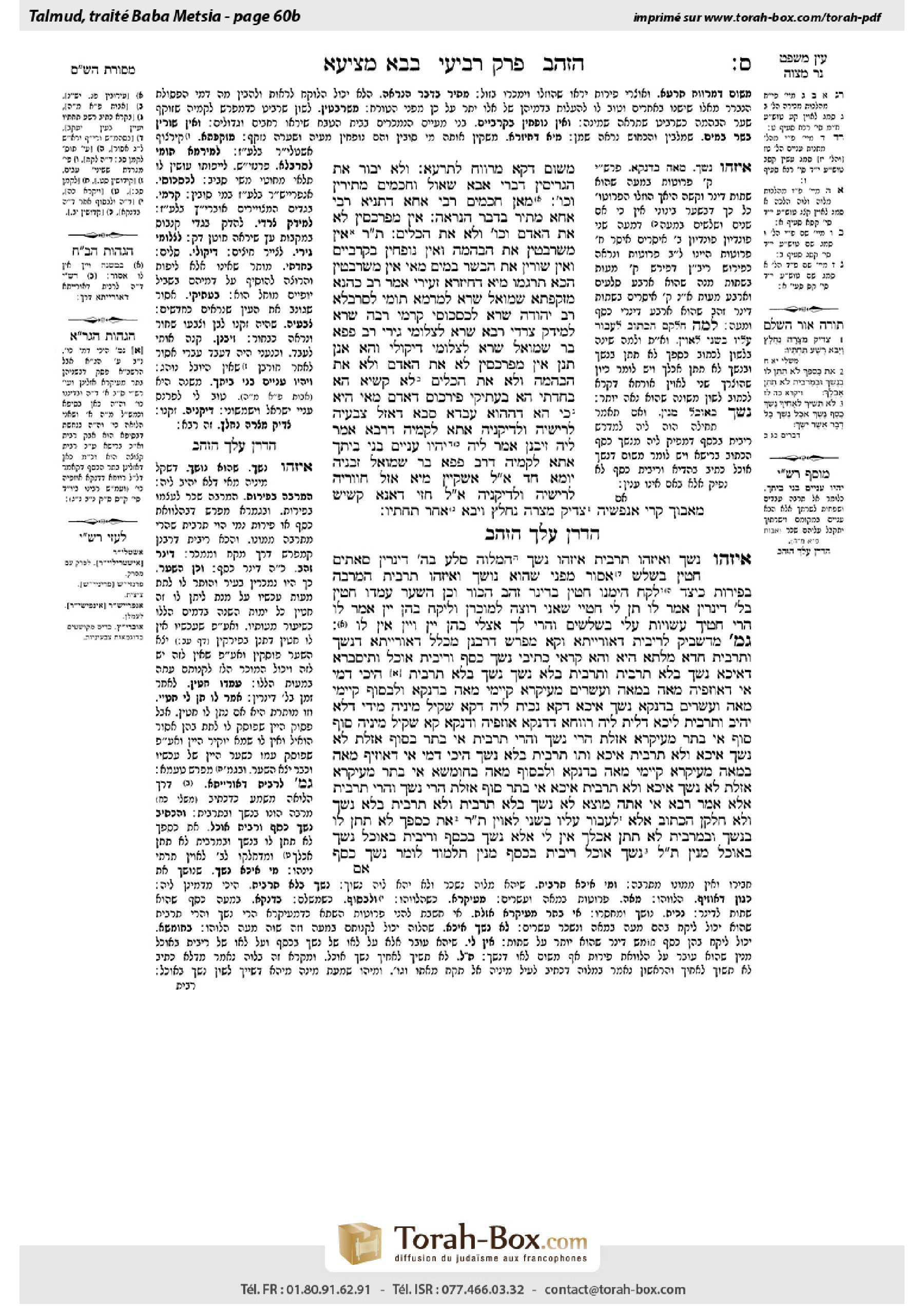
Bava Metzia 60b: Talmud study for Daf Yomi
Study the Talmud for Daf Yomi with scanned pages, Hebrew text, English translations from Sefaria and AI-generated French translations.
Passage selection and English or AI-generated French translation are available where the scan has annotations. Daf Study is independent of Torah-Box and Sefaria.
Browse Bava Metzia · בבא מציעא · All tractatesBava Metzia 60b text and translations
This page of Bava Metzia includes the Aramaic text, an English translation and an AI-generated French translation, alongside the scan above.
בבא מציעא ס׳ ב · Aramaic and Hebrew text
מִשּׁוּם דְּקָא מַרְוַוח לְתַרְעָא:
וְלֹא יָבוֹר אֶת הַגְּרִיסִין, דִּבְרֵי אַבָּא שָׁאוּל. וַחֲכָמִים מַתִּירִין וְכוּ׳. מַאן חֲכָמִים? רַבִּי אַחָא, דְּתַנְיָא: רַבִּי אַחָא מַתִּיר בְּדָבָר הַנִּרְאֶה.
אֵין מְפַרְכְּסִין, לֹא אֶת הָאָדָם וְכוּ׳ וְלֹא אֶת הַכֵּלִים. תָּנוּ רַבָּנַן: אֵין מְשַׁרְבְּטִין אֶת הַבְּהֵמָה, וְאֵין נוֹפְחִין בַּקְּרָבַיִים, וְאֵין שׁוֹרִין אֶת הַבָּשָׂר בַּמַּיִם. מַאי אֵין מְשַׁרְבְּטִין? הָכָא תַּרְגִּמוּ: מַיָּא דְחִיזְרָא. זְעֵירִי אָמַר רַב כָּהֲנָא: מַזְקַפְתָּא.
שְׁמוּאֵל שְׁרָא לְמִרְמֵא תּוּמֵי לְסַרְבָּלָא. רַב יְהוּדָה שְׁרָא לְכַסְכּוֹסֵי קִרְמֵי. רַבָּה שְׁרָא לְמִידַּק (צַרְדֵי) [צַדְרֵי]. רָבָא שְׁרָא לְצַלּוֹמֵי גִּירֵי. רַב פָּפָּא בַּר שְׁמוּאֵל שְׁרָא לְצַלּוֹמֵי דִּיקּוּלֵי. וְהָא אֲנַן תְּנַן: אֵין מְפַרְכְּסִין לֹא אֶת הָאָדָם, וְלֹא אֶת הַבְּהֵמָה, וְלֹא אֶת הַכֵּלִים! לָא קַשְׁיָא: הָא בְּחַדְתֵי, הָא בְּעַתִּיקֵי.
פִּרְכּוּס דְּאָדָם מַאי הִיא? כִּי הָא דְּהָהוּא עַבְדָּא סָבָא, דַּאֲזַל צַבְעֵיהּ לְרֵישֵׁיהּ וּלְדִיקְנֵיהּ. אֲתָא לְקַמֵּיהּ דְּרָבָא, אֲמַר לֵיהּ: זִיבְנַן! אֲמַר לֵיהּ: יִהְיוּ עֲנִיִּים בְּנֵי בֵיתֶךָ.
אֲתָא לְקַמֵּיהּ דְּרַב פָּפָּא בַּר שְׁמוּאֵל, זַבְנֵיהּ. יוֹמָא חַד אֲמַר לֵיהּ: ״אַשְׁקְיַין מַיָּא!״ אֲזַל חַוְּורֵיהּ לְרֵישֵׁיהּ וּלְדִיקְנֵיהּ. אֲמַר לֵיהּ: ״חֲזִי דַּאֲנָא קַשִּׁישׁ מֵאֲבוּךְ״. קָרֵי אַנַּפְשֵׁיהּ: ״צַדִּיק מִצָּרָה נֶחֱלָץ וַיָּבֹא אַחֵר תַּחְתָּיו״.
הֲדַרַן עֲלָךְ הַזָּהָב
מַתְנִי׳ אֵיזֶהוּ נֶשֶׁךְ וְאֵיזֶהוּ תַּרְבִּית?
אֵיזֶהוּ נֶשֶׁךְ? הַמַּלְוֶה סֶלַע בַּחֲמִשָּׁה דִּינָרִין, סָאתַיִם חִטִּין בְּשָׁלֹשׁ – אָסוּר, מִפְּנֵי שֶׁהוּא נוֹשֵׁךְ.
וְאֵיזֶהוּ תַּרְבִּית? הַמַּרְבֶּה בְּפֵירוֹת. כֵּיצַד? לָקַח הֵימֶנּוּ חִטִּין בְּדִינַר זָהָב הַכּוֹר, וְכֵן הַשַּׁעַר. עָמְדוּ חִטִּין בִּשְׁלֹשִׁים דִּינָרִין.
אָמַר לוֹ: תֵּן לִי חִטַּי, שֶׁאֲנִי רוֹצֶה לְמוֹכְרָן וְלִיקַּח בָּהֶן יַיִן. אָמַר לוֹ: הֲרֵי חִטֶּיךָ עֲשׂוּיוֹת עָלַי בִּשְׁלֹשִׁים, וַהֲרֵי לְךָ אֶצְלִי בָּהֶן יַיִן, וְיַיִן אֵין לוֹ.
גְּמָ׳ מִדְּשָׁבֵיק לְרִיבִּית דְּאוֹרָיְיתָא, וְקָא מְפָרֵשׁ דְּרַבָּנַן, מִכְּלָל דְּאוֹרָיְיתָא, (דְּ)נֶשֶׁךָ וְתַרְבִּית – חֲדָא מִלְּתָא הִיא. וְהָא קְרָאֵי כְּתִיבִי: נֶשֶׁךְ כֶּסֶף, וְרִיבִּית אוֹכֶל!
וְתִיסְבְּרָא דְּאִיכָּא נֶשֶׁךְ בְּלֹא תַּרְבִּית, וְתַרְבִּית בְּלֹא נֶשֶׁךְ? נֶשֶׁךְ בְּלֹא תַּרְבִּית הֵיכִי דָּמֵי?
אִי דְּאוֹזְפֵיהּ מְאָה בִּמְאָה וְעֶשְׂרִים, מֵעִיקָּרָא קָיְימִי מְאָה בְּדַנְקָא, וּלְבַסּוֹף קָיְימִי מְאָה וְעֶשְׂרִים בְּדַנְקָא. נֶשֶׁךְ אִיכָּא – דְּקָא נָכֵית לֵיהּ, דְּקָא שָׁקֵיל מִינֵּיהּ מִידֵּי דְּלָא יָהֵיב. וְתַרְבִּית לֵיכָּא – דְּלֵית לֵיהּ רַוְוחָא, דְּדַנְקָא אוֹזְפֵיהּ וְדַנְקָא קָא שָׁקֵיל מִינֵּיהּ.
סוֹף סוֹף, אִי בָּתַר מֵעִיקָּרָא אָזְלַתְּ – הֲרֵי נֶשֶׁךְ וַהֲרֵי תַּרְבִּית. אִי בָּתַר בְּסוֹף אָזְלַתְּ, לָא נֶשֶׁךְ אִיכָּא וְלָא תַּרְבִּית אִיכָּא.
וְתוּ, תַּרְבִּית בְּלֹא נֶשֶׁךְ הֵיכִי דָמֵי? אִי דְּאוֹזֵיף מְאָה בִּמְאָה, מֵעִיקָּרָא קָיְימִי מְאָה בְּדַנְקָא, וּלְבַסּוֹף מְאָה בְּחוּמְשָׁא.
אִי בָּתַר מֵעִיקָּרָא אָזְלַתְּ – לָא נֶשֶׁךְ אִיכָּא וְלָא תַּרְבִּית אִיכָּא. אִי בָּתַר סוֹף אָזְלַתְּ – הֲרֵי נֶשֶׁךְ וַהֲרֵי תַּרְבִּית!
אֶלָּא אָמַר רָבָא: אִי אַתָּה מוֹצֵא לֹא נֶשֶׁךְ בְּלֹא תַּרְבִּית, וְלֹא תַּרְבִּית בְּלֹא נֶשֶׁךְ. וְלֹא חִלְּקָן הַכָּתוּב אֶלָּא לַעֲבוֹר עָלָיו בִּשְׁנֵי לָאוִין.
תָּנוּ רַבָּנַן: ״אֶת כַּסְפְּךָ לֹא תִתֵּן לוֹ בְּנֶשֶׁךְ וּבְמַרְבִּית לֹא תִתֵּן אׇכְלֶךָ״. אֵין לִי אֶלָּא נֶשֶׁךְ בְּכֶסֶף וְרִבִּית בְּאוֹכֶל. נֶשֶׁךְ בְּאוֹכֶל מִנַּיִן? תַּלְמוּד לוֹמַר: ״נֶשֶׁךְ אֹכֶל״. רִבִּית בְּכֶסֶף מִנַּיִן? תַּלְמוּד לוֹמַר: ״נֶשֶׁךְ כֶּסֶף״.
Bava Metzia 60b · English translation
The Gemara explains: It is due to the fact that by lowering the price he eases the market rate, i.e., his actions lead to the establishment of a lower market price.
The mishna teaches: And one may not sift ground beans to remove the waste and charge a higher price; this is the statement of Abba Shaul. And the Rabbis permit doing so. The Gemara comments: Who are the Rabbis whose opinion is cited in the mishna? It is Rabbi Aḥa, as it is taught in a baraita: Rabbi Aḥa permits mixing, and sifting, and the like, in the case of an item in which the change is obvious.
The mishna taught: One may neither adorn a person, nor an animal, nor vessels. The Sages taught: One may neither stiffen the hair of an animal to create the impression that it is more voluminous than it is, nor inflate innards sold as meat to create the impression that it is a more substantial piece of meat, nor soak meat in water in order to change its color and create the impression that it is a choice cut. The Gemara asks: What is the meaning of: One may not stiffen the hair of an animal? Here, in Babylonia, they explained that it means to feed the animal bran water, which inflates its intestines and causes its hair to stand on end. Ze’eiri said in the name of Rav Kahana: It means scrubbing the hair clean to increase its volume.
The Gemara relates: Shmuel permitted sellers to place fringes on a cloak; Rav Yehuda permitted them to clean and adorn ornamented garments; Rabba permitted them to taper linen garments to cause them to appear more fine; Rava permitted them to draw arrows to ornament garments; Rav Pappa bar Shmuel permitted them to draw baskets for ornamentation. The Gemara asks: But didn’t we learn in the mishna: One may neither adorn a person, nor an animal, nor vessels? The Gemara answers: This is not difficult, as this series of cases, where the Sages permitted adorning merchandise, are cases of new merchandise. It may be decorated, as doing so merely enhances its intrinsic beauty. That ruling in the mishna, according to which adornment is prohibited, is referring to cases of old merchandise, as the adornment is meant to conceal its flaws.
The Gemara asks: Adornment of a person, what is it? The Gemara relates: It is as in that incident involving a certain elderly slave who went and dyed his head and beard black to create a younger impression. He came before Rava and said to him: Purchase me as your slave. Rava said to him that there is a rabbinic adage: Let the poor be members of your household. I follow their advice and therefore do not require a slave. If I need assistance, the paupers who frequent my house can assist me.
The slave came before Rav Pappa bar Shmuel, who purchased him. One day Rav Pappa said to the slave: Give me water to drink. The slave went and removed the dye and whitened the hair on his head and his beard. The slave said to Rav Pappa: See that I am older than your father, and I am unfit to serve you. Rav Pappa read about himself: The righteous person is delivered from trouble, and another comes in his stead (see Proverbs 11:8). Rav Pappa applied the verse to the incident of the slave. The righteous person, Rava, was spared the problem of the slave; while another, Rav Pappa bar Shmuel, came in his stead.
MISHNA: The Torah states the prohibition against taking interest: “And if your brother becomes impoverished, and his hand falters with you, then you shall support him; whether a stranger or a native, he shall live with you. You shall not take from him interest [neshekh] or increase [tarbit]; you shall fear your God and your brother shall live with you. You shall not give him your money with neshekh and with marbit you shall not give him your food” (Leviticus 25:35–37). The mishna asks: Which is neshekh, and which is tarbit?
Which is the case in which there is neshekh? With regard to one who lends another a sela, worth four dinars, for five dinars to be paid later, or one who lends another two se’a of wheat for three se’a to be returned later, this is prohibited, as it is taking interest [noshekh].
And which is the case in which there is tarbit? It is the case of one who enters into a transaction that yields an increase in the produce beyond his investment. How so? For example, one acquired wheat from another at the price of one kor of wheat for one gold dinar, worth twenty-five silver dinars, with the wheat to be supplied at a later date, and such was the market price of wheat at the time he acquired it. The price of one kor of wheat then increased and stood at thirty dinars.
At that point, the buyer said to the seller: Give me all of my wheat now, as I wish to sell it and purchase wine with it. The seller said to him: Since it is ultimately wine that you want, not wheat, each kor of your wheat is considered by me to be worth thirty dinars, and you have the right to collect its value in wine from me. And in this case, the seller did not have wine in his possession. If wine then appreciates in value, the result will be an interest-bearing transaction, as the buyer collects from the seller wine worth more than the wheat for which he paid.
GEMARA: The Gemara asks: From the fact that in explaining the term tarbit, the tanna sets aside the topic of interest by Torah law, which is interest decided upon at the time of a loan, and instead explicates a case of lending with interest that is prohibited by rabbinic law, one can conclude by inference that by Torah law, neshekh and tarbit are one matter, and there is no halakhic distinction between them. The Gemara asks: But aren’t the verses written using the term neshekh for interest that is on a loan of money and tarbit or marbit, which are cognates of the term ribit, for interest that is on a loan of food? This is as the verse states: “You shall not give him your money with neshekh and with marbit you shall not give him your food” (Leviticus 25:37).
The Gemara asks: And can you understand that there is neshekh without tarbit, and tarbit without neshekh? The term neshekh, from a root meaning bite, connotes loss to the borrower, while the term tarbit, literally increase, connotes profit for the lender. The Gemara asks: What are the circumstances where there could be neshekh without tarbit?
If it is in a case where one lends to another one hundred perutot with the agreement to be repaid one hundred and twenty, and initially one hundred copper perutot are worth one-sixth [bedanka] of a dinar, and ultimately, when he pays, one hundred and twenty perutot are worth one-sixth of a dinar, this is not an example of one without the other. Although one might say that there is neshekh, as the lender reduces the borrower’s assets since the lender takes in payment from the borrower coins that he did not give him in the loan, and there is no tarbit, as there is no profit for the lender in this transaction, since he lent him one-sixth of a dinar and he received from him one-sixth of a dinar, that is not correct.
The Gemara explains: Ultimately, if you go according to the initial value, when the loan was granted, there is neshekh and there is tarbit, as the borrower agreed to pay more than he received. If you go according to the ultimate value, when the loan was repaid, there is neither neshekh nor is there tarbit, as he repaid only the value he received.
Additionally, what are the circumstances in which there could be tarbit without neshekh? If it is in a case where one lends to another one hundred perutot with the agreement to be repaid one hundred, and initially one hundred copper perutot are worth one-sixth of a dinar, and ultimately, when he is repaid, one hundred perutot are worth one-fifth of a dinar, this is not an example of one without the other.
The Gemara explains: If you go according to the initial value, when the loan was granted, there is neither neshekh nor is there tarbit, as he is repaid only the value that he lent. If you go according to the ultimate value, when the loan was repaid, there is neshekh and there is tarbit, as the value of one hundred perutot has increased.
Rather, Rava said: You do not find neshekh without tarbit nor tarbit without neshekh, and the verse distinguished between them only so that lending with interest always involves violating two prohibitions.
The Sages taught in a baraita: The verse states: “You shall not give him your money with neshekh and with marbit you shall not give him your food” (Leviticus 25:37). I have derived only that there is a prohibition of neshekh for a loan of money and a prohibition of ribit for a loan of food. From where is it derived that there is neshekh with regard to a loan of food as well? The baraita answers: A different verse states: “You shall not lend with interest [tashikh] to your brother: Neshekh of money, neshekh of food, neshekh of anything that is lent with interest [asher yishakh]” (Deuteronomy 23:20). The baraita continues: From where is it derived that there is ribit with regard to a loan of money? The verse states: “Neshekh of money.”
Bava Metzia 60b · Traduction française (IA)
La Guemara explique : C'est en raison du fait qu'en baissant le prix, il facilite le taux du marché, c'est-à-dire que ses actions entraînent l'établissement d'un prix de marché plus bas.
La mitsna enseigne : On ne doit pas tamiser les haricots en poudre pour enlever les impuretés et facturer un prix plus élevé ; c'est la déclaration d'Abba Shaul. Et les Sages autorisent cela. La Guemara commente : De quels Sages s'agit-il dont l'opinion est citée dans la mitsna ? C'est Rabbi Acha, comme il est enseigné dans une baraïta : Rabbi Acha autorise le mélange, la tamisation et les choses similaires dans le cas d'un objet dont la modification est évidente.
La mitsna enseignait : On ne doit ni décorer une personne, ni un animal, ni des objets. Les Sages enseignaient : On ne doit pas raidir la fourrure d'un animal pour donner l'impression qu'elle est plus volumineuse qu'elle ne l'est, ni gonfler les entrailles vendues comme de la viande pour donner l'impression qu'il s'agit d'une portion de viande plus consistante, ni tremper la viande dans l'eau pour changer sa couleur et donner l'impression qu'il s'agit d'une portion de viande de choix. La Guemara demande : Quelle est la signification de : On ne doit pas raidir la fourrure d'un animal ? Ici, en Babylonie, ils expliquent que cela signifie nourrir l'animal avec de l'eau de blé, ce qui gonfle ses intestins et fait dresser ses poils. Ze’eiri a dit en nom de Rav Kahana : Cela signifie nettoyer la fourrure pour augmenter son volume.
La Guemara rapporte : Shmuel autorisait les vendeurs à ajouter des franges à un manteau ; Rav Yehuda autorisait les vendeurs à nettoyer et à décorer des vêtements ornés ; Rabba autorisait les vendeurs à évaser des vêtements en lin pour qu'ils aient l'air plus fins ; Rava autorisait les vendeurs à tracer des flèches pour décorer des vêtements ; Rav Pappa bar Shmuel autorisait les vendeurs à tracer des paniers pour la décoration. La Guemara demande : Mais n'avons-nous pas appris dans la mitsna : On ne doit ni décorer une personne, ni un animal, ni des objets ? La Guemara répond : Ce n'est pas difficile, car ces cas, où les Sages autorisaient la décoration des marchandises, sont des cas de marchandises neuves. Elles peuvent être décorées, car cela ne fait qu'accentuer leur beauté intrinsèque. Cette décision de la mitsna, selon laquelle la décoration est interdite, fait référence aux cas de marchandises usagées, car la décoration a pour but de cacher leurs défauts.
La Guemara demande : Qu'est-ce que la décoration d'une personne ? La Guemara rapporte : C'est comme dans l'incident concernant un certain esclave âgé qui est allé teindre ses cheveux et sa barbe en noir pour donner l'impression d'être plus jeune. Il est venu devant Rava et lui a dit : Achète-moi comme ton esclave. Rava lui a dit que l'adage rabbinique dit : Fais des pauvres membres de ta maison. Je suis d'accord avec leur conseil et je ne veux donc pas d'esclave. Si j'ai besoin d'aide, les pauvres qui fréquentent ma maison peuvent m'aider.
L'esclave est venu devant Rav Pappa bar Shmuel, qui l'a acheté. Un jour, Rav Pappa a dit à l'esclave : Donne-moi de l'eau à boire. L'esclave est allé et a retiré la teinture et a blanchi les cheveux de sa tête et de sa barbe. L'esclave a dit à Rav Pappa : Regarde que je suis plus âgé que ton père, et je ne suis pas digne de t'assister. Rav Pappa a lu sur lui : Le juste est sauvé de la détresse, et un autre vient à sa place (voir Proverbes 11:8). Rav Pappa a appliqué cette versette à l'incident de l'esclave. Le juste, Rava, a été épargné du problème de l'esclave ; tandis qu'un autre, Rav Pappa bar Shmuel, est venu à sa place.
MICHNA: La Torah interdit de prêter de l'intérêt : « Et si ton frère devient pauvre, et sa main faiblit avec toi, alors tu le soutiendras ; qu'il soit étranger ou indigène, il habitera avec toi. Tu ne prendras pas d'intérêt [neshekh] ni d'augmentation [tarbit] de lui ; tu crains ton Dieu et ton frère habitera avec toi. Tu ne donneras pas à lui ton argent avec neshekh et avec marbit tu ne donneras pas à lui ton aliment » (Lévitique 25:35–37). La mitsna demande : Quel est le cas de neshekh, et quel est le cas de tarbit ?
Quel est le cas où il y a neshekh ? C'est le cas d'une personne qui prête à un autre un sela, valant quatre dinars, pour cinq dinars à payer ultérieurement, ou d'une personne qui prête à un autre deux se'a de blé pour trois se'a à rendre ultérieurement, cela est interdit, car c'est prendre de l'intérêt [neshekh].
Et quel est le cas où il y a tarbit ? C'est le cas d'une transaction qui produit une augmentation du produit au-delà de l'investissement. Comment cela ? Par exemple, une personne a acquis du blé d'une autre à un prix d'un kor de blé pour un dinar d'or, valant vingt-cinq dinars d'argent, avec le blé à fournir ultérieurement, et tel était le prix du blé à l'époque où il l'a acquis. Le prix d'un kor de blé a ensuite augmenté et s'est élevé à trente dinars.
À ce moment-là, l'acheteur a dit au vendeur : Donne-moi tout mon blé maintenant, car je veux le vendre et acheter du vin avec. Le vendeur a dit à lui : Puisque c'est finalement du vin que tu veux, pas du blé, chaque kor de ton blé me semble valoir trente dinars, et tu as le droit de récupérer sa valeur en vin de ma part. Et dans ce cas, le vendeur n'avait pas de vin en sa possession. Si le vin augmente en valeur, le résultat sera une transaction à intérêt, car l'acheteur récupère du vin plus cher que le blé pour lequel il a payé.
GUEMARA : La Guemara demande : D'après le fait que, dans l'explication du terme tarbit, le tanna met de côté le sujet de l'intérêt selon la Loi juive, qui est l'intérêt décidé à l'époque d'un prêt, et au lieu d'expliquer un cas de prêt avec intérêt interdit par la loi rabbinique, on peut conclure par déduction que selon la Loi juive, neshekh et tarbit sont une seule chose, et qu'il n'y a pas de distinction halakhique entre eux. La Guemara demande : Mais ne sont-ce pas les versets qui utilisent le terme neshekh pour l'intérêt sur un prêt d'argent et tarbit ou marbit, qui sont des synonymes du terme ribit, pour l'intérêt sur un prêt d'aliment ? C'est comme le verset qui dit : « Tu ne donneras pas à lui ton argent avec neshekh et avec marbit tu ne donneras pas à lui ton aliment » (Lévitique 25:37).
La Guemara pose la question : Et pouvez-vous comprendre qu'il y a neshekh sans tarbit, et tarbit sans neshekh ? Le terme neshekh, issu d'une racine signifiant mordre, implique une perte pour le prêteur, tandis que le terme tarbit, littéralement « augmentation », implique un profit pour le prêteur. La Guemara pose la question : Quelles sont les circonstances où il pourrait y avoir neshekh sans tarbit ?
Si c'est dans un cas où l'on prête à un autre cent perutot avec l'accord de le rembourser cent vingt, et si initialement cent perutot en cuivre valaient un sixième [bedanka] d'un dinar, et finalement, lorsqu'il paie, cent vingt perutot valent un sixième d'un dinar, cela n'est pas un exemple d'un sans l'autre. Bien qu'on puisse dire qu'il y a neshekh, car le prêteur réduit les biens du prêteur puisqu'il reçoit en paiement des pièces qu'il n'a pas données en prêt, et qu'il n'y a pas de tarbit, car il n'y a pas de profit pour le prêteur dans cette transaction, puisqu'il a prêté un sixième d'un dinar et il a reçu un sixième d'un dinar, cela n'est pas correct.
La Guemara explique : Finalement, si l'on suit la valeur initiale, lorsqu'on a accordé le prêt, il y a neshekh et il y a tarbit, car le prêteur a convenu de payer plus qu'il n'a reçu. Si l'on suit la valeur ultime, lorsqu'on a remboursé le prêt, il n'y a ni neshekh ni tarbit, car il a remboursé seulement la valeur qu'il avait reçue.
De plus, quels sont les cas où il pourrait y avoir tarbit sans neshekh ? Si c'est dans un cas où l'on prête à un autre cent perutots avec l'accord de les rembourser cent, et si initialement cent perutots en cuivre valaient un sixième d'un dinar, et finalement, lorsqu'il est remboursé, cent perutots valaient un cinquième d'un dinar, cela n'est pas un exemple de tarbit sans neshekh.
La Guemara explique : Si l'on suit la valeur initiale, lorsqu'on a accordé le prêt, il n'y a ni neshekh ni tarbit, car il est remboursé seulement la valeur qu'il avait prêté. Si l'on suit la valeur ultime, lorsqu'on a remboursé le prêt, il y a neshekh et il y a tarbit, car la valeur de cent perutots a augmenté.
En réalité, Rava a dit : Vous ne trouvez ni neshekh sans tarbit ni tarbit sans neshekh, et la Sainte Écriture a distingué entre eux uniquement afin que prêter avec intérêt implique toujours la violation de deux prohibitions.
Les Sages ont enseigné dans une baraïta : L'Écriture dit : « Tu ne donneras pas à ton frère ton argent avec neshekh, et tu ne lui donneras pas ton aliment avec marbit » (Lévitique 25:37). J'ai déduit seulement que le prêt d'argent est prohibé par le neshekh et le prêt d'aliment est prohibé par le ribit. D'où est-il déduit que le neshekh s'applique également au prêt d'aliment ? La baraïta répond : Une autre Écriture dit : « Tu ne prêteras pas avec intérêt [tashikh] à ton frère : neshekh d'argent, neshekh d'aliment, neshekh de toute chose que l'on prête avec intérêt [asher yishakh] » (Dn 23:20). La baraïta continue : D'où est-il déduit que le ribit s'applique également au prêt d'argent ? L'Écriture dit : « Neshekh d'argent. »
Traduction française générée par IA à partir de l’édition anglaise de Sefaria. Vérifie toujours un passage avec le texte source.
Text from Sefaria: William Davidson Edition - Vocalized Aramaic (CC BY NC); William Davidson Edition - English (CC BY NC).