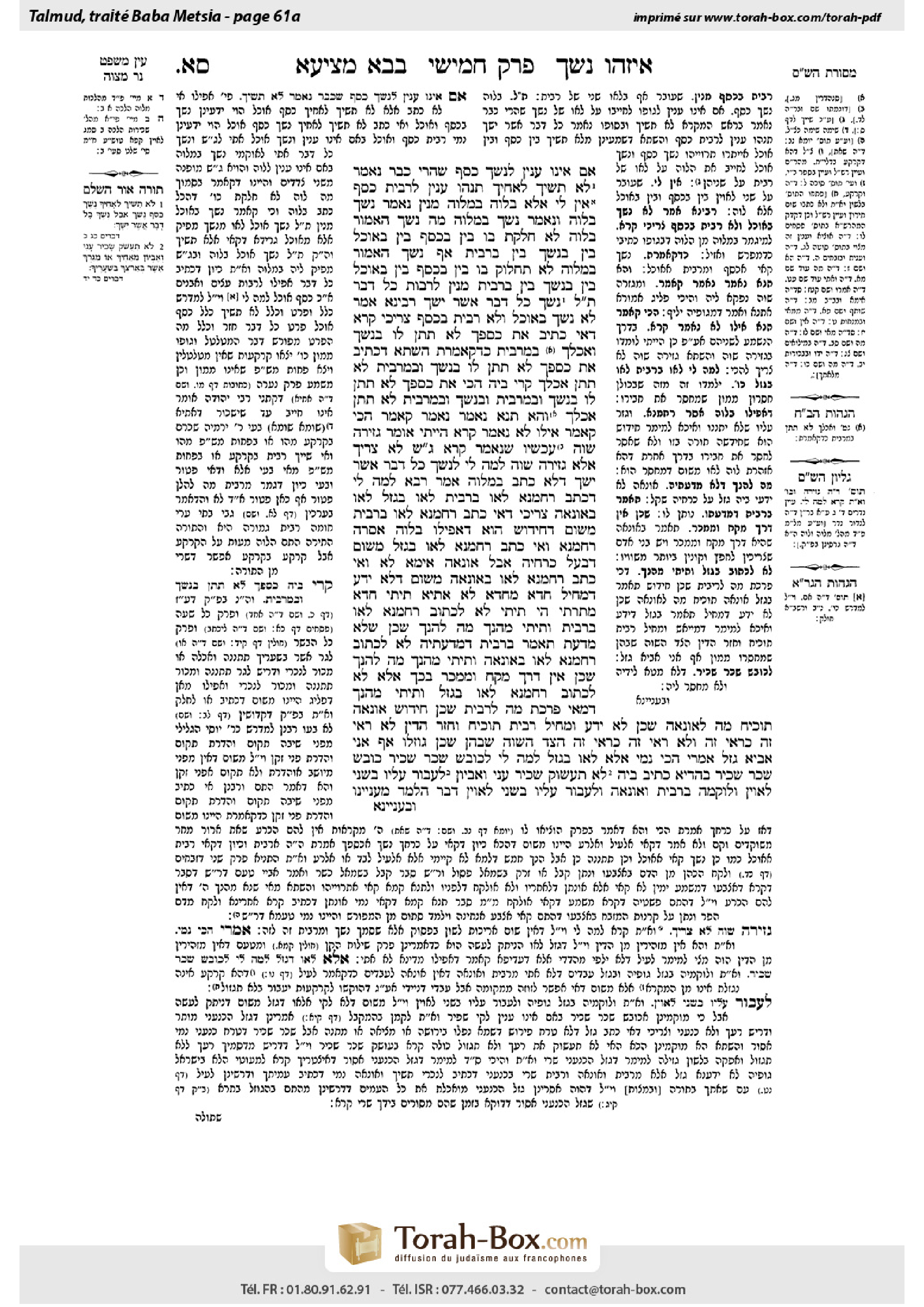
Bava Metzia 61a: Talmud study for Daf Yomi
Study the Talmud for Daf Yomi with scanned pages, Hebrew text, English translations from Sefaria and AI-generated French translations.
Passage selection and English or AI-generated French translation are available where the scan has annotations. Daf Study is independent of Torah-Box and Sefaria.
Browse Bava Metzia · בבא מציעא · All tractatesBava Metzia 61a text and translations
This page of Bava Metzia includes the Aramaic text, an English translation and an AI-generated French translation, alongside the scan above.
בבא מציעא ס״א א · Aramaic and Hebrew text
אִם אֵינוֹ עִנְיָן לְנֶשֶׁךְ כֶּסֶף, שֶׁהֲרֵי כְּבָר נֶאֱמַר ״לֹא תַשִּׁיךְ לְאָחִיךָ״, תְּנֵהוּ עִנְיָן לְרִבִּית כֶּסֶף.
אֵין לִי אֶלָּא בְּלֹוֶה, בְּמַלְוֶה מִנַּיִן?
נֶאֱמַר נֶשֶׁךְ בַּלֹּוֶה וְנֶאֱמַר נֶשֶׁךְ בַּמַּלְוֶה. מָה נֶשֶׁךְ הָאָמוּר בַּלֹּוֶה – לֹא חִלַּקְתָּ בּוֹ בֵּין בְּכֶסֶף בֵּין בְּאוֹכֶל בֵּין בְּנֶשֶׁךְ בֵּין בְּרִבִּית, אַף נֶשֶׁךְ הָאָמוּר בַּמַּלְוֶה – לֹא תַּחְלוֹק בּוֹ בֵּין בְּכֶסֶף בֵּין בְּאוֹכֶל בֵּין בְּנֶשֶׁךְ בֵּין בְּרִבִּית. מִנַּיִן לְרַבּוֹת כׇּל דָּבָר? תַּלְמוּד לוֹמַר: ״נֶשֶׁךְ כׇּל דָּבָר אֲשֶׁר יִשָּׁךְ״.
רָבִינָא אָמַר: לָא נֶשֶׁךְ בְּאוֹכֶל וְלָא רִבִּית בְּכֶסֶף צְרִיכִי קְרָא, דְּאִי כְּתִיב ״אֶת כַּסְפְּךָ לֹא תִתֵּן לוֹ בְּנֶשֶׁךְ וְאׇכְלְךָ בְּמַרְבִּית״ – כִּדְקָאָמְרַתְּ. הַשְׁתָּא דִּכְתִיב ״אֶת כַּסְפְּךָ לֹא תִתֵּן לוֹ בְּנֶשֶׁךְ וּבְמַרְבִּית לֹא תִתֵּן אׇכְלֶךָ״, קְרִי בֵּיהּ הָכִי: ״אֶת כַּסְפְּךָ לֹא תִתֵּן לוֹ בְּנֶשֶׁךְ וּבְמַרְבִּית״, ״וּבְנֶשֶׁךְ וּבְמַרְבִּית לֹא תִתֵּן אׇכְלֶךָ״.
וְהָא תַּנָּא ״נֶאֱמַר״ ״נֶאֱמַר״ קָאָמַר!
הָכִי קָאָמַר: אִילּוּ לֹא נֶאֱמַר קְרָא, הָיִיתִי אוֹמֵר גְּזֵירָה שָׁוָה. עַכְשָׁיו שֶׁנֶּאֱמַר קְרָא, גְּזֵירָה שָׁוָה לָא צְרִיךְ. אֶלָּא גְּזֵירָה שָׁוָה לְמָה לִי? לְ״נֶשֶׁךְ כׇּל דָּבָר אֲשֶׁר יִשָּׁךְ״, דְּלָא כְּתִב בְּמַלְוֶה.
אָמַר רָבָא: לְמָה לִי דִּכְתַב רַחֲמָנָא לָאו בְּרִבִּית, לָאו בְּגָזֵל, לָאו בְּאוֹנָאָה?
צְרִיכִי, דְּאִי כְּתַב רַחֲמָנָא לָאו בְּרִבִּית – מִשּׁוּם דְּחִידּוּשׁ הוּא, דַּאֲפִילּוּ בְּלֹוֶה אָסְרָה רַחֲמָנָא.
וְאִי כְּתַב רַחֲמָנָא לָאו בְּגָזֵל – מִשּׁוּם דִּבְעַל כֻּרְחֵיהּ, אֲבָל אוֹנָאָה – אֵימָא לָא.
וְאִי כְּתַב רַחֲמָנָא לָאו בְּאוֹנָאָה, מִשּׁוּם דְּלָא יָדַע דְּמָחֵיל.
חֲדָא מֵחֲדָא לָא אָתְיָא. תֵּיתֵי חֲדָא מִתַּרְתֵּי. הֵי תֵּיתֵי? לָא לִכְתּוֹב רַחֲמָנָא לָאו בְּרִבִּית, וְתֵיתֵי מֵהָנָךְ. מָה לְהָנָךְ שֶׁכֵּן שֶׁלֹּא מִדַּעַת, תֹּאמַר בְּרִבִּית דְּמִדַּעְתֵּיהּ.
לָא לִכְתּוֹב רַחֲמָנָא לָאו בְּאוֹנָאָה, וְתֵיתֵי מֵהָנָךְ. מָה לְהָנָךְ, שֶׁכֵּן אֵין דֶּרֶךְ מִקָּח וּמִמְכָּר בְּכָךְ.
אֶלָּא לָא לִכְתּוֹב רַחֲמָנָא לָאו בְּגָזֵל, וְתֵיתֵי מֵהָנָךְ. דְּמַאי פָּרְכַתְּ: מָה לְרִבִּית שֶׁכֵּן חִידּוּשׁ? אוֹנָאָה תּוֹכִיחַ!
מָה לְאוֹנָאָה שֶׁכֵּן לָא יָדַע וּמָחֵיל? רִבִּית תּוֹכִיחַ!
וְחָזַר הַדִּין: לֹא רְאִי זֶה כִּרְאִי זֶה, וְלֹא רְאִי זֶה כִּרְאִי זֶה. הַצַּד הַשָּׁוֶה שֶׁבָּהֶן, שֶׁכֵּן גּוֹזְלוֹ. אַף אֲנִי אָבִיא גָּזֵל!
אָמְרִי: הָכִי נָמֵי. אֶלָּא, לָאו בְּגָזֵל לְמָה לִי? לְכוֹבֵשׁ שְׂכַר שָׂכִיר.
כּוֹבֵשׁ שְׂכַר שָׂכִיר, בְּהֶדְיָא כְּתִיב בֵּיהּ ״לֹא תַעֲשֹׁק שָׂכִיר עָנִי וְאֶבְיוֹן״! לַעֲבוֹר עָלָיו בִּשְׁנֵי לָאוִין.
וְלוֹקְמַהּ בְּרִבִּית וְאוֹנָאָה, וְלַעֲבוֹר עָלָיו בִּשְׁנֵי לָאוִין? דָּבָר הַלָּמֵד מֵעִנְיָינוֹ,
Bava Metzia 61a · English translation
If the verse is not referring to the matter of neshekh with money, as it is already stated in that same verse: “You shall not lend with interest [tashikh] to your brother,” indicating that taking money as interest is prohibited, apply the expression “neshekh of money” to the matter of ribit, i.e., tarbit with money.
The baraita continues: I have derived a source for this prohibition only with regard to a borrower, for whom it is prohibited to pay interest on a loan. From where is it derived that there is also a prohibition stated with regard to a lender?
The baraita answers: Neshekh is stated with regard to a borrower, and neshekh is stated with regard to a lender. Just as concerning neshekh that is stated with regard to a borrower, you did not distinguish with regard to it between a loan of money and a loan of food, or between whether the interest is forbidden as neshekh or as ribit, so too, concerning neshekh stated with regard to a lender, do not distinguish with regard to it between a loan of money and a loan of food, or between whether the interest is forbidden as neshekh or as ribit. The baraita concludes: From where is it derived to include in the prohibition interest of any sort? The verse states: “Neshekh of anything that is lent with interest.”
Ravina said: An explicit verse is not required, neither to derive neshekh of food nor to derive ribit of money. As, if it were written: You shall not give him your money with neshekh and your food with marbit, juxtaposing neshekh with money alone and marbit with food alone, it would be as you say, that there is a need for the derivation of the baraita. But now that it is written: “You shall not give him your money with neshekh and with marbit you shall not give him your food,” interposing both neshekh and marbit between money and food, read into the verse this interpretation: Your money you shall not give him for neshekh and for marbit; and for neshekh and for marbit you shall not give your food.
The Gemara asks: But isn’t the tanna of the baraita saying that neshekh of food and tarbit of money are derived by means of a verbal analogy: Neshekh is stated with regard to a borrower, and neshekh is also stated with regard to a lender? How can Ravina, an amora, state that the verbal analogy is not needed?
The Gemara answers: This is what Ravina is saying: Had the verse not stated the terms neshekh and tarbit interposed between money and food, I would have said that the halakha that both terms apply to both money and food would be derived by means of a verbal analogy. Now, as the verse is stated in that manner, a verbal analogy is not necessary. The Gemara asks: Rather, why do I need this verbal analogy? The Gemara explains: I need the verbal analogy to teach that “neshekh of anything that is lent for interest” (Deuteronomy 23:20), which is written with regard to a borrower but not written with regard to a lender, applies to a lender as well.
§ Rava said: Why do I need it to be that the Merciful One writes a prohibition with regard to interest, a prohibition with regard to robbery (see Leviticus 19:13), and a prohibition with regard to exploitation (see Leviticus 25:14), a transaction where one of the parties overcharged or underpaid? There appears to be one principle underlying all three prohibitions: One must not take possession of another’s money in illegitimate ways.
The Gemara explains: They are necessary. As, had the Merciful One written the prohibition only with regard to interest, one could not have derived the other prohibitions from it because it is a prohibition with a novel element that does not appear in other halakhot. This novel element is that the Merciful One prohibited a loan with interest even for the borrower. With regard to the two other prohibitions, there is a prohibition against taking another’s money, but there is no prohibition for the victim, who has his money taken.
And had the Merciful One written the prohibition only with regard to robbery, one could not have derived the other prohibitions from it, as perhaps robbery is prohibited only due to the fact that it is an action taken against the will of the victim. But in the cases of exploitation and interest, where there is an element of consent, one would say they are not prohibited.
And had the Merciful One written the prohibition only with regard to exploitation, one could not have derived the other prohibitions from it, as perhaps exploitation is prohibited only due to the fact that the victim does not know that he was the victim of exploitation and therefore cannot waive repayment. In the cases of interest and robbery, the borrower and the victim, respectively, are aware that their money was taken and waiving repayment is possible, so perhaps those actions are not prohibited.
The Gemara suggests: Although no one of these prohibitions can be derived from one of the other prohibitions, perhaps one of them can be derived from the other two. The Gemara clarifies: Which prohibition will you derive from the other two? Let the Merciful One not write the prohibition with regard to interest, and instead derive that prohibition from these two, robbery and exploitation. The Gemara rejects that suggestion: What is notable about these prohibitions? They are notable in that they are transgressed without the consent of the victim. Will you say the same with regard to interest, which the borrower gives with his consent, as he agrees to accept the loan under those conditions?
The Gemara suggests: Let the Merciful One not write the prohibition with regard to exploitation, and instead derive that prohibition from these two, robbery and interest. The Gemara rejects that suggestion: What is notable about these prohibitions? They are notable in that they are not transgressed in the typical manner of buying and selling. Will you say the same with regard to exploitation, which is transgressed in the context of typical buying and selling?
Rather, let the Merciful One not write the prohibition with regard to robbery, and instead derive that prohibition from these two, interest and exploitation. As what refutation will you offer? If you say: What is notable about interest? It is notable in that the prohibition of interest contains a novel element; the case of exploitation will prove that a novel element is not a factor, as the prohibition against exploitation contains no novel element.
If you say, what is notable about exploitation? It is notable in that in this case, the victim does not know that he was the victim of exploitation and therefore he cannot waive repayment; the case of interest will prove that the inability to waive repayment is not a factor, as the borrower is aware of the interest and able to waive repayment.
The Gemara comments: And the inference has reverted to its starting point. The aspect of this case, interest, is not like the aspect of that case, exploitation, and the aspect of that case, exploitation, is not like the aspect of this case, interest. Their common denominator is that one robs another of money, i.e., takes money from another that is not due to him. I will also bring the prohibition against robbery, which shares that common denominator, and derive it from the other two prohibitions.
The Sages said: Indeed, the prohibition against robbery is superfluous. But if the prohibition against robbery can be derived from the prohibitions against interest and exploitation, why do I need the prohibition written in the Torah with regard to robbery? The Gemara answers: That verse is not written to prohibit a standard case of robbery; rather, it serves to prohibit the action of one who withholds the wages of a hired laborer. In that case, unlike robbery, the employer does not take money from the laborer; he merely fails to pay him his wages.
The Gemara challenges: With regard to one who withholds the wages of a hired laborer, it is explicitly written: “You shall not oppress a hired laborer who is poor and destitute” (Deuteronomy 24:14). There is no need to derive this prohibition from the verse concerning robbery. The Gemara answers: It is written so that withholding the wages of a hired laborer always involves violating two prohibitions.
The Gemara asks: But let us interpret the verse concerning robbery as prohibiting interest or exploitation, and say that it is written so that these prohibitions always involve violating two prohibitions. The Gemara answers: The prohibition against robbery is applied to the case of withholding the wages of a hired laborer because it is a matter derived from its context,
Bava Metzia 61a · Traduction française (IA)
Si la versette ne fait pas référence à la question du neshekh avec de l'argent, comme il est déjà dit dans la même versette : « Tu ne prêteras pas à ton frère à intérêt [tashikh] », indiquant que prendre de l'argent à intérêt est interdit, applique l'expression « neshekh de l'argent » à la question de la ribit, c'est-à-dire la tarbit avec de l'argent.
La baraïta continue : Je dérive une source pour cette interdiction uniquement concernant un emprunteur, pour lequel il est interdit de payer un intérêt sur un prêt. D'où cette interdiction est-elle dérivée concernant aussi un prêteur ?
La baraïta répond : Le neshekh est dit concernant un emprunteur, et le neshekh est dit concernant un prêteur. Tout comme concernant le neshekh qui est dit concernant un emprunteur, vous n'avez pas distingué concernant cela entre un prêt d'argent et un prêt de nourriture, ou entre le fait que l'intérêt est interdit comme neshekh ou comme ribit, de même concernant le neshekh dit concernant un prêteur, ne faites pas la distinction entre un prêt d'argent et un prêt de nourriture, ou entre le fait que l'intérêt est interdit comme neshekh ou comme ribit. La baraïta conclut : D'où cette interdiction inclut-elle tout genre d'intérêt ? La versette dit : « Neshekh de toute chose que l'on prête à intérêt. »
Ravina dit : Une versette explicite n'est pas nécessaire, ni pour dériver le neshekh de la nourriture, ni pour dériver la ribit de l'argent. Car, si elle avait dit : « Tu ne prêteras pas à lui ton argent avec neshekh et ton nourriture avec marbit », juxtaposant le neshekh avec l'argent seul et le marbit avec la nourriture seule, cela serait comme vous dites, qu'il y a besoin de la dérivation de la baraïta. Mais maintenant qu'elle est écrite : « Tu ne prêteras pas à lui ton argent avec neshekh et avec marbit tu ne prêteras pas à lui ton nourriture », interposant à la fois le neshekh et le marbit entre l'argent et la nourriture, lisant dans la versette cette interprétation : Ton argent tu ne le prêteras pas à lui pour neshekh et pour marbit ; et pour neshekh et pour marbit tu ne prêteras pas ta nourriture.
La Guemara demande : Mais n'est-ce pas le tanna de la baraïta qui dit que le neshekh de la nourriture et la ribit de l'argent sont dérivés par analogie verbale : Le neshekh est dit concernant un emprunteur, et la ribit est aussi dit concernant un prêteur ? Comment Ravina, un amora, peut-il dire que l'analogie verbale n'est pas nécessaire ?
La Guemara répond : C'est ce que Ravina dit : Si la versette n'avait pas dit les termes neshekh et marbit interposés entre l'argent et la nourriture, j'aurais dit que la halakha selon laquelle ces termes s'appliquent à la fois à l'argent et à la nourriture serait dérivée par analogie verbale. Maintenant, comme la versette est écrite ainsi, l'analogie verbale n'est pas nécessaire. La Guemara demande : Plutôt, pourquoi ai-je besoin de cette analogie verbale ? La Guemara explique : J'ai besoin de l'analogie verbale pour enseigner que « neshekh de toute chose que l'on prête à intérêt » (Deutéronome 23:20), qui est écrite concernant un emprunteur mais pas concernant un prêteur, s'applique aussi à un prêteur.
§ Rava dit : Pourquoi ai-je besoin que le Très Miséricordieux ait écrit une interdiction concernant l'intérêt, une interdiction concernant le vol (voir Lévitique 19:13), et une interdiction concernant l'exploitation (voir Lévitique 25:14), une transaction où l'un des parties a surestimé ou sous-estimé ? Il semble y avoir un principe unique sous-jacent à ces trois interdictions : On ne doit pas prendre la propriété d'autrui de manière illégale.
La Guemara explique : Elles sont nécessaires. Car, si le Très Miséricordieux avait écrit l'interdiction uniquement concernant l'intérêt, on ne pourrait pas avoir dérivé les autres interdictions à partir d'elle, car c'est une interdiction avec un élément nouveau qui ne se trouve pas dans d'autres halakhot. Cet élément nouveau est que le Très Miséricordieux a interdit un prêt à intérêt même pour l'emprunteur. Concernant les deux autres interdictions, il y a une interdiction de prendre la propriété d'autrui, mais il n'y a pas d'interdiction pour la victime, qui a perdu sa propriété.
Et si le Très Miséricordieux avait écrit l'interdiction uniquement concernant le vol, on ne pourrait pas avoir dérivé les autres interdictions à partir d'elle, car peut-être le vol est interdit uniquement en raison du fait qu'il est une action prise contre la volonté de la victime. Mais dans les cas d'exploitation et d'intérêt, où il y a un élément de consentement, on dirait qu'ils ne sont pas interdits.
Et si le Très Miséricordieux avait écrit l'interdiction uniquement concernant l'exploitation, on ne pourrait pas déduire les autres interdictions à partir d'elle, car peut-être l'exploitation est interdite uniquement en raison du fait que la victime ne sait pas qu'elle a été la victime de l'exploitation et donc ne peut pas renoncer au remboursement. Dans les cas d'intérêt et de vol, l'emprunteur et la victime, respectivement, savent que leur argent a été pris et que le renoncement au remboursement est possible, donc peut-être ces actions ne sont pas interdites.
La Guemara suggère : Bien que aucune de ces interdictions ne puisse être dérivée d'une autre, peut-être l'une d'entre elles peut être dérivée des deux autres. La Guemara clarifie : Quelle interdiction dériverez-vous des deux autres ? Que le Très Miséricordieux n'écrive pas l'interdiction concernant l'intérêt, et plutôt dérive cette interdiction à partir de ces deux, le vol et l'exploitation. La Guemara rejette cette suggestion : Qu'est-ce qui est notable à ces interdictions ? Ils sont notables en ce qu'ils sont transgressés sans le consentement de la victime. Direz-vous la même chose concernant l'intérêt, qui est donné avec le consentement de l'emprunteur, car il accepte le prêt sous ces conditions ?
La Guemara suggère : Que le Très Miséricordieux n'écrive pas l'interdiction concernant l'exploitation, et plutôt dérive cette interdiction à partir de ces deux, le vol et l'intérêt. La Guemara rejette cette suggestion : Qu'est-ce qui est notable à ces interdictions ? Ils sont notables en ce qu'ils ne sont pas transgressés dans le mode typique d'achat et de vente. Direz-vous la même chose concernant l'exploitation, qui est transgressée dans le contexte d'un achat et vente typique ?
Plutôt, que le Miséricordieux ne mette pas en écrit la prohibition concernant le vol, mais dérive cette prohibition à partir de ces deux-là, l'intérêt et l'exploitation. Quelle réfutation offririez-vous ? Si vous dites : Qu'est-ce qui est remarquable à propos de l'intérêt ? C'est que la prohibition de l'intérêt contient un élément nouveau ; le cas de l'exploitation prouvera que l'élément nouveau n'est pas un facteur, car la prohibition contre l'exploitation ne contient pas d'élément nouveau.
Si vous dites, qu'est-ce qui est remarquable à propos de l'exploitation ? C'est que dans ce cas, la victime ne sait pas qu'elle a été exploitée et donc ne peut pas renoncer au remboursement ; le cas de l'intérêt prouvera que l'incapacité à renoncer au remboursement n'est pas un facteur, car le prêteur sait l'intérêt et peut renoncer au remboursement.
Le Guemara commente : Et l'inférence est retournée à son point de départ. L'aspect de ce cas, l'intérêt, n'est pas comme l'aspect de ce cas, l'exploitation, et l'aspect de ce cas, l'exploitation, n'est pas comme l'aspect de ce cas, l'intérêt. Le point commun est que l'un vole à l'autre de l'argent, c'est-à-dire prend de l'argent à un autre qui ne lui est pas dû. Je mets aussi en avant la prohibition contre le vol, qui partage ce point commun, et la dérive à partir des deux autres prohibitions.
Les Sages dirent : En effet, la prohibition contre le vol est superflue. Mais si la prohibition contre le vol peut être dérivée des prohibitions contre l'intérêt et l'exploitation, pourquoi ai-je besoin de la prohibition écrite dans la Torah concernant le vol ? Le Guemara répond : Ce verset n'est pas écrit pour prohibiter un cas standard de vol ; il sert plutôt à prohibiter l'action de celui qui retient les salaires d'un ouvrier engagé. Dans ce cas, contrairement au vol, l'employeur ne prend pas de l'argent à l'ouvrier ; il ne fait qu'omettre de lui payer ses salaires.
Le Guemara conteste : Concernant celui qui retient les salaires d'un ouvrier engagé, il est explicitement écrit : « Tu ne devras pas opprimer un ouvrier engagé qui est pauvre et démunis » (Deutéronome 24:14). Il n'y a pas besoin de dériver cette prohibition à partir du verset concernant le vol. Le Guemara répond : Il est écrit ainsi pour que le retenir des salaires d'un ouvrier engagé implique toujours la violation de deux prohibitions.
Le Guemara demande : Mais laissons-nous interpréter le verset concernant le vol comme prohibitant l'intérêt ou l'exploitation, et disons qu'il est écrit ainsi pour que ces prohibitions impliquent toujours la violation de deux prohibitions. Le Guemara répond : La prohibition contre le vol s'applique au cas de retenir les salaires d'un ouvrier engagé car c'est une question dérivée de son contexte,
Traduction française générée par IA à partir de l’édition anglaise de Sefaria. Vérifie toujours un passage avec le texte source.
Text from Sefaria: William Davidson Edition - Vocalized Aramaic (CC BY NC); William Davidson Edition - English (CC BY NC).