Bava Metzia 61b: Talmud study for Daf Yomi
Study the Talmud for Daf Yomi with scanned pages, Hebrew text, English translations from Sefaria and AI-generated French translations.
Passage selection and English or AI-generated French translation are available where the scan has annotations. Daf Study is independent of Torah-Box and Sefaria.
Browse Bava Metzia · בבא מציעא · All tractatesBava Metzia 61b text and translations
This page of Bava Metzia includes the Aramaic text, an English translation and an AI-generated French translation, alongside the scan above.
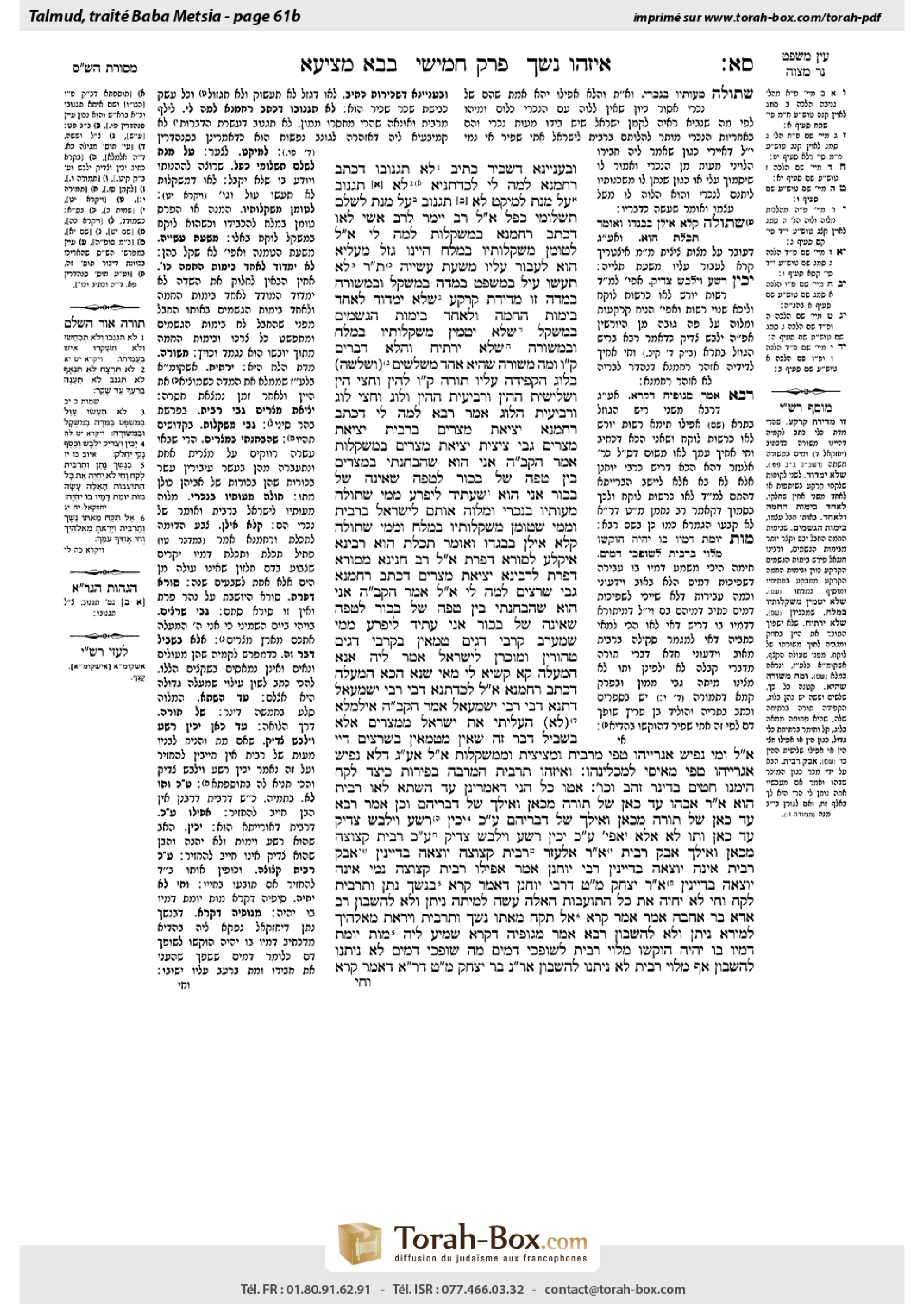
בבא מציעא ס״א ב · Aramaic and Hebrew text
וּבְעִנְיָינָא דְּשָׂכִיר כְּתִיב.
״לֹא תִּגְנֹבוּ״ דִּכְתַב רַחֲמָנָא לְמָה לִי? לְכִדְתַנְיָא: לֹא תִּגְנֹב – עַל מְנָת לְמֵיקַט, לֹא תִּגְנֹב – עַל מְנָת לְשַׁלֵּם תַּשְׁלוּמֵי כֶפֶל.
אֲמַר לֵיהּ רַב יֵימַר לְרַב אָשֵׁי: לָאו דִּכְתַב רַחֲמָנָא בְּמִשְׁקָלוֹת, לְמָה לִי? אֲמַר לֵיהּ: לְטוֹמֵן מִשְׁקְלוֹתָיו בְּמֶלַח. הַיְינוּ גָּזֵל מְעַלְּיָא הוּא! לַעֲבוֹר עָלָיו מִשְּׁעַת עֲשִׂיָּיה.
תָּנוּ רַבָּנַן: ״לֹא תַעֲשׂוּ עָוֶל בַּמִּשְׁפָּט בַּמִּדָּה בַּמִּשְׁקָל וּבַמְּשׂוּרָה״. ״בַּמִּדָּה״ – זוֹ מְדִידַת קַרְקַע, שֶׁלֹּא יִמְדּוֹד לְאֶחָד בִּימוֹת הַחַמָּה וּלְאֶחָד בִּימוֹת הַגְּשָׁמִים. ״בַּמִּשְׁקָל״ – שֶׁלֹּא יַטְמִין מִשְׁקְלוֹתָיו בְּמֶלַח. ״וּבַמְּשׂוּרָה״ – שֶׁלֹּא יַרְתִּיחַ.
וַהֲלֹא דְּבָרִים קַל וְחוֹמֶר: וּמָה מְשׂוּרָה שֶׁהִיא אֶחָד מִשְּׁלֹשִׁים וּשְׁלֹשָׁה בַּלּוֹג הִקְפִּידָה עָלָיו תּוֹרָה – קַל וְחוֹמֶר לְהִין, וַחֲצִי הִין, וּשְׁלִישִׁית הִין, וּרְבִיעִית הַהִין, וְלוֹג, וַחֲצִי לוֹג, וּרְבִיעִית הַלּוֹג.
אָמַר רָבָא: לְמָה לִי דִּכְתַב רַחֲמָנָא יְצִיאַת מִצְרַיִם בְּרִבִּית, יְצִיאַת מִצְרַיִם גַּבֵּי צִיצִית, יְצִיאַת מִצְרַיִם בְּמִשְׁקָלוֹת?
אָמַר הַקָּדוֹשׁ בָּרוּךְ הוּא: אֲנִי הוּא שֶׁהִבְחַנְתִּי בְּמִצְרַיִם בֵּין טִפָּה שֶׁל בְּכוֹר לְטִפָּה שֶׁאֵינָהּ שֶׁל בְּכוֹר, אֲנִי הוּא שֶׁעָתִיד לִיפָּרַע מִמִּי שֶׁתּוֹלֶה מְעוֹתָיו בְּגוֹי וּמַלְוָה אוֹתָם לְיִשְׂרָאֵל בְּרִבִּית, וּמִמִּי שֶׁטּוֹמֵן מִשְׁקְלוֹתָיו בְּמֶלַח, וּמִמִּי שֶׁתּוֹלֶה קָלָא אִילָן בְּבִגְדוֹ וְאוֹמֵר: ״תְּכֵלֶת הוּא״.
רָבִינָא אִיקְּלַע לְסוּרָא דִפְרָת. אֲמַר לֵיהּ רַב חֲנִינָא מִסּוּרָא דִּפְרָת לְרָבִינָא: יְצִיאַת מִצְרַיִם דִּכְתַב רַחֲמָנָא גַּבֵּי שְׁרָצִים, לְמָה לִי? אֲמַר לֵיהּ: אָמַר הַקָּדוֹשׁ בָּרוּךְ הוּא, אֲנִי הוּא שֶׁהִבְחַנְתִּי בֵּין טִפָּה שֶׁל בְּכוֹר לְטִפָּה שֶׁאֵינָהּ שֶׁל בְּכוֹר, אֲנִי עָתִיד לִיפָּרַע מִמִּי שֶׁמְּעָרֵב קִרְבֵי דָגִים טְמֵאִין בְּקִרְבֵי דָגִים טְהוֹרִין וּמוֹכְרָן לְיִשְׂרָאֵל.
אֲמַר לֵיהּ: אֲנָא ״הַמַּעֲלֶה״ קָא קַשְׁיָא לִי, מַאי שְׁנָא הָכָא ״הַמַּעֲלֶה״ דִּכְתַב רַחֲמָנָא?
אֲמַר לֵיהּ: לְכִדְתָנָא דְּבֵי רַבִּי יִשְׁמָעֵאל. דְּתָנָא דְּבֵי רַבִּי יִשְׁמָעֵאל, אָמַר הַקָּדוֹשׁ בָּרוּךְ הוּא: אִילְמָלֵא (לֹא) הֶעֱלֵיתִי אֶת יִשְׂרָאֵל מִמִּצְרָיִם אֶלָּא בִּשְׁבִיל דָּבָר זֶה, שֶׁאֵין מְטַמְּאִין בִּשְׁרָצִים – דַּיִּי.
אֲמַר לֵיהּ: וּמִי נְפִישׁ אַגְרַיְיהוּ טְפֵי מֵרִבִּית וּמִצִּיצִית וּמִמִּשְׁקָלוֹת? אֲמַר לֵיהּ: אַף עַל גַּב דְּלָא נְפִישׁ אַגְרַיְיהוּ טְפֵי, מְאִיסִי לְמֵכְלִינְהוּ.
וְאֵיזֶהוּ תַּרְבִּית, הַמַּרְבֶּה בְּפֵירוֹת. כֵּיצַד? לָקַח הֵימֶנּוּ חִטִּים בְּדִינַר זָהָב וְכוּ׳. אַטּוּ כֹּל הָנֵי דְּאָמְרִינַן עַד הַשְׁתָּא, לָאו רִבִּית הוּא?
אָמַר רַבִּי אֲבָהוּ: עַד כָּאן שֶׁל תּוֹרָה, מִכָּאן וְאֵילָךְ שֶׁל דִּבְרֵיהֶם. וְכֵן אָמַר רָבָא: עַד כָּאן שֶׁל תּוֹרָה, מִכָּאן וְאֵילָךְ שֶׁל דִּבְרֵיהֶם.
עַד כָּאן – ״יָכִין רָשָׁע וְיִלְבַּשׁ צַדִּיק״. עַד כָּאן, וְתוּ לָא? אֶלָּא, אֲפִילּוּ עַד כָּאן – ״יָכִין רָשָׁע וְיִלְבַּשׁ צַדִּיק״!
עַד כָּאן – רִבִּית קְצוּצָה. מִכָּאן וְאֵילָךְ – אֲבַק רִבִּית.
אָמַר רַבִּי אֶלְעָזָר: רִבִּית קְצוּצָה יוֹצְאָה בְּדַיָּינִין, אֲבַק רִבִּית אֵינָהּ יוֹצְאָה בְּדַיָּינִין. רַבִּי יוֹחָנָן אָמַר: אֲפִילּוּ רִבִּית קְצוּצָה נָמֵי אֵינָהּ יוֹצְאָה בְּדַיָּינִין.
אָמַר רַבִּי יִצְחָק: מַאי טַעְמָא דְּרַבִּי יוֹחָנָן? דְּאָמַר קְרָא: ״בַּנֶּשֶׁךְ נָתַן וְתַרְבִּית לָקַח וָחָי לֹא יִחְיֶה אֵת כׇּל הַתֹּעֵבוֹת הָאֵלֶּה עָשָׂה״ – לְמִיתָה נִיתַּן וְלֹא לְהִישָּׁבוֹן. רַב אַדָּא בַּר אַהֲבָה אָמַר, אָמַר קְרָא: ״אֶל תִּקַּח מֵאִתּוֹ נֶשֶׁךְ וְתַרְבִּית וְיָרֵאתָ מֵאֱלֹהֶיךָ״ – לְמוֹרָא נִיתַּן וְלֹא לְהִשָּׁבוֹן.
רָבָא אָמַר: מִגּוּפֵיהּ דִּקְרָא שְׁמִיעַ לֵיהּ, ״מוֹת יוּמָת דָּמָיו בּוֹ יִהְיֶה״. הוּקְשׁוּ מַלְוֵי רִבִּית לְשׁוֹפְכֵי דָּמִים: מָה שׁוֹפְכֵי דָּמִים לֹא נִיתְּנוּ לְהִשָּׁבוֹן – אַף מַלְוֵי רִבִּית לֹא נָתְנוּ לְהִשָּׁבוֹן.
אָמַר רַב נַחְמָן בַּר יִצְחָק: מַאי טַעְמָא דְּרַבִּי אֶלְעָזָר? דְּאָמַר קְרָא:
Bava Metzia 61b · English translation
and this prohibition is written in the context of the matter of a hired laborer: “You shall not oppress your neighbor, nor rob him, and the wages of a hired servant shall not abide with you all night until the morning” (Leviticus 19:13).
The Gemara asks: Why do I need the prohibition: “You shall not steal” (Leviticus 19:11), that the Merciful One wrote? This is yet another prohibition against taking money by illegitimate means, and it could be derived from the other prohibitions mentioned previously. The Gemara answers that it is necessary for the Merciful One to write that prohibition for that which is taught in a baraita: “You shall not steal” applies in all circumstances, even if you do so only in order to aggravate the victim; “you shall not steal” applies in all circumstances, even if you do so in order to pay the double payment as a gift to the person from whom you stole.
Rav Yeimar said to Rav Ashi: Why do I need the prohibition that the Merciful One wrote with regard to weights: “You shall do no unrighteousness in judgment, in measure, in weight, or in volume” (Leviticus 19:35)? It is merely another form of robbery. Rav Ashi said to him: It is referring to a seller who buries his weights in salt, in order to lighten them. Rav Yeimar said: That is the same as full-fledged robbery; therefore, it should not require a separate derivation. Rav Ashi answered: It is written to establish that he violates the prohibition from the moment of the act of burying them. He violates the prohibition even before he actually deceives a buyer with the buried weights.
The Sages taught: The verse states: “You shall do no unrighteousness in judgment, in measure, in weight, or in volume [uvamesura]” (Leviticus 19:35). “In measure”; this is referring to the measurement of land, e.g., this means that in a case where two people are dividing their jointly owned field, one may not measure the land to be given to one during the summer and measure the land to be given to the other during the rainy season, because the length of the measuring cord is affected by the weather conditions. “In weight”; this is referring to the fact that he may not bury his measuring weights in salt. And “in volume”; this teaches that one may not froth the liquid one is selling, creating the impression that there is more liquid in the vessel than there actually is.
The Gemara adds: And are the following matters not inferred a fortiori: And if with regard to the mesura volume, which equals one thirty-third of a log, the Torah was fastidious concerning it that one may not deceive another, it can be inferred a fortiori that with regard to a hin, which equals twelve log, and a half-hin, and a third-hin, and a quarter-hin, and a log, and a half-log, and a quarter-log, which are all much larger volumes, that one may not deceive another.
§ Rava says: Why do I need the mention of the exodus from Egypt that the Merciful One wrote in the context of the halakhot of the prohibition against interest (see Leviticus 25:37–38), and the mention of the exodus from Egypt with regard to the mitzva to wear ritual fringes (see Numbers 15:39–41), and the mention of the exodus from Egypt in the context of the prohibition concerning weights (see Leviticus 19:35–36)?
Rava explains: The Holy One, Blessed be He, said: I am He Who distinguished in Egypt between the drop of seed that became a firstborn and the drop of seed that did not become a firstborn, and I killed only the firstborn. I am also He Who is destined to exact punishment from one who attributes ownership of his money to a gentile and thereby lends it to a Jew with interest. Even if he is successful in deceiving the court, God knows the truth. And I am also He Who is destined to exact punishment from one who buries his weights in salt, as this changes their weight in a manner not visible to the eye. And I am also He Who is destined to exact punishment from one who hangs ritual fringes dyed with indigo [kala ilan] dye on his garment and says it is dyed with the sky-blue dye required in ritual fringes. The allusion to God’s ability to distinguish between two apparently like entities is why the exodus is mentioned in all of these contexts.
The Gemara relates: Ravina happened to come to Sura on the Euphrates. Rav Ḥanina of Sura on the Euphrates said to Ravina: Why do I need the mention of the exodus from Egypt that the Merciful One wrote in the context of creeping animals: “Do not make yourselves detestable with all the creeping animals that swarm…for I am the Lord Who brings you up from the land of Egypt” (Leviticus 11:43–45)? Ravina said to him: The Holy One, Blessed be He, said: I am He Who distinguished in Egypt between the drop of seed that became a firstborn and the drop of seed that did not become a firstborn, and I killed only the firstborn. I am also He Who is destined to exact punishment from one who intermingles the innards of non-kosher fish with the innards of kosher fish and sells them to a Jew, who is unable to distinguish between them.
Rav Ḥanina said to him: I was not asking about the very mention of the exodus. Rather, I was asking about the term “Who brings you up” mentioned in that verse; that is what is difficult for me. What is different here, that the Merciful One wrote: “Who brings you up from the land of Egypt,” as opposed to the other three instances cited by Rava where the exodus is mentioned in the context of mitzvot and prohibitions, where it is written: “Who brought you out”?
Ravina said to him: It is to teach as it was taught in the school of Rabbi Yishmael. As it was taught in the school of Rabbi Yishmael: The Holy One, Blessed be He, said: Had I brought the Jewish people up from Egypt only for this matter, so that they would not become impure by consuming creeping animals, it would be sufficient for Me, as observance of this mitzva elevates their spiritual stature.
Rav Ḥanina said to him: And is the reward for abstaining from consuming creeping animals greater than the reward for observing the halakhot with regard to interest and ritual fringes and weights? Let the Merciful One write: Who brings you up, in the context of those mitzvot as well. Ravina said to him: Even though their reward is not greater, it is more repulsive for Jews to eat creeping animals. Avoiding those animals brings them up, in the sense that it is praiseworthy and enhances the transcendent nature of the Jews.
§ The mishna teaches: And which is tarbit? It is the case of one who enters into a transaction that yields an increase in the produce beyond his investment. How so? For example, a case where one acquired wheat from another at the price of one kor of wheat for one gold dinar, with the wheat to be supplied at a later date, and such was the market price of wheat at the time he acquired it. The price of one kor of wheat then increased and stood at thirty dinars. At that point, the buyer said to the seller: Give me all of my wheat now, as I wish to sell it and purchase wine with it. The seller said to him: Since it is ultimately wine that you want, not wheat, each kor of your wheat is considered by me to be worth thirty dinars, and you have the right to collect its value in wine from me. And in this case, the seller did not have wine in his possession. The Gemara asks: Is that to say that all these cases that we said in the mishna until now are not cases of interest?
Rabbi Abbahu says: Until here, i.e., in the first two cases it presents, the mishna is referring to cases of interest by Torah law, and from this point forward the mishna is referring to cases of interest by rabbinic law. If the lender does not explicitly stipulate that the debtor must pay a sum greater than the value of the loan they do not violate the Torah prohibition of interest, but the Sages prohibited doing so. And so says Rava: Until here the mishna is referring to cases of interest by Torah law, and from this point forward the mishna is referring to cases of interest by rabbinic law.
The Gemara comments: In the cases in the mishna cited until here there is a fulfillment of the verse: The wicked may prepare and the righteous shall don (see Job 27:17), which is interpreted as referring to the case of a wicked father who collects interest from borrowers. Upon inheriting the father’s estate, his righteous son is not obligated to return the interest to the borrower. The Gemara asks: Is this verse applicable only in the cases discussed until here, and no further? It is logical that if the heir does not need to return the interest that was prohibited by Torah law, all the more so the heir should not need to return the interest that was prohibited by rabbinic law. Rather, Rava said: Even in the cases discussed until here one can apply the verse: The wicked may prepare and the righteous shall don.
The Gemara comments: Until here the tanna cites cases of fixed interest, i.e., where the amount to be paid as interest was fixed at the time of the loan, which is prohibited by Torah law. From this point forward the tanna cites cases with only a hint of interest, prohibited by rabbinic law, as there is no fixed sum paid as interest.
Rabbi Elazar says: Fixed interest can be removed from the lender’s possession by means of legal proceedings adjudicated by judges. By contrast, in cases of a hint of interest, prohibited by rabbinic law, the money paid cannot be removed by means of legal proceedings adjudicated by judges. Rabbi Yoḥanan says: Even fixed interest cannot be removed by means of legal proceedings adjudicated by judges.
Rabbi Yitzḥak says: What is the reason for the opinion of Rabbi Yoḥanan? It is as the verse states: “He has given forth with neshekh and he took tarbit, shall he live? He shall not live. He performed all these abominations, he shall be executed; his blood shall be upon him” (Ezekiel 18:13). It can be inferred that one who takes interest is subject to death at the hand of Heaven but not to repayment, as the court cannot compel him to repay the interest. Citing a different proof, Rav Adda bar Ahava said that the verse states: “You shall not take from him neshekh or tarbit; you shall fear your God and your brother shall live with you.” (Leviticus 25:36). It can be inferred that one who does so is subject to shirking the fear of Heaven, but not to repayment.
Rava said: It can be derived from the verse in Ezekiel itself, not by inference, as it is written: “He shall be executed; his blood shall be upon him” (Ezekiel 18:13). In the verse, lenders who charged interest were juxtaposed with shedders of blood. This teaches: Just as shedders of blood are not subject to repayment, so too, lenders who charge interest are not subject to repayment.
Rav Naḥman bar Yitzḥak said: What is the reason for the opinion of Rabbi Elazar that interest prohibited by Torah law can be reclaimed by means of legal proceedings adjudicated by judges? It is as the verse concerning the prohibition against taking interest states:
Bava Metzia 61b · Traduction française (IA)
et cette interdiction est écrite dans le contexte de la question du travailleur engagé : « Vous ne devriez pas opprimer votre prochain, ni le voler, et les salaires du serviteur engagé ne devraient pas rester avec vous toute la nuit jusqu’au matin » (Lévitique 19:13).
La Guemara demande : Pourquoi a-t-on besoin de l’interdiction : « Vous ne devriez pas voler » (Lévitique 19:11), que l’Éternel a écrit ? C’est une autre interdiction de prendre de l’argent par des moyens illicites, et elle pourrait être déduite des interdictions mentionnées précédemment. La Guemara répond que cette interdiction est nécessaire pour ce qui est enseigné dans une baraïta : « Vous ne devriez pas voler » s’applique à tous les cas, même si l’on le fait uniquement pour aggraver la victime ; « vous ne devriez pas voler » s’applique à tous les cas, même si l’on le fait dans le but de payer le double comme cadeau à la personne d’où l’on a volé.
Rav Yeimar dit à Rav Ashi : Pourquoi a-t-on besoin de l’interdiction que l’Éternel a écrite concernant les poids : « Vous ne ferez pas de l’injustice en jugement, en mesure, en poids ou en volume » (Lévitique 19:35) ? C’est simplement une autre forme de vol. Rav Ashi répond à lui : C’est en référence à un vendeur qui enterrerait ses poids dans le sel, afin de les alléger. Rav Yeimar dit : C’est la même chose qu’un vol complet ; par conséquent, cela ne devrait pas nécessiter une dérivation séparée. Rav Ashi répond : C’est écrit pour établir qu’il enfreint l’interdiction dès l’instant de l’acte d’enterrer les poids. Il enfreint l’interdiction même avant qu’il ne mente réellement à un acheteur avec ces poids enterrés.
Les Sages enseignent : La parabole dit : « Vous ne ferez pas d’injustice en jugement, en mesure, en poids ou en volume [uvamesura] » (Lévitique 19:35). « En mesure » : cela fait référence à la mesure des terres, par exemple, cela signifie qu’en cas où deux personnes divisent un champ commun, l’un ne peut pas mesurer la terre à donner à l’un pendant l’été et mesurer la terre à donner à l’autre pendant la saison des pluies, car la longueur de la corde de mesure est affectée par les conditions météorologiques. « En poids » : cela fait référence au fait qu’il ne peut pas enterrer ses poids dans le sel. Et « en volume » : cela enseigne qu’on ne peut pas mousse la liquide qu’on vend, créant l’illusion qu’il y a plus de liquide dans le récipient qu’il n’y en a effectivement.
La Guemara ajoute : Et ces questions-ci ne sont-elles pas déduites a fortiori ? Et si, concernant la mesura, qui égale un trentième de log, la Torah est minutieuse à ce point qu’on ne peut pas tromper un autre, on peut déduire a fortiori que, concernant un hin, qui égale douze logs, et un demi-hin, et un tiers-hin, et un quart-hin, et un log, et un demi-log, et un quart-log, qui sont tous des volumes bien plus grands, on ne peut pas tromper un autre.
§ Rava dit : Pourquoi a-t-on besoin de la mention de l’Exode d’Egypte que l’Éternel a écrite dans le contexte des halakhot de l’interdiction d’intérêt (cf. Lévitique 25:37–38), et de la mention de l’Exode d’Egypte concernant la mitsva de porter des franges rituelles (cf. Nb 15:39–41), et de la mention de l’Exode d’Egypte dans le contexte de l’interdiction concernant les poids (cf. Lévitique 19:35–36) ?
Rava explique : L’Éternel, le Très Haut, a dit : Je suis celui qui a distingué en Égypte entre la goutte de semence qui est devenue un premier-né et la goutte de semence qui n’est pas devenue un premier-né, et j’ai tué seulement le premier-né. Je suis aussi celui qui est destiné à punir celui qui attribue la propriété de son argent à un non-Juif et le prête à un Juif avec intérêt. Même s’il réussit à tromper la cour, Dieu connaît la vérité. Et je suis aussi celui qui est destiné à punir celui qui enterrerait ses poids dans le sel, car cela modifie leur poids d’une manière invisible à l’œil. Et je suis aussi celui qui est destiné à punir celui qui accroche des franges rituelles teintes en indigo [kala ilan] à son vêtement et dit qu’elles sont teintes en bleu céleste comme requis pour les franges rituelles. L’allusion à la capacité de l’Éternel à distinguer entre deux entités apparemment semblables est la raison pour laquelle l’Exode est mentionné dans tous ces contextes.
La Guemara rapporte : Ravina est arrivé à Sura sur l’Euphrate. Rav Ḥanina de Sura sur l’Euphrate a dit à Ravina : Pourquoi a-t-on besoin de la mention de l’Exode d’Égypte que l’Éternel a écrite dans le contexte des animaux rampants : « Vous ne devriez pas vous rendre détestables avec tous les animaux rampants qui pullulent… car je suis l’Éternel qui vous avez tirés d’Égypte » (Lévitique 11:43–45) ? Ravina a répondu : L’Éternel, le Très Haut, a dit : Je suis celui qui a distingué en Égypte entre la goutte de semence qui est devenue un premier-né et la goutte de semence qui n’est pas devenue un premier-né, et j’ai tué seulement le premier-né. Je suis aussi celui qui est destiné à punir celui qui mélange les entrailles des poissons non-kosher avec les entrailles des poissons kosher et les vend à un Juif, qui ne peut pas distinguer entre eux.
Rav Ḥanina said to him: I was not asking about the very mention of the exodus. Rather, I was asking about the term "Who brings you up" mentioned in that verse; that is what is difficult for me. What is different here, that the Merciful One wrote: "Who brings you up from the land of Egypt," as opposed to the other three instances cited by Rava where the exodus is mentioned in the context of mitsvot and prohibitions, where it is written: "Who brought you out"?
Ravina said to him: It is to teach as it was taught in the school of Rabbi Yishmael. As it was taught in the school of Rabbi Yishmael: The Holy One, Blessed be He, said: Had I brought the Jewish people up from Egypt only for this matter, so that they would not become impure by consuming creeping animals, it would be sufficient for Me, as observance of this mitsva elevates their spiritual stature.
Rav Ḥanina dit à lui : Et la récompense de s'abstenir de manger les animaux rampants est-elle plus grande que la récompense d'observer les halakhot concernant l'intérêt, les franges rituelles et les poids ? Écrivons donc : Celui qui vous élève, dans le contexte de ces mitsvot également. Ravina dit à lui : Même si leur récompense n'est pas plus grande, il est plus répugnant aux Juifs de manger les animaux rampants. Éviter ces animaux les élève, dans le sens où c'est louable et renforce la nature transcendante des Juifs.
§ La mitsna enseigne : Et qu'est-ce que le tarbit ? C'est le cas d'une personne qui entre dans une transaction qui génère un accroissement du produit au-delà de son investissement. Comment ? Par exemple, dans un cas où l'on a acquis du blé d'un autre à un prix d'un kor de blé pour un dinar d'or, avec le blé à fournir ultérieurement, et tel était le prix du blé à l'époque où l'on l'avait acquis. Le prix d'un kor de blé a ensuite augmenté et s'est élevé à trente dinars. À ce moment-là, l'acheteur a dit au vendeur : Donnez-moi tout mon blé maintenant, car je veux le vendre et acheter du vin avec. Le vendeur a dit à lui : Puisque c'est finalement du vin que vous voulez, pas du blé, chaque kor de votre blé me semble valoir trente dinars, et vous avez le droit de récupérer sa valeur en vin. Et dans ce cas, le vendeur ne possédait pas de vin. La Guemara demande : Est-ce que cela signifie que tous ces cas que nous avons dits dans la mitsna jusqu'à présent ne sont pas des cas d'intérêt ?
Rabbi Abbahu dit : Jusqu'ici, c'est-à-dire dans les deux premiers cas qu'il présente, la mitsna fait référence à des cas d'intérêt selon la loi divine, et à partir de ce point, la mitsna fait référence à des cas d'intérêt selon la loi rabbinique. Si le prêteur ne stipule pas explicitement que le débiteur doit payer une somme supérieure à la valeur du prêt, il ne commet pas la transgression divine d'intérêt, mais les Sages ont interdit cela. Et ainsi dit Rava : Jusqu'ici la mitsna fait référence à des cas d'intérêt selon la loi divine, et à partir de ce point, la mitsna fait référence à des cas d'intérêt selon la loi rabbinique.
La Guemara commente : Dans les cas de la mitsna cités jusqu'ici, il y a une application de la parole : Le méchant peut préparer et le juste portera (voir Job 27:17), qui est interprété comme faisant référence au cas d'un père méchant qui collecte des intérêts auprès des prêteurs. Lorsqu'il hérite de l'immobilier de son père, son fils juste n'est pas tenu de rembourser l'intérêt au prêteur. La Guemara demande : Cette parole est-elle applicable uniquement dans les cas discutés jusqu'ici, et pas davantage ? Il est logique que si l'héritier n'a pas besoin de rembourser l'intérêt interdit par la loi divine, encore plus l'héritier ne devrait-il pas avoir besoin de rembourser l'intérêt interdit par la loi rabbinique. Plutôt, Rava dit : Même dans les cas discutés jusqu'ici, on peut appliquer la parole : Le méchant peut préparer et le juste portera.
La Guemara commente : Jusqu'ici le tanna cite des cas d'intérêt fixe, c'est-à-dire où la somme à payer en intérêt était fixée à l'époque du prêt, ce qui est interdit par la loi divine. À partir de ce point, le tanna cite des cas avec seulement une suggestion d'intérêt, interdit par la loi rabbinique, car il n'y a pas de somme fixe payée en intérêt.
Rabbi Elazar dit : L'intérêt fixe peut être retiré de la possession du prêteur grâce à des procédures légales décidées par des juges. À l'inverse, dans les cas d'une indication d'intérêt, interdit par la loi rabbinique, l'argent payé ne peut pas être retiré grâce à des procédures légales décidées par des juges. Rabbi Yoḥanan dit : Même l'intérêt fixe ne peut pas être retiré grâce à des procédures légales décidées par des juges.
Rabbi Yitzḥak dit : Quelle est la raison de l'opinion de Rabbi Yoḥanan ? C'est comme la parole : « Il a donné avec neshekh et il a pris tarbit, vivra-t-il ? Il ne vivra pas. Il a accompli toutes ces abominations, il sera exécuté ; son sang sera sur lui » (Ezéchiel 18:13). On peut en déduire que celui qui prête de l'intérêt est sujet à la mort à la main du Ciel mais pas à la réparation, car le tribunal ne peut pas le forcer à réparer l'intérêt. Citant une preuve différente, Rav Adda bar Ahava dit que la parole dit : « Vous ne prendrez pas de lui neshekh ou tarbit ; vous craignez votre Dieu et votre frère vivra avec vous » (Lévitique 25:36). On peut en déduire que celui qui fait cela est sujet à l'ignorance de la crainte du Ciel, mais pas à la réparation.
Rava dit : On peut en déduire directement de la parole dans Ezéchiel lui-même, pas par déduction, car il est écrit : « Il sera exécuté ; son sang sera sur lui » (Ezéchiel 18:13). Dans la parole, les prêteurs qui prêtaient de l'intérêt sont juxtaposés aux meurtriers. Cela enseigne : Comme les meurtriers ne sont pas soumis à la réparation, de même les prêteurs qui prêtent de l'intérêt ne sont pas soumis à la réparation.
Rav Naḥman bar Yitzḥak dit : Quelle est la raison de l'opinion de Rabbi Elazar selon laquelle l'intérêt interdit par la loi divine peut être récupéré grâce à des procédures légales décidées par des juges ? C'est d'après la parole concernant l'interdiction de prendre de l'intérêt :
Traduction française générée par IA à partir de l’édition anglaise de Sefaria. Vérifie toujours un passage avec le texte source.
Text from Sefaria: William Davidson Edition - Vocalized Aramaic (CC BY NC); William Davidson Edition - English (CC BY NC).