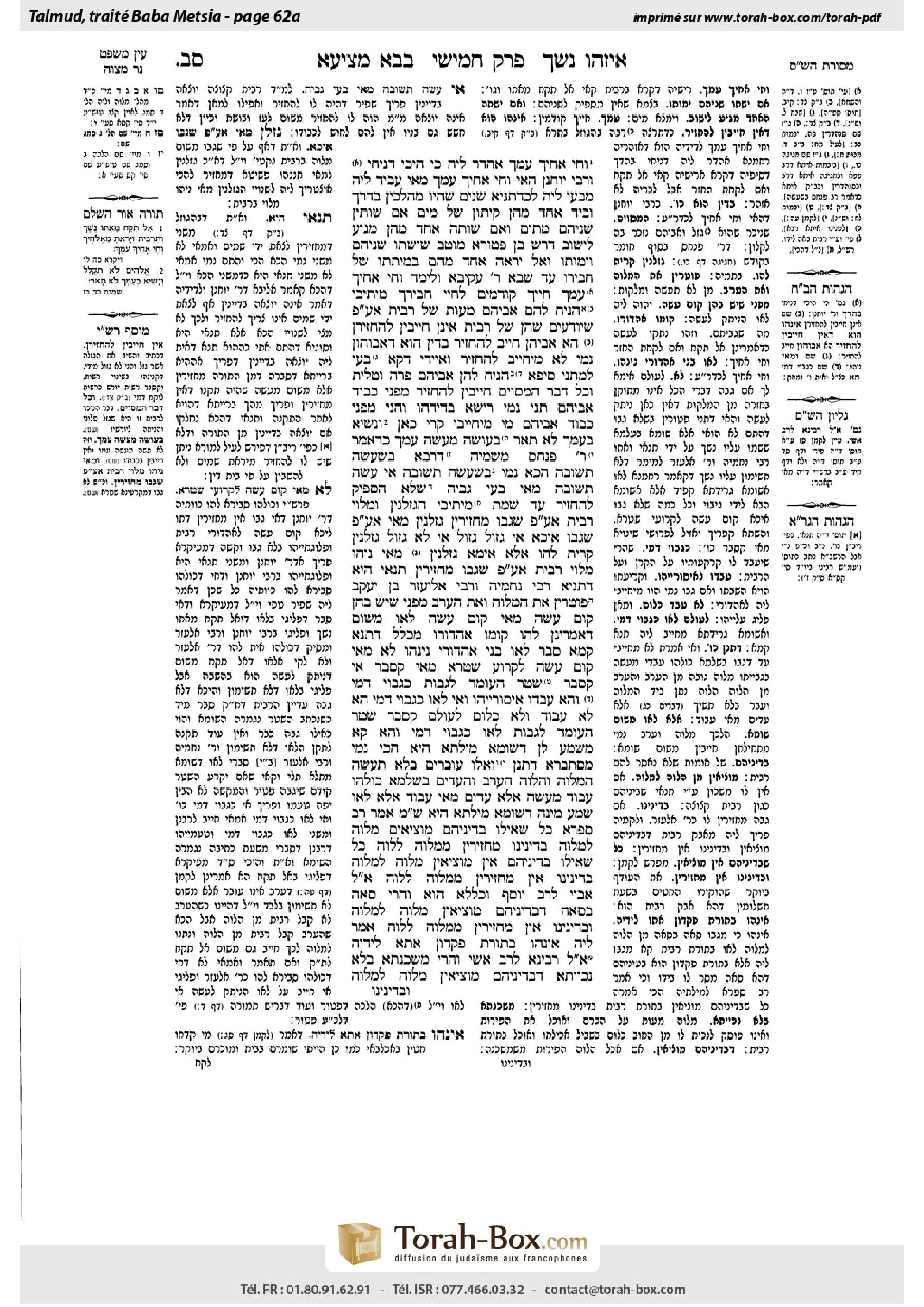
Bava Metzia 62a: Talmud study for Daf Yomi
Study the Talmud for Daf Yomi with scanned pages, Hebrew text, English translations from Sefaria and AI-generated French translations.
Passage selection and English or AI-generated French translation are available where the scan has annotations. Daf Study is independent of Torah-Box and Sefaria.
Browse Bava Metzia · בבא מציעא · All tractatesBava Metzia 62a text and translations
This page of Bava Metzia includes the Aramaic text, an English translation and an AI-generated French translation, alongside the scan above.
בבא מציעא ס״ב א · Aramaic and Hebrew text
״וְחֵי אָחִיךָ עִמָּךְ״. אַהְדַּר לֵיהּ כִּי הֵיכִי דְּנֵיחֵי.
וְרַבִּי יוֹחָנָן, הַאי ״וְחֵי אָחִיךָ עִמָּךְ״ מַאי עָבֵיד לֵיהּ? מִבְּעֵי לֵיהּ לְכִדְתַנְיָא: שְׁנַיִם שֶׁהָיוּ מְהַלְּכִין בַּדֶּרֶךְ וּבְיַד אֶחָד מֵהֶן קִיתוֹן שֶׁל מַיִם, אִם שׁוֹתִין שְׁנֵיהֶם – מֵתִים. וְאִם שׁוֹתֶה אֶחָד מֵהֶן – מַגִּיעַ לַיִּשּׁוּב. דָּרַשׁ בֶּן פְּטוֹרָא: מוּטָב שֶׁיִּשְׁתּוּ שְׁנֵיהֶם וְיָמוּתוּ, וְאַל יִרְאֶה אֶחָד מֵהֶם בְּמִיתָתוֹ שֶׁל חֲבֵירוֹ. עַד שֶׁבָּא רַבִּי עֲקִיבָא וְלִימֵּד: ״וְחֵי אָחִיךָ עִמָּךְ״, חַיֶּיךָ קוֹדְמִים לְחַיֵּי חֲבֵירֶךָ.
מֵיתִיבִי: הִנִּיחַ לָהֶם אֲבִיהֶם מָעוֹת שֶׁל רִבִּית, אַף עַל פִּי שֶׁיּוֹדְעִים שֶׁהֵן שֶׁל רִבִּית – אֵינָן חַיָּיבִין לְהַחְזִירָן. הָא אֲבִיהֶן חַיָּיב לְהַחְזִיר!
בְּדִין הוּא דַּאֲבוּהוֹן נָמֵי לָא מִיחַיַּיב לְהַחְזִיר, וְאַיְּידֵי דְּקָא בָעֵי לְמִתְנֵי סֵיפָא: הִנִּיחַ לָהֶן אֲבִיהֶם פָּרָה וְטַלִּית וְכׇל דָּבָר הַמְסוּיָּם חַיָּיבִין לְהַחְזִיר מִפְּנֵי כְּבוֹד אֲבִיהֶם, תָּנֵי נָמֵי רֵישָׁא בְּדִידְהוּ.
וְהָנֵי, מִפְּנֵי כְּבוֹד אֲבִיהֶם מִי מִיחַיְּיבִי? קְרִי כָּאן: ״וְנָשִׂיא בְעַמְּךָ לֹא תָאֹר״, בְּעוֹשֶׂה מַעֲשֵׂה עַמְּךָ.
כִּדְאָמַר רַבִּי פִּנְחָס מִשְּׁמֵיהּ דְּרָבָא: בְּשֶׁעָשָׂה תְּשׁוּבָה, הָכָא נָמֵי בְּשֶׁעָשָׂה תְּשׁוּבָה. אִי עָשָׂה תְּשׁוּבָה, מַאי בָּעֵי גַּבֵּיהּ? שֶׁלֹּא הִסְפִּיק לְהַחְזִיר עַד שֶׁמֵּת.
מֵיתִיבִי: הַגַּזְלָנִין וּמַלְוֵי רִבִּית, אַף עַל פִּי שֶׁגָּבוּ – מַחְזִירִין. גַּזְלָנִים מַאי ״אַף עַל פִּי שֶׁגָּבוּ״ אִיכָּא? אִי גְּזוּל – גְּזוּל, אִי לָא גְּזוּל – גַּזְלָנִין קָרֵית לְהוּ?! אֶלָּא אֵימָא: גַּזְלָנִין, מַאי נִיהוּ? מַלְוֵי רִבִּית. אַף עַל פִּי שֶׁגָּבוּ – מַחְזִירִין.
תַּנָּאֵי הִיא, דְּתַנְיָא: רַבִּי נְחֶמְיָה וְרַבִּי אֱלִיעֶזֶר בֶּן יַעֲקֹב פּוֹטְרִין אֶת הַמַּלְוֶה וְאֶת הֶעָרֵב, מִפְּנֵי שֶׁיֵּשׁ בָּהֶן קוּם עֲשֵׂה. מַאי קוּם עֲשֵׂה? לָאו מִשּׁוּם דְּאָמְרִינַן לְהוּ קוּמוּ אַהֲדוּרוּ?
מִכְּלָל דְּתַנָּא קַמָּא סָבַר לָאו בְּנֵי אַהְדּוֹרֵי נִינְהוּ! לָא, מַאי ״קוּם עֲשֵׂה״ – לִקְרוֹעַ שְׁטָרָא.
מַאי קָסָבַר? אִי קָסָבַר שְׁטָר הָעוֹמֵד לִגְבּוֹת כְּגָבוּי דָּמֵי, וְהָא עֲבַדוּ אִיסּוּרַיְיהוּ. וְאִי לָאו כְּגָבוּי דָּמֵי, הָא לָא עֲבוּד וְלֹא כְּלוּם!
לְעוֹלָם קָסָבַר שְׁטָר הָעוֹמֵד לִגְבּוֹת לָאו כְּגָבוּי דָּמֵי, וְהָא קָא מַשְׁמַע לַן דְּשׂוּמָא מִילְּתָא הִיא.
הָכִי נָמֵי מִסְתַּבְּרָא, דִּתְנַן: וְאֵלּוּ עוֹבְרִים בְּלֹא תַעֲשֶׂה: הַמַּלְוֶה וְהַלּוֹוֶה, הֶעָרֵב וְהָעֵדִים. בִּשְׁלָמָא כּוּלְּהוּ עֲבוּד מַעֲשֶׂה, אֶלָּא עֵדִים מַאי עֲבוּד? אֶלָּא לָאו, שְׁמַע מִינַּהּ דְּשׂוּמָא מִילְּתָא הִיא. שְׁמַע מִינַּהּ.
אָמַר רַב סָפְרָא: כֹּל שֶׁאִילּוּ בְּדִינֵיהֶם מוֹצִיאִים מִלֹּוֶה לְמַלְוֶה, בְּדִינֵינוּ מַחְזִירִין מִמַּלְוֶה לְלֹוֶה. כֹּל שֶׁאִילּוּ בְּדִינֵיהֶם אֵין מוֹצִיאִין מִלֹּוֶה לְמַלְוֶה, בְּדִינֵינוּ אֵין מַחְזִירִין מִמַּלְוֶה לְלֹוֶה.
אֲמַר לֵיהּ אַבָּיֵי לְרַב יוֹסֵף: וּכְלָלָא הוּא? וַהֲרֵי סְאָה בִּסְאָה – דִּבְדִינֵיהֶם מוֹצִיאִין מִלֹּוֶה לְמַלְוֶה, וּבְדִינֵינוּ אֵין מַחְזִירִין מִמַּלְוֶה לְלֹוֶה! אֲמַר לֵיהּ: אִינְהוּ בְּתוֹרַת פִּקָּדוֹן אֲתָא לִידֵיהּ.
אֲמַר לֵיהּ רָבִינָא לְרַב אָשֵׁי: וַהֲרֵי מַשְׁכַּנְתָּא בְּלָא נַכְיְיתָא – דִּבְדִינֵיהֶם מוֹצִיאִין מִלֹּוֶה לְמַלְוֶה
Bava Metzia 62a · English translation
“And your brother shall live with you” (Leviticus 25:36), from which it is derived: Return the interest to him so that he may live.
The Gemara asks: And Rabbi Yoḥanan, what does he do with this verse: “And your brother shall live with you”? The Gemara answers: He requires the verse for that which is taught in a baraita: If two people were walking on a desolate path and there was a jug [kiton] of water in the possession of one of them, and the situation was such that if both drink from the jug, both will die, as there is not enough water, but if only one of them drinks, he will reach a settled area, there is a dispute as to the halakha. Ben Petora taught: It is preferable that both of them drink and die, and let neither one of them see the death of the other. This was the accepted opinion until Rabbi Akiva came and taught that the verse states: “And your brother shall live with you,” indicating that your life takes precedence over the life of the other.
The Gemara raises an objection from a baraita to the opinion that one is not obligated to return interest that he took: If their father bequeathed them money that he had collected as interest, even though his sons know that the money was collected as interest, they are not obligated to return the money. The Gemara infers: But this indicates that their father himself is obligated to return the money.
The Gemara rejects the inference: By right, it should have said that their father is also not obligated to return the money. But since the tanna wants to teach the latter clause, which states: If their father bequeathed them a cow, or a garment, or any defined item that was stolen property, they are obligated to return it to its owner due to their obligation to uphold their father’s honor, the tanna also taught the first clause with regard to their obligation, not that of their father.
The Gemara asks: And these children, are they obligated to take action due to the obligation to uphold their father’s honor? Read and apply here the verse: “Nor curse a ruler of your people” (Exodus 22:27), from which it is inferred that this prohibition applies only to one who performs an action becoming of your people. The actions of the father, who lent money with interest, were unbecoming of the Jewish people. Why then, must his sons uphold his honor?
The Gemara explains: It is as Rabbi Pineḥas said in the name of Rava in a different context, that it is referring to a case where the father repented. Here too, it is a case where the father repented, and therefore he was righteous and worthy of respect. The Gemara asks: If he repented, what is the stolen item doing in his possession? The Gemara answers: It is a case where the father did not manage to return the item before he died. Consequently, the children must return the item in order to uphold their father’s honor.
The Gemara raises an objection from a baraita: Concerning robbers and those who lend money with interest, even though they collected the money, they must return it. The Gemara analyzes the language of the baraita: In the case of robbers, what case is there that can be described as: Even though they collected the money? If they robbed, they robbed, and it is imprecise to use the language of collecting money; if they did not rob, do you call them robbers? Rather, say in explanation of the baraita: Robbers; in this context, who are they? They are those who lend with interest, and even though they collected the money, they must return it. Evidently, money collected as interest must be returned.
The Gemara answers: In fact, this issue is a dispute between tanna’im, as it is taught in a baraita: Rabbi Neḥemya and Rabbi Eliezer ben Ya’akov exempt the lender and the guarantor from lashes for violating the prohibition of interest, because although they violated a prohibition, once they have done so they are commanded to arise and take action, and there is a principle that one is not flogged for a transgression that can be rectified by the performance of a mitzva. The Gemara clarifies: What mitzva to arise and take action is there? Is it not due to the fact that we say to them: Arise and return it?
From the opinion of these Sages, it can be derived by inference that the first tanna holds that these people are not subject to the obligation of repayment. Apparently, he holds that there is no mitzva to arise and take action. The Gemara rejects that inference: No, what is the mitzva to arise and take action? It is the mitzva to tear up the promissory note documenting the commitment to pay interest.
The Gemara asks: What is accomplished by tearing up the document? What does this tanna hold? If he holds that the legal status of the debt in a document that is fit to be collected is as though it were already collected, and accordingly, they already performed their transgression by writing the document, then they accomplish nothing by tearing it, as the very act of writing the document is tantamount to collecting the debt. And if the legal status of the debt in a document that is fit to be collected is not as though it were already collected, they have done nothing so long as the interest has not been collected. Either way, tearing up the document changes nothing.
The Gemara answers: Actually, this tanna holds that the legal status of the debt in a document that is fit to be collected is not as though it were already collected, and he teaches us the following principle: That appraisal of an item’s value is a significant matter. If a document was written for a loan with interest and the debtor’s property was appraised, this is itself a significant matter and punishable with lashes.
The Gemara comments: So too, it is reasonable to explain the matter in this way, as we learned in a mishna (75b): And these individuals violate the prohibition of interest: The lender, and the borrower, the guarantor, and the witnesses. The Gemara asks: Granted, with regard to all of them, i.e., the lender, the borrower, and the guarantor, it is understood that they violate the prohibition, as they performed an action. But with regard to the witnesses, what did they do to render themselves liable? Rather, isn’t it correct to conclude from the mishna that the appraisal of an item’s value is a significant matter? Since the mishna states that the witnesses, whose testimony enables appraisal, participate in the transgression, this proves that appraisal is significant. The Gemara affirms: Conclude from the mishna that this is so.
§ Rav Safra says: According to the opinion that the lender is compelled to return the money paid as interest, these are the rules to be employed: In any case where the obligation recorded in the document is so clear that by the laws of the gentiles, who are not prohibited from collecting interest, one removes the interest from the possession of the borrower to give to the lender, by our Jewish laws one returns the interest from the lender to the borrower. And in any case where the agreement is not unequivocal and by their laws one does not remove the interest from the possession of the borrower to give to the lender, by our laws one does not return the interest from the lender to the borrower.
Abaye said to Rav Yosef: And is it an established principle that applies in all cases? But there is the case where one lent a se’a of produce for the return of a se’a of the same type of produce, and the price of the produce went up in the interim, where by their laws one removes the interest from the possession of the borrower to give to the lender, and yet by our laws one does not return the interest from the lender to the borrower, as taking this type of interest is not prohibited by Torah law. Rav Yosef said to him: The gentiles do not consider that transaction a loan. Rather, according to their laws, it entered the possession of the borrower with the status of a deposit, and consequently, returning the produce is not considered repayment of a loan with interest, even though its value is greater than it was at the outset.
Ravina said to Rav Ashi: But there is the case of a mortgage without deduction, where the debtor’s field is held by the creditor until the debt is repaid, and while holding the field the creditor is allowed to consume the produce of the field without deducting from the debt the value of the produce he consumed. The consumption of the produce constitutes a type of interest, and in that case, by the laws of the gentiles one removes the interest from the possession of the borrower to give to the lender.
Bava Metzia 62a · Traduction française (IA)
«Et ton frère habitera avec toi» (Lévitique 25,36), d'où on déduit : Rends-lui l'intérêt afin qu'il puisse vivre.
La Guemara pose la question : Et Rabbi Yoḥanan, que fait-il avec cette versette : «Et ton frère habitera avec toi» ? La Guemara répond : Il exige cette versette pour ce qui est enseigné dans une baraïta : Si deux personnes marchaient sur un chemin désert et qu'il y avait une outre d'eau en possession d'une d'entre elles, et la situation était telle que si les deux buvaient de l'outre, les deux mourraient, car il n'y avait pas assez d'eau, mais si seulement l'un buvait, il parviendrait à un lieu habité, il y a un débat sur la halakha. Ben Petora enseigna : Il est préférable que les deux boivent et meurent, et qu'aucun d'eux ne voie la mort de l'autre. C'était l'opinion retenue jusqu'à ce que Rabbi Akiva vienne et enseigne que la versette dit : «Et ton frère habitera avec toi», indiquant que ta vie prévient celle de l'autre.
La Guemara soulève un objection contre l'opinion selon laquelle on n'est pas tenu de rendre l'intérêt : Si leur père avait légué à ses fils de l'argent qu'il avait récolté comme intérêt, même si ses fils savent que cet argent avait été récolté comme intérêt, ils ne sont pas tenu de le rendre. La Guemara déduit : Mais cela indique que leur père lui-même était tenu de rendre l'argent.
La Guemara rejette cette déduction : D'après la loi, il aurait dû dire que leur père n'était pas non plus tenu de rendre l'argent. Mais puisque le tanna veut enseigner la clause ultérieure, qui dit : Si leur père avait légué à ses fils une vache, ou une robe, ou tout objet défini qui était un objet volé, ils sont tenu de le rendre à son propriétaire en raison de leur obligation de respecter le nom de leur père, le tanna a aussi enseigné la clause première concernant leur obligation, pas celle de leur père.
La Guemara pose la question : Et ces enfants, sont-ils tenu d'agir en raison de l'obligation de respecter le nom de leur père ? Lis et applique ici la versette : « Ni maudis le chef de ton peuple » (Exode 22,27), d'où on déduit que cette interdiction s'applique seulement à celui qui agit selon la dignité de ton peuple. Les actions du père, qui prêta de l'argent avec intérêt, étaient indignes du peuple juif. Pourquoi alors doit-on respecter son nom ?
La Guemara explique : C'est comme Rabbi Pineḥas a dit en nom de Rava dans un contexte différent, que cela fait référence à un cas où le père s'est repenti. Ici aussi, c'est un cas où le père s'est repenti, et donc il était juste et digne d'être respecté. La Guemara pose la question : Si il s'est repenti, que fait l'objet volé dans sa possession ? La Guemara répond : C'est un cas où le père n'a pas réussi à rendre l'objet avant sa mort. Ainsi, les enfants doivent le rendre afin de respecter le nom de leur père.
La Guemara soulève une objection tirée d'une baraïta : Concernant les voleurs et ceux qui prêtent de l'argent avec intérêt, même s'ils ont récolté l'argent, ils doivent le rendre. La Guemara analyse la langue de la baraïta : Dans le cas des voleurs, quel cas peut-on décrire comme : Même s'ils ont récolté l'argent ? S'ils ont volé, ils ont volé, et il est imprecis d'utiliser la langue de la récolte d'argent ; s'ils n'ont pas volé, appelles-tu des voleurs ? Plutôt, explique la baraïta ainsi : Les voleurs ; dans ce contexte, qui sont-ils ? Ce sont ceux qui prêtent avec intérêt, et même s'ils ont récolté l'argent, ils doivent le rendre. Évidemment, l'argent récolté comme intérêt doit être rendu.
La Guemara répond : En réalité, cette question est un débat entre les tannaïm, comme il est enseigné dans une baraïta : Rabbi Néchemyah et Rabbi Eliezer ben Ya'akov exemptent le prêteur et le garant de coups de fouet pour avoir violé l'interdiction d'intérêt, car bien qu'ils aient violé une interdiction, une fois qu'ils l'ont fait, ils sont commandés à agir, et il y a un principe selon lequel on n'est pas fouetté pour une transgression que l'on peut corriger par la performance d'une mitsva. La Guemara clarifie : Quelle mitsva à agir ? N'est-ce pas du fait que nous disons à eux : Lève-toi et rends-le ?
De l'opinion de ces Sages, on peut déduire par inférence que le premier tanna considère que ces personnes ne sont pas soumises à l'obligation de rembourser. Apparemment, il considère qu'il n'y a pas de mitsva à agir. La Guemara rejette cette déduction : Non, quelle mitsva à agir ? C'est la mitsva de déchirer le document attestant la promesse de paiement d'intérêt.
La Guemara pose la question : Quel est l'effet de la déchirure du document ? Quel est le point de vue de ce tanna ? Si celui-ci considère que le statut juridique de la dette dans un document apte à être recueilli est comme si elle avait déjà été recueillie, et donc qu'ils ont déjà commis leur transgression en écrivant le document, alors ils accomplissent rien en déchirant, car l'acte d'écrire le document est équivalent à recueillir la dette. Et si le statut juridique de la dette dans un document apte à être recueilli n'est pas comme si elle avait déjà été recueillie, ils n'ont rien fait tant que l'intérêt n'a pas été recueilli. Quel que soit le cas, la déchirure du document ne change rien.
La Guemara répond : En réalité, ce tanna considère que le statut juridique de la dette dans un document apte à être recueilli n'est pas comme si elle avait déjà été recueillie, et il nous enseigne le principe suivant : L'évaluation de la valeur d'un objet est une affaire importante. Si un document a été écrit pour un prêt avec intérêt et que la propriété du débiteur a été évaluée, cela est lui-même une affaire importante et punissable par des coups de fouet.
La Guemara commente : De même, il est raisonnable d'expliquer la question ainsi, comme nous l'avons appris dans une mitsna (75b) : Ces individus transgressent l'interdiction d'intérêt : le prêteur, le prêteur, le caution, et les témoins. La Guemara demande : D'accord, concernant tous d'entre eux, c'est-à-dire le prêteur, le prêteur et le caution, il est compris qu'ils transgressent l'interdiction, car ils ont accompli une action. Mais concernant les témoins, qu'ont-ils fait pour se rendre coupables ? Plutôt, n'est-ce pas correct de conclure de la mitsna que l'évaluation de la valeur d'un objet est une affaire importante ? Puisque la mitsna indique que les témoins, dont le témoignage permet l'évaluation, participent à la transgression, cela prouve que l'évaluation est importante. La Guemara affirme : Concluez de la mitsna que c'est ainsi.
§ Rav Safra dit : Selon l'opinion selon laquelle le prêteur est tenu de rendre l'argent payé comme intérêt, ces sont les règles à appliquer : Dans tout cas où l'obligation inscrite dans le document est si claire que selon les lois des non-juifs, qui ne sont pas interdits de collecter des intérêts, on retire l'intérêt des mains du prêteur pour le donner au prêteur, selon nos lois juives, on rend l'intérêt du prêteur au prêteur. Et dans tout cas où l'accord n'est pas clair et selon leurs lois on ne retire pas l'intérêt des mains du prêteur pour le donner au prêteur, selon nos lois, on ne rend pas l'intérêt du prêteur au prêteur.
Abaye dit à Rav Yosef : Et est-ce un principe établi applicable à tous les cas ? Mais il y a le cas où l'on a prêté un sé'ah de produits pour le retour d'un sé'ah du même type de produits, et le prix des produits a augmenté pendant l'intervalle, où selon leurs lois on retire l'intérêt des mains du prêteur pour le donner au prêteur, et pourtant selon nos lois on ne rend pas l'intérêt du prêteur au prêteur, car prendre cet type d'intérêt n'est pas interdit par la loi divine. Rav Yosef dit à lui : Les non-juifs ne considèrent pas cette transaction comme un prêt. Plutôt, selon leurs lois, cela est entré dans les mains du prêteur avec le statut d'un dépôt, et par conséquent, rendre les produits n'est pas considéré comme un remboursement de prêt avec intérêt, même si sa valeur est supérieure à ce qu'elle était au départ.
Ravina dit à Rav Ashi : Mais il y a le cas d'une hypothèque sans déduction, où le champ du débiteur est tenu par le créancier jusqu'au remboursement de la dette, et pendant que le créancier tient le champ, il est autorisé à consommer les produits du champ sans déduire de la dette la valeur des produits qu'il a consommés. La consommation des produits constitue un type d'intérêt, et dans ce cas, selon les lois des non-juifs, on retire l'intérêt des mains du prêteur pour le donner au créancier.
Traduction française générée par IA à partir de l’édition anglaise de Sefaria. Vérifie toujours un passage avec le texte source.
Text from Sefaria: William Davidson Edition - Vocalized Aramaic (CC BY NC); William Davidson Edition - English (CC BY NC).