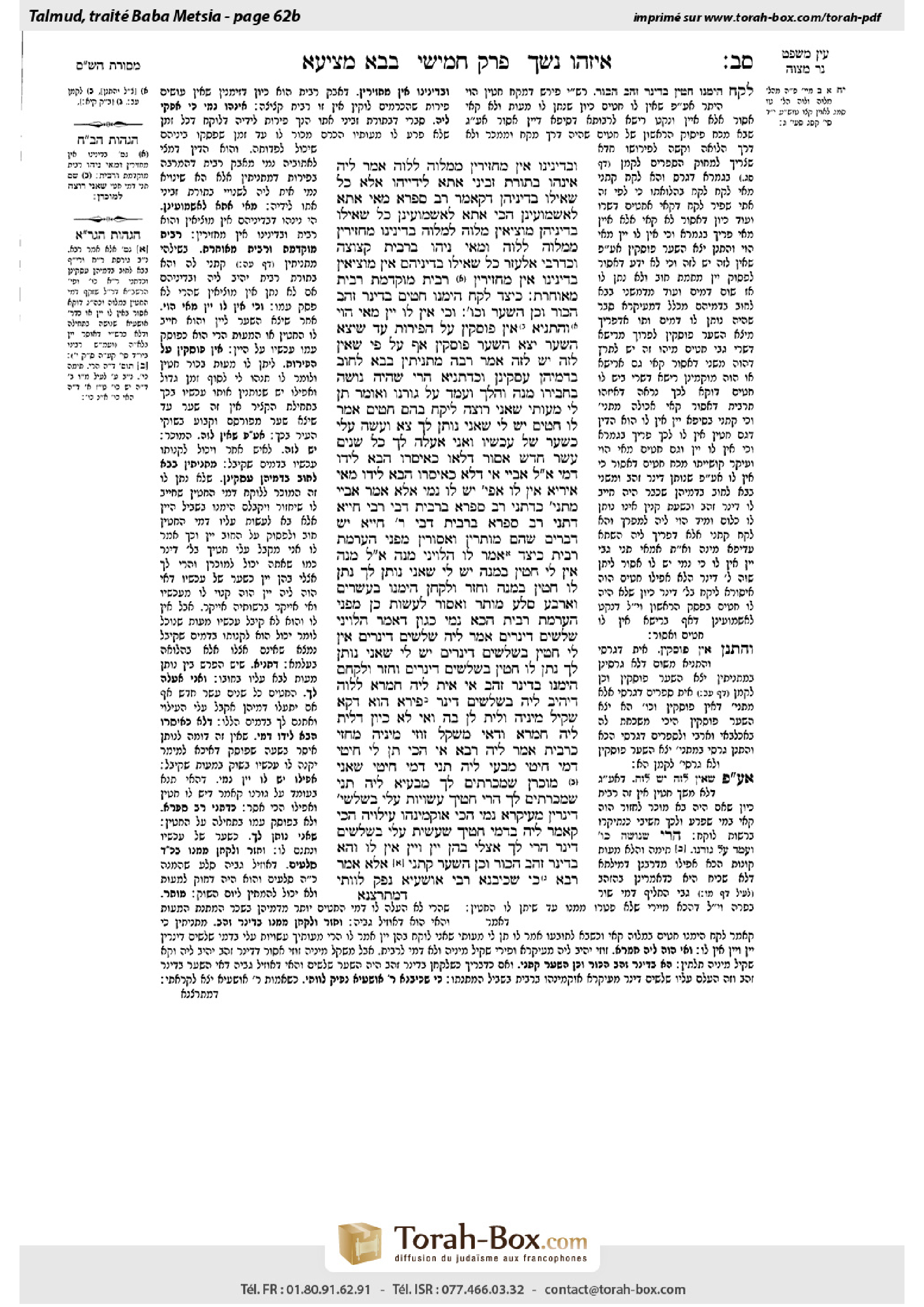
Bava Metzia 62b: Talmud study for Daf Yomi
Study the Talmud for Daf Yomi with scanned pages, Hebrew text, English translations from Sefaria and AI-generated French translations.
Passage selection and English or AI-generated French translation are available where the scan has annotations. Daf Study is independent of Torah-Box and Sefaria.
Browse Bava Metzia · בבא מציעא · All tractatesBava Metzia 62b text and translations
This page of Bava Metzia includes the Aramaic text, an English translation and an AI-generated French translation, alongside the scan above.
בבא מציעא ס״ב ב · Aramaic and Hebrew text
וּבְדִינֵינוּ אֵין מַחְזִירִין מִמַּלְוֶה לְלֹוֶה. אֲמַר לֵיהּ: אִינְהוּ, בְּתוֹרַת זְבִינֵי אֲתָא לִידַיְיהוּ.
אֶלָּא כֹּל שֶׁאִילּוּ בְּדִינֵיהֶן, דְּקָאָמַר רַב סָפְרָא: מַאי אֲתָא לְאַשְׁמוֹעִינַן! הָכִי אֲתָא לְאַשְׁמוֹעִינַן: כֹּל שֶׁאִילּוּ בְּדִינֵיהֶן מוֹצִיאִין מִלֹּוֶה לְמַלְוֶה, בְּדִינֵינוּ מַחְזִירִין מִמַּלְוֶה לְלֹוֶה, וּמַאי נִיהוּ – בְּרִבִּית קְצוּצָה, וְכִדְרַבִּי אֶלְעָזָר.
כֹּל שֶׁאִילּוּ בְּדִינֵיהֶם אֵין מוֹצִיאִין, בְּדִינֵינוּ אֵין מַחְזִירִין – רִבִּית מוּקְדֶּמֶת, רִבִּית מְאוּחֶרֶת.
כֵּיצַד: לָקַח הֵימֶנּוּ חִטִּים בְּדִינַר זָהָב הַכּוֹר, וְכֵן הַשַּׁעַר וְכוּ׳. וְכִי אֵין לוֹ יַיִן, מַאי הָוֵי?
וְהָתַנְיָא: אֵין פּוֹסְקִין עַל הַפֵּירוֹת עַד שֶׁיֵּצֵא הַשַּׁעַר, יָצָא הַשַּׁעַר – פּוֹסְקִין, אַף עַל פִּי שֶׁאֵין לָזֶה, יֵשׁ לָזֶה!
אָמַר רַבָּה: מַתְנִיתִין בְּבָא לָחוּב בִּדְמֵיהֶן עָסְקִינַן.
וְכִדְתַנְיָא: הֲרֵי שֶׁהָיָה נוֹשֶׁה בַּחֲבֵירוֹ מָנֶה, וְהָלַךְ וְעָמַד עַל גּוֹרְנוֹ, וְאוֹמֵר: תֵּן לִי מְעוֹתַי, שֶׁאֲנִי רוֹצֶה לִיקַּח בָּהֶם חִטִּים. אָמַר לוֹ: חִטִּים יֵשׁ לִי שֶׁאֲנִי נוֹתֵן לְךָ, צֵא וַעֲשֵׂה עָלַי כְּשַׁעַר שֶׁל עַכְשָׁיו, וַאֲנִי אַעֲלֶה לְךָ כׇּל שְׁנֵים עָשָׂר חֹדֶשׁ – אָסוּר, דְּלָאו כְּאִיסָּרוֹ הַבָּא לְיָדוֹ דָּמֵי.
אֲמַר לֵיהּ אַבָּיֵי: אִי דְּלָא כְּאִיסָּרוֹ הַבָּא לְיָדוֹ, מַאי אִירְיָא ״אֵין לוֹ״? אֲפִילּוּ יֵשׁ לוֹ נָמֵי! אֶלָּא אָמַר אַבָּיֵי: מַתְנִיתִין, כִּדְתָנֵי רַב סָפְרָא בְּרִבִּית דְּבֵי רַבִּי חִיָּיא.
דְּתָנֵי רַב סָפְרָא בְּרִבִּית דְּבֵי רַבִּי חִיָּיא: יֵשׁ דְּבָרִים שֶׁהֵם מוּתָּרִין וַאֲסוּרִין מִפְּנֵי הַעֲרָמַת רִבִּית. כֵּיצַד? אָמַר לוֹ: הַלְוֵינִי מָנֶה! אָמַר לוֹ: מָנֶה אֵין לִי, חִטִּין בְּמָנֶה יֵשׁ לִי שֶׁאֲנִי נוֹתֵן לָךְ. נָתַן לוֹ חִטִּין בְּמָנֶה, וְחָזַר וּלְקָחָן הֵימֶנּוּ בְּעֶשְׂרִים וְאַרְבַּע סֶלַע – מוּתָּר, וְאָסוּר לַעֲשׂוֹת כֵּן מִפְּנֵי הַעֲרָמַת רִבִּית.
הָכָא נָמֵי. כְּגוֹן דְּאָמַר: הַלְוֵינִי שְׁלֹשִׁים דִּינָרִים, אֲמַר לֵיהּ: שְׁלֹשִׁים דִּינָרִים אֵין לִי, חִטִּין בִּשְׁלֹשִׁים דִּינָרִים יֵשׁ לִי שֶׁאֲנִי נוֹתֵן לָךְ. נָתַן לוֹ חִטִּין בִּשְׁלֹשִׁים דִּינָרִים, וְחָזַר וּלְקָחָם הֵימֶנּוּ בְּדִינַר זָהָב. אִי אִית לֵיהּ חַמְרָא לְלֹוֶה, דְּיָהֵיב לֵיהּ בִּשְׁלֹשִׁים דִּינָר – פֵּירָא הוּא דְּקָא שָׁקֵיל מִינֵּיהּ, וְלֵית לַן בַּהּ. וְאִי לָא, כֵּיוָן דְּלֵית לֵיהּ חַמְרָא – וַדַּאי מִשְׁקַל זוּזֵי מִינֵּיהּ, מִחֲזֵי כְּרִבִּית.
אֲמַר לֵיהּ רָבָא: אִי הָכִי, ״תֵּן לִי חִיטַּי״, דְּמֵי חִיטַּי מִבְּעֵי לֵיהּ! תְּנִי ״דְּמֵי חִיטַּי״. ״שֶׁאֲנִי מוֹכְרָן״, ״שֶׁמְּכַרְתִּים לָךְ״ מִבַּעְיָא לֵיהּ! תְּנִי ״שֶׁמְּכַרְתִּים לָךְ״. ״הֲרֵי חִטֶּיךָ עֲשׂוּיוֹת עָלַי בִּשְׁלֹשִׁים דִּינָרִין״, מֵעִיקָּרָא נָמֵי הָכִי אוֹקְמִינְהוּ עִילָּוֵיהּ! הָכִי קָאָמַר לֵיהּ: בִּדְמֵי חִטֶּיךָ שֶׁעָשִׂיתָ עָלַי בִּשְׁלֹשִׁים דִּינָר.
״הֲרֵי לָךְ אֶצְלִי בָּהֶן יַיִן וְיַיִן אֵין לוֹ״, וְהָא ״בְּדִינַר זָהָב הַכּוֹר וְכֵן הַשַּׁעַר״ קָתָנֵי! אֶלָּא אָמַר רָבָא: כִּי שָׁכֵיבְנָא רַבִּי אוֹשַׁעְיָא נְפַק לְווֹתִי,
Bava Metzia 62b · English translation
And yet, by our laws one does not return the interest from the lender to the borrower. Since the interest was not fixed from the outset, and there is also no certainty that he will consume any produce, this is merely a case of a hint of interest. Rav Ashi said to him: The gentiles do not consider that transaction a loan; rather, they see this as a case where the field came into his possession by means of a transaction in the form of a sale. The field was temporarily sold to the lender, who sells it back to the borrower when the debt is paid.
The Gemara asks: But if one is a case of deposit and the other is a case of sale, the principle that begins with: Any case where by their laws, that Rav Safra is saying, what is he coming to teach us? The Gemara answers that this is what he is coming to teach us: In any case where by their laws one removes the interest from the possession of the borrower to give to the lender, by our laws one returns the interest from the lender to the borrower. And what is that case? It is a case of fixed interest, and it is in accordance with the opinion of Rabbi Elazar.
And as for the statement that in any case where by their laws one does not remove the interest from the possession of the borrower to give to the lender, by our laws one does not return the interest from the lender to the borrower, this is referring to a case of prior interest, i.e., interest paid prior to the granting of a loan in order to induce the lender to grant the loan, and subsequent interest, i.e., a gift given after a loan has been repaid to show thanks to the lender for lending the money. Although paying these types of interest is prohibited, as they are not actually part of the agreement, by our laws one does not compel the lender to return those payments.
§ The mishna teaches: How so? For example, one acquired wheat from another at the price of one kor of wheat for one gold dinar, worth twenty-five silver dinars, with the wheat to be supplied at a later date, and such was the market price of wheat at the time he acquired it. The price of a kor of wheat then increased and stood at thirty dinars. At that point, the buyer said to the seller: Give me all of my wheat now, as I wish to sell it and purchase wine with it. The seller said to him: Each kor of your wheat is considered by me to be worth thirty dinars, and you have the right to collect its value in wine from me. And in this case, the seller does not have wine in his possession. The seller is considered to be a borrower with regard to the lender, who is viewed as lending the wheat to the seller. The Gemara asks: And if he does not have any wine, what of it? Why is this factor relevant?
But isn’t it taught in a baraita: When purchasing produce to be collected by the buyer at a later stage, one may not set a price for produce until the market rate is publicized. If the rate has been publicized, one may set a price, despite the fact that the seller is not actually in possession of any such produce, as even though this seller does not have any of that produce, that one, i.e., another seller, does have some of that produce, which the first seller could purchase at the market rate. Evidently, once the market rate is publicized, the transaction is considered a purchase and not a loan with interest, even if the buyer does not receive the produce immediately.
Rabba said: In the mishna, we are dealing with one who comes to incur a debt for their value, i.e., for the value of the wine. If the borrower, i.e., the seller, possessed wine at that time he would have transferred it to the lender, i.e., the buyer, in place of the wheat, and this could have constituted a proper sale. Since he did not possess any wine, he promised it to the seller at a later date for a higher price, and this constituted a loan with interest as opposed to a sale.
And this is as it is taught in a baraita: If a person was owed one hundred dinars by another, and he went and stood by the other’s granary and said to him: Give me my money, as I wish to buy wheat with it. And the debtor said to him: I have wheat in my granary that I will give you; go and calculate for me the amount of wheat to which you are entitled by the current market rate, and I will give you this amount of wheat over the span of a full twelve months, even if the price rises in the interim. Such a practice is forbidden because of interest, as this is not similar to a case where his issar has come into his possession. Since the lender did not give the borrower even a single issar as payment for the wheat, this is not a sale, but a loan with interest.
Abaye said to Rabba: If this transaction is forbidden because it is not similar to a case where his issar has come into his possession, why does the mishna specifically teach the case where he does not have wine? Even if he does have wine, it would also be forbidden, as he gave no money at the time of the acquisition. Rather, Abaye rejected Rabba’s explanation and said: The mishna should be understood like the baraita taught by Rav Safra with regard to the halakhot of interest, which was taught originally in the school of Rabbi Ḥiyya.
As Rav Safra taught a baraita from the school of Rabbi Ḥiyya with regard to interest: There are matters that are intrinsically permitted by Torah law, but are prohibited because they are artifices used to circumvent transgressing the prohibition of interest. How so? If one said to another: Lend me one hundred dinars, and the other said to him: I do not have one hundred dinars but I have wheat worth one hundred dinars that I will give you, and he gave him wheat worth one hundred dinars, and later he went and acquired the wheat back from him for twenty-four sela, the equivalent of ninety-six dinars, this is permitted by Torah law, as it is considered a double transaction since it included first a loan of the equivalent of one hundred dinars, and then the purchase of the wheat at a discounted rate. But it is prohibited to do so by rabbinic law because this is an artifice allowing the circumvention of transgressing the prohibition of interest.
Here too, the mishna is referring to a case where he said to him: Lend me thirty dinars, and the other said to him: I do not have thirty dinars, but I have wheat worth thirty dinars that I will give you. He then gave him wheat worth thirty dinars, and he subsequently went and acquired the wheat back from him for a gold dinar, which is worth twenty-five dinars. In this case, if the borrower has wine that he gives him in place of the thirty dinars, it is produce that the lender takes from him, and therefore we have no problem with it. And if not, since he does not have wine, certainly the taking of money from him has at least the appearance of interest.
Rava said to Abaye: If so, your explanation does not accord with the wording of the mishna, as the mishna states: Give me my wheat, while according to your interpretation it should have said: Give me the value of my wheat. Abaye responds: Emend the text and teach: The value of my wheat. Rava further asked: The phrase: As I wish to sell it, is also imprecise, as it should have said: Which I sold to you. Abaye again suggests: Emend the text and teach: Which I sold to you. Rava raises yet another difficulty concerning the language of the mishna. The tanna states: Your wheat is considered by me to be worth thirty dinars, but while according to your interpretation he had also established the price for him at this amount at the outset. Abaye answers: This is what he is saying to him: The wine should be collected according to the value of your wheat that you calculated for me at thirty dinars.
Rava continued to question the wording of the mishna. It states: And you have the right to collect its value in wine from me, and he does not have wine in his possession. But the tanna taught: At the price of one kor of wheat for one gold dinar, and indeed that is the market price of wheat at the time. Both of these clauses do not accord with Abaye’s explanation. Rather, Rava said another explanation. He prefaced it by commenting: When I die, Rabbi Oshaya will come out from the Garden of Eden to greet me,
Bava Metzia 62b · Traduction française (IA)
Et pourtant, selon nos lois, on ne rend pas l'intérêt au prêteur par le débiteur. Puisque l'intérêt n'était pas fixé dès le départ, et qu'il n'y a pas non plus de certitude qu'il consomme quelque produit que ce soit, c'est simplement un cas de simple indication d'intérêt. Rav Ashi dit à lui : Les Gentils ne considèrent pas cette transaction comme un prêt ; ils la voient plutôt comme un cas où le champ est entré en possession de la personne par le biais d'une transaction de vente. Le champ a été temporairement vendu au prêteur, qui le revend à nouveau au débiteur lors du paiement de la dette.
La Guemara pose la question : Mais si l'un est un cas de dépôt et l'autre un cas de vente, le principe qui commence par : Tout cas où, selon leurs lois, Rav Safra dit, que veut-il nous enseigner ? La Guemara répond que c'est ce qu'il veut nous enseigner : dans tout cas où, selon leurs lois, on retire l'intérêt de la possession du débiteur pour le donner au prêteur, selon nos lois, on rend l'intérêt du prêteur au débiteur. Et quel est ce cas ? C'est un cas d'intérêt fixé, et cela correspond à l'opinion de Rabbi Elazar.
Et quant à l'affirmation que dans tout cas où, selon leurs lois, on ne retire pas l'intérêt de la possession du débiteur pour le donner au prêteur, selon nos lois, on ne rend pas l'intérêt du prêteur au débiteur, cela fait référence à un cas d'intérêt antérieur, c'est-à-dire un intérêt payé avant la concession du prêt afin d'inciter le prêteur à accorder le prêt, et d'intérêt ultérieur, c'est-à-dire un cadeau donné après le remboursement du prêt pour montrer sa gratitude envers le prêteur pour avoir prêté l'argent. Bien que le paiement de ces types d'intérêts soit interdit, puisqu'ils ne font pas réellement partie de l'accord, selon nos lois, on ne force pas le prêteur à rendre ces paiements.
§ La Michna enseigne : Comment cela se passe-t-il ? Par exemple, l'un a acheté du blé à un autre au prix d'un kor de blé pour un dinar d'or, valant vingt-cinq dinars d'argent, avec le blé à être fourni ultérieurement, et c'était le prix du blé à l'époque de l'achat. Le prix d'un kor de blé a ensuite augmenté et s'est élevé à trente dinars. À ce moment-là, l'acheteur a dit au vendeur : Donnez-moi tout mon blé maintenant, car je veux le vendre et acheter du vin avec. Le vendeur a dit à lui : Chaque kor de votre blé est considéré par moi comme valant trente dinars, et vous avez le droit de réclamer sa valeur en vin de ma part. Et dans ce cas, le vendeur ne possède pas de vin. Le vendeur est considéré comme un emprunteur envers le prêteur, qui est vu comme ayant prêté le blé au vendeur. La Guemara pose la question : Et s'il n'a pas de vin, qu'est-ce que cela change ? Pourquoi ce facteur est-il pertinent ?
Mais n'est-ce pas enseigné dans une baraïta : Lors de l'achat de produits à être récupérés ultérieurement par l'acheteur, on ne peut pas fixer un prix pour les produits avant que le taux du marché ne soit publié. Si le taux a été publié, on peut fixer un prix, même si le vendeur ne possède pas réellement de tels produits, car même si ce vendeur n'a pas de tels produits, un autre vendeur en possède certains, que le premier vendeur pourrait acheter au taux du marché. Évidemment, une fois que le taux du marché est publié, la transaction est considérée comme un achat et non un prêt avec intérêt, même si l'acheteur ne reçoit pas les produits immédiatement.
Rabba dit : Dans la Michna, nous traitons d'une personne qui vient contracter une dette pour sa valeur, c'est-à-dire pour la valeur du vin. Si le vendeur, c'est-à-dire le prêteur, possédait du vin à ce moment-là, il aurait transféré ce vin au prêteur, c'est-à-dire à l'acheteur, à la place du blé, et cela aurait pu constituer une vente valide. Puisque il ne possédait pas de vin, il a promis de le lui donner ultérieurement à un prix plus élevé, et cela constitue un prêt avec intérêt plutôt qu'une vente.
Et cela est enseigné dans une baraïta : Si une personne devait un hundred dinars à une autre, et il est allé se tenir à côté du grenier de l'autre et a dit : Donnez-moi mon argent, car je veux l'acheter de blé avec. Et le débiteur a dit à lui : J'ai du blé dans mon grenier que je vais te donner ; va et calcule pour moi la quantité de blé à laquelle tu as droit selon le taux du marché actuel, et je te donnerai cette quantité de blé sur une période de douze mois entiers, même si le prix augmente pendant ce temps. Une telle pratique est interdite en raison d'intérêt, car cela n'est pas comparable à un cas où son issar est entré en sa possession. Puisque le prêteur n'a pas donné au débiteur même un seul issar comme paiement pour le blé, cela n'est pas une vente, mais un prêt avec intérêt.
Abaye a dit à Rabba : Si cette transaction est interdite en raison de ne pas être comparable à un cas où son issar est entré en sa possession, pourquoi la Michna enseigne spécifiquement le cas où il n'a pas de vin ? Même s'il en possède, cela serait également interdit, car il n'a pas donné d'argent à l'époque de l'achat. Plutôt, Abaye a rejeté l'explication de Rabba et a dit : La Michna devrait être comprise comme la baraïta enseignée par Rav Safra concernant les halakhot d'intérêt, qui a été enseignée initialement dans l'école de Rabbi Ḥiyya.
Rav Safra a enseigné une baraïta de l'école de Rabbi Ḥiyya concernant l'intérêt : Il y a des choses qui sont intrinsèquement permises par la loi divine, mais sont interdites car elles sont des artifices utilisés pour contourner la transgression de l'intérêt. Comment cela ? Si l'un a dit à l'autre : Prête-moi cent dinars, et l'autre a dit à lui : Je n'ai pas cent dinars, mais j'ai du blé valant cent dinars que je vais te donner, et il lui a donné du blé valant cent dinars, et plus tard il est allé acheter ce blé à nouveau à lui pour vingt-quatre sela, équivalent de quatre-vingt-dix-six dinars, cela est permis par la loi divine, car cela est considéré comme une transaction double puisqu'il y a eu d'abord un prêt équivalent à cent dinars, puis l'achat du blé à un prix réduit. Mais il est interdit de le faire selon la loi rabbinique, car c'est un artifice permettant de contourner la transgression de l'intérêt.
Ici aussi, la Michna fait référence à un cas où l'un dit à l'autre : Prête-moi trente dinars, et l'autre dit : Je n'ai pas trente dinars, mais j'ai du blé valant trente dinars que je te donnerai. Il lui donne alors du blé valant treinte dinars, et ensuite il va acheter ce blé à nouveau auprès de lui pour un dinar d'or, ce qui vaut vingt-cinq dinars. Dans ce cas, si le prêteur lui donne du vin à la place des trente dinars, c'est de la production que le prêteur prend, et donc nous n'avons pas de problème avec cela. Et si ce n'est pas le cas, puisque l'homme n'a pas de vin, certainement l'emprunt d'argent de sa part a au moins l'apparence d'intérêt.
Rava dit à Abaye : Si c'est ainsi, votre explication ne correspond pas au texte de la Michna, car la Michna dit : Donne-moi ton blé, alors que selon votre interprétation, elle aurait dû dire : Donne-moi la valeur de ton blé. Abaye répond : Corrigez le texte et enseignez : La valeur de ton blé. Rava demande encore : La phrase : Comme je veux le vendre, est aussi imprecise, car elle aurait dû dire : Que j'ai vendu à toi. Abaye suggère à nouveau : Corrigez le texte et enseignez : Que j'ai vendu à toi. Rava soulève une autre difficulté concernant la formulation de la Michna. Le tanna dit : Ton blé est considéré par moi comme valant trente dinars, mais selon votre interprétation, il avait aussi fixé le prix à cet égard dès le début. Abaye répond : C'est ce qu'il lui dit : Le vin doit être récupéré selon la valeur de ton blé que tu as calculé pour moi à trente dinars.
Rava continua à questionner la formulation de la Michna. Elle dit : Et tu as le droit de récupérer sa valeur en vin de ma part, et il n'a pas de vin en sa possession. Mais le tanna enseigne : À un prix d'un kor de blé pour un dinar d'or, et en effet, c'est le prix du marché à l'époque. Ces deux clauses ne correspondent pas à l'explication d'Abaye. Plutôt, Rava dit une autre explication. Il commence par commenter : Quand je mourrai, Rabbi Oshaya sortira du Jardin d'Éden pour me saluer,
Traduction française générée par IA à partir de l’édition anglaise de Sefaria. Vérifie toujours un passage avec le texte source.
Text from Sefaria: William Davidson Edition - Vocalized Aramaic (CC BY NC); William Davidson Edition - English (CC BY NC).