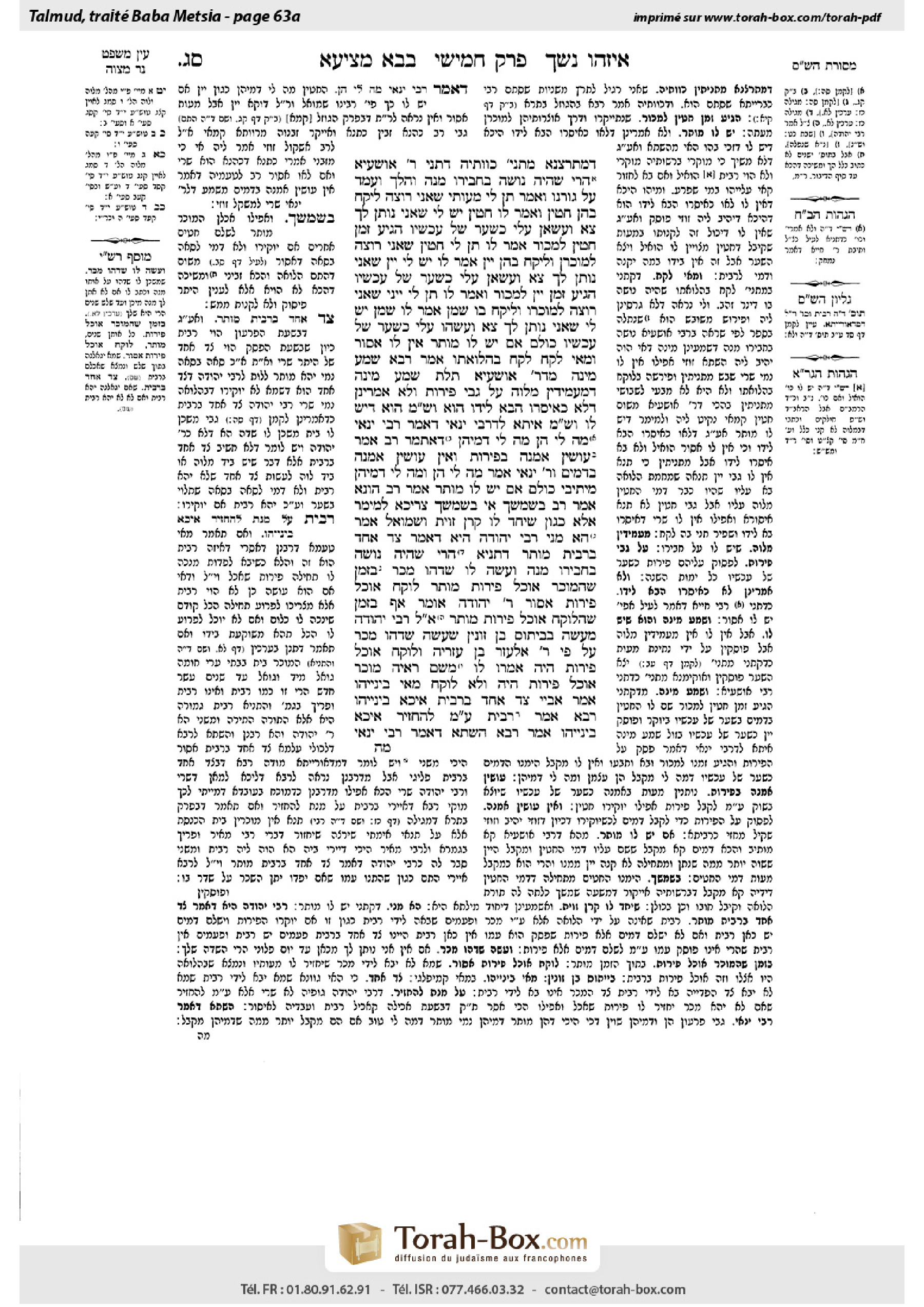
Bava Metzia 63a: Talmud study for Daf Yomi
Study the Talmud for Daf Yomi with scanned pages, Hebrew text, English translations from Sefaria and AI-generated French translations.
Passage selection and English or AI-generated French translation are available where the scan has annotations. Daf Study is independent of Torah-Box and Sefaria.
Browse Bava Metzia · בבא מציעא · All tractatesBava Metzia 63a text and translations
This page of Bava Metzia includes the Aramaic text, an English translation and an AI-generated French translation, alongside the scan above.
בבא מציעא ס״ג א · Aramaic and Hebrew text
דִּמְתָרַצְנָא מַתְנִיתִין כְּווֹתֵיהּ.
דְּתָנֵי רַבִּי אוֹשַׁעְיָא: הֲרֵי שֶׁהָיָה נוֹשֶׁה בַּחֲבֵירוֹ מָנֶה, וְהָלַךְ וְעָמַד עַל גּוֹרְנוֹ וְאָמַר: תֵּן לִי מְעוֹתַי, שֶׁאֲנִי רוֹצֶה לִיקַּח בָּהֶן חִטִּין. וְאָמַר לוֹ: חִטִּין יֵשׁ לִי שֶׁאֲנִי נוֹתֵן לְךָ, צֵא וַעֲשָׂאֵן עָלַי כְּשַׁעַר שֶׁל עַכְשָׁיו. הִגִּיעַ זְמַן חִטִּין לִמְכּוֹר, אָמַר לוֹ: תֵּן לִי חִטִּין, שֶׁאֲנִי רוֹצֶה לְמוֹכְרָן וְלִיקַּח בָּהֶן יַיִן. אָמַר לוֹ: יֵשׁ לִי יַיִן שֶׁאֲנִי נוֹתֵן לְךָ, צֵא וַעֲשָׂאֵן עָלַי כְּשַׁעַר שֶׁל עַכְשָׁיו.
הִגִּיעַ זְמַן יַיִן לִמְכּוֹר, וְאָמַר לוֹ: תֵּן לִי יֵינִי שֶׁאֲנִי רוֹצֶה לְמוֹכְרוֹ וְלִיקַּח בּוֹ שֶׁמֶן. אָמַר לוֹ: שֶׁמֶן יֵשׁ לִי שֶׁאֲנִי נוֹתֵן לְךָ, צֵא וַעֲשֵׂהוּ עָלַי כְּשַׁעַר שֶׁל עַכְשָׁיו. כּוּלָּם, אִם יֵשׁ לוֹ – מוּתָּר. אֵין לוֹ – אָסוּר. וּמַאי ״לָקַח״ – לָקַח בְּהַלְוָאָתוֹ.
אָמַר רָבָא: שְׁמַע מִינַּהּ מִדְּרַבִּי אוֹשַׁעְיָא תְּלָת. שְׁמַע מִינַּהּ דְּמַעֲמִידִין מִלְוֶה עַל גַּבֵּי פֵּירוֹת, וְלָא אָמְרִינַן דְּלָא כְּאִיסָּרוֹ הַבָּא לְיָדוֹ הוּא. וּשְׁמַע מִינַּהּ: הוּא דְּיֵשׁ לוֹ. וּשְׁמַע מִינַּהּ: אִיתַהּ לִדְרַבִּי יַנַּאי.
דְּאָמַר רַבִּי יַנַּאי: מָה לִי הֵן מָה לִי דְּמֵיהֶן.
דְּאִתְּמַר, רַב אָמַר: עוֹשִׂין אֲמָנָה בְּפֵירוֹת. וְאֵין עוֹשִׂין אֲמָנָה בְּדָמִים. וְרַבִּי יַנַּאי אָמַר: מָה לִי הֵן, וּמָה לִי דְּמֵיהֶן.
מֵיתִיבִי: כּוּלָּם, אִם יֵשׁ לוֹ מוּתָּר. אָמַר רַב הוּנָא אָמַר רַב: בְּשֶׁמָּשַׁךְ. אִי בְּשֶׁמָּשַׁךְ צְרִיכָא לְמֵימַר? אֶלָּא כְּגוֹן שֶׁיִּחֵד לוֹ קֶרֶן זָוִית.
וּשְׁמוּאֵל אָמַר: הָא מַנִּי – רַבִּי יְהוּדָה הִיא, דְּאָמַר: צַד אֶחָד בְּרִבִּית מוּתָּר.
דְּתַנְיָא: הֲרֵי שֶׁהָיָה נוֹשֶׁה בַּחֲבֵירוֹ מָנֶה, וְעָשָׂה לוֹ שָׂדֵהוּ מֶכֶר. בִּזְמַן שֶׁהַמּוֹכֵר אוֹכֵל פֵּירוֹת – מוּתָּר. לוֹקֵחַ אוֹכֵל פֵּירוֹת – אָסוּר. רַבִּי יְהוּדָה אוֹמֵר: אַף בִּזְמַן שֶׁהַלּוֹקֵחַ אוֹכֵל פֵּירוֹת – מוּתָּר.
אָמַר לָהֶם רַבִּי יְהוּדָה: מַעֲשֶׂה בְּבַיְתוֹס בֶּן זוֹנִין שֶׁעָשָׂה שָׂדֵהוּ מֶכֶר עַל פִּי רַבִּי אֶלְעָזָר בֶּן עֲזַרְיָה וְלוֹקֵחַ אוֹכֵל פֵּירוֹת הָיָה! אָמְרוּ לוֹ: מִשָּׁם רְאָיָה?! מוֹכֵר אוֹכֵל פֵּרוֹת הָיָה, וְלֹא לוֹקֵחַ.
מַאי בֵּינַיְיהוּ? אָמַר אַבָּיֵי: צַד אֶחָד בְּרִבִּית אִיכָּא בֵּינַיְיהוּ. רָבָא אָמַר: רִבִּית עַל מְנָת לְהַחֲזִיר אִיכָּא בֵּינַיְיהוּ.
אָמַר רָבָא, הַשְׁתָּא דְּאָמַר רַבִּי יַנַּאי:
Bava Metzia 63a · English translation
as I resolve the mishna in accordance with his opinion, expressed in the baraitot he edited.
Rava explains: As Rabbi Oshaya teaches in a baraita: One was owed one hundred dinars by another, and he went and stood by the other’s granary and said: Give me my money, as I wish to buy wheat with it, and the other said to him: I have wheat in my granary that I will give you; go and calculate for me the amount to which you are entitled at the current market rate. When the time to sell wheat arrived, the lender said to him: Give me wheat, as I want to sell it and acquire wine with the money received for it. The borrower said to him: I have wine that I will give you; go and calculate for me the amount of wine to which you are entitled at the current market rate.
The baraita continues: Then the time to sell wine arrived, and the lender said to the borrower: Give me my wine, as I want to sell it and acquire oil with the money received for it. The borrower said to him: I have oil that I will give you; go and calculate for me the amount of oil to which you are entitled at the current market rate. With regard to all such cases, if the borrower has wine and oil, the transaction is permitted, as this is a proper sale. But if he does not have these items it is forbidden. Since he cannot give him the merchandise at the current moment, if its value appreciates in the interim he is considered to have paid an additional sum for the delay of the repayment of the debt. Rava concludes his explanation: And what is the meaning in the mishna of: Acquired? It means that he acquired it as payment for his loan.
Rava said: Conclude from this baraita of Rabbi Oshaya three halakhot: Conclude from it that one may establish repayment of a loan upon produce, meaning that a borrower can promise to pay the lender in produce over the course of a year, based on the market rate at the beginning of the year, and we do not say that this is like a case where his issar has not already come into his possession, as Rabbi Ḥiyya said in the baraita on the previous amud. Since he owns produce it is as though he has provided it at the present time, and the current lack of payment is not significant. Accordingly, one can conclude from it another halakha, that this practice is permitted provided that he has produce in his possession. And further conclude from it that the halakha is in accordance with the opinion of Rabbi Yannai.
This is as Rabbi Yannai says: What difference is it to me if he referred to the produce, and what difference is it to me if he referred to the produce’s value? If he stipulated that he would receive a certain amount of produce, he can later take its value in money rather than the produce itself without violating the prohibition of interest.
As it was stated that amora’im disagreed about this issue: Rav says that one may make an arrangement of trust with regard to the delivery of items such as produce, i.e., one may loan the money in advance with the agreement that he will be repaid with produce at a later date, but one may not make an arrangement of trust with regard to money, i.e., one may not loan the money in advance with the agreement that he will receive the value of the produce at a later date, as this has the appearance of collecting interest. And Rabbi Yannai says: What difference is it to me if the agreement concerned the produce, and what difference is it to me if it concerned the produce’s value? Just as the lender can take the produce and sell it himself, he can likewise accept the value of the produce directly.
The Gemara raises an objection against Rav’s opinion from the above baraita: With regard to all of them, if the borrower has the items in his possession, it is permitted, apparently even if he actually pays with something else. Rav Huna says that Rav says: That baraita is stated with regard to a case where the lender pulled the produce itself, thereby performing an act of acquisition. The Gemara questions Rav Huna’s statement: If he pulled the produce, does it need to be said? After all, there was a proper act of acquisition. Rather, the baraita is discussing a case where the borrower designated a corner for the lender in which to place the produce that he acquired. For the purposes of this halakha, such an action is sufficient.
And Shmuel said: In accordance with whose opinion is this baraita, which permits the practice if the borrower is in possession of such produce? It is in accordance with that of Rabbi Yehuda, who said that uncertain interest, a transaction that may or may not result in the payment of interest, is permitted. Rabbi Yehuda holds that if at the time of the loan it was not certain that the agreement would result in the paying of interest, then even if it is so that if specific circumstances were to develop there would be interest paid according to the agreement, the transaction is permitted.
As it is taught in a baraita: If one was owed one hundred dinars by another, and the borrower performed a sale of his field for him in order to repay the one hundred dinars, if they agreed that the seller, i.e., the borrower, consumes the produce of the field until the debt is repaid, this is certainly permitted, but if the buyer, i.e., the lender, consumes the produce, it is prohibited, as he is in effect taking the produce as interest while awaiting the payment that he is owed. Rabbi Yehuda says: Even if the buyer consumes the produce, it is permitted.
The tanna relates: Rabbi Yehuda said to the Sages: An incident occurred involving Baitos ben Zunin, who performed a sale of his field on the basis of a directive from Rabbi Elazar ben Azarya, and that was a case where the buyer consumed the produce. The Sages said to the tanna: Will you bring a proof from there? The reverse was the case: It was the seller, not the buyer, who consumed the produce.
The Gemara asks: What is the difference in opinion between the first tanna and Rabbi Yehuda? Abaye said: The difference between them concerns the halakha of uncertain interest. According to the opinion of Rabbi Yehuda, if it is uncertain that a transaction will ultimately involve the payment of interest, it is permitted. Rava said: The difference between them involves the status of interest taken on the condition that it be given back. Rava maintains that Rabbi Yehuda did not mean that the lender can consume the produce without payment, as he must repay the amount he ate if the borrower pays off his debt. The first tanna rules that since the sale is not yet final, his consumption of the produce constitutes interest.
Rava said: Now that Rabbi Yannai is saying
Bava Metzia 63a · Traduction française (IA)
alors que je résous la Michna conformément à son avis, exprimé dans les baraitot qu'il a rédigés.
Rava explique : Comme Rabbi Oshaya enseigne dans une baraïta : Un homme devait à un autre un hundred dinars, et il alla se poster près du grenier de l'autre et dit : Donnez-moi mon argent, car je veux l'employer pour acheter du blé, et l'autre lui dit : J'ai du blé dans mon grenier que je vais te donner ; va donc calculer la quantité à laquelle tu as droit selon le taux du marché actuel. Lorsque vint le moment de vendre du blé, le prêteur dit à l'emprunteur : Donne-moi du blé, car je veux le vendre et acheter du vin avec l'argent reçu. L'emprunteur lui dit : J'ai du vin que je vais te donner ; va donc calculer la quantité de vin à laquelle tu as droit selon le taux du marché actuel.
La baraïta continue : Lorsque vint le moment de vendre du vin, et le prêteur dit à l'emprunteur : Donne-moi ton vin, car je veux le vendre et acheter de l'huile avec l'argent reçu. L'emprunteur lui dit : J'ai de l'huile que je vais te donner ; va donc calculer la quantité d'huile à laquelle tu as droit selon le taux du marché actuel. En ce qui concerne tous ces cas, si l'emprunteur a du vin et de l'huile, la transaction est permise, car c'est une vente appropriée. Mais s'il n'a pas ces objets, elle est interdite. Puisque il ne peut lui donner les marchandises à ce moment, si leur valeur augmente pendant l'intervalle, il est considéré comme ayant payé une somme supplémentaire pour le retard du remboursement de la dette. Rava conclut son explication : Et quelle est la signification dans la Michna de : Acquis ? Cela signifie qu'il l'a acquis comme paiement de son prêt.
Rava dit : Conclure de cette baraïta de Rabbi Oshaya trois halakhot : Conclure qu'on peut établir le remboursement d'un prêt sur des produits, c'est-à-dire qu'un emprunteur peut promettre de rembourser le prêteur en produits au cours d'une année, en se basant sur le taux du marché au début de l'année, et nous ne disons pas que cela ressemble à un cas où son issar n'a pas encore été acquis, comme Rabbi Ḥiyya a dit dans la baraïta sur l'amud précédent. Puisqu'il possède des produits, cela est comme s'il les avait fournis à l'instant présent, et le manque actuel de paiement n'est pas significatif. Ainsi, on peut conclure d'après cela une autre halakha, que cette pratique est permise à condition qu'il possède des produits. Et enfin conclure que la halakha suit l'avis de Rabbi Yannai.
C'est ce que Rabbi Yannai dit : Quelle différence fait-il pour moi si l'accord concernait les produits, et quelle différence fait-il pour moi si l'accord concernait la valeur des produits ? Si l'emprunteur a stipulé qu'il recevrait une certaine quantité de produits, il peut plus tard prendre leur valeur en argent plutôt que les produits eux-mêmes sans enfreindre l'interdiction d'intérêt.
Comme il a été dit que les amoraïm s'entendaient sur ce sujet : Rav dit que l'on peut établir un arrangement de confiance concernant la livraison d'objets tels que des produits, c'est-à-dire qu'on peut prêter l'argent à l'avance avec l'accord de le récupérer plus tard en produits, mais on ne peut pas établir un arrangement de confiance concernant l'argent, c'est-à-dire qu'on ne peut pas prêter l'argent à l'avance avec l'accord de recevoir la valeur des produits plus tard, car cela a l'apparence de collecter des intérêts. Et Rabbi Yannai dit : Quelle différence fait-il pour moi si l'accord concernait les produits, et quelle différence fait-il pour moi si l'accord concernait la valeur des produits ? Tout comme le prêteur peut prendre les produits et les vendre lui-même, il peut également accepter directement la valeur des produits.
La Guemara soulève une objection contre l'avis de Rav à partir de la baraïta ci-dessus : En ce qui concerne tous ces cas, si l'emprunteur possède les objets, cela est permis, semble-t-il même s'il paie avec quelque chose d'autre. Rav Huna dit que Rav dit : Cette baraïta est formulée dans un cas où le prêteur a tiré lui-même les produits, effectuant ainsi un acte d'acquisition. La Guemara questionne l'affirmation de Rav Huna : Si le prêteur a tiré les produits, cela a-t-il besoin d'être dit ? Après tout, il y avait un acte d'acquisition approprié. Plutôt, la baraïta discute d'un cas où l'emprunteur a désigné un coin pour que le prêteur place les produits qu'il a acquis. Pour les besoins de cette halakha, telle action est suffisante.
Et Shmuel dit : Selon quel avis est-ce que cette baraïta, qui permet cette pratique si l'emprunteur possède de tels produits ? C'est selon celui de Rabbi Yehuda, qui a dit que l'intérêt incertain, une transaction qui peut ou ne peut pas entraîner le paiement d'intérêt, est permise. Rabbi Yehuda considère que si, au moment du prêt, il n'était pas certain que l'accord entraînerait le paiement d'intérêt, alors même si c'est tel que, si des circonstances spécifiques se développaient, il y aurait paiement d'intérêt selon l'accord, la transaction est permise.
Comme il est enseigné dans une baraïta : Si l'un devait à un autre un hundred dinars, et l'emprunteur effectuait une vente de son champ à l'effet de rembourser les hundred dinars, et s'ils convenaient que le vendeur, c'est-à-dire l'emprunteur, consommerait les produits du champ jusqu'au remboursement de la dette, cela est certainement permis, mais si c'était l'acheteur, c'est-à-dire le prêteur, qui consommait les produits, cela est interdit, car il prend effectivement les produits comme intérêt tout en attendant le paiement qu'il est dû. Rabbi Yehuda dit : Même si c'est l'acheteur qui consomme les produits, cela est permis.
Le tanna rapporte : Rabbi Yehuda dit aux Sages : Un incident s'est produit concernant Baitos ben Zunin, qui a effectué une vente de son champ sur la base d'une directive de Rabbi Elazar ben Azarya, et c'était un cas où le vendeur consommait les produits. Les Sages dirent au tanna : Vas-tu apporter une preuve de là ? Le contraire était le cas : c'était l'acheteur, et non le vendeur, qui consommait les produits.
Le Guemara pose la question : Quelle est la différence d'opinion entre le premier tanna et Rabbi Yéhuda ? Abaye dit : La différence entre eux concerne la halakha du bénéfice incertain. Selon l'opinion de Rabbi Yéhuda, si on ne sait pas avec certitude que la transaction entraînera finalement le paiement d'intérêts, cela est permis. Rava dit : La différence entre eux concerne le statut des intérêts acquis sous condition qu'ils soient rendus. Rava considère que Rabbi Yéhuda n'entendait pas dire que le prêteur puisse consommer les produits sans paiement, car il doit rembourser la quantité qu'il a mangée si le prêteur remborse sa dette. Le premier tanna considère que puisque la vente n'est pas encore conclue, la consommation des produits par le prêteur constitue un intérêt.
Rava a dit : Maintenant que Rabbi Yannai dit
Traduction française générée par IA à partir de l’édition anglaise de Sefaria. Vérifie toujours un passage avec le texte source.
Text from Sefaria: William Davidson Edition - Vocalized Aramaic (CC BY NC); William Davidson Edition - English (CC BY NC).