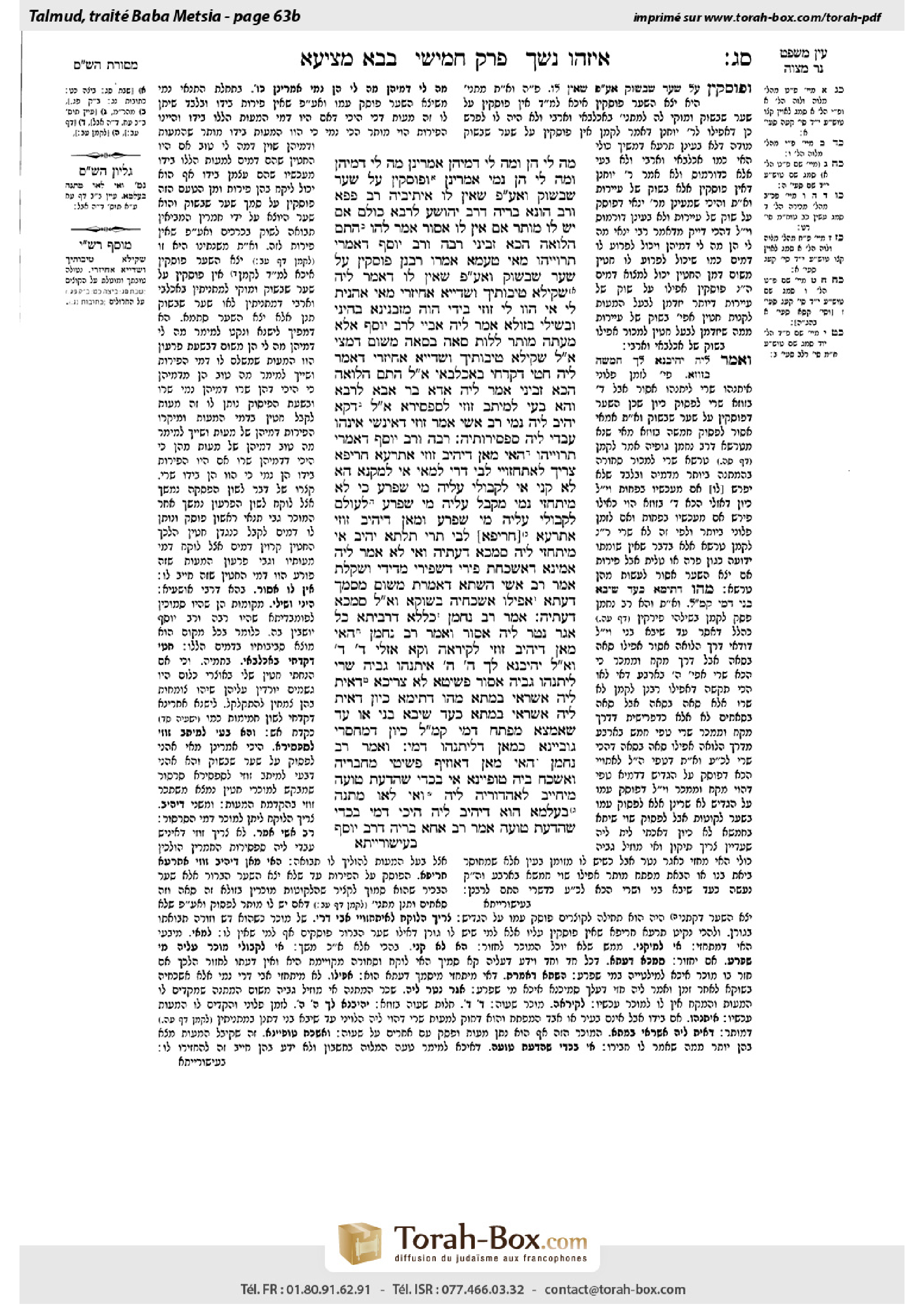
Bava Metzia 63b: Talmud study for Daf Yomi
Study the Talmud for Daf Yomi with scanned pages, Hebrew text, English translations from Sefaria and AI-generated French translations.
Passage selection and English or AI-generated French translation are available where the scan has annotations. Daf Study is independent of Torah-Box and Sefaria.
Browse Bava Metzia · בבא מציעא · All tractatesBava Metzia 63b text and translations
This page of Bava Metzia includes the Aramaic text, an English translation and an AI-generated French translation, alongside the scan above.
בבא מציעא ס״ג ב · Aramaic and Hebrew text
מָה לִי הֵן וּמָה לִי דְּמֵיהֶן – אָמְרִינַן, מָה לִי דְּמֵיהֶן וּמָה לִי הֵן – נָמֵי אָמְרִינַן. וּפוֹסְקִין עַל שַׁעַר שֶׁבַּשּׁוּק, וְאַף עַל פִּי שֶׁאֵין לוֹ.
אֵיתִיבֵיהּ רַב פָּפָּא וְרַב הוּנָא בְּרֵיהּ דְּרַב יְהוֹשֻׁעַ לְרָבָא: כּוּלָּם, אִם יֵשׁ לוֹ – מוּתָּר, אִם אֵין לוֹ – אָסוּר! אֲמַר לְהוּ: הָתָם הַלְוָאָה, הָכָא זְבִינֵי.
רַבָּה וְרַב יוֹסֵף דְּאָמְרִי תַּרְוַיְיהוּ: מַאי טַעְמָא אֲמַרוּ רַבָּנַן פּוֹסְקִין עַל שַׁעַר שֶׁבַּשּׁוּק וְאַף עַל פִּי שֶׁאֵין לוֹ? דְּאָמַר לֵיהּ: שְׁקִילָא טֵיבוּתָיךְ וְשַׁדְיָיא אַחִיזְרֵי. מַאי אַהְנֵית לִי? אִי הֲווֹ לִי זוּזֵי בִּידֵי – הֲוָה מְזַבֵּנְינָא בְּהִינֵי וּבְשִׁילֵי בְּזוּלָא.
אֲמַר לֵיהּ אַבָּיֵי לְרַב יוֹסֵף: אֶלָּא מֵעַתָּה מוּתָּר לִלְוֹת סְאָה בִּסְאָה, מִשּׁוּם דְּמָצֵי אֲמַר לֵיהּ: שְׁקִילָא טֵיבוּתָיךְ וְשַׁדְיָיא אַחִיזְרֵי, דְּאָמַר לֵיהּ: חִטֵּי דְּקָדְחִי בַּאֲכַלְבַּאי? אֲמַר לֵיהּ: הָתָם הַלְוָאָה, הָכָא – זְבִינֵי.
אֲמַר לֵיהּ אַדָּא בַּר אַבָּא לְרָבָא: וְהָא בָּעֵי לְמִיתַּב זוּזֵי לְסַפְסֵירָא! אֲמַר לֵיהּ: דְּקָא יָהֵיב לֵיהּ נָמֵי. רַב אָשֵׁי אָמַר: זוּזֵי דְּאִינָשֵׁי אִינְהוּ עָבְדִי לֵיהּ סַפְסֵירוּתֵיהּ.
רַבָּה וְרַב יוֹסֵף דְּאָמְרִי תַּרְוַיְיהוּ: הַאי מַאן דְּיָהֵיב זוּזֵי אַתַּרְעָא חֲרִיפָא, צָרִיךְ לְאִיתְחֲזוֹיֵי לְבֵי דָרֵי.
לְמַאי? אִי לְמִקְנֵא – הָא לָא קָנֵי, אִי לְקַבּוֹלֵי עֲלֵיהּ ״מִי שֶׁפָּרַע״, כִּי לָא מִיתְחֲזֵי נָמֵי מְקַבֵּל עֲלֵיהּ ״מִי שֶׁפָּרַע״!
לְעוֹלָם לְקַבּוֹלֵי עֲלֵיהּ ״מִי שֶׁפָּרַע״, וּמַאן דְּיָהֵיב זוּזֵי אַתַּרְעָא [חֲרִיפָא], לְבֵי תְרֵי תְּלָתָא יָהֵיב, אִי מִיתְחֲזֵי לֵיהּ – סָמְכָא דַּעְתֵּיהּ, וְאִי לָא – אָמַר לֵיהּ: אָמֵינָא דְּאַשְׁכַּחְתְּ פֵּירֵי דְּשַׁפִּירֵי מִדִּידִי וּשְׁקַלְתְּ.
אָמַר רַב אָשֵׁי: הַשְׁתָּא דְּאָמְרַתְּ מִשּׁוּם מִסְמָךְ דַּעְתָּא, אֲפִילּוּ אַשְׁכְּחֵיהּ בְּשׁוּקָא וַאֲמַר לֵיהּ – סָמְכָא דַּעְתֵּיהּ.
אָמַר רַב נַחְמָן: כְּלָלָא דְרִיבִּיתָא, כֹּל אֲגַר נְטַר לֵיהּ – אָסוּר. וְאָמַר רַב נַחְמָן: הַאי מַאן דְּיָהֵיב זוּזֵי לְקִירָאָה וְקָא אָזְלִי אַרְבַּע אַרְבַּע, וַאֲמַר לֵיהּ: יָהֵיבְנָא לָךְ חֲמֵשׁ חֲמֵשׁ, אִיתַנְהוּ גַּבֵּיהּ – שְׁרֵי, לֵיתַנְהוּ גַּבֵּיהּ – אָסוּר.
פְּשִׁיטָא! לָא צְרִיכָא דְּאִית לֵיהּ אַשְׁרַאי בְּמָתָא. מַהוּ דְּתֵימָא: כֵּיוָן דְּאִית לֵיהּ אַשְׁרַאי בְּמָתָא – כְּ״עַד שֶׁיָּבֹא בְּנִי״ אוֹ ״עַד שֶׁאֶמְצָא מַפְתֵּחַ״ דָּמֵי, קָא מַשְׁמַע לַן כֵּיוָן דִּמְחַסְּרִי גּוּבְיָינָא – כְּמַאן דְּלֵיתַנְהוּ דָּמֵי.
וְאָמַר רַב נַחְמָן: הַאי מַאן דְּאוֹזֵיף פְּשִׁיטֵי מֵחַבְרֵיהּ וְאַשְׁכַּח בֵּיהּ טוּפְיָינָא, אִי בִּכְדֵי שֶׁהַדַּעַת טוֹעָה – מִיחַיַּיב לְאַהֲדוֹרֵיהּ לֵיהּ, וְאִי לָאו – מַתָּנָה בְּעָלְמָא הוּא דְּיָהֵיב לֵיהּ.
הֵיכִי דָּמֵי ״בִּכְדֵי שֶׁהַדַּעַת טוֹעָה״? אָמַר רַב אַחָא בְּרֵיהּ דְּרַב יוֹסֵף:
Bava Metzia 63b · English translation
that we say: What difference is it to me if he referred to the produce, and what difference is it to me if he referred to the produce’s value, meaning that we do not require the payment to be in the form of the produce stipulated, we therefore also say: What difference is it to me if he referred to the produce’s value, and what difference is it to me if he referred to the produce, and therefore one may set a price by the market rate. And this is permitted even though he does not have produce at the present moment. Since he could purchase it if he wished it is considered as though he had the produce in his possession, and therefore one may make an agreement with another to provide him with produce at a later date in accordance with the current price.
Rav Pappa, and Rav Huna, son of Rav Yehoshua, raised an objection to the opinion of Rava from the aforementioned baraita, which explicitly teaches: With regard to all of them, if he has the produce in his possession, the transaction is permitted, and if he does not have it, the transaction is prohibited. Rava said to them: The tanna there is referring to a transaction for the repayment of the debt conducted after a loan has been given but before it has been repaid, whereas here Rabbi Yannai is dealing with an actual sale, without any loan at all, and therefore there is no interest involved.
Rabba and Rav Yosef both say: What is the reason that the Sages said one may set a price by the market rate and that one may do so even though he does not have the produce in his possession? Because the buyer says to the seller: Your favor is taken and thrown on the thorns. In other words, I am deriving no benefit from my transaction with you, as how have you helped me? If I had money in my hands I would buy the produce myself in the towns of Hini and Shili, nearby market towns, at an inexpensive price. Consequently, the acquisition of produce at the current market rate is of no benefit to him.
Abaye said to Rav Yosef: But if that is so, according to this same logic it should be permitted to lend a se’a of produce for a se’a of the same produce, as the lender can say to the borrower: Your favor is taken and thrown on the thorns, since he says to him: I stand to gain nothing from the se’a you will later give me, as the price of my wheat would increase if it were to remain in my granary, and therefore the loan does not benefit me at all, for will the wheat burn in my warehouse [be’akalbai]? Rav Yosef said to him: The two cases are different, as there it is referring to a loan, and consequently there is a concern about interest, whereas here it is a sale.
Adda bar Abba said to Rava: But with regard to establishing the repayment of the loan upon produce valued at the market rate, the buyer does stand to gain from the agreement, as, if he would have to go to acquire produce elsewhere, he would have to give a dinar to a broker, and therefore he gains a dinar from the early payment. Rava said to him: The case is one where the buyer also gives the seller the broker’s fee. Rav Ashi said: There is generally no need to add this fee, as a person’s dinars serve as a broker for him. One who has ready cash has no need for the services of a broker.
§ The Gemara addresses a related issue. Rabba and Rav Yosef both say: One who gives money in advance to purchase produce at the advance price that is in effect shortly after the harvest but before the market price is set must present himself at the granary when the seller is threshing his produce.
The Gemara asks: For what reason is he required to be there? If it is in order to acquire the produce, he does not acquire it by merely being present there, as the acquisition is not completed until he pulls the actual produce. And if it is in order for the seller to accept upon himself, in the event that he reneges on the transaction, the curse of: He Who exacted payment from the people of the generation of the flood, and from the people of the generation of the dispersion, will in the future exact payment from whoever does not stand by his statement (see 44a), even if the buyer does not present himself there the seller also accepts upon himself the curse of: He Who exacted payment. This curse is in effect for anyone who reneges on a transaction after the money has been paid.
The Gemara explains: Actually, the reason he must go to the granary is for the seller to accept upon himself the curse of: He Who exacted payment, for the following reason: One who gives money in advance to purchase produce at the advance price gives it to two or three different sellers, in order to ensure that he will collect a profit. Consequently, if he presents himself to the seller when he is threshing his produce, the seller relies upon him, as he knows the transaction will proceed. But if the buyer does not present himself to the seller when he is threshing his produce, the seller could say to him: I said to myself that you must have found better produce than mine, and you took that produce. Since the seller is unsure if the transaction will be completed, he may change his mind and sell to a different buyer.
Rav Ashi said: Now that you have said that the reason is due to the seller’s relying upon him, it can be concluded that the buyer does not have to go to the seller’s granary in order to convince him that he intends to uphold the transaction. Rather, even if the buyer finds the seller in the marketplace and says to him that he will not retract his offer to buy the produce, the seller will likewise rely upon him.
§ Rav Naḥman said: The principle with regard to the halakhot of interest is: Any payment for his waiting, meaning any additional sum added in consideration of the fact that the lender delays claiming his money, is forbidden. And Rav Naḥman also said: In the case of this one who gives money to a wax seller to purchase loaves of wax from him, and loaves of wax go at the current rate of one dinar for four loaves, and the seller said to him: I will give you wax in the future at the rate of five loaves for each dinar if you pay me now in advance, if the seller has wax with him at the time of the transaction, it is permitted to sell at a discounted rate because he is in need of cash. But if the seller does not have wax with him, it is forbidden, as the extra loaf given is interest.
The Gemara asks: Isn’t this obvious? It is clearly interest. The Gemara answers: No, it is necessary for a case where the seller has credit in the town, and therefore he could receive wax from others. It is necessary lest you say: Since he has credit in the town and could receive wax now, this should be similar to a case where he said: Give me produce until my son comes, or: Until I find the key, and therefore it is permitted to give him money, as this is not considered a loan (see 75a). Rav Naḥman therefore teaches us that since the loaves of wax still lack collection, i.e., the seller does not actually own them, they are considered as though they were not in existence, which means the reduction in price is classified as interest.
And Rav Naḥman said: In the case of this one who borrowed coins from another, and when he later counted them he found an additional amount of money, above the sum they had agreed upon, if the addition was within the range that a person can make a mistake, the assumption is that the lender erred in his calculation, and therefore the borrower is obligated to return the extra coins to him. But if not, if the difference was so large that it could not have been the result of a simple mistake, it must only be that the lender has given him a gift.
The Gemara inquires: What are the circumstances where the additional amount would be within the range that one can make a mistake? Rav Aḥa, son of Rav Yosef, said:
Bava Metzia 63b · Traduction française (IA)
que nous disons : Quelle différence cela fait-il pour moi si c'était les produits, et quelle différence cela fait-il pour moi si c'était la valeur des produits, c'est-à-dire que nous ne requérons pas le paiement sous la forme des produits stipulés, nous disons donc aussi : Quelle différence cela fait-il pour moi si c'était la valeur des produits, et quelle différence cela fait-il pour moi si c'était les produits, et donc on peut fixer un prix selon le taux du marché. Et cela est permis même s'il n'a pas de produits à l'instant présent. Puisqu'il pourrait les acheter s'il le voulait, on considère qu'il possède les produits, et donc on peut conclure un accord avec un autre pour lui fournir les produits à une date ultérieure conformément au prix actuel.
Rav Pappa, et Rav Huna, fils de Rav Yéhoshua, ont soulevé une objection contre l'opinion de Rava, tirée de la baraïta mentionnée précédemment, qui enseigne explicitement : Concernant tous ceux-ci, si il possède les produits, la transaction est permise, et si il ne les possède pas, la transaction est interdite. Rav a répondu à eux : Le tanna y parle d'une transaction concernant le remboursement d'une dette, effectuée après un prêt mais avant son remboursement, tandis que ici Rabbi Yannai traite d'une vente réelle, sans prêt du tout, et donc il n'y a pas d'intérêt impliqué.
Rabba et Rav Yosef disent tous les deux : Quelle est la raison pour laquelle les Sages ont dit qu'on peut fixer un prix selon le taux du marché et qu'on peut le faire même si on ne possède pas les produits ? Parce que l'acheteur dit au vendeur : Votre faveur est prise et jetée sur les épines. En d'autres termes, je ne tire aucun avantage de ma transaction avec vous, car comment avez-vous m'aider ? Si j'avais de l'argent en main, je achèterais les produits moi-même dans les villes de Hini et Shili, des marchés proches, à un prix abordable. Ainsi, l'acquisition des produits au taux du marché actuel n'apporte aucun avantage à lui.
Abaye dit à Rav Yosef : Mais si c'est ainsi, selon ce même raisonnement, il devrait être permis de prêter un se'a de produits pour un se'a de produits identiques, car le prêteur peut dire au prêteur : Votre faveur est prise et jetée sur les épines, car il dit : Je ne gagne rien du se'a que vous me donnerez plus tard, car le prix de mon blé augmenterait s'il restait dans mon grenier, et donc le prêt ne m'apporte aucun avantage, car le blé brûlerait-il dans mon entrepôt [be'akalbai] ? Rav Yosef répond à lui : Les deux cas sont différents, car le premier concerne un prêt, et donc il y a une crainte d'intérêt, tandis que celui-ci est une vente.
Adda bar Abba dit à Rava : Mais concernant l'établissement du remboursement du prêt sur des produits à la valeur du marché, l'acheteur tire réellement avantage de l'accord, car s'il devait aller acheter des produits ailleurs, il devrait donner un dinar à un intermédiaire, et donc il gagne un dinar par le paiement anticipé. Rava répond à lui : Le cas est celui où l'acheteur donne également à la vendeuse la commission de l'intermédiaire. Rav Ashi dit : Il n'y a généralement pas besoin d'ajouter cette commission, car les dinars d'une personne servent d'intermédiaire pour lui. Celui qui a de l'argent liquide n'a pas besoin des services d'un intermédiaire.
§ La Guemara aborde un sujet lié. Rabba et Rav Yosef disent tous les deux : Celui qui verse de l'argent à l'avance pour acheter des produits au prix d'advancement, qui est en vigueur peu après la récolte mais avant que le prix du marché ne soit fixé, doit se présenter au grenier lorsque le vendeur est en train de concasser ses produits.
La Guemara pose la question : Pour quelle raison est-il requis qu'il soit présent ? Si c'est pour acquérir les produits, il ne les acquiert pas simplement en étant présent là, car l'acquisition n'est pas achevée jusqu'à ce qu'il arrache les produits réels. Et si c'est pour que le vendeur s'engage, en cas de rétractation, à la malédiction : Celui qui a exigé le paiement des gens de la génération de la diluvion, et des gens de la génération de la dispersion, exigera à l'avenir le paiement de celui qui ne se tient pas à sa déclaration (voir 44a), même si l'acheteur ne se présente pas là, le vendeur s'engage également à la malédiction : Celui qui a exigé le paiement. Cette malédiction s'applique à toute personne qui rétracte une transaction après que l'argent ait été payé.
La Guemara explique : En réalité, la raison pour laquelle il doit aller au grenier est pour que le vendeur s'engage à la malédiction : Celui qui a exigé le paiement, pour la raison suivante : Celui qui verse de l'argent à l'avance pour acheter des produits au prix d'advancement le donne à deux ou trois vendeurs différents, afin de s'assurer qu'il collectera un profit. Ainsi, s'il se présente au vendeur lorsqu'il concasse ses produits, le vendeur se repose sur lui, car il sait que la transaction se réalisera. Mais si l'acheteur ne se présente pas au vendeur lorsqu'il concasse ses produits, le vendeur pourrait lui dire : J'ai pensé que vous aviez trouvé des produits meilleurs que les miens, et vous les avez pris. Puisque le vendeur est incertain si la transaction se réalisera, il peut changer d'avis et vendre à un autre acheteur.
Rav Ashi a dit : Maintenant que vous avez dit que la raison est due à la confiance du vendeur en lui, on peut conclure que l'acheteur n'a pas besoin d'aller au grenier du vendeur pour convaincre celui-ci qu'il tient à honorer la transaction. Plutôt, même si l'acheteur trouve le vendeur au marché et lui dit qu'il ne rétractera pas son offre d'acheter les produits, le vendeur se reposera également sur lui.
§ Rav Naḥman a dit : Le principe concernant les halakhot de l'intérêt est le suivant : toute rémunération pour son attente, c'est-à-dire toute somme supplémentaire ajoutée en raison du fait que le prêteur diffère de prétendre à son argent, est interdite. Et Rav Naḥman a également dit : Dans le cas d'une personne qui donne de l'argent à un vendeur de cire pour acheter des pains de cire, et que les pains de cire se vendent au taux actuel de un dinar pour quatre pains, et que le vendeur lui dit : Je te donnerai de la cire à l'avenir au taux de cinq pains pour chaque dinar si tu me paies maintenant à l'avance, si le vendeur a de la cire avec lui au moment de la transaction, il est permis de vendre à un taux réduit car il a besoin d'argent liquide. Mais si le vendeur n'a pas de cire avec lui, il est interdit, car le pain supplémentaire donné est de l'intérêt.
Le Guemara demande : N'est-ce pas évident ? C'est clairement de l'intérêt. Le Guemara répond : Non, il est nécessaire pour un cas où le vendeur a une réputation dans la ville, et donc il pourrait recevoir de la cire d'autres personnes. Il est nécessaire pour éviter de dire : Puisque il a une réputation dans la ville et pourrait recevoir de la cire maintenant, cela devrait être semblable à un cas où il dit : Donne-moi des produits jusqu'à ce que mon fils arrive, ou : Jusqu'à ce que je trouve la clé, et donc il est permis de lui donner de l'argent, car cela n'est pas considéré comme un prêt (voir 75a). Rav Naḥman enseigne donc que puisque les pains de cire n'ont pas encore été récoltés, c'est-à-dire que le vendeur ne les possède pas effectivement, ils sont considérés comme s'ils n'existaient pas, ce qui signifie que la réduction de prix est classée comme de l'intérêt.
Et Rav Naḥman a dit : Dans le cas d'une personne qui a emprunté des monnaies à un autre, et lorsqu'il les a comptées plus tard, il a trouvé une somme supplémentaire d'argent, au-delà de la somme convenue, si l'ajout était dans la mesure où une personne peut faire une erreur, on suppose que le prêteur a fait une erreur dans son calcul, et donc l'emprunteur est tenu de rendre les pièces supplémentaires. Mais si ce n'est pas le cas, c'est-à-dire si la différence était si grande qu'elle ne pouvait pas résulter d'une erreur simple, il faut seulement que le prêteur ait donné à l'emprunteur un cadeau.
Le Guemara interroge : Quels sont les cas où la somme supplémentaire serait dans la mesure où l'on peut faire une erreur ? Rav Aḥa, fils de Rav Yosef, a dit :
Traduction française générée par IA à partir de l’édition anglaise de Sefaria. Vérifie toujours un passage avec le texte source.
Text from Sefaria: William Davidson Edition - Vocalized Aramaic (CC BY NC); William Davidson Edition - English (CC BY NC).