Bava Metzia 64a: Talmud study for Daf Yomi
Study the Talmud for Daf Yomi with scanned pages, Hebrew text, English translations from Sefaria and AI-generated French translations.
Passage selection and English or AI-generated French translation are available where the scan has annotations. Daf Study is independent of Torah-Box and Sefaria.
Browse Bava Metzia · בבא מציעא · All tractatesBava Metzia 64a text and translations
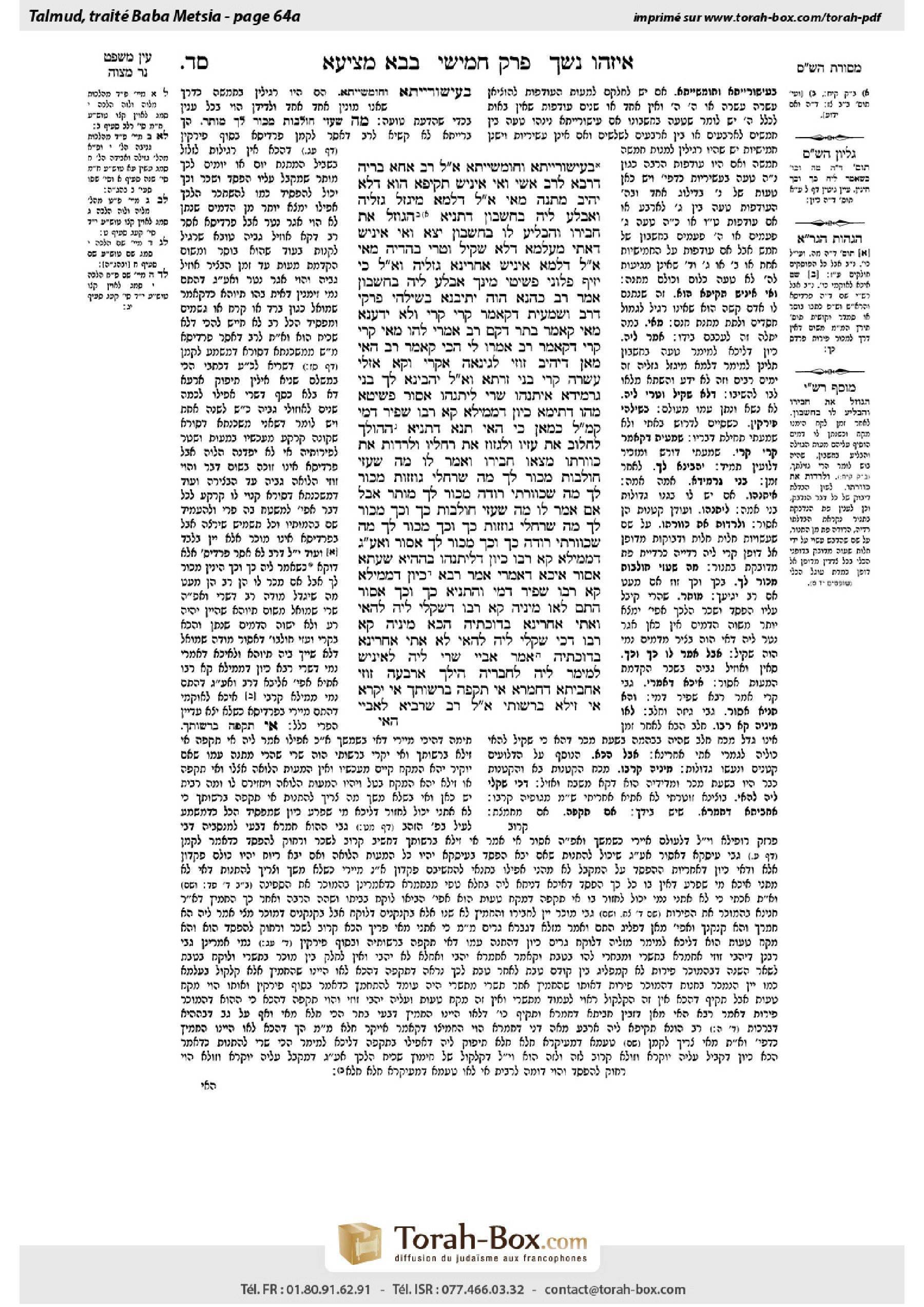
This page of Bava Metzia includes the Aramaic text, an English translation and an AI-generated French translation, alongside the scan above.
בבא מציעא ס״ד א · Aramaic and Hebrew text
בְּעִישּׂוּרְיָיתָא וְחוּמְשְׁיָיתָא.
אֲמַר לֵיהּ רַב אַחָא בְּרֵיהּ דְּרָבָא לְרַב אָשֵׁי: וְאִי אִינִישׁ תַּקִּיפָא הוּא דְּלָא יָהֵיב מַתָּנָה, מַאי? אֲמַר לֵיהּ: דִּלְמָא מִיגְזָל גַּזְלֵיהּ וְאַבְלַע לֵיהּ בְּחֶשְׁבּוֹן. דְּתַנְיָא: הַגּוֹזֵל אֶת חֲבֵירוֹ וְהִבְלִיעַ לוֹ בְּחֶשְׁבּוֹן – יָצָא.
וְאִי אִינִישׁ דְּאָתֵי מֵעָלְמָא, דְּלָא שָׁקֵיל וְטָרֵי בַּהֲדֵיהּ, מַאי? אֲמַר לֵיהּ: דִּלְמָא אִינִישׁ אַחֲרִינָא גַּזְלֵיהּ, וַאֲמַר לֵיהּ: כִּי יָזֵיף פְּלוֹנִי פְּשִׁיטֵי מִינָּךְ – אַבְלַע לֵיהּ בְּחֶשְׁבּוֹן.
אָמַר רַב כָּהֲנָא: הֲוָה יָתֵיבְנָא בְּשִׁילְהֵי פִּרְקֵי דְּרַב, וּשְׁמַעִית דְּקָאָמַר ״קָרֵי קָרֵי״ וְלָא יָדַעְנָא מַאי קָאָמַר. בָּתַר דְּקָם רַב, אָמְרִי לְהוּ: מַאי ״קָרֵי קָרֵי״ דְּקָאָמַר רַב?
אֲמַרוּ לִי, הָכִי קָאָמַר רַב: הַאי מַאן דְּיָהֵיב זוּזֵי לְגִינָּאָה אַקָּרֵי, וְקָא אָזְלִי עֲשָׂרָה קָרֵי בְּנֵי זַרְתָּא, וַאֲמַר לֵיהּ: יָהֵבְינָא לָךְ בְּנֵי גַרְמִידָא, אִיתַנְהוּ – שְׁרֵי, לֵיתַנְהוּ – אָסוּר.
פְּשִׁיטָא! מַהוּ דְּתֵימָא: כֵּיוָן דְּמִמֵּילָא קָא רָבוּ – שַׁפִּיר דָּמֵי, קָא מַשְׁמַע לַן.
כְּמַאן – כִּי הַאי תַּנָּא. דְּתַנְיָא: הַהוֹלֵךְ לַחְלוֹב אֶת עִזָּיו, וְלִגְזוֹז אֶת רְחֵלָיו, וְלִרְדּוֹת אֶת כַּוַּורְתּוֹ, מְצָאוֹ חֲבֵירוֹ וְאָמַר לוֹ: מַה שֶּׁעִזַּי חוֹלְבוֹת מָכוּר לָךְ, מַה שֶּׁרְחֵלַי גּוֹזְזוֹת מָכוּר לָךְ, מַה שֶּׁכַּוַּורְתִּי רוֹדָה מָכוּר לָךְ – מוּתָּר.
אֲבָל אִם אָמַר לוֹ: מַה שֶּׁעִזַּי חוֹלְבוֹת כָּךְ וְכָךְ מָכוּר לָךְ, מַה שֶּׁרְחֵלַי גּוֹזְזוֹת כָּךְ וְכָךְ מָכוּר לָךְ, מַה שֶּׁכַּוַּורְתִּי רוֹדָה כָּךְ וְכָךְ מָכוּר לָךְ – אָסוּר. וְאַף עַל גַּב דְּמִמֵּילָא קָא רָבוּ, כֵּיוָן דְּלֵיתַנְהוּ בְּהַהִיא שַׁעְתָּא – אָסוּר.
אִיכָּא דְּאָמְרִי, אָמַר רָבָא: כֵּיוָן דְּמִמֵּילָא קָא רָבוּ – שַׁפִּיר דָּמֵי. וְהָתַנְיָא: כָּךְ וְכָךְ – אָסוּר!
הָתָם לָאו מִינֵּיהּ קָא רָבוּ, דְּשָׁקְלִי לֵיהּ לְהַאי וְאָתֵי אַחֲרִינָא בְּדוּכְתֵּיהּ. הָכָא מִינֵּיהּ קָא רָבוּ, דְּכִי שָׁקְלִי לֵיהּ לְהַאי – לָא אָתֵי אַחֲרִינָא בְּדוּכְתֵּיהּ.
אָמַר אַבָּיֵי: שָׁרֵי לֵיהּ לְאִינִישׁ לְמֵימַר לֵיהּ לְחַבְרֵיהּ, הֵילָךְ אַרְבְּעָה זוּזֵי אַחָבִיתָא דְחַמְרָא, אִי תָּקְפָה – בִּרְשׁוּתָךְ, אִי יָקְרָא אִי זִילָא – בִּרְשׁוּתַי. אֲמַר לֵיהּ רַב שֵׁרֵבְיָא לְאַבָּיֵי:
Bava Metzia 64a · English translation
For example, if the money was given in units of tens or fives, it can be assumed that the owner of the money counted the coins in groups of tens or fives and erred in his count.
Rav Aḥa, son of Rava, said to Rav Ashi: And if the one who gave the money is a harsh person, who is not accustomed to giving gifts, what is the halakha? Should it be assumed that he made a mistake? Rav Ashi said to him: Perhaps that person once robbed the recipient, and now he included in the calculation the amount he stole, in order to return the stolen money without informing him of the theft. As it is taught in a baraita: One who robs another and then returns the stolen money by including it in the calculation of money paid for another item has fulfilled his obligation to return the stolen money.
Rav Aḥa, son of Rava, asked Rav Ashi: And if the giver was a person from the outside, with whom the recipient had never conducted business, what is the halakha? Should it be assumed that the additional money was given in error? Rav Ashi said to him: Perhaps another person, an acquaintance of the giver’s, robbed the recipient and said to the giver: When so-and-so borrows money from you, include it in the calculation. It is possible that the one who robbed the recipient chose this manner of restoring the latter’s money in order to be spared any shame.
§ Rav Kahana said: I was sitting at the far end of Rav’s house of study, and I heard him say: Gourds, gourds, but I did not know what he was saying, as I did not hear the entire discussion. After Rav arose and left, I said to the students: What is this statement concerning gourds, gourds, that Rav was saying?
They said to me: This is what Rav was saying: If someone gave money to a gardener to purchase gourds from him, and they were going for the price of ten gourds of the length of a span, i.e., the distance between the thumb and the little finger, for a dinar, and the gardener said to the buyer: If you pay me the money now, I will give you gourds a cubit in length at a later point in time, the halakha depends on the circumstances. If gourds of this larger kind are in the possession of the seller, this type of sale is permitted. If they are not in his possession, it is prohibited, as, if he gives him larger gourds at a later date for the price of small gourds, this constitutes interest.
The Gemara asks: Isn’t this obvious? What is the novelty in Rav’s statement? The Gemara answers: The statement is necessary, lest you say: Since they increase in and of themselves it is permitted, as the gardener does not perform any action, but simply waits for the gourds to grow larger before supplying them. Rav therefore teaches us that this is also classified as interest.
The Gemara asks: In accordance with whose opinion did Rav rule? He ruled in accordance with the opinion of this tanna, as it is taught in a baraita: With regard to one who went to milk his goats, or shear his sheep, or extract the honey from his hives, if another found him and the farmer said to him: Whatever milk my goats produce is sold to you, or whatever wool will be sheared from my sheep is sold to you, or whatever honey will be extracted from my hive is sold to you, this is permitted. It is permitted despite the fact that the farmer did not specify precisely how much he is selling, and the buyer may receive more of the product than the current market value would dictate due to his paying for it in advance, as he may also receive less of the product than the current market value would dictate.
The baraita continues: But if the farmer said to him: Such and such an amount of milk from what my goats produce is sold to you, or such and such an amount of wool from what will be sheared from my sheep is sold to you, or such and such an amount of honey from what will be extracted from my hive is sold to you, a transaction of this kind is prohibited, as the farmer is selling him more of the product than the current market value would dictate due to his paying for it in advance. The Gemara states its question: And one sees in this baraita that even though these products increased in value in and of themselves, since they are not in existence at the time of the sale, the practice is forbidden.
The Gemara records another version of this discussion: There are those who say that Rava said: The halakha is that since the sold items grow by themselves it is permitted, as it does not constitute interest. The Gemara raises a difficulty: But isn’t it taught in a baraita that if he specifies: Such and such an amount, it is forbidden?
The Gemara answers that there is a difference between the two cases: There, with regard to milk and wool, they do not increase in and of themselves. This is evident from the fact that if they remove this milk from the goat, other milk replaces it. Therefore, the milk or wool that is generated after the sale is not an extension of the milk or wool that was present at the time of the sale. Conversely, here, in the case of the gourds, they increase in and of themselves, as the same gourds continue to grow. This is evident from the fact that when they remove this gourd from the ground, no other will replace it. Consequently, if he sells him gourds now, any additional growth belongs to the buyer, as the gourds are in his possession from the moment of acquisition.
§ Abaye said: It is permitted for a person to say to another: Take these four dinars for the future delivery of a barrel of wine; if it sours, it is in your possession and you are responsible, but if it appreciates or depreciates in value, it is in my possession, as I accept any loss that results from a change in price. Rav Sherevya said to Abaye:
Bava Metzia 64a · Traduction française (IA)
Par exemple, si l'argent a été donné en unités de dix ou de cinq, on peut supposer que l'owner de l'argent a compté les pièces par groupes de dix ou de cinq et s'est trompé dans son comptage.
Rav Aḥa, fils de Rava, dit à Rav Ashi : Et si celui qui a donné l'argent est une personne dure, qui n'est pas habitué à donner des cadeaux, quelle est la halakha ? Doit-on supposer qu'il a fait une erreur ? Rav Ashi dit à lui : Peut-être que cette personne a volé le receveur et qu'il inclut maintenant dans le calcul la somme volée afin de rendre l'argent volé sans informer le receveur de la volaison. Comme il est enseigné dans une baraïta : Celui qui vole un autre et qui rend ensuite l'argent volé en incluant cette somme dans le calcul de l'argent payé pour un autre objet a accompli son obligation de rendre l'argent volé.
Rav Aḥa, fils de Rava, demande à Rav Ashi : Et si le donneur était une personne extérieure, avec laquelle le receveur n'avait jamais eu affaire, quelle est la halakha ? Doit-on supposer que l'argent supplémentaire a été donné par erreur ? Rav Ashi dit à lui : Peut-être un autre homme, un connaissant du donneur, a volé le receveur et a dit au donneur : Quand tel et tel emprunte de l'argent à vous, incluez-le dans le calcul. Il est possible que celui qui a volé le receveur ait choisi cette manière de restaurer l'argent du receveur afin d'éviter toute honte.
§ Rav Kahana dit : J'étais assis à l'extrémité de la maison de étude de Rav, et j'ai entendu lui dire : Des citrons, des citrons, mais je ne savais pas ce qu'il disait, car je n'avais pas entendu la discussion complète. Après que Rav est sorti et est parti, j'ai dit aux étudiants : Quelle est cette déclaration concernant des citrons, des citrons, que Rav disait ?
Ils m'ont répondu : C'est ce que Rav disait : Si quelqu'un a donné de l'argent à un jardinier pour acheter des citrons, et qu'ils étaient vendus au prix de dix citrons de la longueur d'un pouce, c'est-à-dire la distance entre l'index et le pouce, pour un dinar, et que le jardinier a dit à l'acheteur : Si vous me payez l'argent maintenant, je vous donnerai des citrons d'un cubit de longueur à une date ultérieure, la halakha dépend des circonstances. Si des citrons de ce genre sont en possession du vendeur, cette vente est permise. Si ce n'est pas le cas, elle est interdite, car, si il donne des citrons plus grands à une date ultérieure au prix de citrons petits, cela constitue un intérêt.
La Guemara pose la question : N'est-ce pas évident ? Quel est le nouveauté dans la déclaration de Rav ? La Guemara répond : Cette déclaration est nécessaire, afin que l'on ne dise pas : Puisque les citrons augmentent par eux-mêmes, cela est permis, car le jardinier ne fait aucun acte, mais attend simplement que les citrons grandissent avant de les lui donner. Rav enseigne donc que cela est également classé comme intérêt.
La Guemara pose la question : Selon l'opinion de qui a-t-il régi ? Il a régi selon l'opinion de ce tanna, comme il est enseigné dans une baraïta : Concernant celui qui va laitier ses chèvres, ou tondre ses moutons, ou extraire le miel de ses ruches, si un autre le trouve et que l'agriculteur lui dit : Tout le lait que mes chèvres produisent est vendu à vous, ou tout le laine que l'on tondra de mes moutons est vendu à vous, ou tout le miel que l'on extraira de ma ruche est vendu à vous, cela est permis. Cela est permis même si l'agriculteur n'a pas spécifié précisément la quantité qu'il vend, et que l'acheteur peut recevoir plus du produit que la valeur actuelle du marché ne le permettrait, car il paie à l'avance, et il peut aussi recevoir moins du produit que la valeur actuelle du marché ne le permettrait.
La baraïta continue : Mais si l'agriculteur a dit à lui : Une quantité déterminée de lait de ce que mes chèvres produisent est vendu à vous, ou une quantité déterminée de laine de ce que l'on tondra de mes moutons est vendu à vous, ou une quantité déterminée de miel de ce que l'on extraira de ma ruche est vendu à vous, une telle transaction est interdite, car l'agriculteur lui vend plus du produit que la valeur actuelle du marché ne le permettrait, en raison du paiement à l'avance. La Guemara énonce sa question : Et l'on voit dans cette baraïta que même si ces produits augmentent en valeur par eux-mêmes, puisque ce n'est pas leur existence au moment de la vente, la pratique est interdite.
La Guemara enregistre une autre version de cette discussion : Il y a ceux qui disent que Rava a dit : La halakha est que puisque les produits vendus grandissent par eux-mêmes, cela est permis, car cela ne constitue pas d'intérêt. La Guemara soulève une difficulté : Mais n'est-ce pas enseigné dans une baraïta que si l'on spécifie : Une quantité déterminée, cela est interdit ?
La Guemara répond que c'est une différence entre les deux cas : Là, concernant le lait et la laine, ils ne se développent pas par eux-mêmes. Cela est évident du fait que si l'on retire ce lait des chèvres, d'autres laits le remplacent. Par conséquent, le lait ou la laine générés après la vente ne sont pas une extension du lait ou de la laine présent au moment de la vente. À l'inverse, ici, dans le cas des citrons, ils augmentent par eux-mêmes, car les mêmes citrons continuent à grandir. Cela est évident du fait que quand l'on retire ce citron du sol, aucun autre ne le remplacera. Par conséquent, si l'on vend à l'acheteur des citrons maintenant, toute la croissance supplémentaire appartient à l'acheteur, car les citrons sont en sa possession dès l'acquisition.
§ Abaye dit : Il est permis à une personne de dire à une autre : Prends ces quatre dinars pour la livraison future d'une barrique de vin ; si elle s'acidifie, c'est en votre possession et vous êtes responsable, mais si elle augmente ou diminue en valeur, c'est en mon possession, car je accepte toute perte résultant d'un changement de prix. Rav Sherevya dit à Abaye :
Traduction française générée par IA à partir de l’édition anglaise de Sefaria. Vérifie toujours un passage avec le texte source.
Text from Sefaria: William Davidson Edition - Vocalized Aramaic (CC BY NC); William Davidson Edition - English (CC BY NC).