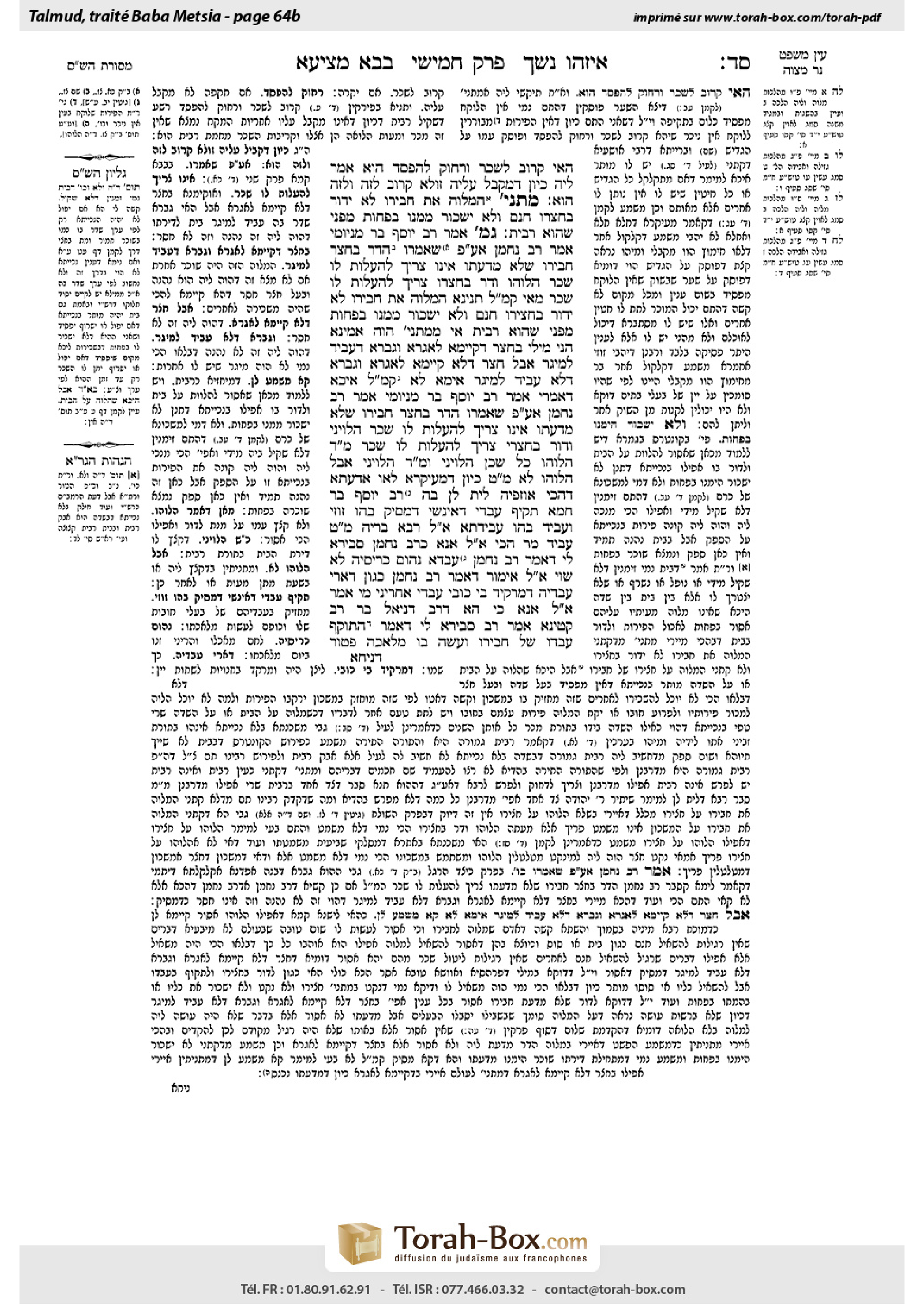
Bava Metzia 64b: Talmud study for Daf Yomi
Study the Talmud for Daf Yomi with scanned pages, Hebrew text, English translations from Sefaria and AI-generated French translations.
Passage selection and English or AI-generated French translation are available where the scan has annotations. Daf Study is independent of Torah-Box and Sefaria.
Browse Bava Metzia · בבא מציעא · All tractatesBava Metzia 64b text and translations
This page of Bava Metzia includes the Aramaic text, an English translation and an AI-generated French translation, alongside the scan above.
בבא מציעא ס״ד ב · Aramaic and Hebrew text
הַאי קָרוֹב לְשָׂכָר וְרָחוֹק לְהֶפְסֵד הוּא. אֲמַר לֵיהּ כֵּיוָן דִּמְקַבֵּל עֲלֵיהּ זוֹלָא, קָרוֹב לָזֶה וְלָזֶה הוּא.
מַתְנִי׳: הַמַּלְוֶה אֶת חֲבֵירוֹ לֹא יָדוּר בַּחֲצֵרוֹ חִנָּם, וְלֹא יִשְׂכּוֹר מִמֶּנּוּ בְּפָחוֹת – מִפְּנֵי שֶׁהוּא רִבִּית.
גְּמָ׳ אָמַר רַב יוֹסֵף בַּר מִנְיוֹמֵי אָמַר רַב נַחְמָן: אַף עַל פִּי שֶׁאָמְרוּ הַדָּר בַּחֲצַר חֲבֵירוֹ שֶׁלֹּא מִדַּעְתּוֹ – אֵינוֹ צָרִיךְ לְהַעֲלוֹת לוֹ שָׂכָר. הִלְוָהוּ וְדָר בַּחֲצֵירוֹ – צָרִיךְ לְהַעֲלוֹת לוֹ שָׂכָר. מַאי קָא מַשְׁמַע לַן? תְּנֵינָא: הַמַּלְוֶה אֶת חֲבֵירוֹ לֹא יָדוּר בַּחֲצֵירוֹ חִנָּם, וְלֹא יִשְׂכּוֹר מִמֶּנּוּ בְּפָחוֹת, מִפְּנֵי שֶׁהוּא רִבִּית!
אִי מִמַּתְנִיתִין, הֲוָה אָמֵינָא: הָנֵי מִילֵּי בְּחָצֵר דְּקַיְימָא לְאַגְרָא, וְגַבְרָא דַּעֲבִיד לְמֵיגַר. אֲבָל חָצֵר דְּלָא קָיְימָא לְאַגְרָא, וְגַבְרָא דְּלָא עֲבִיד לְמֵיגַר – אֵימָא לָא, קָא מַשְׁמַע לַן.
אִיכָּא דְּאָמְרִי, אָמַר רַב יוֹסֵף בַּר מִנְיוֹמֵי אָמַר רַב נַחְמָן: אַף עַל פִּי שֶׁאָמְרוּ הַדָּר בַּחֲצַר חֲבֵירוֹ שֶׁלֹּא מִדַּעְתּוֹ – אֵינוֹ צָרִיךְ לְהַעֲלוֹת לוֹ שָׂכָר. ״הַלְוֵינִי וְדוּר בַּחֲצֵרִי״ – צָרִיךְ לְהַעֲלוֹת לוֹ שָׂכָר.
מַאן דְּאָמַר הִלְוָהוּ – כׇּל שֶׁכֵּן הַלְוֵינִי. וּמַאן דְּאָמַר הַלְוֵינִי – אֲבָל הִלְוָהוּ לָא. מַאי טַעְמָא – כֵּיוָן דְּמֵעִיקָּרָא לָאו אַדַּעְתָּא דְּהָכִי אוֹזְפֵיהּ – לֵית לַן בַּהּ.
רַב יוֹסֵף בַּר חָמָא תָּקֵיף עַבְדֵי דְאִינָשֵׁי דְּמַסֵּיק בְּהוּ זוּזֵי, וְעָבֵיד בְּהוּ עֲבִידְתָּא. אֲמַר לֵיהּ רָבָא בְּרֵיהּ: מַאי טַעְמָא עָבֵיד מָר הָכִי? אֲמַר לֵיהּ: אֲנָא כְּרַב נַחְמָן סְבִירָא לִי, דְּאָמַר רַב נַחְמָן: עַבְדָּא, נְהוֹם כְּרֵיסֵיהּ לָא שָׁוֵי.
אֲמַר לֵיהּ: אֵימוֹר דְּאָמַר רַב נַחְמָן כְּגוֹן דָּארוּ עַבְדֵּיהּ דִּמְרַקֵּיד בֵּי כוּבֵי, עַבְדֵי אַחֲרִינֵי מִי אָמַר? אֲמַר לֵיהּ: אֲנָא, כִּי הָא דְּרַב דָּנִיאֵל בַּר רַב קַטִּינָא אָמַר רַב סְבִירָא לִי. דְּאָמַר: הַתּוֹקֵף עַבְדּוֹ שֶׁל חֲבֵירוֹ וְעָשָׂה בּוֹ מְלָאכָה – פָּטוּר.
Bava Metzia 64b · English translation
This transaction is close to a gain and far from a loss for the seller, as he accepts upon himself the risk that the wine may go sour. An arrangement of this sort constitutes interest by rabbinic law. Abaye said to him: Since the buyer accepts upon himself the potential loss if the price depreciates, it is considered a transaction that is close to both this and that, as there is the possibility of both gain and loss. The transaction is therefore permitted.
MISHNA: One who lends another money may not reside in the borrower’s courtyard free of charge, nor may he rent living quarters from him at less than the going rate, because this is interest. The benefit he receives from living on the borrower’s property constitutes the equivalent of an additional payment as interest on the loan.
GEMARA: Rav Yosef bar Minyumi says that Rav Naḥman says: Even though the Sages said that one who resides in another’s courtyard without his knowledge does not have to pay him rent if the owner of the courtyard does not suffer any loss from the arrangement, nevertheless, if he lent money to the owner of a courtyard and then resides in his courtyard, the lender must pay him rent. The Gemara poses a question: What is Rav Naḥman teaching us by this statement? We learn this explicitly in the mishna: One who lends money to another may not reside in the borrower’s courtyard free of charge, nor may he rent living quarters from him at less than the going rate, because this is interest.
The Gemara refutes this claim: If this halakha is learned from the mishna alone, I would say that this matter applies only to a situation with a courtyard that stands to be rented out and a man who usually rents a place of residence that would otherwise need to find a place to reside. But with regard to a courtyard that does not stand to be rented out and a man who does not usually rent a place of residence, as he has another place where he could reside, the owner of the courtyard appears to have lost nothing and the resident appears to have gained nothing, so you might say that he should not have to pay at all. Rav Naḥman therefore teaches us that even in that case he must pay rent in order to prevent the appearance of interest.
There are those who say a different version of this discussion: Rav Yosef bar Minyumi says that Rav Naḥman says: Even though the Sages said that one who resides in another’s courtyard without his knowledge does not have to pay him rent, if the courtyard owner says to another: Lend me money and you may reside in my courtyard, the lender must pay him rent.
The Gemara analyzes the difference between the two versions. According to the one who said that the lender must pay rent to the courtyard owner if he lent him money without the courtyard owner’s stipulating any conditions, all the more so would he hold that the lender must pay rent to the courtyard owner if the courtyard owner explicitly stated: Lend me money and you may reside in my courtyard, as this indicates a condition obligating the borrower to pay interest. According to the one who said that the arrangement is forbidden if he says: Lend me money and you may reside in my courtyard, it is forbidden only in such a case. But if he merely lent him money without any stipulation about the courtyard, it is not forbidden. What is the reason for the more lenient ruling? Since initially he did not lend him the money with this intention, we have no problem with it, as it is possible that there is no connection between the loan and his residing in the courtyard.
The Gemara relates: Rav Yosef bar Ḥama, Rava’s father, would seize the slaves of people who owed him money, and he would work them against the will of their owners. Rava, son of Rav Yosef bar Ḥama, said to him: What is the reason that the Master does this, i.e., seizes and uses these slaves? Rav Yosef bar Ḥama said to him: I maintain that the halakha is in accordance with the opinion of Rav Naḥman, as Rav Naḥman said: A slave is not worth even the bread in his stomach. When the slaves work for me and eat in my home, I am not causing the owners any monetary loss.
Rava said to him: I will say that Rav Naḥman said this with regard to specific slaves, such as his slave Dari, who only dances among the wine barrels [khuvei] and does not perform any labor. Did he say this concerning other slaves? All other slaves perform labor, and their labor is worth more than their board. His father said to him: I maintain that the halakha is in accordance with this statement said by Rav Daniel bar Rav Ketina that Rav says, as he says: One who seizes another’s slave and has him perform labor is exempt from paying the master for the labor of the slave,
Bava Metzia 64b · Traduction française (IA)
Cette transaction est proche d’un gain et éloignée d’une perte pour le vendeur, car il accepte le risque que le vin s’aigre. Une telle disposition constitue un intérêt selon la loi rabbinique. Abaye répondit à lui : Puisque l’acheteur accepte la possibilité de perte en cas de dépréciation du prix, il s’agit d’une transaction proche à la fois d’un gain et d’une perte, car il y a la possibilité d’un gain et d’une perte. La transaction est donc permise.
MICHNA : Celui qui prête de l’argent à un autre ne peut pas habiter librement dans la cour du prêteur, ni louer des appartements de lui à un prix inférieur au taux normal, car cela constitue un intérêt. Le bénéfice qu’il reçoit en habitant sur la propriété du prêteur constitue l’équivalent d’un paiement supplémentaire d’intérêt sur le prêt.
GUEMARA : Rav Yosef bar Minyumi dit que Rav Naḥman dit : Même si les Sages ont dit que celui qui habite dans la cour d’un autre sans son consentement n’a pas à lui payer un loyer si l’propriétaire de la cour ne subit aucune perte de cette disposition, néanmoins, si l’on prête de l’argent à l’propriétaire d’une cour et qu’on habite alors dans sa cour, le prêteur doit payer un loyer. La Guemara pose une question : Qu’est-ce que Rav Naḥman nous enseigne par cette déclaration ? Nous apprenons cela explicitement dans la mishna : Celui qui prête de l’argent à un autre ne peut pas habiter librement dans la cour du prêteur, ni louer des appartements de lui à un prix inférieur au taux normal, car cela constitue un intérêt.
La Guemara réfute cette affirmation : Si cette halakha est apprise uniquement à partir de la mishna, je dirais que cela s’applique uniquement à un cas où une cour est louable et un homme qui loue habituellement un lieu de résidence qui aurait autrement besoin de trouver un lieu où habiter. Mais concernant une cour qui n’est pas louable et un homme qui ne loue pas habituellement un lieu de résidence, car il a un autre lieu où il pourrait habiter, l’propriétaire de la cour semble avoir perdu rien et le résident semble avoir gagné rien, donc on pourrait dire qu’il ne doit pas payer du tout. Rav Naḥman enseigne donc que même dans ce cas, il doit payer un loyer afin d’éviter l’apparence d’un intérêt.
Il y a ceux qui disent une autre version de cette discussion : Rav Yosef bar Minyumi dit que Rav Naḥman dit : Même si les Sages ont dit qu'une personne qui demeure dans le courtil d'autrui sans son accord n'a pas à lui payer un loyer, si le propriétaire du courtil dit à un autre : Prête-moi de l'argent et tu pourras demeurer dans mon courtil, le prêteur doit payer un loyer au propriétaire du courtil.
La Guemara examine la différence entre les deux versions. Selon celui qui a dit que le prêteur doit payer un loyer au propriétaire du courtil s'il lui a prêté de l'argent sans que le propriétaire n'ait stipulé de conditions, encore plus encore serait-il de l'avis que le prêteur doit payer un loyer au propriétaire du courtil si le propriétaire du courtil a explicitement dit : Prête-moi de l'argent et tu pourras demeurer dans mon courtil, car cela indique une condition qui engage le prêteur à payer un intérêt. Selon celui qui a dit que l'arrangement est interdit si l'on dit : Prête-moi de l'argent et tu pourras demeurer dans mon courtil, il est interdit uniquement dans ce cas-là. Mais si l'on lui a simplement prêté de l'argent sans stipulation concernant le courtil, il n'est pas interdit. Quelle est la raison de ce jugement plus clément ? Parce que d'abord il n'a pas prêté de l'argent avec cette intention, nous n'avons pas de problème avec cela, car il est possible qu'il n'y ait pas de lien entre le prêt et son séjour dans le courtil.
La Guemara rapporte : Rav Yosef bar Ḥama, le père de Rava, saisissait les esclaves de ceux qui lui devaient de l'argent, et les faisait travailler contre la volonté de leurs propriétaires. Rava, fils de Rav Yosef bar Ḥama, lui dit : Quelle est la raison que le Maître fait cela, c'est-à-dire saisit et utilise ces esclaves ? Rav Yosef bar Ḥama lui répondit : Je maintiens que la halakha suit l'opinion de Rav Naḥman, car Rav Naḥman a dit : Un esclave n'est pas d'une valeur supérieure à la pain dans son estomac. Lorsque les esclaves travaillent pour moi et mangent chez moi, je ne cause aucun préjudice financier aux propriétaires.
Rava lui dit : Je dirai que Rav Naḥman a dit cela concernant des esclaves spécifiques, tels que son esclave Dari, qui ne danse qu'entre les barriques de vin [khuvei] et ne fait aucun travail. A-t-il dit cela concernant d'autres esclaves ? Tous les autres esclaves travaillent, et leur travail est plus précieux que leur nourriture. Son père lui répondit : Je maintiens que la halakha suit cette déclaration faite par Rav Daniel bar Rav Ketina, qui rapporte que Rav dit, car il dit : Celui qui saisit un esclave d'autrui et le fait travailler est exempt de payer au maître la valeur du travail de l'esclave,
Traduction française générée par IA à partir de l’édition anglaise de Sefaria. Vérifie toujours un passage avec le texte source.
Text from Sefaria: William Davidson Edition - Vocalized Aramaic (CC BY NC); William Davidson Edition - English (CC BY NC).