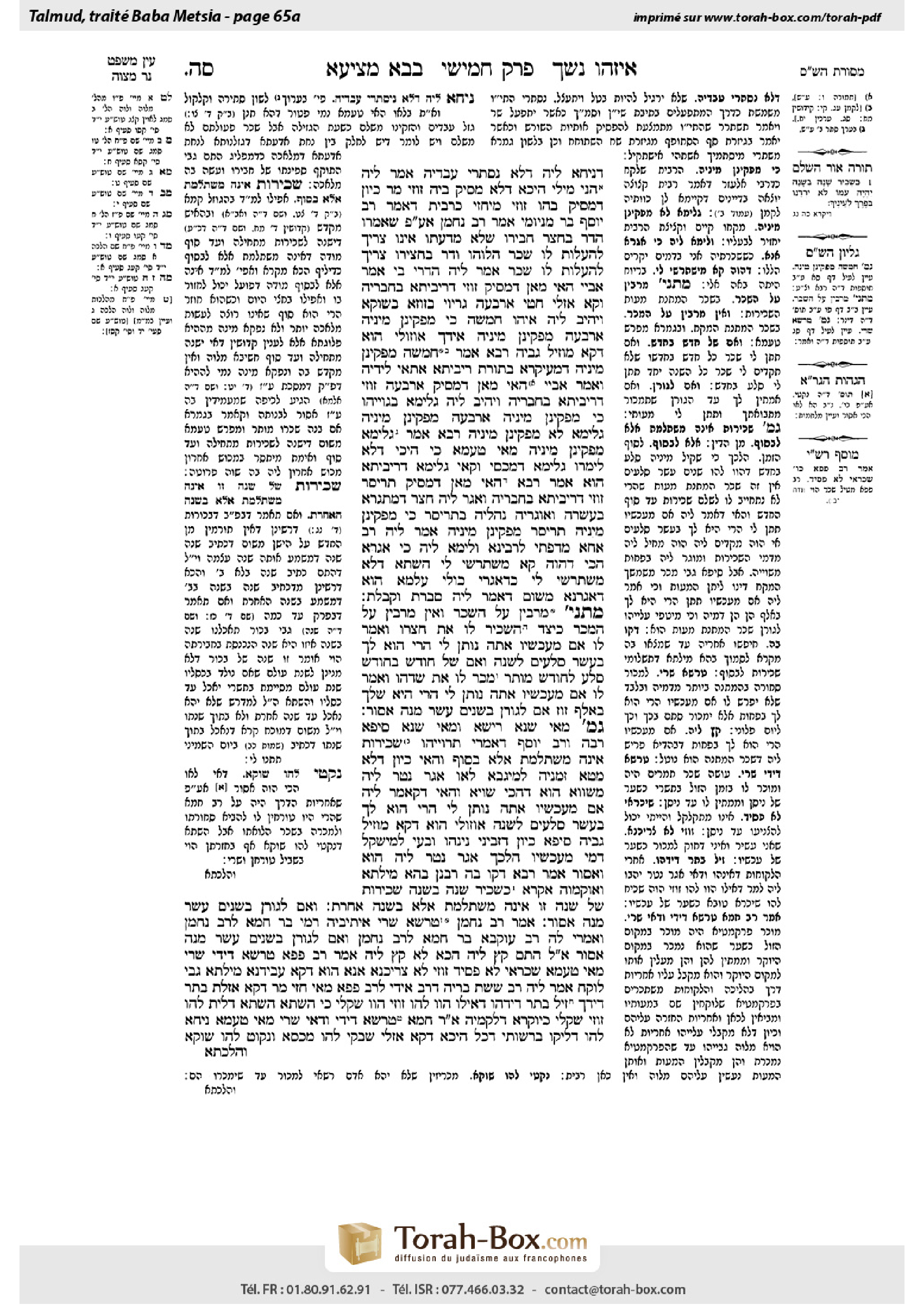
Bava Metzia 65a: Talmud study for Daf Yomi
Study the Talmud for Daf Yomi with scanned pages, Hebrew text, English translations from Sefaria and AI-generated French translations.
Passage selection and English or AI-generated French translation are available where the scan has annotations. Daf Study is independent of Torah-Box and Sefaria.
Browse Bava Metzia · בבא מציעא · All tractatesBava Metzia 65a text and translations
This page of Bava Metzia includes the Aramaic text, an English translation and an AI-generated French translation, alongside the scan above.
בבא מציעא ס״ה א · Aramaic and Hebrew text
דְּנִיחָא לֵיהּ דְּלָא נִסְתְּרֵי עַבְדֵּיהּ.
אֲמַר לֵיהּ: הָנֵי מִילֵּי הֵיכָא דְּלָא מַסֵּיק בֵּיהּ זוּזֵי. מָר כֵּיוָן דְּמַסֵּיק בְּהוּ זוּזֵי מִחֲזֵי כְּרִבִּית. דְּאָמַר רַב יוֹסֵף בַּר מִנְיוֹמֵי אָמַר רַב נַחְמָן: אַף עַל פִּי שֶׁאָמְרוּ הַדָּר בַּחֲצַר חֲבֵירוֹ שֶׁלֹּא מִדַּעְתּוֹ אֵינוֹ צָרִיךְ לְהַעֲלוֹת לוֹ שָׂכָר. הִלְוָהוּ וְדָר בַּחֲצֵירוֹ צָרִיךְ לְהַעֲלוֹת לוֹ שָׂכָר. אֲמַר לֵיהּ: הֲדַרִי בִּי.
אָמַר אַבָּיֵי: הַאי מַאן דְּמַסֵּיק זוּזֵי דְרִיבִּיתָא בְּחַבְרֵיהּ וְקָא אָזְלִי חִטֵּי אַרְבְּעָה גְּרִיוֵי בְּזוּזָא בְּשׁוּקָא, וְיָהֵיב לֵיהּ אִיהוּ חַמְשָׁה, כִּי מַפְּקִינַן מִינֵּיהּ – אַרְבְּעָה מַפְּקִינַן מִינֵּיהּ. אִידַּךְ – אוֹזוֹלֵי הוּא דְּקָא מוֹזֵיל גַּבֵּיהּ. רָבָא אָמַר: חַמְשָׁה מַפְּקִינַן מִינֵּיהּ, דְּמֵעִיקָּרָא בְּתוֹרַת רִיבִּיתָא אֲתַאי לִידֵיהּ.
וְאָמַר אַבָּיֵי: הַאי מַאן דְּמַסֵּיק אַרְבְּעָה זוּזֵי דְרִיבִּיתָא בְּחַבְרֵיהּ וְיָהֵיב לֵיהּ גְּלִימָא בְּגַוַּיְיהוּ, כִּי מַפְּקִינַן מִינֵּיהּ – אַרְבְּעָה מַפְּקִינַן מִינֵּיהּ, גְּלִימָא לָא מַפְּקִינַן מִינֵּיהּ. רָבָא אָמַר: גְּלִימָא מַפְּקִינַן מִינֵּיהּ. מַאי טַעְמָא, כִּי הֵיכִי דְּלָא לֵימְרוּ: גְּלִימָא דִּמְכַסֵּי וְקָאֵי – גְּלִימָא דְרִיבִּיתָא הוּא.
אָמַר רָבָא: הַאי מַאן דְּמַסֵּיק תְּרֵיסַר זוּזֵי דְּרִיבִּיתָא בְּחַבְרֵיהּ וְאֹגַר לֵיהּ חָצֵר דְּמִתַּגְרָא בְּעַשְׂרָה וְאוֹגְרַיהּ נִהֲלֵיהּ בִּתְרֵיסַר, כִּי מַפְּקִינַן מִינֵּיהּ – תְּרֵיסַר מַפְּקִינַן מִינֵּיהּ.
אֲמַר לֵיהּ רַב אַחָא מִדִּפְתִּי לְרָבִינָא: וְלֵימָא לֵיהּ, כִּי (אַגְרָא) [אֲגַרִי] הָכִי – דַּהֲוָה קָא מִשְׁתָּרְשִׁי לִי, הַשְׁתָּא דְּלָא מִשְׁתָּרְשִׁי לִי – כִּדְאָגְרִי כּוּלֵּי עָלְמָא הוּא דְּאָגַרְנָא, מִשּׁוּם דַּאֲמַר לֵיהּ: סְבַרְתְּ וְקַבֵּלְתְּ.
מַתְנִי׳ מַרְבִּין עַל הַשָּׂכָר וְאֵין מַרְבִּין עַל הַמֶּכֶר. כֵּיצַד? הִשְׂכִּיר לוֹ אֶת חֲצֵרוֹ, וְאָמַר לוֹ: ״אִם מֵעַכְשָׁיו אַתָּה נוֹתֵן לִי – הֲרֵי הוּא לְךָ בְּעֶשֶׂר סְלָעִים לַשָּׁנָה, וְאִם שֶׁל חוֹדֶשׁ בַּחוֹדֶשׁ – סֶלַע לַחוֹדֶשׁ״, מוּתָּר. מָכַר לוֹ אֶת שָׂדֵהוּ, וְאָמַר לוֹ: ״אִם מֵעַכְשָׁיו אַתָּה נוֹתֵן לִי – הֲרֵי הִיא שֶׁלְּךָ בְּאֶלֶף זוּז, אִם לַגּוֹרֶן – בִּשְׁנֵים עָשָׂר מָנֶה״, אָסוּר.
גְּמָ׳ מַאי שְׁנָא רֵישָׁא וּמַאי שְׁנָא סֵיפָא? רַבָּה וְרַב יוֹסֵף דְּאָמְרִי תַּרְוַיְיהוּ: שְׂכִירוּת אֵינָהּ מִשְׁתַּלֶּמֶת אֶלָּא בַּסּוֹף, וְהַאי כֵּיוָן דְּלָא מְטָא זִמְנֵיהּ לְמִיגְבֵּא – לָאו אֲגַר נְטַר לֵיהּ, מִשְׁווֹא הוּא דְּהָכִי שָׁוְיָא, וְהַאי דְּקָאָמַר לֵיהּ ״אִם מֵעַכְשָׁיו אַתָּה נוֹתֵן לִי הֲרֵי הוּא לְךָ בְּעֶשֶׂר סְלָעִים לְשָׁנָה״ – אוֹזוֹלֵי הוּא דְּקָא מוֹזֵיל גַּבֵּיהּ.
סֵיפָא: כֵּיוָן דִּזְבִינֵי נִינְהוּ וּבָעֵי לְמִשְׁקַל דְּמֵי מֵעַכְשָׁיו, הִלְכָּךְ אֲגַר נְטַר לֵיהּ הוּא, וְאָסוּר. אָמַר רָבָא: דָּקוּ בַּהּ רַבָּנַן בְּהָא מִילְּתָא וְאוֹקְמוּהָ אַקְּרָא: ״כִּשְׂכִיר שָׁנָה בְּשָׁנָה״, שְׂכִירוּת שֶׁל שָׁנָה זוֹ אֵינָהּ מִשְׁתַּלֶּמֶת אֶלָּא בְּשָׁנָה אַחֶרֶת.
וְאִם לַגּוֹרֶן בִּשְׁנֵים עָשָׂר מָנֶה – אָסוּר. אָמַר רַב נַחְמָן: טַרְשָׁא שְׁרֵי.
אֵיתִיבֵיהּ רָמֵי בַּר חָמָא לְרַב נַחְמָן, וְאָמְרִי לַהּ רַב עוּקְבָא בַּר חָמָא לְרַב נַחְמָן: וְאִם לַגּוֹרֶן בִּשְׁנֵים עָשָׂר מָנֶה – אָסוּר! אֲמַר לֵיהּ: הָתָם – קַץ לֵיהּ, הָכָא – לָא קַץ לֵיהּ.
אָמַר רַב פָּפָּא: טַרְשָׁא דִּידִי שְׁרֵי, מַאי טַעְמָא – שִׁכְרַאי לָא פָּסֵיד, זוּזֵי לָא צְרִיכְנָא, אֲנָא הוּא דְּקָא עָבֵידְנָא מִילְּתָא גַּבֵּי לוֹקֵחַ.
אֲמַר לֵיהּ רַב שֵׁשֶׁת בְּרֵיהּ דְּרַב אִידִי לְרַב פָּפָּא: מַאי חָזֵי מָר דְּקָא אָזְלַתְּ בָּתַר דִּידָךְ? זִיל בָּתַר דִּידְהוּ, דְּאִילּוּ הֲווֹ לְהוּ זוּזֵי – הֲווֹ שָׁקְלִי כִּי הַשְׁתָּא, הַשְׁתָּא דְּלֵית לְהוּ זוּזֵי – שָׁקְלִי כְּיוּקְרָא דִּלְקַמֵּיהּ!
אָמַר רַב חָמָא: טַרְשָׁא דִּידִי וַדַּאי שְׁרֵי.
מַאי טַעְמָא – נִיחָא לְהוּ דְּלֵיקוּ בִּרְשׁוּתִי, דְּכֹל הֵיכָא דְּקָא אָזְלִי – שָׁבְקִי לְהוּ מִכְסָא (וּנְקוּט) [וְנָקְטִי] לְהוּ שׁוּקָא.
Bava Metzia 65a · English translation
as it is satisfactory for the master that the work habits of his slave not be undone.
Rava said to him: This statement of Rav Daniel applies when the one who seizes the slave is not owed money by the owner of the slave. But since the Master is owed money by the owner of the slave, this has the appearance of interest, as Rav Yosef bar Minyumi says that Rav Naḥman says: Even though the Sages said that one who resides in another’s courtyard without his knowledge does not have to pay him rent, nevertheless, if he lent a courtyard owner money and then resides in his courtyard, the lender must pay him rent. Rav Yosef bar Ḥama said to him: I retract my opinion, and I will no longer seize the slaves of my debtors.
§ Abaye said: In the case of this one, who was owed a dinar of interest by another, and wheat was going for the price of four se’a [gerivei] for a dinar in the market, and the borrower gave the lender five se’a of wheat as the interest payment, when we, the court, remove the interest the lender took from the borrower, we remove only four se’a, worth one dinar, from the lender. As the other, additional se’a is a discount he granted him, it is merely a favor, not counted as part of the interest. Rava said: We take all five se’a from him, as all of the wheat initially came into his possession in the form of interest, and therefore it is all classified as interest.
And Abaye said: In the case of this one, who was owed four dinars of interest by another, and the borrower gave him a cloak as payment for it, when we take the interest from the lender we take four dinars from him, but we do not take the actual cloak from him, as the giving of the cloak is considered a sale. Rava said: We take the cloak from him. What is the reason for this? So that people should not say that the cloak so-and-so is wearing is a cloak procured as interest.
Rava further said: Consider the case of this one, who was owed twelve dinars of interest by another, and the lender rented a courtyard from the borrower that was generally rented for ten dinars, but he rented it to him with the price inflated to twelve dinars. The borrower agreed to forgo the entire rental payment, thereby effectively repaying the twelve dinars of interest. When we take the interest from the lender we take twelve dinars from him to pay for the rental, as this was the amount of interest he is considered to have collected from him.
Rav Aḥa of Difti said to Ravina: But let the lender say to the borrower: If I were to rent it now, I would pay not twelve dinars, but only ten. As when I rented it from you at the higher price it was because I profited from it by not having to pay for it, but now that I am not profiting, I will rent it as everyone else rents, for ten. The Gemara responds: This claim is rejected, as we say to him: You considered and willingly accepted it for the price of twelve dinars.
MISHNA: One may increase the price of rent to be received at a later date instead of at an earlier one, but one may not similarly increase the price of a sale. How so? If a courtyard owner rented his courtyard to a renter, and the owner said to the renter: If you give me the payment now, the rental is yours for ten sela a year, but if you pay on a monthly basis it will cost a sela for each month, equaling twelve sela a year. Such a practice is permitted, despite the fact that he charges more for a monthly payment. If a field owner sold his field to a buyer and said to him: If you give me the payment now, it is yours for one thousand dinars, but if you wait and pay me at the time of the harvest, it is yours for twelve hundred dinars, this transaction is prohibited as interest.
GEMARA: The Gemara poses a question: What is different in the first clause of the mishna, and what is different in the latter clause? Why is the additional charge for later payment permitted in the case of rent but prohibited in the case of a sale? Rabba and Rav Yosef both say: The halakha is that the obligation to pay a rental fee is incurred only at the end of the rental period, and therefore, in this case, since its time to be claimed had not yet arrived at the beginning of the rental, the early payment is not considered payment for waiting. Rather, the opposite is the case: This higher price is the value it is worth, and that which he says to him: If you give me payment now it is yours for ten sela a year, is a discount that he offers him for the early payment, and therefore it is not interest.
By contrast, in the latter clause, since it is a sale, and the owner of the field wants to take the money from now, if he agrees to a later payment at a higher price, this is therefore considered payment for waiting, and it is forbidden. Rava said: The Sages examined this matter closely and established that this halakha is derived from the verse that states: “Like a hired laborer, year by year” (Leviticus 25:53). It is derived from this verse that the obligation to pay the rental fee of this year is incurred only in the following year.
§ The mishna teaches: If the field owner said: But if you wait and pay me at the time of the harvest, the field is yours for twelve hundred dinars, this is prohibited. Rav Naḥman said: Tacit interest [tarsha] is permitted. In other words, one may make a contract for a sale with a later payment date at an increased price, as long as he does not specify that the higher price is due to the delay but merely states a price and a date.
Rami bar Ḥama raised an objection to Rav Naḥman, and some say it was Rav Ukva bar Ḥama who raised the objection to Rav Naḥman: The mishna states: But if you wait and pay me at the time of the harvest, the field is yours for twelve hundred dinars, this is prohibited. Rav Naḥman said to him: There is a difference between the two cases. There, in the case of the mishna, he fixed the price for him as interest, as he explicitly stated that there was an additional cost for a later payment, whereas here, in the case concerning which I stated my ruling, he did not fix it for him as interest, but merely quoted a higher price.
Rav Pappa said: My tacit interest arrangement that I offer customers, where I sell my liquor at the times when the market price is low and agree to have the buyer pay me for it later on when the market price is higher, is permitted. What is the reason for this? My liquor would not be lost were I to store it for a while, and I do not need money at the present time. I could therefore simply hold it to sell at a higher price later. I sell it early because it is I who am performing a beneficial matter for the customer, by selling it to him earlier without demanding immediate payment, and this is not interest.
Rav Sheshet, son of Rav Idi, said to Rav Pappa: What does the Master see to indicate that you should follow yourself, i.e., consider this matter from your perspective, and therefore conclude that it is permitted because you are not earning interest? You could equally follow their side, and consider the matter from the perspective of your customers, as, if they had money available they would buy liquor at the current price, but now that they have no money available they buy it in accordance with the future, more expensive rate. Consequently, they are actually paying interest in exchange for the delay in payment. Rav Pappa did not respond.
Rav Ḥama said: My tacit interest arrangement is certainly permitted. He would contract to sell merchandise in a location where its price was low while setting the price according to the more expensive rate in effect in a different location. Those who would purchase the merchandise from him would then take the merchandise to the other location to sell at the highest price, while Rav Ḥama would accept upon himself a certain measure of responsibility for the risks incurred during transport. This deal is considered a sales partnership, not interest.
What is the reason for this? Rav Ḥama said: It is convenient for them that the merchandise remains established in my domain, as anywhere that they go, the authorities leave them alone with regard to taxes and other people maintain the market for these sellers. The merchants selling Rav Ḥama’s wares received preferential treatment, as Rav Ḥama was a scholar from the house of the Exilarch, whose members would receive assistance from all. The higher price they paid was in consideration for these advantages; it was not payment for waiting.
Bava Metzia 65a · Traduction française (IA)
car il est satisfaisant pour le maître que les habitudes de travail de son serviteur ne soient pas perturbées.
Rava dit à lui : Cette déclaration de Rav Daniel s'applique lorsque celui qui emprunte le serviteur n'est pas dû de l'argent par le propriétaire du serviteur. Mais puisque le maître est dû de l'argent par le propriétaire du serviteur, cela a l'air d'un intérêt, comme Rav Yosef bar Minyumi dit que Rav Naḥman dit : Même si les Sages ont dit que celui qui demeure dans le courtyard d'autrui sans son accord n'a pas à lui payer un loyer, néanmoins, s'il prête un courtyard à son propriétaire et ensuite demeure dans son courtyard, le prêteur doit lui payer un loyer. Rav Yosef bar Ḥama dit à lui : Je retire mon opinion, et je ne sais plus emprunter les serviteurs de mes créanciers.
§ Abaye dit : Dans le cas de celui-ci, qui était dû un dinar d'intérêt par un autre, et le blé était vendu à quatre se'a [gerivei] pour un dinar sur le marché, et le prêteur donnait au créancier cinq se'a de blé comme paiement d'intérêt, lorsque nous, la cour, retirons l'intérêt que le créancier a pris du prêteur, nous retirons seulement quatre se'a, valant un dinar, du créancier. Comme l'autre, se'a supplémentaire est un rabais qu'il a offert, c'est simplement un cadeau, pas compté comme partie de l'intérêt. Rava dit : Nous prenons les cinq se'a de lui, car tout le blé a initialement été en sa possession sous la forme d'intérêt, et donc tout est classé comme intérêt.
Et Abaye dit : Dans le cas de celui-ci, qui était dû quatre dinars d'intérêt par un autre, et le prêteur lui donnait un manteau comme paiement, lorsque nous prenons l'intérêt du créancier, nous prenons quatre dinars de lui, mais nous ne prenons pas le manteau lui-même, car la donnation du manteau est considérée comme une vente. Rava dit : Nous prenons le manteau de lui. Quelle est la raison de cela ? Afin que les gens ne disent pas que le manteau que tel ou tel porte est un manteau acquis comme intérêt.
Rava a dit de plus : Considérons le cas de celui-ci, qui était dû douze dinars d'intérêt par un autre, et le créancier louait un courtyard au prêteur qui était normalement loué pour dix dinars, mais il le louait à lui au prix augmenté de douze dinars. Le prêteur acceptait de renoncer à l'ensemble du loyer, ce qui revenait à payer les douze dinars d'intérêt. Lorsque nous prenons l'intérêt du créancier, nous prenons douze dinars de lui pour payer le loyer, car c'était le montant d'intérêt qu'on considère qu'il a collecté de lui.
Rav Aḥa de Difti a dit à Ravina : Mais laissez le créancier dire au prêteur : Si je loue maintenant, je paierai pas douze dinars, mais seulement dix. Car lorsque j'ai loué de vous au prix élevé, c'était parce que j'avais profité de ne pas avoir à payer, mais maintenant que je ne profite plus, je louerai comme tout le monde, pour dix. La Guemara répond : Cette déclaration est rejetée, car nous disons à lui : Tu as réfléchi et tu as volontairement accepté le prix de douze dinars.
MICHNA : On peut augmenter le prix du loyer à recevoir à une date ultérieure plutôt qu'à une date antérieure, mais on ne peut pas faire de même pour une vente. Comment cela se passe-t-il ? Si un propriétaire d'un courtyard loue son courtyard à un locataire, et le propriétaire dit au locataire : Si tu me paies maintenant, le loyer est à dix sela par an, mais si tu paies mensuellement, cela coûtera un sela par mois, égalant douze sela par an. Cette pratique est permise, malgré le fait qu'il charge plus pour un paiement mensuel. Si un propriétaire de champ vend son champ à un acheteur et dit à lui : Si tu me paies maintenant, c'est à toi pour mille dinars, mais si tu attends et me paies à la récolte, c'est à toi pour mille deux cents dinars, cette transaction est interdite comme intérêt.
GUEMARA : La Guemara pose une question : Qu'est-ce qui diffère dans la première clause de la mishna, et qu'est-ce qui diffère dans la dernière clause ? Pourquoi cette augmentation du prix pour un paiement ultérieur est-elle permise dans le cas du loyer mais interdite dans le cas d'une vente ? Rabba et Rav Yosef disent tous les deux : La halakha est que l'obligation de payer un loyer est engagée seulement à la fin de la période de location, et donc, dans ce cas, puisque le moment de le réclamer n'était pas encore arrivé au début de la location, le paiement anticipé n'est pas considéré comme un paiement pour l'attente. Au contraire, c'est le cas opposé : ce prix élevé est la valeur qu'il a, et ce qu'il dit à lui : Si tu me paies maintenant, c'est à toi pour dix sela par an, est un rabais qu'il lui offre pour le paiement anticipé, et donc ce n'est pas un intérêt.
Par contraste, dans la dernière clause, puisque c'est une vente, et que le propriétaire du champ veut prendre l'argent maintenant, si l'on accepte un paiement ultérieur à un prix plus élevé, cela est donc considéré comme un paiement pour l'attente, et cela est interdit. Rava dit : Les Sages ont examiné cette question de près et ont établi que cette halakha est tirée d'une versette qui dit : « Comme un ouvrier engagé, année par année » (Lévitique 25:53). C'est à partir de ce verset que l'obligation de payer le loyer de cette année est engagée seulement l'année suivante.
§ La mishna enseigne : Si le propriétaire du champ dit : Mais si tu attends et me paies à la récolte, le champ est à toi pour mille deux cents dinars, cela est interdit. Rav Naḥman dit : L'intérêt tacite [tarsha] est permis. En d'autres termes, on peut conclure un contrat de vente avec une date de paiement ultérieure à un prix augmenté, à condition qu'on ne spécifie pas que le prix plus élevé est dû à la délais, mais qu'on mentionne simplement un prix et une date.
Rami bar Ḥama a soulevé un objet contre Rav Naḥman, et certains disent que c'était Rav Ukva bar Ḥama qui a soulevé l'objet contre Rav Naḥman : La mishna dit : Mais si tu attends et me paies à la récolte, le champ est à toi pour mille deux cents dinars, cela est interdit. Rav Naḥman dit à lui : Il y a une différence entre les deux cas. Là, dans le cas de la mishna, il a fixé le prix pour lui comme intérêt, car il a explicitement dit qu'il y avait un coût supplémentaire pour un paiement ultérieur, tandis que ici, dans le cas concernant lequel j'ai exprimé mon avis, il n'a pas fixé le prix pour lui comme intérêt, mais a simplement mentionné un prix plus élevé.
Rav Pappa a dit : Mon arrangement implicite d'intérêt que j'offre à mes clients, où je vends mon vin aux moments où le prix du marché est bas et je conviens que le client me paie plus tard, lorsque le prix du marché est plus élevé, est permis. Pourquoi ? Mon vin ne serait pas perdu si je le stockais un moment, et je n'ai pas besoin d'argent maintenant. Je pourrais donc simplement le garder pour le vendre plus tard à un prix plus élevé. Je le vends tôt car c'est moi qui effectue un bénéfice pour le client, en le vendant plus tôt sans exiger le paiement immédiat, et cela n'est pas de l'intérêt.
Rav Sheshet, fils de Rav Idi, a dit à Rav Pappa : Qu'est-ce qui fait que le Maître considère que vous devriez suivre votre propre point de vue, c'est-à-dire examiner cette affaire à partir de votre perspective, et conclure qu'il est permis car vous ne gagnez pas d'intérêt ? Vous auriez tout aussi bien pu suivre leur point de vue, et examiner l'affaire à partir de la perspective de vos clients, car, s'ils avaient de l'argent disponible, ils achèteraient du vin au prix actuel, mais maintenant qu'ils n'en ont pas, ils l'achètent selon le prix futur plus élevé. Ils paient donc effectivement un intérêt en échange du retard de paiement. Rav Pappa n'a pas répondu.
Rav Ḥama a dit : Mon arrangement implicite d'intérêt est certainement permis. Il concluait à vendre des marchandises dans un lieu où leur prix était bas tout en fixant le prix selon le taux plus élevé en vigueur dans un autre lieu. Ceux qui achetaient les marchandises chez lui les emmenaient alors dans l'autre lieu pour les vendre au prix le plus élevé, tandis que Rav Ḥama acceptait lui-même une certaine responsabilité pour les risques encourus lors du transport. Ce deal est considéré comme un partenariat commercial, pas d'intérêt.
Pourquoi ? Rav Ḥama a dit : C'est pratique pour eux que les marchandises restent établies dans mon domaine, car partout où ils vont, les autorités les laissent tranquilles concernant les impôts et les autres personnes maintiennent le marché pour ces vendeurs. Les vendeurs des marchandises de Rav Ḥama recevaient un traitement préférentiel, car Rav Ḥama était un savant de la maison de l'Exilarch, dont les membres recevaient de l'aide de tous. Le prix plus élevé qu'ils paient est en considération pour ces avantages ; ce n'était pas un paiement pour l'attente.
Traduction française générée par IA à partir de l’édition anglaise de Sefaria. Vérifie toujours un passage avec le texte source.
Text from Sefaria: William Davidson Edition - Vocalized Aramaic (CC BY NC); William Davidson Edition - English (CC BY NC).