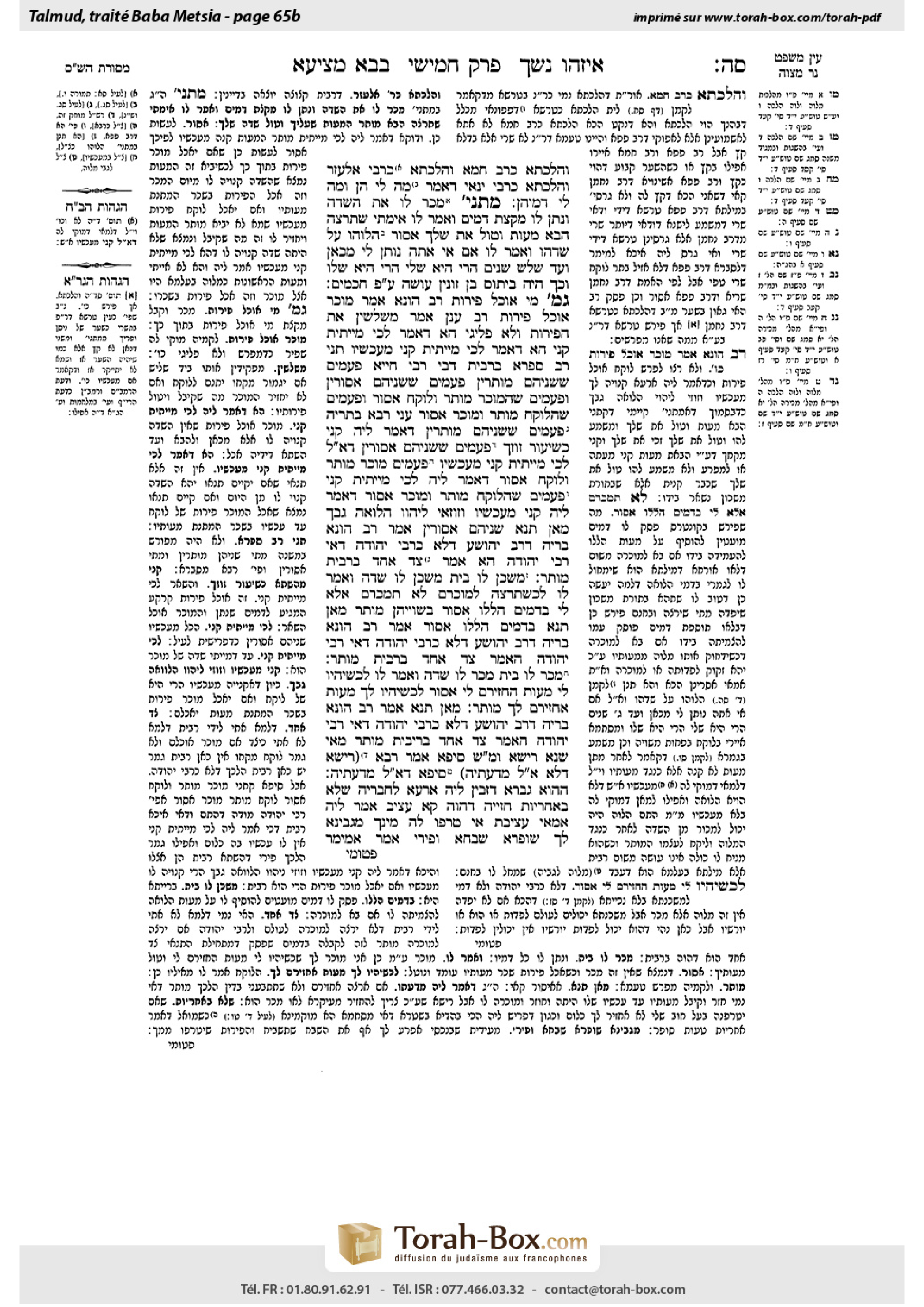
Bava Metzia 65b: Talmud study for Daf Yomi
Study the Talmud for Daf Yomi with scanned pages, Hebrew text, English translations from Sefaria and AI-generated French translations.
Passage selection and English or AI-generated French translation are available where the scan has annotations. Daf Study is independent of Torah-Box and Sefaria.
Browse Bava Metzia · בבא מציעא · All tractatesBava Metzia 65b text and translations
This page of Bava Metzia includes the Aramaic text, an English translation and an AI-generated French translation, alongside the scan above.
בבא מציעא ס״ה ב · Aramaic and Hebrew text
וְהִלְכְתָא כְּרַב חָמָא, וְהִלְכְתָא כְּרַבִּי אֶלְעָזָר, וְהִלְכְתָא כְּרַבִּי יַנַּאי, דְּאָמַר: מָה לִי הֵן וּמָה לִי דְּמֵיהֶן.
מַתְנִי׳ מָכַר לוֹ אֶת הַשָּׂדֶה, וְנָתַן לוֹ מִקְצָת דָּמִים, וְאָמַר לוֹ: אֵימָתַי שֶׁתִּרְצֶה הָבֵא מָעוֹת וְטוֹל אֶת שֶׁלְּךָ – אָסוּר. הִלְוָהוּ עַל שָׂדֵהוּ, וְאָמַר לוֹ: אִם אִי אַתָּה נוֹתֵן לִי מִכָּאן וְעַד שָׁלֹשׁ שָׁנִים – הֲרֵי הִיא שֶׁלִּי, הֲרֵי הִיא שֶׁלּוֹ. וְכָךְ הָיָה בַּיְתוֹס בֶּן זוֹנִין עוֹשֶׂה עַל פִּי חֲכָמִים.
גְּמָ׳ מִי אוֹכֵל פֵּירוֹת? רַב הוּנָא אָמַר: מוֹכֵר אוֹכֵל פֵּירוֹת. רַב עָנָן אָמַר: מְשַׁלְּשִׁין אֶת הַפֵּירוֹת. וְלָא פְּלִיגִי. הָא דְּאָמַר: לְכִי מַיְיתֵית קְנִי. הָא דְּאָמַר: לְכִי מַיְיתֵית קְנִי מֵעַכְשָׁיו.
תָּנֵי רַב סָפְרָא בְּרִבִּית דְּבֵי רַבִּי חִיָּיא: פְּעָמִים שֶׁשְּׁנֵיהֶם מוּתָּרִין, פְּעָמִים שֶׁשְּׁנֵיהֶם אֲסוּרִין, וּפְעָמִים שֶׁהַמּוֹכֵר מוּתָּר וְלוֹקֵחַ אָסוּר, וּפְעָמִים שֶׁהַלּוֹקֵחַ מוּתָּר וּמוֹכֵר אָסוּר.
עָנֵי רָבָא בָּתְרֵיהּ: פְּעָמִים שֶׁשְּׁנֵיהֶם מוּתָּרִין, דְּאָמַר לֵיהּ: קְנִי כְּשִׁיעוּר זוּזָךְ. פְּעָמִים שֶׁשְּׁנֵיהֶם אֲסוּרִין, דְּאָמַר לֵיהּ: לְכִי מַיְיתֵית קְנִי מֵעַכְשָׁיו.
פְּעָמִים מוֹכֵר מוּתָּר וְלוֹקֵחַ אָסוּר, דְּאָמַר לֵיהּ: לְכִי מַיְיתֵית קְנִי. פְּעָמִים שֶׁהַלּוֹקֵחַ מוּתָּר וּמוֹכֵר אָסוּר, דְּאָמַר לֵיהּ: קְנִי מֵעַכְשָׁיו וְזוּזַאי לִהְווֹ הַלְוָאָה גַּבָּךְ.
מַאן תָּנָא שְׁנֵיהֶם אֲסוּרִין? אָמַר רַב הוּנָא בְּרֵיהּ דְּרַב יְהוֹשֻׁעַ, דְּלָא כְּרַבִּי יְהוּדָה. דְּאִי רַבִּי יְהוּדָה, הָאָמַר: צַד אֶחָד בְּרִבִּית – מוּתָּר.
מִשְׁכֵּן לוֹ בַּיִת, מִשְׁכֵּן לוֹ שָׂדֶה, וְאָמַר לוֹ: ״לִכְשֶׁתִּרְצֶה לְמוֹכְרָם – לֹא תִּמְכְּרֵם אֶלָּא לִי בַּדָּמִים הַלָּלוּ״ – אָסוּר. ״בְּשׇׁוְיֵיהֶן״ – מוּתָּר.
מַאן תַּנָּא ״בַּדָּמִים הַלָּלוּ״ אָסוּר? אָמַר רַב הוּנָא בְּרֵיהּ דְּרַב יְהוֹשֻׁעַ: דְּלָא כְּרַבִּי יְהוּדָה, דְּאִי רַבִּי יְהוּדָה, הָאָמַר: צַד אֶחָד בְּרִבִּית – מוּתָּר.
מָכַר לוֹ בַּיִת, מָכַר לוֹ שָׂדֶה, וְאָמַר לוֹ: ״לִכְשֶׁיִּהְיוּ לִי מָעוֹת הַחְזִירֵם לִי״ – אָסוּר. ״לִכְשֶׁיִּהְיוּ לְךָ מָעוֹת אַחֲזִירֵם לָךְ״ – מוּתָּר. מַאן תַּנָּא? אָמַר רַב הוּנָא בְּרֵיהּ דְּרַב יְהוֹשֻׁעַ: דְּלָא כְּרַבִּי יְהוּדָה. דְּאִי רַבִּי יְהוּדָה, הָאָמַר צַד אֶחָד בְּרִבִּית – מוּתָּר.
מַאי שְׁנָא רֵישָׁא וּמַאי שְׁנָא סֵיפָא? אָמַר רָבָא: רֵישָׁא – דְּלָא אֲמַר לֵיהּ מִדַּעְתֵּיהּ. סֵיפָא – דְּאָמַר לֵיהּ מִדַּעְתֵּיהּ.
הָהוּא גַּבְרָא דְּזַבֵּין לֵיהּ אַרְעָא לְחַבְרֵיהּ שֶׁלֹּא בְּאַחְרָיוּת, חַזְיֵיהּ דַּהֲוָה (קָא) עֲצִיב. אֲמַר לֵיהּ: אַמַּאי עֲצִיבַתְּ? אִי טָרְפוּ לַהּ מִינָּךְ, מַגְבֵּינָא לָךְ שׁוּפְרָא, שְׁבָחָא, וּפֵירֵי.
אָמַר אַמֵּימָר:
Bava Metzia 65b · English translation
The Gemara summarizes the rulings in a number of the cases discussed above: And the halakha is in accordance with the opinion of Rav Ḥama, that his type of tacit interest agreement is permitted. And the halakha is in accordance with the opinion of Rabbi Elazar, that fixed interest can be reclaimed in court. And the halakha is in accordance with the opinion of Rabbi Yannai, who says: What difference is it to me if he referred to the produce, and what difference is it to me if he referred to the produce’s value? In other words, if one gave an item or money to another as payment of his loan, this is considered a sale without interest.
MISHNA: If one sold another a field and the buyer gave him some of the money, and the seller said to him: Whenever you wish, bring the outstanding money and take your field at that point, this is prohibited. If one lent money to another on the basis of the borrower’s field serving as a guarantee, and said to him: If you do not give me the money now and instead delay your payment from now until three years have passed, the field is mine, then after three years, the field is his. This is permitted even if the field is worth more than the amount of the loan. And this is what Baitos ben Zunin would do, with the consent of the Sages, when he lent money.
GEMARA: The ruling of the mishna is unclear, as it requires clarification: In a sale such as this, when the buyer has made only a partial payment, who enjoys the profits of this field in the interim period, until the entire transaction is complete? Rav Huna says: The seller enjoys the profits until he receives the full payment, while Rav Anan says: In the meantime they deposit the profits in escrow with a third party until the transaction is finalized. The Gemara comments: And Rav Huna and Rav Anan do not disagree. This one is referring to a case where the seller says: When you bring all the money you will acquire the field, whereas that one is referring to a case where he says at the time of the transaction: When you bring all the money you will acquire it from now.
The Gemara relates: Rav Safra taught the following halakhot of interest as a baraita of the school of Rabbi Ḥiyya: Sometimes they are both permitted to enjoy the profits of the field, as this does not constitute interest at all; sometimes they are both prohibited from doing so. And sometimes it is permitted for the seller to enjoy the profits of the field but it is prohibited for the buyer to do so; and sometimes it is permitted for the buyer to enjoy the profits of the field and it is prohibited for the seller to do so.
When Rav Safra taught this baraita, Rava answered after him, in explanation: Sometimes they are both permitted to benefit from the field. For example, if the seller said to him: Acquire the field for yourself in accordance with the measure of your money, he effectively acquires the field incrementally in small portions, which is certainly permitted. Sometimes they are both prohibited from benefiting from the field. For example, if the seller said to him: When you bring the money you will acquire it all from now, if the seller enjoys the profits until the remainder of the money is paid, he has clearly taken interest. If the buyer does not make the final payment, the field will remain the property of the seller and his partial payment will be returned, and the field will be considered a loan given to the seller. If the buyer enjoys the profits of the field in the interim, he will have taken interest.
Rava continues: Sometimes the seller is permitted to benefit from the field and the buyer is prohibited from benefiting from it, i.e., the transaction is considered interest from the perspective of the buyer but not the seller. For example, if the seller said to him: When you bring the money you will acquire the field. And sometimes the buyer is permitted to benefit from the field and the seller is prohibited from benefiting from it. For example, if the seller said to him: Acquire it from now, and the money you still owe me will be considered a loan in your possession. In this case, if the seller enjoys the profits he benefits from the extended payment of the loan.
The Gemara poses a question: Who is the tanna who taught that they are both prohibited from benefiting from the field if he says: When you bring the money you will acquire it from now? Rav Huna, son of Rav Yehoshua, says that the opinion of this tanna is not in accordance with the opinion of Rabbi Yehuda. As, if it is in accordance with the opinion of Rabbi Yehuda, doesn’t Rabbi Yehuda say that uncertain interest is permitted? In this case as well, it is uncertain whether the arrangement will result in the payment of interest, as it depends on whether or not the rest of the payment is given.
§ It is taught in a baraita: If a borrower pledged a house to the lender or pledged a field to him as a guarantee for the loan, and the lender said to the borrower: When you want to sell the house or the field, you must sell them only to me for this specified monetary value, it is prohibited, as the selling of the field for a low price is considered interest paid in exchange for the granting of the loan. But if he said: You must sell them to me according to their value at the time of the sale, this is permitted.
The Gemara asks: Who is the tanna who taught that if he said: You must sell them only to me for this specified monetary value, it is prohibited? Rav Huna, son of Rav Yehoshua, said that it is not in accordance with the opinion of Rabbi Yehuda. As, if it is in accordance with the opinion of Rabbi Yehuda, doesn’t Rabbi Yehuda say that uncertain interest is permitted? The interest in this case is uncertain, as there is no guarantee that the sale will ever be implemented.
If one sold another a house or sold him a field, and said to the buyer: When I have money, give the property back to me in exchange for the return of the money that you paid for it, it is prohibited, as this transaction is essentially a loan, with the buyer enjoying the profits of the field in the interim. But if the buyer said to him of his own accord: When you have money I will return the property to you, this is permitted. The Gemara again asks: Who is the tanna who taught this ruling? Rav Huna, son of Rav Yehoshua, said that it is not in accordance with the opinion of Rabbi Yehuda. As, if it is in accordance with the opinion of Rabbi Yehuda, doesn’t Rabbi Yehuda say that uncertain interest is permitted?
The Gemara asks: What is different in the first clause and what is different in the latter clause? Why does it matter who stated the condition? Rava says: The first clause is referring to a situation where the seller did not tell the buyer that the decision to return the field will be of the buyer’s own accord, but made it a condition of the sale. Consequently, the seller always retains the option to return the money and recover his field, which means it was essentially a loan with the temporary use of the field serving as a substitute for interest. Conversely, in the latter clause, it is referring to a situation where the buyer said he would return the field of his own accord. Since the buyer can choose to keep the field, it is a proper sale.
§ The Gemara relates: There was a certain man who sold land to another without a guarantee that if the field is repossessed, the seller will compensate the buyer for his loss. He observed that the buyer was distressed, as he was concerned that the field might have been designated as a pledge to a creditor and would be taken from him, which would cause him to lose his investment. The seller said to the buyer: Why are you distressed? If the creditor seizes the field from you, I will pay you from my best-quality land, and I will also provide compensation for your investment in the improvement of the field, and in addition, I will give you the value of any produce taken from you.
Later, the legal status of this promise was called into question. Ameimar said:
Bava Metzia 65b · Traduction française (IA)
La Guemara résume les décisions concernant plusieurs des cas discutés ci-dessus : Et la halakha suit l'opinion de Rav Ḥama, selon laquelle son type d'accord implicite sur l'intérêt est permis. Et la halakha suit l'opinion de Rabbi Elazar, selon laquelle l'intérêt fixe peut être récupéré devant un tribunal. Et la halakha suit l'opinion de Rabbi Yannai, qui dit : Quelle différence cela fait-il pour moi si c'est les produits qu'il a mentionnés, et quelle différence cela fait-il pour moi si c'est la valeur des produits qu'il a mentionnés ? Autrement dit, si l'on donne un objet ou de l'argent à un autre comme paiement de son prêt, cela est considéré comme une vente sans intérêt.
MICHNA : Si l'on vend à un autre un champ et que l'acheteur lui donne une partie de l'argent, et que le vendeur lui dise : Quand tu veux, apporte l'argent restant et prends ton champ à ce moment-là, cela est interdit. Si l'on prête de l'argent à un autre sur la base du champ de l'emprunteur servant de garantie, et qu'on lui dise : Si tu ne me donnes pas l'argent maintenant et que tu retards le paiement de maintenant jusqu'à ce que trois ans s'écoulent, le champ est à moi, alors après trois ans, le champ est à lui. Cela est permis même si le champ vaut plus que le montant du prêt. Et c'est ce que Baitos ben Zunin faisait, avec le consentement des Sages, lorsqu'il prêtait de l'argent.
GUEMARA : La décision de la Michna est ambiguë, car elle nécessite une clarification : Dans une vente telle que celle-ci, lorsque l'acheteur a seulement versé une partie de l'argent, qui profite des bénéfices de ce champ pendant la période intermédiaire, jusqu'à ce que la transaction soit terminée ? Rav Huna dit : Le vendeur profite des bénéfices jusqu'à ce qu'il reçoive le paiement complet, tandis que Rav Anan dit : Pendant ce temps, les bénéfices sont déposés chez un tiers jusqu'à ce que la transaction soit finalisée. La Guemara commente : Et Rav Huna et Rav Anan ne sont pas en désaccord. Celui-ci parle d'un cas où le vendeur dit : Quand tu apporteras tout l'argent, tu auras le champ, tandis que celui-là parle d'un cas où il dit au moment de la transaction : Quand tu apporteras tout l'argent, tu l'acquerras dès maintenant.
La Guemara rapporte : Rav Safra a enseigné les halakhot suivantes sur l'intérêt comme une baraïta de la maison de Rabbi Ḥiyya : Parfois ils sont tous deux autorisés à profiter des bénéfices du champ, car cela ne constitue pas d'intérêt du tout ; parfois ils sont tous deux interdits de le faire. Et parfois il est permis au vendeur de profiter des bénéfices du champ mais interdit à l'acheteur de le faire ; et parfois il est permis à l'acheteur de profiter des bénéfices du champ et interdit au vendeur de le faire.
Quand Rav Safra a enseigné cette baraïta, Rava a répondu après lui, en explication : Parfois ils sont tous deux autorisés à bénéficier du champ. Par exemple, si le vendeur a dit à lui : Acquière le champ selon la mesure de ton argent, il acquiert le champ progressivement en petites portions, ce qui est certainement permis. Parfois ils sont tous deux interdits de bénéficier du champ. Par exemple, si le vendeur a dit à lui : Quand tu apporteras l'argent, tu l'acquerras dès maintenant, si le vendeur profite des bénéfices jusqu'à ce que l'argent restant soit payé, il a clairement pris intérêt. Si l'acheteur ne fait pas le paiement final, le champ restera la propriété du vendeur et son paiement partiel sera remboursé, et le champ sera considéré comme un prêt donné au vendeur. Si l'acheteur profite des bénéfices du champ pendant la période intermédiaire, il aura pris intérêt.
Rava continue : Parfois le vendeur est autorisé à bénéficier du champ et l'acheteur est interdit de bénéficier du champ, c'est-à-dire que la transaction est considérée comme un intérêt du point de vue de l'acheteur mais pas du vendeur. Par exemple, si le vendeur a dit à lui : Quand tu apporteras l'argent, tu auras le champ. Et parfois l'acheteur est autorisé à bénéficier du champ et le vendeur est interdit de bénéficier du champ. Par exemple, si le vendeur a dit à lui : Acquière-le dès maintenant, et l'argent que tu me dois encore sera considéré comme un prêt en ton possession. Dans ce cas, si le vendeur profite des bénéfices, il bénéficie de l'extension du prêt.
La Guemara pose une question : Qui est le tanna qui a enseigné qu'ils sont tous deux interdits de bénéficier du champ s'il dit : Quand tu apporteras l'argent, tu l'acquerras dès maintenant ? Rav Huna, fils de Rav Yehoshua, dit que l'opinion de ce tanna n'est pas en accord avec celle de Rabbi Yehuda. Car, si elle est en accord avec celle de Rabbi Yehuda, ne dit-il pas Rabbi Yehuda que l'intérêt incertain est permis ? Dans ce cas également, il est incertain que l'arrangement entraînera le paiement d'intérêt, car cela dépend de savoir si l'argent restant est payé ou non.
§ Il est enseigné dans une baraïta : Si un emprunteur a mis en gage une maison ou un champ à l'emprunteur comme garantie pour le prêt, et que l'emprunteur a dit à l'emprunteur : Quand tu veux vendre la maison ou le champ, tu dois les vendre uniquement à moi pour cette valeur monétaire spécifiée, cela est interdit, car la vente du champ à un prix bas est considérée comme un intérêt payé en échange de la concession du prêt. Mais si il a dit : Tu dois les vendre à moi selon leur valeur à l'époque de la vente, cela est permis.
La Guemara pose une question : Qui est le tanna qui a enseigné que si il a dit : Tu dois les vendre uniquement à moi pour cette valeur monétaire spécifiée, cela est interdit ? Rav Huna, fils de Rav Yehoshua, a dit que cela n'est pas en accord avec l'opinion de Rabbi Yehuda. Car, si cela est en accord avec l'opinion de Rabbi Yehuda, ne dit-il pas Rabbi Yehuda que l'intérêt incertain est permis ? L'intérêt dans ce cas est incertain, car il n'y a pas de garantie que la vente aura lieu.
Si l'on vend à un autre une maison ou un champ, et qu'on dit à l'acheteur : Lorsque j'aurai de l'argent, rends-moi la propriété en échange du retour de l'argent que tu as payé, cela est interdit, car cette transaction est essentiellement un prêt, l'acheteur profitant des bénéfices du champ pendant la durée. Mais si l'acheteur dit de sa propre initiative : Lorsque tu auras de l'argent, je te rendrai la propriété, cela est permis. La Guemara pose à nouveau la question : Quel est le tanna qui a enseigné cette décision ? Rav Huna, fils de Rav Yehoshua, dit que cela n'est pas conforme à l'opinion de Rabbi Yehuda. Car, si cela était conforme à l'opinion de Rabbi Yehuda, ne dit-il pas Rabbi Yehuda que l'intérêt incertain est permis ?
La Guemara pose la question : Qu'est-ce qui diffère dans la première clause et qu'est-ce qui diffère dans la seconde clause ? Pourquoi est-ce important de savoir qui a formulé la condition ? Rava dit : La première clause fait référence à une situation où le vendeur n'a pas dit à l'acheteur que la décision de rendre le champ serait de la volonté de l'acheteur, mais l'a rendu condition de la vente. Ainsi, le vendeur conserve toujours l'option de rendre l'argent et de récupérer son champ, ce qui signifie que cela était essentiellement un prêt, la possession temporaire du champ servant de substitut à l'intérêt. À l'inverse, dans la seconde clause, il s'agit d'une situation où l'acheteur a dit qu'il rendrait le champ de sa propre initiative. Puisque l'acheteur peut choisir de garder le champ, c'est une vente valide.
§ La Guemara relate : Il y avait un certain homme qui avait vendu un terrain à un autre sans garantie que, si le terrain est réclamé, le vendeur compenserait l'acheteur pour sa perte. Il observa que l'acheteur était inquiet, car il craignait que le terrain ait été désigné comme caution pour un créancier et soit enlevé à lui, ce qui causerait la perte de son investissement. Le vendeur dit à l'acheteur : Pourquoi es-tu inquiet ? Si le créancier enlève le terrain à toi, je paierai à partir de mon meilleur terrain, et je compenserai également ta perte liée à l'amélioration du terrain, et en plus, je te donnerai la valeur de tout ce que tu as perdu en production.
Plus tard, le statut juridique de cette promesse a été mis en question. Ameimar dit :
Traduction française générée par IA à partir de l’édition anglaise de Sefaria. Vérifie toujours un passage avec le texte source.
Text from Sefaria: William Davidson Edition - Vocalized Aramaic (CC BY NC); William Davidson Edition - English (CC BY NC).