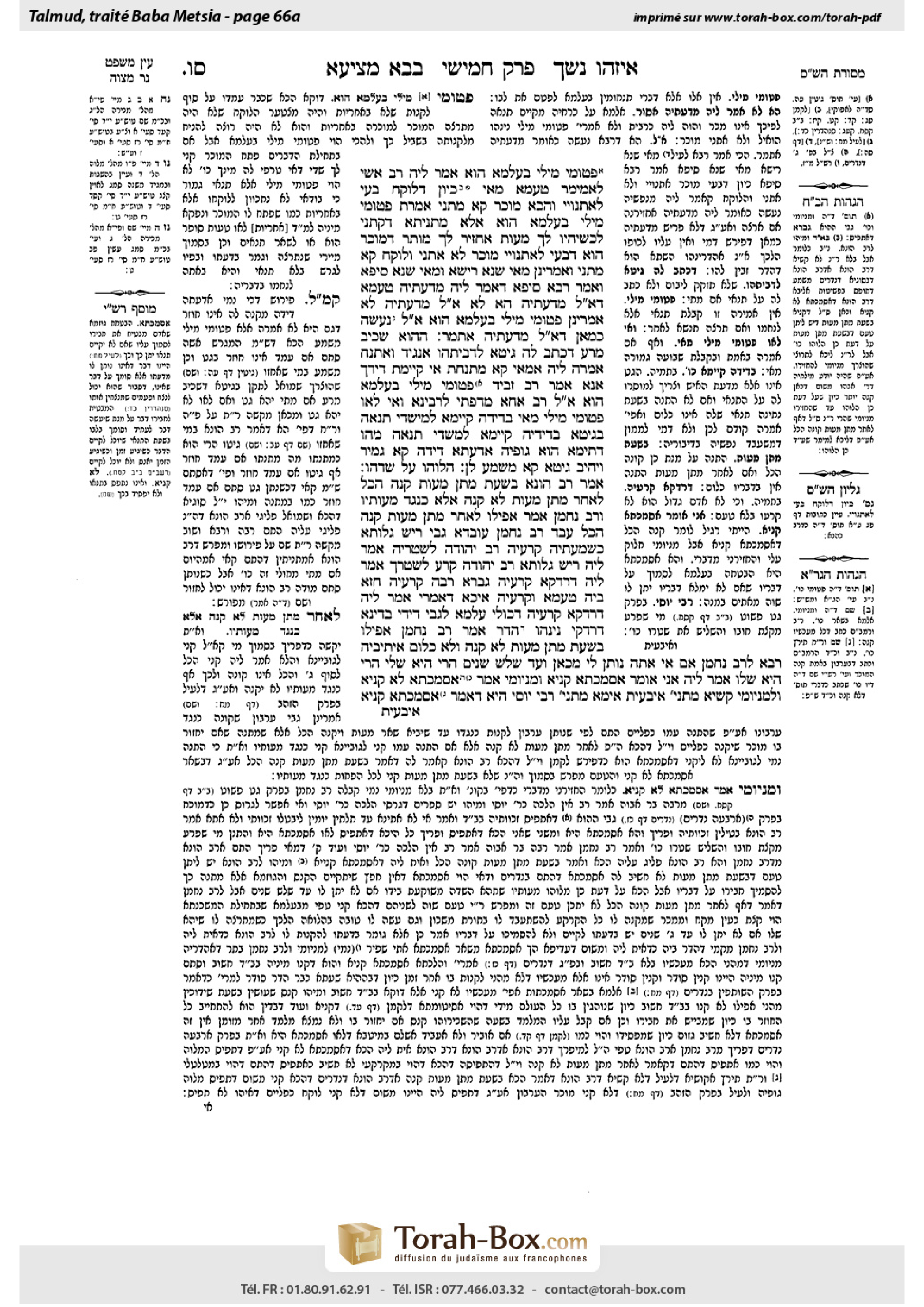
Bava Metzia 66a: Talmud study for Daf Yomi
Study the Talmud for Daf Yomi with scanned pages, Hebrew text, English translations from Sefaria and AI-generated French translations.
Passage selection and English or AI-generated French translation are available where the scan has annotations. Daf Study is independent of Torah-Box and Sefaria.
Browse Bava Metzia · בבא מציעא · All tractatesBava Metzia 66a text and translations
This page of Bava Metzia includes the Aramaic text, an English translation and an AI-generated French translation, alongside the scan above.
בבא מציעא ס״ו א · Aramaic and Hebrew text
פַּטּוֹמֵי מִילֵּי בְּעָלְמָא הוּא. אֲמַר לֵיהּ רַב אָשֵׁי לְאַמֵּימָר: טַעְמָא מַאי – כֵּיוָן דְּלוֹקֵחַ בָּעֵי לְאַתְנוֹיֵי, וְהָכָא מוֹכֵר קָא מַתְנֵי, אָמְרַתְּ פַּטּוֹמֵי מִילֵּי בְּעָלְמָא הוּא.
אֶלָּא מַתְנִיתָא דְּקָתָנֵי: ״לִכְשֶׁיִּהְיוּ לְךָ מָעוֹת אַחְזִיר לָךְ – מוּתָּר״, דְּמוֹכֵר הוּא דְּבָעֵי לְאַתְנוֹיֵי, מוֹכֵר לָא אַתְנִי וְלוֹקֵחַ קָא מַתְנֵי.
וְאָמְרִינַן: מַאי שְׁנָא רֵישָׁא וּמַאי שְׁנָא סֵיפָא? וְאָמַר רָבָא: סֵיפָא, דַּאֲמַר לֵיהּ מִדַּעְתֵּיהּ. טַעְמָא דַּאֲמַר לֵיהּ מִדַּעְתֵּיהּ, הָא לָא אֲמַר לֵיהּ מִדַּעְתֵּיהּ – לָא אָמְרִינַן פַּטּוֹמֵי מִילֵּי בְּעָלְמָא הוּא.
אֲמַר לֵיהּ: נַעֲשֶׂה כְּמַאן דַּאֲמַר לֵיהּ מִדַּעְתֵּיהּ אִתְּמַר.
הָהוּא שְׁכִיב מְרַע, דִּכְתַב לַהּ גִּיטָּא לִדְבֵיתְהוּ, אִנְּגִיד וְאִתְּנַח. אֲמַרָה לֵיהּ: אַמַּאי קָא מִתְּנַחַתְּ? אִי קָיְימַתְּ – דִּידָךְ אֲנָא. אָמַר רַב זְבִיד: פַּטּוֹמֵי מִילֵּי בְּעָלְמָא הוּא.
אֲמַר לֵיהּ רַב אַחָא מִדִּפְתִּי לְרָבִינָא: וְאִי לָאו פַּטּוֹמֵי מִילֵּי מַאי? בְּדִידַהּ קָיְימָא לְמִישְׁדֵּי תְּנָאָה בְּגִיטָּא? בְּדִידֵיהּ קָיְימָא לְמִשְׁדֵּי תְּנָאָה! מַהוּ דְּתֵימָא: הוּא גּוּפֵיהּ אַדַּעְתָּא דִידַהּ קָא גָמֵיר וְיָהֵיב גִּיטָּא – קָא מַשְׁמַע לַן.
הִלְוָהוּ עַל שָׂדֵהוּ, אָמַר רַב הוּנָא: בִּשְׁעַת מַתַּן מָעוֹת – קָנָה הַכֹּל. לְאַחַר מַתַּן מָעוֹת – לֹא קָנָה אֶלָּא כְּנֶגֶד מְעוֹתָיו. וְרַב נַחְמָן אָמַר: אֲפִילּוּ לְאַחַר מַתַּן מָעוֹת – קָנָה הַכֹּל.
עֲבַד רַב נַחְמָן עוֹבָדָא גַּבֵּי רֵישׁ גָּלוּתָא כִּשְׁמַעְתֵּיהּ, קַרְעֵיהּ רַב יְהוּדָה לִשְׁטָרֵיהּ. אֲמַר לֵיהּ רֵישׁ גָּלוּתָא: רַב יְהוּדָה קְרַע לִשְׁטָרָךְ. אֲמַר לֵיהּ: דַּרְדְּקָא קַרְעֵיהּ? גַּבְרָא רַבָּה קַרְעֵיהּ, חֲזָא בֵּיהּ טַעְמָא וְקַרְעֵיהּ!
אִיכָּא דְאָמְרִי, אֲמַר לֵיהּ: דַּרְדְּקָא קַרְעֵיהּ, דְּכוּלֵּי עָלְמָא לְגַבֵּי דִּידִי בְּדִינָא דַּרְדְּקֵי נִינְהוּ.
הֲדַר אָמַר רַב נַחְמָן: אֲפִילּוּ בִּשְׁעַת מַתַּן מָעוֹת – לֹא קָנָה וְלֹא כְּלוּם. אֵיתִיבֵיהּ רָבָא לְרַב נַחְמָן: אִם אִי אַתָּה נוֹתֵן לִי מִכָּאן וְעַד שָׁלֹשׁ שָׁנִים, הֲרֵי הִיא שֶׁלִּי – הֲרֵי הִיא שֶׁלּוֹ!
אֲמַר לֵיהּ: אֲנִי אוֹמֵר אַסְמַכְתָּא קָנְיָא. וּמִנְיוֹמֵי אָמַר: אַסְמַכְתָּא לָא קָנְיָא.
וּלְמִנְיוֹמֵי קַשְׁיָא מַתְנִיתִין! אִיבָּעֵית אֵימָא מַתְנִיתִין רַבִּי יוֹסֵי הִיא, דְּאָמַר אַסְמַכְתָּא קָנְיָא.
Bava Metzia 66a · English translation
These are merely words of enticement [pittumei millei] designed to encourage the buyer, but they are not part of a legal contract and therefore do not obligate the seller. Rav Ashi said to Ameimar: What is the reason for this? Since the buyer is the one who needs to stipulate this condition but he neglected to do so, and here it was the seller who stipulated the condition, is that why you said that these are merely words of enticement?
But according to this reasoning, consider the baraita, as it teaches that if the buyer says: When you have money I will give the property back to you, this is permitted. Now in this case it is the seller who needs to stipulate this condition, but the seller did not stipulate it and it was the buyer who stipulated it. Accordingly, they should likewise be regarded as words of enticement.
And we said concerning the baraita: What is different in the first clause and what is different in the latter clause? And Rava says that the latter clause is referring to a situation where the buyer said he would return the field of his own accord. Rav Ashi infers: The reason the condition is invalid is that the buyer said to him that he would return the field of his own accord. But if he did not say to him that he would return the field of his own accord, we would not say that these are merely words of enticement, even though the statement was made by the buyer about himself, and not as a condition by the seller.
Ameimar said to him: In fact, any condition stated by the wrong person is invalid, but it was stated in the baraita that whenever the buyer states such a condition, he is considered like one who said that he would return the field of his own accord.
§ The Gemara relates: There was a certain person on his deathbed who wrote a bill of divorce for his wife in order to exempt her from the obligation of ḥalitza in the event of his death, and he moaned and sighed at the time, in distress over having to divorce her. She said to him: Why do you sigh? If you recover from this illness, I am yours, as I will marry you again. The Gemara discusses the legal validity of this promise. Rav Zevid said: These are merely words of enticement designed to encourage him to grant the divorce, but they do not actually obligate the wife to remarry him if he lives.
Rav Aḥa of Difti said to Ravina: And even if they were not merely words of enticement, but she had made an actual condition upheld by an oath or an act of acquisition, what of it? Is it her prerogative to stipulate a condition concerning her bill of divorce? It is not in her power to do so, as it is his right to establish such a condition, and since he failed to do so explicitly, any condition she accepts upon herself is of no consequence. The Gemara answers: This statement of Rav Zevid is necessary, lest you say that he himself relied upon her condition when he decided to give her the bill of divorce, and therefore it is as though he stipulated the condition. Rav Zevid therefore teaches us that this is not the case.
§ The mishna teaches: If one lent money to another on the basis of his field serving as a guarantee, and he said to borrower: If you do not give me the money from now until three years have passed, your field is mine, then if his money is not returned within three years, the field is his. Rav Huna says: If the lender stated the condition at the time of the giving of the money, he has acquired it all, meaning that if the borrower fails to pay the debt, the entire field is transferred to the lender. But if the lender stated his condition at some point after the giving of the money, he has acquired only a portion of the field corresponding to the money that he lent. And Rav Naḥman says: Even if the lender stated his condition after the giving of the money, he has acquired it all.
The Gemara relates: Rav Naḥman performed an action in the court of the Exilarch in accordance with his statement that even if the lender states his condition after the loan is granted, the lender acquires the entire field if the loan isn’t repaid within the specified time period. The case then came before Rav Yehuda, who tore up the lender’s deed of ownership of the field, claiming it was invalid. The Exilarch said to Rav Naḥman: Rav Yehuda tore up your document, i.e., he overruled your decision. Rav Naḥman said to him: Did a child tear it up? A great man tore it up; he must have seen in it some reason to invalidate it, and that is why he tore it up.
There are those who say a different version of this exchange, according to which Rav Naḥman said to him: A child tore it up, i.e., there is no need to take his opinion into consideration, as everyone is like a child relative to me with regard to monetary laws. Rav Naḥman was the greatest expert of his generation with regard to monetary matters, and therefore he could discount the opinions of others.
After examining the matter again, Rav Naḥman retracted his words and then said the opposite of his initial ruling: Even if the lender stated his condition at the time of the giving of the money, he has not acquired anything. Rava raised an objection to Rav Naḥman from the mishna, which teaches: If one lent money to another on the basis of the borrower’s field serving as a guarantee, and said to him: If you do not give me the money now and instead delay your payment from now until three years have passed, the field is mine, then after three years, the field is his. Evidently, a condition of this kind is valid.
Rav Naḥman said to him: I used to say that a transaction with inconclusive consent [asmakhta] effects acquisition, meaning that any obligation one accepts to serve as a penalty over and above the value of what he actually owes is nevertheless binding. But Minyumi said that an asmakhta does not effect acquisition, and the transaction under discussion is an asmakhta. Now that he convinced me that his opinion is correct, I have retracted my previous opinion.
The Gemara asks: But if so, the mishna is difficult according to Minyumi. The Gemara answers: If you wish, say that the mishna is in accordance with the opinion of Rabbi Yosei, who said that an asmakhta effects acquisition, but his is a minority opinion.
Bava Metzia 66a · Traduction française (IA)
Ces paroles sont simplement des mots de séduction [pittumei millei], conçus pour encourager l'acheteur, mais elles ne font pas partie d'un contrat légal et n'engagent donc pas le vendeur. Rav Ashi a dit à Ameimar : Quel est le motif de cela ? Puisque l'acheteur est celui qui doit stipuler cette condition, mais il l'a négligée, et ici c'est le vendeur qui a stipulé la condition, est-ce pourquoi tu as dit que ces paroles sont simplement des mots de séduction ?
Mais selon cette raisonnement, considérons la baraïta, car elle enseigne que si l'acheteur dit : Quand tu auras de l'argent, je te rendrai la propriété, cela est permis. Maintenant, dans ce cas, c'est le vendeur qui doit stipuler cette condition, mais le vendeur n'a pas stipulé cette condition et c'est l'acheteur qui l'a stipulée. Ainsi, ils devraient être considérés comme des mots de séduction également.
Et nous avons dit concernant la baraïta : Qu'est-ce qui diffère dans la première clause et qu'est-ce qui diffère dans la seconde clause ? Et Rava dit que la seconde clause fait référence à un cas où l'acheteur a dit qu'il allait rendre le champ de son propre chef. Rav Ashi en déduit : La raison pour laquelle la condition est invalide est que l'acheteur a dit à lui qu'il allait rendre le champ de son propre chef. Mais si l'acheteur n'avait pas dit à lui qu'il allait rendre le champ de son propre chef, nous ne dirions pas que ces paroles sont simplement des mots de séduction, même si l'énoncé a été fait par l'acheteur à son sujet, et non comme une condition par le vendeur.
Ameimar said to him: In fact, any condition stated by the wrong person is invalid, but it was stated in the baraïta that whenever the buyer states such a condition, he is considered like one who said that he would return the field of his own accord.
§ The Guemara relates: There was a certain person on his deathbed who wrote a bill of divorce for his wife in order to exempt her from the obligation of ḥalitza in the event of his death, and he moaned and sighed at the time, in distress over having to divorce her. She said to him: Why do you sigh? If you recover from this illness, I am yours, as I will marry you again. The Guemara discusses the legal validity of this promise. Rav Zevid said: These are merely words of enticement designed to encourage him to grant the divorce, but they do not actually obligate the wife to remarry him if he lives.
Rav Aḥa of Difti said to Ravina: And even if they were not merely words of enticement, but she had made an actual condition upheld by an oath or an act of acquisition, what of it? Is it her prerogative to stipulate a condition concerning her bill of divorce? It is not in her power to do so, as it is his right to establish such a condition, and since he failed to do so explicitly, any condition she accepts upon herself is of no consequence. The Guemara answers: This statement of Rav Zevid is necessary, lest you say that he himself relied upon her condition when he decided to give her the bill of divorce, and therefore it is as though he stipulated the condition. Rav Zevid therefore teaches us that this is not the case.
§ La mitsna enseigne : Si l'un prête de l'argent à un autre sur la base de son champ servant de garantie, et qu'il dit au prêteur : Si tu ne me donnes pas l'argent maintenant jusqu'à ce que trois ans passent, ton champ est à moi, alors si son argent n'est pas rendu dans les trois ans, le champ est à lui. Rav Huna dit : Si le prêteur a énoncé la condition au moment de la donation de l'argent, il l'a acquis tout entier, c'est-à-dire que si le prêteur ne rembourse pas la dette, l'ensemble du champ est transféré au prêteur. Mais si le prêteur a énoncé sa condition à un moment postérieur à la donation de l'argent, il a acquis seulement une partie du champ correspondant à l'argent qu'il a prêté. Et Rav Naḥman dit : Même si le prêteur a énoncé sa condition après la donation de l'argent, il l'a acquis tout entier.
La Guemara rapporte : Rav Naḥman a accompli une action devant la cour de l'Exilarch conformément à son affirmation que même si le prêteur énonce sa condition après que le prêt ait été accordé, le prêteur acquiert l'ensemble du champ si le prêt n'est pas remboursé dans la période spécifiée. Le cas est ensuite venu devant Rav Yehuda, qui a déchiré le document de propriété du prêteur, affirmant qu'il était invalide. L'Exilarch a dit à Rav Naḥman : Rav Yehuda a déchiré ton document, c'est-à-dire qu'il a annulé ta décision. Rav Naḥman a dit à lui : Un enfant l'a déchiré ? Un grand homme l'a déchiré ; il doit avoir vu dans ce document une raison pour l'invalidation, et c'est pourquoi il l'a déchiré.
Il y a ceux qui disent une version différente de cet échange, selon laquelle Rav Naḥman a dit à lui : Un enfant l'a déchiré, c'est-à-dire qu'il n'y a pas besoin de prendre son avis en compte, car tout le monde est comme un enfant par rapport à moi concernant les lois monétaires. Rav Naḥman était l'expert le plus compétent de sa génération concernant les affaires monétaires, et donc il pouvait ignorer les opinions des autres.
Après avoir examiné la question à nouveau, Rav Naḥman a rétracté ses paroles et a ensuite dit l'opposé de son premier jugement : Même si le prêteur a énoncé sa condition au moment de la donation de l'argent, il n'a acquis rien. Rava a soulevé une objection contre Rav Naḥman à partir de la mitsna, qui enseigne : Si l'un prête de l'argent à un autre sur la base du champ du prêteur servant de garantie, et qu'il dit à lui : Si tu ne me donnes pas l'argent maintenant et que tu retards le paiement maintenant jusqu'à ce que trois ans passent, le champ est à moi, alors après trois ans, le champ est à lui. Évidemment, une telle condition est valide.
Rav Naḥman a dit à lui : J'avais l'habitude de dire qu'une transaction avec un consentement indéterminé [asmakhta] produit l'acquisition, c'est-à-dire que toute obligation qu'une personne accepte comme sanction au-delà de la valeur de ce qu'elle doit réellement est néanmoins contraignante. Mais Minyumi a dit qu'une asmakhta ne produit pas l'acquisition, et la transaction en question est une asmakhta. Maintenant que tu m'as convaincu que ton avis est correct, j'ai rétracté mon opinion précédente.
Le Guemara demande : Mais si c'est ainsi, la Michna est difficile selon les Minyumi. Le Guemara répond : Si vous le souhaitez, dites que la Michna suit l'opinion du Rabbi Yosei, qui affirmait qu'un asmakhta constitue une acquisition, mais cette opinion est minoritaire.
Traduction française générée par IA à partir de l’édition anglaise de Sefaria. Vérifie toujours un passage avec le texte source.
Text from Sefaria: William Davidson Edition - Vocalized Aramaic (CC BY NC); William Davidson Edition - English (CC BY NC).