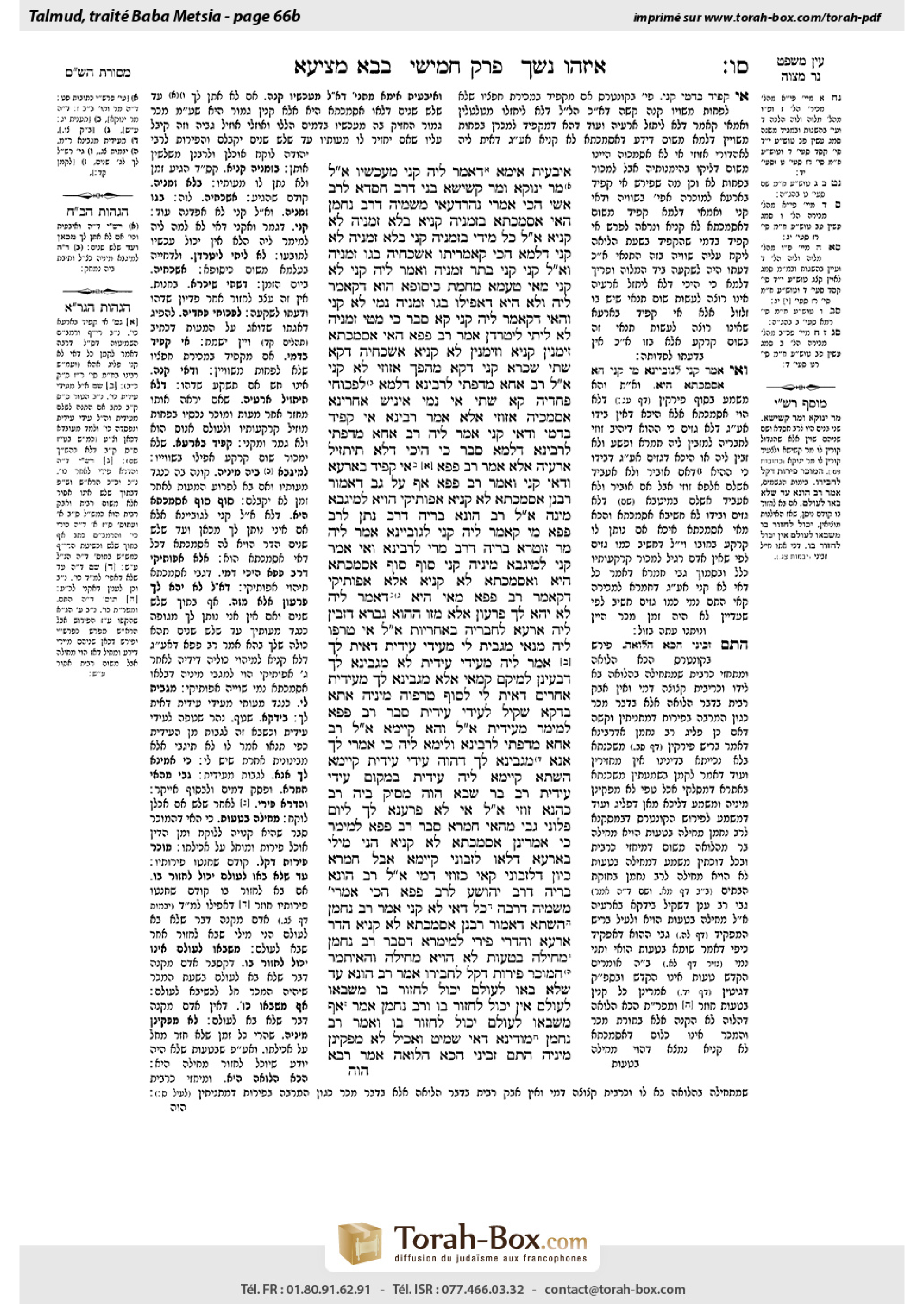
Bava Metzia 66b: Talmud study for Daf Yomi
Study the Talmud for Daf Yomi with scanned pages, Hebrew text, English translations from Sefaria and AI-generated French translations.
Passage selection and English or AI-generated French translation are available where the scan has annotations. Daf Study is independent of Torah-Box and Sefaria.
Browse Bava Metzia · בבא מציעא · All tractatesBava Metzia 66b text and translations
This page of Bava Metzia includes the Aramaic text, an English translation and an AI-generated French translation, alongside the scan above.
בבא מציעא ס״ו ב · Aramaic and Hebrew text
אִיבָּעֵית אֵימָא: דַּאֲמַר לֵיהּ קְנִי מֵעַכְשָׁיו.
אֲמַרוּ לֵיהּ מָר יָנוֹקָא וּמָר קַשִּׁישָׁא בְּנֵי דְּרַב חִסְדָּא לְרַב אָשֵׁי, הָכִי אָמְרִי נְהַרְדְּעָאֵי מִשְּׁמֵיהּ דְּרַב נַחְמָן: הַאי אַסְמַכְתָּא, בְּזִמְנֵיהּ קָנְיָא, בְּלָא זִמְנֵיהּ לָא קָנְיָא.
אֲמַר לְהוּ: כֹּל מִידֵּי, בְּזִמְנֵיהּ קָנֵי, בְּלָא זִמְנֵיהּ לָא קָנֵי.
דִּלְמָא הָכִי קָאָמְרִיתוּ: אַשְׁכְּחֵיהּ בְּגוֹ זִמְנֵיהּ וַאֲמַר לֵיהּ קְנִי – קָנֵי, בָּתַר זִמְנֵיהּ וַאֲמַר לֵיהּ קְנִי – לָא קָנֵי. מַאי טַעְמָא – מֵחֲמַת כִּיסּוּפָא הוּא דְּקָאָמַר לֵיהּ.
וְלָא הִיא, דַּאֲפִילּוּ בְּגוֹ זִמְנֵיהּ נָמֵי לָא קָנֵי, וְהַאי דְּקָאָמַר לֵיהּ ״קְנִי״ – קָא סָבַר: כִּי מָטֵי זִמְנֵיהּ, לָא לַיְתֵי לִיטְרְדַן.
אָמַר רַב פָּפָּא: הַאי אַסְמַכְתָּא, זִימְנִין קָנְיָא וְזִימְנִין לָא קָנְיָא. אַשְׁכְּחֵיהּ דְּקָא שָׁתֵי שִׁכְרָא – קָנֵי. דְּקָא מְהַפֵּךְ אַזּוּזֵי – לָא קָנֵי.
אֲמַר לֵיהּ רַב אַחָא מִדִּפְתִּי לְרָבִינָא: דִּלְמָא לְפַכּוֹחֵי פַּחְדֵּיהּ קָא שָׁתֵי, אִי נָמֵי: אִינִישׁ אַחֲרִינָא אַסְמְכֵיהּ אַזּוּזֵי! אֶלָּא אָמַר רָבִינָא: אִי קָפֵיד בִּדְמֵי – וַדַּאי קָנֵי.
אֲמַר לֵיהּ רַב אַחָא מִדִּפְתִּי לְרָבִינָא: דִּלְמָא סָבַר כִּי הֵיכִי דְּלָא תִּיתְּזִיל אַרְעֵיהּ, אֶלָּא אָמַר רַב פָּפָּא: אִי קָפֵיד בְּאַרְעָא, וַדַּאי קָנֵי.
וְאָמַר רַב פָּפָּא: אַף עַל גַּב דַּאֲמוּר רַבָּנַן אַסְמַכְתָּא לָא קָנְיָא, אַפּוֹתֵיקֵי הָוְיָא לְמִיגְבֵּא מִינַּהּ.
אֲמַר לֵיהּ רַב הוּנָא בְּרֵיהּ דְּרַב נָתָן לְרַב פָּפָּא: מִי קָאָמַר לֵיהּ קְנִי לְגוּבְיָינָא? אֲמַר לֵיהּ מָר זוּטְרָא בְּרֵיהּ דְּרַב מָרִי לְרָבִינָא: וְאִי אָמַר קְנִי לְמִיגְבֵּא מִינֵּיהּ – קָנֵי? סוֹף סוֹף אַסְמַכְתָּא הִיא, וְאַסְמַכְתָּא לָא קָנְיָא.
אֶלָּא אַפּוֹתֵיקֵי דְּאָמַר רַב פָּפָּא, מַאי הִיא: דַּאֲמַר לֵיהּ לֹא יְהֵא לְךָ פֵּרָעוֹן אֶלָּא מִזּוֹ.
הָהוּא גַּבְרָא דְּזַבֵּין לֵיהּ אַרְעָא לְחַבְרֵיהּ בְּאַחְרָיוּת. אֲמַר לֵיהּ: אִי טָרְפוּ לַיהּ מִנַּאי מַגְבֵּית לִי מֵעִידֵּי עִידִּית דְּאִית לָךְ. אֲמַר לֵיהּ: מֵעִידֵּי עִידִּית לָא מַגְבֵּינָא לָךְ, דְּבָעֵינָא לְמֵיקַם קַמַּאי, אֶלָּא מַגְבֵּינָא לָךְ מֵעִידִּית אַחֲרִיתִ[י] דְּאִית לִי. לְסוֹף טַרְפוּהָ מִינֵּיהּ, אֲתָא בִּדְקָא שְׁקֵיל לְעִידֵּי עִידִּית.
סְבַר רַב פָּפָּא לְמֵימַר: מֵעִידִּית אֲמַר לֵיהּ, וְהָא קָיְימָא.
אֲמַר לֵיהּ רַב אַחָא מִדִּפְתִּי לְרָבִינָא: וְלֵימָא לֵיהּ, כִּי אֲמַרִי לָךְ אֲנָא מַגְבֵּינָא לָךְ – דַּהֲוָה עִידֵּי עִידִּית קָיְימָא, הַשְׁתָּא קָיְימָא לֵיהּ עִידִּית בִּמְקוֹם עִידֵּי עִידִּית.
רַב בַּר שְׁבָא הֲוָה מַסֵּיק בֵּיהּ רַב כָּהֲנָא זוּזֵי. אֲמַר לֵיהּ: אִי לָא פָּרַעְנָא לָךְ לְיוֹם פְּלוֹנִי – גְּבִי מֵהַאי חַמְרָא. סְבַר רַב פָּפָּא לְמֵימַר: כִּי אָמְרִינַן אַסְמַכְתָּא לָא קָנְיָא – הָנֵי מִילֵּי בְּאַרְעָא, דְּלָאו לְזַבּוֹנֵי קָיְימָא. אֲבָל חַמְרָא כֵּיוָן דִּלְזַבּוֹנֵי קָאֵי – כְּזוּזֵי דָּמֵי.
אֲמַר לֵיהּ רַב הוּנָא בְּרֵיהּ דְּרַב יְהוֹשֻׁעַ לְרַב פָּפָּא, הָכִי אָמְרִינַן מִשְּׁמֵיהּ דְּרַבָּה: כֹּל דְּאִי – לָא קָנֵי.
אָמַר רַב נַחְמָן: הַשְׁתָּא דַּאֲמוּר רַבָּנַן אַסְמַכְתָּא לָא קָנְיָא, הָדְרָא אַרְעָא וְהָדְרִי פֵּירֵי. לְמֵימְרָא דְּסָבַר רַב נַחְמָן מְחִילָה בְּטָעוּת לָא הָוְיָא מְחִילָה?
וְהָאִיתְּמַר: הַמּוֹכֵר פֵּירוֹת דֶּקֶל לַחֲבֵירוֹ. אָמַר רַב הוּנָא: עַד שֶׁלֹּא בָּאוּ לָעוֹלָם – יָכוֹל לַחְזוֹר בּוֹ. מִשֶּׁבָּאוּ לָעוֹלָם – אֵין יָכוֹל לַחְזוֹר בּוֹ. וְרַב נַחְמָן אָמַר: אַף מִשֶּׁבָּאוּ לָעוֹלָם יָכוֹל לַחְזוֹר בּוֹ,
וְאָמַר רַב נַחְמָן: מוֹדֵינָא דְּאִי שָׁמֵיט וְאָכֵיל – לָא מַפְּקִינַן מִינֵּיהּ! הָתָם זְבִינֵי, הָכָא הַלְוָאָה.
אָמַר רָבָא:
Bava Metzia 66b · English translation
If you wish, say instead that the mishna is referring to a case where the borrower said to the lender: If I do not repay you within three years, you will acquire the field from now, and they performed a formal act of acquisition. Since an act of acquisition was performed at the time, this is a proper sale and not an asmakhta.
Mar Yanuka and Mar Kashisha, the younger and elder sons of Rav Ḥisda, said to Rav Ashi: This is what the Sages of Neharde’a say in the name of Rav Naḥman: With regard to this asmakhta described in the mishna, it effects acquisition at its proper time, but it does not effect acquisition not at its proper time.
Rav Ashi understood them to be saying that the lender acquires the field only when the loan is due, and he said to them: This statement seems to teach no novel ruling, as the same is true of every matter: It effects acquisition at its proper time, but it does not effect acquisition not at its proper time.
Rav Ashi suggests: Perhaps you meant to say this: If the borrower encountered the lender within its time, i.e., before the payment of the loan was due, and told him to acquire the field, the lender acquires the field, as it is assumed that the borrower was sincere. But if the borrower encountered the lender after its time, i.e., when the payment of the loan was due, and told the lender to acquire the field, he does not acquire it. What is the reason for this? The borrower says this to the lender out of shame with regard to his failure to pay the debt, but he did not really intend for him to acquire the field.
The Gemara comments: But this is not so, as the halakha is that the lender does not acquire the field even if the borrower stated this within its time. And as for the fact that the borrower told him to acquire it, he told him this only because he thinks: This will ensure that when the time for payment arrives, he will not come and disturb me. In other words, he is trying to buy time until he can repay the loan, but he was not sincere in his statement that the lender may acquire the field.
Rav Pappa says: With regard to this asmakhta, sometimes it effects acquisition and sometimes it does not effect acquisition. How so? If the lender encountered the borrower while the borrower was drinking beer, it effects acquisition, as, if the borrower agreed to transfer ownership of his field when he did not appear to be in financial stress, such as when he was enjoying a drink, he assumedly did so with full acceptance of the consequences, and therefore the transaction is valid. By contrast, if the lender encountered the borrower when he was searching for money with which to repay the loan, his agreement does not effect acquisition, as it is clear the borrower made the statement under duress.
Rav Aḥa of Difti said to Ravina: In the case where the lender encountered the borrower while he was drinking beer, perhaps he was drinking to neutralize his fear, and he really was under financial pressure. Or, perhaps someone else promised him money, and therefore he remains in a precarious position even though he can repay the debt, which would again mean that his promise is merely an asmakhta. Rather, Ravina said that there is a different distinction: If the borrower is particular about the money, i.e., if he is unwilling to sell his property at less than its market value, the lender has certainly acquired the field, as the borrower is clearly not in such a precarious financial position, and he is therefore assumed to have willingly stated his agreement to give the field to the lender.
Rav Aḥa of Difti said to Ravina: Even in that case, perhaps the borrower thinks that he ought to present himself as particular about the price of his property in order that the price of his other lands not be lowered. If people know that he is in need of money they will pressure to him to lower the price, and therefore he acts as though he is particular about the price, but in reality he did not wish to sell the property at all. Rather, Rav Pappa said that there is a different distinction: If he is particular about any other land he owns and does not want to sell it even at its market rate, he is clearly not suffering from financial problems, and in that case the creditor certainly acquires the field.
And Rav Pappa said: Even though the Sages said that an asmakhta does not effect acquisition, and therefore even if he stipulated that the lender can collect the debt by seizing land, the lender does not acquire that land, nevertheless, the land is considered to be set aside as designated repayment [apoteiki] for the lender to collect repayment from it up to the amount of money owed.
Rav Huna, son of Rav Natan, said to Rav Pappa: Did the borrower say to the lender: Acquire it for the sake of debt collection? Since the borrower did not specify that transferring ownership of the field was in place of the payment of the debt, his statement is considered an asmakhta, and the field is not set aside as designated repayment. Mar Zutra, son of Rav Mari, said to Ravina: And if he had said to him: Acquire it for the sake of debt collection, would the lender then acquire it? Ultimately, it is an asmakhta, and the halakha is that an asmakhta does not effect acquisition.
The Gemara poses a question: But in that case, what is the designated repayment spoken of by Rav Pappa? According to Mar Zutra’s analysis, it makes no difference whether or not he said it was set aside as designated repayment of the loan. The Gemara explains: Rav Pappa is referring to a case, for example, where the borrower said to the lender: Not only will I give you the land if I fail to repay the loan, but even if I do pay you will receive payment only from this land alone, as I will pay off my debt to you by giving you land from this field. In that case the asmakhta is negated, while the promise of repayment from the land remains intact.
§ The Gemara relates: There was a certain man who sold land to another with a property guarantee, meaning that in the event that land is seized by the seller’s creditors, the seller will reimburse the buyer his purchase money. The buyer said to him: If your creditors seize the land from me, will you allow me to collect that which is owed to me from the most superior quality of the superior-quality land that you have? The seller said to him: I will not allow you to collect from the most superior quality of my superior-quality land, as I want to keep those before me. But I will allow you to collect from other superior-quality land I have. Ultimately, creditors seized the field from the buyer, and in the meantime a flood came and flooded the seller’s most superior quality of his superior-quality land.
As his remaining superior-quality land was now the best he had, the seller was unwilling to give them to the buyer and sought to repay him with intermediate-quality land, in accordance with the standard halakha concerning reimbursement to a buyer. Rav Pappa thought to say: Since the seller said to the buyer that he could collect from his superior-quality land, and this superior-quality land is intact, the seller must give it to him, in accordance with his promise.
Rav Aḥa of Difti said to Ravina: But let the seller say to the buyer: When I said to you that I would allow you to collect from my superior-quality land, that was when the most superior quality of my superior-quality land was intact. But now my superior-quality land stands for me in place of the most superior quality of the superior-quality land I had before, and I am not obligated to give you the very best of my property.
The Gemara relates: Rav bar Shabba owed money to Rav Kahana. Rav bar Shabba said to him: If I do not repay you by such and such a date, you can collect the debt from this wine. Rav Pappa thought to say: When we said that an asmakhta does not effect acquisition, this matter applies only to land, which does not stand to be sold, i.e., which is not typically bought and sold on the market, and therefore the promise is invalid, as he did not genuinely intend to give it to him. But in the case of wine, since it does stand to be sold, it is considered like money, and therefore he can claim the debt from wine, as he can claim the debt from any other item with monetary worth.
Rav Huna, son of Rav Yehoshua, said to Rav Pappa: This is what we say in the name of Rabba: Any statement including a condition introduced with the word: If, does not effect acquistion. Any agreement that does not involve a definitive commitment but does obligate one in the event of a particular outcome has the status of an asmakhta and does not effect acquisition, as the one setting the condition did not really intend to fulfill the commitment.
§ Rav Naḥman said: Now that the Sages have said that an asmakhta does not effect acquisition, in a case such as that in the mishna, when one promised another land for the repayment of a debt, if the lender in fact took it, the land must be returned and the value of any produce the creditor consumed from this land must also be returned. The Gemara poses a question: Is this to say that Rav Naḥman maintains that mistaken forgiveness of payment is not valid forgiveness, meaning that if one forgoes repayment of a loan of a certain amount of money in error, he can change his mind? In this case, the borrower had thought that the lender had acquired the land, and he therefore allowed him to consume the produce.
But it was stated that amora’im disputed this very issue: If one sells the fruit of a palm tree to another before the fruit ripens, Rav Huna says: He can retract and cancel the sale until the fruits have come into the world, as the fruit is not yet in existence. But once they have come into the world, even if they are still unripe, he cannot retract, as once the fruits that are being acquired exist, the sale has gone into effect. And Rav Naḥman says: He can retract even once they have come into the world, as one cannot transfer ownership of an entity that has not yet come into the world, and the actual transaction was performed before the fruits existed.
And Rav Naḥman said: I concede that if the buyer seized the fruit and consumed it, we do not take its value from him. The reason is that since the seller initially accepted the transaction, although it involved a legal error, it can be assumed that he decided to waive his rights to the fruit and allowed the other to take it. Consequently, it can be demonstrated that Rav Naḥman holds that mistaken forgiveness is forgiveness. The Gemara rejects this proof: There, the discussion involves a sale, with regard to which it can be said that the seller waived his rights to the fruit. Here, it is referring to a loan, and not requiring the lender to reimburse the borrower for the produce consumed is considered a form of interest.
Rava said:
Bava Metzia 66b · Traduction française (IA)
Si tu le veux, dis plutôt que la Michna fait référence à un cas où le prêteur a dit au créancier : Si je ne te rembourse pas dans trois ans, tu auras la propriété à partir de maintenant, et ils ont accompli une formalité d'acquisition. Puisque l'acte d'acquisition a été accompli à l'époque, c'est une vente légale et non une asmakhta.
Mar Yanuka et Mar Kashisha, les fils de Rav Ḥisda, jeunes et vieux, dirent à Rav Ashi : C'est ce que disent les Sages de Neharde’a en nom de Rav Naḥman : En ce qui concerne cette asmakhta décrite dans la Michna, elle produit une acquisition à son moment propre, mais pas à un moment inapproprié.
Rav Ashi les comprit comme voulant dire que le créancier acquiert la propriété seulement lorsque le prêt est dû, et il dit à eux : Cette déclaration semble enseigner une règle nouvelle, car c'est la même chose pour toute affaire : elle produit une acquisition à son moment propre, mais pas à un moment inapproprié.
Rav Ashi suggère : Peut-être que vous vouliez dire cela : Si le prêteur rencontre le créancier dans son temps, c'est-à-dire avant que le paiement du prêt ne soit dû, et lui dit d'acquérir la propriété, le créancier acquiert la propriété, car on suppose que le prêteur était sincère. Mais si le prêteur rencontre le créancier après son temps, c'est-à-dire lorsque le paiement du prêt était dû, et lui dit d'acquérir la propriété, il ne l'acquiert pas. Pourquoi ? Le prêteur dit cela au créancier par honte à cause de son échec à payer la dette, mais il n'avait pas vraiment l'intention qu'il acquière la propriété.
Le Guemara commente : Mais cela n'est pas vrai, car la halakha est que le créancier ne acquiert pas la propriété même si le prêteur a dit cela dans son temps. Et quant au fait que le prêteur lui ait dit d'acquérir, il a dit cela uniquement parce qu'il pensait : Cela garantira que lorsque viendra le temps du paiement, il ne viendra pas me déranger. En d'autres termes, il essaie de gagner du temps jusqu'à ce qu'il puisse rembourser le prêt, mais il n'était pas sincère dans son déclaration que le créancier puisse acquérir la propriété.
Rav Pappa dit : En ce qui concerne cette asmakhta, parfois elle produit une acquisition et parfois elle ne la produit pas. Comment cela ? Si le créancier a rencontré le prêteur alors qu'il buvait de la bière, l'acquisition est valide, car, si le prêteur a accepté de transférer la propriété de son champ lorsqu'il ne semblait pas être en difficulté financière, comme lorsqu'il buvait, il a probablement accepté les conséquences avec pleine acceptation, et donc la transaction est valide. À l'inverse, si le créancier a rencontré le prêteur alors qu'il cherchait de l'argent pour rembourser le prêt, son accord ne produit pas d'acquisition, car il est clair que le prêteur a fait cette déclaration sous la contrainte.
Rav Aḥa de Difti dit à Ravina : Dans le cas où le créancier a rencontré le prêteur alors qu'il buvait de la bière, peut-être buvait-il pour neutraliser sa peur, et il était vraiment en difficulté financière. Ou, peut-être quelqu'un d'autre lui avait promis de l'argent, et donc il restait dans une situation précaire même s'il pouvait rembourser la dette, ce qui signifierait à nouveau que sa promesse est simplement une asmakhta. Plutôt, Ravina dit qu'il y a une distinction différente : Si le prêteur est particulier sur l'argent, c'est-à-dire s'il refuse de vendre sa propriété à moins de sa valeur marchande, le créancier a certainement acquis la propriété, car le prêteur n'est clairement pas dans une situation financière précaire, et il est donc supposé avoir volontairement déclaré son accord de donner la propriété au créancier.
Rav Aḥa de Difti dit à Ravina : Même dans ce cas, peut-être le prêteur pense qu'il doit se montrer particulier sur le prix de sa propriété afin que le prix de ses autres terres ne soit pas abaissé. Si les gens savent qu'il a besoin d'argent, ils le presseront de baisser le prix, et donc il agit comme s'il était particulier sur le prix, mais en réalité il ne voulait pas vendre la propriété du tout. Plutôt, Rav Pappa dit qu'il y a une distinction différente : Si il est particulier sur toute autre terre qu'il possède et ne veut pas la vendre même à son prix de marché, il est clairement pas en difficulté financière, et dans ce cas le créancier acquiert certainement la propriété.
Et Rav Pappa dit : Même si les Sages ont dit qu'une asmakhta ne produit pas d'acquisition, et donc même s'il a stipulé que le créancier puisse récupérer le prêt en s'emparant de la terre, le créancier ne l'acquiert pas, néanmoins, la terre est considérée comme désignée pour le paiement, c'est-à-dire apoteiki, pour que le créancier puisse récupérer le paiement de cette terre jusqu'au montant dû.
Rav Huna, fils de Rav Natan, dit à Rav Pappa : Le prêteur a-t-il dit au créancier : Acquière-la pour la collecte de la dette ? Puisque le prêteur n'a pas spécifié que le transfert de la propriété était en lieu et place du paiement de la dette, sa déclaration est considérée comme une asmakhta, et la terre n'est pas désignée comme rétribution. Mar Zutra, fils de Rav Mari, dit à Ravina : Et si il avait dit : Acquière-la pour la collecte de la dette, le créancier l'aurait-il alors acquise ? Finalement, c'est une asmakhta, et la halakha est que l'asmakhta ne produit pas d'acquisition.
Le Guemara pose une question : Mais dans ce cas, quelle est la rétribution désignée parlée par Rav Pappa ? Selon l'analyse de Mar Zutra, cela ne fait aucune différence si ou non il l'a dit être désignée comme rétribution du prêt. Le Guemara explique : Rav Pappa fait référence à un cas, par exemple, où le prêteur a dit au créancier : Non seulement je te donnerai la terre si je ne rembourse pas le prêt, mais même si je rembourse, tu recevras le paiement uniquement de cette terre, car je paierai ma dette à toi en donnant cette terre. Dans ce cas, l'asmakhta est nulle, tandis que la promesse de paiement de la terre reste intacte.
§ Le Guemara rapporte : Il y avait un homme qui avait vendu un terrain à un autre avec une garantie de propriété, c'est-à-dire que, en cas de saisie du terrain par les créanciers du vendeur, le vendeur rembourserait au acheteur le prix d'achat. L'acheteur lui dit : Si vos créanciers saisissent le terrain de moi, permettras-tu que je récupère ce qui me revient de la meilleure qualité du meilleur terrain que tu as ? Le vendeur lui répondit : Je ne permettrai pas que tu récupères la meilleure qualité de mon meilleur terrain, car je veux le garder pour moi. Mais je permettrai que tu récupères d'autres terrains de bonne qualité que j'ai. Finalement, les créanciers saisirent le champ de l'acheteur, et pendant ce temps, une inondation survint et inonda la meilleure qualité du meilleur terrain du vendeur.
Comme le meilleur terrain restant était désormais le meilleur qu'il avait, le vendeur était réticent à lui donner ces terrains et chercha à le rembourser avec des terrains de qualité intermédiaire, conformément à la halakha standard concernant le remboursement à un acheteur. Rav Pappa pensait dire : Puisque le vendeur a dit à l'acheteur qu'il pouvait récupérer de son terrain de bonne qualité, et que ce terrain de bonne qualité est intact, le vendeur doit lui donner ce terrain, conformément à sa promesse.
Rav Acha de Difti dit à Ravina : Mais laisse le vendeur dire à l'acheteur : Quand j'ai dit à toi que je permettrais de récupérer de mon terrain de bonne qualité, c'était quand la meilleure qualité de mon terrain de bonne qualité était intacte. Mais maintenant mon terrain de bonne qualité remplace la meilleure qualité de mon terrain de bonne qualité précédent, et je ne suis pas tenu de lui donner le meilleur de ma propriété.
Le Guemara rapporte : Rav bar Shabba devait de l'argent à Rav Kahana. Rav bar Shabba dit à lui : Si je ne te rembourse pas avant une certaine date, tu peux récupérer la dette à partir de ce vin. Rav Pappa pensait dire : Quand nous avons dit qu'un asmakhta n'effetue pas l'acquisition, cette affaire s'applique uniquement aux terres, qui ne sont pas destinées à être vendues, c'est-à-dire qui ne sont pas typiquement achetées et vendues sur le marché, et donc la promesse est invalide, car il n'avait pas vraiment l'intention de lui donner cela. Mais dans le cas du vin, puisqu'il est destiné à être vendu, il est considéré comme de l'argent, et donc il peut réclamer la dette à partir du vin, car il peut réclamer la dette à partir de tout autre objet ayant une valeur monétaire.
Rav Huna, fils de Rav Yéhoshua, dit à Rav Pappa : C'est ce que nous disons en nom de Rabba : Toute déclaration incluant une condition introduite par le mot : Si, n'effetue pas l'acquisition. Tout accord qui ne comporte pas un engagement définitif mais qui oblige à l'issue d'un événement particulier a le statut d'un asmakhta et n'effetue pas l'acquisition, car celui qui fixe la condition n'avait pas vraiment l'intention de remplir l'engagement.
§ Rav Naḥman dit : Maintenant que les Sages ont dit qu'un asmakhta n'effetue pas l'acquisition, dans un cas tel que celui de la mitsna, lorsque l'un promet à l'autre un terrain pour le remboursement d'une dette, si le prêteur a effectivement pris le terrain, le terrain doit être rendu et la valeur de toute récolte que le créancier a consommée de ce terrain doit également être rendue. Le Guemara pose une question : Est-ce que cela signifie que Rav Naḥman maintient que le pardon erroné de la dette n'est pas un pardon valide, c'est-à-dire que si l'un renonce à la remise d'un prêt d'une certaine somme d'argent par erreur, il peut changer d'avis ? Dans ce cas, le prêteur avait pensé que le créancier avait acquis le terrain, et il avait donc permis à ce dernier de consommer la récolte.
Mais il a été dit que les amoraïm disputaient cette question : Si l'on vend les fruits d'un palmier à un autre avant que les fruits ne soient mûrs, Rav Huna dit : Il peut révoquer et annuler la vente jusqu'à ce que les fruits soient entrés dans le monde, car les fruits n'existent pas encore. Mais une fois qu'ils sont entrés dans le monde, même s'ils sont encore immatures, il ne peut pas révoquer, car une fois que les fruits acquis existent, la vente est entrée en effet. Et Rav Naḥman dit : Il peut révoquer même une fois qu'ils sont entrés dans le monde, car on ne peut transférer la propriété d'une entité qui n'a pas encore entré dans le monde, et la transaction réelle a été effectuée avant que les fruits n'existent.
Et Rav Naḥman dit : Je reconnais que si l'acheteur a saisi les fruits et les a consommés, nous ne prenons pas leur valeur auprès de lui. La raison est que puisque le vendeur a accepté la transaction, bien qu'elle implique une erreur juridique, on peut supposer qu'il a décidé de renoncer à ses droits sur les fruits et a permis à l'autre de les prendre. Ainsi, on peut démontrer que Rav Naḥman considère que le pardon erroné est un pardon. Le Guemara rejette cette preuve : Là, la discussion concerne une vente, à laquelle on peut dire que le vendeur a renoncé à ses droits sur les fruits. Ici, il s'agit d'un prêt, et ne pas exiger que le prêteur rembourse l'acheteur pour la récolte consommée est considéré comme un type d'intérêt.
Rava dit :
Traduction française générée par IA à partir de l’édition anglaise de Sefaria. Vérifie toujours un passage avec le texte source.
Text from Sefaria: William Davidson Edition - Vocalized Aramaic (CC BY NC); William Davidson Edition - English (CC BY NC).