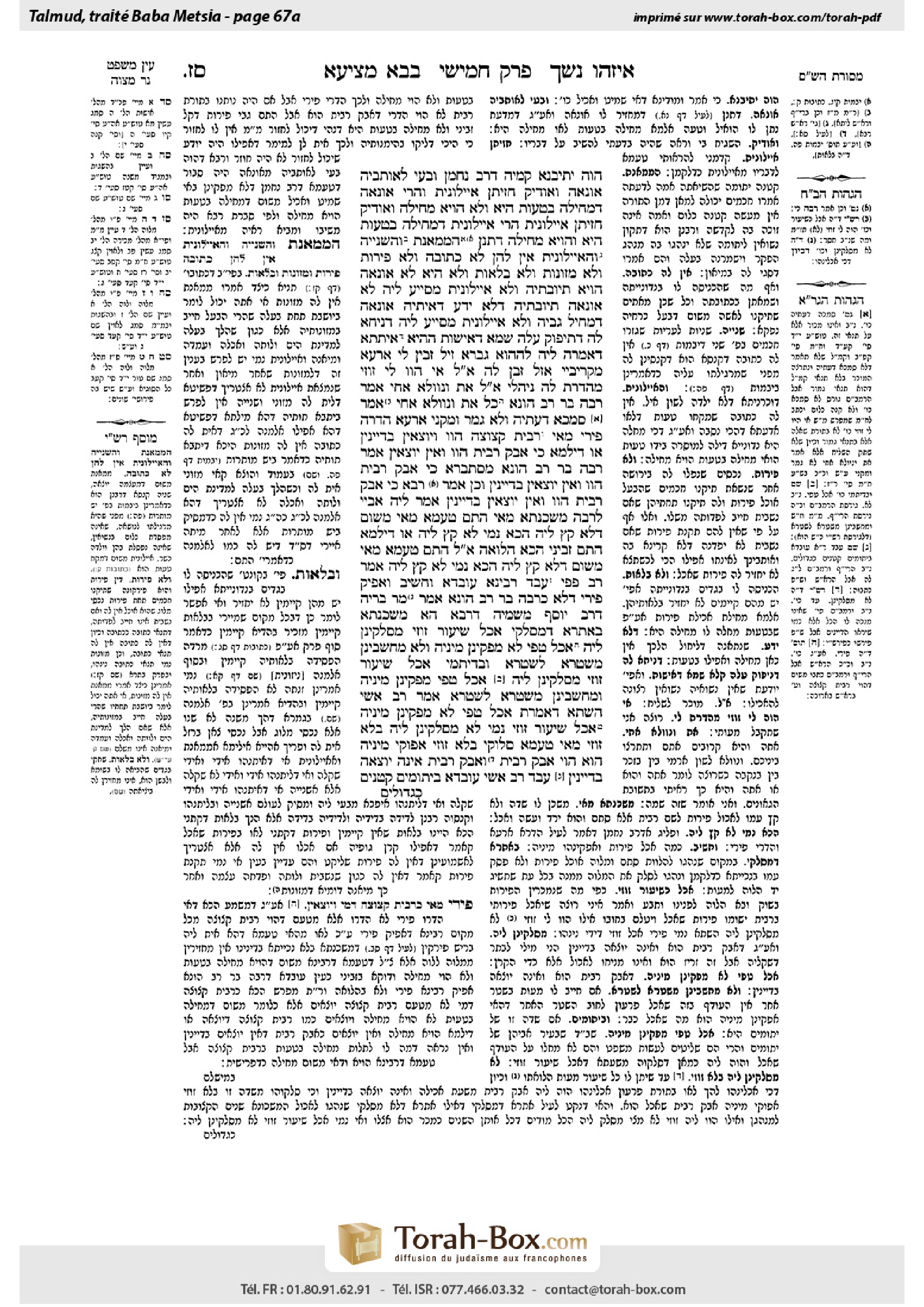
Bava Metzia 67a: Talmud study for Daf Yomi
Study the Talmud for Daf Yomi with scanned pages, Hebrew text, English translations from Sefaria and AI-generated French translations.
Passage selection and English or AI-generated French translation are available where the scan has annotations. Daf Study is independent of Torah-Box and Sefaria.
Browse Bava Metzia · בבא מציעא · All tractatesBava Metzia 67a text and translations
This page of Bava Metzia includes the Aramaic text, an English translation and an AI-generated French translation, alongside the scan above.
בבא מציעא ס״ז א · Aramaic and Hebrew text
הֲוָה יָתֵיבְנָא קַמֵּיהּ דְּרַב נַחְמָן, וּבְעַי לְאוֹתֹבֵיהּ אוֹנָאָה, וְאוֹדֵיק, חֲזִיתַן אַיְילוֹנִית. וַהֲרֵי אוֹנָאָה דִּמְחִילָה בְּטָעוּת הִיא, וְלָא הָוְיָא מְחִילָה! וְאוֹדֵיק, חֲזִיתַן אַיְילוֹנִית: הֲרֵי אַיְילוֹנִית דִּמְחִילָה בְּטָעוּת הִיא, וְהָוְיָא מְחִילָה.
דִּתְנַן: הַמְמָאֶנֶת וְהַשְּׁנִיָּיה וְהָאַיְילוֹנִית, אֵין לָהֶן לֹא כְּתוּבָּה וְלֹא פֵּירוֹת וְלֹא מְזוֹנוֹת וְלֹא בְּלָאוֹת.
וְלָא הִיא: לָא אוֹנָאָה הָוְיָא תְּיוּבְתֵּיהּ, וְלָא אַיְילוֹנִית מְסַיַּיע לֵיהּ.
לָא אוֹנָאָה תְּיוּבְתֵּיהּ: דְּלָא יָדַע דְּאִיתֵיהּ אוֹנָאָה דְּמָחֵיל גַּבֵּיהּ. וְלָא אַיְילוֹנִית מְסַיַּיע לֵיהּ, דְּנִיחָא לַהּ (דְּתִיפּוֹק) [דְּנִיפּוֹק] עֲלַהּ שְׁמָא דְאִישׁוּת.
הָהִיא אִיתְּתָא דַּאֲמַרָה לֵיהּ לְהָהוּא גַּבְרָא: זִיל זְבֵין לִי אַרְעָא מִקָּרִיבַיי. אֲזַל זְבַן לַהּ. אֲמַר לֵיהּ: אִי הָווּ לִי זוּזֵי מַהְדְּרַתְּ לַהּ נִיהֲלִי? אֲמַר לֵיהּ: אַתְּ וְנַוְולָא אַחֵי.
אָמַר רַבָּה בַּר רַב הוּנָא: כֹּל ״אַתְּ וְנַוְולָא אַחֵי״ (אָמַר) סָמְכָא דַּעְתֵּיהּ, וְלָא גָּמַר וּמַקְנֵי.
אַרְעָא הָדְרָה, פֵּירֵי מַאי? רִבִּית קְצוּצָה הָווּ וְיוֹצְאִין בְּדַיָּינִין, אוֹ דִילְמָא כִּי אֲבַק רִבִּית הָווּ וְאֵין יוֹצְאִין?
אָמַר רַבָּה בַּר רַב הוּנָא: מִסְתַּבְּרָא כִּי אֲבַק רִבִּית הָווּ, וְאֵין יוֹצְאִין בְּדַיָּינִין. וְכֵן אָמַר רָבָא: כִּי אֲבַק רִבִּית הָווּ, וְאֵין יוֹצְאִין בְּדַיָּינִין.
אֲמַר לֵיהּ אַבָּיֵי לְרַבָּה: מַשְׁכַּנְתָּא, מַאי? הָתָם טַעְמָא מַאי – מִשּׁוּם דְּלָא קַץ לֵיהּ, הָכָא נָמֵי לָא קַץ לֵיהּ. אוֹ דִילְמָא הָתָם זְבִינֵי, הָכָא הַלְוָאָה?
אֲמַר לֵיהּ: הָתָם טַעְמָא מַאי – מִשּׁוּם דְּלָא קַץ לֵיהּ, הָכָא נָמֵי לָא קַץ לֵיהּ.
אָמַר רַב פַּפִּי: עֲבַד רָבִינָא עוֹבָדָא, וְחַשֵּׁיב וְאַפֵּיק פֵּירֵי, דְּלָא כְּרַבָּה בַּר רַב הוּנָא.
אָמַר מָר בְּרֵיהּ דְּרַב יוֹסֵף מִשְּׁמֵיהּ דְּרָבָא: הָא מַשְׁכַּנְתָּא בְּאַתְרָא דִּמְסַלְּקִי, אֲכַל שִׁיעוּר זוּזֵי – מְסַלְּקִינַן לֵיהּ.
אֲכַל טְפֵי – לָא מַפְּקִינַן מִינֵּיהּ, וְלָא מְחַשְּׁבִינַן מִשְּׁטָרָא לִשְׁטָרָא.
וּבִדְיַתְמֵי אֲכַל שִׁיעוּר זוּזֵי, מְסַלְּקִינַן לֵיהּ. אֲכַל טְפֵי – מַפְּקִינַן מִינֵּיהּ, וּמְחַשְּׁבִינַן מִשְּׁטָרָא לִשְׁטָרָא.
אָמַר רַב אָשֵׁי: הַשְׁתָּא דְּאָמְרַתְּ אֲכַל טְפֵי – לָא מַפְּקִינַן מִינֵּיהּ. אֲכַל שִׁיעוּר זוּזֵי נָמֵי – לָא מְסַלְּקִינַן לֵיהּ בְּלָא זוּזֵי, מַאי טַעְמָא: סַלּוֹקֵי בְּלָא זוּזֵי – אַפּוֹקֵי מִינֵּיהּ הוּא. הָוֵי אֲבַק רִבִּית, וַאֲבַק רִבִּית אֵינָהּ יוֹצְאָה בְּדַיָּינִין.
עֲבַד רַב אָשֵׁי עוֹבָדָא בִּיתוֹמִים קְטַנִּים
Bava Metzia 67a · English translation
I was sitting before Rav Naḥman when he said that mistaken forgiveness is valid, and I wanted to raise an objection to him from the halakha of exploitation, and he observed me, anticipated my objection, and showed me that he was correct based on the halakha of a sexually underdeveloped woman who is incapable of bearing children [ailonit]. The Gemara explains: Rava wanted to ask: But there is the case of exploitation, where the price paid in a sale was in excess of the market value (see 50b), which is a case of mistaken forgiveness at the time of the sale, and yet it is not considered forgiveness. The seller must return the excess money paid. And he observed me and showed me the halakha of an ailonit. Doesn’t the case of an ailonit involve mistaken forgiveness, and yet it is valid forgiveness?
Rava explains: As we learned in a mishna (Ketubot 100b): In the case of a minor girl married off by her mother or brother who refuses to continue living with her husband, and in the case of a woman who is a secondary forbidden relative, and in the case of an ailonit, each of these women is not entitled to payment of a marriage contract, and they are not entitled to remuneration for the produce that the husband consumed from her property while they were together, and they are not entitled to sustenance, and they are not entitled to their worn clothes that were brought into the marriage as part of their dowry and became worn out during the marriage. The ailonit granted the rights to the profits the husband earned from her property while under the mistaken premise that she was married. Yet after the marriage was determined to have been contracted in error, the husband does not have to return these profits.
The Gemara comments: But that is not so; the halakha of exploitation is not a refutation of Rav Naḥman’s opinion, nor does the case of a sexually underdeveloped woman support his opinion, as there are differences between the cases.
The Gemara clarifies: Exploitation is not a refutation of his opinion, as the buyer does not know that there is exploitation at the time of the sale that would enable him to forgive him the amount he was overcharged, and therefore there is no forgiveness in this case at all. Nor does the case of a sexually underdeveloped woman support his opinion, as it is amenable to her for her husband to receive the profits in order that she receive the name of a married woman. She wants to be known as a woman who was once married, and therefore she willingly relinquishes her rights to the profits from her property during her marriage even if it will be found to have been contracted in error. There is no mistaken forgiveness in that case.
§ The Gemara relates: There was a certain woman who said to a certain man: Go purchase land for me from my relatives. He went and purchased land for her. The relative who sold her the property said to the man acting as her agent: If I will have money in the future, will you give the field back to me? The agent said to him: You and she [venavla] are relatives, and I assume that you will be able to come to an arrangement between the two of you.
The Gemara discusses the halakhic significance of this response. Rabba bar Rav Huna said: In the case of any expression such as: You and she are relatives, that the agent says, the seller relies on the assumption that he will be able to come to an agreement with his relative, and therefore he does not conclusively resolve to enable the other to acquire the field.
The Gemara comments: In that case, the land itself must be returned to its owner, but what is the halakha with regard to the produce consumed by the buyer in the interim? Is it deemed fixed interest, prohibited by Torah law, and can it be removed from the buyer by means of legal proceedings adjudicated by judges? Or perhaps it is considered like a hint of interest, prohibited by rabbinic law, and therefore it cannot be removed from the buyer by means of legal proceedings adjudicated by judges?
Rabba bar Rav Huna said: It stands to reason that it is like a hint of interest, and it cannot be removed from the buyer by means of legal proceedings adjudicated by judges. And Rava similarly said: It is like a hint of interest, and it cannot be removed from the buyer by means of legal proceedings adjudicated by judges.
Abaye said to Rava: With regard to a mortgage, if the borrower pledged a field to the lender, who worked the field and consumed its produce during the term of the loan without any agreement allowing him to do so, what is the halakha? There, in the previous case, what is the reason it is merely a hint of interest? Is it because the seller did not fix a particular sum for the buyer as interest? Here too, the lender did not fix a particular sum for the borrower, and accordingly, this would also be merely a hint of interest. Or perhaps the key issue is that there, it is a sale, whereas here, it is a loan, with regard to which there is a greater concern about interest.
Rava said to him: There, what is the reason it is merely a hint of interest? It is considered a hint of interest because the seller did not fix a particular sum for the buyer as interest. Here too, the lender did not fix a particular sum for the borrower, and therefore this is not fixed interest.
Rav Pappi said: Ravina performed an action with regard to a case like this, and he calculated and removed from the lender the value of the produce he had consumed in the interim. This decision was not in accordance with the opinion of Rabba bar Rav Huna.
Mar, son of Rav Yosef, said in the name of Rava: With regard to this following type of mortgage, in which the lender holds part of the borrower’s land and may consume its produce, the halakha depends on the local custom. In a place where the custom is that the borrower can repay the loan at any time and the court removes the lender from the land once the loan is repaid, then once the lender consumed a measure of produce equivalent to the amount of money that he lent, we remove him from the land at that point, as the produce consumed is considered repayment of the loan.
If the lender consumed a measure of produce worth more than the value of the loan, we do not remove the value of the excess produce from him, as that which he consumed is already gone. And similarly, we do not calculate any extra produce as payment from one document to another. If the same borrower owed the lender an additional sum from another debt recorded in a different document, we do not consider the additional produce he consumed as part of the payment for the second document; rather, each loan is treated on its own terms.
And if the field belonged to orphans, once the lender consumed a measure of produce equivalent to the amount of money he was owed, we remove him from the field. And if he consumed a measure of produce worth more than the value of the loan, we take the additional amount from him; and we do calculate extra produce as payment from one document to another. The reason is that the owner of the field generally forgives payment for the extra produce the lender consumed, but minor orphans are too young to forgive a debt, and the case is therefore judged according to the letter of the law.
Rav Ashi said: Now that you have said that if he consumed more than the value of the loan we do not take it from him, as it is considered merely a hint of interest, it follows that if he consumed a measure of produce equivalent to the amount of the money owed him, we also do not remove him from the land without the borrower’s paying him money. What is the reason for this? To remove him from the land without the borrower’s paying him money is like taking money from him, and this consumption of the produce is only a hint of interest, and the halakha is that a hint of interest cannot be removed by legal proceedings adjudicated by judges.
The Gemara relates: Rav Ashi performed an action in a case of this kind even involving minor orphans,
Bava Metzia 67a · Traduction française (IA)
Je me trouvais en présence de Rav Naḥman lorsqu'il a dit que l'indulgence erronée est valide, et j'avais l'intention de lui opposer un argument tiré de la halakha de l'exploitation, mais il m'a observé, anticipé mon objection, et m'a montré qu'il avait raison en se fondant sur la halakha d'une femme sexuellement sous-développée, incapable d'avoir des enfants [ailonit]. La Guemara explique : Rava voulait poser la question : Mais il y a le cas de l'exploitation, où le prix payé lors d'une vente dépassait la valeur du marché (voir 50b), ce qui est un cas d'indulgence erronée au moment de la vente, et pourtant cela n'est pas considéré comme une indulgence. Le vendeur doit rendre l'excédent payé. Et il m'a observé et m'a montré la halakha de l'ailonit. N'est-ce pas que le cas de l'ailonit implique une indulgence erronée, et pourtant elle est valide ?
Rava explique : Comme nous l'avons appris dans une mitsna (Ketubot 100b) : Dans le cas d'une jeune fille mariée par sa mère ou son frère qui refuse de continuer à vivre avec son mari, et dans le cas d'une femme qui est un parent interdit secondaire, et dans le cas d'une ailonit, chacune de ces femmes n'a pas droit à la rémunération du contrat de mariage, ni à la rémunération des produits que le mari a consommés de sa propriété pendant leur union, ni à la subsistance, ni à ses vêtements usagés apportés dans le mariage et devenus usagés pendant la durée du mariage. L'ailonit a reçu le droit aux profits que le mari avait gagnés sur sa propriété pendant l'erreur de mariage. Cependant, après que le mariage ait été déterminé comme étant conclu en erreur, le mari n'a pas à rendre ces profits.
La Guemara commente : Ce n'est pas ainsi ; la halakha de l'exploitation n'est pas une réfutation de l'opinion de Rav Naḥman, ni le cas de l'ailonit ne soutient son opinion, car il y a des différences entre les cas.
La Guemara clarifie : L'exploitation n'est pas une réfutation de son opinion, car l'acheteur ne sait pas à l'époque de la vente qu'il y a une exploitation qui lui permettrait d'indulger l'excès payé, et donc il n'y a pas d'indulgence dans ce cas. De même, le cas de la femme sexuellement sous-développée ne soutient pas son opinion, car elle permet à son mari de recevoir les profits afin qu'elle obtienne le nom de femme mariée. Elle veut être connue comme une femme qui a été mariée, et donc elle renonce volontairement à ses droits sur les profits de sa propriété pendant son mariage, même si le mariage s'est révélé être conclu en erreur. Il n'y a pas d'indulgence erronée dans ce cas.
§ La Guemara rapporte : Il y avait une certaine femme qui a dit à un certain homme : Va acheter un terrain pour moi auprès de mes parents. Il est allé acheter un terrain pour elle. Le parent qui lui a vendu la propriété a dit à l'homme agissant en tant qu'agent de la femme : Si j'aurai de l'argent à l'avenir, me rendras-tu le terrain ? L'agent a répondu à lui : Tu et elle [venavla] êtes des parents, et je suppose que vous pourrez trouver un arrangement entre les deux.
La Guemara discute de la signification halakhique de cette réponse. Rabba bar Rav Huna a dit : Dans le cas d'une expression telle que : Tu et elle sont des parents, que l'agent dit, le vendeur repose sur l'hypothèse qu'il pourra trouver un arrangement avec son parent, et donc il ne résout pas définitivement pour permettre à l'autre d'acquérir le terrain.
La Guemara commente : Dans ce cas, le terrain lui-même doit être rendu à son propriétaire, mais quelle est la halakha concernant les produits consommés par l'acheteur pendant la période intermédiaire ? Est-ce considéré comme un intérêt fixe, interdit par la loi divine, et peut-il être retiré de l'acheteur par des procédures judiciaires ? Ou peut-être est-ce considéré comme un indice d'intérêt, interdit par la loi rabbinique, et donc il ne peut pas être retiré de l'acheteur par des procédures judiciaires ?
Rabba bar Rav Huna a dit : Il est logique qu'il s'agisse d'un indice d'intérêt, et il ne peut pas être retiré de l'acheteur par des procédures judiciaires. Et Rava a dit de même : Il s'agit d'un indice d'intérêt, et il ne peut pas être retiré de l'acheteur par des procédures judiciaires.
Abaye a dit à Rava : Concernant un prêt, si le prêteur a mis en gage un champ au prêteur, qui a cultivé le champ et a consommé ses produits pendant la durée du prêt sans aucun accord permettant cela, quelle est la halakha ? Là, dans le cas précédent, pourquoi est-ce simplement un indice d'intérêt ? Est-ce parce que le vendeur n'a pas fixé une somme particulière pour l'acheteur comme intérêt ? Ici aussi, le prêteur n'a pas fixé une somme particulière pour le prêteur, et donc cela serait également simplement un indice d'intérêt. Ou peut-être l'élément clé est que là, il s'agit d'une vente, tandis que ici, il s'agit d'un prêt, où il y a une préoccupation plus grande concernant l'intérêt.
Rava dit à lui : Là, pourquoi est-ce simplement un indice d'intérêt ? C'est considéré comme un indice d'intérêt car le vendeur n'a pas fixé une somme particulière pour l'acheteur comme intérêt. Ici aussi, le prêteur n'a pas fixé une somme particulière pour le prêteur, et donc cela n'est pas un intérêt fixé.
Rav Pappi dit : Ravina a accompli une action concernant un cas semblable, et il a calculé et retiré à l'emprunteur la valeur des produits qu'il avait consommés pendant la durée. Cette décision n'était pas conforme à l'opinion de Rabba bar Rav Huna.
Mar, fils de Rav Yosef, a dit en nom de Rava : Concernant ce type de prêt hypothécaire, dans lequel le prêteur détient une partie de la terre du débiteur et peut consommer ses produits, la halakha dépend de la coutume locale. Dans un lieu où la coutume est que le débiteur peut rembourser le prêt à tout moment et que le tribunal retire le prêteur de la terre une fois le prêt remboursé, alors que le prêteur a consommé une mesure de produits équivalente à la somme qu'il a prêtée, nous le retirons de la terre à ce moment-là, car les produits consommés sont considérés comme un remboursement du prêt.
Si le prêteur a consommé une mesure de produits dont la valeur excède celle du prêt, nous ne retirons pas la valeur du surplus de ses produits, car ce qu'il a consommé est déjà disparu. De même, nous ne comptons pas les produits supplémentaires comme paiement d'un document à un autre. Si le même débiteur devait au prêteur une somme supplémentaire d'un autre prêt enregistré dans un document différent, nous ne considérons pas les produits supplémentaires qu'il a consommés comme faisant partie du paiement du second document ; chaque prêt est traité selon ses propres termes.
Et si le champ appartenait aux orphelins, une fois que le prêteur a consommé une mesure de produits équivalente à la somme qu'il était dû, nous le retirons du champ. Et si il a consommé une mesure de produits dont la valeur excède celle du prêt, nous prenons la somme supplémentaire ; et nous comptons les produits supplémentaires comme paiement d'un document à un autre. La raison est que l'propriétaire du champ pardonne généralement le surplus des produits consommés par le prêteur, mais les orphelins mineurs sont trop jeunes pour pardonner une dette, et le cas est donc jugé selon la lettre de la loi.
Rav Ashi a dit : Maintenant que vous avez dit que si l'on a consommé plus que la valeur du prêt, nous ne le prenons pas, car cela est considéré comme un simple indice d'intérêt, il suit que si l'on a consommé une mesure de produits équivalente à la somme due, nous ne le retirons pas de la terre sans que le débiteur ne lui paie de l'argent. Quelle est la raison de cela ? Retirer le prêteur de la terre sans que le débiteur ne lui paie de l'argent est comme prendre de l'argent de lui, et cette consommation des produits est seulement un indice d'intérêt, et la halakha est que cet indice d'intérêt ne peut être retiré par des procédures judiciaires.
La Guemara rapporte : Rav Ashi a accompli une action dans un cas de ce genre même impliquant des orphelins mineurs,
Traduction française générée par IA à partir de l’édition anglaise de Sefaria. Vérifie toujours un passage avec le texte source.
Text from Sefaria: William Davidson Edition - Vocalized Aramaic (CC BY NC); William Davidson Edition - English (CC BY NC).