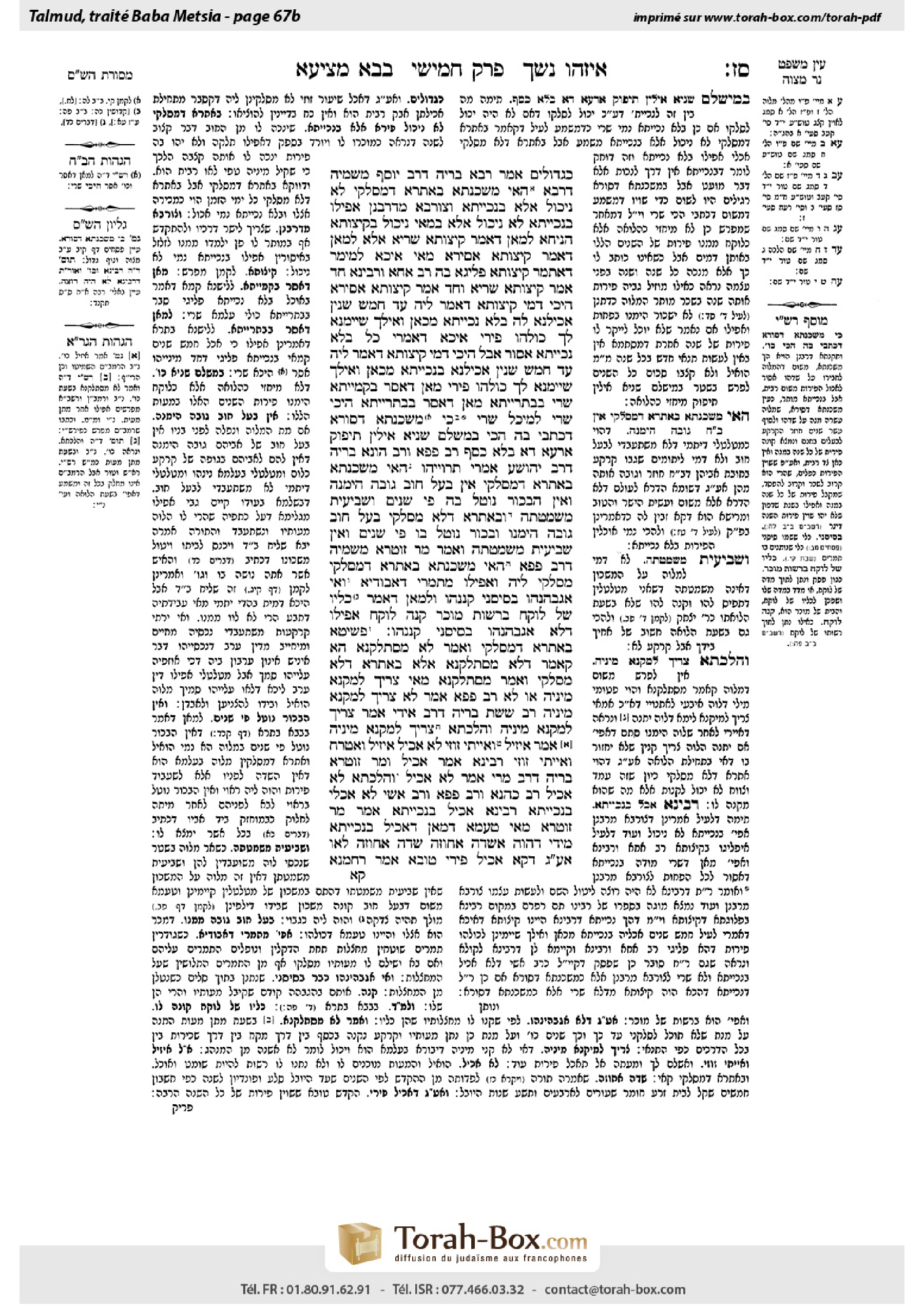
Bava Metzia 67b: Talmud study for Daf Yomi
Study the Talmud for Daf Yomi with scanned pages, Hebrew text, English translations from Sefaria and AI-generated French translations.
Passage selection and English or AI-generated French translation are available where the scan has annotations. Daf Study is independent of Torah-Box and Sefaria.
Browse Bava Metzia · בבא מציעא · All tractatesBava Metzia 67b text and translations
This page of Bava Metzia includes the Aramaic text, an English translation and an AI-generated French translation, alongside the scan above.
בבא מציעא ס״ז ב · Aramaic and Hebrew text
כִּגְדוֹלִים,
אָמַר רָבָא בְּרֵיהּ דְּרַב יוֹסֵף מִשְּׁמֵיהּ דְּרָבָא: הַאי מַשְׁכַּנְתָּא, בְּאַתְרָא דִּמְסַלְּקִי – לָא נֵיכוֹל אֶלָּא בְּנַכְיְיתָא. וְצוּרְבָּא מִדְּרַבָּנַן – אֲפִילּוּ בְּנַכְיְיתָא לָא נֵיכוֹל. אֶלָּא בְּמַאי נֵיכוֹל? בְּקִיצּוּתָא.
הָנִיחָא לְמַאן דְּאָמַר קִיצּוּתָא שַׁרְיָא, אֶלָּא לְמַאן דְּאָמַר קִיצּוּתָא אֲסִירָא, מַאי אִיכָּא לְמֵימַר? דְּאִתְּמַר: קִיצּוּתָא, פְּלִיגָא בַּהּ רַב אַחָא וְרָבִינָא. חַד אָמַר: קִיצּוּתָא שַׁרְיָא, וְחַד אָמַר: קִיצּוּתָא אֲסִירָא. הֵיכִי דָּמֵי קִיצּוּתָא? דְּאָמַר לֵיהּ: עַד חֲמֵשׁ שְׁנִין אָכֵילְנָא לַהּ בְּלָא נַכְיְיתָא, מִכָּאן וְאֵילָךְ שָׁיֵימְנָא לָךְ כּוּלְּהוּ פֵּירֵי.
אִיכָּא דְאָמְרִי: כֹּל בְּלָא נַכְיְיתָא – אָסוּר, אֲבָל הֵיכִי דָּמֵי קִיצּוּתָא – דְּאָמַר לֵיהּ: עַד חֲמֵשׁ שְׁנִין אָכֵילְנָא בְּנַכְיְיתָא, מִכָּאן וְאֵילָךְ שָׁיֵימְנָא לָךְ כּוּלְּהוּ פֵּירֵי.
מַאן דְּאָסַר בְּקַמַּיְיתָא שָׁרֵי בְּבָתְרַיְיתָא, מַאן דְּאָסַר בְּבָתְרַיְיתָא, הֵיכִי שְׁרֵי לְמֵיכַל? שְׁרֵי כִּי מַשְׁכַּנְתָּא דְסוּרָא, דְּכָתְבִי בַּהּ הָכִי: בְּמִשְׁלָם שְׁנַיָּא אִילֵּין תִּיפּוֹק אַרְעָא דָּא בְּלָא כְּסַף.
רַב פָּפָּא וְרַב הוּנָא בְּרֵיהּ דְּרַב יְהוֹשֻׁעַ אָמְרִי תַּרְוַיְיהוּ: הַאי מַשְׁכַּנְתָּא, בְּאַתְרָא דִּמְסַלְּקִי – אֵין בַּעַל חוֹב גּוֹבֶה הֵימֶנָּה, וְאֵין הַבְּכוֹר נוֹטֵל בָּהּ פִּי שְׁנַיִם, וּשְׁבִיעִית מְשַׁמַּטְתָּהּ.
וּבְאַתְרָא דְּלָא מְסַלְּקִי – בַּעַל חוֹב גּוֹבֶה הֵימֶנָּה וּבְכוֹר נוֹטֵל בָּהּ פִּי שְׁנַיִם, וְאֵין שְׁבִיעִית מְשַׁמַּטְתָּהּ.
וְאָמַר מָר זוּטְרָא מִשְּׁמֵיהּ דְּרַב פָּפָּא: הַאי מַשְׁכַּנְתָּא, בְּאַתְרָא דִּמְסַלְּקִי – מְסַלְּקִי לֵיהּ וַאֲפִילּוּ מִתַּמְרֵי דְּאַבּוּדְיָא. וְאִי אַגְבְּהִנְהוּ בְּסִיסָנֵי, קְנָנְהוּ. וּלְמַאן דְּאָמַר כִּלְיוֹ שֶׁל לוֹקֵחַ בִּרְשׁוּת מוֹכֵר קָנָה לוֹקֵחַ – אֲפִילּוּ דְּלָא אַגְבְּהִנְהוּ בְּסִיסָנֵי, קְנָנְהוּ.
פְּשִׁיטָא: בְּאַתְרָא דִּמְסַלְּקִי וְאָמַר ״לָא מִסְתַּלַּקְנָא״ – הָא קָאָמַר דְּלָא מִסְתַּלַּקְנָא. אֶלָּא בְּאַתְרָא דְּלָא מְסַלְּקִי, וְאָמַר ״מִסְתַּלַּקְנָא״ – מַאי: צָרִיךְ לְמִיקְנֵא מִינֵּיהּ, אוֹ לָא?
רַב פָּפָּא אָמַר: לָא צְרִיךְ לְמִקְנֵא מִינֵּיהּ. רַב שֵׁשֶׁת בְּרֵיהּ דְּרַב אִידִי אָמַר: צְרִיךְ לְמִקְנֵא מִינֵּיהּ. וְהִלְכְתָא: צְרִיךְ לְמִקְנֵא מִינֵּיהּ.
אָמַר: ״אֵיזִיל וְאַיְיתֵי זוּזֵי״ – לָא אָכֵיל. ״אֵיזִיל וְאֶטְרַח וְאַיְיתֵי זוּזֵי״, רָבִינָא אָמַר: אָכֵיל, וּמָר זוּטְרָא בְּרֵיהּ דְּרַב מָרִי אָמַר: לָא אָכֵיל. וְהִלְכְתָא: לָא אָכֵיל.
רַב כָּהֲנָא וְרַב פָּפָּא וְרַב אָשֵׁי לָא אָכְלִי בְּנַכְיְיתָא. רָבִינָא אָכֵיל בְּנַכְיְיתָא.
אָמַר מָר זוּטְרָא: מַאי טַעְמָא דְּמַאן דְּאָכֵיל בְּנַכְיְיתָא – מִידֵּי דְּהָוֵה אַשְּׂדֵה אֲחוּזָּה. שְׂדֵה אֲחוּזָּה, לָאו אַף עַל גַּב דְּקָא אָכֵיל פֵּירֵי טוּבָא, אָמַר רַחֲמָנָא
Bava Metzia 67b · English translation
as though they were adults. Even if the lender consumed produce equivalent to the amount of the debt, Rav Ashi would not collect the value of the produce from him, as this is merely a hint of interest and therefore it cannot be claimed in court.
§ Rava, son of Rav Yosef, says in the name of Rava: With regard to this following type of mortgage, in which the lender holds part of the borrower’s land and may consume its produce, the halakha depends on the local custom. In a place where the custom is that the borrower can repay the loan at any time and the court removes the lender from the land, the lender may consume the produce of the land only with a deduction in the amount of the loan granted to the borrower, equivalent in value to that of the produce consumed by the lender. And a Torah scholar [tzurva miderabbanan], who must be especially careful with regard to his conduct, may not consume the produce even with a deduction in the amount of the loan. The Gemara poses a question: But if so, in what manner may he consume the produce? The Gemara answers: By a fixed payment, the details of which the Gemara will soon explain.
The Gemara asks: This works out well according to the one who says that a fixed payment is permitted, but according to the one who says that a fixed payment is forbidden, what is there to say? As it was stated: With regard to a fixed payment, Rav Aḥa and Ravina disagreed: One said that a fixed payment is permitted, and one said a fixed payment is forbidden. The Gemara clarifies: What are the circumstances of this fixed payment? The Gemara explains: One case of a fixed payment is where the lender says to the borrower: For a period of up to five years, I will consume the produce of the field without a deduction in the amount of the loan; from that point forward I will appraise for you the value of all the produce I consume and subtract this sum from the debt.
There are those who say a different version of this discussion: Any consumption of produce by the lender without a deduction in the amount of the loan is prohibited as interest. And what are the circumstances of a permitted fixed payment? When the lender says to the borrower: For a period of up to five years I will consume the produce with a fixed deduction in the amount of the loan; from this point forward I will appraise for you the value of all the produce I consume and deduct the sum from the loan.
The Gemara comments: The one who prohibits the practice according to the first version permits the practice described in the second. The Gemara asks: But according to the one who also prohibits the practice described in the second version, how is it permitted to consume the produce of a mortgaged field? The Gemara replies: It is permitted in a case like that of a mortgage according to the custom in Sura, a city in Babylonia, in which this is written in the loan document: Upon the completion of these years, during which the lender may consume the produce of the field, this land shall leave his possession without money and return to the owner, as the entire amount of the loan will have been repaid by means of the consumption of the produce.
Rav Pappa and Rav Huna, son of Rav Yehoshua, both say: With regard to this type of mortgage, the halakha depends on the local custom. In a place where the custom is that the borrower can repay the loan at any time and the court removes the lender from the land, the land is not considered his property at all, and therefore another creditor cannot collect a debt owed by the lender by repossessing it; and if the lender dies, his firstborn son does not receive a double portion of it as part of his inheritance, as it did not belong to his father; and the Sabbatical Year cancels a debt of this kind, because it is not viewed as having already been collected.
But in a place where they do not remove him from the land before the appointed time even if the debt is paid, then the land has been temporarily transferred to him, and therefore a creditor can collect a debt owed by the lender by repossessing it, and his firstborn receives a double portion of it, and the Sabbatical Year does not cancel the debt.
And Mar Zutra said in the name of Rav Pappa: With regard to this type of mortgage, the halakha depends on the local custom. In a place where the custom is that the borrower can repay the loan at any time and the court removes the lender from the land, they remove him even from dates he has already harvested and spread out on the mats. But if he has lifted them and placed them in the baskets [besisanei], he has thereby acquired them, and they are his. And according to the one who says that when an act of acquisition is performed by means of placing items in the buyer’s vessels that are located in the seller’s domain the buyer has acquired the items, even if he did not lift them while they were in the baskets, he acquired them when they were placed on the mats.
§ The Gemara discusses other halakhot of mortgages. It is obvious that if the loan was given in a place where they generally remove the lender from the field upon the repayment of the debt, but upon lending the money, the lender said: I will not be removed, his stipulation is respected, as he said that he will not be removed, and he gave him the money only subject to this condition. But if the loan took place in a place where they generally do not remove him, and he said: I will be removed when the money is returned, what is the halakha? Is it necessary to perform a formal act of acquisition with him to formalize this commitment, or is it not necessary, as his statement alone is binding?
Rav Pappa said: It is not necessary to perform an act of acquisition with him. Rav Sheshet, son of Rav Idi, said: It is necessary to perform an act of acquisition with him. The Gemara concludes: And the halakha is that it is necessary to perform an act of acquisition with him.
The Gemara addresses another case. If the borrower said to the lender: I will go to get the money to repay you, the lender may not consume any more of the produce, as this statement is sufficient to remove him from the property. But if he said: I am going to make an effort to get the money, amora’im engaged in a dispute concerning the halakha. Ravina said: The lender may continue to consume the produce until the borrower actually brings the payment, as he cannot be certain the borrower will manage to get the money. And Mar Zutra, son of Rav Mari, said: He may not consume the produce. The Gemara concludes: And the halakha is that he may not consume the produce.
The Gemara relates: Rav Kahana, and Rav Pappa, and Rav Ashi would not consume the produce of mortgaged fields even with a deduction in the amount of the loan, as they were concerned about the possible violation of the prohibition of interest. Ravina would consume this produce with a deduction in the amount of the loan.
Mar Zutra said: The explanation for the practice of the one who does consume the produce with a deduction in the amount of the loan is just as it is in the case of an ancestral field, i.e., a field that one inherits from his ancestors within his family holdings in Eretz Yisrael. The Torah states that one who consecrates his ancestral field can redeem it from the Temple treasury in return for one sela, which is four dinars, for each year remaining until the Jubilee (see Leviticus 27:16–19). The comparison is as follows: With regard to an ancestral field, is it not the case that even though he consumes abundant produce over the course of the years, nevertheless, the Merciful One states in the Torah
Bava Metzia 67b · Traduction française (IA)
comme s'ils étaient adultes. Même si le prêteur consommait des produits équivalents à la somme de la dette, Rav Ashi ne réclamerait pas la valeur de ces produits, car cela n'est qu'un indice d'intérêt et ne peut donc pas être exigé devant un tribunal.
§ Rava, fils de Rav Yosef, dit au nom de Rava : En ce qui concerne ce type d'hypothèque, dans lequel le prêteur détient une partie de la terre du débiteur et peut consommer ses produits, la halakha dépend de la coutume locale. Dans un lieu où la coutume est que le débiteur peut rembourser le prêt à tout moment et que le tribunal retire le prêteur de la terre, le prêteur peut consommer les produits de la terre uniquement avec une déduction égale à la somme du prêt accordé au débiteur, équivalente à la valeur des produits consommés par le prêteur. Et un savant [tzurva miderabbanan], qui doit être particulièrement vigilant en ce qui concerne son comportement, ne peut pas consommer les produits même avec cette déduction. La Guemara pose une question : Mais si c'est ainsi, comment peut-il consommer les produits ? La Guemara répond : Par un paiement fixe, les détails desquels la Guemara expliquera bientôt.
La Guemara pose une question : Cela fonctionne bien selon celui qui dit qu'un paiement fixe est permis, mais selon celui qui dit qu'un paiement fixe est interdit, que dire alors ? Comme il a été dit : En ce qui concerne un paiement fixe, Rav Aḥa et Ravina ont eu un désaccord : l'un a dit qu'un paiement fixe était permis, et l'autre a dit qu'un paiement fixe était interdit. La Guemara clarifie : Quelles sont les circonstances de ce paiement fixe ? La Guemara explique : Un cas de paiement fixe est celui où le prêteur dit au débiteur : Pendant une période de cinq ans, je consommerai les produits du champ sans déduction de la somme du prêt ; à partir de ce moment, je ferai évaluer la valeur de tous les produits que je consomme et je déduirai cette somme de la dette.
Certains disent une version différente de cette discussion : toute consommation des produits par le prêteur sans déduction de la somme du prêt est interdite comme intérêt. Et quels sont les circonstances d'un paiement fixe permis ? Lorsque le prêteur dit au débiteur : Pendant une période de cinq ans, je consommerai les produits avec une déduction fixe de la somme du prêt ; à partir de ce moment, je ferai évaluer la valeur de tous les produits que je consomme et je déduirai cette somme du prêt.
La Guemara commente : celui qui interdit la pratique selon la première version permet la pratique décrite dans la seconde. La Guemara pose une question : Mais selon celui qui interdit également la pratique décrite dans la seconde version, comment est-il permis de consommer les produits d'un champ hypothéqué ? La Guemara répond : C'est permis dans le cas d'une hypothèque selon la coutume de Sura, une ville en Babylonie, dans laquelle il est écrit dans le document de prêt : À la fin de ces années, pendant lesquelles le prêteur peut consommer les produits du champ, cette terre quittera sa possession sans argent et reviendra à l'propriétaire, car la totalité de la dette aura été remboursée grâce à la consommation des produits.
Rav Pappa et Rav Huna, fils de Rav Yehoshua, disent tous les deux : En ce qui concerne ce type d'hypothèque, la halakha dépend de la coutume locale. Dans un lieu où la coutume est que le débiteur peut rembourser le prêt à tout moment et que le tribunal retire le prêteur de la terre, la terre n'est pas considérée comme étant à lui du tout, et par conséquent un autre créancier ne peut pas récupérer une dette due par le prêteur en s'emparant de celle-ci ; et si le prêteur meurt, son premier fils ne reçoit pas une double part de celle-ci en tant qu'héritage, car elle n'appartenait pas à son père ; et la année sabbatique annule une dette de ce type, car elle n'est pas vue comme ayant déjà été recueillie.
Mais dans un lieu où ils ne le retirent pas de la terre avant l'échéance, même si la dette est remboursée, alors la terre a été temporairement transférée à lui, et par conséquent un créancier peut récupérer une dette due par le prêteur en s'emparant de celle-ci, et son premier fils reçoit une double part de celle-ci, et la année sabbatique ne annule pas la dette.
Et Mar Zutra dit au nom de Rav Pappa : En ce qui concerne ce type d'hypothèque, la halakha dépend de la coutume locale. Dans un lieu où la coutume est que le débiteur peut rembourser le prêt à tout moment et que le tribunal retire le prêteur de la terre, ils retirent même les dattes qu'il a déjà récoltées et étalées sur les tapis. Mais s'il les a soulevées et les a placées dans les paniers [besisanei], il les a acquis, et elles sont à lui. Et selon celui qui dit que lorsqu'un acte d'acquisition est effectué par le biais de la mise d'objets dans les vases du acheteur situés dans le domaine du vendeur, l'acheteur a acquis les objets, même s'il n'a pas soulevé les objets pendant qu'ils étaient dans les paniers, il les a acquis lorsqu'ils ont été placés sur les tapis.
§ La Guemara discute d'autres halakhot d'hypothèques. Il est évident que si le prêt a été donné dans un lieu où ils retirent généralement le prêteur du champ lors du remboursement de la dette, mais lors du prêt, le prêteur a dit : Je ne serai pas retiré, sa stipulation est respectée, car il a dit qu'il ne serait pas retiré, et il a donné l'argent uniquement sous cette condition. Mais si le prêt s'est produit dans un lieu où ils ne retirent généralement pas le prêteur, et qu'il a dit : Je serai retiré lorsque l'argent sera remboursé, quelle est la halakha ? Faut-il effectuer un acte d'acquisition avec lui pour formaliser cette promesse, ou n'est-ce pas nécessaire, car sa déclaration seule est contraignante ?
Rav Pappa a dit : Il n'est pas nécessaire d'effectuer un acte d'acquisition avec lui. Rav Sheshet, fils de Rav Idi, a dit : Il est nécessaire d'effectuer un acte d'acquisition avec lui. La Guemara conclut : Et la halakha est que l'acte d'acquisition doit être effectué avec lui.
La Guemara aborde un autre cas. Si le prêteur dit au prêteur : Je vais aller chercher l'argent pour te rembourser, le prêteur ne peut pas consommer davantage des produits, car cette déclaration suffit à éloigner le prêteur de la propriété. Mais si il dit : Je vais faire un effort pour obtenir l'argent, les amoraïm se disputent sur la halakha. Ravina dit : Le prêteur peut continuer à consommer les produits jusqu'à ce que le prêteur apporte effectivement le paiement, car il ne peut pas être certain que le prêteur arrivera à obtenir l'argent. Et Mar Zutra, fils de Rav Mari, dit : Il ne peut pas consommer les produits. La Guemara conclut : Et la halakha est que l'on ne peut pas consommer les produits.
La Guemara rapporte : Rav Kahana, Rav Pappa et Rav Ashi ne consommaient pas les produits des champs hypothéqués même avec une réduction dans le montant du prêt, car ils craignaient la violation de l'interdiction d'intérêt. Ravina consommait ce produit avec une réduction dans le montant du prêt.
Mar Zutra dit : L'explication de la pratique de celui qui consomme les produits avec une réduction dans le montant du prêt est telle que dans le cas d'un champ ancestral, c'est-à-dire un champ que l'on hérite de ses ancêtres au sein de ses terres en Terre d'Israël. La Torah stipule que celui qui consacre son champ ancestral peut le racheter auprès du trésor du Temple en échange d'un sela, qui est quatre dinars, pour chaque année restante jusqu'au Jubilé (voir Lévitique 27:16–19). La comparaison est la suivante : En ce qui concerne un champ ancestral, n'est-ce pas le cas que même s'il consomme abondamment les produits au cours des années, néanmoins, le Tout-Puissant stipule dans la Torah
Traduction française générée par IA à partir de l’édition anglaise de Sefaria. Vérifie toujours un passage avec le texte source.
Text from Sefaria: William Davidson Edition - Vocalized Aramaic (CC BY NC); William Davidson Edition - English (CC BY NC).