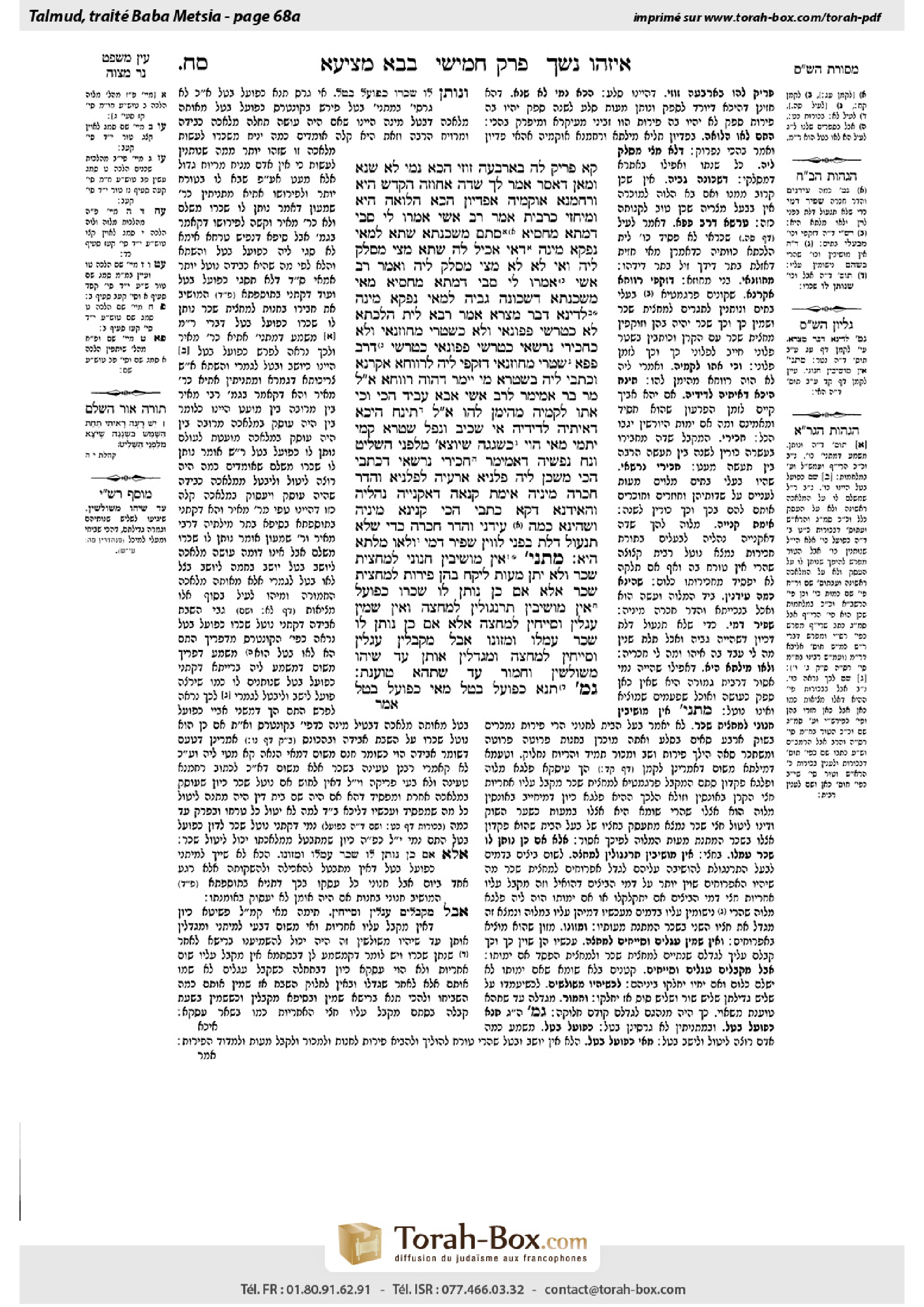
Bava Metzia 68a: Talmud study for Daf Yomi
Study the Talmud for Daf Yomi with scanned pages, Hebrew text, English translations from Sefaria and AI-generated French translations.
Passage selection and English or AI-generated French translation are available where the scan has annotations. Daf Study is independent of Torah-Box and Sefaria.
Browse Bava Metzia · בבא מציעא · All tractatesBava Metzia 68a text and translations
This page of Bava Metzia includes the Aramaic text, an English translation and an AI-generated French translation, alongside the scan above.
בבא מציעא ס״ח א · Aramaic and Hebrew text
קָא פָרֵיק לַהּ בְּאַרְבְּעָה זוּזֵי, הָכָא נָמֵי לָא שְׁנָא.
וּמַאן דְּאָסַר – אָמַר לָךְ: שְׂדֵה אֲחוּזָּה הֶקְדֵּשׁ הִיא, וְרַחֲמָנָא אוֹקְמֵיהּ אַפִּדְיוֹן. הָכָא – הַלְוָאָה הִיא וּמִיחֲזֵי כְּרִבִּית.
אָמַר רַב אָשֵׁי: אֲמַרוּ לִי סָבֵי דְּמָתָא מַחְסֵיָא: סְתַם מַשְׁכַּנְתָּא – שַׁתָּא. לְמַאי נָפְקָא מִינַּהּ? דְּאִי אָכֵיל לַהּ שַׁתָּא – מָצֵי מְסַלֵּק לֵיהּ, וְאִי לָא – לָא מָצֵי מְסַלֵּק לֵיהּ.
וְאָמַר רַב אָשֵׁי: אֲמַרוּ לִי סָבֵי דְּמָתָא מַחְסֵיָא, מַאי ״מַשְׁכַּנְתָּא״ – דִּשְׁכוּנָה גַּבֵּיהּ. לְמַאי נָפְקָא מִינַּהּ? לְדִינָא דְּבַר מִצְרָא.
אָמַר רָבָא: לֵית הִלְכְתָא לָא כְּטַרְשֵׁי פַּפּוּנָאֵי, וְלָא כִּשְׁטָרֵי מָחוֹזְנָאֵי, וְלָא כַּחֲכִירֵי נַרְשָׁאֵי.
כְּטַרְשֵׁי פַּפּוּנָאֵי – כְּטַרְשֵׁי דְּרַב פָּפָּא.
שְׁטָרֵי מָחוֹזְנָאֵי – דְּזָקְפִי לֵיהּ לְרַוְוחָא אַקַּרְנָא, וְכָתְבִי לֵיהּ בִּשְׁטָרָא. מִי יֵימַר דְּהָוֵה רַוְוחָא?
אֲמַר לֵיהּ מָר בַּר אַמֵּימָר לְרַב אָשֵׁי: אַבָּא עָבֵיד הָכִי, וְכִי אָתוּ לְקַמֵּיהּ מְהֵימַן לְהוּ. אֲמַר לֵיהּ: תִּינַח הֵיכָא דְּאִיתֵיהּ לְדִידֵיהּ, אִי שָׁכֵיב וְנָפֵל שְׁטָרָא קַמֵּי יַתְמֵי, מַאי? הָוֵי ״כִּשְׁגָגָה שֶׁיֹּצָא מִלִּפְנֵי הַשַּׁלִּיט״ וְנָח נַפְשֵׁיהּ דְּאַמֵּימָר.
חֲכִירֵי נַרְשָׁאֵי, דְּכָתְבִי הָכִי: מִשְׁכֵּן לֵיהּ פְּלָנְיָא אַרְעֵיהּ לִפְלָנְיָא, וַהֲדַר חַכְרַהּ מִינֵּיהּ. אֵימַת קְנָאָהּ דְּאַקְנְיַיהּ נִהֲלֵיהּ?
וְהָאִידָּנָא דְּקָא כָתְבִי הָכִי: ״קְנֵינָא מִינֵּיהּ וּשְׁהֵינָא כַּמָּה עִידָּנֵי, וַהֲדַר חַכְרַהּ״, כְּדֵי שֶׁלֹּא תִּנְעוֹל דֶּלֶת בִּפְנֵי לוֹוִין – שַׁפִּיר דָּמֵי. וְלָאו מִלְּתָא הִיא.
מַתְנִי׳ אֵין מוֹשִׁיבִין חֶנְוָנִי לְמַחֲצִית שָׂכָר, וְלֹא יִתֵּן מָעוֹת לִיקַּח בָּהֶן פֵּירוֹת לְמַחֲצִית שָׂכָר, אֶלָּא אִם כֵּן נוֹתֵן לוֹ שְׂכָרוֹ כְּפוֹעֵל.
אֵין מוֹשִׁיבִין תַּרְנְגוֹלִין לְמֶחֱצָה, וְאֵין שָׁמִין עֲגָלִין וּסְיָיחִין לְמֶחֱצָה, אֶלָּא אִם כֵּן נוֹתֵן לוֹ שְׂכַר עֲמָלוֹ וּמְזוֹנוֹ.
אֲבָל מְקַבְּלִין עֲגָלִין וּסְיָיחִין לְמֶחֱצָה, וּמְגַדְּלִין אוֹתָן עַד שֶׁיְּהוּ מְשׁוּלָּשִׁין. וַחֲמוֹר עַד שֶׁתְּהֵא טוֹעֶנֶת.
גְּמָ׳ תָּנָא: כְּפוֹעֵל בָּטֵל. מַאי כְּפוֹעֵל בָּטֵל?
Bava Metzia 68a · English translation
that he redeems it at four dinars a year, despite the fact that the produce is worth more? Here too, it is no different. Since he established the deduction of a fixed sum that he cannot be sure he will receive, the practice is permitted, even if he in fact profits from the arrangement.
And the one who prohibits this arrangement could have said to you that the halakha with regard to an ancestral field is discussing consecrated property and the Merciful One established redemption for it, on the basis of which the Sages determined the full redemption. Here, by contrast, it is a loan, and therefore it has the appearance of interest.
Rav Ashi said: The elders of the town of Mata Meḥasya told me: An unspecified mortgage [mashkanta] is for a year. The Gemara poses a question: What is the practical difference resulting from this ruling? The Gemara explains: It means that if the lender consumed its produce for a year, the borrower can then remove him; but if not, the borrower cannot yet remove him, as an unspecified mortgage does not last less than this period of time.
And Rav Ashi said: The elders of Mata Meḥasya told me: What is the meaning of the word mashkanta? It is referring to the fact that it resides [shekhuna] with him. The Gemara again asks: What is the practical difference resulting from his statement? The Gemara answers: It is relevant for the halakha of one whose field borders the field of his neighbor. Since the mortgaged field resides with him, it is considered his property to a certain extent, and therefore he is granted the right to purchase a neighboring field before an outside party does so.
Rava said: The halakha is not in accordance with those who approve of the tacit interest agreement of Rav Pappa, nor in accordance with those who approve of the documents of Meḥoza, nor in accordance with those who approve of the tenancies of Neresh.
The Gemara clarifies these statements: The halakha is not in accordance with those who approve of the tacit interest agreement of Rav Pappa; this is referring to the tacit interest agreement of Rav Pappa (65a). Rav Pappa would sell liquor and accept delayed payment at a higher price, and believed this to be permitted since he did not gain anything from the arrangement.
What are the documents of Meḥoza? In Meḥoza they would lend money to someone for him to use in a joint business venture, and add the profits to the principal, as though the transaction were already completed, and they would write the full sum owed, including the lender’s share of the profits, in the document. The reason it is prohibited to do this is that who says there will be any profit? It is possible that the borrower will suffer a loss or earn less than expected, and he will eventually be paying interest if he pays the full amount recorded in the document.
Mar, son of Ameimar, said to Rav Ashi: Father would do so, i.e., he would add the profits to the sum of the loan contract, and when they came before him and told him they had not earned enough profit he would believe them and reduce the debt to the amount they had actually earned. Rav Ashi said to him: This works out well while the lender is still here, but if he dies and the document comes before the orphans, what would happen in that case? Unaware that profits have been added to the document, the orphans would demand the entire sum, which would constitute interest. The Gemara comments: This innocent observation of Rav Ashi’s was “like an error that proceeds from a ruler” (Ecclesiastes 10:5), and Ameimar died shortly afterward.
The Gemara addresses the final ruling. What are the tenancies of Neresh? In the town of Neresh they would write a document in this manner: So-and-so has mortgaged his land to so-and-so, and the borrower then went and leased it back from him for a fee that was added to the payment of the loan. This transaction is problematic. When did the lender acquire it, such that he can subsequently transfer it back to the borrower? As he is not the actual owner of the field, the money for the lease is actually payment for the delay in repaying the loan, and therefore this arrangement is considered interest.
The Gemara comments: And nowadays, when we write a document in this manner: We acquired the property from him and we waited a while and then the borrower went and leased it back for such and such a price, a formula that states that the lender has acquired the field and may now lease it to others, which is utilized so as not to lock the door in the face of potential borrowers, it is permitted, as it does not have the appearance of a loan with interest. The Gemara concludes: But this is not correct, as even if the field is in his possession, since he has not acquired it properly, it is considered interest.
MISHNA: One may not establish a deal with a storekeeper for half the profits. It is prohibited for one to provide a storekeeper with produce for him to sell in his store, with half the profits going to the lender. In such an arrangement, the storekeeper himself is responsible for half of any loss from the venture, effectively rendering half of the produce as a loan to the storekeeper. The lender remains responsible for the other half of any loss, and the storekeeper provides a service by selling his produce for him. This service, if provided free of charge, is viewed as interest paid for the loan, and is prohibited. And similarly, one may not give a storekeeper money with which to acquire produce for the storekeeper to sell for half the profits. These activities are both prohibited unless the owner gives the storekeeper his wages as a salaried laborer hired to sell the produce, after which they can divide the remaining profits.
One may not give eggs to another to place chickens on them in exchange for half the profits, and one may not appraise calves or foals for another to raise them for half the profits. These activities are both prohibited unless the owner gives the other wages for his toil and the cost of the food he gives to the animals in his temporary care. All this applies when the lender establishes a fixed minimum profit he insists on receiving regardless of what happens to the animals.
But one may accept calves or foals to raise as a joint venture for half of the earnings, with one side providing the animals and taking full responsibility for losses, and the other providing the work and the sustenance, and the one raising them may raise them until they reach one-third of their maturation, at which point they are sold and the profits shared. And with regard to a donkey, it can be raised in this manner until it is large enough to bear a load.
GEMARA: The Sages taught: When the mishna states that the owner must pay the manager of the venture as a salaried laborer, it means he must pay him as an idle laborer. The Gemara poses a question: What does it mean to pay someone as an idle laborer?
Bava Metzia 68a · Traduction française (IA)
qu'il le rachète à quatre drachmes par an, malgré le fait que la récolte est plus précieuse ? Ici aussi, c'est identique. Puisqu'il a établi la déduction d'une somme fixe qu'il ne peut pas être sûr d'obtenir, la pratique est permise, même s'il en profite effectivement.
Et celui qui interdit cette pratique pourrait avoir dit à vous que la halakha concernant un champ ancestral est celle des biens consacrés et que le Très Haut a établi son rachat, sur la base de laquelle les Sages ont déterminé le rachat complet. Ici, par contraste, il s'agit d'un prêt, et donc il a l'air d'intérêt.
Rav Ashi a dit : Les anciens de la ville de Mata Meḥasya m'ont dit : Un hypothèque indéterminée [mashkanta] est pour un an. La Guemara pose une question : Quelle est la différence pratique résultant de cette décision ? La Guemara explique : Cela signifie que si le prêteur a consommé la récolte pendant un an, le débiteur peut alors le faire partir ; mais si non, le débiteur ne peut pas encore le faire partir, car une hypothèque indéterminée ne dure pas moins que cette période.
Et Rav Ashi a dit : Les anciens de Mata Meḥasya m'ont dit : Quelle est la signification du mot mashkanta ? Cela signifie qu'il réside [shekhuna] avec lui. La Guemara pose à nouveau une question : Quelle est la différence pratique résultant de son affirmation ? La Guemara répond : Cela est pertinent pour la halakha d'une personne dont le champ est adjacent à celui de son voisin. Puisqu'il s'agit d'un champ hypothéqué qui réside avec lui, il est considéré comme étant à une certaine mesure sa propriété, et donc il lui est accordé le droit d'acheter un champ voisin avant qu'un tiers ne le fasse.
Rava a dit : La halakha ne suit pas ceux qui approuvent le pacte implicite d'intérêt de Rav Pappa, ni ceux qui approuvent les documents de Meḥoza, ni ceux qui approuvent les locations de Neresh.
La Guemara clarifie ces déclarations : La halakha ne suit pas ceux qui approuvent le pacte implicite d'intérêt de Rav Pappa ; cela fait référence au pacte implicite d'intérêt de Rav Pappa (65a). Rav Pappa vendait de l'alcool et acceptait un paiement différé à un prix plus élevé, et croyait que cela était permis puisqu'il ne gagnait rien de l'arrangement.
Quels sont les documents de Meḥoza ? À Meḥoza, ils prêtaient de l'argent à quelqu'un pour qu'il l'utilise dans un projet d'entreprise conjoint, et ajoutaient les bénéfices au principal, comme si la transaction était déjà accomplie, et ils inscrivaient la somme totale due, y compris la part du prêteur des bénéfices, dans le document. La raison pour laquelle cela est interdit est que qui dit qu'il y aura un bénéfice ? Il est possible que le débiteur subisse une perte ou gagne moins que prévu, et il finira par payer un intérêt s'il paie la somme totale inscrite dans le document.
Mar, fils d'Ameimar, a dit à Rav Ashi : Mon père le ferait, c'est-à-dire qu'il ajouterait les bénéfices à la somme du contrat de prêt, et quand ils sont venus devant lui et lui ont dit qu'ils n'avaient pas gagné assez de bénéfices, il croirait leur parole et réduirait la dette au montant qu'ils avaient effectivement gagné. Rav Ashi a dit à lui : Cela fonctionne bien tant que le prêteur est encore vivant, mais si celui-ci meurt et que le document arrive devant les orphelins, que se passerait-il dans ce cas ? Sans savoir que les bénéfices ont été ajoutés au document, les orphelins demanderaient l'intégralité de la somme, ce qui constituerait un intérêt. La Guemara commente : Cette observation innocente de Rav Ashi était « comme une erreur qui vient d'un roi » (Ecclésiaste 10:5), et Ameimar est décédé peu après.
La Guemara aborde la décision finale. Quels sont les contrats de Neresh ? Dans la ville de Neresh, ils écrivaient un document ainsi : tel a hypothéqué son champ à tel, et le prêteur est ensuite allé louer ce champ à lui-même pour un prix ajouté au paiement du prêt. Cette transaction est problématique. À quel moment le prêteur a-t-il acquis le champ, de sorte qu'il puisse ensuite le transférer au prêteur ? Puisqu'il n'est pas le propriétaire réel du champ, l'argent de la location est en réalité un paiement pour le retard de remboursement du prêt, et donc cette disposition est considérée comme un intérêt.
La Guemara commente : Et maintenant, lorsque nous écrivons un document ainsi : nous avons acquis la propriété de lui et nous avons attendu un moment, puis le prêteur est allé le louer à nouveau pour telle et telle somme, une formule qui indique que le prêteur a acquis le champ et peut maintenant le louer à d'autres, ce qui est utilisé afin de ne pas fermer la porte aux futurs prêteurs, cela est permis, car cela n'a pas l'air d'un prêt à intérêt. La Guemara conclut : Mais cela n'est pas correct, car même si le champ est en son possession, puisqu'il n'a pas acquis le champ de manière appropriée, cela est considéré comme un intérêt.
MICHNA : On ne peut pas établir un accord avec un marchand pour la moitié des bénéfices. Il est interdit de fournir à un marchand des produits pour qu'il les vende dans son magasin, avec la moitié des bénéfices allant au prêteur. Dans ce type d'arrangement, le marchand lui-même est responsable de la moitié de toute perte du projet, ce qui rend effectivement la moitié des produits un prêt au marchand. Le prêteur reste responsable de l'autre moitié de toute perte, et le marchand fournit un service en vendant ses produits. Ce service, s'il est fourni gratuitement, est considéré comme un intérêt payé pour le prêt, et est interdit. De même, il est interdit de donner à un marchand de l'argent pour qu'il achète des produits à vendre, avec la moitié des bénéfices. Ces activités sont toutes deux interdites à moins que l'propriétaire ne donne au marchand ses salaires comme un employé rémunéré chargé de vendre les produits, après quoi ils peuvent diviser les bénéfices restants.
On ne peut pas donner des œufs à quelqu'un d'autre pour y placer des poulets en échange de la moitié des bénéfices, et on ne peut pas évaluer des veaux ou des poulains pour que quelqu'un d'autre les élève en échange de la moitié des bénéfices. Ces activités sont toutes deux interdites à moins que le propriétaire ne donne à l'autre des salaires pour son travail et le coût de la nourriture qu'il donne aux animaux sous sa garde temporaire. Tout cela s'applique lorsque le prêteur établit un profit minimum fixe qu'il exige indépendamment de ce qui arrive aux animaux.
Mais on peut accepter des veaux ou des poulains pour les élévés en tant que projet commun pour la moitié des recettes, avec un côté fournissant les animaux et assumant pleinement la responsabilité des pertes, et l'autre fournissant le travail et la nourriture, et celui qui les élève peut les élévés jusqu'à ce qu'ils atteignent un tiers de leur maturité, à partir de là ils sont vendus et les bénéfices sont partagés. Et concernant un âne, il peut être élevé ainsi jusqu'à ce qu'il soit assez grand pour porter une charge.
GUEMARA : Les Sages ont enseigné : Lorsque la mésorah dit que le propriétaire doit payer le gestionnaire du projet comme un ouvrier salarial, cela signifie qu'il doit le payer comme un ouvrier inactif. La Guemara pose une question : De quoi cela signifie-t-il de payer quelqu'un comme un ouvrier inactif ?
Traduction française générée par IA à partir de l’édition anglaise de Sefaria. Vérifie toujours un passage avec le texte source.
Text from Sefaria: William Davidson Edition - Vocalized Aramaic (CC BY NC); William Davidson Edition - English (CC BY NC).