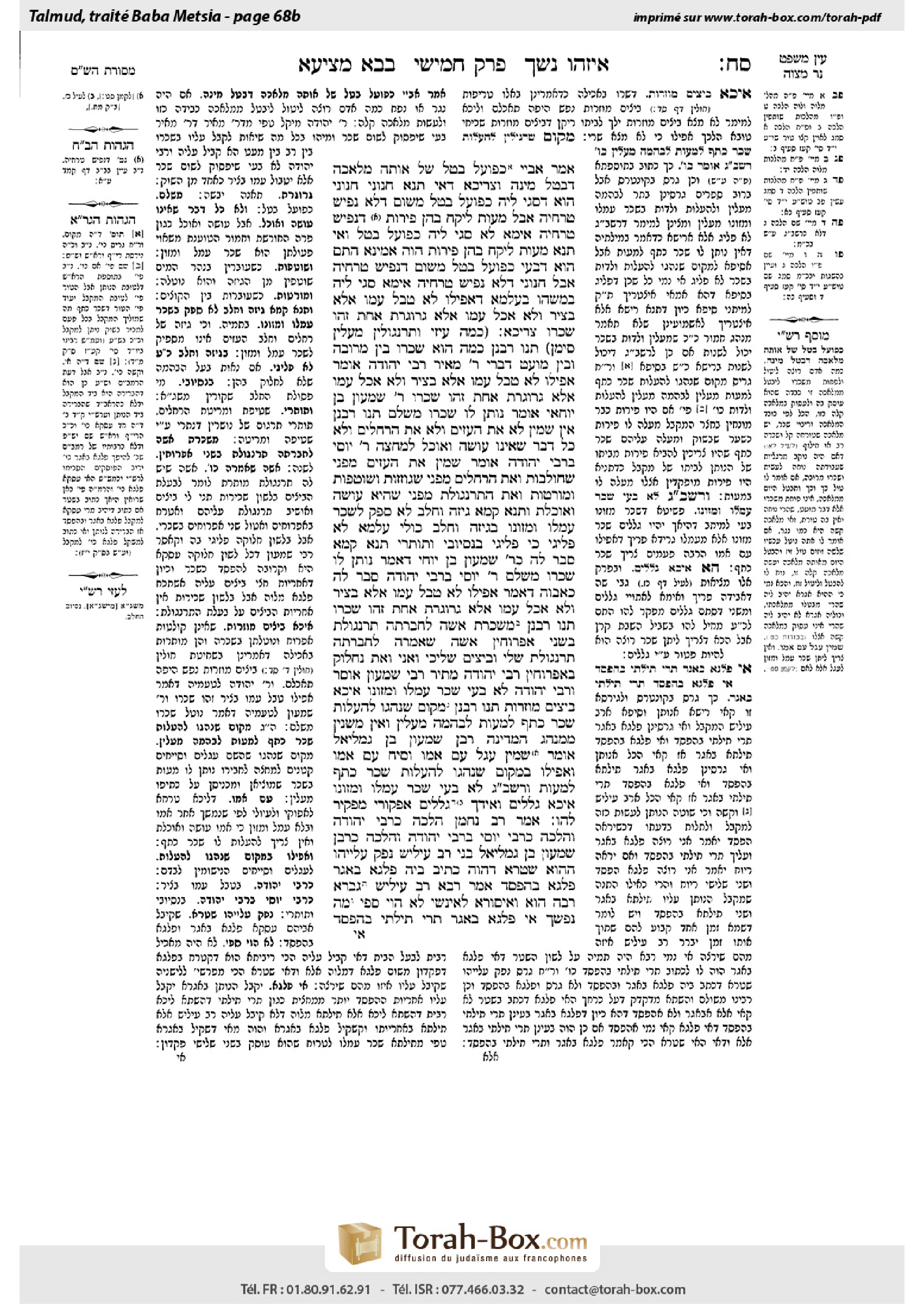
Bava Metzia 68b: Talmud study for Daf Yomi
Study the Talmud for Daf Yomi with scanned pages, Hebrew text, English translations from Sefaria and AI-generated French translations.
Passage selection and English or AI-generated French translation are available where the scan has annotations. Daf Study is independent of Torah-Box and Sefaria.
Browse Bava Metzia · בבא מציעא · All tractatesBava Metzia 68b text and translations
This page of Bava Metzia includes the Aramaic text, an English translation and an AI-generated French translation, alongside the scan above.
בבא מציעא ס״ח ב · Aramaic and Hebrew text
אָמַר אַבָּיֵי: כְּפוֹעֵל בָּטֵל שֶׁל אוֹתָהּ מְלָאכָה דִּבְטַל מִינַּהּ.
וּצְרִיכָא, דְּאִי תְּנָא חֶנְוָנִי: חֶנְוָנִי הוּא דְּסַגִּי לֵיהּ כְּפוֹעֵל בָּטֵל, מִשּׁוּם דְּלָא נְפִישׁ טִרְחֵיהּ. אֲבָל מָעוֹת לִיקַּח בָּהֶן פֵּירוֹת, דִּנְפִישׁ טִרְחֵיהּ – אֵימָא לָא סַגִּי לֵיהּ כְּפוֹעֵל בָּטֵל.
וְאִי תְּנָא מָעוֹת לִיקַּח בָּהֶן פֵּירוֹת – הֲוָה אָמֵינָא: הָתָם הוּא דְּבָעֵי כְּפוֹעֵל בָּטֵל, מִשּׁוּם דִּנְפִישׁ טִרְחֵיהּ. אֲבָל חֶנְוָנִי, דְּלָא נְפִישׁ טִרְחֵיהּ – אֵימָא סַגִּי לֵיהּ בְּמַשֶּׁהוּ בְּעָלְמָא, דַּאֲפִילּוּ לֹא טִבֵּל עִמּוֹ אֶלָּא בְּצִיר, וְלֹא אָכַל עִמּוֹ אֶלָּא גְּרוֹגֶרֶת אַחַת – זֶהוּ שְׂכָרוֹ, צְרִיכָא.
(כַּמָּה עִיזֵּי וְתַרְנְגוֹלִין מַעֲלִין סִימָן)
תָּנוּ רַבָּנַן: כַּמָּה הוּא שְׂכָרוֹ? בֵּין מְרוּבֶּה וּבֵין מוּעָט, דִּבְרֵי רַבִּי מֵאִיר. רַבִּי יְהוּדָה אוֹמֵר: אֲפִילּוּ לֹא טִבֵּל עִמּוֹ אֶלָּא בְּצִיר, וְלֹא אָכַל עִמּוֹ אֶלָּא גְּרוֹגֶרֶת אַחַת – זֶהוּ שְׂכָרוֹ. רַבִּי שִׁמְעוֹן בֶּן יוֹחַאי אוֹמֵר: נוֹתֵן לוֹ שְׂכָרוֹ מְשַׁלֵּם.
תָּנוּ רַבָּנַן: אֵין שָׁמִין לֹא אֶת הָעִזִּים וְלֹא אֶת הָרְחֵלִים, וְלֹא כׇּל דָּבָר שֶׁאֵינוֹ עוֹשֶׂה וְאוֹכֵל לְמֶחֱצָה.
רַבִּי יוֹסֵי בְּרַבִּי יְהוּדָה אוֹמֵר: שָׁמִין אֶת הָעִזִּים מִפְּנֵי שֶׁחוֹלְבוֹת, וְאֶת הָרְחֵלִים מִפְּנֵי שֶׁגּוֹזְזוֹת וְשׁוֹטְפוֹת וּמוֹרְטוֹת, וְאֶת הַתַּרְנְגוֹלֶת מִפְּנֵי שֶׁהִיא עוֹשָׂה וְאוֹכֶלֶת.
וְתַנָּא קַמָּא: גִּיזָּה וְחָלָב לָא סָפֵק שְׂכַר עֲמָלוֹ וּמְזוֹנוֹ? בְּגִיזָּה וְחָלָב – כּוּלֵּי עָלְמָא לָא פְּלִיגִי, כִּי פְלִיגִי בְּנַסְיוֹבֵי וְתוּתְרֵי.
תַּנָּא קַמָּא סָבַר לַהּ כְּרַבִּי שִׁמְעוֹן בֶּן יוֹחַי, דְּאָמַר: נוֹתֵן לוֹ שְׂכָרוֹ מִשָּׁלֵם. רַבִּי יוֹסֵי בְּרַבִּי יְהוּדָה סָבַר לַהּ כַּאֲבוּהּ, דְּאָמַר: אֲפִילּוּ לֹא טִבֵּל עִמּוֹ אֶלָּא בְּצִיר, וְלֹא אָכַל עִמּוֹ אֶלָּא גְּרוֹגֶרֶת אַחַת – זֶהוּ שְׂכָרוֹ.
תָּנוּ רַבָּנַן: מַשְׂכֶּרֶת אִשָּׁה לַחֲבֶרְתָּהּ תַּרְנְגוֹלֶת בִּשְׁנֵי אֶפְרוֹחִין. אִשָּׁה שֶׁאָמְרָה לַחֲבֶרְתָּהּ: ״תַּרְנְגוֹלֶת שֶׁלִּי וּבֵיצִים שֶׁלִּיכִי, וַאֲנִי וְאַתְּ נַחְלוֹק בָּאֶפְרוֹחִין״ – רַבִּי יְהוּדָה מַתִּיר, רַבִּי שִׁמְעוֹן אוֹסֵר.
וְרַבִּי יְהוּדָה לָא בָּעֵי שְׂכַר עֲמָלוֹ וּמְזוֹנוֹ? אִיכָּא בֵּיצִים מוּזָרוֹת.
תָּנוּ רַבָּנַן: מָקוֹם שֶׁנָּהֲגוּ לְהַעֲלוֹת שְׂכַר כַּתָּף לְמָעוֹת לִבְהֵמָה – מַעֲלִין, וְאֵין מְשַׁנִּין מִמִּנְהַג הַמְּדִינָה. רַבָּן שִׁמְעוֹן בֶּן גַּמְלִיאֵל אוֹמֵר: שָׁמִין עֵגֶל עִם אִמּוֹ, וּסְיָח עִם אִמּוֹ, וַאֲפִילּוּ בִּמְקוֹם שֶׁנָּהֲגוּ לְהַעֲלוֹת שְׂכַר כַּתָּף לְמָעוֹת.
וְרַבָּן שִׁמְעוֹן בֶּן גַּמְלִיאֵל לָא בָּעֵי שְׂכַר עֲמָלוֹ וּמְזוֹנוֹ? אִיכָּא גְּלָלִים. וְאִידַּךְ: גְּלָלִים – אַפְקוֹרֵי מַפְקֵיר לְהוּ.
אָמַר רַב נַחְמָן: הֲלָכָה כְּרַבִּי יְהוּדָה, וַהֲלָכָה כְּרַבִּי יוֹסֵי בְּרַבִּי יְהוּדָה, וַהֲלָכָה כְּרַבָּן שִׁמְעוֹן בֶּן גַּמְלִיאֵל.
בְּנֵי רַב עִילִישׁ נְפַק עֲלַיְיהוּ הָהוּא שְׁטָרָא דַּהֲוָה כְּתִיב בֵּיהּ ״פַּלְגָא בַּאֲגַר, פַּלְגָא בְּהֶפְסֵד״. אָמַר רָבָא: רַב עִילִישׁ גַּבְרָא רַבָּה הוּא, וְאִיסּוּרָא לְאִינָשֵׁי לָא הָוֵי סָפֵי. מָה נַפְשָׁךְ? אִי פַּלְגָא בַּאֲגַר – תְּרֵי תִּילְתֵי בְּהֶפְסֵד,
Bava Metzia 68b · English translation
Abaye says: It means that he is paid as a laborer who is idle from that typical labor of his from which he is kept idle. In other words, he must receive the amount of money that an individual would be willing to accept to refrain from his current occupation and engage in an easier task.
The Gemara comments: And it is necessary for the tanna to teach us both halakhot, that of a storekeeper who was given produce to sell as well as one who was given money to buy the produce. As had he taught only the halakha of a storekeeper who receives produce to sell, I would say that it is specifically a storekeeper for whom it is enough to receive his wages as an idle laborer, because his toil is not great, as the produce is already prepared and he merely has to sell it. But in the case of one who was given money with which to acquire produce, whose toil is great, as he must find the produce in the market and bring it back to his store, I might say that it is not sufficient for him to be paid as an idle laborer.
And conversely, had the tanna taught only the halakha of one who receives money with which to acquire produce, I would say it is in the case there that he requires payment as an idle laborer, because his toil is great, but with regard to a storekeeper, whose toil is not great, I would say that any amount is enough for him; that, for example, even if the one providing the produce only immersed his bread in brine with the storekeeper, or only ate one dried fig with him, this is sufficient to count as his wages, i.e., providing the bit of brine or a fig is sufficient to account for the storekeeper’s labor. It was therefore necessary for this halakha to be stated with regard to both cases.
§ Parenthetically, the Gemara lists the terms: How many goats, and chickens, we add; this constitutes a mnemonic device for the following discussions.
The mishna teaches that one may not enter into a joint venture with a storekeeper unless he gives him his wages. The Sages taught in a baraita: How much is his wage? What is the minimum amount he must be paid to avoid the prohibition of interest? It is permitted whether it is a lot or a little, in accordance with the agreement between them; this is the statement of Rabbi Meir. Rabbi Yehuda says: Even if he only immersed his bread in brine with him, or only ate one dried fig with him, this is sufficient for his wage. Rabbi Shimon ben Yoḥai says: He must give him his full wage, i.e., as a laborer.
The Sages taught: One may not appraise animals, i.e., one may not give his animals to someone else to raise after appraising their worth, in exchange for half the profits, neither goats, nor sheep, nor anything else that does not produce revenue while it eats. In other words, one may not enter into an agreement that any increase in value over and above the original appraisal of the animals will be shared between the owner and the one raising the animals. Since the animals do not produce revenue for the one raising them, his caring for the animal on behalf of the owner is tantamount to paying interest, as in the mishna.
Rabbi Yosei, son of Rabbi Yehuda, says: One may appraise goats for another to raise in this manner, because they produce milk, and one may appraise sheep for another to raise in this manner, because they are shorn for their wool, and they also have their wool removed when they are washed in water, and they are plucked of their wool by means of thorns, and the one who raises them can collect this wool. Consequently, the milk and wool generate revenue for the one raising them, and this can serve as a wage to avoid the prohibition of interest. And the same applies to a chicken, because it produces eggs while it eats.
The Gemara asks a question: And as for the first tanna, how does he respond to this claim? Does he claim that shearing and milk do not provide the payment of the wage for his toil and for the animal’s food? The Gemara answers: If the arrangement allows him to keep the sheared wool and milk, everyone agrees that this is sufficient to avoid the prohibition of interest. When they disagree, it is with regard to a case when he receives only the whey [benasyovi], i.e., the water left from the milk, and the pluckings [vetoteri] from the goats.
The Gemara clarifies the dispute: The first tanna holds in accordance with the opinion of Rabbi Shimon ben Yoḥai, who says that he gives him his full wage. Since the value of the whey and pluckings is less than a full wage, his receiving them does not suffice to replace his wage. Rabbi Yosei, son of Rabbi Yehuda, holds in accordance with the opinion of his father, who says that even if he only immersed his bread in brine with him, or only ate one dried fig with him, this is his wage, as there is no demand that his wages be commensurate with his toil.
The Sages taught: A woman may rent out to another woman a chicken to sit on the eggs belonging to the renter in exchange for two of the chicks hatched from the eggs. But with regard to a woman who said to another: The chicken is mine and the eggs are yours, and you and I shall share the chicks, i.e., my chicken will sit on your eggs until they hatch, Rabbi Yehuda permits this practice, and Rabbi Shimon prohibits it. He holds that since the owner of the chicken is responsible for half of the loss to the eggs, therefore part of this venture is a loan. As she is not being paid for her efforts, it is considered interest.
The Gemara asks: And as for Rabbi Yehuda, does he not require one to pay at least a minimal amount of the wage for the toil of the one caring for the chicken and the chicken’s food? The Gemara answers: There are unfertilized eggs, from which no chicks will hatch. Such eggs are retained by the owner of the chicken, and therefore she does receive some benefit.
The Sages taught: In a place where people are accustomed to add the wages of a porter for carrying a young animal on his shoulders to the money paid, the owner of the animal must add it to the overall sum, and one may not deviate from the regional custom. Rabban Shimon ben Gamliel says: One may appraise a calf that grows up with its mother for another to raise, and a foal that grows up with its mother for another to raise, as part of a single venture and split the profits, but one does not add to the wages for his toil, and this applies even in a place where they have the custom to add the wages of a porter to the money paid.
The Gemara asks: But as for Rabban Shimon ben Gamliel, does he not require that one pay at least a minimal amount for the wage for the toil of the one caring for the animals and the animals’ food? The Gemara answers: There is the animals’ dung, which is of some benefit to the one who raises the animals. The Gemara asks: And how does the other Sage respond to this claim? The Gemara replies: He maintains that he declares the dung ownerless, as he does not consider this important enough to retain. Consequently, this does not qualify as compensation paid to the one raising the young animal.
Rav Naḥman said: With regard to these joint ventures involving animals, the halakha is in accordance with the opinion of Rabbi Yehuda; and the halakha is in accordance with the opinion of Rabbi Yosei, son of Rabbi Yehuda; and the halakha is in accordance with the opinion of Rabban Shimon ben Gamliel.
The Gemara relates: A business document emerged concerning the sons of Rav Ilish, as it was a venture entered into by their late father, in which it was written that Rav Ilish and his partner will share one-half of the profit and one-half of the loss. Rava said: Rav Ilish was a great man, and therefore he would not feed people with something forbidden. In other words, he certainly would not have involved himself in a joint venture through which someone would have earned money by means of interest, and an arrangement of this kind appears to constitute interest. Consequently, no matter what, there must have been some mistake with regard to this document. If the actual condition stated that one party would receive one-half of the profit, the other party must have agreed to accept upon himself two-thirds of the loss,
Bava Metzia 68b · Traduction française (IA)
Abaye dit : Cela signifie qu'il est payé comme un ouvrier qui est inactif par rapport à ce travail typique qu'il est empêché d'effectuer. En d'autres termes, il doit recevoir la somme d'argent que quelqu'un accepterait pour se désengager de son occupation actuelle et s'engager dans une tâche plus facile.
Le Guemara commente : Il est nécessaire que le tanna nous enseigne à la fois les halakhot, celle du marchand qui a reçu des produits à vendre ainsi que celle du marchand qui a reçu de l'argent pour acheter les produits. Car s'il avait seulement enseigné la halakha du marchand qui reçoit des produits à vendre, je dirais qu'il s'agit spécifiquement du marchand pour qui il suffit de recevoir ses salaires comme un ouvrier inactif, car son effort n'est pas grand, puisque les produits sont déjà préparés et qu'il suffit de les vendre. Mais dans le cas d'une personne qui a reçu de l'argent pour acheter des produits, dont l'effort est grand, car il doit trouver les produits sur le marché et les ramener chez lui, je pourrais dire qu'il n'est pas suffisant de le payer comme un ouvrier inactif.
Et inversement, si le tanna avait seulement enseigné la halakha d'une personne qui reçoit de l'argent pour acheter des produits, je dirais qu'il s'agit de ce cas précis où il faut lui payer comme un ouvrier inactif, car son effort est grand, mais concernant le marchand, dont l'effort n'est pas grand, je dirais que toute somme est suffisante pour lui ; par exemple, même si la personne qui fournit les produits n'a que trempé son pain dans de l'eau de mer avec le marchand, ou n'a mangé qu'une figue sèche avec lui, cela suffit à compter comme son salaire, c'est-à-dire que fournir un peu d'eau de mer ou une figue est suffisant pour représenter le travail du marchand. Il fallait donc que cette halakha soit énoncée à propos des deux cas.
§ Par parenthèse, la Guemara cite les termes : combien de boucs et de poulets nous ajoutons ; cela constitue un dispositif mnémotechnique pour les discussions suivantes.
La mitsna enseigne que l'on ne peut pas entrer dans une association avec un marchand sans lui donner ses salaires. Les Sages ont enseigné dans une baraïta : quel est son salaire ? Quel est le montant minimum qu'il doit recevoir pour éviter la prohibition d'intérêt ? C'est permis qu'il soit beaucoup ou peu, selon l'accord entre eux ; c'est la déclaration de Rabbi Meir. Rabbi Yéhuda dit : même s'il n'a que trempé son pain dans de l'eau de mer avec lui, ou n'a mangé qu'une figue sèche avec lui, cela suffit pour son salaire. Rabbi Shimon ben Yochai dit : il doit lui donner son salaire complet, c'est-à-dire comme un ouvrier.
Les Sages ont enseigné : on ne peut pas évaluer des animaux, c'est-à-dire on ne peut pas donner ses animaux à quelqu'un d'autre pour les élever après avoir évalué leur valeur, en échange de la moitié des profits, ni des boucs, ni des moutons, ni quoi que ce soit d'autre qui ne produit pas de revenus pendant qu'il mange. En d'autres termes, on ne peut pas entrer dans un accord selon lequel toute augmentation de valeur au-delà de l'évaluation initiale des animaux sera partagée entre le propriétaire et celui qui les élève. Puisque les animaux ne produisent pas de revenus pour celui qui les élève, son soin des animaux au nom du propriétaire est équivalent à un intérêt, comme dans la mitsna.
Rabbi Yosei, fils de Rabbi Yéhuda, dit : On peut évaluer des boucs pour qu'un autre les élève ainsi, car ils produisent du lait, et on peut évaluer des moutons pour qu'un autre les élève ainsi, car on les tond pour leur laine, et ils sont aussi dépouillés de leur laine lorsqu'ils sont lavés à l'eau, et on les dépouille de leur laine avec des épines, et celui qui les élève peut récolter cette laine. Ainsi, le lait et la laine génèrent des revenus pour celui qui les élève, et cela peut servir de salaire pour éviter la prohibition d'intérêt. Et cela s'applique également au poulet, car il produit des œufs pendant qu'il mange.
Le Guemara pose une question : Et concernant le premier tanna, comment répond-il à cette allégation ? Affirme-t-il que le lait et la toison ne fournissent pas le paiement du salaire pour son effort et pour la nourrité de l'animal ? Le Guemara répond : Si l'arrangement permet à l'homme de garder la laine et le lait, tout le monde convient que cela suffit à éviter la prohibition d'intérêt. Lorsqu'ils sont en désaccord, c'est concernant un cas où il reçoit seulement le lait de lait (benasyovi), c'est-à-dire l'eau restante du lait, et les dépouillements (vetoteri) des boucs.
Le Guemara clarifie le débat : Le premier tanna suit l'opinion de Rabbi Shimon ben Yochai, qui dit qu'il doit lui donner son salaire complet. Puisque la valeur du lait de lait et des dépouillements est inférieure à un salaire complet, recevoir ces choses ne suffit pas à remplacer son salaire. Rabbi Yosei, fils de Rabbi Yéhuda, suit l'opinion de son père, qui dit que même s'il n'a que trempé son pain dans de l'eau de mer avec lui, ou n'a mangé qu'une figue sèche avec lui, cela est son salaire, car il n'y a pas de demande que ses salaires soient proportionnels à son effort.
Les Sages ont enseigné : Une femme peut louer à une autre femme un poulet pour qu'il couve les œufs appartenant à la loueuse en échange de deux des poussins issus des œufs. Mais concernant une femme qui a dit à une autre : Le poulet est à moi et les œufs sont à toi, et toi et moi partagerons les poussins, c'est-à-dire que mon poulet couvera tes œufs jusqu'à ce qu'ils éclosent, Rabbi Yéhuda autorise cette pratique, et Rabbi Shimon la interdit. Il considère que puisque le propriétaire du poulet est responsable de la moitié de la perte des œufs, donc une partie de ce projet est un prêt. Comme elle n'est pas payée pour ses efforts, cela est considéré comme un intérêt.
Le Guemara pose une question : Et concernant Rabbi Yéhuda, ne requiert-il pas qu'on paie au moins une somme minimale du salaire pour l'effort de celui qui s'occupe du poulet et de la nourriture du poulet ? Le Guemara répond : Il existe des œufs non fécondés, d'où aucun poussin ne sortira. Ces œufs sont conservés par la propriétaire du poulet, et donc elle reçoit quelque bénéfice.
Les Sages enseignent : Dans un lieu où les gens sont habitués à ajouter les salaires d'un porteur chargé d'un petit animal sur ses épaules au montant payé, l'propriétaire de l'animal doit ajouter cela au total, et on ne peut pas s'écarter de la coutume locale. Rabban Shimon ben Gamliel dit : On peut évaluer un veau qui grandit avec sa mère pour être élevé par un autre, et un poulain qui grandit avec sa mère pour être élevé par un autre, comme un seul projet et partager les profits, mais on ne rajoute pas les salaires pour son travail, et cela s'applique même dans un lieu où ils ont la coutume d'ajouter les salaires d'un porteur au montant payé.
Le Guemara demande : Mais concernant Rabban Shimon ben Gamliel, ne requiert-il pas qu'on paie au moins une somme minimale pour le salaire du travail du gardien des animaux et de l'alimentation des animaux ? Le Guemara répond : Il y a les déjections des animaux, qui sont quelque chose de bénéfique pour celui qui élève les animaux. Le Guemara demande : Et comment le sage opposé répond-il à cette affirmation ? Le Guemara répond : Il considère que les déjections sont sans propriétaire, car il ne juge pas cela suffisamment important pour les conserver. Ainsi, cela ne constitue pas une rémunération pour celui qui élève l'animal jeune.
Rav Naḥman a dit : En ce qui concerne ces projets communs impliquant des animaux, la halakha suit l'opinion de Rabbi Yehuda ; et la halakha suit l'opinion de Rabbi Yosei, fils de Rabbi Yehuda ; et la halakha suit l'opinion de Rabban Shimon ben Gamliel.
Le Guemara rapporte : Un document commercial est apparu concernant les fils de Rav Ilish, car il s'agissait d'un projet entrepris par leur père décédé, dans lequel il était écrit que Rav Ilish et son partenaire partageraient la moitié des profits et la moitié des pertes. Rava a dit : Rav Ilish était un grand homme, et donc il ne nourrirait pas les gens avec quelque chose interdit. En d'autres termes, il n'aurait certainement pas participé à un projet commun par lequel quelqu'un aurait gagné de l'argent par intérêt, et un tel arrangement semble constituer de l'intérêt. Ainsi, qu'importe, il y a dû y avoir une erreur dans ce document. Si la condition réelle était que l'une des parties recevrait la moitié des profits, l'autre partie aurait dû accepter de prendre sur lui les deux tiers des pertes,
Traduction française générée par IA à partir de l’édition anglaise de Sefaria. Vérifie toujours un passage avec le texte source.
Text from Sefaria: William Davidson Edition - Vocalized Aramaic (CC BY NC); William Davidson Edition - English (CC BY NC).