Bava Metzia 69a: Talmud study for Daf Yomi
Study the Talmud for Daf Yomi with scanned pages, Hebrew text, English translations from Sefaria and AI-generated French translations.
Passage selection and English or AI-generated French translation are available where the scan has annotations. Daf Study is independent of Torah-Box and Sefaria.
Browse Bava Metzia · בבא מציעא · All tractatesBava Metzia 69a text and translations
This page of Bava Metzia includes the Aramaic text, an English translation and an AI-generated French translation, alongside the scan above.
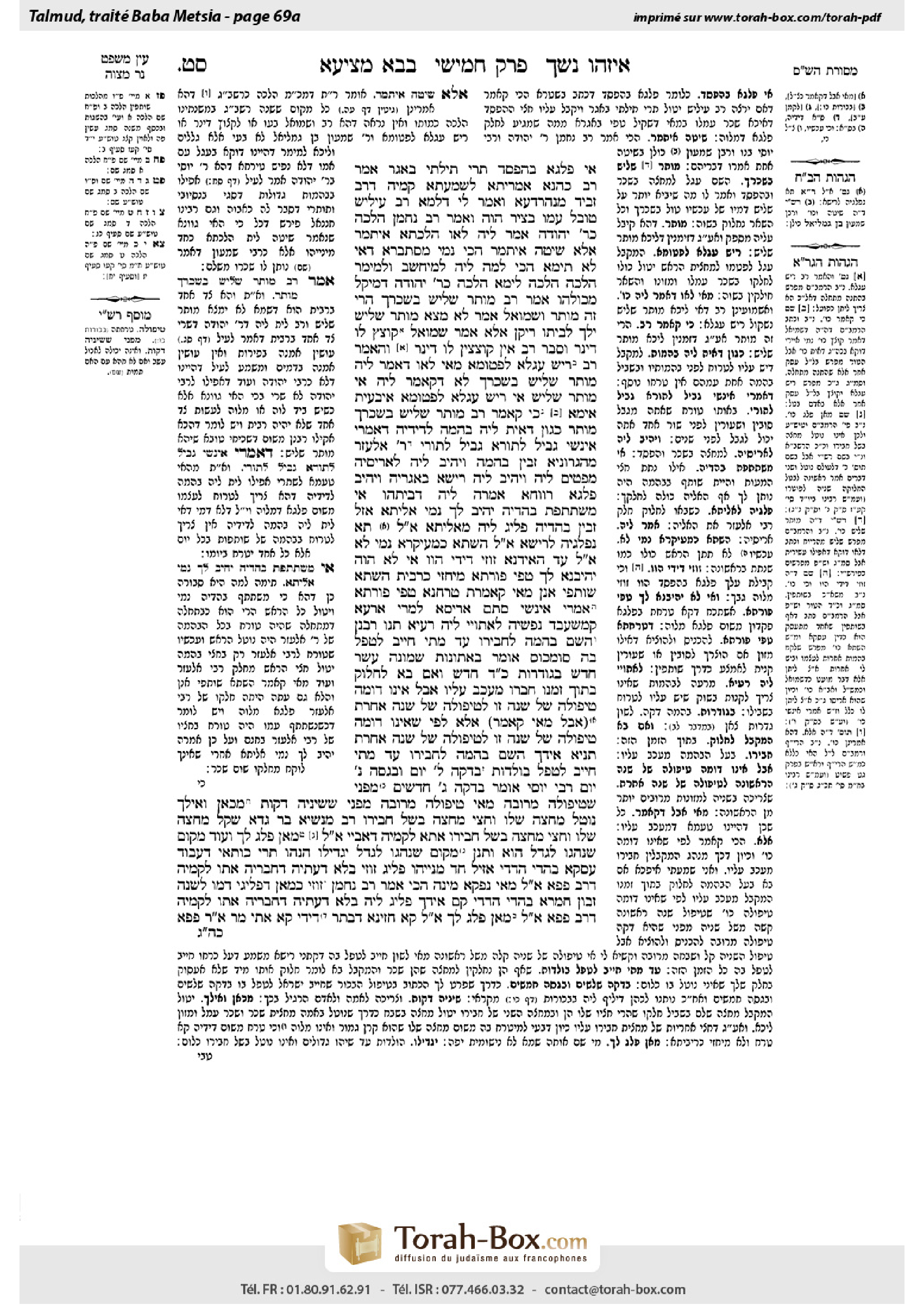
בבא מציעא ס״ט א · Aramaic and Hebrew text
אִי פַּלְגָא בְּהֶפְסֵד – תְּרֵי תִּילְתֵי בַּאֲגַר.
אָמַר רַב כָּהֲנָא: אַמְרִיתָא לִשְׁמַעְתָּא קַמֵּיהּ דְּרַב זְבִיד מִנְּהַרְדְּעָא, וַאֲמַר לִי: דִּלְמָא רַב עִילִישׁ טוֹבֵל עִמּוֹ בְּצִיר הֲוָה. וְאָמַר רַב נַחְמָן: הֲלָכָה כְּרַבִּי יְהוּדָה! אֲמַר לֵיהּ: לָאו הִלְכְתָא אִיתְּמַר, אֶלָּא שִׁיטָה אִיתְּמַר.
הָכִי נָמֵי מִסְתַּבְּרָא, דְּאִי לָא תֵּימָא הָכִי – לְמָה לֵיהּ לְמִיחְשַׁב וּלְמֵימַר הֲלָכָה הֲלָכָה? לֵימָא הֲלָכָה כְּרַבִּי יְהוּדָה, דְּמֵיקֵל מִכּוּלְּהוּ.
אָמַר רַב: מוֹתַר שְׁלִישׁ בִּשְׂכָרְךָ – הֲרֵי זֶה מוּתָּר. וּשְׁמוּאֵל אָמַר: לֹא מָצָא מוֹתַר שְׁלִישׁ, יֵלֵךְ לְבֵיתוֹ רֵיקָן! אֶלָּא אָמַר שְׁמוּאֵל: קוֹצֵץ לוֹ דִּינָר.
וְסָבַר רַב אֵין קוֹצְצִין לוֹ דִּינָר? וְהָאָמַר רַב: רֵישׁ עִגְלָא לְפָטוֹמָא, מַאי לָאו דְּאָמַר לֵיהּ: מוֹתַר שְׁלִישׁ בִּשְׂכָרְךָ?
לֹא, דְּקָאָמַר לֵיהּ: אִי מוֹתַר שְׁלִישׁ, אִי רֵישׁ עִגְלָא לְפָטוֹמָא. אִיבָּעֵית אֵימָא: כִּי קָאָמַר רַב מוֹתַר שְׁלִישׁ בִּשְׂכָרְךָ מוּתָּר – כְּגוֹן דְּאִית לֵיהּ בְּהֵמָה לְדִידֵיהּ. דְּאָמְרִי אִינָשֵׁי: גַּבֵּיל לְתוֹרָא, גַּבֵּיל לְתוֹרֵי.
רַבִּי אֶלְעָזָר מֵהַגְרוֹנְיָא זָבֵין בְּהֵמָה, וְיָהֵיב לֵיהּ לַאֲרִיסֵיהּ מְפַטֵּים לֵיהּ, וְיָהֵיב לֵיהּ רֵישָׁא בְּאַגְרֵיהּ, וְיָהֵיב פַּלְגָא רַוְוחָא. אֲמַרָה לֵיהּ דְּבֵיתְהוּ: אִי מִשְׁתַּתְּפַתְּ בַּהֲדֵיהּ יָהֵיב לָךְ נָמֵי אַלְיְתָא. אֲזַל זָבֵין בַּהֲדֵיהּ, פְּלֵיג לֵיהּ מֵאַלְיְתָא. אֲמַר לֵיהּ: תָּא נִפְלְגֵיהּ לְרֵישָׁא. אֲמַר לֵיהּ: הַשְׁתָּא כְּמֵעִיקָּרָא נָמֵי לָא?
אֲמַר לֵיהּ: עַד הָאִידָּנָא זוּזֵי דִּידִי הֲווֹ, אִי לָא הֲוָה יָהֵיבְנָא לָךְ טְפֵי פּוּרְתָּא – מִיחֲזֵי כְּרִבִּית, הַשְׁתָּא שׁוּתָּפֵי אֲנַן, מַאי קָאָמְרַתְּ טָרַחְנָא טְפֵי פּוּרְתָּא, אָמְרִי אִינָשֵׁי: סְתַם אֲרִיסָא לְמָרֵי אַרְעָא קָמְשַׁעְבֵּד נַפְשֵׁיהּ לְאֵתוֹיֵי לֵיהּ רִעְיָא.
תָּנוּ רַבָּנַן: הַשָּׁם בְּהֵמָה לַחֲבֵירוֹ, עַד מָתַי חַיָּיב לִטַּפֵּל בָּהּ? סוֹמְכוֹס אוֹמֵר: בַּאֲתוֹנוֹת שְׁמוֹנָה עָשָׂר חֹדֶשׁ, בְּגוֹדְרוֹת עֶשְׂרִים וְאַרְבָּעָה חֹדֶשׁ. וְאִם בָּא לַחֲלוֹק בְּתוֹךְ זְמַנּוֹ – חֲבֵרוֹ מְעַכֵּב עָלָיו, אֲבָל אֵינוֹ דּוֹמֶה טִיפּוּלָהּ שֶׁל שָׁנָה זוֹ לְטִיפּוּלָהּ שֶׁל שָׁנָה אַחֶרֶת.
״אֲבָל״ מַאי קָאָמַר? אֶלָּא: לְפִי שֶׁאֵינוֹ דּוֹמֶה טִיפּוּלָהּ שֶׁל שָׁנָה זוֹ לְטִיפּוּלָהּ שֶׁל שָׁנָה אַחֶרֶת.
תַּנְיָא אִידַּךְ: הַשָּׁם בְּהֵמָה לַחֲבֵירוֹ, עַד מָתַי חַיָּיב לִטַּפֵּל בַּוְּלָדוֹת? בַּדַּקָּה – שְׁלֹשִׁים יוֹם, וּבַגַּסָּה – חֲמִשִּׁים יוֹם. רַבִּי יוֹסֵי אוֹמֵר: בַּדַּקָּה שְׁלֹשָׁה חֳדָשִׁים, מִפְּנֵי שֶׁטִּיפּוּלָהּ מְרוּבֶּה. מַאי טִיפּוּלָהּ מְרוּבֶּה – מִפְּנֵי שֶׁשִּׁינֶּיהָ דַּקּוֹת. מִכָּאן וְאֵילָךְ נוֹטֵל מֶחֱצָה שֶׁלּוֹ, וַחֲצִי מֶחֱצָה בְּשֶׁל חֲבֵירוֹ.
רַב מְנַשְּׁיָא בַּר גַּדָּא שְׁקַל מֶחֱצָה שֶׁלּוֹ וַחֲצִי מֶחֱצָה בְּשֶׁל חֲבֵירוֹ. אֲתָא לְקַמֵּיהּ דְּאַבָּיֵי. אֲמַר לֵיהּ: מַאן פְּלַג לָךְ? וְעוֹד: מָקוֹם שֶׁנָּהֲגוּ לְגַדֵּל הוּא, וּתְנַן: מָקוֹם שֶׁנָּהֲגוּ לְגַדֵּל – יְגַדֵּילוּ.
הָנְהוּ תְּרֵי כּוּתָאֵי דַּעֲבוּד עִסְקָא בַּהֲדֵי הֲדָדֵי. אֲזַל חַד מִנַּיְיהוּ פְּלַיג זוּזֵי בְּלָא דַּעְתֵּיהּ דְּחַבְרֵיהּ. אֲתוֹ לְקַמֵּיהּ דְּרַב פָּפָּא. אֲמַר לֵיהּ: מַאי נָפְקָא מִינַּהּ? הָכִי אָמַר רַב נַחְמָן: זוּזֵי כְּמַאן דִּפְלִיגִי דָּמוּ.
לְשָׁנָה זְבוּן חַמְרָא בַּהֲדֵי הֲדָדֵי. קָם אִידַּךְ פְּלַיג לֵיהּ בְּלָא דַּעְתֵּיהּ דְּחַבְרֵיהּ, אֲתוֹ לְקַמֵּיהּ דְּרַב פָּפָּא. אֲמַר לֵיהּ: מַאן פְּלַג לָךְ? אֲמַר לֵיהּ: קָא חָזֵינָא דְּבָתַר דִּידִי קָא אָתֵי מָר! אֲמַר רַב פָּפָּא:
Bava Metzia 69a · English translation
or it must have been that the other party accepted one-half of the loss and that Rav Ilish was entitled to two-thirds of the profit. Either way, the disparity in the terms served as payment to Rav Ilish for his effort, removing any concern about violation of the prohibition of interest.
Rav Kahana said: I said this halakha before Rav Zevid of Neharde’a and he said to me: Why is it certain that the document included all the details of the transaction? Perhaps Rav Ilish immersed his bread in brine together with the other party? According to the opinion of Rabbi Yehuda, this would suffice to avoid the prohibition of interest, and Rav Naḥman says: The halakha is in accordance with the opinion of Rabbi Yehuda. Rav Kahana said to Rav Zevid: It was not stated by Rav Naḥman that the halakha is in accordance with the opinion of Rabbi Yehuda, but rather it was stated that a single opinion is common to three Sages: Rabbi Yehuda; Rabban Shimon ben Gamliel; and Rabbi Yosei, son of Rabbi Yehuda. This does not establish the halakha in accordance with their statements, but on the contrary, they all hold one common opinion that is not accepted as the halakha.
The Gemara comments: This too stands to reason, as, if you do not say so, why did Rav Naḥman list them individually and say: The halakha is in accordance with the opinion of so-and-so, and the halakha is in accordance with the opinion of so-and-so? Instead let Rav Naḥman say simply: The halakha is in accordance with the opinion of Rabbi Yehuda, as he is the most lenient of all of them, and their rulings can be derived from his. Since Rav Naḥman did not state this, it is reasonable to say that he was not issuing a ruling in accordance with their opinion, but simply clarifying that these three opinions are actually one.
§ Rav says: If one says to another: I am giving you a calf to fatten, and let us divide the profit between us when it is sold, and the surplus over one-third of its current value is your wages, meaning that they will split the profits up to one-third of the value of the calf, and any additional profits will belong exclusively to the one who fattened the animal and serve as his wages, this arrangement is permitted, because the one fattening the calf is compensated for his efforts, and there is therefore no interest on the part that is a loan. And Shmuel says: It is not permitted, because if there is no surplus over one-third and he goes home empty-handed, he will have worked for free, and this is considered interest. Rather, Shmuel says: The owner of the calf must set aside a dinar for the other, to compensate him for his efforts in the event that there is no surplus over one-third.
The Gemara asks: And does Rav hold that he is not required to set aside a dinar for him? But doesn’t Rav say a different way to structure such an arrangement, that the head of the calf is given to the fattener, i.e., they may divide most of the profits evenly, but the head of the calf is given as a supplement to the one who does the fattening? What, is it not that he said to him: The surplus over one-third is your wages, and according to Rav the calf’s owner must nevertheless also give him the head in case there is no surplus?
The Gemara refutes this: No, Rav was referring to a case where the owner of the calf said to him: Either he will receive the surplus over one-third, or the head of the calf will serve as wages to the fattener. Or if you wish, say instead: When Rav says that if the owner said to him: The surplus over one-third is your wages it is permitted, this was a case where the one fattening the calf already had his own animal to fatten, as people say in a common adage: Mix food for an ox, mix for oxen, meaning that since he already has to prepare food for one ox, it is not a big inconvenience and expense for him to add food for an additional ox, so the surplus over one-third is sufficient to compensate him.
The Gemara relates: Rav Elazar of Hagronya purchased an animal, and gave it to his sharecropper to fatten it, and gave him the head as his wages and gave him one-half of the profits. The sharecropper’s wife said to him: If you would have participated with him in the purchase of the animal he would have given you the tail also. The next time, the sharecropper went and purchased the calf with Rabbi Elazar, and Rabbi Elazar gave him one-half of the tail and then said to him: Let’s divide the head. The sharecropper said to him: Now will you not also give me as you did initially? Before, when I was not a partner in the animal but accepted it only in order to fatten it, you gave me the entire head. Now that I am a partner with you, are you going to give me only one-half of the head?
Rabbi Elazar said to him: Until now the money was mine, and had I not given you a little more value as compensation for your efforts, it would have appeared to be like interest. But now that we are partners, what can you say? That you must exert a little more effort than I do to take the animal in and out of the pasture? As people say in a common adage: An ordinary sharecropper subjugates himself to the owner to bring him pasture. Sharecroppers are accustomed to expending extra effort on behalf of the owner of the field. Therefore we are equal partners and divide everything.
The Sages taught: With regard to one who appraises an animal for another to raise, how long is the other obligated to care for it if they did not stipulate this explicitly? Sumakhos says: For female donkeys, eighteen months; for flocks of sheep or goats, twenty-four months. And if one of them comes to divide, i.e., if he wishes to sell the animal and divide the profits, within the time, i.e., before the time for taking care of it has ended, the other can prevent him from doing so, but the effort involved in the care of the animal for this year is not comparable to the care of another year.
The Gemara asks: With regard to the word but that was said here, what is it saying? It does not seem to belong in the statement. Rather, the text must be corrected as follows: Because the care of this year is not comparable to the care of another year. The profits are not necessarily divided evenly during the entire time of the animal’s growth, and therefore either party can insist that the contract be carried through to the end of the specified period.
It is taught in another baraita: With regard to one who appraises an animal for another to raise, for how long is the latter obligated to care for the offspring that are born to it? For a species of small animals, he is obligated to care for the offspring for thirty days, and for a species of large animals, fifty days. Rabbi Yosei says: For a species of small animals, he is obligated to care for the offspring for three months, as it requires a lot of care. The Gemara asks: What is the meaning of: A lot of care? It means that due to the fact that its teeth are thin, its food has to be cut up for it, which is not necessary for a species of large animals. From this point forward, the one raising the animal takes one-half of the offspring as his share, since one-half of the animal is his, and he takes one-half of one-half of the other’s share of the offspring, i.e., one-fourth of the total, as wages for caring for the animal and raising it.
The Gemara relates: Rav Menashya bar Gadda accepted an animal to raise, and of the offspring he took his one-half and one-half of the other’s one-half. This matter came before Abaye. Abaye said to Rav Menashya bar Gadda: Who divided it for you? Since he did this on his own, there is a concern that he may not have divided it fairly. And furthermore, this place is a place where it is customary for the one raising the animal to raise the offspring, and we learned in a mishna (69b): In a place where it is customary to raise the offspring, they should be raised by the one raising the mother, and not divided between them.
The Gemara relates: There were these two Samaritans who entered into a joint venture with each other. One of them went and divided the money without the knowledge of the other. They came for judgment before Rav Pappa. Rav Pappa said to the plaintiff: What difference is there, meaning: What did you lose? This is what Rav Naḥman said: Money is considered as though it were already divided. It is not viewed as a single sum.
The next year these same two purchased wine together, and the other one arose and divided the wine without the knowledge of the other. And again, they came for judgment before Rav Pappa. Rav Pappa said to the defendant: Who divided it for you? You did not act properly since you did not get your partner’s permission to divide the wine. The Samaritan said to him: I see that the Master pursues me in order to harass me, since last year, when we came with what appears to be essentially the same case, you gave a different ruling in favor of the other. Rav Pappa said:
Bava Metzia 69a · Traduction française (IA)
ou bien il fallait que l'autre partie acceptât la moitié de la perte, et que Rav Ilish fût dû deux tiers du bénéfice. Quel que soit le cas, la différence dans les termes servait de rémunération à Rav Ilish pour son effort, éliminant toute inquiétude concernant la violation de l'interdiction d'intérêt.
Rav Kahana dit : J'ai dit cette halakha à Rav Zevid de Neharde’a, et il m'a répondu : Pourquoi est-ce certain que le document contenait tous les détails de la transaction ? Peut-être Rav Ilish avait-il trempé son pain dans le sel avec l'autre partie ? Selon l'opinion de Rabbi Yehuda, cela suffirait à éviter l'interdiction d'intérêt, et Rav Naḥman dit : La halakha suit l'opinion de Rabbi Yehuda. Rav Kahana dit à Rav Zevid : Il n'a pas été dit par Rav Naḥman que la halakha suit l'opinion de Rabbi Yehuda, mais plutôt qu'une seule opinion est commune à trois Sages : Rabbi Yehuda ; Rabban Shimon ben Gamliel ; et Rabbi Yosei, fils de Rabbi Yehuda. Cela ne constitue pas une halakha suivant leurs déclarations, mais au contraire, ils tous partagent une même opinion qui n'est pas acceptée comme halakha.
La Guemara commente : Cela aussi est logique, car si vous ne dites pas cela, pourquoi Rav Naḥman a-t-il listé individuellement et dit : La halakha suit l'opinion de tel ou tel ? Au lieu de cela, il aurait pu simplement dire : La halakha suit l'opinion de Rabbi Yehuda, car il est le plus accommodant de tous, et ses décisions peuvent être dérivées de la sienne. Puisque Rav Naḥman n'a pas dit cela, il est raisonnable de dire qu'il ne donnait pas un avis suivant leur opinion, mais simplement clarifiait que ces trois opinions sont en réalité une seule.
§ Rav dit : Si l'un dit à l'autre : Je te donne un veau pour l'élever, et nous diviserons le bénéfice lorsqu'il sera vendu, et le surplus au-delà d'un tiers de sa valeur actuelle est ton salaire, c'est-à-dire qu'ils partageront les bénéfices jusqu'à un tiers de la valeur du veau, et tout bénéfice supplémentaire appartiendra exclusivement à celui qui a élevé l'animal et servira de salaire, cette disposition est permise, car celui qui élève le veau est rémunéré pour son effort, et donc il n'y a pas d'intérêt sur la part qui est un prêt. Et Shmuel dit : Cela n'est pas permis, car si il n'y a pas de surplus au-delà d'un tiers et qu'il rentre vide, il aura travaillé gratuitement, et cela est considéré comme de l'intérêt. Plutôt, Shmuel dit : L'propriétaire du veau doit mettre de côté un dinar pour l'autre, afin de le rémunérer pour son effort en cas de manque de surplus.
La Guemara pose la question : Et Rav ne considère-t-il pas que l'on doit mettre de côté un dinar pour lui ? Mais ne dit-il pas une autre manière de structurer cette disposition, à savoir que la tête du veau est donnée à l'éleveur, c'est-à-dire qu'ils peuvent diviser la plupart des bénéfices de manière égale, mais la tête du veau est donnée comme supplément à celui qui fait l'élevage ? Qu'est-ce que cela signifie, n'est-ce pas qu'il a dit : Le surplus au-delà d'un tiers est ton salaire, et selon Rav, l'propriétaire du veau doit néanmoins aussi lui donner la tête en cas de manque de surplus ?
La Guemara réfute cela : Non, Rav faisait référence à un cas où l'propriétaire du veau avait dit à lui : Soit il recevra le surplus au-delà d'un tiers, soit la tête du veau servira de rémunération à l'éleveur. Ou si vous voulez, dites plutôt : Lorsque Rav dit que si l'propriétaire a dit : Le surplus au-delà d'un tiers est ton rémunération, cela est permis, c'était un cas où l'éleveur avait déjà son propre animal à élever, comme les gens disent dans une adage commune : Mélangez de la nourriture pour un bœuf, mélangez pour plusieurs bœufs, c'est-à-dire que puisque il doit déjà préparer de la nourriture pour un bœuf, ce n'est pas un grand inconvénient et une grande dépense pour lui d'ajouter de la nourriture pour un autre bœuf, donc le surplus au-delà d'un tiers suffit à le rémunérer.
La Guemara rapporte : Rav Elazar de Hagronya acheta un animal, et le donna à son fermier pour l'élever, et lui donna la tête comme rémunération et lui donna la moitié des bénéfices. La femme du fermier lui dit : Si tu avais participé avec lui à l'achat de l'animal, il t'aurait donné la queue aussi. La prochaine fois, le fermier alla acheter le veau avec Rabbi Elazar, et Rabbi Elazar lui donna la moitié de la queue et dit : Divisons la tête. Le fermier lui dit : Maintenant ne vas-tu pas aussi me donner comme tu l'as fait initialement ? Avant, quand je n'étais pas partenaire dans l'animal mais l'avais accepté uniquement pour l'élever, tu m'as donné toute la tête. Maintenant que je suis partenaire avec toi, vas-tu me donner seulement la moitié de la tête ?
Rabbi Elazar lui dit : Jusqu'à présent l'argent était à moi, et si je n'avais pas donné un peu plus de valeur en rémunération pour ton effort, cela aurait semblé comme de l'intérêt. Mais maintenant que nous sommes partenaires, que peux-tu dire ? Que tu dois t'efforcer un peu plus que moi pour emmener l'animal dans les pâturages ? Comme les gens disent dans une adage commune : Un fermier ordinaire se soumet à l'exploitant pour lui apporter les pâturages. Les fermiers sont habitués à dépenser un effort supplémentaire au nom de l'exploitant du champ. Donc nous sommes partenaires égaux et divisons tout.
Les Sages enseignèrent : En ce qui concerne celui qui évalue un animal pour que quelqu'un l'élève, pendant combien de temps l'autre est-il tenu de le soigner si ils n'ont pas stipulé cela explicitement ? Sumakhos dit : Pour les juments, dix-huit mois ; pour les troupeaux de moutons ou de chèvres, vingt-quatre mois. Et si l'un d'eux vient diviser, c'est-à-dire s'il veut vendre l'animal et diviser les bénéfices, pendant la période, c'est-à-dire avant la fin de la période de soin, l'autre peut l'en empêcher, mais l'effort impliqué dans la soin de l'animal cette année n'est pas comparable à celui d'une autre année.
La Guemara pose la question : En ce qui concerne le mot « mais cela a été dit ici », de quoi parle-t-il ? Il ne semble pas s'inscrire dans l'affirmation. Plutôt, le texte doit être corrigé ainsi : Parce que la précaution de cette année n'est pas comparable à la précaution d'une autre année. Les profits ne sont pas nécessairement répartis de manière égale tout au long de la période de croissance de l'animal, et par conséquent, chaque partie peut exiger que le contrat soit mené jusqu'à la fin de la période spécifiée.
Il est enseigné dans une autre baraïta : En ce qui concerne celui qui évalue un animal pour que quelqu'un d'autre le cultive, pendant combien de temps est-il tenu de s'occuper des petits qui en naissent ? Pour une espèce d'animaux petits, il est tenu de s'occuper des petits pendant trente jours, et pour une espèce d'animaux grands, cinquante jours. Rabbi Yosei dit : Pour une espèce d'animaux petits, il est tenu de s'occuper des petits pendant trois mois, car cela exige beaucoup de soins. La Guemara pose la question : De quoi parle-t-on lorsqu'on dit : beaucoup de soins ? Cela signifie que, en raison du fait que ses dents sont fines, son aliment doit être coupé en morceaux pour lui, ce qui n'est pas nécessaire pour une espèce d'animaux grands. À partir de ce moment, celui qui cultive l'animal prend la moitié des petits comme part, puisque la moitié de l'animal est la sienne, et il prend la moitié de la moitié de la part de l'autre de la descendance, c'est-à-dire un quart du total, comme rémunération pour s'occuper de l'animal et le cultiver.
La Guemara rapporte : Rav Menashya bar Gadda a accepté un animal à élever, et des petits qu'il a pris, il a pris sa moitié et la moitié de la moitié de l'autre. Cette affaire est venue devant Abaye. Abaye a dit à Rav Menashya bar Gadda : Qui a divisé cela pour toi ? Puisque cela a été fait par lui-même, il y a une préoccupation que cela n'ait pas été divisé équitablement. Et de plus, cette place est une place où il est coutumier que celui qui élève l'animal élève les petits, et nous avons appris dans une mitsva (69b) : Dans une place où il est coutumier d'élever les petits, ils doivent être élevés par celui qui élève la mère, et non divisés entre eux.
La Guemara rapporte : Il y avait ces deux Samaritains qui ont entrepris un projet commun entre eux. L'un d'eux est allé diviser l'argent sans la connaissance de l'autre. Ils sont venus demander justice devant Rav Pappa. Rav Pappa a dit au plaignant : Quelle différence y a-t-il, c'est-à-dire : Qu'as-tu perdu ? C'est ce que dit Rav Naḥman : L'argent est considéré comme s'il était déjà divisé. Il n'est pas vu comme une somme unique.
L'année suivante, ces mêmes deux ont acheté du vin ensemble, et l'autre est monté et a divisé le vin sans la connaissance de l'autre. Et à nouveau, ils sont venus demander justice devant Rav Pappa. Rav Pappa a dit au défendeur : Qui a divisé cela pour toi ? Tu n'as pas agi correctement, car tu n'as pas obtenu la permission de ton associé pour diviser le vin. Le Samaritain a dit à lui : Je vois que le Maître me persèvre afin de m'importuner, puisque l'année dernière, lorsqu'on est venu avec ce qui semble être essentiellement le même cas, tu as donné un jugement différent en faveur de l'autre. Rav Pappa a dit :
Traduction française générée par IA à partir de l’édition anglaise de Sefaria. Vérifie toujours un passage avec le texte source.
Text from Sefaria: William Davidson Edition - Vocalized Aramaic (CC BY NC); William Davidson Edition - English (CC BY NC).