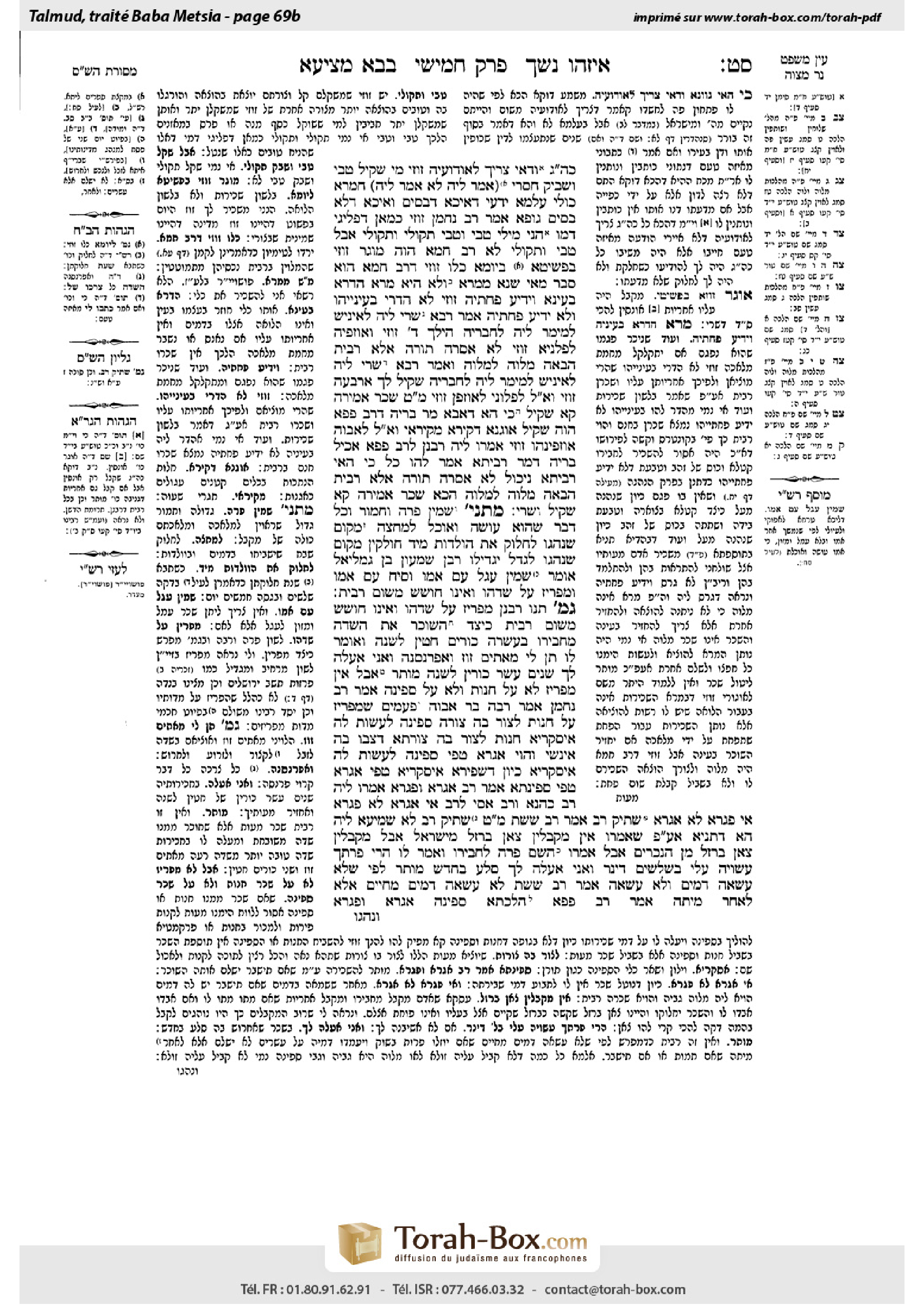
Bava Metzia 69b: Talmud study for Daf Yomi
Study the Talmud for Daf Yomi with scanned pages, Hebrew text, English translations from Sefaria and AI-generated French translations.
Passage selection and English or AI-generated French translation are available where the scan has annotations. Daf Study is independent of Torah-Box and Sefaria.
Browse Bava Metzia · בבא מציעא · All tractatesBava Metzia 69b text and translations
This page of Bava Metzia includes the Aramaic text, an English translation and an AI-generated French translation, alongside the scan above.
בבא מציעא ס״ט ב · Aramaic and Hebrew text
כְּהַאי גַּוְנָא וַדַּאי צְרִיךְ לְאוֹדוֹעֵיהּ: זוּזֵי, מִי שָׁקֵיל טָבֵי וְשָׁבֵיק חַסִּרֵי?
אֲמַר לֵיהּ: לָא. אֲמַר לֵיהּ: חַמְרָא, כּוּלֵּי עָלְמָא יָדְעִי דְּאִיכָּא דִּבְסִים וְאִיכָּא דְּלָא בְּסִים.
גּוּפָא, אָמַר רַב נַחְמָן: זוּזֵי, כְּמַאן דִּפְלִיגִי דָּמוּ. הָנֵי מִילֵּי טָבֵי וְטָבֵי, תְּקוּלֵי וּתְקוּלֵי. אֲבָל טָבֵי וּתְקוּלֵי – לָא.
רַב חָמָא הֲוָה מוֹגַר זוּזֵי בִּפְשִׁיטָא בְּיוֹמָא. כְּלוֹ זוּזֵי דְּרַב חָמָא. הוּא סָבַר: מַאי שְׁנָא מִמָּרָא? וְלָא הִיא מָרָא הָדְרָא בָּעֵינָא וִידִיעַ פְּחָתֵיהּ, זוּזֵי לָא הָדְרִי בְּעֵינַיְיהוּ וְלָא יְדִיעַ פְּחָתֵיהּ.
אָמַר רָבָא: שְׁרֵי לֵיהּ לְאִינִישׁ לְמֵימַר לֵיהּ לְחַבְרֵיהּ: הֵילָךְ אַרְבְּעָה זוּזֵי וְאוֹזְפֵיהּ לִפְלָנְיָא זוּזֵי, לֹא אָסְרָה תּוֹרָה אֶלָּא רִבִּית הַבָּאָה מִלֹּוֶה לְמַלְוֶה. וְאָמַר רָבָא: שְׁרֵי לֵיהּ לְאִינִישׁ לְמֵימַר לֵיהּ לְחַבְרֵיהּ ״שְׁקֹל לָךְ אַרְבְּעָה זוּזֵי וֶאֱמוֹר לֵיהּ לִפְלוֹנִי לְאוֹזֹפַן זוּזֵי״. מַאי טַעְמָא – שְׂכַר אֲמִירָה קָא שָׁקֵיל.
כִּי הָא דְּאַבָּא מָר בְּרֵיהּ דְּרַב פָּפָּא הֲוָה שָׁקֵיל אוּגְנָא דְקִירָא מִקִּירָאֵי, וַאֲמַר לֵיהּ לַאֲבוּהּ: אוֹזְפִינְהוּ זוּזֵי. אֲמַרוּ לֵיהּ רַבָּנַן לְרַב פָּפָּא: אָכֵיל בְּרֵיהּ דְּמָר רִבִּיתָא! אֲמַר לְהוּ: כֹּל כִּי הַאי רִבִּיתָא נֵיכוֹל, לֹא אָסְרָה תּוֹרָה אֶלָּא רִבִּית הַבָּאָה מִלֹּוֶה לְמַלְוֶה. הָכָא – שְׂכַר אֲמִירָה קָא שָׁקֵיל, וּשְׁרֵי.
מַתְנִי׳ שָׁמִין פָּרָה וַחֲמוֹר וְכׇל דָּבָר שֶׁהוּא עוֹשֶׂה וְאוֹכֵל לְמֶחֱצָה. מָקוֹם שֶׁנָּהֲגוּ לַחְלוֹק אֶת הַוְּלָדוֹת מִיָּד – חוֹלְקִין. מָקוֹם שֶׁנָּהֲגוּ לְגַדֵּל – יְגַדֵּילוּ.
רַבָּן שִׁמְעוֹן בֶּן גַּמְלִיאֵל אוֹמֵר: שָׁמִין עֵגֶל עִם אִמּוֹ, וּסְיָח עִם אִמּוֹ, וּמַפְרִיז עַל שָׂדֵהוּ, וְאֵינוֹ חוֹשֵׁשׁ מִשּׁוּם רִבִּית.
גְּמָ׳ תָּנוּ רַבָּנַן: מַפְרִיז עַל שָׂדֵהוּ וְאֵינוֹ חוֹשֵׁשׁ מִשּׁוּם רִבִּית, כֵּיצַד? הַשּׂוֹכֵר אֶת הַשָּׂדֶה מֵחֲבֵירוֹ בַּעֲשָׂרָה כּוֹרִים חִטִּין לְשָׁנָה, וְאוֹמֵר לוֹ: תֵּן לִי מָאתַיִם זוּז וַאֲפַרְנְסֶנָּה, וַאֲנִי אַעֲלֶה לְךָ שְׁנֵים עָשָׂר כּוֹרִין לְשָׁנָה – מוּתָּר.
אֲבָל אֵין מַפְרִיז לֹא עַל חֲנוּת וְלֹא עַל סְפִינָה.
אָמַר רַב נַחְמָן אָמַר רַבָּה בַּר אֲבוּהּ: פְּעָמִים שֶׁמַּפְרִיז עַל חֲנוּת לָצוֹר בָּהּ צוּרָה, סְפִינָה לַעֲשׂוֹת לָהּ אִיסְקַרְיָא. חֲנוּת לָצוֹר בָּהּ צוּרְתָּא: דְּצָבוּ בַּהּ אִינָשֵׁי וְהָוֵי אַגְרָא טְפֵי. סְפִינָה לַעֲשׂוֹת לָהּ אִיסְקַרְיָא: כֵּיוָן דְּשַׁפִּירָא אִיסְקַרְיָא טְפֵי – אַגְרָא טְפֵי.
סְפִינְתָּא, אָמַר רַב: אַגְרָא וּפַגְרָא. אֲמַרוּ לֵיהּ רַב כָּהֲנָא וְרַב אַסִּי לְרַב: אִי אַגְרָא – לָא פַּגְרָא, אִי פַּגְרָא – לָא אַגְרָא. שְׁתֵיק רַב.
אָמַר רַב שֵׁשֶׁת: מַאי טַעְמָא שְׁתֵיק רַב? לָא שְׁמִיעָא לֵיהּ הָא דְּתַנְיָא: אַף עַל פִּי שֶׁאָמְרוּ אֵין מְקַבְּלִין צֹאן בַּרְזֶל מִיִּשְׂרָאֵל, אֲבָל מְקַבְּלִין צֹאן בַּרְזֶל מִן הַגּוֹיִם. אֲבָל אָמְרוּ: הַשָּׁם פָּרָה לַחֲבֵירוֹ, וְאָמַר לוֹ: הֲרֵי פָּרָתְךָ עֲשׂוּיָה עָלַי בִּשְׁלֹשִׁים דִּינָר, וַאֲנִי אַעֲלֶה לְךָ סֶלַע בְּחֹדֶשׁ – מוּתָּר, לְפִי שֶׁלֹּא עֲשָׂאָהּ דָּמִים.
וְלֹא עֲשָׂאָהּ?! אָמַר רַב שֵׁשֶׁת: לֹא עֲשָׂאָהּ דָּמִים מֵחַיִּים, אֶלָּא לְאַחַר מִיתָה.
אָמַר רַב פָּפָּא, הִלְכְתָא: סְפִינָה אַגְרָא וּפַגְרָא.
Bava Metzia 69b · English translation
In a case like this it is certainly necessary to inform the litigant of the reasons for the decision. Although a judge is not always obligated to explain the reasons for his decision to the litigants, in a case like this, where there is room for suspicion, he must. Rav Pappa explained: Last year, when the other individual divided money, did he take the good coins and leave the deficient ones?
The Samaritan said to him: No, he simply divided the money without any particular consideration, and that was acceptable, as there is no difference between one coin and another. Rav Pappa said to him: With regard to wine, everyone knows that there is wine that is sweet and there is wine that is not sweet, so it is not equitable to simply divide the barrels evenly. Therefore, I ruled that you were not entitled to divide the wine without your partner’s knowledge.
The Gemara now returns to discuss the matter itself: Rav Naḥman said: Money is considered as if it were already divided and there is no need to actually divide it in the presence of both of them. The Gemara comments: This matter applies when he divided between good dinars and good dinars, or heavy dinars and heavy dinars, as then there is no need for evaluation. But if some of the coins were good and some were heavy, it is not permitted for him to divide them without informing the other party, as either one may have a preference for a particular type of coin.
§ The Gemara relates: Rav Ḥama would rent out dinars at a rate of one peshita, i.e., one-eighth of a dinar, per day for a dinar. He viewed this as rental of an item for use rather than as a loan. Ultimately, all of Rav Ḥama’s money was lost as divine punishment for violating the prohibition of interest (see 71a). The Gemara explains: He did this because he thought: In what way is it different from the rental of a hoe? He viewed the money as an item that can be rented for a fee. But that is not so, as the hoe returns to its owner as is, and its depreciation is known, but the dinars do not return as is, as a borrower does not return the same coins he borrowed, and their depreciation is not known. Therefore, this cannot be called a rental; it is a loan with interest.
Rava said: It is permitted for a person to say to another: Here are four dinars; go and lend money to so-and-so. Even though the lender earns a profit from the loan, it is not prohibited because the Torah prohibited only interest that comes directly from the borrower to the lender, but not that which comes via a third party. And Rava said: It is permitted for a person to say to another: Take four dinars for yourself and tell so-and-so to lend me money. The Gemara explains: What is the reason for this? It is permitted because he takes payment for talking to the lender, as these four dinars are a fee for the brokerage in arranging the loan.
This is similar to this situation where Abba Mar, son of Rav Pappa, would take pans of wax from wax manufacturers and tell his father: Lend them money. The Sages said to Rav Pappa: The Master’s son consumes interest, since the wax he receives is payment of interest for the loan. Rav Pappa said to them: We may consume any interest of this kind. It is totally permitted, as the Torah prohibited only interest that comes directly from the borrower to the lender. Here, he takes payment for talking, and this is permitted.
MISHNA: One may appraise a cow or a donkey or any item that generates revenue while it eats and give it to another to feed it and take care of it in exchange for one-half the profits, with the one who cares for the animal benefiting from the profits it generates during the period in which he raises it. Afterward, they divide the profit that accrues due to appreciation in the value of the animal and due to the offspring it produces. In a place where it is customary to divide the offspring immediately upon their birth, they divide them, and in a place where it is customary for the one who cared for the mother to raise the offspring for an additional period of time before dividing them, he shall raise them.
Rabban Shimon ben Gamliel says: One may appraise a calf together with its mother or a foal with its mother even though these young animals do not generate revenue while they eat. The costs of raising the young animal need not be considered. And one may inflate [umafriz] the rental fee paid for his field, and he need not be concerned with regard to the prohibition of interest, as the Gemara will explain.
GEMARA: The Sages taught: One may inflate the rental fee paid for his field, and he need not be concerned with regard to the prohibition of interest. How so? In the case of one who rents a field from another for the price of ten kor of wheat per year, and the renter says to the owner: Give me two hundred dinars as a loan and I will use it to cultivate the field and equip it by fertilizing it and hiring people to work in it, and then I will pay you twelve kor per year in addition to returning your two hundred dinars, this is permitted, as the two hundred dinars are viewed as a joint investment in improving the field, with the owner providing the capital and the renter providing the labor. The higher rental fee is therefore paid for a higher-quality field, and not as interest on the loan.
But one may not inflate the rental fee paid for a store or a ship. The renter cannot borrow money from the owner to purchase merchandise to sell in the store or transport in the ship and in return increase the rental fee. That is considered a loan with interest.
Rav Naḥman says that Rabba bar Avuh said: There are times when one may inflate the rental fee paid for a store, such as in a case where one needs money in order to paint a design on its walls, or in the case of a ship, where one needs money to fashion a new sail [iskarya]. The Gemara explains: It is permitted when the money is borrowed to invest in a store in order to paint a design on its walls, because people will want to come to the more attractive store to purchase, and the profits are thereby increased. Similarly, it is permitted when the money is to be used for a ship to fashion a sail, because the profits from the use of the ship are greater since the sail is improved. Therefore, in these cases the arrangement is an investment, similar to the case of the field, and not interest.
Since the subject of a ship was raised, the Gemara mentions a related statement of Rav. Rav said: For a ship, it is permitted to conduct a transaction where someone pays rent for the use of the ship and is also liable to pay for any damage caused to the ship. Rav Kahana and Rav Asi said to Rav: If he receives rent, then he should not receive payment for damage, and if he receives payment for damage, then he should not receive rent, as, if the ship is the responsibility of the renter, it is a loan, and if he pays rent for such a loan, it is interest. Rav was silent, and it appeared that he could not answer this question.
Rav Sheshet said: What is the reason that Rav was silent? Did he not hear that which is taught in a baraita: Even though the Sages said that one may not accept a guaranteed investment [tzon barzel] from a Jew, meaning one may not accept from a Jew animals to raise and receive one-half of the profits while also accepting full responsibility to pay the initial value of the animals in the event there is a loss, as this arrangement is deemed a loan with interest, but one may accept a guaranteed investment from gentiles, because there is no prohibition against paying them interest. But nevertheless, the Sages said: If one appraised a cow for another to raise and to divide the profits, and the one accepting the cow said to the cow’s owner: Your cow is evaluated for me at thirty dinars if I do not return it to you, and I will pay you a sela per month for the use of it, this is permitted, because he did not make it a matter of lending money.
The Gemara asks rhetorically: And did he not make it a matter of lending money? He most certainly did, as he obligated himself to pay for the cow if he does not return it, making the transaction into a loan, and therefore the payment of a sela per month should constitute interest. Rav Sheshet said: It means that he did not make it a matter of lending money while the cow was alive, meaning that he did not obligate himself to return this specific sum to him if the value of the cow decreased, but rather agreed to pay the set payment of thirty dinars only after its death. Therefore, the transaction was not a loan and the monthly payment is not interest. According to this baraita, the halakha should be the same in the case of a ship.
Rav Pappa said: In fact, the halakha is that in the case of a ship it is permitted to collect rent and payment for damage.
Bava Metzia 69b · Traduction française (IA)
Dans un cas tel que celui-ci, il est certainement nécessaire d'informer le litigeur des raisons de la décision. Bien qu'un juge ne soit pas toujours tenu d'expliquer les raisons de sa décision aux parties, dans un cas tel que celui-ci, où il y a lieu de soupçon, il le doit. Rav Pappa expliqua : L'an dernier, lorsque l'autre individu a divisé l'argent, a-t-il pris les pièces bonnes et laissé les déficientes ?
Le Samaritain lui répondit : Non, il a simplement divisé l'argent sans aucune considération particulière, et cela était acceptable, car il n'y a pas de différence entre une pièce et une autre. Rav Pappa dit à lui : En ce qui concerne le vin, tout le monde sait qu'il y a du vin sucré et du vin non sucré, donc il n'est pas équitable de simplement diviser les barriques de manière égale. Par conséquent, j'ai décidé que vous n'aviez pas le droit de diviser le vin sans l'accord de votre partenaire.
La Guemara revient maintenant à discuter de la question elle-même : Rav Naḥman dit : L'argent est considéré comme s'il était déjà divisé et il n'est pas nécessaire de le diviser effectivement en présence des deux parties. La Guemara commente : Cette question s'applique lorsque l'on a divisé entre des dinars bons et des dinars bons, ou des dinars lourds et des dinars lourds, car alors il n'y a pas besoin d'évaluation. Mais si certaines des pièces étaient bonnes et d'autres lourdes, il n'est pas permis de les diviser sans informer l'autre partie, car l'une ou l'autre pourrait avoir une préférence pour un type particulier de pièce.
§ La Guemara rapporte : Rav Ḥama louait des dinars à un taux de une peshita, c'est-à-dire un huitième de dinar, par jour pour un dinar. Il considérait cela comme un prêt d'objet à usage plutôt qu'un prêt. Finalement, toute l'argent de Rav Ḥama fut perdu en tant que punition divine pour avoir violé l'interdiction d'intérêt (voir 71a). La Guemara explique : Il a fait cela en pensant : De quelle manière est-ce différent du louage d'une faux ? Il considérait l'argent comme un objet pouvant être loué contre une rémunération. Mais cela n'est pas le cas, car la faux revient à son propriétaire telle quelle, et sa dépréciation est connue, tandis que les dinars ne reviennent pas tels qu'ils étaient, car un emprunteur ne rend pas les mêmes dinars qu'il a empruntés, et leur dépréciation n'est pas connue. Par conséquent, cela ne peut pas être appelé un louage ; c'est un prêt à intérêt.
Rava dit : Il est permis à une personne de dire à une autre : Ici sont quatre dinars ; va et prête de l'argent à tel ou tel. Bien que le prêteur gagne un profit du prêt, cela n'est pas interdit, car la Torah interdit uniquement l'intérêt qui vient directement du prêteur au prêteur, mais pas celui qui vient via un tiers. Et Rava dit : Il est permis à une personne de dire à une autre : Prends quatre dinars pour toi-même et dis à tel ou tel de me prêter de l'argent. La Guemara explique : Quelle est la raison de cela ? Cela est permis car il prend une rémunération pour parler au prêteur, car ces quatre dinars sont une rémunération pour la médiation dans l'obtention du prêt.
Cela ressemble à cette situation où Abba Mar, fils de Rav Pappa, prenait des moules de cire des fabricants de cire et disait à son père : Prête-moi de l'argent. Les Sages dirent à Rav Pappa : Le fils du Maître consomme de l'intérêt, car la cire qu'il reçoit est le paiement de l'intérêt pour le prêt. Rav Pappa dit à eux : Nous pouvons consommer tout intérêt de ce genre. C'est totalement permis, car la Torah interdit uniquement l'intérêt qui vient directement du prêteur au prêteur. Ici, il prend une rémunération pour parler, et cela est permis.
MICHNA : On peut évaluer un taureau ou un âne ou tout objet qui génère des revenus pendant qu'il mange et le donner à un autre pour qu'il le nourrisse et le prenne soin, en échange de la moitié des profits, avec celui qui s'occupe de l'animal profitant des profits qu'il génère pendant la période où il le nourrit. Ensuite, ils divisent les profits qui s'accumulent en raison de l'augmentation de la valeur de l'animal et en raison des petits qui en naissent. Dans un lieu où il est coutume de diviser les petits dès leur naissance, ils les divisent, et dans un lieu où il est coutume que celui qui a pris soin de la mère élève les petits pendant une période supplémentaire avant de les diviser, il doit les élever.
Rabban Shimon ben Gamliel dit : On peut évaluer un veau avec sa mère ou un poulain avec sa mère même si ces jeunes animaux ne génèrent pas de revenus pendant qu'ils mangent. Les coûts d'élevage du jeune animal n'ont pas besoin d'être considérés. Et on peut augmenter [umafriz] le loyer payé pour son champ, et il n'a pas besoin de s'inquiéter concernant l'interdiction d'intérêt, comme l'expliquera la Guemara.
GUEMARA : Les Sages enseignèrent : On peut augmenter le loyer payé pour son champ, et il n'a pas besoin de s'inquiéter concernant l'interdiction d'intérêt. Comment cela est-il possible ? Dans le cas d'une personne qui loue un champ à un autre pour le prix de dix kor de blé par an, et le locataire dit au propriétaire : Donne-moi deux cents dinars comme prêt et je les utiliserai pour cultiver le champ et l'équiper en fertilisant et en embauchant des personnes pour travailler dedans, et ensuite je te paierai douze kor par an en plus de te rendre tes deux cents dinars, cela est permis, car les deux cents dinars sont vus comme un investissement commun pour améliorer le champ, avec le propriétaire fournissant le capital et le locataire fournissant le travail. Le loyer plus élevé est donc payé pour un champ de meilleure qualité, et non comme intérêt sur le prêt.
Mais on ne peut pas augmenter le loyer payé pour un magasin ou un bateau. Le locataire ne peut pas emprunter de l'argent au propriétaire pour acheter des marchandises à vendre dans le magasin ou pour transporter dans le bateau, et en échange augmenter le loyer. Cela est considéré comme un prêt à intérêt.
Rav Naḥman dit que Rabba bar Avuh a dit : Il y a des moments où l'on peut augmenter le loyer payé pour un magasin, par exemple dans le cas où l'on a besoin d'argent pour peindre un décor sur ses murs, ou dans le cas d'un bateau, où l'on a besoin d'argent pour fabriquer un nouveau voile [iskarya]. La Guemara explique : C'est permis lorsque l'argent emprunté est investi dans un magasin pour peindre un décor sur ses murs, car les gens veulent venir dans le magasin plus attrayant pour acheter, et les profits augmentent ainsi. De même, c'est permis lorsque l'argent est utilisé pour un bateau afin de fabriquer un voile, car les profits issus de l'utilisation du bateau sont plus élevés puisque le voile est amélioré. Ainsi, dans ces cas, l'arrangement est un investissement, similaire au cas d'un champ, et non un intérêt.
Puisque la question du bateau a été soulevée, la Guemara mentionne une déclaration connexe de Rav. Rav a dit : Pour un bateau, il est permis d'effectuer une transaction où l'on paie un loyer pour l'utilisation du bateau et qu'on est également tenu de payer pour tout dommage causé au bateau. Rav Kahana et Rav Asi ont dit à Rav : Si l'on reçoit un loyer, alors l'on ne devrait pas recevoir de paiement pour les dommages, et si l'on reçoit un paiement pour les dommages, alors l'on ne devrait pas recevoir un loyer, car, si le bateau est la responsabilité du locataire, c'est un prêt, et si l'on paie un intérêt pour un tel prêt, c'est de l'intérêt. Rav a gardé le silence, et il semblait qu'il ne pouvait pas répondre à cette question.
Rav Sheshet a dit : Pourquoi Rav a-t-il gardé le silence ? N'a-t-il pas entendu ce qui est enseigné dans une baraïta : Même si les Sages ont dit qu'on ne peut pas accepter un investissement garanti [tzon barzel] d'un Juif, c'est-à-dire qu'on ne peut pas accepter d'animaux à élever et de recevoir la moitié des profits tout en acceptant pleinement la responsabilité de payer la valeur initiale des animaux en cas de perte, car cette disposition est considérée comme un prêt à intérêt, mais on peut accepter un investissement garanti d'un non-Juif, car il n'y a pas de prohibition contre de payer un intérêt à eux. Cependant, les Sages ont dit : Si l'on a évalué un taureau pour un autre afin de le faire élever et de partager les profits, et que celui qui accepte le taureau a dit à l'propriétaire du taureau : Votre taureau est évalué pour moi à trente dinars si je ne vous le rends pas, et je vous paierai un sela par mois pour l'utilisation de celui-ci, cela est permis, car il n'a pas rendu la transaction un prêt.
La Guemara pose une question rhétorique : Et n'a-t-il pas rendu la transaction un prêt ? Il l'a certainement fait, car il s'est engagé à payer pour le taureau s'il ne le rendait pas, transformant ainsi la transaction en un prêt, et donc le paiement d'un sela par mois devrait constituer un intérêt. Rav Sheshet a dit : Cela signifie qu'il n'a pas rendu la transaction un prêt pendant que le taureau était vivant, c'est-à-dire qu'il n'a pas s'engage à lui rendre cette somme spécifique s'il y avait une baisse de valeur du taureau, mais plutôt qu'il a convenu de payer la somme fixe de trente dinars seulement après sa mort. Ainsi, la transaction n'était pas un prêt et le paiement mensuel n'était pas un intérêt. Selon cette baraïta, la halakha devrait être la même dans le cas d'un bateau.
Rav Pappa a dit : En réalité, la halakha est que dans le cas d'un bateau, il est permis de collecter un loyer et un paiement pour les dommages.
Traduction française générée par IA à partir de l’édition anglaise de Sefaria. Vérifie toujours un passage avec le texte source.
Text from Sefaria: William Davidson Edition - Vocalized Aramaic (CC BY NC); William Davidson Edition - English (CC BY NC).