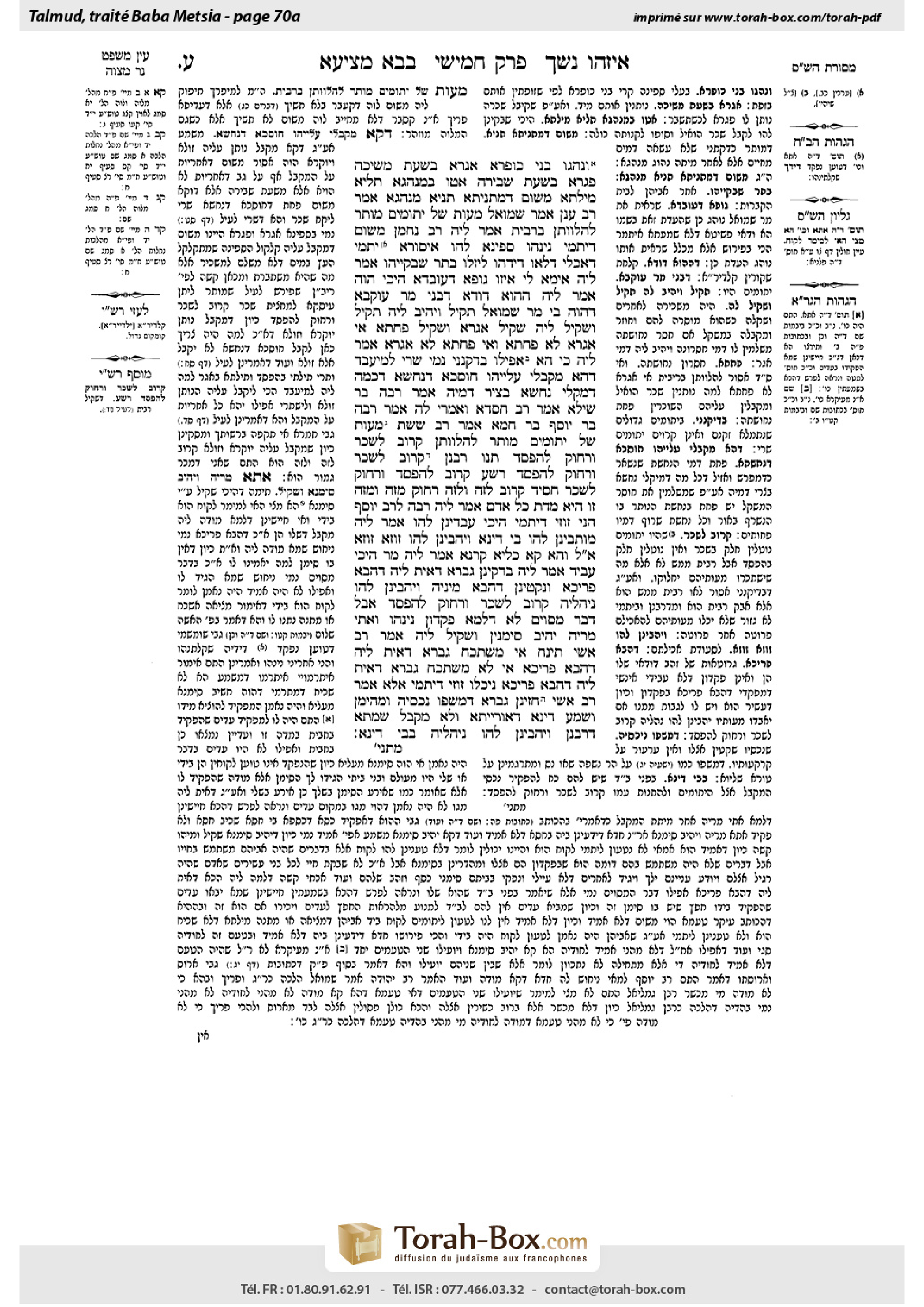
Bava Metzia 70a: Talmud study for Daf Yomi
Study the Talmud for Daf Yomi with scanned pages, Hebrew text, English translations from Sefaria and AI-generated French translations.
Passage selection and English or AI-generated French translation are available where the scan has annotations. Daf Study is independent of Torah-Box and Sefaria.
Browse Bava Metzia · בבא מציעא · All tractatesBava Metzia 70a text and translations
This page of Bava Metzia includes the Aramaic text, an English translation and an AI-generated French translation, alongside the scan above.
בבא מציעא ע׳ א · Aramaic and Hebrew text
וְנָהֲגוּ בְּנֵי כוּפְרָא אַגְרָא בִּשְׁעַת מְשִׁיכָה, פַּגְרָא בִּשְׁעַת שְׁבִירָה. אַטּוּ בְּמִנְהָגָא תַּלְיָא מִילְּתָא? מִשּׁוּם דְּמַתְנִיתָא תַּנְיָא – מִנְהָגָא.
אָמַר רַב עָנָן אָמַר שְׁמוּאֵל: מָעוֹת שֶׁל יְתוֹמִים מוּתָּר לְהַלְווֹתָן בְּרִבִּית. אֲמַר לֵיהּ רַב נַחְמָן: מִשּׁוּם דְּיַתְמֵי נִינְהוּ (סָפֵינָא) [סָפֵינַן] לְהוּ אִיסּוּרָא?! יַתְמֵי דְּאָכְלִי דְּלָאו דִּידְהוּ לֵיזְלוּ בָּתַר שָׁבְקַיְיהוּ! אֲמַר לֵיהּ: אֵימָא לִי אִיזִי גּוּפָא דְעוֹבָדָא הֵיכִי הֲוָה?
אֲמַר לֵיהּ: הָהוּא דּוּדָא דִּבְנֵי מָר עוּקְבָא דַּהֲוָה בֵּי מָר שְׁמוּאֵל, תָּקֵיל וְיָהֵיב לֵיהּ, תָּקֵיל וְשָׁקֵיל לֵיהּ. שָׁקֵיל אַגְרָא וְשָׁקֵיל פַּחֲתָא. אִי אַגְרָא – לָא פַּחֲתָא, וְאִי פַּחֲתָא – לָא אַגְרָא.
אֲמַר לֵיהּ: כִּי הָא – אֲפִילּוּ בְּדִקְנָנֵי נָמֵי שְׁרֵי לְמִיעְבַּד, דְּהָא מְקַבְּלִי עֲלַיְיהוּ חוּסְכָא דִנְחָשָׁא, דְּכַמָּה דְּמִקְּלֵי נְחָשָׁא בְּצִיר דְּמֵיהּ.
אָמַר רַבָּה בַּר שֵׁילָא אָמַר רַב חִסְדָּא, וְאָמְרִי לַהּ, אָמַר רַבָּה בַּר יוֹסֵף בַּר חָמָא אָמַר רַב שֵׁשֶׁת: מָעוֹת שֶׁל יְתוֹמִים מוּתָּר לְהַלְווֹתָן קָרוֹב לְשָׂכָר וְרָחוֹק לְהֶפְסֵד.
תָּנוּ רַבָּנַן: קָרוֹב לְשָׂכָר וְרָחוֹק לְהֶפְסֵד – רָשָׁע. קָרוֹב לְהֶפְסֵד וְרָחוֹק לְשָׂכָר – חָסִיד. קָרוֹב לָזֶה וְלָזֶה, רָחוֹק מִזֶּה וּמִזֶּה – זוֹ הִיא מִדַּת כׇּל אָדָם.
אֲמַר לֵיהּ רַבָּה לְרַב יוֹסֵף: הָנֵי זוּזֵי דְיַתְמֵי הֵיכִי עָבְדִינַן לְהוּ? אֲמַר לֵיהּ: מוֹתְבִינַן לְהוּ בֵּי דִינָא וְיָהֲבִינַן לְהוּ זוּזָא זוּזָא. אֲמַר לֵיהּ: וְהָא קָא כָלְיָא קַרְנָא.
אֲמַר לֵיהּ מָר: הֵיכִי עָבֵיד? אֲמַר לֵיהּ: בָּדְקִינַן גַּבְרָא דְּאִית לֵיהּ דַּהֲבָא פְּרִיכָא, וְנָקְטִינַן דַּהֲבָא מִינֵּיהּ, וְיָהֲבִינַן לְהוּ נִיהֲלֵיהּ קָרוֹב לְשָׂכָר וְרָחוֹק לְהֶפְסֵד. אֲבָל דָּבָר מְסוּיָּם – לָא, דִּלְמָא פִּקָּדוֹן נִינְהוּ, וְאָתֵי מָרֵיהּ יָהֵיב סִימָנִין וְשָׁקֵיל לֵיהּ.
אָמַר רַב אָשֵׁי: תִּינַח אִי מִשְׁתְּכַח גַּבְרָא דְּאִית לֵיהּ דַּהֲבָא פְּרִיכָא, אִי לָא מִשְׁתְּכַח גַּבְרָא דְּאִית לֵיהּ דַּהֲבָא פְּרִיכָא נֵיכְלוּ זוּזֵי דְיַתְמֵי? אֶלָּא אָמַר רַב אָשֵׁי: חָזֵינַן גַּבְרָא דִּמְשַׁפּוּ נִכְסֵיהּ, וּמְהֵימַן, וְשָׁמַע דִּינָא דְאוֹרָיְיתָא וְלָא מְקַבֵּל שַׁמְתָּא דְרַבָּנַן, וְיָהֲבִינַן לְהוּ נִיהֲלֵיהּ בְּבֵי דִינָא.
Bava Metzia 70a · English translation
And the men of pitch [benei kufera], i.e., sailors, are accustomed to paying rent at the time of pulling and paying for damage at the time of breakage. The Gemara asks: Is that to say that this matter depends on custom? Is there no halakha with regard to this issue? The Gemara answers: Because the baraita taught this, it is an acceptable custom and therefore permitted.
§ Rav Anan says that Shmuel says: It is permitted to lend with interest money belonging to orphans. Since the orphans are minors and exempt from mitzvot, the prohibition against taking interest does not apply to them. Rav Naḥman said to him: Because they are orphans we may feed them prohibited items? In harsher language, he added: Orphans that consume that which is not theirs will follow their deceased parent to the graveyard. It cannot be that this was Shmuel’s intention. Therefore, Rav Naḥman said to Rav Anan: Say to me now, what was the actual incident? What exactly did you hear Shmuel say?
Rav Anan said to him: There was a certain kettle that belonged to the children of Mar Ukva, who were minor orphans, and this kettle was in the house of Mar Shmuel, who would rent it out on behalf of the orphans. Mar Shmuel would weigh it and then give it out, and when the renter returned it Mar Shmuel would weigh it and take it back, and he would take a rental fee for use of the kettle and would also take payment for depreciation of the kettle due to the reduction in the weight of the metal. In general, the halakha is that if he takes a rental fee, he should not take payment for depreciation, and if he takes payment for depreciation, this means the kettle was a loan, and therefore he should not take a rental fee, as by taking both, it is interest. Nevertheless, Mar Shmuel did so with the kettle belonging to Mar Ukva’s children, which means he rendered it permitted for the orphans to take interest.
Rav Naḥman said to him: There is no proof from a case like this, as even for bearded ones, i.e., adults, it is permitted to act in this manner, as the owners accept upon themselves the depreciation of the copper, as the more the copper is burned, the more the value of the pot is diminished. Since this is so, the renters pay for the visible depreciation as measured by the reduction in the weight of the vessel, and therefore this arrangement is certainly permitted.
Rabba bar Sheila says that Rav Ḥisda says, and some say that Rabba bar Yosef bar Ḥama says that Rav Sheshet says: It is permitted to lend the money of orphans to be invested in a business venture that is close to profit and far from loss. Since this is only a hint of interest (see 64b), the relevant prohibition is a matter of rabbinic law, and the Sages rendered it permitted in the case of minor orphans, in order that their inheritance be preserved for them.
The Sages taught: If there is a joint venture in which the conditions for the investor are close to profit and far from loss, then the investor is a wicked person, as this is similar to a loan with interest. If the conditions for the investor are close to loss and far from profit, then he is a pious person, as he accepts additional restrictions upon himself in order to be absolutely sure he is not taking interest. If it is close to this and to that or far from this and from that, this is the quality of every person who acts in accordance with halakha.
Rabba said to Rav Yosef: When we are entrusted with this money belonging to orphans, what do we do with it? What is the halakhically appropriate way to manage these funds on behalf of the orphans so that they do not squander or lose their inheritance? Rav Yosef said to him: We set up a special court that holds the money for them, and we instruct the court to give it to them dinar by dinar, according to their needs. Rabba said to him: But if the estate is managed in that manner, the principal, meaning the estate itself, will be depleted, and therefore the court will not be acting as suitable guardians for the orphans, as they will not be properly administering their estate.
Rav Yosef said to him: What does the Master do in such a case? Rabba said to him: We look for a man who has scraps of gold, and we purchase the gold from him and then we give it back to him in a joint business venture with terms that are close to profit and far from loss. The Gemara explains what Rabba says: We specifically buy scraps of gold, but we do not buy a specific item, meaning a finished gold item, as perhaps it is a deposit in the possession of the one holding it and the owner will come and provide distinguishing marks and take it, and then the orphans will suffer a loss.
Rav Ashi said: This works out well if a man is found who has scraps of gold. But if no man is found who has scraps of gold, shall the money of the orphans be depleted? There is a possibility that the extra precaution taken to avoid the appearance of interest may lead to a loss for the orphans. Rather, Rav Ashi said: We look for a man whose properties are quiet, meaning that there is no claim disputing his ownership of them, and who is a trustworthy individual who listens to and obeys the laws of the Torah and is not subject to excommunication by the Sages, meaning that he is known as one who obeys the court’s instructions willingly without having to be coerced, and we give him this money in court as a joint business venture with terms that are close to profit and far from loss, and in this way the orphans’ money can be invested in a safe and profitable manner.
Bava Metzia 70a · Traduction française (IA)
Et les hommes de cire [benei kufera], c'est-à-dire les marins, sont habitués à payer un loyer au moment de l'entraînement et à réparer les dommages au moment de la casse. La Guemara demande : Est-ce que cela signifie que cette affaire dépend de la coutume ? N'y a-t-il pas une halakha concernant cette question ? La Guemara répond : Puisque la baraïta a enseigné cela, c'est une coutume acceptable et donc permise.
§ Rav Anan dit que Shmuel dit : Il est permis de prêter de l'argent appartenant aux orphelins avec intérêt. Puisque les orphelins sont des mineurs et dispensés des mitsvot, l'interdiction de prendre intérêt ne s'applique pas à eux. Rav Naḥman lui dit : Parce qu'ils sont orphelins, pouvons-nous nourrir des choses interdites ? En langage plus dur, il ajouta : Les orphelins qui consomment ce qui n'est pas leur propriété suivront leur père décédé au cimetière. Il ne peut pas être que cela fût l'intention de Shmuel. Par conséquent, Rav Naḥman dit à Rav Anan : Dis-moi maintenant, quel était l'incident exact ? Quel était exactement ce que tu as entendu dire par Shmuel ?
Rav Anan dit à lui : Il y avait une certaine marmite appartenant aux enfants de Mar Ukva, qui étaient des orphelins mineurs, et cette marmite était chez Mar Shmuel, qui la louait à leur place. Mar Shmuel pesait la marmite avant de la donner et la pesait à nouveau lorsqu'elle était rendue, et il prenait un loyer pour l'usage de la marmite ainsi qu'un paiement pour la dépréciation de la marmite en raison de la réduction du poids du métal. En général, la halakha est que s'il prend un loyer, il ne doit pas prendre un paiement pour la dépréciation, et s'il prend un paiement pour la dépréciation, cela signifie que la marmite est un prêt, et donc il ne doit pas prendre un loyer, car prendre les deux est de l'intérêt. Néanmoins, Mar Shmuel agissait ainsi avec la marmite appartenant aux enfants de Mar Ukva, ce qui signifie qu'il la rendait permise pour que les orphelins prennent de l'intérêt.
Rav Naḥman dit à lui : Il n'y a pas de preuve dans un cas comme celui-ci, car même pour les hommes barbus, c'est-à-dire les adultes, il est permis d'agir ainsi, car les propriétaires acceptent de leur propre volonté la dépréciation du cuivre, car plus le cuivre brûle, plus la valeur de la marmite diminue. Puisque c'est ainsi, les locataires paient pour la dépréciation visible mesurée par la réduction du poids du récipient, et donc cette disposition est certainement permise.
Rabba bar Sheila dit que Rav Ḥisda dit, et certains disent que Rabba bar Yosef bar Ḥama dit que Rav Sheshet dit : Il est permis de prêter l'argent des orphelins pour qu'il soit investi dans un projet commercial qui est proche du profit et loin de la perte. Puisque cela n'est qu'une indication d'intérêt (voir 64b), l'interdiction pertinente est une question de droit rabbinique, et les Sages l'ont rendu permis dans le cas des orphelins mineurs, afin que leur héritage soit préservé pour eux.
Les Sages enseignèrent : Si un projet commun existe dans lequel les conditions pour l'investisseur sont proches du profit et loin de la perte, alors l'investisseur est un mauvais homme, car cela ressemble à un prêt avec intérêt. Si les conditions pour l'investisseur sont proches de la perte et loin du profit, alors il est un homme pieux, car il accepte des restrictions supplémentaires sur lui-même afin d'être absolument sûr qu'il ne prend pas d'intérêt. Si c'est proche de cela et de cela ou loin de cela et de cela, cela est la qualité de chaque personne qui agit selon la halakha.
Rabba dit à Rav Yosef : Quand nous sommes chargés de cette somme appartenant aux orphelins, que faisons-nous avec elle ? Quelle est la manière halakhiquement appropriée de gérer ces fonds au nom des orphelins afin qu'ils ne gaspillent pas leur héritage ni ne le perdent ? Rav Yosef dit à lui : Nous établissons un tribunal spécial qui tient la somme pour eux, et nous instruisons le tribunal de leur donner l'argent pièce par pièce, selon leurs besoins. Rabba dit à lui : Mais si l'administration est faite ainsi, le principal, c'est-à-dire l'actif lui-même, sera épuisé, et donc le tribunal ne sera pas un bon gardien pour les orphelins, car ils ne géreront pas correctement leur patrimoine.
Rav Yosef dit à lui : Que fait le Maître dans un cas comme celui-ci ? Rabba dit à lui : Nous cherchons un homme qui a des morceaux d'or, et nous achetons l'or de lui, puis nous le donnons à nouveau à lui dans un projet commun avec des conditions proches du profit et loin de la perte. La Guemara explique ce que dit Rabba : Nous achetons spécifiquement des morceaux d'or, mais nous n'achetons pas un objet spécifique, c'est-à-dire un objet en or fini, car peut-être c'est un dépôt en possession de celui qui le tient et le propriétaire viendra et fournira des marques distinctives et le prendra, et alors les orphelins subiront une perte.
Rav Ashi dit : Cela fonctionne bien si l'on trouve un homme qui possède des morceaux d'or. Mais si aucun homme n'est trouvé qui possède des morceaux d'or, devra-t-on permettre que l'argent des orphelins soit épuisé ? Il y a une possibilité que la précaution supplémentaire prise pour éviter l'apparence d'intérêt entraîne une perte pour les orphelins. Par conséquent, Rav Ashi dit : Nous cherchons un homme dont les biens sont tranquilles, c'est-à-dire qu'il n'y a pas de réclamation contestant sa propriété, et qui est une personne de confiance, qui écoute et obéit aux lois de la Torah et n'est pas sujet à l'excommunication par les Sages, c'est-à-dire qu'il est connu comme celui qui obéit volontairement aux instructions du tribunal sans avoir à être contraint, et nous lui donnons cet argent en tribunal comme un projet commun avec des conditions proches du profit et loin de la perte, et ainsi l'argent des orphelins peut être investi de manière sûre et rentable.
Traduction française générée par IA à partir de l’édition anglaise de Sefaria. Vérifie toujours un passage avec le texte source.
Text from Sefaria: William Davidson Edition - Vocalized Aramaic (CC BY NC); William Davidson Edition - English (CC BY NC).