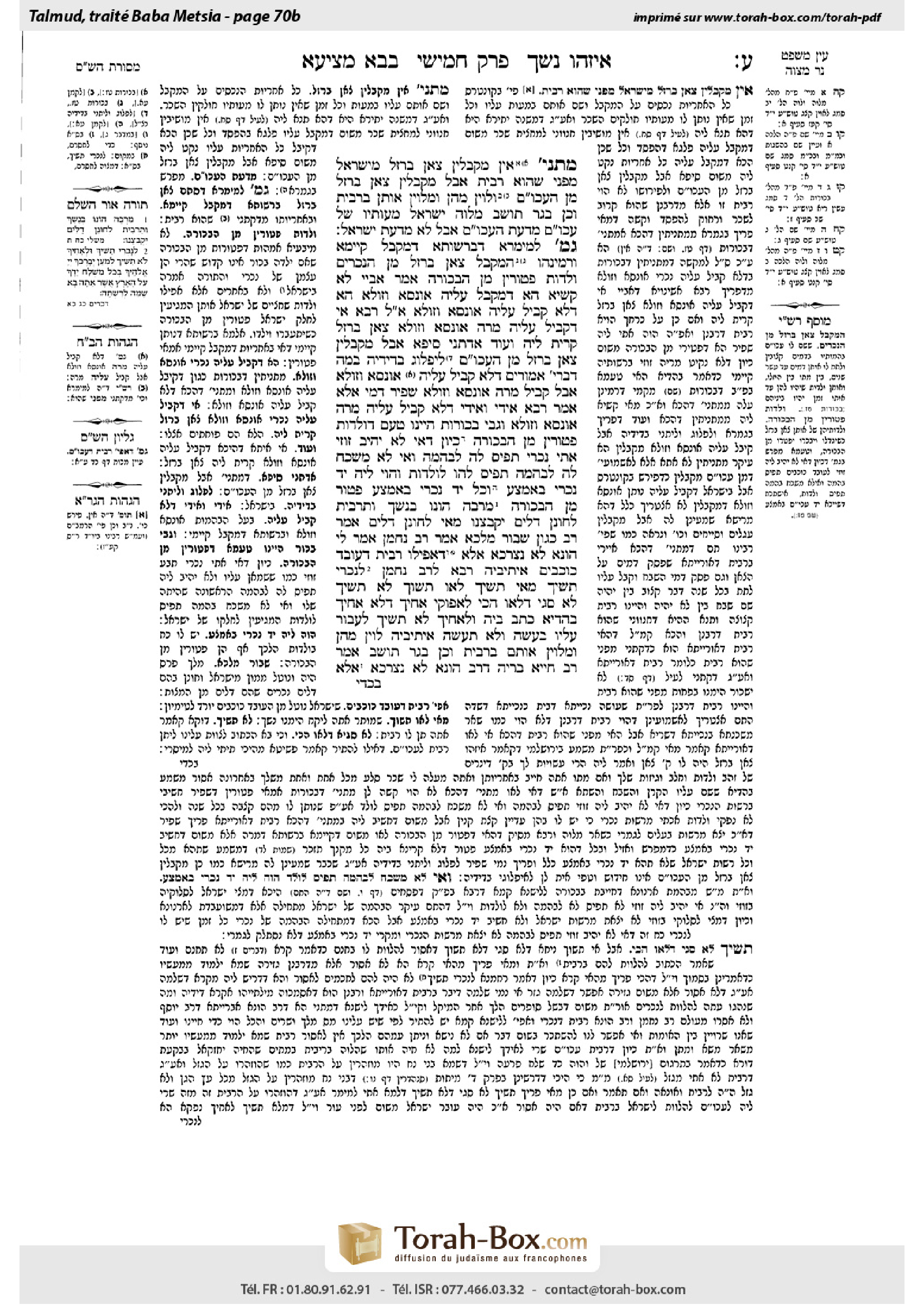
Bava Metzia 70b: Talmud study for Daf Yomi
Study the Talmud for Daf Yomi with scanned pages, Hebrew text, English translations from Sefaria and AI-generated French translations.
Passage selection and English or AI-generated French translation are available where the scan has annotations. Daf Study is independent of Torah-Box and Sefaria.
Browse Bava Metzia · בבא מציעא · All tractatesBava Metzia 70b text and translations
This page of Bava Metzia includes the Aramaic text, an English translation and an AI-generated French translation, alongside the scan above.
בבא מציעא ע׳ ב · Aramaic and Hebrew text
מַתְנִי׳ אֵין מְקַבְּלִין צֹאן בַּרְזֶל מִיִּשְׂרָאֵל – מִפְּנֵי שֶׁהוּא רִבִּית. אֲבָל מְקַבְּלִין צֹאן בַּרְזֶל מִן הַגּוֹיִם,
וְלֹוִין מֵהֶן וּמַלְוִין אוֹתָן בְּרִבִּית. וְכֵן בְּגֵר תּוֹשָׁב. מַלְוֶה יִשְׂרָאֵל מְעוֹתָיו שֶׁל נׇכְרִי – מִדַּעַת הַנׇּכְרִי, אֲבָל לֹא מִדַּעַת יִשְׂרָאֵל.
גְּמָ׳ לְמֵימְרָא דְּבִרְשׁוּתָא דִּמְקַבֵּל קָיְימָא? וּרְמִינְהוּ: הַמְקַבֵּל צֹאן בַּרְזֶל מִן הַגּוֹיִם – וְלָדוֹת פְּטוּרִין מִן הַבְּכוֹרָה!
אָמַר אַבָּיֵי, לָא קַשְׁיָא: הָא דִּמְקַבֵּל עֲלֵיהּ אוּנְסָא וְזוֹלָא, הָא דְּלָא קַבֵּיל עֲלֵיהּ אוּנְסָא וְזוֹלָא.
אֲמַר לֵיהּ רָבָא: אִי דְּקַבֵּיל עֲלֵיהּ מָרַהּ אוּנְסָא וְזוֹלָא – צֹאן בַּרְזֶל קָרֵית לֵיהּ?
וְעוֹד אַדְּתָנֵי סֵיפָא: אֲבָל מְקַבְּלִין צֹאן בַּרְזֶל מִן הַגּוֹיִם לִיפְלוֹג בְּדִידֵיהּ: בַּמֶּה דְּבָרִים אֲמוּרִים – דְּלָא קַבֵּיל עֲלֵיהּ אוּנְסָא וְזוֹלָא, אֲבָל קַבֵּיל מָרַהּ אוּנְסָא וְזוֹלָא – שַׁפִּיר דָּמֵי!
אֶלָּא אָמַר רָבָא: אִידֵּי וְאִידֵּי דְּלָא קַבֵּיל עֲלֵיהּ מָרַהּ אוּנְסָא וְזוֹלָא, וְגַבֵּי בְּכוֹרוֹת הַיְינוּ טַעַם דִּוְלָדוֹת פְּטוּרִין מִן הַבְּכוֹרָה: כֵּיוָן דְּאִי לָא יָהֵיב זוּזֵי, אָתֵי גּוֹי תָּפֵיס לַהּ לִבְהֵמָה. וְאִי לָא מַשְׁכַּח לַהּ לִבְהֵמָה, תָּפֵיס לְהוּ לִוְלָדוֹת, וְהָוֵי לַיהּ יַד גּוֹי בָּאֶמְצַע.
וְכׇל יָד גּוֹי בָּאֶמְצַע – פָּטוּר מִן הַבְּכוֹרָה.
״מַרְבֶּה הוֹנוֹ בְּנֶשֶׁךְ וְתַרְבִּית לְחוֹנֵן דַּלִּים יִקְבְּצֶנּוּ״. מַאי לְחוֹנֵן דַּלִּים? אָמַר רַב: כְּגוֹן שַׁבּוּר מַלְכָּא.
אָמַר רַב נַחְמָן, אָמַר לִי הוּנָא: לֹא נִצְרְכָה אֶלָּא דַּאֲפִילּוּ רִבִּית דְּגוֹי. אֵיתִיבֵיהּ רָבָא לְרַב נַחְמָן: ״לַנׇּכְרִי תַשִּׁיךְ״, מַאי תַשִּׁיךְ – לָאו תִּשּׁוֹךְ? לָא, תַּשִּׁיךְ.
לָא סַגִּי דְּלָאו הָכִי? לְאַפּוֹקֵי אָחִיךָ דְּלָא.
אָחִיךָ בְּהֶדְיָא כְּתִב בֵּיהּ: ״וּלְאָחִיךְ לֹא תַשִּׁיךְ״! לַעֲבוֹר עָלָיו בַּעֲשֵׂה וְלֹא תַעֲשֶׂה.
אֵיתִיבֵיהּ: לֹוִין מֵהֶן וּמַלְוִין אוֹתָם בְּרִבִּית, וְכֵן בְּגֵר תּוֹשָׁב! אָמַר רַב חִיָּיא בְּרֵיהּ דְּרַב הוּנָא: לֹא נִצְרְכָה אֶלָּא
Bava Metzia 70b · English translation
MISHNA: One may not accept from a Jew sheep to raise or other items to care for as a guaranteed investment, in which the terms of the transaction dictate that the one accepting the item takes upon himself complete responsibility to repay its value in the event of depreciation or loss, but receives only part of the profit. This is because it is a loan, as the principal is fixed and always returned to the owner, and any additional sum the owner receives is interest. But one may accept a guaranteed investment from gentiles, as there is no prohibition of interest in transactions with them.
And one may borrow money from them and one may lend money to them with interest. And similarly, with regard to a gentile who resides in Eretz Yisrael and observes the seven Noahide mitzvot [ger toshav], one may borrow money from him with interest and lend money to him with interest, since he is not a Jew. Also, a Jew may serve as a middleman and lend a gentile’s money to another Jew with the knowledge of the gentile, but not with the knowledge of a Jew, i.e., the middleman himself, as the Gemara will explain.
GEMARA: With regard to the ruling that a guaranteed investment is considered a loan with interest, the Gemara asks: Is this to say that the guaranteed investment stands in the possession of the recipient, i.e., the recipient is viewed as its owner? And the Gemara raises a contradiction from a mishna (Bekhorot 16a): In the case of one who accepts from gentiles an animal as a guaranteed investment, the offspring are exempt from the halakhot of a firstborn. This exemption apparently proves that the sheep still legally belong to the gentile owner.
Abaye said: This is not difficult. That case, referring to the mishna in Bekhorot, is where the gentile owner of the sheep accepts upon himself the responsibility for losses due to an accident or depreciation in the market value, and that is why the sheep are considered to still belong to him. And this case, referring to the mishna here, is where the owner did not accept upon himself responsibility for losses due to an accident or depreciation. Therefore, the guaranteed investment stands in the possession of the recipient.
Rava said to Abaye: If the owner accepted upon himself responsibility for losses due to an accident or depreciation, can you call it a guaranteed investment? This case is not a guaranteed investment, as the owner is not guaranteed to receive what he had given, but rather it is a type of joint business venture that is permitted between two Jews.
Rava continues: And furthermore, even if one will grant that this arrangement can be called a guaranteed investment, there is another difficulty. Instead of the tanna teaching in the latter clause of the mishna: But one may accept a guaranteed investment from gentiles, let the tanna distinguish within the case itself, that of accepting a guaranteed investment from a Jew. He should have taught: In what case is this statement, i.e., that one may not accept from a Jew sheep to raise or other items to care for as a guaranteed investment, said? It is said in a case when the owner did not accept upon himself responsibility for losses due to an accident or depreciation, but if the owner accepted upon himself responsibility for losses due to an accident or depreciation, one may well enter into such an arrangement.
Rather, Rava rejected this explanation and said: Both this case in the mishna here and that case with regard to the firstborn animal are discussing a situation where the owner did not accept upon himself responsibility for losses due to an accident or depreciation. And with regard to the firstborn, this is the reason that the offspring are exempt from the halakhot of a firstborn: Since, if for some reason the recipient does not give the money due to the gentile, the gentile will come and seize the animal, and if he does not find the animal he will seize the offspring; this means that the hand of a gentile is in the middle, i.e., the gentile has some degree of ownership of the bodies of the offspring.
And there is a halakha: In every case where the hand of a gentile is in the middle, the animal is exempt from the halakhot of a firstborn. By contrast, in the case of the mishna concerning the halakhot of interest, the animal is entirely in the possession of the recipient.
§ Apropos the discussion concerning the halakhot of interest, the Gemara cites several aggadic statements on the subject. The verse states: “He who augments his substance by interest [beneshekh] and increase [vetarbit] gathers it for him who has pity on the poor” (Proverbs 28:8). The Gemara asks: What is the meaning of the phrase “him who has pity on the poor”? How does this money ultimately reach someone who has pity on the poor? Rav said: This is referring to one such as King Shapur, for ultimately the money will reach the king, who provides for the poor from the possessions of the one who lends with interest.
Rav Naḥman said: Rav Huna said to me that this verse is necessary only to state that even interest that a Jew took from a gentile will ultimately reach the government treasury, and the one who took it will not be successful. Rava raised an objection to the statement of Rav Naḥman: The verse states: “Unto a gentile tashikh” (Deuteronomy 23:21), which indicates that it is permitted for a Jew to take interest from a gentile, as what is the meaning of “tashikh”? Doesn’t it mean the same as tishokh, take interest, thereby teaching that one may take interest from a gentile? The Gemara refutes this claim: No, it means to pay interest, meaning that you must pay him interest.
The Gemara asks: Is it not sufficient without this? In other words, can the verse actually require Jews to borrow money from a gentile and to pay him interest? This cannot be. The Gemara answers: It does not mean that borrowing money with interest is a mitzva; rather, the verse mentions paying interest to a gentile in order to exclude your brother, to teach that although one may pay interest to a gentile, one may not pay interest to a Jew.
The Gemara challenges this explanation of the verse: The prohibition against paying interest to your brother is written explicitly in the continuation of that same verse in Deuteronomy: “Unto your brother you shall not lend with interest.” Consequently, there is no need to learn this halakha from an inference. The Gemara responds: It is necessary in order to teach that if one pays interest to a Jew he violates both the positive mitzva to pay interest to a gentile but not to a Jew, and the prohibition against paying interest to a Jew.
Rava raised an objection to the statement of Rav Naḥman based on another difficulty in the mishna, which teaches: One may borrow money from them and one may lend money to them with interest. And similarly, with regard to a ger toshav, one may borrow money from him and lend money to him with interest, since he is not a Jew. The mishna indicates that a Jew may lend money with interest to a gentile ab initio. Rav Ḥiyya, son of Rav Huna, said: This ruling of the mishna is necessary only
Bava Metzia 70b · Traduction française (IA)
MICHNA: On ne peut pas accepter d'un Juif un mouton à élever ou d'autres objets à entretenir comme investissement garanti, dans lequel les termes de la transaction indiquent que celui qui accepte l'objet s'engage à rembourser sa valeur en cas de dépréciation ou de perte, mais reçoit seulement une partie des bénéfices. Cela est dû au fait que c'est un prêt, car le principal est fixe et toujours rendu à l'owner, et toute somme supplémentaire que l'owner reçoit est un intérêt. Mais on peut accepter un investissement garanti d'un non-Juif, car il n'y a pas de prohibition d'intérêt dans les transactions avec eux.
Et on peut emprunter de l'argent à eux et prêter de l'argent à eux avec intérêt. De même, concernant un non-Juif résidant en Terre d'Israël et observant les sept commandements de Noé [ger toshav], on peut emprunter de l'argent à lui avec intérêt et prêter de l'argent à lui avec intérêt, car il n'est pas un Juif. Aussi, un Juif peut servir d'intermédiaire et prêter l'argent d'un non-Juif à un autre Juif, à la connaissance du non-Juif, mais pas à la connaissance d'un Juif, c'est-à-dire l'intermédiaire lui-même, comme l'expliquera la Guemara.
GUEMARA: Concernant la décision selon laquelle un investissement garanti est considéré comme un prêt avec intérêt, la Guemara pose la question : Est-ce que cela signifie que l'investissement garanti est en possession du receveur, c'est-à-dire que le receveur est vu comme son propriétaire ? Et la Guemara soulève une contradiction à partir d'une mitsva (Bekhorot 16a) : Dans le cas d'une personne qui accepte d'un non-Juif un animal comme investissement garanti, les petits sont exemptés des halakhot du premier-né. Cette exemption semble prouver que le mouton appartient encore légalement à l'propriétaire non-Juif.
Abaye dit : Ce n'est pas difficile. Ce cas, faisant référence à la mitsna dans Bekhorot, est celui où l'propriétaire gentil du mouton s'engage à assumer la responsabilité des pertes dues à un accident ou à la dépréciation du prix de marché, et c'est pourquoi les moutons sont considérés comme appartenant encore à lui. Et ce cas, faisant référence à la mitsna ici, est celui où l'propriétaire n'a pas accepté de s'engager à assumer la responsabilité des pertes dues à un accident ou à la dépréciation. Ainsi, l'investissement garanti est en possession du receveur.
Rava dit à Abaye : Si l'propriétaire s'est engagé à assumer la responsabilité des pertes dues à un accident ou à la dépréciation, pouvez-vous appeler cela un investissement garanti ? Ce cas n'est pas un investissement garanti, car l'propriétaire n'est pas garanti de recevoir ce qu'il a donné, mais plutôt c'est un type de partenariat commercial autorisé entre deux Juifs.
Rava continue : Et de plus, même si l'on accepte que cette disposition puisse être appelée un investissement garanti, il y a une autre difficulté. Au lieu de ce que le tanna enseigne dans la dernière partie de la mitsna : Mais on peut accepter un investissement garanti d'un gentil, pourquoi ne pas distinguer à l'intérieur même du cas, celui d'accepter un investissement garanti d'un Juif. Il aurait dû enseigner : Dans quel cas cette déclaration, c'est-à-dire que l'on ne peut pas accepter d'un Juif un mouton à élever ou d'autres objets à entretenir comme investissement garanti, est-elle dite ? Elle est dite dans un cas où l'propriétaire n'a pas accepté de s'engager à assumer la responsabilité des pertes dues à un accident ou à la dépréciation, mais si l'propriétaire s'est engagé à assumer cette responsabilité, l'on peut bien entrer dans un tel arrangement.
Rava rejette plutôt cette explication et dit : À la fois ce cas dans la mitsna ici et celui concernant l'animal premier-né discutent d'une situation où l'owner n'a pas accepté de s'engager à assumer la responsabilité des pertes dues à un accident ou à la dépréciation. Et concernant l'animal premier-né, c'est la raison pour laquelle les petits sont exemptés des halakhot du premier-né : car, si pour une raison quelconque le receveur ne donne pas l'argent dû au non-Juif, le non-Juif viendra et prendra l'animal, et s'il ne le trouve pas, il prendra les petits ; cela signifie que la main d'un non-Juif est au milieu, c'est-à-dire que le non-Juif a un certain degré de propriété sur les corps des petits.
Et il y a une halakha : Dans tout cas où la main d'un non-Juif est au milieu, l'animal est exempt des halakhot du premier-né. À l'inverse, dans le cas de la mitsna concernant les halakhot d'intérêt, l'animal est entièrement en possession du receveur.
§ À propos de la discussion concernant les halakhot d'intérêt, la Guemara cite plusieurs déclarations aggadiques sur ce sujet. La versette dit : « Celui qui accroît sa richesse par intérêt [beneshekh] et augmentation [vetarbit] l'accumule pour celui qui a pitié des pauvres » (Proverbes 28:8). La Guemara pose la question : Quelle est la signification de la phrase « celui qui a pitié des pauvres » ? Comment cette somme finit-elle par arriver à quelqu'un qui a pitié des pauvres ? Rav dit : Cela fait référence à quelqu'un tel que le roi Shapur, car finalement l'argent arrivera au roi, qui fournit aux pauvres à partir des possessions de celui qui prête avec intérêt.
Rav Naḥman dit : Rav Huna me dit que cette versette est nécessaire uniquement pour indiquer que même l'intérêt que tout Juif a pris d'un non-Juif finira finalement par arriver au trésor du gouvernement, et celui qui l'a pris ne sera pas réussi. Rava a soulevé un objection à l'explication de Rav Naḥman : La versette dit : « À un non-Juif tashikh » (Deutéronome 23:21), ce qui indique que c'est permis pour un Juif de prendre intérêt d'un non-Juif, car quelle est la signification de « tashikh » ? N'est-ce pas la même chose que tishokh, prendre intérêt, enseignant ainsi que l'on peut prendre intérêt d'un non-Juif ? La Guemara réfute cette affirmation : Non, cela signifie payer intérêt, c'est-à-dire que vous devez lui payer l'intérêt.
La Guemara pose la question : N'est-ce pas suffisant sans cela ? En d'autres termes, peut-elle vraiment exiger des Juifs de prêter de l'argent à un non-Juif et de lui payer l'intérêt ? Cela ne peut pas être. La Guemara répond : Ce n'est pas que prêter de l'argent avec intérêt est un mitsva ; plutôt, la versette mentionne payer l'intérêt à un non-Juif afin d'exclure votre frère, pour enseigner que bien que l'on puisse payer l'intérêt à un non-Juif, l'on ne peut pas payer l'intérêt à un Juif.
La Guemara remet en question cette explication de la parole : l'interdiction de prêter de l'argent à son frère avec intérêt est explicitement écrite dans la continuation de la même parole dans Deutéronome : « Tu ne prêteras pas à ton frère avec intérêt. » Par conséquent, il n'est pas nécessaire d'apprendre cette halakha par une déduction. La Guemara répond : il est nécessaire afin d'enseigner que si l'on prête de l'argent à un Juif, on viole à la fois la positive mitsva de prêter de l'argent à un non-Juif mais pas à un Juif, et l'interdiction de prêter de l'argent à un Juif.
Rava a soulevé une objection contre la déclaration de Rav Naḥman, en se basant sur une autre difficulté dans la mitsna, qui enseigne : on peut emprunter de l'argent à eux et on peut prêter de l'argent à eux avec intérêt. De même, concernant un ger toshav, on peut emprunter de l'argent à lui et prêter de l'argent à lui avec intérêt, puisqu'il n'est pas un Juif. La mitsna indique que un Juif peut prêter de l'argent avec intérêt à un non-Juif dès le début. Rav Ḥiyya, fils de Rav Huna, a dit : cette décision de la mitsna est nécessaire uniquement
Traduction française générée par IA à partir de l’édition anglaise de Sefaria. Vérifie toujours un passage avec le texte source.
Text from Sefaria: William Davidson Edition - Vocalized Aramaic (CC BY NC); William Davidson Edition - English (CC BY NC).