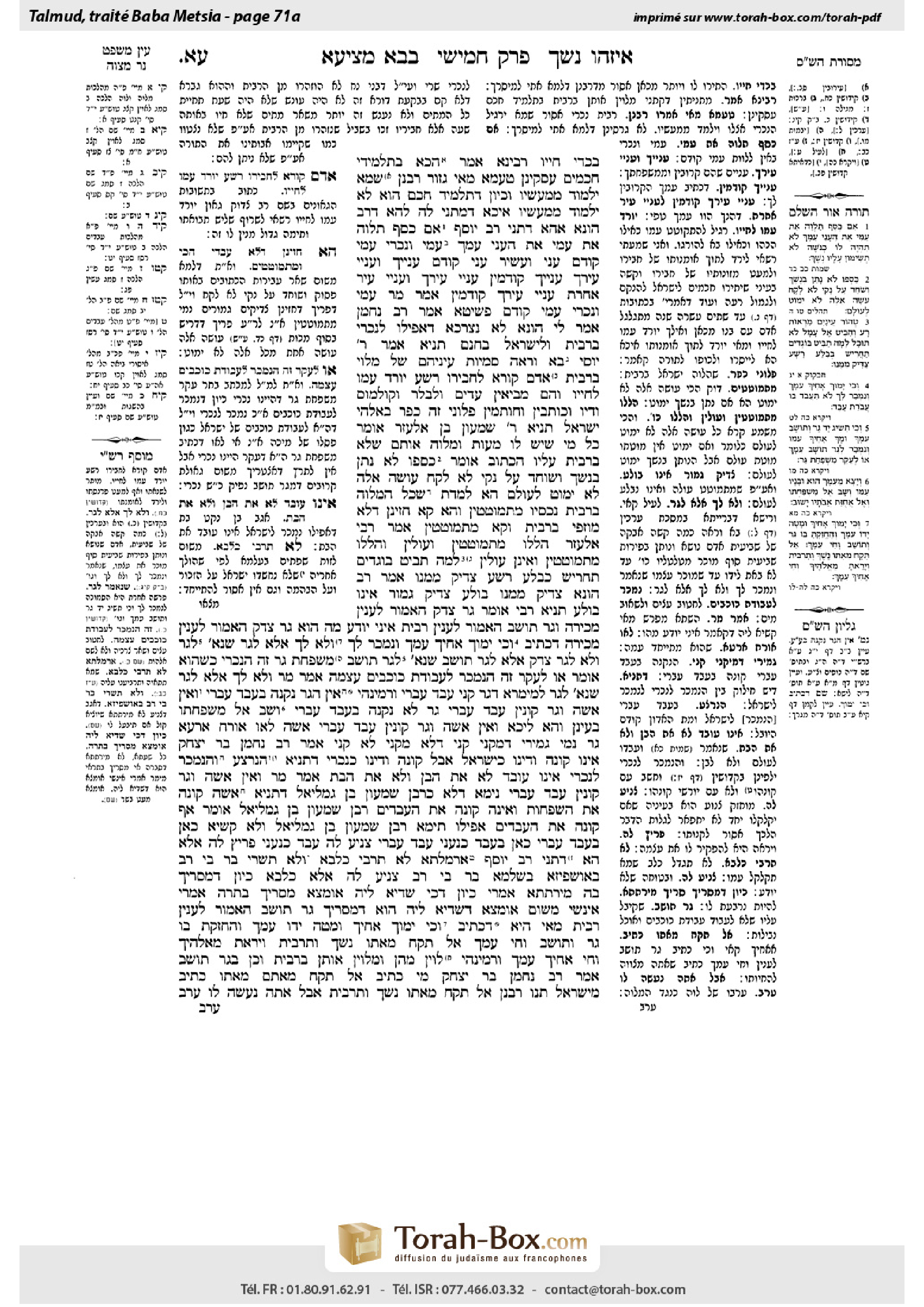
Bava Metzia 71a: Talmud study for Daf Yomi
Study the Talmud for Daf Yomi with scanned pages, Hebrew text, English translations from Sefaria and AI-generated French translations.
Passage selection and English or AI-generated French translation are available where the scan has annotations. Daf Study is independent of Torah-Box and Sefaria.
Browse Bava Metzia · בבא מציעא · All tractatesBava Metzia 71a text and translations
This page of Bava Metzia includes the Aramaic text, an English translation and an AI-generated French translation, alongside the scan above.
בבא מציעא ע״א א · Aramaic and Hebrew text
בִּכְדֵי חַיָּיו.
רָבִינָא אָמַר: הָכָא בְּתַלְמִידֵי חֲכָמִים עָסְקִינַן. טַעְמָא מַאי גְּזוּר רַבָּנַן – שֶׁמָּא יִלְמוֹד מִמַּעֲשָׂיו, וְכֵיוָן דְּתַלְמִיד חָכָם הוּא – לֹא יִלְמוֹד מִמַּעֲשָׂיו.
אִיכָּא דְּמַתְנֵי לַהּ לְהָא דְּרַב הוּנָא אַהָא דְּתָנֵי רַב יוֹסֵף: ״אִם כֶּסֶף תַּלְוֶה אֶת עַמִּי אֶת הֶעָנִי עִמָּךְ״. עַמִּי וְגוֹי – עַמִּי קוֹדֵם, עָנִי וְעָשִׁיר – עָנִי קוֹדֵם. ״עֲנִיֶּיךָ וַעֲנִיֵּי עִירֶךָ״ – עֲנִיֶּיךָ קוֹדְמִין, עֲנִיֵּי עִירֶךָ וַעֲנִיֵּי עִיר אַחֶרֶת – עֲנִיֵּי עִירֶךָ קוֹדְמִין.
אָמַר מָר: עַמִּי וְגוֹי עַמִּי קוֹדֵם, פְּשִׁיטָא! אָמַר רַב נַחְמָן אָמַר לִי הוּנָא: לָא נִצְרְכָא, דַּאֲפִילּוּ לְגוֹי בְּרִבִּית וּלְיִשְׂרָאֵל בְּחִנָּם.
תַּנְיָא, אָמַר רַבִּי יוֹסֵי: בֹּא וּרְאֵה סַמְיוּת עֵינֵיהֶם שֶׁל מַלְוֵי בְּרִבִּית. אָדָם קוֹרֵא לַחֲבֵירוֹ ״רָשָׁע״ – יוֹרֵד עִמּוֹ לְחַיָּיו. וְהֵם מְבִיאִין עֵדִים וְלַבְלָר וְקוּלְמוֹס וּדְיוֹ, וְכוֹתְבִין וְחוֹתְמִין: פְּלוֹנִי זֶה כָּפַר בֵּאלֹהֵי יִשְׂרָאֵל.
תַּנְיָא, רַבִּי שִׁמְעוֹן בֶּן אֶלְעָזָר אוֹמֵר: כָּל מִי שֶׁיֵּשׁ לוֹ מָעוֹת וּמַלְוֶה אוֹתָם שֶׁלֹּא בְּרִבִּית, עָלָיו הַכָּתוּב אוֹמֵר ״כַּסְפּוֹ לֹא נָתַן בְּנֶשֶׁךְ וְשֹׁחַד עַל נָקִי לֹא לָקָח עֹשֵׂה אֵלֶּה לֹא יִמּוֹט לְעוֹלָם״. הָא לָמַדְתָּ שֶׁכׇּל הַמַּלְוֶה בְּרִבִּית נְכָסָיו מִתְמוֹטְטִין. וְהָא קָא חָזֵינַן דְּלָא מוֹזְפִי בְּרִבִּית וְקָא מִתְמוֹטְטִין! אָמַר רַבִּי אֶלְעָזָר: הַלָּלוּ מִתְמוֹטְטִין וְעוֹלִין, וְהַלָּלוּ מִתְמוֹטְטִין וְאֵינָן עוֹלִין.
״לָמָּה תַבִּיט בּוֹגְדִים תַּחֲרִישׁ כְּבַלַּע רָשָׁע צַדִּיק מִמֶּנּוּ״. אָמַר רַב הוּנָא: צַדִּיק מִמֶּנּוּ – בּוֹלֵעַ, צַדִּיק גָּמוּר – אֵינוֹ בּוֹלֵעַ.
תַּנְיָא, רַבִּי אוֹמֵר: גֵּר צֶדֶק הָאָמוּר לְעִנְיַן מְכִירָה, וְגֵר תּוֹשָׁב הָאָמוּר לְעִנְיַן רִבִּית, אֵינִי יוֹדֵעַ מַה הוּא.
גֵּר צֶדֶק הָאָמוּר לְעִנְיַן מְכִירָה, דִּכְתִיב: ״וְכִי יָמוּךְ אָחִיךָ עִמָּךְ וְנִמְכַּר לָךְ״. וְלֹא לְךָ, אֶלָּא לְגֵר, שֶׁנֶּאֱמַר: ״לְגֵר״.
וְלֹא לְגֵר צֶדֶק אֶלָּא לְגֵר תּוֹשָׁב, שֶׁנֶּאֱמַר: ״לְגֵר תּוֹשָׁב״. ״מִשְׁפַּחַת גֵּר״ – זֶה הַגּוֹי. כְּשֶׁהוּא אוֹמֵר ״אוֹ לְעֵקֶר״ – זֶה הַנִּמְכָּר לַעֲבוֹדָה זָרָה עַצְמָהּ.
אָמַר מָר: וְלֹא לְךָ אֶלָּא לְגֵר, שֶׁנֶּאֱמַר: ״לְגֵר״, לְמֵימְרָא דְּגֵר קָנֵי עֶבֶד עִבְרִי? ורְמִינְהִי: אֵין הַגֵּר נִקְנֶה בְּעֶבֶד עִבְרִי, וְאֵין אִשָּׁה וְגֵר קוֹנִין עֶבֶד עִבְרִי.
גֵּר לֹא נִקְנֶה בְּעֶבֶד עִבְרִי: ״וְשָׁב אֶל מִשְׁפַּחְתּוֹ״ בָּעֵינַן, וְהָא לֵיכָּא. וְאֵין אִשָּׁה וְגֵר קוֹנִין עֶבֶד עִבְרִי: אִשָּׁה – לָאו אוֹרַח אַרְעָא. גֵּר נָמֵי גְּמִירִי: דְּמִקְּנֵי – קָנֵי, דְּלָא מִקְּנֵי – לָא קָנֵי.
אָמַר רַב נַחְמָן בַּר יִצְחָק: אֵינוֹ קוֹנֶה וְדִינוֹ כְּיִשְׂרָאֵל, אֲבָל קוֹנֶה וְדִינוֹ כְּגוֹי.
דְּתַנְיָא: הַנִּרְצָע וְהַנִּמְכָּר לְגוֹי אֵינוֹ עוֹבֵד לֹא אֶת הַבֵּן וְלֹא אֶת הַבַּת.
אָמַר מָר: וְאֵין אִשָּׁה וְגֵר קוֹנִין עֶבֶד עִבְרִי. נֵימָא דְּלָא כְּרַבָּן שִׁמְעוֹן בֶּן גַּמְלִיאֵל? דְּתַנְיָא: אִשָּׁה קוֹנָה אֶת הַשְּׁפָחוֹת, וְאֵינָהּ קוֹנָה אֶת הָעֲבָדִים. רַבָּן שִׁמְעוֹן בֶּן גַּמְלִיאֵל אוֹמֵר: אַף קוֹנָה אֶת הָעֲבָדִים! אֲפִילּוּ תֵּימָא רַבָּן שִׁמְעוֹן בֶּן גַּמְלִיאֵל, וְלָא קַשְׁיָא: כָּאן – בְּעֶבֶד עִבְרִי, כָּאן – בְּעֶבֶד כְּנַעֲנִי.
עֶבֶד עִבְרִי צְנִיעַ לַהּ, עֶבֶד כְּנַעֲנִי פְּרִיץ לַהּ.
אֶלָּא הָא דְּתָנֵי רַב יוֹסֵף: אַרְמַלְתָּא לָא תְּרַבֵּי כַּלְבָּא, וְלָא תַּשְׁרֵי בַּר בֵּי רַב בְּאוּשְׁפִּיזָא. בִּשְׁלָמָא בַּר בֵּי רַב צְנִיעַ לַהּ, אֶלָּא כַּלְבָּא, כֵּיוָן דִּמְסָרֵיךְ בַּהּ מִירַתְּתָא! אָמְרִי: כֵּיוָן דְּכִי שָׁדְיָא לֵיהּ אוּמְצָא מְסָרֵיךְ בָּתְרַהּ, אָמְרִי אִינָשֵׁי: מִשּׁוּם אוּמְצָא דְּשָׁדְיָא לֵיהּ הוּא דִּמְסָרֵיךְ.
גֵּר תּוֹשָׁב הָאָמוּר לְעִנְיַן רִבִּית מַאי הִיא, דִּכְתִיב: ״וְכִי יָמוּךְ אָחִיךָ וּמָטָה יָדוֹ עִמָּךְ וְהֶחֱזַקְתָּ בּוֹ גֵּר וְתוֹשָׁב וָחַי עִמָּךְ. אַל תִּקַּח מֵאִתּוֹ נֶשֶׁךְ וְתַרְבִּית וְיָרֵאתָ מֵאֱלֹהֶיךָ וְחֵי אָחִיךָ עִמָּךְ״. וּרְמִינְהִי: לֹוִין מֵהֶן וּמַלְוִין אוֹתָן בְּרִבִּית, וְכֵן בְּגֵר תּוֹשָׁב!
אָמַר רַב נַחְמָן בַּר יִצְחָק: מִי כְּתִיב ״אַל תִּקַּח מֵאִתָּם״? ״מֵאִתּוֹ״ כְּתִיב, מִיִּשְׂרָאֵל.
תָּנוּ רַבָּנַן: ״אַל תִּקַּח מֵאִתּוֹ נֶשֶׁךְ וְתַרְבִּית״ – אֲבָל אַתָּה נַעֲשֶׂה לוֹ עָרֵב.
Bava Metzia 71a · English translation
to teach that one may lend money with interest to a ger toshav only to the extent required to provide a livelihood to the lender, but not to do so as a regular business.
Ravina said: Here in the mishna we are dealing with Torah scholars, for whom it is permitted to lend money to a gentile with interest. The Gemara explains: What is the reason the Sages decreed that one should not lend money to a gentile with interest? The reason is that perhaps the Jew will learn from the gentile’s actions. Continuous interactions with gentiles for the sake of financial dealings may have a negative influence on a Jew. And since in this case the lender is a Torah scholar, he will not learn from the gentile’s actions.
There are those who teach that which Rav Huna said in connection with that which Rav Yosef taught: The verse states: “If you lend money to any of My people, even to the poor person who is with you” (Exodus 22:24). The term “My people” teaches that if one of My people, i.e., a Jew, and a gentile both come to borrow money from you, My people take precedence. The term “the poor person” teaches that if a poor person and a rich person come to borrow money, the poor person takes precedence. And from the term: “Who is with you,” it is derived: If your poor person, meaning one of your relatives, and one of the poor of your city come to borrow money, your poor person takes precedence. If it is between one of the poor of your city and one of the poor of another city, the one of the poor of your city takes precedence.
The Master said above: If one of My people and a gentile come to you for a loan, My people take precedence. The Gemara asks: Isn’t this obvious? Is there any reason to think that a gentile would take precedence over a Jew? Rav Naḥman said that Rav Huna said to me: It is necessary only to teach that even if the choice is to lend money to a gentile with interest or to a Jew for free, without interest, one must still give preference to the Jew and lend the money to him, even though this will entail a lack of profit.
It is taught in a baraita: Rabbi Yosei says: Come and see the blindness in the eyes of those who lend money with interest. If a person calls another a wicked person in public, the other becomes insulted and he harasses him in all aspects of his life because he called him by this disgraceful name. But they who lend with interest bring witnesses and a scribe [velavlar] and a pen [vekulmos] and ink and write and sign a document that testifies: So-and-so denies the existence of the God of Israel, as the very fact that he lent with interest in defiance of the Torah is tantamount to a denial of the existence of God.
It is taught in a baraita: Rabbi Shimon ben Elazar says: Concerning anyone who has money and lends it without interest, the verse says about him: “He who has not given his money with interest and who has not taken a bribe against the innocent, he who does these shall never collapse” (Psalms 15:5). From this statement, the opposite can also be inferred: You learn from this that concerning anyone who lends his money to others with interest, his property, i.e., his financial standing, collapses. The Gemara asks: But we see people who do not lend money with interest and nevertheless their property collapses. Rabbi Elazar says: There is still a difference: Those who do not lend money with interest collapse but then ultimately rise, but these, who lend with interest, collapse and do not rise again.
Referring to the subject of honest people who collapse temporarily, it is said: “Why do You observe the treacherous, and remain silent while the wicked swallows the one who is more righteous than he?” (Habakkuk 1:13). Rav Huna says about this verse: One who is more righteous than he, he swallows for the moment, but he does not swallow a completely righteous person at all.
§ The Gemara returns to the clarification of the mishna, which mentioned the subject of a gentile who resides in Eretz Yisrael and observes the seven Noahide mitzvot [ger toshav]. It is taught in a baraita: Rabbi Yehuda HaNasi says: With regard to the convert that is mentioned concerning the sale of a Hebrew slave and the ger toshav that is mentioned concerning interest, I do not know what the meaning of each of these references is.
The Gemara explains: The convert that is mentioned concerning the sale of a Hebrew slave is referring to the following, as it is written: “If your brother waxes poor with you and is sold unto you” (Leviticus 25:39), and it was expounded in a baraita: And not only will he be sold to you, a born Jew, but he will be sold even to a convert, as it is stated: “And sells himself to a stranger [leger]” (Leviticus 25:47).
And this sale to a ger is referring to a sale not only to a righteous convert [leger tzedek], but even to a ger toshav, as it is stated: “And sells himself to a stranger who is a settler [leger toshav]” (Leviticus 25:47). With regard to the continuation of the verse: “Or to an offshoot of a stranger’s family,” this is referring to a gentile, i.e., he will reach a state where he has no choice but to sell himself to a gentile. When it states: “Or to an offshoot of a stranger’s family,” this is referring to one sold for idol worship itself, i.e., he is forced to sell himself as a slave to work in a temple of idol worship.
The Gemara clarifies the baraita. The Master said: And not only will he be sold to you, a born Jew, but he will be sold even to a convert, as it is stated: “And sells himself to a stranger.” Is this to say that a convert may acquire a Hebrew slave? The Gemara raises a contradiction from a baraita: A convert cannot be acquired as a Hebrew slave, and a woman or a convert may not acquire a Hebrew slave.
The Gemara explains the baraita. A convert cannot be acquired as a Hebrew slave, as we require the fulfillment of the verse: “Then he shall go out from you, he and his children with him, and shall return to his own family” (Leviticus 25:41), and a convert is not able to do this, since upon conversion the convert severs his relationship with his gentile family, and he therefore has no family. The baraita teaches: And a woman or a convert may not acquire a Hebrew slave. With regard to a woman, the reason is that it is not proper conduct, since people may say that she is purchasing him to engage in sexual intercourse with him. With regard to a convert as well, it is learned as a tradition: Only one who can be acquired as a Hebrew slave can acquire a Hebrew slave, and one who cannot be acquired as a Hebrew slave cannot acquire a Hebrew slave. Since a convert cannot be acquired as a Hebrew slave, he also cannot acquire one.
Rabbi Yehuda HaNasi’s question was that since it has been established that a convert may not acquire a Hebrew slave, why was he mentioned in the verse? Rav Naḥman bar Yitzḥak said: He cannot acquire a Hebrew slave and have his halakha be like that of a Jew who owns a Hebrew slave, but he can acquire a Hebrew slave and have his halakha be like that of a gentile who owns a Hebrew slave.
This is as it is taught in a baraita: A Hebrew slave who had his ear pierced by his own request in order to remain a slave after his six-year period of servitude was over, and therefore is emancipated only during the Jubilee Year, and also a Hebrew slave who was sold to a gentile, does not serve his master’s son and does not serve his master’s daughter after his master’s death, but rather is emancipated. The same halakha would apply to a Hebrew slave sold to a convert, whose status in this respect is similar to that of a gentile.
The Master said above: And a woman or a convert may not acquire a Hebrew slave. The Gemara suggests: Let us say that this baraita is not in accordance with the opinion of Rabban Shimon ben Gamliel. As it is taught in a baraita: A woman may acquire maidservants but may not acquire male slaves, in order to preserve standards of modesty. Rabban Shimon ben Gamliel says: She may also acquire male slaves. The Gemara rejects this suggestion: Even if you say that this baraita is in accordance with the opinion of Rabban Shimon ben Gamliel, it is not difficult. Here, where it is prohibited, the ruling is stated with regard to a Hebrew slave, and there, where Rabban Shimon ben Gamliel renders it permitted, the ruling is stated with regard to a Canaanite slave.
The Gemara explains the difference: A Hebrew slave is regarded as discreet in her eyes, and since she trusts that a Hebrew slave will not reveal their actions to others if they engage in sexual intercourse, it is prohibited for her to acquire a male Hebrew slave. By contrast, a Canaanite slave is regarded as indiscreet in her eyes, so she will be deterred from transgressing with him.
The Gemara asks: But this seems to contradict the baraita that Rav Yosef teaches: A widow may not raise a dog, due to suspicion that she may engage in bestiality, and she may not allow a student of Torah to dwell as a lodger in her home. Granted, it makes sense that it is prohibited for her to have a student of Torah lodging in her home, as he is regarded as discreet in her eyes. But concerning a dog, since it would follow her around afterward if she would engage in bestiality with it, she is afraid to sin with it. Therefore, it should be permitted for her to raise it. The Sages say in response: Since it will also follow her around if she throws it a piece of meat [umtza], people will say: It is following her due to the meat she threw to it, and they will not suspect her of sinning. Consequently, she will not be deterred from transgressing.
The Gemara discusses Rabbi Yehuda HaNasi’s second difficulty: The ger toshav that was mentioned concerning interest, what is it? What was Rabbi Yehuda’s difficulty? As it is written: “And if your brother waxes poor, and his means fail with you, then you shall strengthen him, as a stranger and a resident [ger vetoshav] shall he live with you. You may not take interest or increase from him, but fear your God, and your brother should live with you” (Leviticus 25:35–36). This indicates that interest may not be taken from a ger toshav. And the Gemara raises a contradiction from the mishna: One may borrow money from them, i.e., from gentiles, and lend money to them with interest, and similarly, one may borrow money from and lend money to a ger toshav with interest.
Rav Naḥman bar Yitzḥak says: Is it written: Do not take from them? No, it is written: “Do not take from him,” in the singular, and it means: Do not take interest from a Jew.
With regard to this verse the Sages taught: “You may not take interest or increase from him,” but you may become a guarantor for him for a transaction involving interest.
Bava Metzia 71a · Traduction française (IA)
enseigner que l'on peut prêter de l'argent à un ger toshav avec intérêt uniquement dans la mesure nécessaire pour assurer un revenu au prêteur, mais pas en tant que métier régulier.
Ravina dit : Ici, dans la Michna, nous parlons de savants de la Torah, pour qui il est permis de prêter de l'argent à un non-Juif avec intérêt. La Guemara explique : Pourquoi les Sages ont-ils décrété que l'on ne doive pas prêter de l'argent à un non-Juif avec intérêt ? La raison est que peut-être le Juif apprendra des actions du non-Juif. Les interactions continues avec des non-Juifs à des fins financières peuvent avoir une influence négative sur un Juif. Et puisque dans ce cas le prêteur est un savant de la Torah, il ne s'inspirera pas des actions du non-Juif.
Certains enseignent ce que Rav Huna a dit en lien avec ce que Rav Yosef a enseigné : La Paracha dit : « Si tu prêtes de l'argent à l'un de mes peuples, même à celui qui est pauvre et qui est avec toi » (Exode 22:24). Le terme « mon peuple » enseigne que si un de mes peuples, c'est-à-dire un Juif, et un non-Juif viennent tous les deux te demander un prêt, mon peuple a la priorité. Le terme « le pauvre » enseigne que si un pauvre et un riche viennent tous les deux te demander un prêt, le pauvre a la priorité. Et du terme : « qui est avec toi », on déduit : Si votre pauvre, c'est-à-dire l'un de vos parents, et l'un des pauvres de votre ville viennent tous les deux te demander un prêt, votre pauvre a la priorité. Si c'est entre l'un des pauvres de votre ville et l'un des pauvres d'une autre ville, celui des pauvres de votre ville a la priorité.
Le Maître a dit plus haut : Si l'un de mes peuples et un non-Juif viennent vous demander un prêt, mon peuple a la priorité. La Guemara pose la question : N'est-ce pas évident ? Y a-t-il une raison de penser que le non-Juif prenne la priorité sur le Juif ? Rav Naḥman a dit que Rav Huna m'a dit : Il est nécessaire seulement d'enseigner que même si le choix est entre prêter de l'argent à un non-Juif avec intérêt ou à un Juif gratuitement, sans intérêt, il faut encore préférer le Juif et lui prêter l'argent, même si cela entraîne une perte de profit.
Il est enseigné dans une baraïta : Rabbi Yosei dit : Venez voir la cécité des yeux de ceux qui prêtent de l'argent avec intérêt. Si une personne appelle une autre une personne méchante en public, l'autre se sent insulté et le harcèle dans tous les aspects de sa vie parce qu'il l'a appelé par ce nom disgracieux. Mais ceux qui prêtent avec intérêt font appel à des témoins et un scribe [velavlar], un stylo [vekulmos], de l'encre, écrivent et signent un document qui témoigne : tel et tel nie l'existence du Dieu d'Israël, car le fait même de prêter avec intérêt en défiance de la Torah est équivalent à un déni de l'existence de Dieu.
Il est enseigné dans une baraïta : Rabbi Shimon ben Elazar dit : Concernant celui qui possède de l'argent et le prête sans intérêt, la Paracha dit à son sujet : « Celui qui n'a pas donné son argent avec intérêt et qui n'a pas pris un pot-de-vin contre l'innocent, celui qui fait cela ne s'effondrera jamais » (Psaumes 15:5). À partir de cette déclaration, on peut aussi déduire l'inverse : Vous apprenez de cela que concernant celui qui prête son argent à d'autres avec intérêt, son patrimoine, c'est-à-dire son statut financier, s'effondre. La Guemara pose la question : Mais nous voyons des gens qui ne prêtent pas d'argent avec intérêt et pourtant leur patrimoine s'effondre. Rabbi Elazar dit : Il y a encore une différence : ceux qui ne prêtent pas d'argent avec intérêt s'effondrent mais finissent par se relever, mais ceux qui prêtent avec intérêt s'effondrent et ne se relèvent pas.
Concernant les gens honnêtes qui s'effondrent temporairement, il est dit : « Pourquoi regardes-tu le traître, et restes-tu silencieux alors que le méchant engloutit celui qui est plus juste que lui ? » (Habakuk 1:13). Rav Huna dit à propos de cette parole : Celui qui est plus juste que lui, il l'engloutit pour un moment, mais il ne peut pas engloutir un homme parfaitement juste.
La Guemara retourne à la clarification de la Michna, qui mentionnait la question d'un non-Juif résidant en Eretz Yisrael et observant les sept mitsvot de Noé [ger toshav]. Il est enseigné dans une baraïta : Rabbi Yehuda HaNasi dit : Concernant le converti mentionné concernant la vente d'un serviteur hébreu et le ger toshav mentionné concernant l'intérêt, je ne sais pas ce que signifie chacune de ces références.
La Guemara explique : Le converti mentionné concernant la vente d'un serviteur hébreu fait référence à ce qui suit, car il est écrit : « Si ton frère s'effondre avec toi et est vendu à toi » (Lévitique 25:39), et il a été expliqué dans une baraïta : Et non seulement il sera vendu à toi, un Juif né, mais il sera même vendu à un converti, car il est dit : « Et il vend lui-même à un étranger » (Lévitique 25:47).
Et cette vente à un ger fait référence à une vente non seulement à un converti juste [leger tzedek], mais même à un ger toshav, car il est dit : « Et il vend lui-même à un étranger qui est un résident [ger toshav] » (Lévitique 25:47). En ce qui concerne la continuation de la parole : « Ou à un descendant d'une famille étrangère », cela fait référence à un non-Juif, c'est-à-dire qu'il atteindra un état où il n'a pas d'autre choix que de vendre lui-même à un non-Juif. Lorsqu'il est dit : « Ou à un descendant d'une famille étrangère », cela fait référence à l'idolâtrie elle-même, c'est-à-dire qu'il est contraint de vendre lui-même en esclave pour travailler dans un temple d'idolâtrie.
La Guemara clarifie la baraïta. Le Maître dit : Et non seulement il sera vendu à toi, un Juif né, mais il sera même vendu à un converti, car il est dit : « Et il vend lui-même à un étranger ». Est-ce dire qu'un converti peut acquérir un serviteur hébreu ? La Guemara soulève une contradiction à partir d'une baraïta : Un converti ne peut pas être acquis comme un serviteur hébreu, et une femme ou un converti ne peuvent pas acquérir un serviteur hébreu.
La Guemara explique la baraïta. Un converti ne peut pas être acquis comme un serviteur hébreu, car nous exigeons la réalisation de la parole : « Il sortira de toi, lui et ses enfants avec lui, et retournera à sa propre famille » (Lévitique 25:41), et un converti ne peut pas faire cela, car lors de sa conversion, il coupe son lien avec sa famille païenne, et il n'a donc plus de famille. La baraïta enseigne : une femme ou un converti ne peut pas acquérir un serviteur hébreu. En ce qui concerne la femme, la raison est que cela n'est pas convenable, car les gens pourraient dire qu'elle achète lui pour avoir des relations sexuelles avec lui. En ce qui concerne le converti également, cela est appris comme une tradition : seul celui qui peut être acquis comme un serviteur hébreu peut acquérir un serviteur hébreu, et celui qui ne peut pas être acquis comme un serviteur hébreu ne peut pas non plus en acquérir un. Puisque le converti ne peut pas être acquis comme un serviteur hébreu, il ne peut pas non plus en acquérir un.
La question de Rabbi Yehuda HaNasi était que puisque cela a été établi qu'un converti ne peut pas acquérir un serviteur hébreu, pourquoi est-il mentionné dans la parole ? Rav Naḥman bar Yitzḥak dit : Il ne peut pas acquérir un serviteur hébreu et avoir sa halakha être comme celle d'un Juif qui possède un serviteur hébreu, mais il peut acquérir un serviteur hébreu et avoir sa halakha être comme celle d'un païen qui possède un serviteur hébreu.
C'est ce qui est enseigné dans une baraïta : un serviteur hébreu dont l'oreille a été percée par sa propre demande afin de rester un serviteur après la période de six ans de servitude, et donc qui est libéré uniquement pendant l'année sabbatique, et aussi un serviteur hébreu vendu à un païen, ne sert pas le fils de son maître et ne sert pas la fille de son maître après la mort de son maître, mais est libéré. La même halakha s'applique à un serviteur hébreu vendu à un converti, dont le statut dans ce sens est similaire à celui d'un païen.
Le Maître a dit ci-dessus : une femme ou un converti ne peuvent pas acquérir un serviteur hébreu. La Guemara suggère : disons que cette baraïta n'est pas en accord avec l'opinion de Rabban Shimon ben Gamliel. Comme il est enseigné dans une baraïta : une femme peut acquérir des servantes mais ne peut pas acquérir des serviteurs masculins, afin de préserver les normes de modestie. Rabban Shimon ben Gamliel dit : elle peut aussi acquérir des serviteurs masculins. La Guemara rejette cette suggestion : même si vous dites que cette baraïta est en accord avec l'opinion de Rabban Shimon ben Gamliel, cela n'est pas difficile. Ici, où il est interdit, la décision est formulée concernant un serviteur hébreu, et là, où Rabban Shimon ben Gamliel permet, la décision est formulée concernant un serviteur cananéen.
La Guemara explique la différence : un serviteur hébreu est considéré comme discret à ses yeux, et puisque elle fait confiance au fait qu'un serviteur hébreu ne révélera pas leurs actions à d'autres s'ils ont des relations sexuelles, il est interdit qu'elle acquière un serviteur hébreu masculin. En revanche, un serviteur cananéen est considéré comme indiscret à ses yeux, donc elle sera dissuadée de transgresser avec lui.
La Guemara pose la question : mais cela semble contredire la baraïta que Rav Yosef enseigne : une veuve ne peut pas avoir un chien, en raison de la suspicion qu'elle pourrait avoir des relations bestiales avec lui, et elle ne peut pas permettre à un étudiant de la Torah de séjourner chez elle. Cela a du sens qu'il soit interdit qu'elle ait un étudiant de la Torah chez elle, car il est considéré comme discret à ses yeux. Mais concernant le chien, puisque s'il la suivait après qu'elle ait eu des relations avec lui, elle craindrait de transgresser avec lui. Donc, il devrait être permis qu'elle l'ait. Les Sages répondent : puisque cela suivra aussi si elle lui jette un morceau de viande [umtza], les gens diront : il la suit à cause de la viande qu'elle lui a donnée, et ils ne soupçonneront pas qu'elle ait transgressé. Ainsi, elle ne sera pas dissuadée de transgresser.
La Guemara discute de la deuxième difficulté de Rabbi Yehuda HaNasi : le ger toshav mentionné concernant l'intérêt, qu'est-ce que c'est ? Quelle était la difficulté de Rabbi Yehuda ? Comme il est écrit : « Et si ton frère s'effondre, et ses moyens s'épuisent avec toi, alors tu renforceras lui, comme un étranger et un résident [ger vetoshav] il vivra avec toi. Tu ne prendras pas d'intérêt ou d'augmentation de lui, mais craigne ton Dieu, et ton frère vivra avec toi » (Lévitique 25:35–36). Cela indique que l'intérêt ne peut pas être pris d'un ger toshav. Et la Guemara soulève une contradiction à partir de la mishna : on peut emprunter de l'argent à eux, c'est-à-dire aux païens, et prêter de l'argent à eux avec intérêt, et de même, on peut emprunter de l'argent à et prêter de l'argent à un ger toshav avec intérêt.
Rav Naḥman bar Yitzḥak dit : est-il écrit : ne prends pas d'intérêt ? Non, il est écrit : « ne prends pas de lui », au singulier, et cela signifie : ne prends pas d'intérêt d'un Juif.
Concernant cette parole, les Sages ont enseigné : « Tu ne prendras pas d'intérêt ou d'augmentation de lui », mais tu peux être garant pour lui dans une transaction impliquant de l'intérêt.
Traduction française générée par IA à partir de l’édition anglaise de Sefaria. Vérifie toujours un passage avec le texte source.
Text from Sefaria: William Davidson Edition - Vocalized Aramaic (CC BY NC); William Davidson Edition - English (CC BY NC).