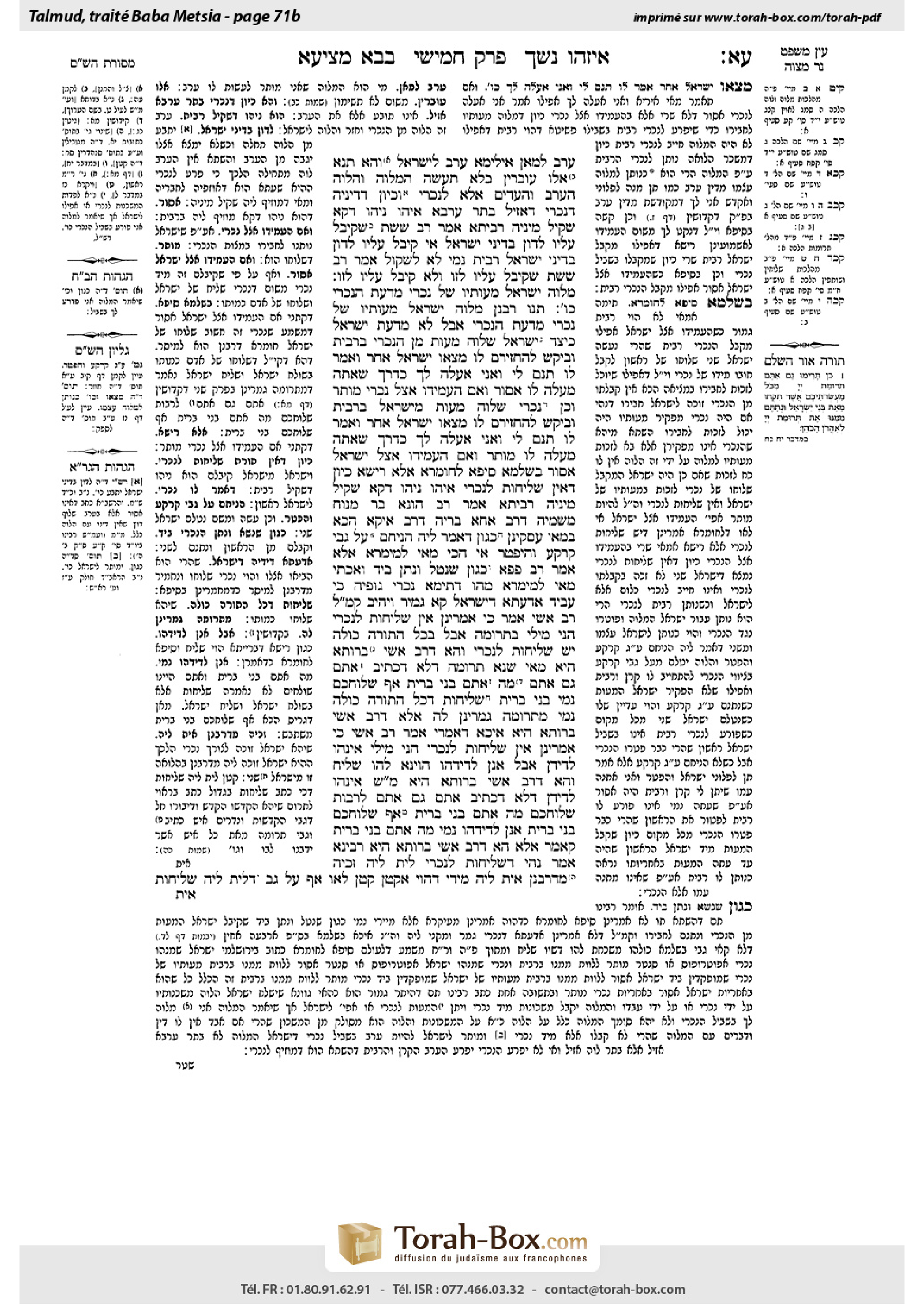
Bava Metzia 71b: Talmud study for Daf Yomi
Study the Talmud for Daf Yomi with scanned pages, Hebrew text, English translations from Sefaria and AI-generated French translations.
Passage selection and English or AI-generated French translation are available where the scan has annotations. Daf Study is independent of Torah-Box and Sefaria.
Browse Bava Metzia · בבא מציעא · All tractatesBava Metzia 71b text and translations
This page of Bava Metzia includes the Aramaic text, an English translation and an AI-generated French translation, alongside the scan above.
בבא מציעא ע״א ב · Aramaic and Hebrew text
עָרֵב לְמַאן? אִילֵימָא עָרֵב לְיִשְׂרָאֵל, וְהָא תָּנָא: אֵלּוּ עוֹבְרִין בְּלֹא תַּעֲשֶׂה הַמַּלְוֶה וְהַלֹּוֶה, הֶעָרֵב וְהָעֵדִים!
אֶלָּא לְגוֹי וְכֵיוָן דְּדִינֵיהּ דְּגוֹי דְּאָזֵיל בָּתַר עָרְבָא, אִיהוּ נִיהוּ דְּקָא שָׁקֵיל מִינֵּיהּ רִבִּיתָא!
אָמַר רַב שֵׁשֶׁת: שֶׁקִּיבֵּל עָלָיו לָדוּן בְּדִינֵי יִשְׂרָאֵל. אִי קִיבֵּל עָלָיו לָדוּן בְּדִינֵי יִשְׂרָאֵל – רִבִּית נָמֵי לָא לִשְׁקוֹל! אָמַר רַב שֵׁשֶׁת: שֶׁקִּיבֵּל עָלָיו לָזוֹ, וְלֹא קִיבֵּל עָלָיו לָזוֹ.
מַלְוֶה יִשְׂרָאֵל מְעוֹתָיו שֶׁל נׇכְרִי מִדַּעַת הַנׇּכְרִי כּוּ׳. תָּנוּ רַבָּנַן: מַלְוֶה יִשְׂרָאֵל מְעוֹתָיו שֶׁל נׇכְרִי מִדַּעַת הַנׇּכְרִי, אֲבָל לֹא מִדַּעַת יִשְׂרָאֵל, כֵּיצַד? יִשְׂרָאֵל שֶׁלָּוָה מָעוֹת מִן הַגּוֹי בְּרִבִּית וּבִיקֵּשׁ לְהַחְזִירָם לוֹ, מְצָאוֹ יִשְׂרָאֵל אַחֵר וְאָמַר לוֹ: תְּנֵם לִי וַאֲנִי אַעֲלֶה לָךְ כְּדֶרֶךְ שֶׁאַתָּה מַעֲלֶה לוֹ – אָסוּר. וְאִם הֶעֱמִידוּ אֵצֶל גּוֹי – מוּתָּר.
וְכֵן גּוֹי שֶׁלָּוָה מָעוֹת מִיִּשְׂרָאֵל בְּרִבִּית וּבִיקֵּשׁ לְהַחְזִירָם לוֹ, מְצָאוֹ יִשְׂרָאֵל אַחֵר וְאָמַר לוֹ: תְּנֵם לִי וַאֲנִי אַעֲלֶה לְךָ כְּדֶרֶךְ שֶׁאַתָּה מַעֲלֶה לוֹ – מוּתָּר. וְאִם הֶעֱמִידוֹ אֵצֶל יִשְׂרָאֵל – אָסוּר.
בִּשְׁלָמָא סֵיפָא, לְחוּמְרָא. אֶלָּא רֵישָׁא: כֵּיוָן דְּאֵין שְׁלִיחוּת לְגוֹי, אִיהוּ נִיהוּ דְּקָא שָׁקֵיל מִינֵּיהּ רִבִּיתָא?
אָמַר רַב הוּנָא בַּר מָנוֹחַ מִשְּׁמֵיהּ דְּרַב אַחָא בְּרֵיהּ דְּרַב אִיקָא: הָכָא בְּמַאי עָסְקִינַן – כְּגוֹן דַּאֲמַר לֵיהּ: הַנִּיחֵם עַל גַּבֵּי קַרְקַע וְהִיפָּטֵר. אִי הָכִי, מַאי לְמֵימְרָא?
אֶלָּא אָמַר רַב פָּפָּא: כְּגוֹן שֶׁנָּטַל וְנָתַן בַּיָּד. וְאַכַּתִּי, מַאי לְמֵימְרָא?! מַהוּ דְּתֵימָא: גּוֹי גּוּפֵיהּ כִּי עָבֵיד – אַדַּעְתָּא דְּיִשְׂרָאֵל קָא גָמֵיר וְיָהֵיב, קָא מַשְׁמַע לַן.
רַב אָשֵׁי אָמַר: כִּי אָמְרִינַן אֵין שְׁלִיחוּת לְגוֹי – הָנֵי מִילֵּי בִּתְרוּמָה, אֲבָל בְּכׇל הַתּוֹרָה כּוּלָּהּ – יֵשׁ שְׁלִיחוּת לְגוֹי.
וְהָא דְּרַב אָשֵׁי בְּרוּתָא הִיא: מַאי שְׁנָא תְּרוּמָה דְּלָא, דִּכְתִיב ״אַתֶּם״ – ״גַּם אַתֶּם״: מָה אַתֶּם בְּנֵי בְּרִית – אַף שְׁלוּחֲכֶם נָמֵי בְּנֵי בְּרִית.
שְׁלִיחוּת דְּכׇל הַתּוֹרָה כּוּלָּהּ נָמֵי מִתְּרוּמָה גָּמְרִינַן לַהּ. אֶלָּא דְּרַב אָשֵׁי בְּרוּתָא הִיא.
אִיכָּא דְּאָמְרִי, אָמַר רַב אָשֵׁי: כִּי אָמְרִינַן אֵין שְׁלִיחוּת לְגוֹי הָנֵי מִילֵּי אִינְהוּ לְדִידַן, אֲבָל אֲנַן לְדִידְהוּ הָוֵינָא לְהוּ שְׁלִיחַ. וְהָא דְּרַב אָשֵׁי בְּרוּתָא הִיא, מַאי שְׁנָא אִינְהוּ לְדִידַן דְּלָא – דִּכְתִיב: ״אַתֶּם״ ״גַּם אַתֶּם״ – לְרַבּוֹת שְׁלוּחֲכֶם: מָה אַתֶּם בְּנֵי בְרִית – אַף שְׁלוּחֲכֶם בְּנֵי בְרִית.
אֲנַן לְדִידְהוּ נָמֵי, מָה אַתֶּם בְּנֵי בְרִית קָאָמַר! אֶלָּא הָא דְּרַב אָשֵׁי בְּרוּתָא הִיא.
רָבִינָא אָמַר: נְהִי דִּשְׁלִיחוּת לְגוֹי לֵית לֵיהּ, זְכִיָּה מִדְּרַבָּנַן אִית לֵיהּ, מִידֵּי דְּהָוֵי אַקָּטָן. קָטָן לָאו אַף עַל גַּב דְּלֵית לֵיהּ שְׁלִיחוּת,
Bava Metzia 71b · English translation
The Gemara asks: You may become a guarantor for whom? If we say it means a guarantor for a Jew who lends money to another Jew with interest, that is difficult. But this would be contradicted by that which the Sages taught in a mishna (75b): These are the ones who transgress a prohibition: The lender and the borrower, the guarantor and the witnesses. It is prohibited to serve as a guarantor for such a loan.
Rather, it must mean that one may serve as a guarantor for a gentile who lends to another Jew with interest. This is also difficult, since the law of the gentiles is that he goes after the guarantor to collect the money without trying to collect first from the borrower. Under gentile law, it is the responsibility of the guarantor to pay the lender and to then retrieve the money from the borrower. Consequently, when this occurs, the guarantor is considered to have borrowed money from the gentile and lent it himself to the Jew, with the result that the guarantor is the one who takes the interest from the borrower, which is prohibited.
Rav Sheshet said: The case is that the gentile accepted upon himself to have this transaction judged by the laws of the Jews, so that he may not claim repayment from the guarantor. The Gemara asks: If the gentile accepted upon himself to have this transaction judged by the laws of the Jews, he should also not take interest, since that is prohibited by Jewish law. In response, Rav Sheshet said: He accepted upon himself the laws of the Jews with regard to this, the procedural matter with regard to the method of collection, but he did not accept upon himself the laws of the Jews with regard to that, the prohibition against taking interest.
§ The mishna teaches: A Jew may serve as a middleman and lend a gentile’s money to another Jew with the knowledge of the gentile, but not with the knowledge of a Jew, i.e., the middleman himself. The Sages taught in a baraita: A Jew may lend a gentile’s money as a middleman to another Jew with the knowledge of the gentile, but not with the knowledge of a Jew. How so? In the case of a Jew who borrowed money with interest from a gentile and then wanted to return it to him, but at that point another Jew found the borrower and said to him: Since you do not need this money anymore and I do need it, give it to me and I will pay you with the addition of interest in the same way that you pay the gentile, this is prohibited, since this is interest paid to a Jew. But if the borrower presented the second Jew to the gentile and the gentile agreed to this arrangement, it is permitted.
The baraita continues: And similarly, if a gentile borrowed money with interest from a Jew and then wanted to return it to him, and another Jew found the gentile and said to him: Give it to me and I will pay you interest in the same way that you pay the Jewish lender, this is permitted, since he pays interest to a gentile and not to a Jew. But if the gentile borrower presented the second Jew to the Jew who lent him the money and the Jewish lender agreed to this arrangement, it is prohibited.
The Gemara discusses the baraita: Granted, the latter clause of the baraita, which says that it is prohibited for a Jew to pay the gentile borrower when the Jewish lender is aware of the transaction, can be explained as a stringency due to concern about the prohibition of interest, but in the first clause the Jewish lender presents the Jewish borrower to the gentile before handing him the money, and the fact that this is permitted indicates that he acts as the gentile’s agent, not on his own. But since the halakha is that there is no agency for a gentile, this means that the Jew is the one who takes the interest from the second borrower. Why, then, does the baraita permit it?
Rav Huna bar Manoaḥ said in the name of Rav Aḥa, son of Rav Ika: Here we are dealing with a case where the gentile said to the Jew when he returned the money: Place it upon the ground and be dismissed, and afterward the other Jew went and took it. Therefore, the loan was transacted directly between the second Jew and the gentile. The Gemara asks: If that is so, what is the purpose of stating it? In this scenario it is obvious that there are two separate loans and the first Jewish lender has nothing to do with the loan to the second. This is certainly permitted.
Rather, Rav Pappa said: It must be speaking about a case where the gentile took the money from the first Jew and gave it to the second Jew by hand. The Gemara asks: But still, what is the purpose of stating it? In this case also, the second loan is clearly transacted directly with the gentile lender. The Gemara answers: Lest you say: The gentile himself, when he does this, he gives it with the knowledge of the Jew, as he trusts the second borrower due to the mediation of the first, and therefore one might have thought he is deemed involved in the loan. To counter this, the baraita teaches us that this is not the case.
Rav Ashi said: It is possible to explain the baraita in a different way. When we say that the halakha is that there is no agency for a gentile, this matter applies concerning the separation of teruma, the portion of produce designated for a priest. It is in this context that the halakha that there is no agency for a gentile is derived, but concerning the rest of the halakhot of the Torah, there is agency for a gentile.
The Gemara comments: And this opinion of Rav Ashi is an error, since what is different about teruma that a gentile cannot be appointed an agent? As it is written concerning teruma: “So you also shall set apart a gift unto the Lord of all your tithes” (Numbers 18:28); once the verse states “you,” the addition of the word “also” in the phrase “you also” serves to include an agent. The Sages additionally derive: Just as you, those who appoint agents, are members of the covenant, i.e., Jews, so too, your agents must be members of the covenant. A gentile cannot separate teruma even if appointed as an agent by a Jew.
The Gemara continues: The concept of agency with regard to the rest of the halakhot of the Torah is also a matter we learn through tradition by a derivation from teruma, as this is the source for the halakha that the legal status of one’s agent is like that of himself. Therefore, the same halakhot apply to agency in all matters. Rather, it must be concluded that the opinion expressed by Rav Ashi is an error.
There are those who say a different version of this discussion: Rav Ashi said: When we say that there is no agency for a gentile, this matter applies concerning them serving as agents for us, but we can be agents for them. With regard to this comment it was said: And this opinion of Rav Ashi is an error, as what is different that they cannot serve as agents for us? As it is written concerning teruma: “So you also shall set apart a gift unto the Lord of all your tithes” (Numbers 18:28). Once the verse states “you,” the addition of the word “also” in the phrase “you also” serves to include your agents. The Sages also derive: Just as you, those who appoint agents, are members of the covenant, i.e., Jews, so too, your agents must be members of the covenant.
The Gemara continues: Therefore, we also cannot serve as agents for them, because the same principle is said: Just as you, those who appoint the agents, are children of the covenant, so too, all who appoint agents must be members of the covenant. Rather, it must be concluded that this opinion expressed by Rav Ashi is an error.
Ravina says another answer: Granted, a gentile is not included in the category of agency. But he has the power, by rabbinic law, to acquire an item through an act of acquisition performed by another. This is similar to the halakha concerning a Jewish minor. As with a minor, is it not the case that even though he is not included in the category of agency,
Bava Metzia 71b · Traduction française (IA)
Le Guemara pose la question : Pour qui peut-on devenir garant ? Si l'on dit que cela signifie un garant pour un Juif qui prête de l'argent à un autre Juif avec intérêt, cela est difficile. Mais cela serait contredit par ce que les Sages ont enseigné dans une mitsva (75b) : Ces sont ceux qui transgressent une interdiction : le prêteur et le presteur, le garant et les témoins. Il est interdit de devenir garant pour un tel prêt.
Plutôt, cela doit signifier que l'on peut devenir garant pour un non-Juif qui prête à un autre Juif avec intérêt. Cela est également difficile, car la loi des non-Juifs stipule qu'il va après le garant pour récupérer l'argent sans chercher d'abord à récupérer auprès du presteur. Selon la loi des non-Juifs, c'est la responsabilité du garant de payer le prêteur et de récupérer l'argent auprès du presteur. Ainsi, lorsqu'il en est ainsi, le garant est considéré comme ayant emprunté de l'argent au non-Juif et l'avoir prêté lui-même au Juif, ce qui entraîne que le garant est celui qui perçoit l'intérêt du presteur, ce qui est interdit.
Rav Sheshet a dit : Le cas est que le non-Juif s'est engagé à ce que cette transaction soit jugée selon les lois des Juifs, afin qu'il ne puisse pas exiger le paiement auprès du garant. Le Guemara pose la question : Si le non-Juif s'est engagé à ce que cette transaction soit jugée selon les lois des Juifs, il ne devrait pas non plus prendre d'intérêt, puisque cela est interdit par la loi juive. En réponse, Rav Sheshet a dit : Il a accepté les lois des Juifs concernant cette transaction, la procédure concernant la méthode de recouvrement, mais il n'a pas accepté les lois des Juifs concernant cela, l'interdiction de prendre de l'intérêt.
§ La mitsva enseigne : Un Juif peut devenir intermédiaire et prêter l'argent d'un non-Juif à un autre Juif avec la connaissance du non-Juif, mais pas avec la connaissance d'un Juif, c'est-à-dire l'intermédiaire lui-même. Les Sages ont enseigné dans une baraïta : Un Juif peut prêter l'argent d'un non-Juif à un autre Juif en tant qu'intermédiaire avec la connaissance du non-Juif, mais pas avec la connaissance d'un Juif. Comment cela se passe-t-il ? Dans le cas d'un Juif qui a emprunté de l'argent avec intérêt à un non-Juif et qui voulait le lui rendre, mais à ce moment un autre Juif a trouvé le presteur et lui a dit : Puisque vous n'avez plus besoin de cet argent et que j'en ai besoin, donnez-le-moi et je vous le paierai avec l'ajout d'intérêt de la même manière que vous payez le non-Juif, cela est interdit, puisque c'est un intérêt payé à un Juif. Mais si le presteur a présenté le second Juif au non-Juif et que le non-Juif a accepté ce dispositif, cela est permis.
La baraïta continue : De même, si un non-Juif a emprunté de l'argent avec intérêt à un Juif et qu'il voulait le lui rendre, et qu'un autre Juif a trouvé le non-Juif et lui a dit : Donnez-le-moi et je vous le paierai avec l'ajout d'intérêt de la même manière que vous payez le prêteur juif, cela est permis, puisque c'est un intérêt payé à un non-Juif et non à un Juif. Mais si le presteur non-Juif a présenté le second Juif au prêteur juif et que le prêteur juif a accepté ce dispositif, cela est interdit.
Le Guemara discute de la baraïta : Admettons que la dernière clause de la baraïta, qui stipule que c'est interdit à un Juif de payer le prêteur non-Juif lorsque le prêteur juif est au courant de la transaction, puisse être expliquée comme une stricteur en raison de l'interdiction d'intérêt, mais dans la première clause, le prêteur juif présente le presteur juif au non-Juif avant de lui donner l'argent, et le fait que cela soit permis indique qu'il agit en tant qu'agent du non-Juif, pas de son propre chef. Mais puisque la halakha stipule qu'il n'y a pas d'agence pour un non-Juif, cela signifie que le Juif est celui qui perçoit l'intérêt du second prêteur. Pourquoi alors la baraïta permet-elle cela ?
Rav Huna bar Manoaḥ a dit en nom de Rav Aḥa, fils de Rav Ika : Nous sommes ici dans un cas où le non-Juif a dit au Juif lorsqu'il lui rendait l'argent : Place-le sur le sol et va-t'en, et après cela, l'autre Juif est allé le prendre. Ainsi, le prêt a été effectué directement entre le second Juif et le non-Juif. Le Guemara pose la question : Si c'est ainsi, à quoi sert-il de le dire ? Dans ce scénario, il est évident qu'il y a deux prêts distincts et que le premier prêteur juif n'a rien à voir avec le prêt au second. Cela est certainement permis.
Plutôt, Rav Pappa a dit : Il doit s'agir d'un cas où le non-Juif a pris l'argent du premier Juif et l'a donné à la main au second Juif. Le Guemara pose la question : Mais même ainsi, à quoi sert-il de le dire ? Dans ce cas également, le second prêt est clairement effectué directement avec le prêteur non-Juif. Le Guemara répond : Pour éviter que l'on ne dise : Le non-Juif, lorsqu'il fait cela, le donne avec la connaissance du Juif, car il fait confiance au second prêteur en raison de la médiation du premier, et donc l'on pourrait penser qu'il est impliqué dans le prêt. Pour contrecarrer cela, la baraïta nous enseigne que cela n'est pas le cas.
Rav Ashi a dit : Il est possible d'expliquer la baraïta d'une autre manière. Lorsque nous disons que la halakha stipule qu'il n'y a pas d'agence pour un non-Juif, cela s'applique concernant la séparation de terouma, la part de production désignée pour un prêtre. C'est dans ce contexte que la halakha stipulant qu'il n'y a pas d'agence pour un non-Juif est dérivée, mais concernant le reste des halakhot de la Torah, il y a une agence pour un non-Juif.
Le Guemara commente : Et cette opinion de Rav Ashi est une erreur, puisque qu'est-ce qui est différent dans la terouma qui un non-Juif ne peut pas être désigné comme agent ? Comme il est écrit concernant la terouma : « Ainsi, vous aussi, vous séparerez un don au Seigneur de toutes vos dîmes » (Nombres 18:28) ; une fois que le verset stipule « vous », l'ajout du mot « aussi » dans la phrase « vous aussi » sert à inclure un agent. Les Sages en dérivent également : Comme vous, ceux qui désignent des agents, êtes membres de la alliance, c'est-à-dire des Juifs, ainsi aussi vos agents doivent être membres de l'alliance. Un non-Juif ne peut séparer de la terouma même s'il est désigné comme agent par un Juif.
La Guemara continue : Le concept d’agence concernant les autres halakhot de la Torah est également une question que nous apprenons par la tradition, en dérivant de la terouma, car c’est la source de la halakha selon laquelle le statut juridique de son agent est comme le sien. Ainsi, les mêmes halakhot s’appliquent à l’agence dans toutes les affaires. En réalité, il faut conclure que l’opinion exprimée par Rav Ashi est une erreur.
Certains disent une version différente de cette discussion : Rav Ashi a dit : Lorsque nous disons qu’il n’y a pas d’agence pour un non-Juif, cela s’applique concernant leur service en tant qu’agents pour nous, mais nous pouvons être des agents pour eux. En ce qui concerne ce commentaire, on a dit : Et cette opinion de Rav Ashi est une erreur, car qu’est-ce qui diffère dans le fait qu’ils ne puissent pas servir en tant qu’agents pour nous ? Comme il est écrit concernant la terouma : « Vous aussi, vous séparerez un don à l’Eternel de toutes vos offrandes » (Nombres 18 : 28). Une fois que le verset dit « vous », l’ajout du mot « aussi » dans la phrase « vous aussi » sert à inclure vos agents. Les Sages en dérivent également : Comme vous, ceux qui désignent des agents, êtes membres du covenant, c’est-à-dire des Juifs, ainsi aussi vos agents doivent être membres du covenant.
La Guemara continue : Ainsi, nous ne pouvons pas non plus servir en tant qu’agents pour eux, car le même principe est dit : Comme vous, ceux qui désignent les agents, êtes enfants du covenant, ainsi aussi tous ceux qui désignent des agents doivent être membres du covenant. En réalité, il faut conclure que cette opinion exprimée par Rav Ashi est une erreur.
Ravina dit une autre réponse : Bien sûr, un non-Juif n’est pas inclus dans la catégorie d’agence. Mais il a le pouvoir, selon la loi rabbinique, d’acquérir un objet par l’acte d’acquisition réalisé par un autre. Cela ressemble à la halakha concernant un mineur juif. Comme un mineur, n’est-ce pas le cas où même s’il n’est pas inclus dans la catégorie d’agence,
Traduction française générée par IA à partir de l’édition anglaise de Sefaria. Vérifie toujours un passage avec le texte source.
Text from Sefaria: William Davidson Edition - Vocalized Aramaic (CC BY NC); William Davidson Edition - English (CC BY NC).